

In 2025, it feels like everyone has an opinion on film photography. For some, it is nostalgia, for others it is a TikTok trend, for a few it is a fully fledged cult. Somewhere between those groups, you find the people who have been quietly lusting after serious mechanical cameras for years, watching prices climb, wondering if owning a Leica is an absurd indulgence or a sensible long-term commitment.
I was that person.
At 16, on an evening photography course, I met my first Leica. An M series, sitting on the tutor’s desk, bright windows, quiet confidence. I had never handled a rangefinder before. That camera rewired my brain. For the next two decades, the idea of owning a Leica sat there in the background, taunting me every time I loaded a roll into something cheaper.
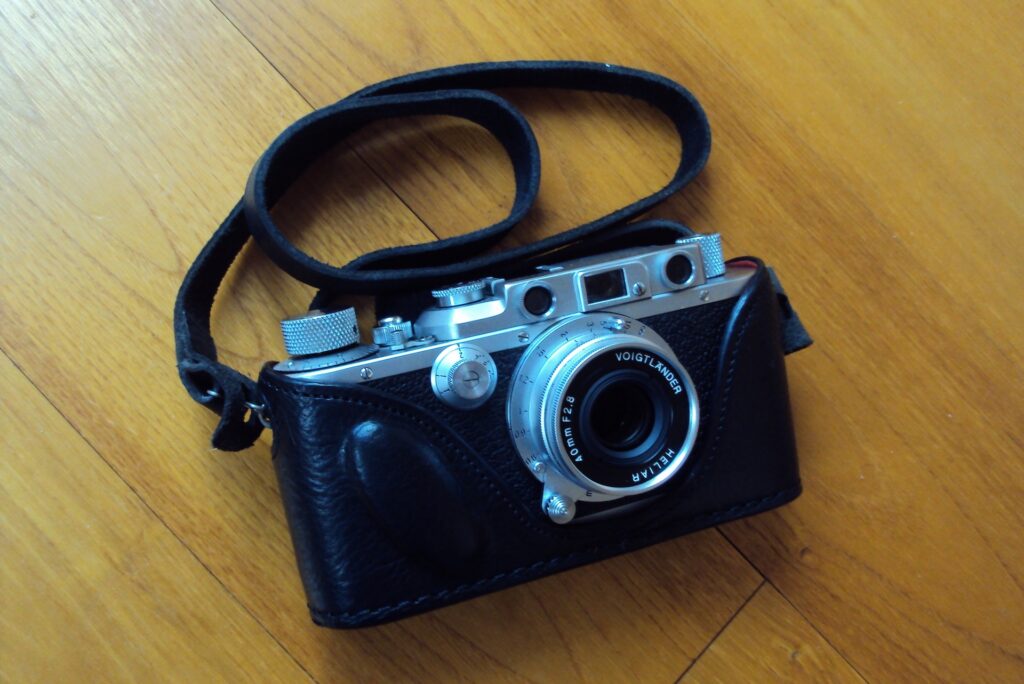
Fast forward to early 2025. After a detour through a lovely but tired 1946 Leica iii, and the heartbreak of discovering its shutter was giving me a one-sided sunburn on every negative, I decided to stop pretending. The Barnack had character, but I wanted reliability; I wanted the camera I had been dreaming about.
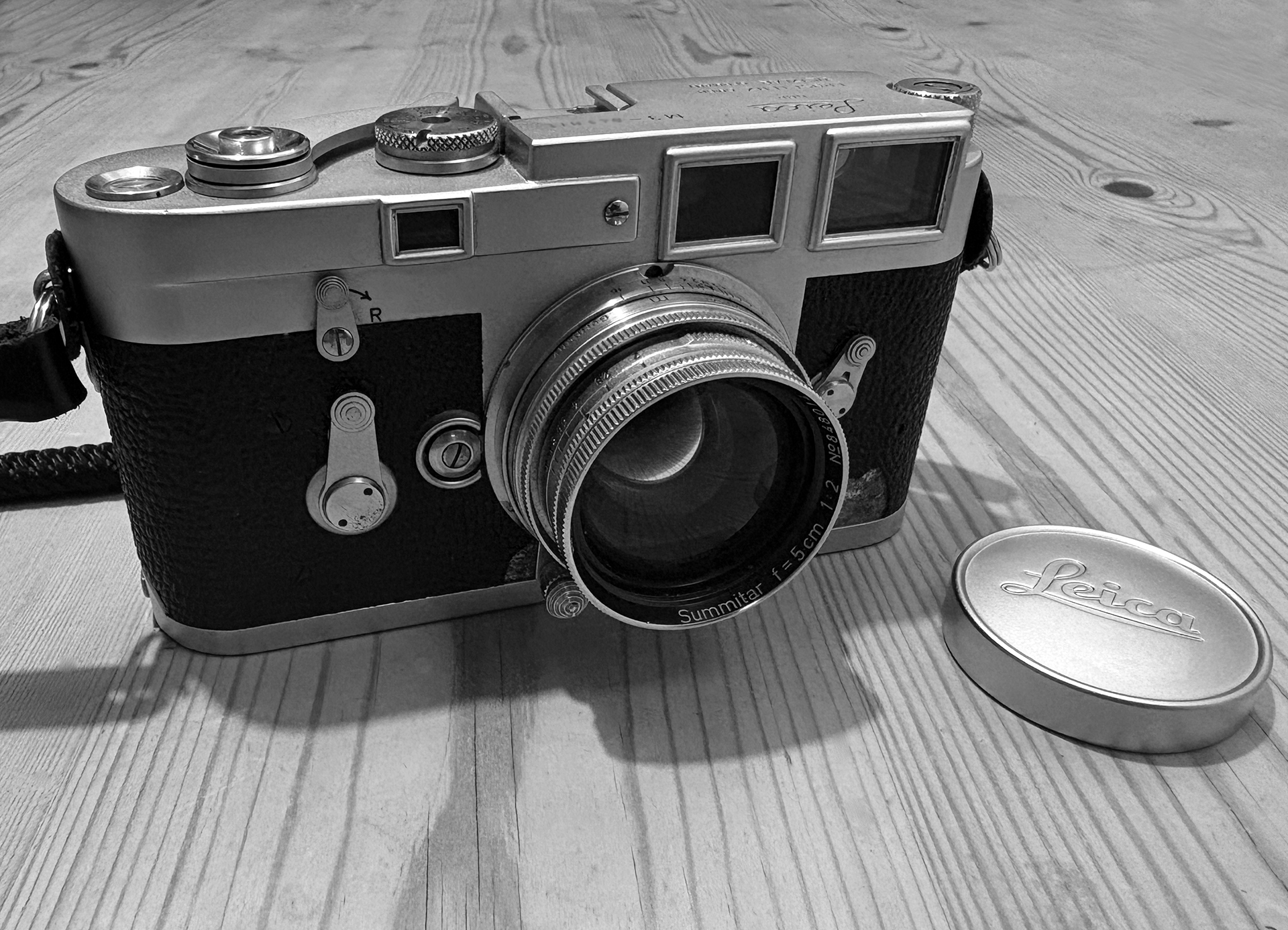
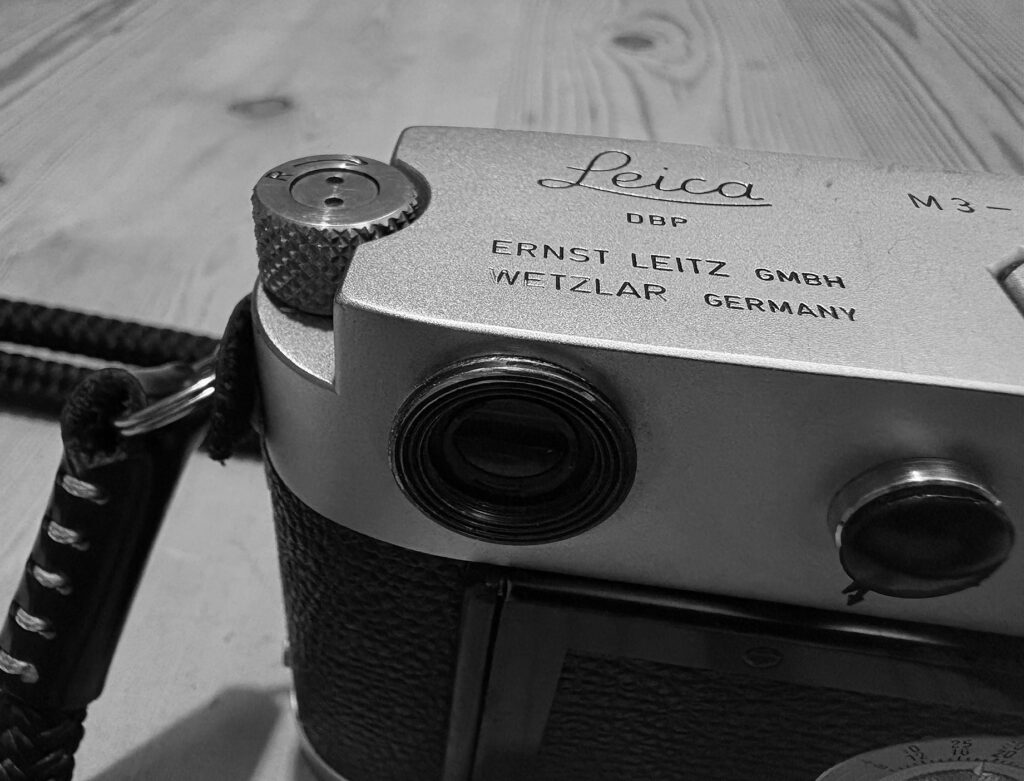
Enter a slightly scuffed, double-stroke 1956 Leica M3 from Japan, paired with a Leitz Summitar 5cm, and helped into my life by a rare eBay discount code and some irresponsible optimism.
First impressions: Is this thing for real?
Unboxing the M3 felt ceremonial. Heavy, dense, no nonsense. The vulcanite had peeled in a couple of places, which, frankly, suited us both. The shutter sounded clean. Speeds felt consistent. The viewfinder was bright, the rangefinder patch popped, and the double stroke advance was smoother than most modern zoom rings.
For photographers coming from digital or from cheaper film bodies, the M3 experience is very different:
• Full, bright rangefinder that makes focusing a pleasure.
• Long base length that rewards precise focusing on wider apertures.
• Viewfinder frame lines that make compositions feel intentional.
• Everything mechanical, no light meter, no gimmicks, nothing getting between photographer and frame.
It looks cool. It works beautifully. It invites photographers to slow down and behave as if they know what they are doing.

2025 reality check: now for the bit Instagram captions often skip.
Film stock prices have climbed aggressively. Processing, especially colour, is not getting friendlier. Labs are busy, shipping is boring, and the cost of experimenting is no longer pocket money. In that context, choosing a Leica M3 is not just romance. Photographers accept that every frame has a financial weight.
At the same time, there has never been a better moment for practical home workflows. From C41 and ECN2 kits to reliable black-and-white chemistry, a patient photographer can bring much of the process in-house. Many are juggling a flatbed scanner with a film adapter while they set up a garage darkroom. It is not perfect, but it keeps them shooting. This is the trade-off in 2025: if they want the control and magic of film, they either pay others or invest time, space, and effort themselves.
Digital, of course, wins on sheer practicality. Autofocus, auto exposure, 4000 shots on a card, instant sharing. For paid work, tight deadlines, or low-risk experimentation, digital is the sensible tool. The Leica M3 is not there to compete with that. It occupies a different mental space: deliberate, finite, considered.
Shooting the M3 with the Summitar 5cm has been a joy on the street and in the studio.
Pros
• Forces photographers to slow down. 36 exposures become decisions, not reflexes.
• Viewfinder clarity encourages strong compositions.
• Build inspires confidence. This is a camera designed to outlive several owners.
• Simple interface: shutter speed, aperture, focus, that’s it.
• With a compact lens, it remains reasonably small and carries well.
Cons
• No light meter. Photographers quickly learn to trust their experience and sometimes embrace a light meter or metering app. After all, if they had wanted automation, they wouldn’t have chosen an M3.
• Not invisible. In 2025, people are far more aware of cameras. Lift a chrome M3 to an eye, and some subjects will notice. Discretion is now about behaviour, not just equipment.
• Financial anxiety. Prices have risen since many buyers picked one up. If it is used regularly, insurance is not optional.
• Scanning and workflow can let results down if the setup is weak.
Compared with later Leica M cameras and premium SLRs, the M3 can still be the sensible choice. Bodies are often more affordable than modern digital versions, the double-stroke models are slightly cheaper than single-stroke versions, and high-quality M and LTM lenses are available for those willing to research adapters and character glass. It is not cheap, but relative to the digital flagship-of-the-month cycle, it starts to look rational.
Who is the M3 for in 2025?
If someone just wants the Leica logo for social media, a phone case is cheaper. Photographers who value the process as much as the product, who are happy working manually, and who enjoy the idea that a 1950s machine can still be a daily tool will find the M3 makes sense.
It rewards consistency, patience, and craft. It can sit next to a digital kit without apology and quietly remind its owner why they started taking photographs in the first place.
Most importantly, owning it reinforces something worth holding onto. A dream kit might be unrealistic today, but that does not mean it always will be. Save slowly, choose carefully, and when the moment comes, use the thing. Do not treat it as a trophy. Take it out, wear it with pride.
Because in the end, it is not about the most expensive body or the rarest lens. It is about a photographer, their 35mm negative, some available light, and the decision to press the shutter with intent. The Leica M3 simply makes that moment feel as special as it deserves.
Thank you for reading, and you can find me on Instagram or www.tony-page.com
Share this post:

Comments
Erik Brammer on Leica M3 – Becoming an Owner in 2025: Romance, Reality, and a Very Shiny Viewfinder
Comment posted: 09/12/2025
thanks for what I consider a solid summary of the Leica M film photo experience that I have been through myself. Just checked out your web page - great photography in the Durres section, and looking forward to seeing more in Bleak Britain - or here! :-)
Cheers,
Erik
Miguel Mendez on Leica M3 – Becoming an Owner in 2025: Romance, Reality, and a Very Shiny Viewfinder
Comment posted: 09/12/2025
Nik Stanbridge on Leica M3 – Becoming an Owner in 2025: Romance, Reality, and a Very Shiny Viewfinder
Comment posted: 09/12/2025
Love that self-portrait.
Comment posted: 09/12/2025
Geoff Chaplin on Leica M3 – Becoming an Owner in 2025: Romance, Reality, and a Very Shiny Viewfinder
Comment posted: 09/12/2025
Russ Rosener on Leica M3 – Becoming an Owner in 2025: Romance, Reality, and a Very Shiny Viewfinder
Comment posted: 10/12/2025
I like the DS because if you just advance it one stroke before putting it away that acts as a safety so the shutter can't be accidentally fired. A single short second advance is all you need when ready to shoot.
Also, no Leica will ever be "valueless" the way many 2005 era digital cameras are today. As a Leica you will always get at least your original money back if kept in good condition. Plus you get to use this incredible machine! I like that the M3 did not sport that silly red dot logo which Leica adopted more recently. The M3 looks utilitarian. It's a camera that means business, like a good set of cutlery. In the right hands both tools can work magic.
Leon Winnert on Leica M3 – Becoming an Owner in 2025: Romance, Reality, and a Very Shiny Viewfinder
Comment posted: 13/12/2025
Dann on Leica M3 – Becoming an Owner in 2025: Romance, Reality, and a Very Shiny Viewfinder
Comment posted: 31/12/2025
Somehow you have summed up all my thoughts about the M3. One can say there are very few cameras that truly register with one as a classic - the '3 is surely one at the very top of my small list.
Alas, I no longer own one, I did in the '80s, with an M2 as a backup, the '3 came with a 50/1.5 Summarit, not really considered as the best lens in the Leitz '50s arsenal, but mine was rock-sharp and gave beautiful tones, also the not quite as good but still stellar 50/2.8 Elmar.
Sadly, I had to sell my entire Leica kit in the early 1990s when my architectural practice hit a dry spell and we had to raise funds to keep our office open. I later went into the Contax G line (I still own two and four beaut Zeiss C lenses) but I could never find two Ms as good as the ones I had owned. One of the (very few) regrets of my long life, seven decades as a photographer and still going traveling with my G1 kit.
Looking forward to more of your excellent writing. I will be following. Best for '26!!
DANN in Indonesia