

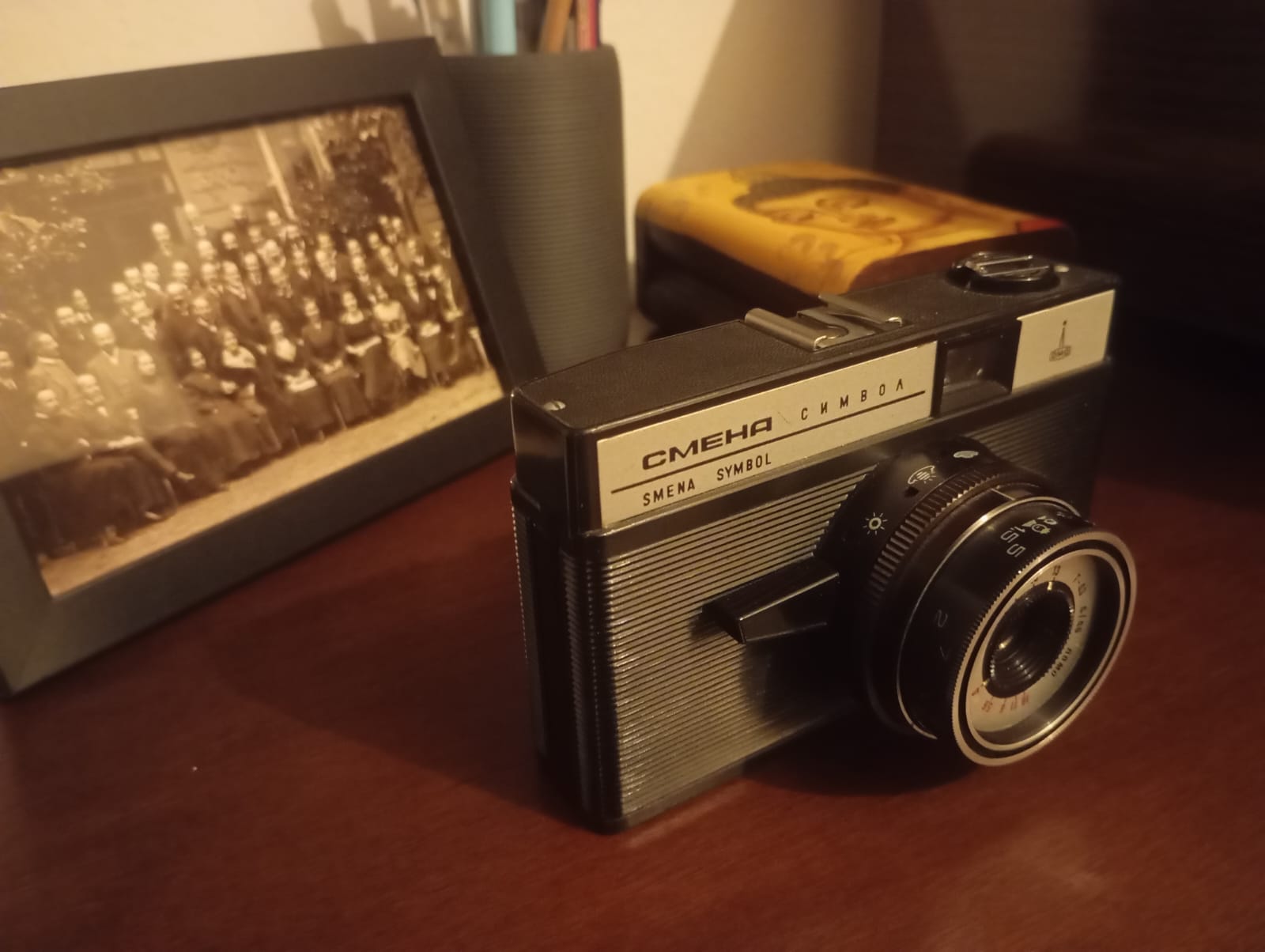
I bought an old Russian camera with the intention of exploring the concept of “Lomography” in its most original sense. Over the years I have developed a certain intolerance towards optical precision, and this has felt rather strange to me. As a novice photographer, about twenty-five years ago, I had fallen in love with almost perfect lenses, capable of producing sharp, well-focused images even at the edges. No optical flaw was allowed: what my eyes demanded was to “see”, completely. Then something changed, perhaps simply with the passing of time. I have noticed this phenomenon in other people of my generation as well, but I do not know whether, in my case, it is a matter of “nostalgia”, that is, the desire to obtain photographs like those my parents (with some effort) managed to take in the 1980s: grainy images, inaccurate colours, optical defects, unsuitable films used at the wrong moments. Is everything we once tried to escape from something we now want back?
The concept behind the Lomo Smena Symbol is to bring photography to young people, thanks to a lightweight camera that is, all in all, simple to use and, above all, affordable. The Symbol comes from a lineage of illustrious sisters, including the Smena 8; in this case, however, the shutter cocking mechanism has been removed, and everything (film advance and cocking) is done with a lever placed on the back of the body. The shutter release, on the other hand, remains mounted to the right of the lens, which makes using the camera feel rather exotic.
The sensation is that of holding something well built, and even though the lens is only an f/4, the images I had seen online nevertheless convinced me. Nostalgia and optical defects, we were saying: what I am looking for now is “not seeing”. Perhaps I am tired of reality as it truly is and I long for an “interpretation”? After all, my own eyes have gradually become less precise: I no longer count the floaters (those little spots we see when we stare at the sky in summer, for instance), and I have to wear glasses.
Or perhaps I think that such “flawed” images are, in the end, more “human”, or more similar to me? I still cannot answer that with any certainty. What is certain, is that I took the Symbol for a walk around my old neighbourhood to take utterly banal photographs: no monuments, no famous people, nothing noteworthy from an artistic point of view. Just the outskirts of Padua, my city, and in particular the Guizza district. A solitary walk, on foot, moving through memories and passing through places I recognise, but which no longer recognise me.
Much has changed, much has stayed the same. The Symbol behaves well; it is a pleasure to use and to have everything under control. I do not yet know how to use it properly—I warn you in case you start noticing that the photos are almost all wrong—and, as if that were not enough, at home with my partner we decided to develop using Caffenol-C-H: it was our first-Caffenol-roll-ever and we made a mistake with the water temperature, 36°C instead of 20°C. A thermal bath: the film did not complain, but perhaps it made things a little worse, an assessment also supported by the fact that the other three rolls developed that evening (with the same solution at the right temperature) have a decidedly less curious look.
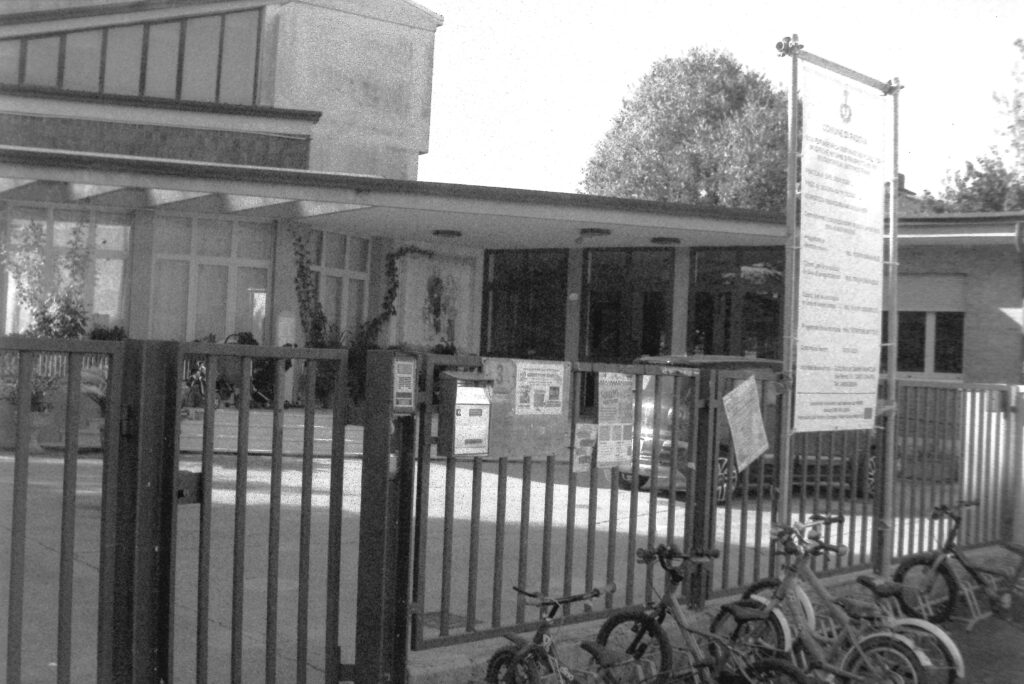
In the end, everything begins here: the nursery school in my neighbourhood, ‘Guizza’, a name derived from an ancient Lombard term meaning ‘wood’. Of course, now there are only houses — ça va sans dire. In the morning I absolutely refused to go through that gate; in the afternoon I did not want to leave anymore. With work it was quite different: I did not want to go in and very much wanted to get out. Now, fortunately, I do something else, and I am much happier.
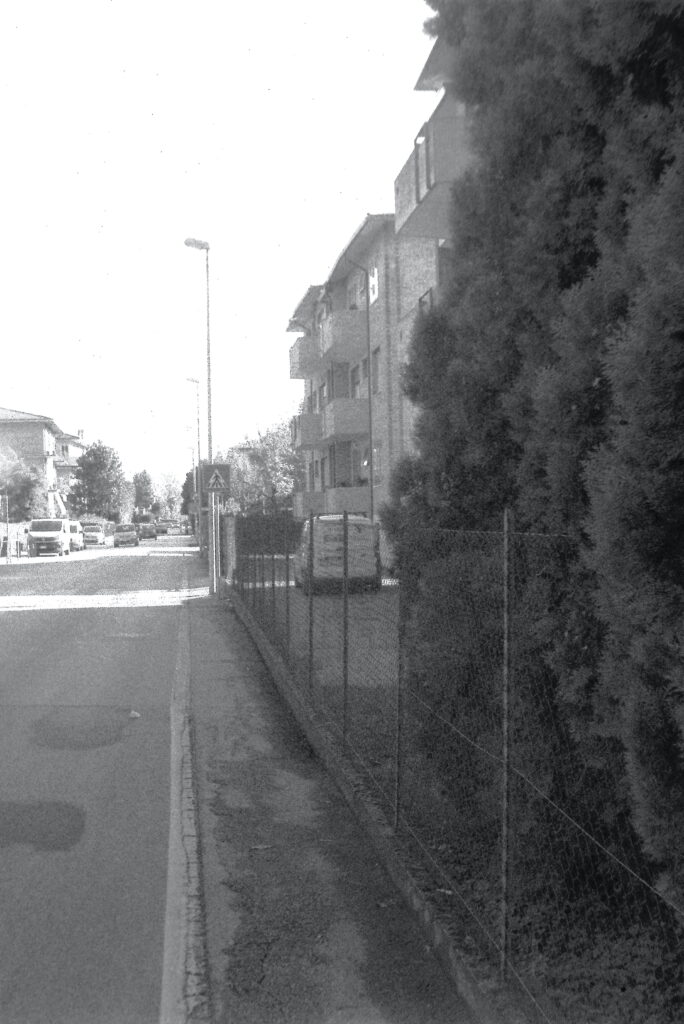
This is the road that led to the complex where I lived, a little further on to the right. A kingdom of children (about ten of us), protected by a tall gate. Every corner was inhabited by our fantasies; even now, decades later, I could still walk through them again. The light captured by the Smena is perhaps closer to what I remember than to what I actually saw while walking there.
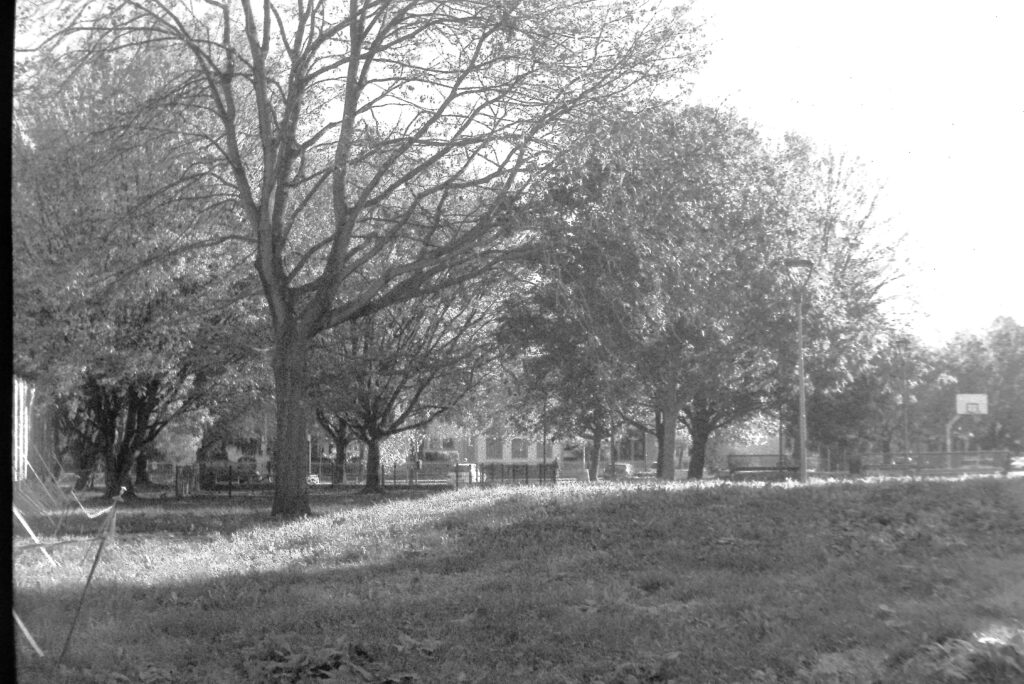
We moved house — the end of the first part of the story. We did not move far (just one kilometre as the crow flies), but it was enough for my friendships to change completely, or rather for me to lose all the ones I had. It was something of a shock, but I got through it. What you see here is what exists today; at the time there was only grass, mud and small hills to be tackled on a bicycle. ‘Cleaner’ is not always ‘more fun’, but grown-ups do not understand that.
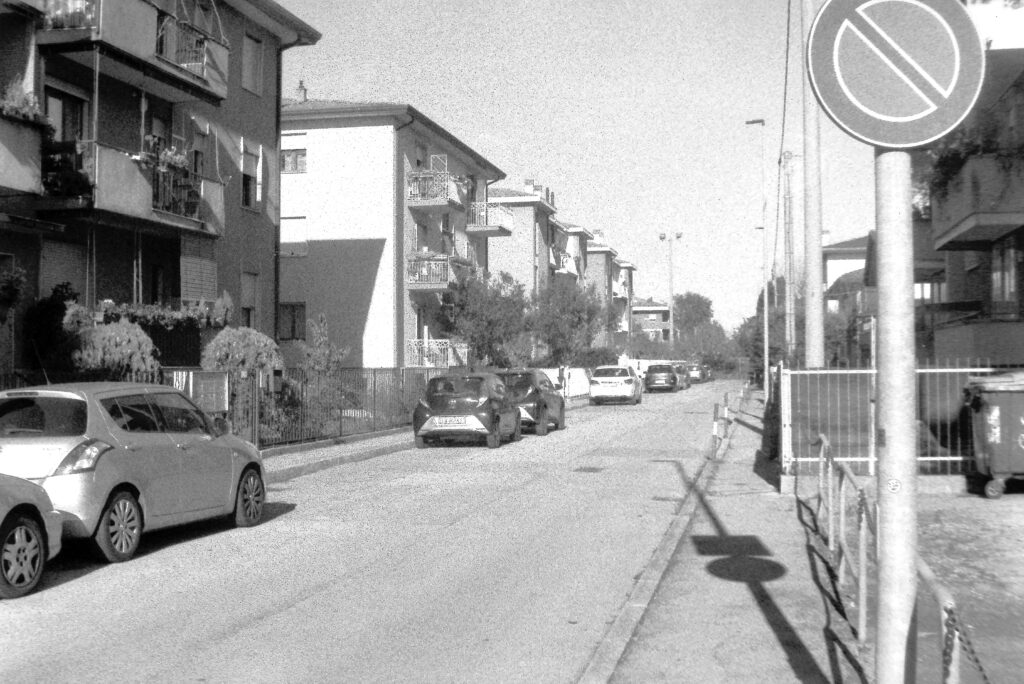
One afternoon, some boys who were not exactly well-behaved had bothered two children my age. I ran to their aid (after the bullies had gone), and we became inseparable friends. They both lived on this street.
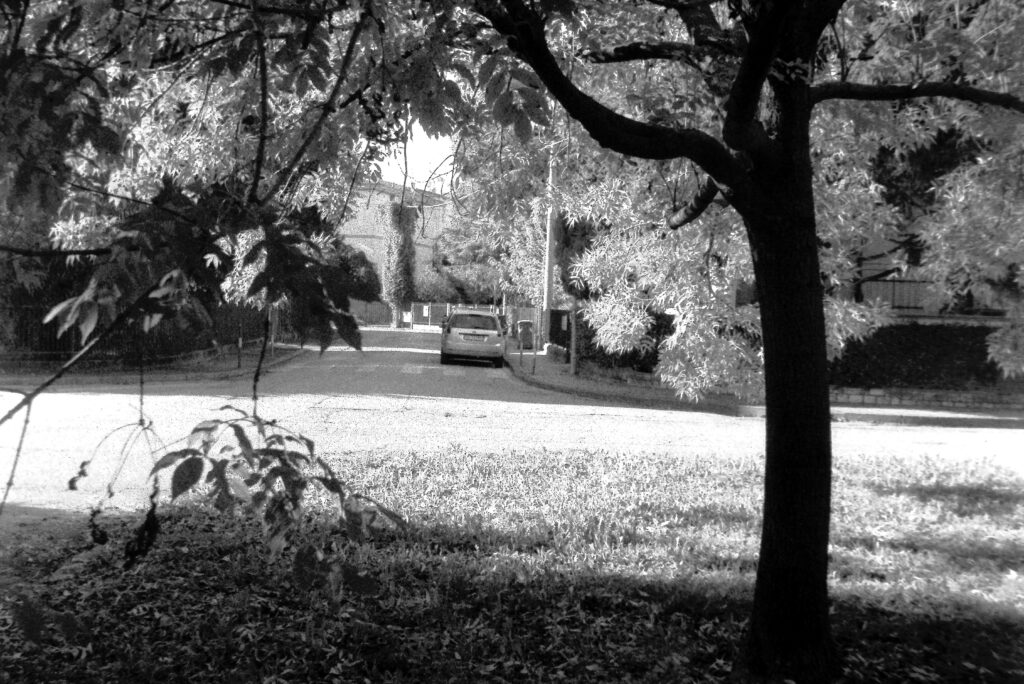
Oh, how quickly puberty arrived. With everything it brings. A few kisses too, perhaps, beside the iris plants in her garden. Then we lost touch — and that too was a blessing, like so many other things lost over time. The fear of losing what we have, sometimes makes us lose everything else: that is something I have learned.
We go to enormous, historically rich cities like tourists and take photos that are all too banal. Yet, often we were born in places that have nothing of those cities. But that does not mean that the corners of our own neighbourhoods do not have a story to tell. Are we swayed by beauty, or do we choose it for ourselves? Is beauty a tool of power, used to establish a hierarchy among people? Perhaps it is something worth questioning.
Share this post:


Comments
Paul Quellin on 5 Frames served with Caffenol – a Smena Symbol in Padua.
Comment posted: 29/01/2026
Ralph Turner on 5 Frames served with Caffenol – a Smena Symbol in Padua.
Comment posted: 29/01/2026
You're right - there is beauty to behold in the everyday of our surroundings, images that trigger fond memories, perhaps a record for posterity of how things are now. Images that are shaped in part by our own memories of place.
Thank you for sharing your great images and interesting reflections on these subjects. Take care.
David Brancaleone on 5 Frames served with Caffenol – a Smena Symbol in Padua.
Comment posted: 29/01/2026
What a special piece of writing, and very nice English. I am Italian too, but will refrain from writing in our language so beautiful, yet not accessible to most.
I agree with Paul. Especially your last shot is really special. Dare I say tenderness comes to mind. What is it? The shadow in the foreground? Something to do with the framing? Can't say, really. After all, it's only an impression. I also love, in the face of all the hype over full frame cameras and multiple lenses and more besides, that you are using this kind of camera and getting such results.
It also points to the paradox and the way you frame your article points to this same way of thinking: even with such a humble camera which shares only its 35mm film size with Leicas, a photographer can make art.
I also share with Paul my appreciation for writing couched in this reflective journal mode. Not easy, but it works!