

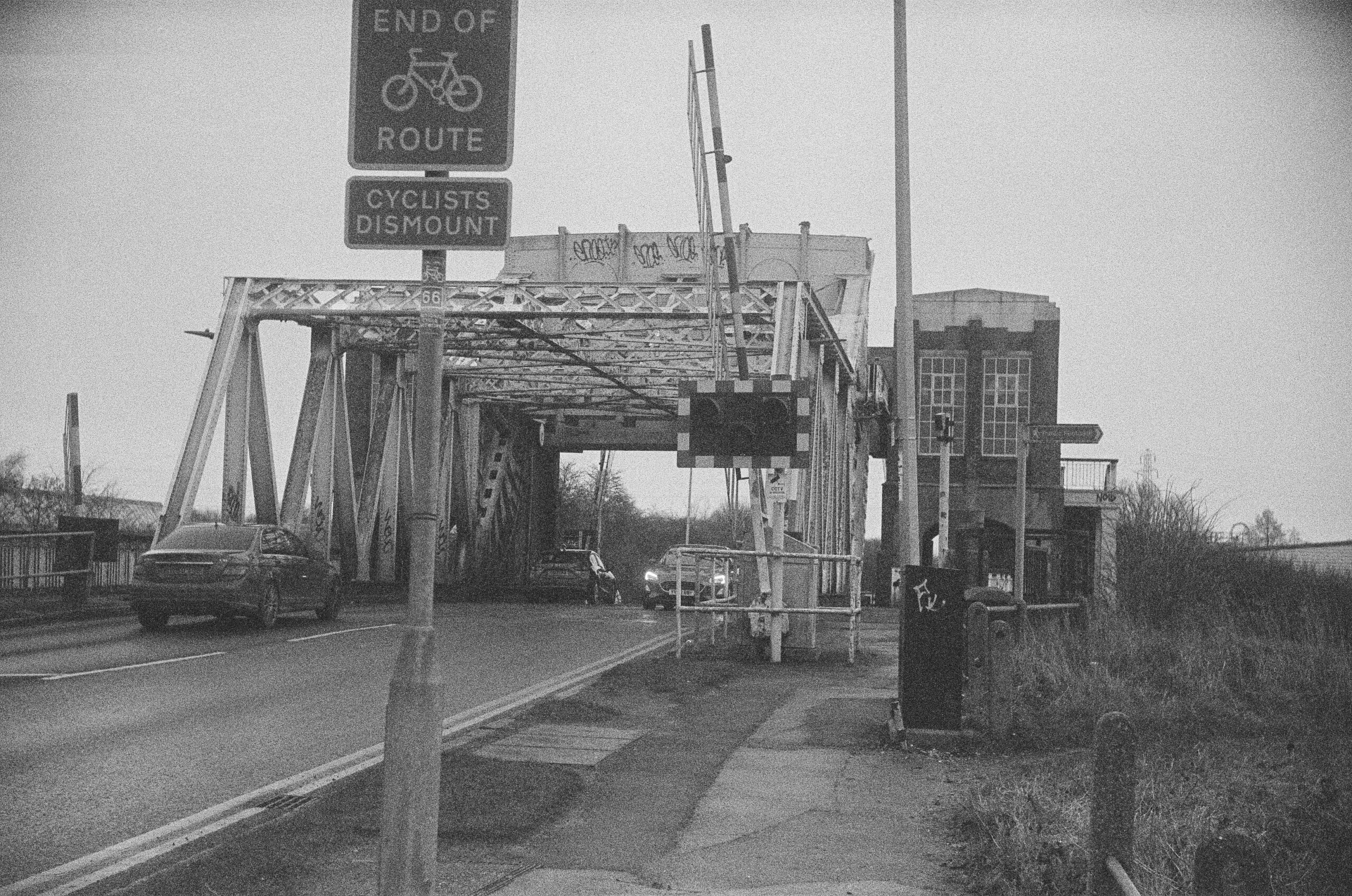
Just to let you know what you’re looking at, this is Sutton Road bridge, one of many that take roads across the River Hull, which bisects the city of Kingston-upon-Hull, in the county of East Yorkshire, on the north-east coast of England. All of these bridges lift or swing, as there used to be a considerable number of coal and freight carrying barges taking cargoes upriver to the county town of Beverley, about ten miles upstream. There was also – somewhat bizarrely – a shipyard there that built trawlers for the Hull fishing fleet, and these had to get downriver to the fish docks.
It was autumn 1976, and I was a seventeen-year old, newly arrived at Hull University. Sometime in my first week, whilst getting to know the student union bar, I bumped into Dave – someone I hadn’t seen for a couple of years, and who I had no idea was in Hull. Dave had been one of my Scout leaders 270 miles away on the south coast, but he’d suddenly and abruptly disappeared – no one knew where to – when his marriage broke up, and now he was a mature student at my university; small world.
Despite the age difference – Dave was probably in his forties whilst I was a pimply teenager away from home for the first time (and nearly half a century later I’m still here) – he took me under his wing and we spent quite a lot of time together that first year. Our branch of scouting was the Sea Scouts, which meant lots of sailing, rowing and canoeing, and as a member of the university rowing club, based on the bank of the River Hull at Oak Road playing fields, Dave invited me to join him a few times.
One very cold and misty afternoon in late November we took out a “coxed pair” rowing skiff; this was long, very narrow (thus tippy), took two rowers with a single oar each, and a cox who steered. Fortunately, Dave knew many young ladies, and persuaded one of them to join us in that capacity; she was bundled up in hat, gloves and a thick, bulky coat due to the wintry weather, and we wore nearly as much. However, as was the norm, none of us was equipped with a lifejacket or buoyancy aid.
We set off upstream, with the tide behind us, helping us on our way. We’d only gone a few hundred yards, when one us us – almost certainly me – got the oar stuck in the water in the horizontal position (“caught a crab” in technical parlance), which had the immediate effect of tipping the boat over, and us into the freezing, muddy River Hull water. Fortunately, and despite our bulky clothing and lack of flotation devices, we all surfaced and grabbed hold of the sides of the boat – but could do little else.
The tidal current swept us slowly towards Sutton Road bridge, and in those days it was constantly manned (no longer, as shipbuilding ceased in the 60’s or 70’s, and freight travels by lorry), at least when water levels were high enough for shipping. The bridge men were commendably vigilant, and, spotting us drifting their way, came out and managed to grab hold of the boat – and us. Freezing cold and saturated, they took us into their luxuriously heated control room, and provided reviving tea. They also allowed us to use their ‘phone to call for assistance and transport.
So, Sutton Road bridge – in the guise of it’s wonderful bridge men – quite literally saved the lives of me and my sodden, frozen companions!
(P.S. Perhaps unsurprisingly, Dave never again invited me to row with him!)
The featured image was taken recently, not then, on my newly acquired Contax iia (desperately in need of a CLA – which hopefully explains the poor quality; it’s still with the technician) with Zeiss 50/1.5 Sonnar lens, on Kodak 5222 (Double-X), developed in HC110/B.
This article was originally published in September 2025 (in a slightly different version) on the website ‘Open Bridges’, an art and historical project, created and curated by my friends – photographers, artists and musicians Lou and Richard Duffy-Howard. If you’re interested in delving further, it features loads of wonderful images – many taken by Rich, who’s a better photographer than me – and including scans from very old negatives, some of them glass plates.
Share this post:


Comments
Charles Young on How A Bridge Saved My Life – a one-shot story
Comment posted: 23/05/2026
Comment posted: 23/05/2026
Comment posted: 23/05/2026
Comment posted: 23/05/2026
Eric Rose on How A Bridge Saved My Life – a one-shot story
Comment posted: 23/05/2026
Eric
Comment posted: 23/05/2026
Gary Smith on How A Bridge Saved My Life – a one-shot story
Comment posted: 23/05/2026
Comment posted: 23/05/2026
Jeffery Luhn on How A Bridge Saved My Life – a one-shot story
Comment posted: 23/05/2026
That could have been a disaster! If we had any kind of life in our youth, it certainly involved close calls. I've had my share, and most involved foolishness. Glad to hear yours worked out okay. So I guess you never represented your queen, college, or country in rowing?
Comment posted: 23/05/2026
Erik Brammer on How A Bridge Saved My Life – a one-shot story
Comment posted: 23/05/2026
Comment posted: 23/05/2026