A Journey into the Past

By Walter Reumkens

Early October, autumn in Germany. Sunny, dry weather with mild temperatures. I got into my car and drove to two places, each 20 km away from where I live. Both places are in the western federal state of North Rhine-Westphalia, near the border with the Netherlands. I took my Mamiya 645 1000s with me, fitted with the Mamiya Sekor C 2.8/55mm lens and loaded with a roll of Ilford XP2 Super 400 film.

I don’t wish to say any more on the subject. The camera kit and film should be well known in the 35mmc community. There’s no story to tell either; not a single shot was staged – they were photographed exactly as found. I determined the exposure using a Gossen Variosix F (with a dome light meter), slightly overexposing at ISO 320. Development and 4K scan to JPEG were carried out at a specialist lab.  The image files were lightly edited in Lightroom Classic (tone correction). Nothing more – all done within reason and without much effort.

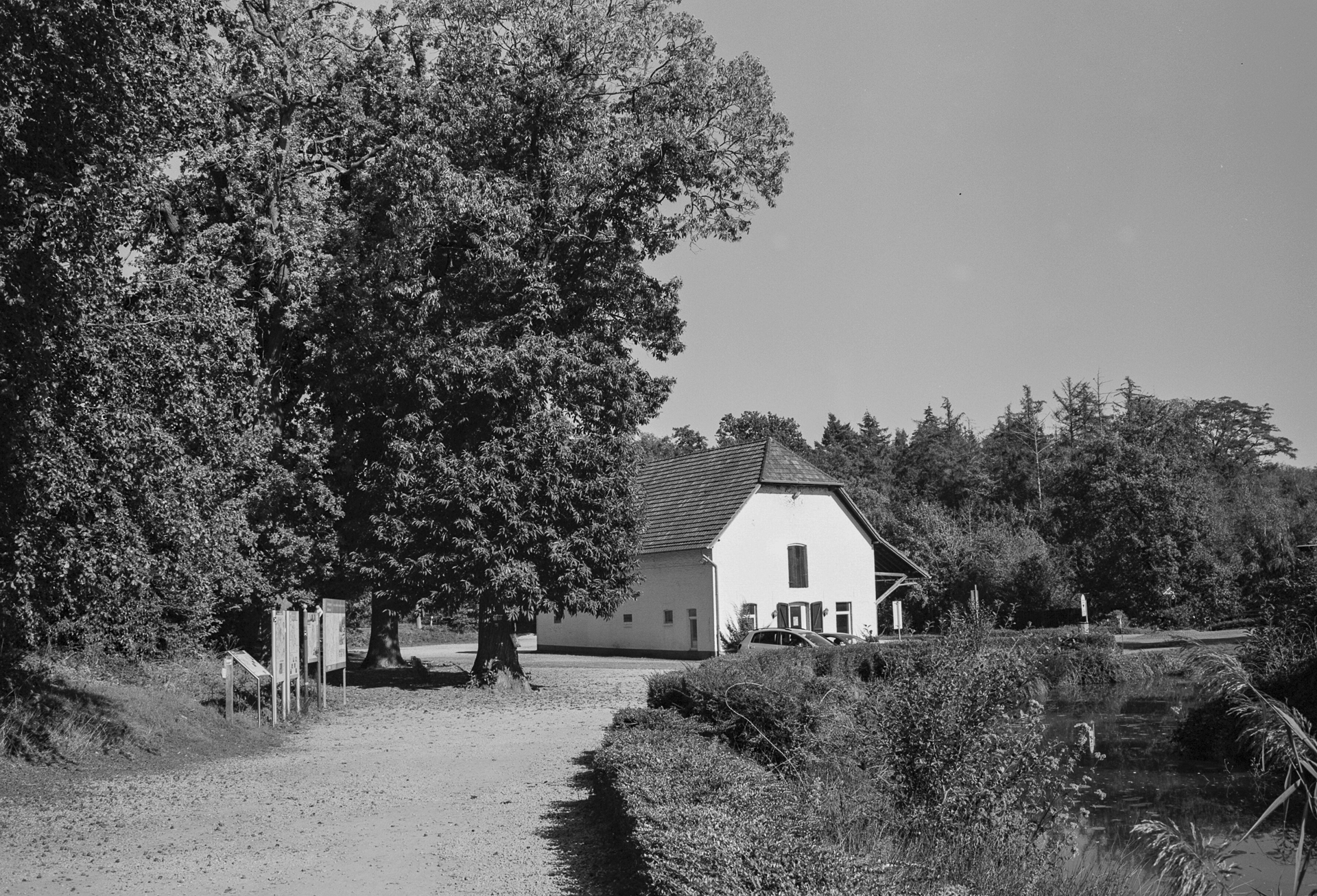
My short trip took me first to Tüschenbroich Castle, situated in a district of the town of Wegberg on the edge of the Maas-Schwalm-Nette Nature Park. The cover photo shows the visitors’ car park, where I had parked my car, with an old outbuilding of the castle. I walked a little further and found myself standing in front of the main building, Tüschenbroich Castle, which is privately owned and inhabited.
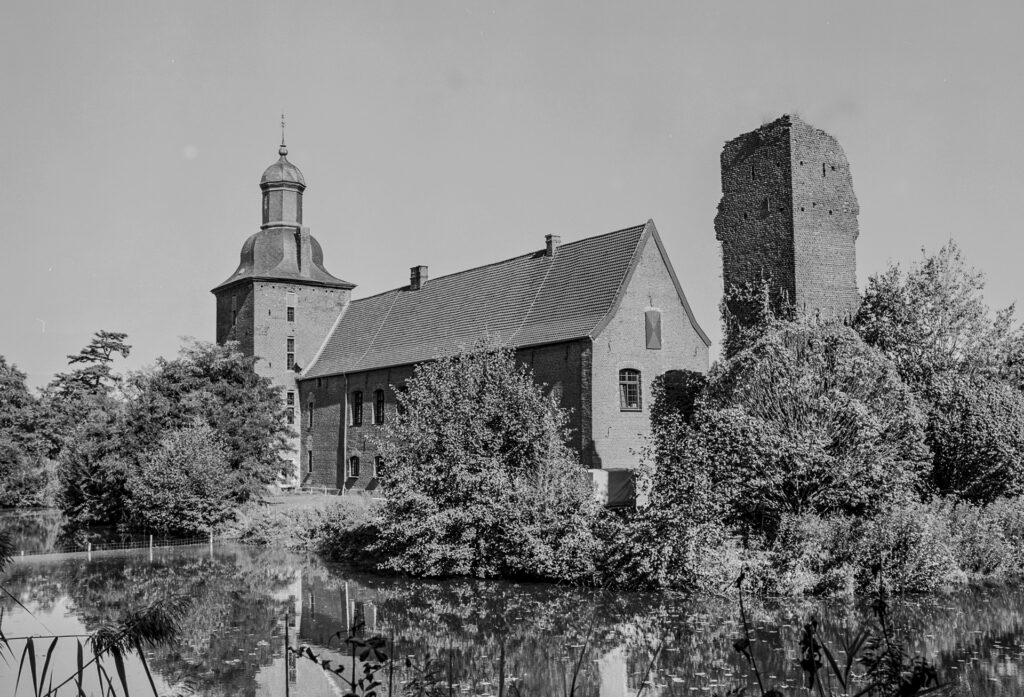
Schloss Tüschenbroich

The castle is surrounded by a body of water, which was also used by the nearby Tüschenbroich oil mill, which can be seen here:
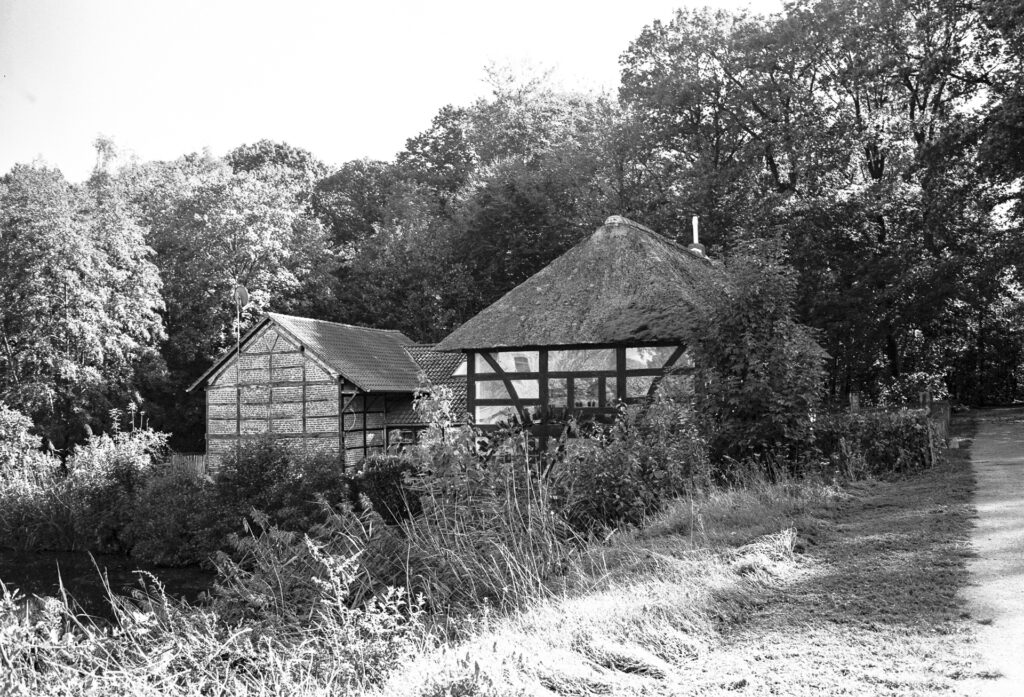
Oelmühle Tüschenbroich

The main building, complete with a waterwheel and barn, was constructed using half-timbered architecture; it is privately owned and is currently occupied by a ceramic artist. Following the renovation, the open spaces in the half-timbered structure of the main building were filled with glass panes.

After a short walk around the castle, we continued on to Brüggen in the district of Viersen, where the castle stands right in the centre of the village.
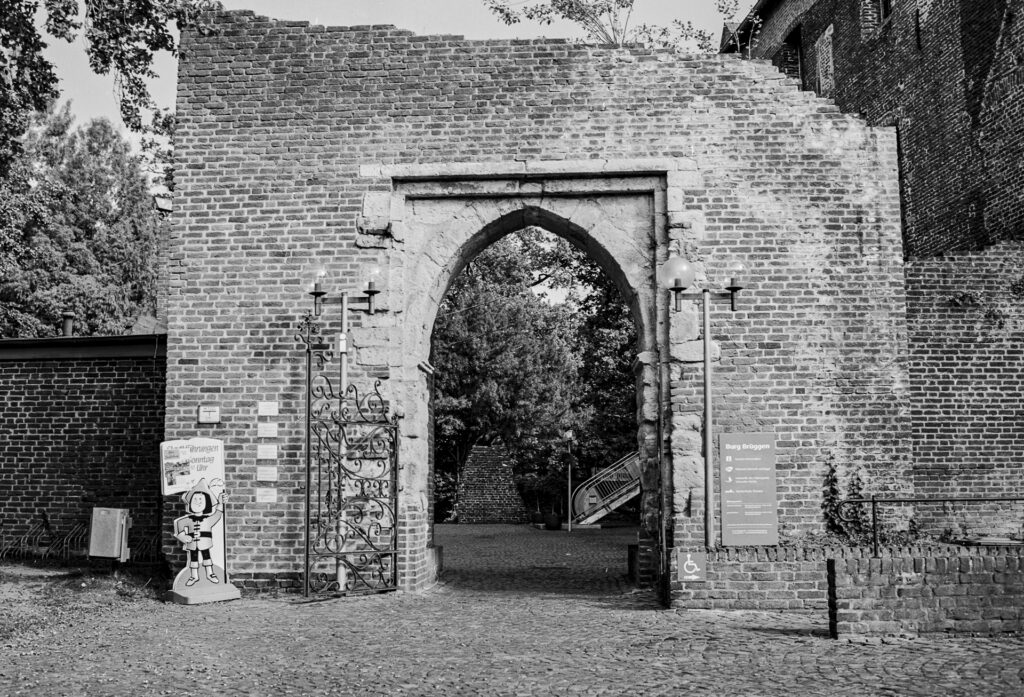
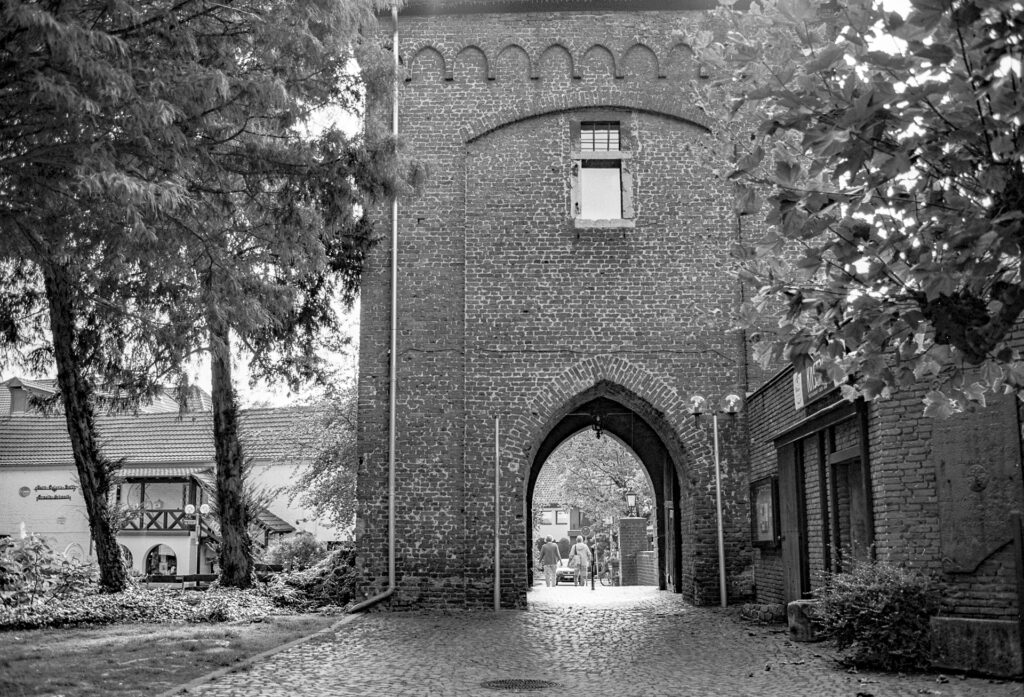
This surviving section of a ruined part of the castle complex leads into the inner courtyard of Brüggen Castle, which is open to the public and houses a local history museum.
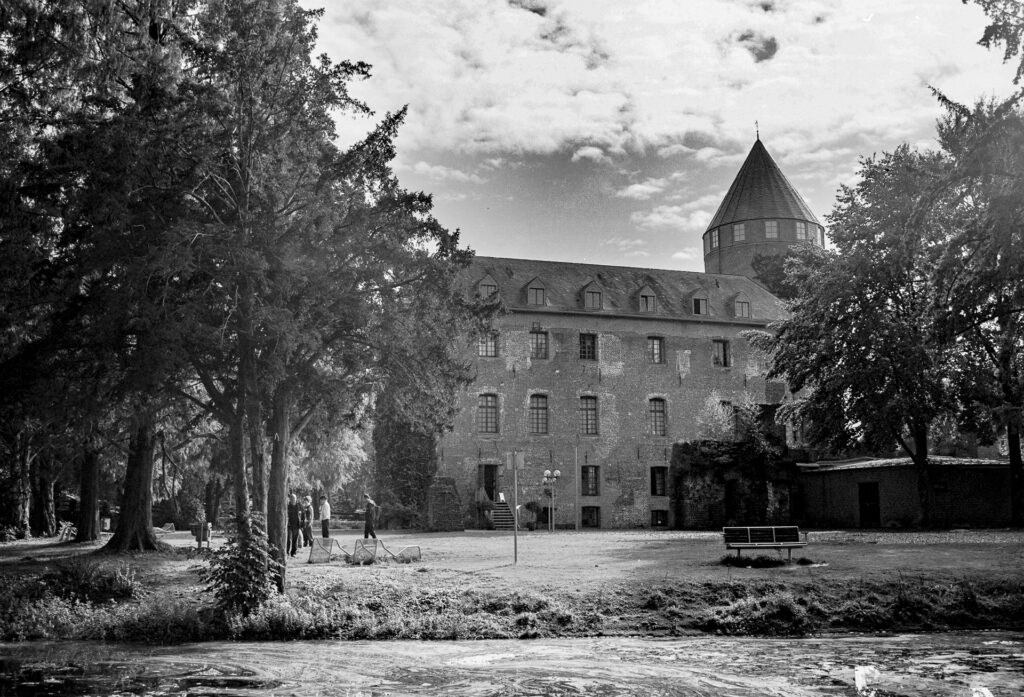
Brüggen Castle is partly surrounded by water, as you can see in the foreground of the picture, and it attracts numerous visitors even during the week. After their walk and tour, they relax in the many restaurants in the town centre and fortify themselves for the journey home.

I, too, am about to leave the castle grounds through this gate, walk to where my car is parked and set off on the 20-kilometre drive home. Without stopping at a restaurant.
The 15 exposures on the 120 roll have been taken, and to be perfectly honest, I’m growing to like the idea of being limited to fewer photos more and more. I won’t even get started on the brilliant handling of a medium-format camera like this Mamiya 645 with a light-well viewfinder and no exposure meter.

Thank you very much for your interest. I’d be delighted to receive any feedback.


Share this post:

About The Author

By Walter Reumkens
Walter Reumkens lives in Mönchengladbach, a medium-sized town in North Rhine-Westphalia, Germany. He is a retired graduate in public administration, worked in the IT sector for 40 years and has been a passionate photographer for over 50 years. In addition to numerous analogue and digital Nikon cameras (SLR, DSLR, DSLM), he also uses cameras and lenses from other manufacturers. To find out whether, alongside the ‘typical, highly touted luxury cameras’, other manufacturers also produce very good, reliable and user-friendly products that fully satisfy experienced photographers.
Read More Articles From Walter Reumkens

Find more similar content on 35mmc

Use the tags below to search for more posts on related topics:

Donate to the upkeep, or contribute to 35mmc for an ad-free experience.

There are two ways to contribute to 35mmc and experience it without the adverts:

Paid Subscription – £3.99 per month and you’ll never see an advert again! (Free 3-day trial).

Subscribe here.

Content contributor – become a part of the world’s biggest film and alternative photography community blog. All our Contributors have an ad-free experience for life.

Sign up here.

Make a donation – If you would simply like to support Hamish Gill and 35mmc financially, you can also do so via ko-fi

Donate to 35mmc here.

Comments

Andrew on A Journey into the Past

Comment posted: 02/11/2026

Great photos which make me want to visit your area!
Being a relatively “modern” formulation, XP-2 Super has great dynamic range, doesn’t it? Couple that with medium format and you have photos with wonderful impact and “presence”.
Reply

Leave a Reply

Your email address will not be published. Required fields are marked *

Walter Reumkens replied:

Comment posted: 02/11/2026

I’m glad you like my photos, Andrew. Yes, life is good between the River Rhine and the Dutch border, with the surrounding cities of Aachen, Düsseldorf, Cologne, Maastricht and Roermond/Venlo. It’s a flat landscape with plenty of lakes, small rivers – many of which have watermills that are no longer in use – and numerous castles and fortresses. I enjoy taking photos with the Ilford XP2, which I think is underrated. It develops very well using the standard C41 process and is also easy to scan. Thanks for your comment. All the best, Andrew.

Reply

Leave a Reply

Your email address will not be published. Required fields are marked *

Jeffery Luhn on A Journey into the Past

Comment posted: 02/11/2026

Walter,
Very nice compositions!! I love my Mamiya 645N. It seems to work well in your hands. You are fortunate to have great old buildings close by. Using XP2 creates stunning long range negatives.

I finally found a like-new normal lens at a decent price. I have four lenses now, two are auto focus. The 35mm is my favorite.

Keep shooting with that rig. Your photos look great. Jeffery
Reply

Leave a Reply

Your email address will not be published. Required fields are marked *

Walter Reumkens replied:

Comment posted: 02/11/2026

Thanks for the comment – I’m glad you like the photos. I reckon you’ve combined the Mamiya 645 1000s and the Pentax 6455N here. I’ve got both cameras. I’ve only had the Pentax 35mm (A version) for a few days. It’s likely to become one of my favourite lenses too. I’m very happy with the results from the XP2; I enjoy taking photos with it, even though I haven’t quite worked out the best ISO setting for it yet. Thanks again, and all the best, Jeffery!

Reply

Leave a Reply

Your email address will not be published. Required fields are marked *

Gary Smith on A Journey into the Past

Comment posted: 02/11/2026

I agree with Andrew: your photographs look great! I have never really bonded with my 645 1000s. It may be due to the fact that I have it fitted with a WLF following the initial trauma (described here: https://www.35mmc.com/08/03/2024/an-ebay-bargain-and-impulse-bought-tale-of-woe/ ). I do love the fact that a roll of 120 can easily be shot during an afternoon walk!
Reply

Leave a Reply

Your email address will not be published. Required fields are marked *

Walter Reumkens replied:

Comment posted: 02/11/2026

Gary, I’m glad you like my photos too. I’m very happy with my M645 1000s – even without the attachment, it’s still compact, light and easy to handle. With the older cameras, I always use one of my external light meters (measuring light with an Invercone or spot meter). I’m growing to like 120 film more and more. Cheers!

Reply

Leave a Reply

Your email address will not be published. Required fields are marked *

Ibraar Hussain on A Journey into the Past

Comment posted: 02/11/2026

Excellent stuff my friend, the photos have so much feel and make me want to visit, you're lucky to have all of this!
The detail is astounding!
Reply

Leave a Reply

Your email address will not be published. Required fields are marked *

Walter Reumkens replied:

Comment posted: 02/11/2026

Thank you, Ibraar, for your kind words. I think one shouldn’t underestimate the significance of the much larger negative compared to 35mm film. Added to that is the professional C41 development in a lab and the 4K scan using a professional specialised scanner. To be honest, the result surprised me too. It was the first Ilford XP2 I’d shot on 120 roll film. By the way, the area is only 200 km from Hoek van Holland. The ferry to get there practically leaves from your front door. :-)))) All the best, Ibraar!

Reply

Leave a Reply

Your email address will not be published. Required fields are marked *

Tony Warren on A Journey into the Past

Comment posted: 02/11/2026

Some very detailed, well composed shots Walter and an informative narrative and illustrations.

I had a Mamiya 645 Super for a while and even though it has a superb finder system I couldn't get to grips with portrait format with the 6x4.5 frame. It certainly produced some excellent images for me, especially with the 150mm lens.

Medium format was the mainstay of studio work for many years because it produced such high quality. Each to his own of course. Your choice of film has produced some excellent results here.
Reply

Leave a Reply

Your email address will not be published. Required fields are marked *

Walter Reumkens replied:

Comment posted: 02/11/2026

Thank you, Tony, for your kind words of praise. My Mamiya, which only had a light well, was the previous model. It was produced for 14 years (1976–1990) and was regarded as the workhorse of the camera range. I find the M645 1000s relatively light, compact and easy to handle, making it well-suited for use outside the studio too. With the light well attached, portrait orientation is of course rather awkward to handle, but I actually quite like the 4:3 portrait format. I even use it very often with my Olympus digital cameras for street and travel photography, or on my Pentax 645. I was inspired to do this by the book *Irrfahrt/Errance* by Raymond Depardon, who, on a round-the-world trip with an Alpa camera, photographed exclusively in portrait orientation using a focal length equivalent to 28mm (35mm equivalent) on Kodak VP 6041 black-and-white film. I no longer develop my own film, and now that I’ve found a lab that develops 120 film, I’m finding it increasingly enjoyable to shoot in this larger format – and also to take just 12 to 15 shots per roll. Compared to a 36-exposure cartridge, which I often find too large, this significantly shortens the time I have to wait in anticipation. Thanks again, Tony, and all the best.

Reply

Leave a Reply

Your email address will not be published. Required fields are marked *

Geoff Chaplin on A Journey into the Past

Comment posted: 03/11/2026

Very interesting buildings, remains and site, and excellent image composition too. The oil mill too sounds like it would be worth a visit inside if they ever open to visitors - an internet search suggests the only mill flaxseed (linseed) oil. Used by local oil painters? Is that commercially viable or is it state funded as part of the historic and cultural remains?
Reply

Leave a Reply

Your email address will not be published. Required fields are marked *

Walter Reumkens replied:

Comment posted: 03/11/2026

Hello Geoff, thank you very much for your lovely comment. I’m glad you like the photos. As far as I know, the oil mill hasn’t produced any oil since 1912. Until then, the farmers from the surrounding villages were obliged to provide the castle’s owner with the necessary grain as a sort of tax. The oil mill and its outbuilding are a listed building housing an artist’s studio, which can be visited during occasional events. The mill is in working order but is no longer used for oil production. A few kilometres away lies the “Schrofmühle” in Wegberg-Rickelrath. There, grain is still ground and pressed into linseed oil several times a year. This was also the case on “Mill Day” at Whitsun one year, when all the mills in the area were open to visitors. There are still a great many mills. The owner lives in this mill too; his activities are solely aimed at preserving this cultural heritage. Thank you, Geoff, and all the best.

Reply

Leave a Reply

Your email address will not be published. Required fields are marked *

Michael Kaplan on A Journey into the Past

Comment posted: 03/11/2026

Walter,

Lovely, contemplated images. I love the direct composition offering clarity in the rustic beauty. Beautiful tone and contrast. Thanks for sharing these wonderful images.
Reply

Leave a Reply

Your email address will not be published. Required fields are marked *

Leon Winnert replied:

Comment posted: 03/11/2026

Michael has summed what I wnted to say. Well done Walter.

Reply

Leave a Reply

Your email address will not be published. Required fields are marked *

Walter Reumkens replied:

Comment posted: 03/11/2026

Hello, and many thanks to Michael and Leon. I’m glad you like the photos. As you can imagine, it wasn’t the first time in my life I’d been to either of these places. I’ve spent my whole life in this area. So I knew what to expect and had only taken the Mamiya Sekor C 55mm with me – equivalent to a focal length of about 33mm in 35mm format. I had plenty of time to work on the composition. There weren’t many people about, and I took my time with the 15 shots I took in total at both locations. The weather was on my side, and I should also mention the Ilford XP-2, which produced these results. Thanks to you both. Cheers

Reply

Leave a Reply

Your email address will not be published. Required fields are marked *

Gerard on A Journey into the Past

Comment posted: 03/11/2026

Great pictures. I like the composition sharpness, the details and the tonality.
I have a Veronica ETRSi (645) to obtain similar results, but I find it to heavy to carry around, si I got back to my Leicaflex SL and R's. And I must say, when carefully used with the right film and developer, the results are very much comparable when making prints up to 30x40.
Reply

Leave a Reply

Your email address will not be published. Required fields are marked *

Walter Reumkens replied:

Comment posted: 03/11/2026

Hello, and thank you very much, Gerard. I’m glad you like the photos. At the moment, medium format is my preferred camera format. I don’t have a problem with the weight and size yet, but I only ever take one lens with me, plus an external light meter. I don’t own a single Leica product, but I completely agree with you. With the right exposure and film that’s been carefully developed, you can achieve good results with any film format. Thanks again and all the best, Gerard. .

Reply

Leave a Reply

Your email address will not be published. Required fields are marked *

Alexander Seidler on A Journey into the Past

Comment posted: 05/11/2026

Great shots, Walter !
Reply

Leave a Reply

Your email address will not be published. Required fields are marked *

Walter Reumkens replied:

Comment posted: 05/11/2026

I’m glad you like the photos, thanks Alexander!

Reply

Leave a Reply

Your email address will not be published. Required fields are marked *

Leave a Comment

Leave a Reply

Your email address will not be published. Required fields are marked *