

I have been interested in the development of consumer cameras, the ones intended for the simplest of operation for a while. From the 1950s manufacturers made great efforts to automate more and more of the technical aspects to simplify photography to satisfy an increasing interest in making photographs without the technical aspects. It must be in our nature to want to create images, from cave paintings to the mobile phone. It was realised that helping make it easier to get good results was also good for business.
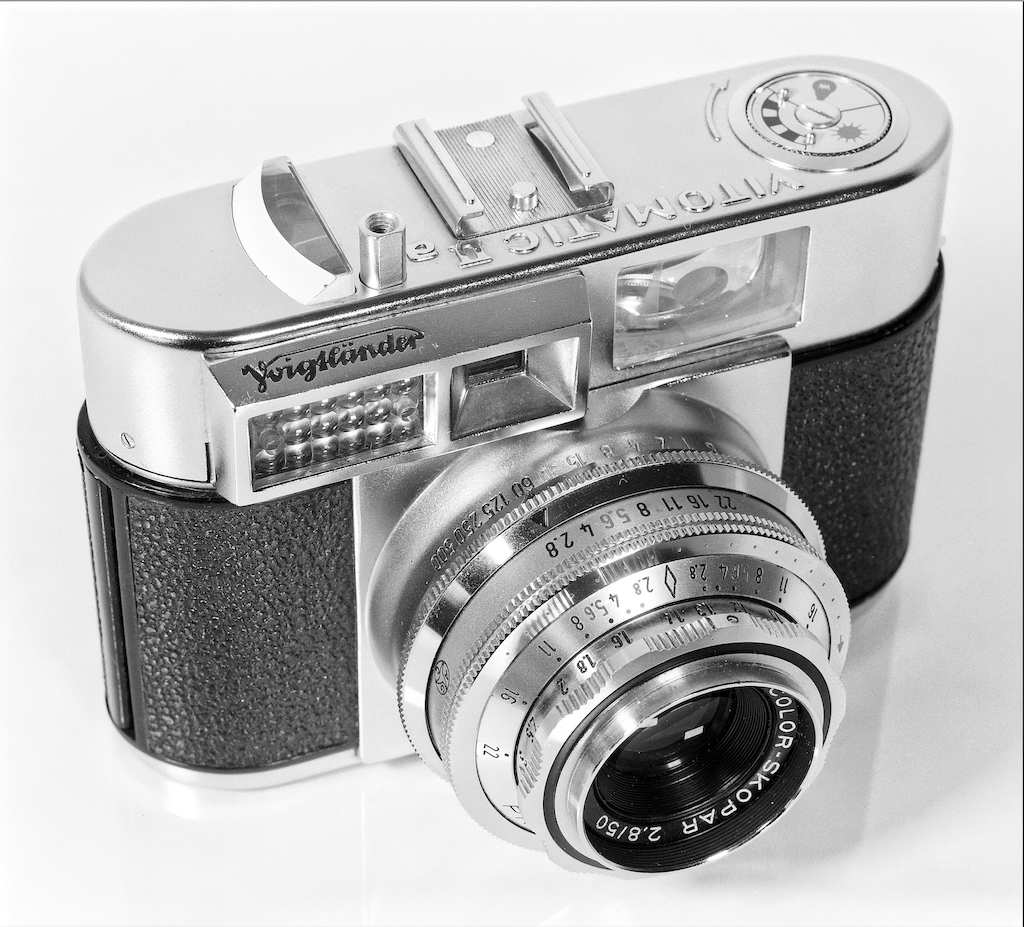
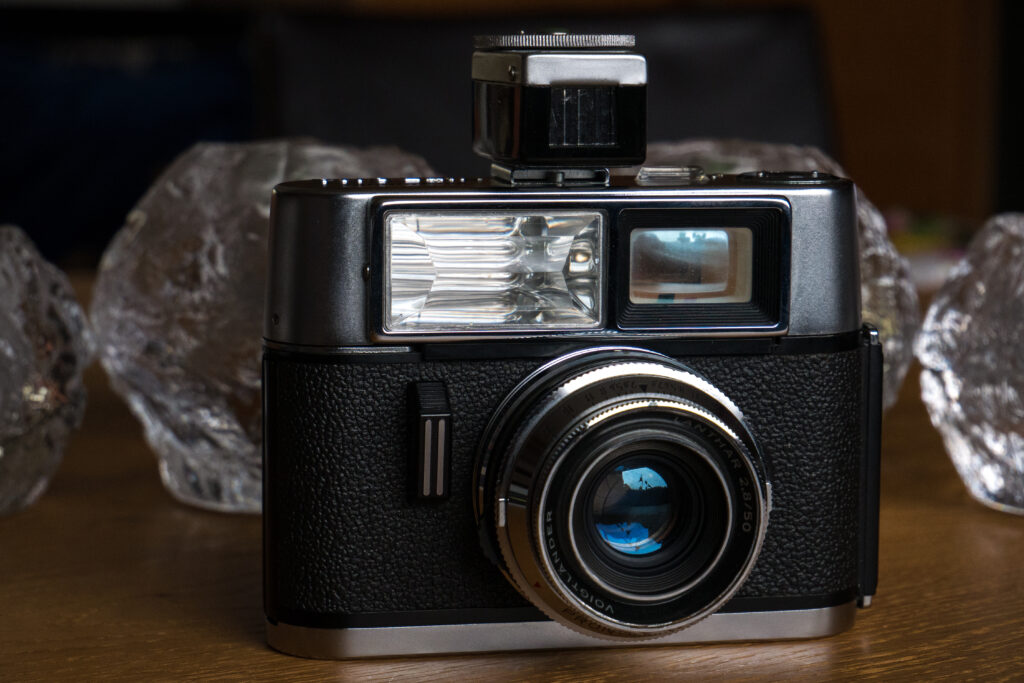
It started for me with a Voigtländer Vitomatic IIa from 1956 and has progressed through a number of cameras incorporating very sophisticated and very unsophisticated features.
My grandson’s current interest in film and film cameras has drawn me into yet another area of consumer cameras, but at the opposite end of the spectrum from the Vitomatic. His recent purchase of a job lot of cameras included two examples of the Agfa Rapid system from the 1960s and provided me with a camera and cassettes to get familiar with the system. The 126 had been of interest but the lack of film stock was limiting and I do like to try out the cameras I am interested in. The Rapid system nicely avoids this problem simply needing standard 35mm stock cut to length.
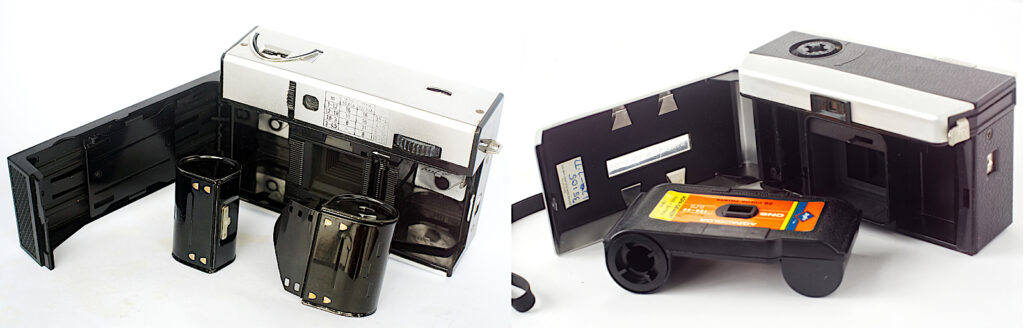
This system was introduced as a competitor to Kodak’s 126 Instamatics.
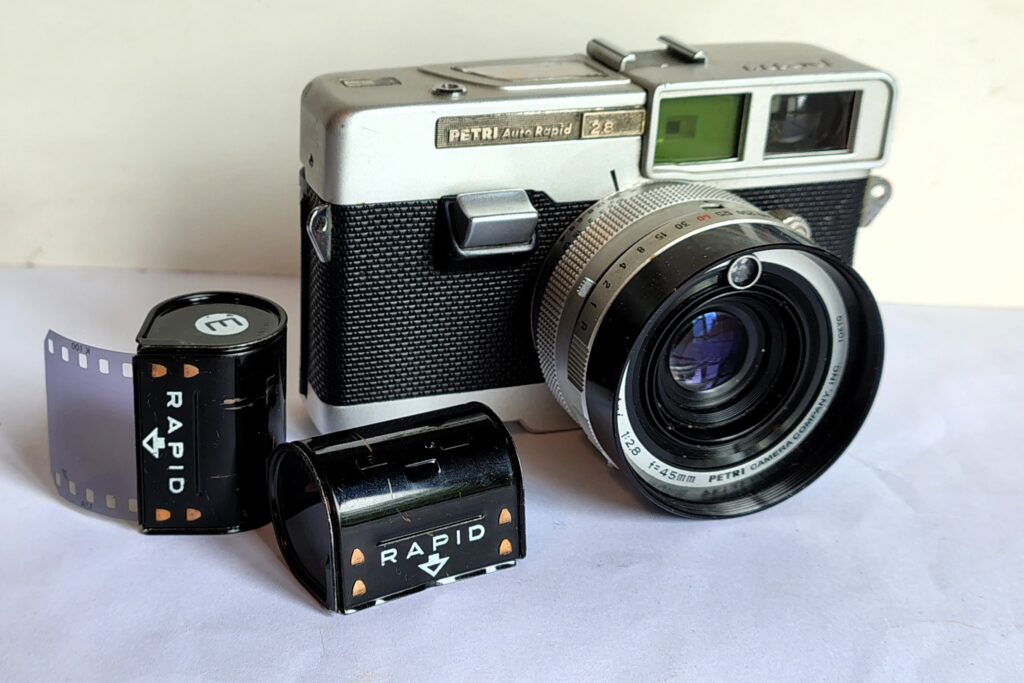
The main attraction for Agfa must have been that the system uses standard perforated 35mm film but ironically it is an Agfa 126 film that appears in my illustration of the two systems so Agfa kept their options open. I could have put the Agfa film through the 126 but it was an unknown quantity and may have been unkind to a test camera. It served better as part of the set.
126 won out and Rapid disappeared after a relatively short life but other manufacturers had had time to produce other models to use the system so a surprisingly wide range was produced. That is assuming you can find them of course, some are in hen’s teeth territory.
The system
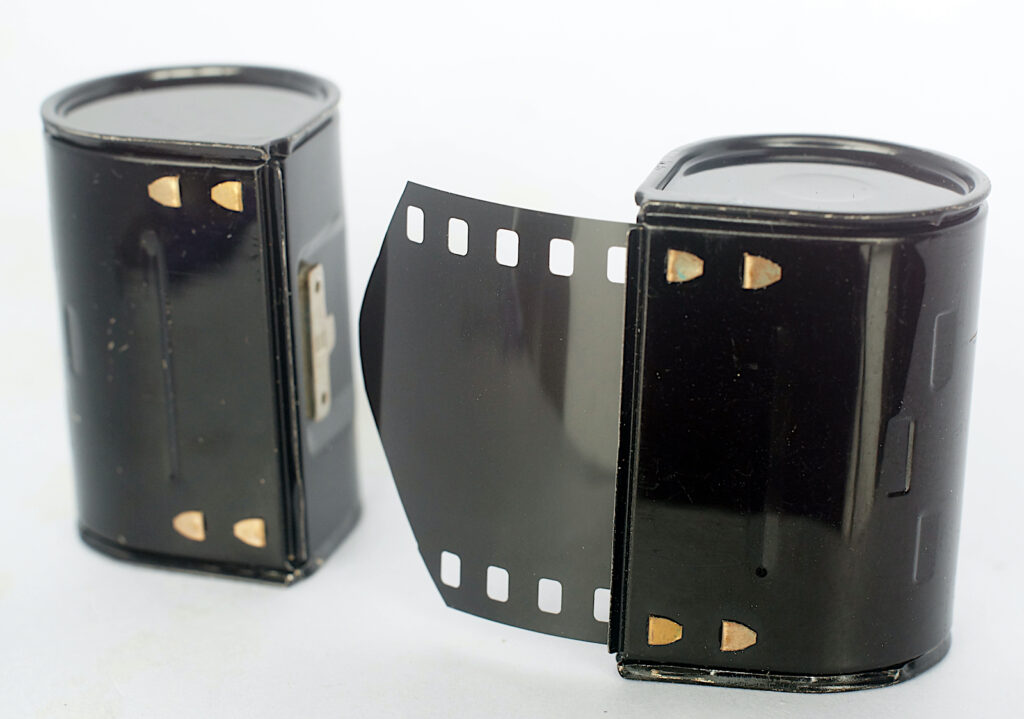
The Rapid cassette was not new having begun life with the Agfa Karat range from the 1930s and the two types are interchangeable. Perhaps Agfa should have noted that their later Karat models switched to the traditional 35mm cassette and saved themselves considerable development costs.
The Rapid version added the silver T-shape which input the film speed to the camera’s metering with varying the length of the T’s stem to communicate exposure information.
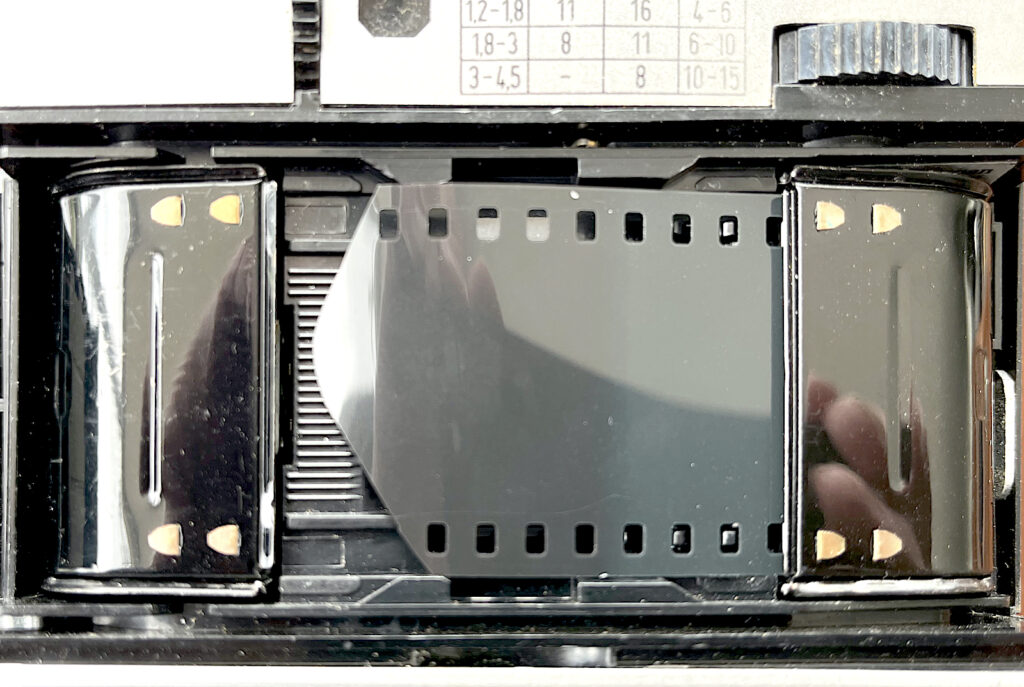
Loading the Agfa Iso-Rapid 1F is simplified by not using a take-up spool or needing a rewinding mechanism. Instead, the film is simply coiled up in the feed cassette and is coiled up again in the take-up side. It is driven across the gate with the cog wheels that engage with the film perforations. At the start no threading is needed and when the back is closed, or after each exposure, the film is simply pushed into the take-up cassette. The start end is recommended to be shaped to assist its entry into the take-up cassette. The precision required for film transport is impressive and removes the need for a conventional pressure plate, only requiring an unsprung backing plate to ensure registration.
After a film is exposed, the cassette is removed for processing, the now empty feed cassette is reversed and placed in the take-up end ready to receive the next film. If trade processing is used these days it is essential to ask for the cassette to be returned.
The cassette is completely sealed apart from the slot to allow the film to pass in or out. To avoid all of the film passing into the take-up cassette, the cogs are placed at the feed side of the gate so an inch or so is always left protruding from the take-up cassette to be accessible for processing.
The cassettes are smaller than the more usual 35mm version but take the same perforated cine gauge. Film length is reduced and gives 16 24x24mm exposures in the original Agfas. Later cameras also gave 12 or 24 exposures with 24x36mm or 24×18 models respectively.
The camera
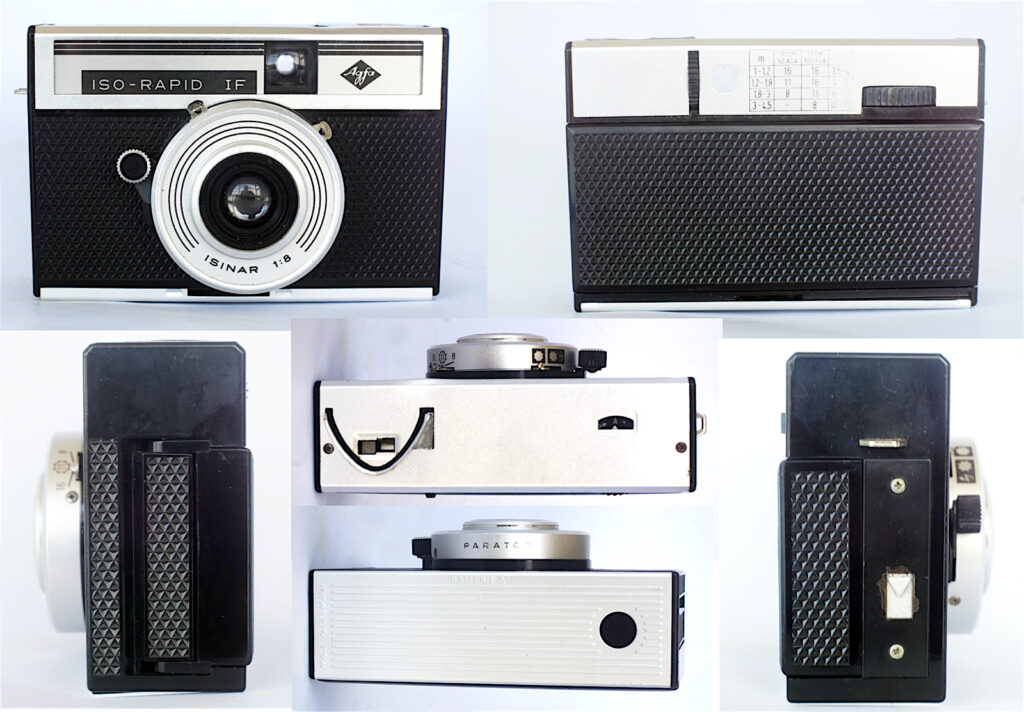
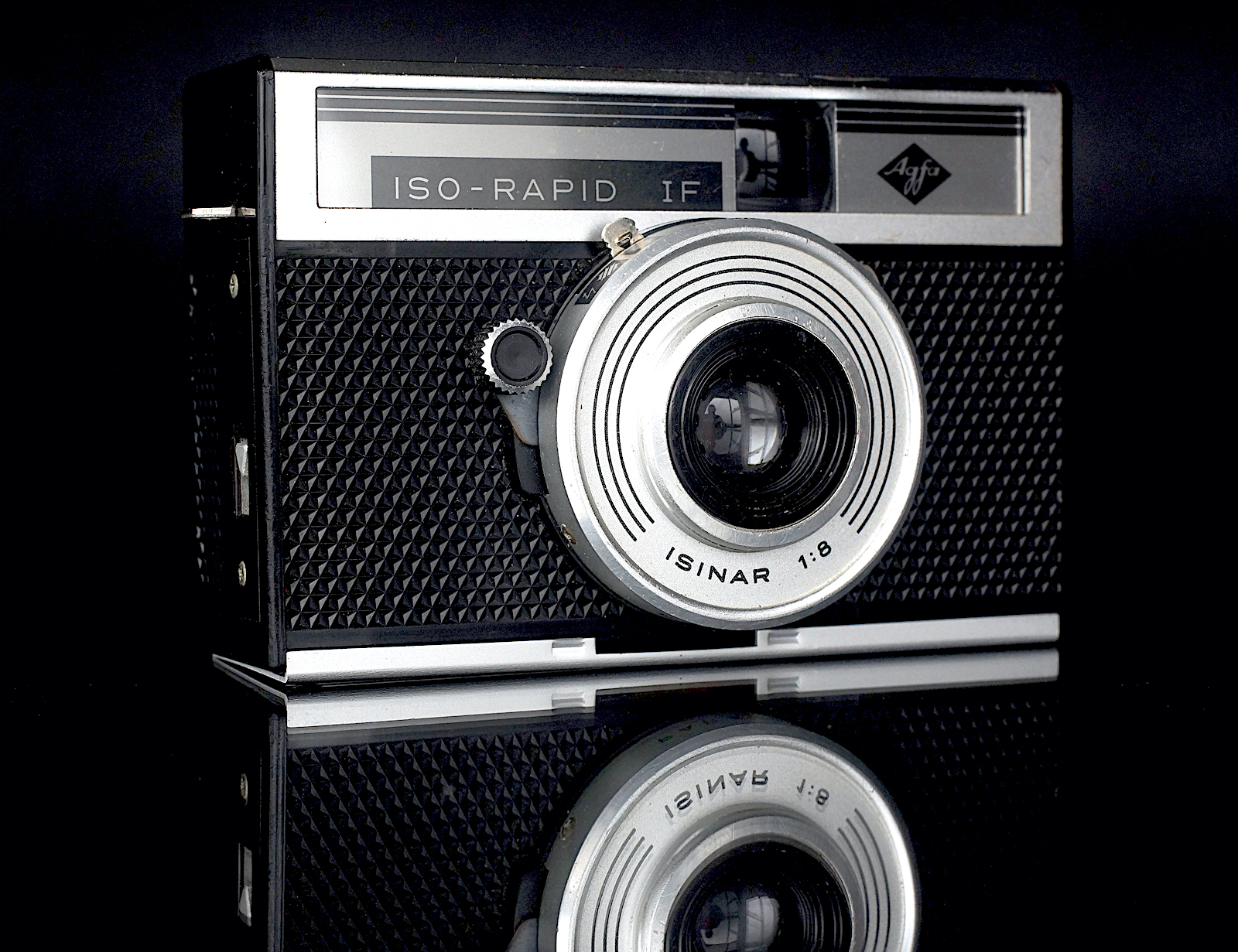
The Agfa Iso-Rapid 1F is brick-like in its body shape, every edge squared off, and light, yet feels solid. Finish is traditional black and silver but the usual leatherette is replaced with a prismatic patterned finish that is very tactile and grippy.
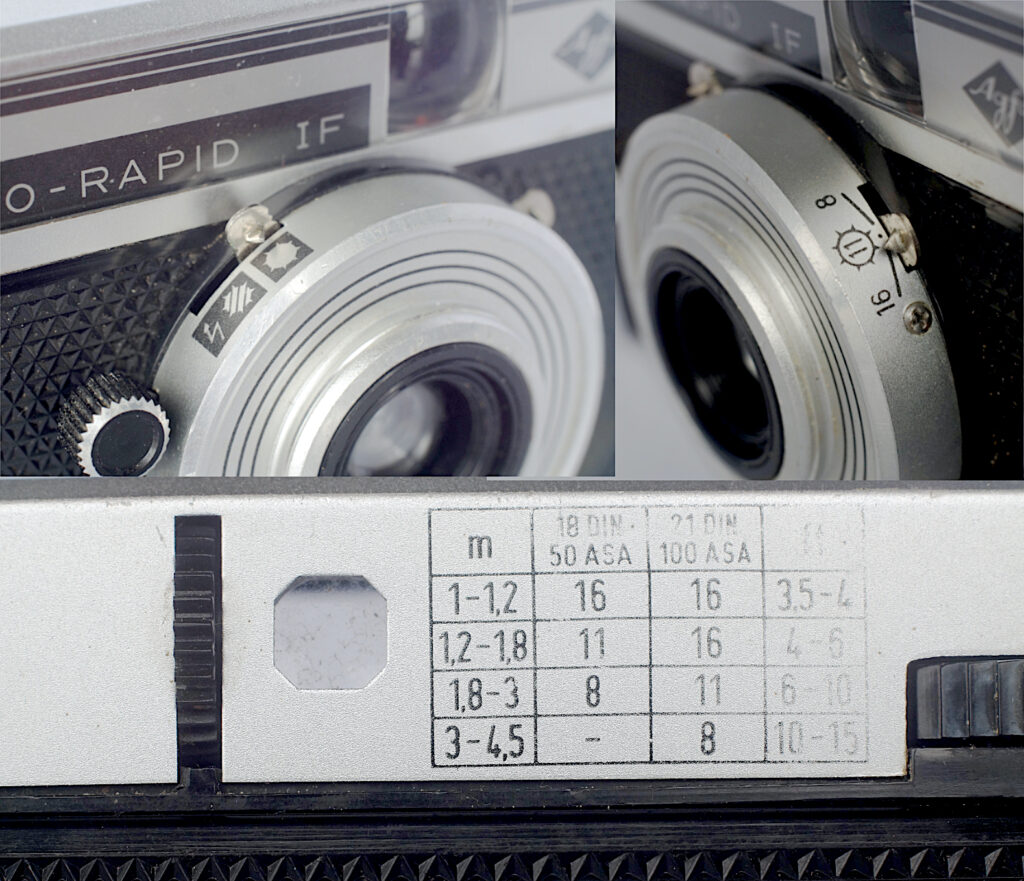
The Agfa Iso-Rapid 1F has a two-speed shutter plus a flash setting and three apertures.
Shutter speeds are 1/40 and 1/80 sec, indicated by cloudy and sunny symbols plus a flash setting. The shutter release is mounted, Optima style, on the side of the shutter and is light and responsive.
Apertures are f8, f11 and f16, with f11 marked with a sunny symbol. In good light with the recommended film simply setting to the sunny symbols would be all that was needed. The other options allow other situations to be tackled.

Flash exposure guidance is given with a table on the back next to the finder eyepiece. The flash reflector is raised and lowered with a thumb wheel driven rack and pinion and encloses an AG-type socket for “peanut” bulbs. Power for the flash is from a PX-23 mercury cell, now banned and unavailable, accessed by un-clipping the base plate.
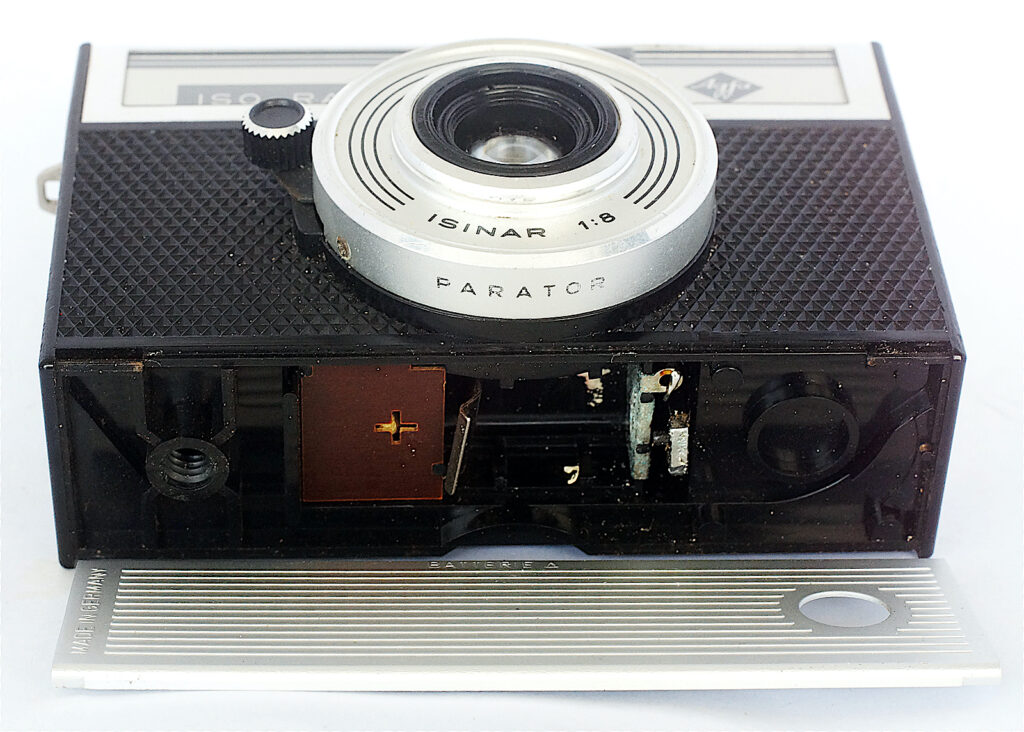
The lens displays four reflections, so a two-element achromat of fixed focus.
Wind is by a larger thumb wheel on the right hand end of the top plate.
In use.
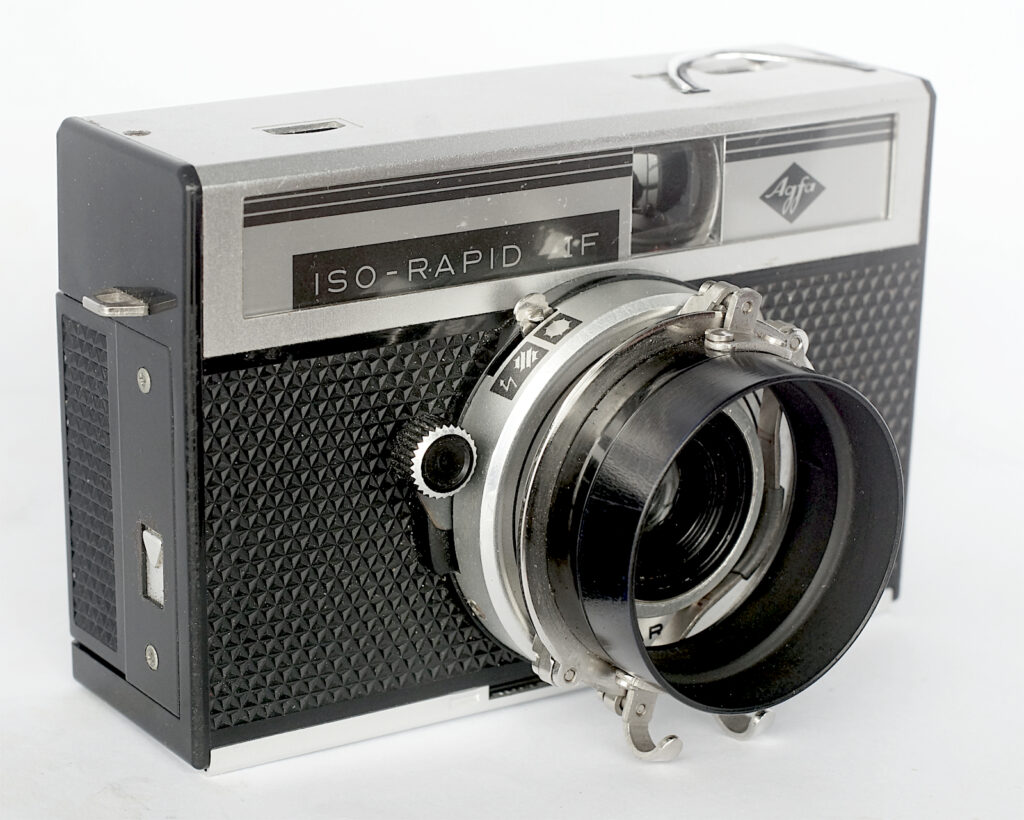
The length of film in Rapid cassettes is around 60cm or 2ft which I cut from a standard cassette of Rollei Superpan 200. Sunny conditions and 1/80sec means I would need a little over one stop reduction at f16, a 2x yellow would be close enough. I could also use orange and red filters at the other stops if I wished or tackle lower light levels. My ever useful Nebro Handcross lens hood / filter holder clips securely to the lens surround to mount filters.
I can’t say there was anything to object to in use. Even with glasses the finder is not difficult and the shutter release and wind-on are both smooth and effortless. It is also worth noting that there is no point in loading a longer length of film because the counter stops at 16 and no more exposures are possible.
Results
Unfortunately, this Agfa Iso-Rapid 1F shutter seems to run slow and everything was overexposed despite using the faster speed and mostly f16. In addition, and more seriously, the cassettes’ light trapping is not effective. Up to the second frame and after frame eight nothing is discernible and shows considerable fogging. It would also be difficult to repair them.
The edge vignetting though comes from my copying rig through not having a suitably sized negative carrier so there is considerable bleed from the very bright blank film margins.
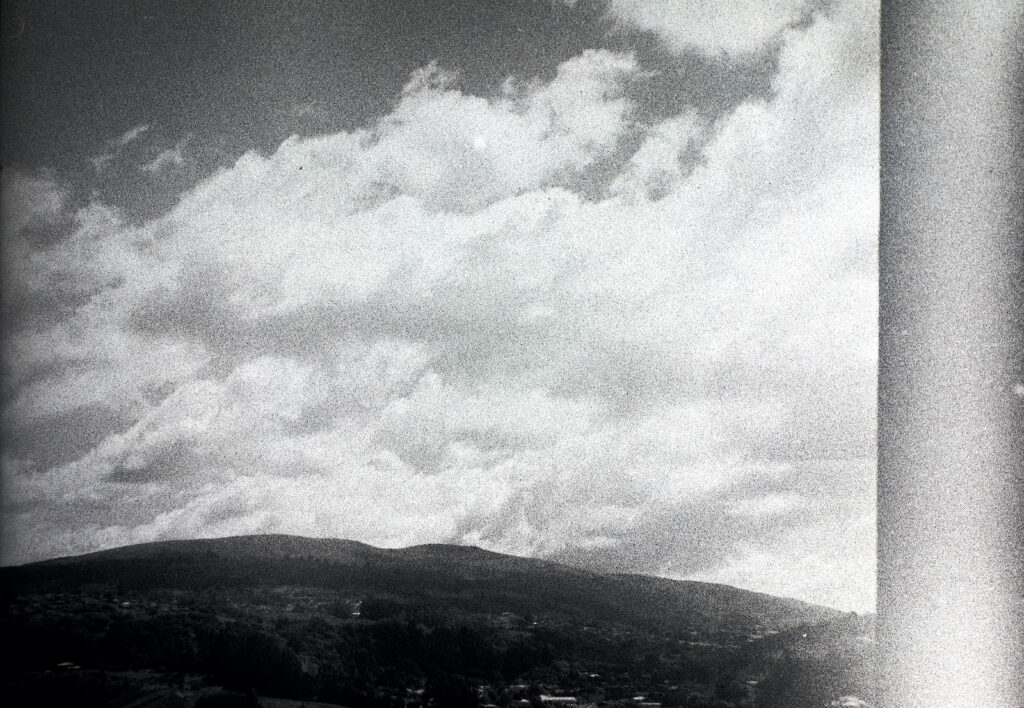 The second frame with fogging evident from the right hand side.
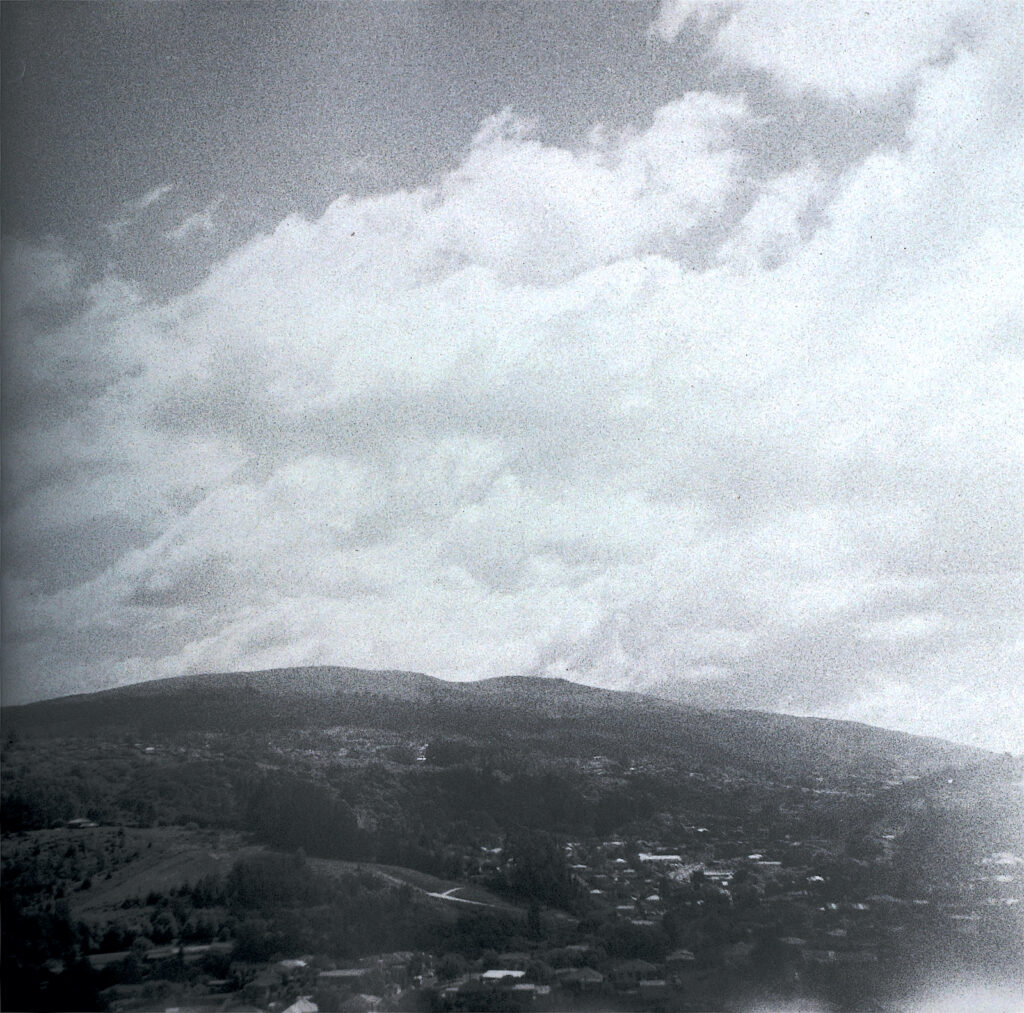
The whole of the frame above, 1/80th and f16 with 2x yellow filter.
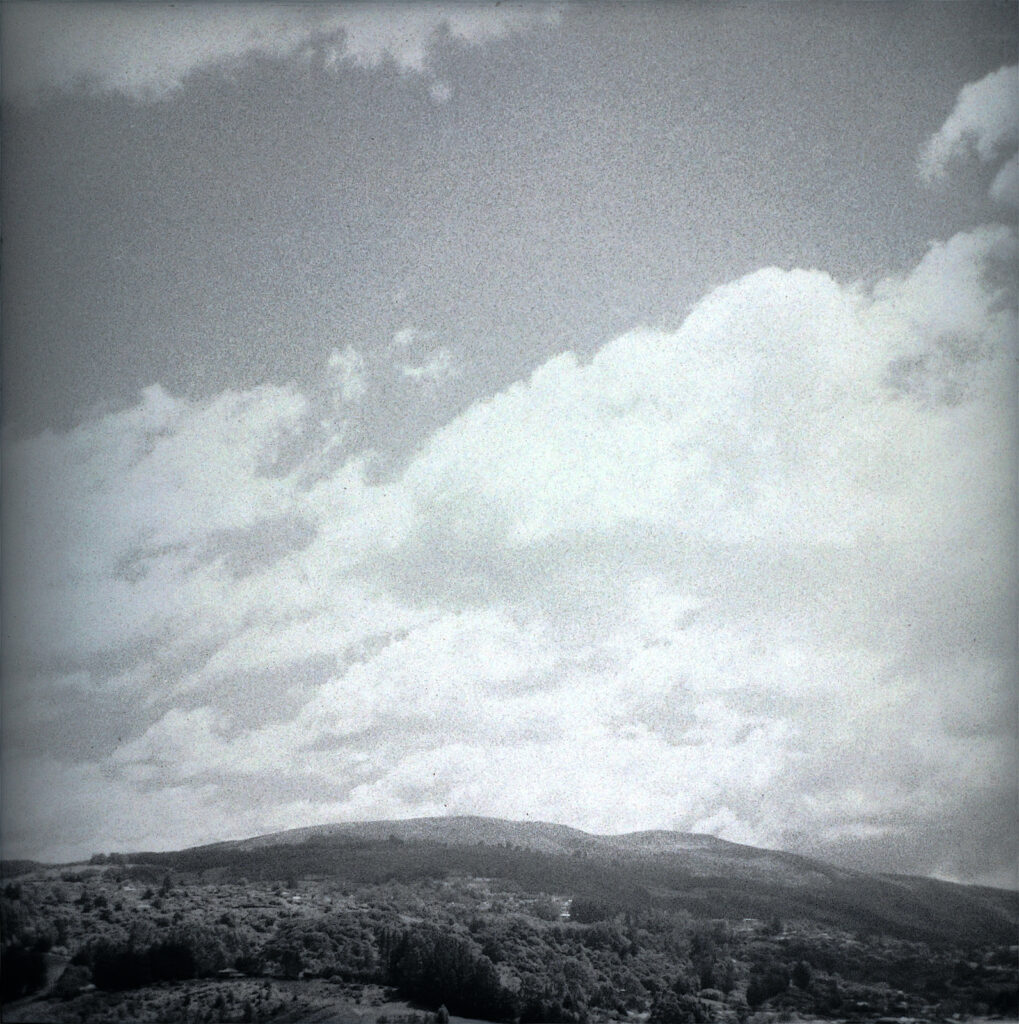
With an orange filter and f11.
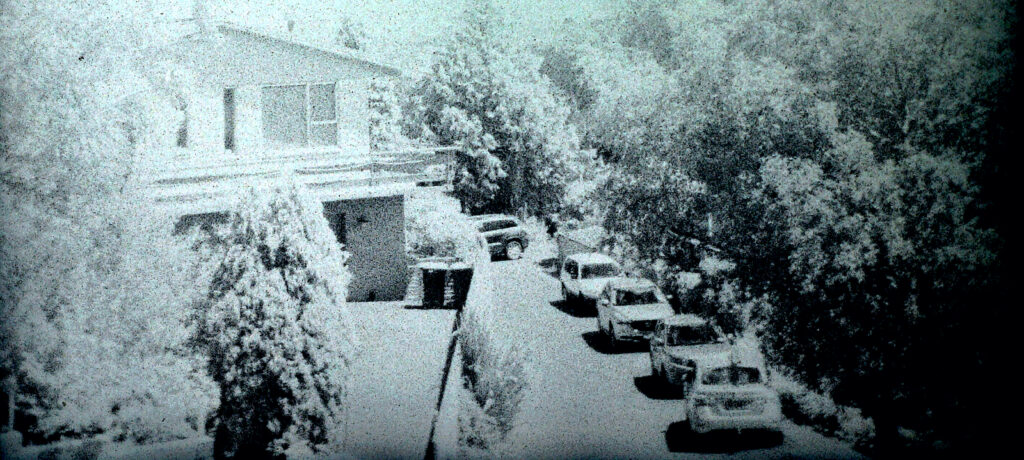
A detail of the lower third of a red filtered frame at f8 with some slight IR foliage apparent.
The other thing I take away from this exercise is that Superpan 200 definitely does not like Rodinal at 1:25, the dilution I used here.
Comments
It is unfortunate that I didn’t get anything more worthwhile from the Agfa Iso-Rapid 1F but it has been interesting learning about the system and seeing how the camera handles.
The limited length of film may be a down-side for some but 16 exposures is quite workable and needs less patience waiting to finish the film. The later 24×36 models give 12 exposures, medium format territory, while the half frame versions made by various manufacturers give a generous 24 frames.
The cassette system has the potential for better registration and is great for self loading. Pushing the film into the feed cassette was a breeze and not needing to rewind is convenient. There were problems with it I understand, in addition to the ones I have experienced here, mainly because the system wasn’t entirely foolproof like 126.
And finally
I have now returned the Agfa Iso-Rapid 1F and cassettes to my grandson. I doubt even a tidy Karat or one of the more advanced Japanese models would tempt me to delve deeper.
I will not miss it, just as I haven’t missed most of the cameras that have passed through my hands over the past seven or eight years and that I have tried out and written about here and elsewhere. I guess it is the academic aspects of history and design that have motivated me. I hope my efforts have proved interesting.
Share this post:


Comments
jfbonnin on Agfa Iso-Rapid 1F Review
Comment posted: 06/01/2026
Comment posted: 06/01/2026
Comment posted: 06/01/2026
Comment posted: 06/01/2026
JAMES LANGMESSER on Agfa Iso-Rapid 1F Review
Comment posted: 06/01/2026
Comment posted: 06/01/2026
Marco Andrés on Agfa Iso-Rapid 1F Review
Comment posted: 06/01/2026
35mmc.com/10/08/2024/5-frames-going-square-with-35mm-film-in-a-minolta-24-rapid/
(Begin quote from post)
Agfa Rapid cartridges were an alternative to Kodak 126 cassettes. Agfa repurposed its Karat cartridge, a 135 alternative. Both failed to gain traction. For more information…
(End quote)
Here’s info on the Karat cartridge from the mid 1930s
camera-wiki.org/wiki/Karat.
And info on loading with 135 film:
artdecocameras.com/resources/using-rapid/
When sending film out for processing and (and hoping it will be returned), do this instead:
In the dark, remove film and either store loose in a light proof container (use one that comes with 135 film) or put tape the film to the end of film sticking out of an empty 135 cartridge and wind it back in..Label with the film type etc. While all labs won’t deal with loose film, mine did.
Although cameras using an Agfa Rapid cartridge are relatively rare , the cartridges are rarer still . Fortunately my Minolta 24 Rapid came with two. But you can 3d print a cartridge. Here’s an stl file:
printables.com/model/545261-film-cartridge-for-agfa-rapid-cameras
Since you wrote:
« The 126 had been of interest but the lack of film stock was limiting. »
The choice of film is not that limited.Some 126 cameras offer full manual control or work with unperforated 35mm wide film. Just reload 126 cartridges. Or use the Camerhacs Fakmatic adapter for load 135 (or any 35mm wide) film in a 126 cameras
(https://www.camerhack.it/product/fakmatic-126-film-cartridge/ ,
While some 126 cameras (but not all) play well with the Fakmatic, a few cameras just do not work at all, while others need to be coaxed.
Have a post underway about using 126 cameras today.
More later on the connection between the Minolta 24 Rapid using Agfa Rapid cartridges and the Minolta Autopak 700, a 126 camera with the same form factor and features, Minolta definitely hedged its bets.
Comment posted: 06/01/2026
Thomas Eland on Agfa Iso-Rapid 1F Review
Comment posted: 06/01/2026
I don't have great expectations but we'll have to wait and see.
Comment posted: 06/01/2026
Russ Rosener on Agfa Iso-Rapid 1F Review
Comment posted: 06/01/2026
Comment posted: 06/01/2026
Omar Tibi on Agfa Iso-Rapid 1F Review
Comment posted: 06/01/2026
Happy shooting in the new year!
Comment posted: 06/01/2026
David Hume on Agfa Iso-Rapid 1F Review
Comment posted: 06/01/2026
Thanks for the deep dive. I actually bought a IF too. I did shoot the I again a bit, by pushing film in to the canister in a dark bag. I like the square format, but in the end I just stuck plastic flags in to a little Canon P&S which wasted film, but was very easy. Cheers
Comment posted: 06/01/2026
Eric Manten on Agfa Iso-Rapid 1F Review
Comment posted: 07/01/2026
Chris Giles on Agfa Iso-Rapid 1F Review
Comment posted: 07/01/2026
Comment posted: 07/01/2026
Paul Quellin on Agfa Iso-Rapid 1F Review
Comment posted: 08/01/2026
Thanks for enlightening me regarding another system.
Comment posted: 08/01/2026