


Landscapes are a tough sell for me. I’m not a dedicated landscape photographer, and all too often, I find myself tiring of my own vista shots over time. My house only has walls for work I know I’ll appreciate for the long haul.
But Norway, Norway got an exception. Its sheer, unbelievable scale with the towering peaks and deep, winding fjords in combination with good company presented an irresistible challenge. One that I could not resist with the Hasselblad XPan.
Embracing the Panorama for True Scale
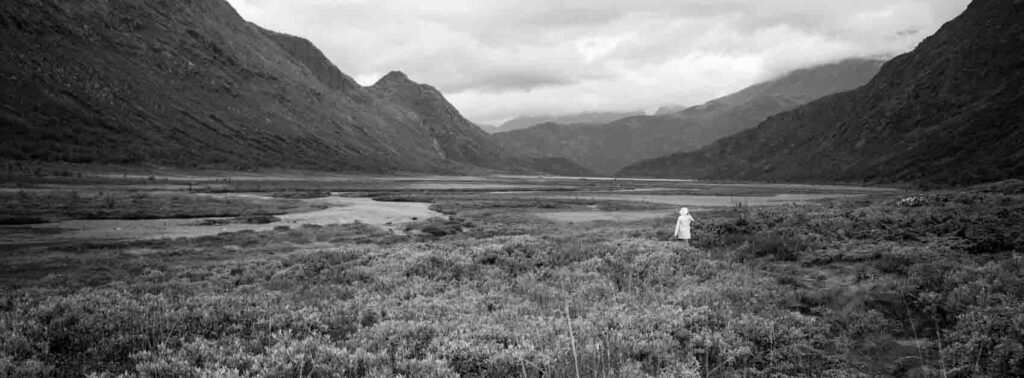
If you love wide format photography, Norway is your ultimate testing ground. The wide frame is crucial for including both the reflective fjord below and the soaring mountain peaks above. However, the scale can be deceiving, therefore I always try to incorporate some sort of reference for scale.
Additionally, the XPan is a perfect hiking companion. It’s small, relatively light, and encourages a measured, intentional pace. A perfect companion when tackling a serious mountain ridge. I rarely went out without the 45mm lens, the 90mm lens, and some film. Film photography allows me to be in the moment and click when I think I found a great composition and after clicking it, instantly forgetting it. Never knowing whether I got the right shot or not.
The Art of the Series: Capturing Moments in Threes
During one of many trips in Norway, I was climbing the Besseggen ridge, I had one core goal: to walk away with a narrative triptych. Three distinctly different, yet linked, images that would tell the complete story of the place and the experience.
The hike is around 8 hours and is considered quite challenging. The drops on either side of the ridge is not for the weak. The official ridge hike can only be accessed by boat, which starts at certain times in the morning. Therefore the times for shooting the incredibly beautiful vast terrain is predefined for you. For this reason I brought black and white film with LEE filters. Whilst the day before, the weather was not working in my favour the day of the hike the weather was everything I could have hoped for, see first image.
The morning light indicated harsh contrast and little to no clouds in the sky. Luckily half way through the climb some clouds appeared to give some texture in the sky.
Whilst the views are worth the hike, I did not only wanted to walk away with wide shots. Therefore I specifically brought the 90mm lens to get some details.
1. The Contrast of Scale
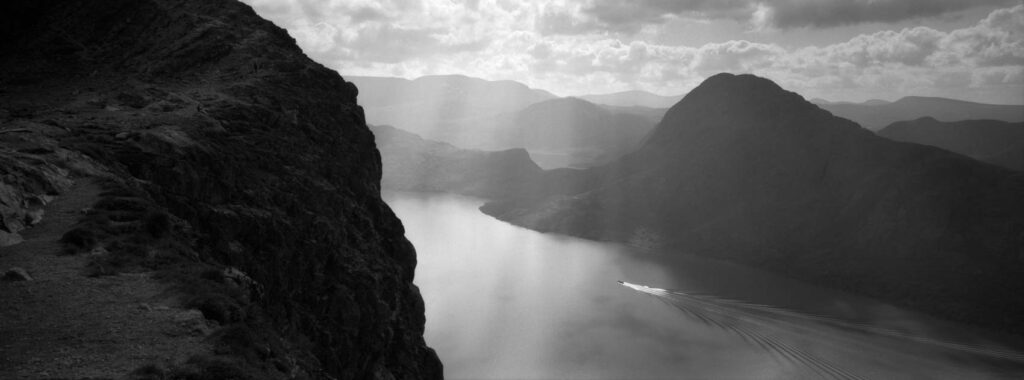
The first image needed to establish the sheer, brutal scale of the environment. I focused on a detail: the steep, dark foreground of a mountain contrasted against the bright, reflective surface of the lake. I waited for a small, distant detail, a tiny dot indicating a human presence or in this case transport for humans to come into view. This small element instantly highlights the vastness of the mountains, drawing the eye and making the viewer feel small. The light/dark contrast forces the eye to the human element, making it the story’s anchor.
With the foreground filled with a part of the ridge in the shadow side makes the contrast steep and naturally draws your eye deeper into the image.
2. Providing Context
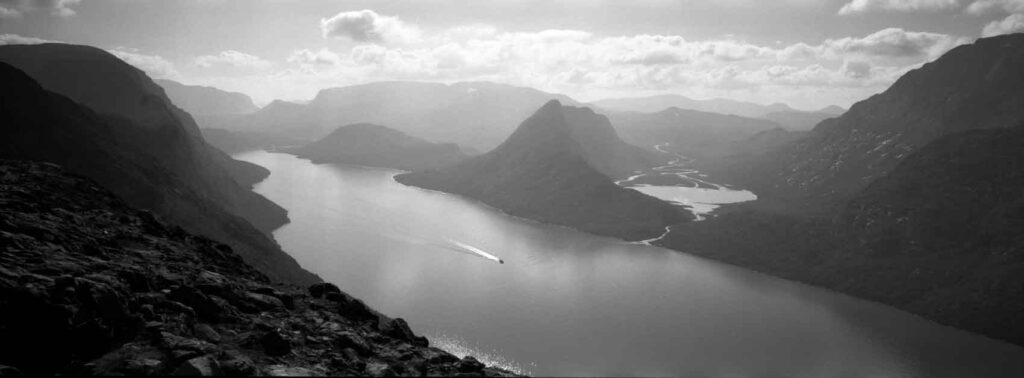
Next was the necessary overview shot. Unlike many panoramas that can feel overwhelming, this one uses the light reflected on the water to guide the viewer’s eye. It provides the geographical clarity and context for the other images, showing the full sweep of the land and allowing the viewer to visually trace the water’s path through the landscape.
3. Humanizing the Landscape
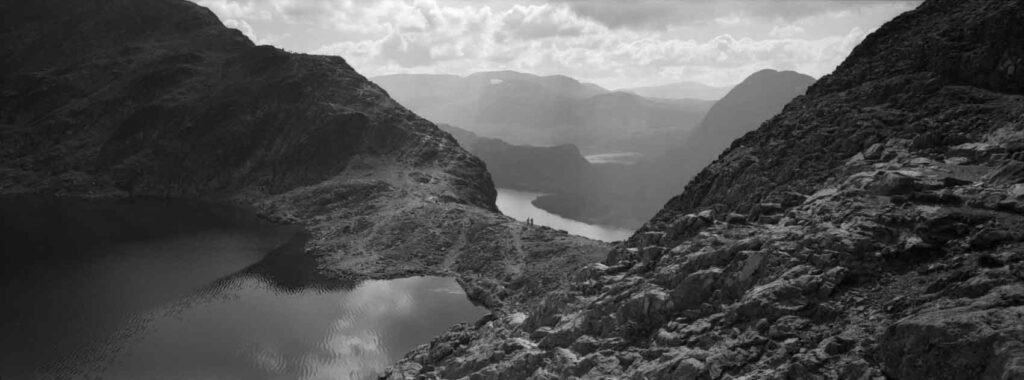
The final frame was needed to bring the story back down to a relatable level. It was taken from another angle, showing the ridge itself and human figures climbing it. The narrowest part of the ridge, where two lakes at complete different altitudes almost connect. The intention of this image was to triptych more accessible. While the first two frames showed our insignificant scale, this frame grounds the abstract landscape, allowing the viewer to place themselves in the scene. The anonymous human element connects the monumental landscape to the personal experience of the hike.
Together, I hope to form with these three deliberate XPan exposures a cohesive narrative sequence, transcending mere standalone moments to tell the full story of a high-altitude trek.
Mastering the Shots: Filters and Film Choice
Capturing the deep shadows and bright skies required careful planning and a little bit of luck, especially under the midday Arctic sun. The significant difference between the brilliant sky and the shadowed side of the mountain would have resulted in either a blown-out sky or blocked-up shadows.
I used a soft gradient LEE filter. Using a rangefinder camera like the XPan means no through-the-lens metering once the filter is attached, it blocks the rangefinder view and therefor the light metering becomes an estimation. Additionally, the filter (if incorrectly positioned) can affect areas in the frame that were not supposed to be affected and therefore the light meter can be off as well. Therefore I recommend to set the exposure beforehand, I set it for a mid-grey on the mountain, hoping the soft gradient would sufficiently dim the bright sky to retain detail. Crucially, because the filter blocks the rangefinder, I had to find the composition, set the focus, make my exposure assumptions, and then carefully attach the filter before firing the shutter. Mind you, this was all handheld, because I didn’t want to hike the extremely steep mountain with a tripod.
Next to the filters, I chose Ilford Delta film for its high dynamic range. Since the harsh contrast of the midday sun was inevitable, I knew I needed a film that could hold detail in both the highlights and shadows.
Reflections on Narrative and Scale
Taking on these Norwegian landscapes with the XPan really showed me that sometimes stepping outside your comfort zone is where the magic happens. It’s not just about the gear or the stunning scenery, especially because I do not consider myself a landscape photographer, it is about seeing the shot, trusting your instincts with film, and then seeing those big, sweeping panoramas come to life.
This project confirmed to me the satisfactory feeling of seeing a comprehensive analog series come together, piece by deliberate piece. Even when trying such a small series like this my approach to photography has certainly shifted, I now think more in terms of narrative sequences and how individual frames contribute to a larger story. I might be forced in this direction, just because the Hasselblad XPan is the ultimate companion for this: capturing a story unfolding.
What unique landscape challenges have you tackled with your film camera? Share your stories in the comments below!
About Tom Kluyver
Through his journey as a full-time photographer, Tom Kluyver has found that true creative freedom lies in embracing the constraints of film and the panoramic format, a path that has shaped his unique style and storytelling. Find another article of Tom’s about the Philippines here. You can see more of his work on his instagram and portfolio website.
Share this post:

Comments
Erik Brammer on In the Land of Fjords – Finding Scale with the XPan
Comment posted: 11/12/2025
chapeau! "I always try to incorporate some sort of reference for scale" - you mastered this task super well. Thanks for sharing these great images. Hopefully those have already been printed and hung on a wall.
Best regards,
Erik
Comment posted: 11/12/2025
Charles Young on In the Land of Fjords – Finding Scale with the XPan
Comment posted: 11/12/2025
Chuck
Comment posted: 11/12/2025
Thomas Wolstenholme on In the Land of Fjords – Finding Scale with the XPan
Comment posted: 11/12/2025
Comment posted: 11/12/2025
Charles Young on In the Land of Fjords – Finding Scale with the XPan
Comment posted: 11/12/2025
Comment posted: 11/12/2025
Scott Ferguson on In the Land of Fjords – Finding Scale with the XPan
Comment posted: 11/12/2025
Wonderful post! I spent a month or so in Norway about a year before I began shooting film again, and am very sad I didn't have my Hasselblad 500 CM at that time! I have lots of very pleasant iphone photos of the stunning landscapes, but they don't feel as poetic to me as the film shots I took with the Hasselblad in the Canadian Rockies a little over a year ago. As a relative newcomer to 'intentional' fillm photography, I don't know if I have a set style or subject, but my first efforts after coming into a Leica and a Hasselblad were dominated by landscape photography in the Canadian Rockies. I learned a lot by trial and error, with a lot more error in the early days when I thought that just by having a famous camera my photos would automatically be great.
One of my early expeditions was to go to a well known vantage point of Canmore's signature "Three Sisters" that had a small reflecting pool where you could get an image with the image of the mountains mirroring the actual mountains on the still surface of the small pond. It is accessible by a very easy 5 minute scramble on well worn rocky path after crossing the highway and ducking under a small railroad trestle. It was nothing that hadn't been photographed by thousands of photographers before or after me -- but for good reasons, it is a beautiful spot! I decided that I would try doing a 'light study' inspired by Monet's Haystack paintings, so I found a good spot, set up my tripod and proceeded to spend about 4 hours there shooting the mountains. What I discovered that day is that 'sun time' moves very differently than 'railroad time' -- over the first 3 & 1/2 hours, sun time moved very slowly and nothing much changed from one photo to the next. Then as we hit late afternoon and the sun began approaching the jagged granite horizon, things started to move very quickly, and the light and colors were shifting from moment to moment. That brief period is when all of my best photos came from. A half a dozen more experienced photographers showed up at the pond around that time and grabbed the shots that I had been sitting there all afternoon waiting for without knowing it. And then suddenly the high alpine rockface was in shadow and the magic light was over and everyone packed up their tripods and left. I followed them. Now that I'm back in NYC I spend more time shooting people on the streets than landscape, but in the event I find myself back in some epic landscape like the Rockies or Norway, I think I'll have to learn how to anticipate the sun and shadow path of my intended destinations, rather than relying on luck and happenstance. Also getting a better handle on how to use tools like soft grad filters would be very handy.
I'm intrigued by the Xpan and the panoramic format for landscape -- I've thought about trying to shoot framing for pano on the 500CM using the 645 back and a mask that I got for the waist level finder, but never really committed to the technique. I'm impressed with people who get cool images in that format -- I haven't learned to think in pano yet. Yours here are great.
Best,
s
Comment posted: 11/12/2025
Jonathan Murray on In the Land of Fjords – Finding Scale with the XPan
Comment posted: 11/12/2025
Comment posted: 11/12/2025
Khürt Williams on In the Land of Fjords – Finding Scale with the XPan
Comment posted: 11/12/2025
The scale work here is really fantastic. That's been my challenge with landscape photography too—how do I actually convey the size of these spaces rather than just showing empty drama. You've done it by placing those human references into the vistas … makes it feel … real.
I've shot a fair bit of landscape on digital with ND filters, mostly on Nikon and Fuji gear, so I appreciate what you've managed here with film and the XPan. Juggling the ND grad on this setup is like a whole different ballgame compared to what I'm used to.
How much time did you spend scouting before you committed the film, or were you mostly working with what you found on the day?
Comment posted: 11/12/2025
Huss on In the Land of Fjords – Finding Scale with the XPan
Comment posted: 12/12/2025
I am confused with this statement:
"Using a rangefinder camera like the XPan means no through-the-lens metering, so everything is an estimation"
Both my Xpan and Xpan 2 have TTL meters
Comment posted: 12/12/2025