

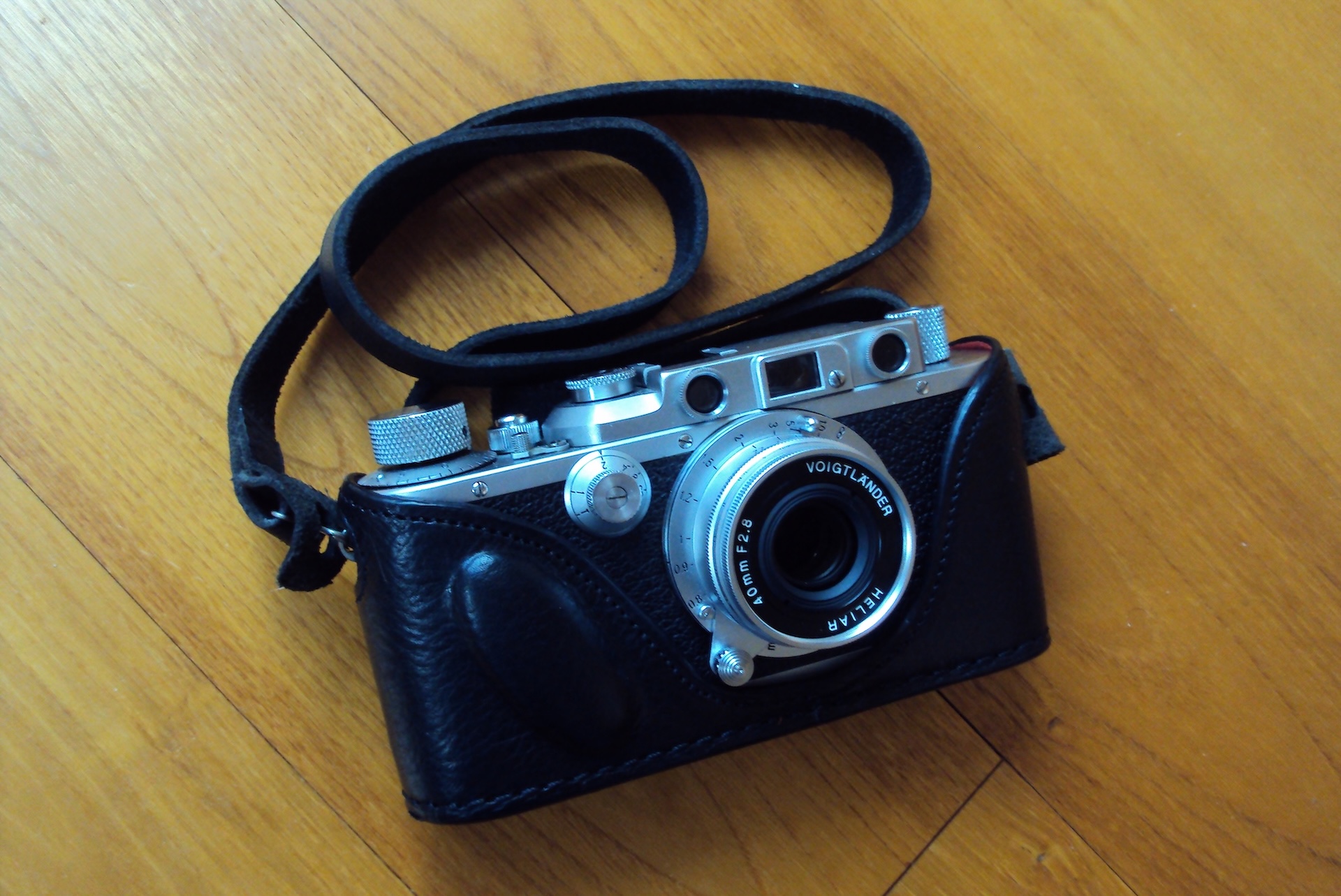
I must admit, I am a bit of a collector. Some time ago, I had a 1976 Triumph Spitfire and a 1991 Mini Cooper. I sold the two because I did not have enough opportunity to drive them. So, it is not surprising that, as an amateur photographer, I am interested in old cameras, the advantage over cars being that they are much cheaper and require much less space.
About one year ago, I decided, as a rangefinder user, that it was time to have a screw mount Leica (aka « Barnack Leica »). Why? Because I like its look, because it is part of the history of photography, because I read so many good opinions on it, because I like mechanical masterpieces.
Act I – Choosing which model to buy and finding one
The first question to answer was: which one to choose? To answer this question, I consulted various sources. Among them, 35mmc of course, other web sites, the Book « Leica – The first fifty years » by Gianni Rogliatti. I also watched some videos.
This analysis phase led me to the following criteria:
• It had to have a rangefinder, so Leica I not suitable
• As I am not a fan of the brassed look, it had to be silver
• I never use a flash, so no need for a Leica IIIf or IIIg (the latter being also bigger)
• I do not even have a timer on my more modern rangefinders, so no need for a Leica IIId
• Slow shutter speeds could be useful, so no Leica II
The choice was therefore reduced to a Leica IIIa, b or c (maybe I have missed a specific model, forgive me, it is a bit complicated …).
Good news: These models (especially the Leica IIIa) are easy to find and the cheapest among the screw mount Leica bodies. There was only to find a good one…
I found a 1939 Leica IIIa for sale on the french site french-camera.fr, which has a rather good reputation. The vulcanite was a disaster, but all the silver plated parts seemed in pretty good shape, no dents, no wear revealing the brass, only minor traces of usage.
Act II – Finding a trustworthy workshop
What I remembered from my preliminary investigations was that it was prudent to plan an overhaul of the camera after buying it, and before taking out my credit card, I wanted to find a good workshop. So I browsed some French forums dedicated to vintage photography and found the rare gem: optomeca.fr.
I sent a mail to this workshop, indicating I had found a Leica IIIa for sale on french-camera.fr and asking whether he would carry on an overhaul of it in case of a purchase. The man behind the site answered pretty quickly to my mail, telling he had taken a look at the photos, and that there were no signs of the camera having been mishandled (damaged screw heads, etc …), and that he could do the overhaul, including replacing the vulcanite by a leather covering. He also gave me an idea of the price, subject to review of the effective condition of the camera.
It was now time to take my credit card out and to buy the camera I was dreaming of, end of Act II.
Act III – Receiving the camera and having it repaired
I received the camera a few days later. As expected, the vulcanite was awful, but all the silver parts had no dents and very few signs of usage. The slow speeds were wrong, and the viewfinder and rangefinder were pretty foggy.
I immediately sent it for the overhaul and two weeks after received the quotation, which was consistent with the price previously given. No major faults were found, rangefinder and curtains were in good shape. About a month later, I received the overhauled camera. It was now time to find a suitable lens. End of act III.
Act IV – Finding a lens:
There are a lot of old screw mount lenses on the market. Leica, Canon, Nikon, etc… I will not mention here all the different references I investigated. I am not fan of the collapsible Leica lenses. I am a bit distracted and it is sure I would sometimes forget to extend the lens before shooting. Other old lenses (Canon, Nikon) are often described as having scratches, or fog, and in case they are in good condition, are rather expensive and usually black instead of silver, which is not to my liking for an old Leica.
There are also more modern screw mount lenses by Voigtlander and I investigated this option too.
But another solution appeared to me after consulting the numerous videos dedicated to screw mount Leicas by Matt Osborne (mrleica.com): the Voigtlander Heliar 40mm f2.8 LTM, which is available new at a reasonable price. Reasonable price means, in my mind, not much more than that of an old lens in very good condition. The big advantage is that there is no risk.
Of course, the Leica IIIa has a 50mm only viewfinder, but I made a few experiments, comparing its field of view with the 35mm and 50mm framelines of another rangefinder. When moving the eye from left to right and from top to bottom of the viewfinder, it appears that its field of view is between 35mm and 50mm, which is consistent with what Matt Osborne describes in one of his videos. Another good reason for adopting this solution is that I prefer a lot the 35mm focal length compared to 50mm: 40mm is quite close to 35mm.
In no time, I was the proud owner of a Leica IIIa equipped with a silver Voigtlander Heliar 40mm, which perfectly suits the aesthetics of the Leica body.
Act V – Testing the camera and lens:
It was now time to test this new companion, and I took the opportunity of three days of good weather to visit a few castles of the Loire Valley: Chambord, Amboise, Le Clos Lucé.
I will now stop bothering you with my stories. Let us take a look at these architectural masterpieces. The photos were made with Kodak Colorplus 200 film, exposed at 200 ISO with the help of a Sekonic Twin Mate L-208 light meter. All shots were made handheld. The film was processed and scanned at Carmencita Film Lab in Barcelona. I only corrected the images to have the vertical lines as correct as possible.
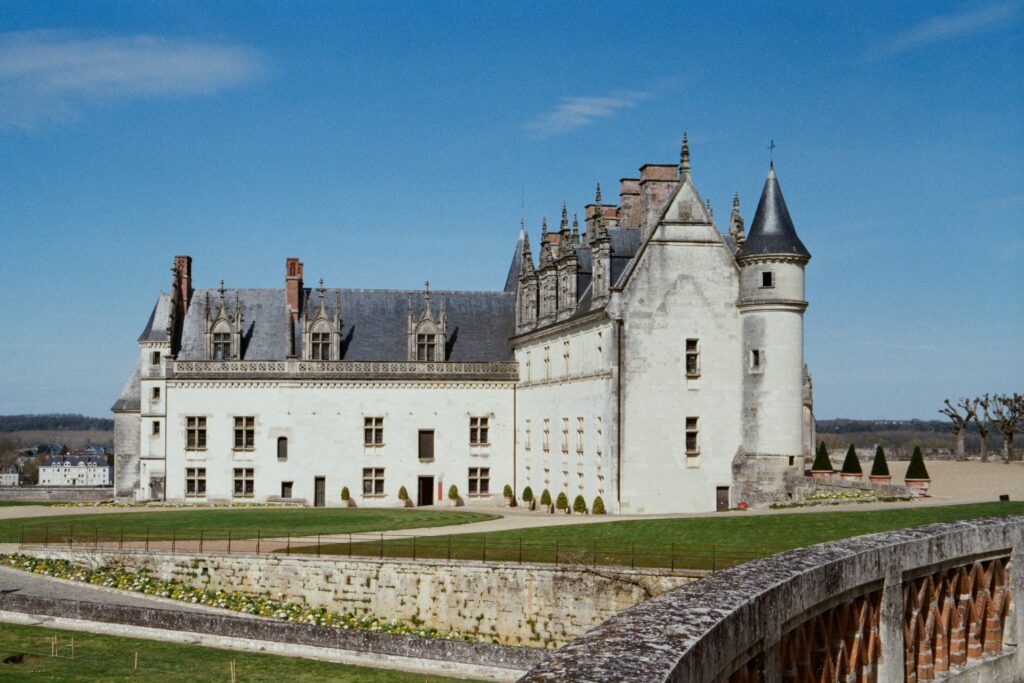
Located on a promontory overlooking the Loire, the Château d’Amboise was a high place of the French monarchy at the time of the Renaissance (15th and 16th centuries). Among the Kings who stayed there: Charles VII, Louis XI, Charles VIII, François I. Its geographical location, overlooking the Loire, an important waterway in the heart of the Kingdom, gave it a strong strategic interest (more information here).
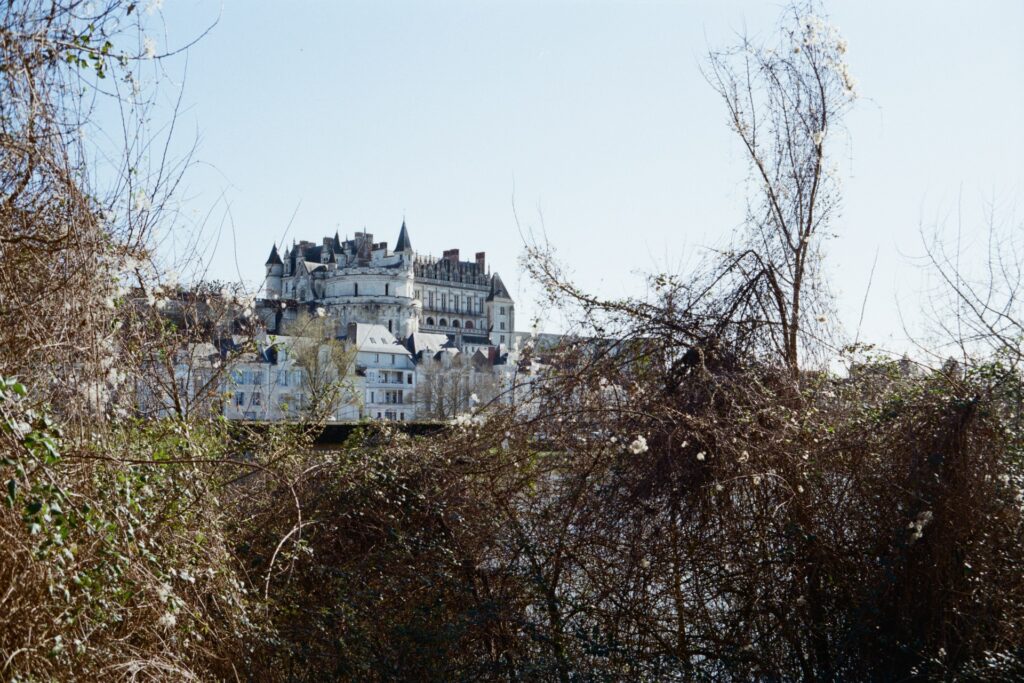
Like many castles, it was often enlarged and transformed. Unfortunately, a large number of the buildings were destroyed, and only a small part of what it was once remains today:
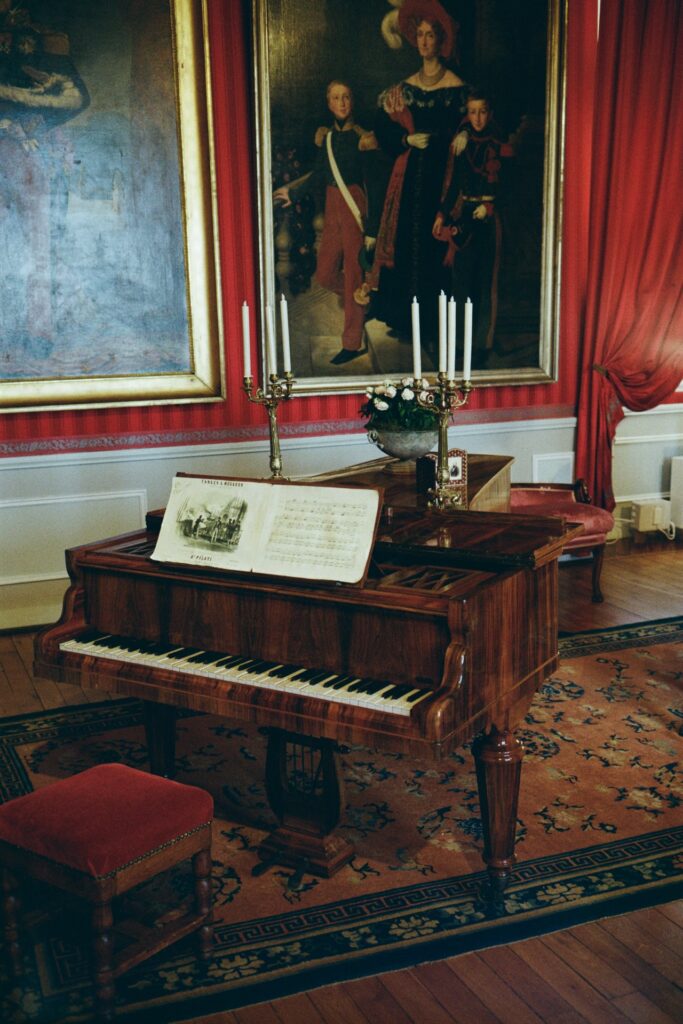
The interior of the castle is fully furnished, below the music room:
A chapel, the Saint-Hubert chapel is located in the gardens of the Castle:
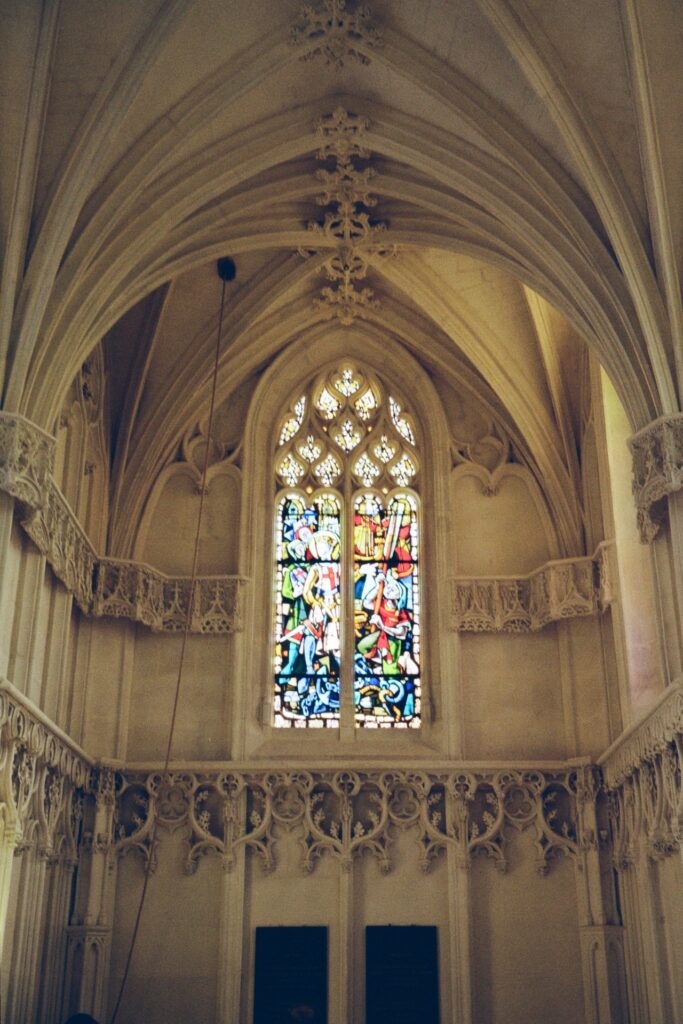
Near the Château d’Amboise is located the Clos Lucé, which was the residence attributed to Leonardo da Vinci when he was installed in France by King François I. This small castle houses a museum presenting many of his inventions. Other of his inventions are also presented in the Park (more information here).
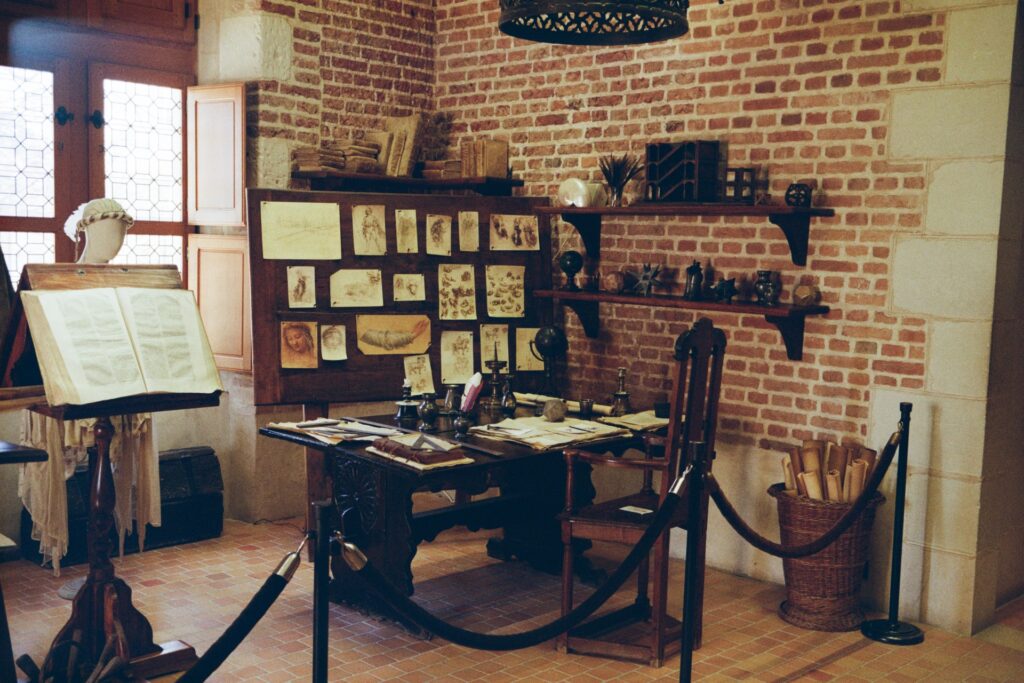
Unfortunately, masonry and earthwork works made the exterior shots of the Castle uninteresting.
The Château de Chambord is located in the heart of an estate that was a game reserve for the hunts of the Court of France. It was built from 1519 on the initiative of François I to accommodate his guests during the hunts that were organized at the estate. Its construction was interrupted several times according to the vicissitudes of the reign of François I (notably his detention in Spain by Charles Quint) and therefore spread over several decades (more information here).
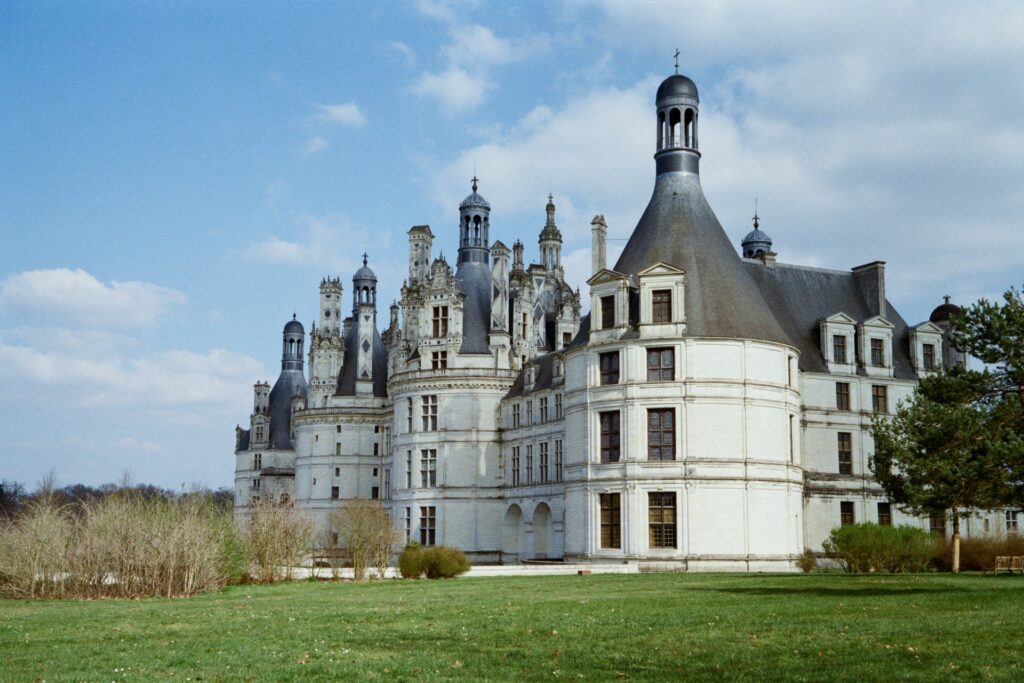
The chateau de Chambord is partially surrounded by the river Cosson, which was diverted during its construction:
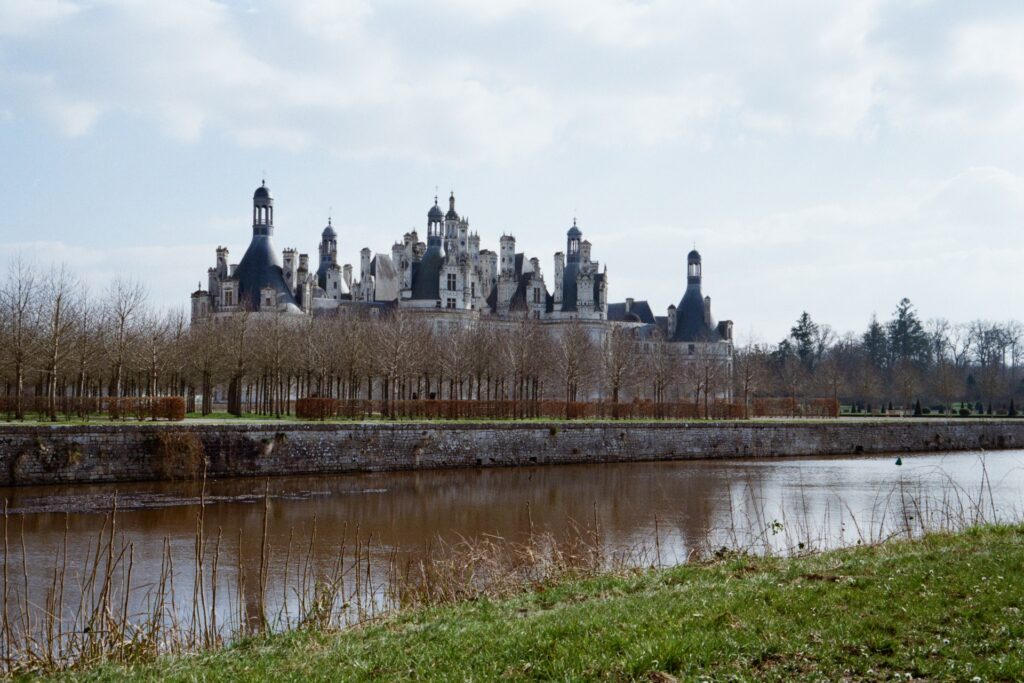
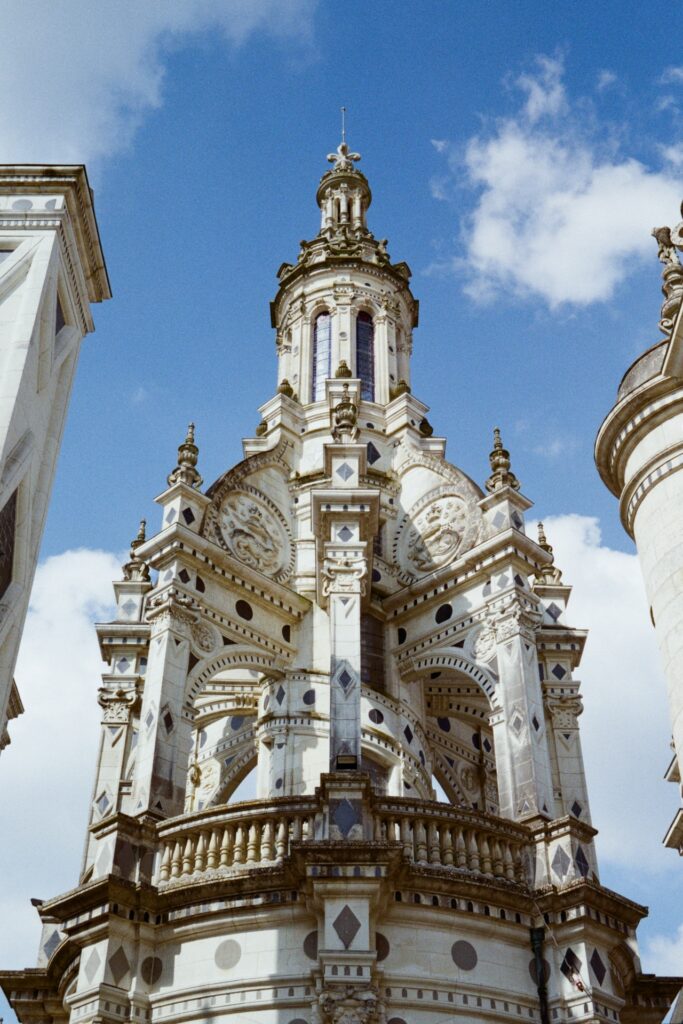
The Lantern Tower below sits at the top of the double helix staircase the Château de Chambord is well reknown for:
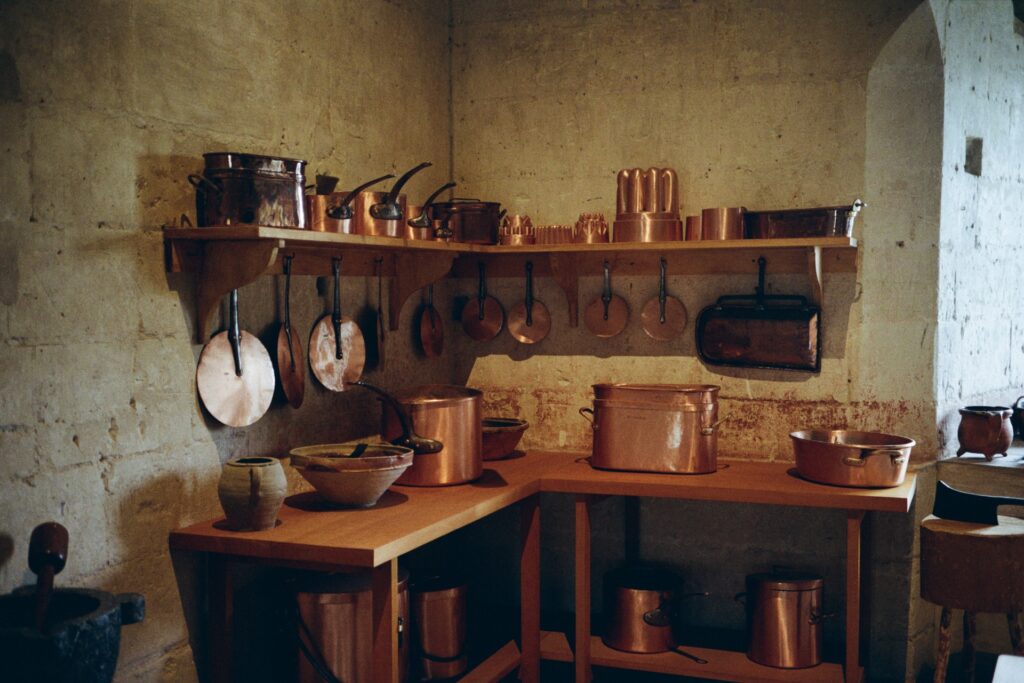
Some parts of the castle are furnished, like these kitchens:
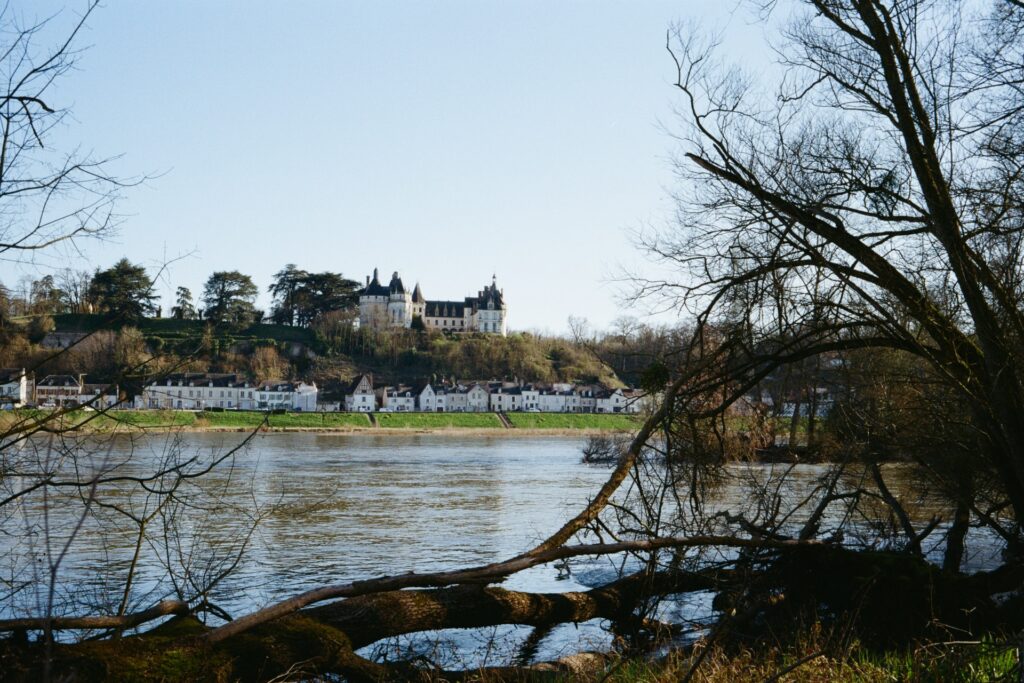
Near Amboise and Chambord is located the lovely village of Chaumont sur Loire which stretches along the river, dominated by the castle of the same name:
As a conclusion, the Leica IIIa is a pleasure to use this equipment. It is very compact, fits well in hand, and does not shake at slow speeds, as the shots taken indoors demonstrate. The field of view of the viewfinder being smaller than 40mm is not a problem. I made a check since then and found out that by moving the eye well behind the viewfinder, roughly 80% of the final image is covered (I wear glasses, so, I believe that without glasses it could be a little more than that). Anyway, the viewfinder is not very comfortable to use, is not adequate for accurate framing and requires some time getting used to. In case an indesirable object would appear in the final shot, there is still the possibility to crop the image a little bit.
Thank you for reading. I hope this article will give some useful information to those who are tempted by the acquisition of a screw mount Leica, and, also, will give you the temptation to visit the magnificent castles of the Loire Valley.
Share this post:

Comments
Ibraar Hussain on Leica IIIa – Buying a Barnack Leica and enjoying it visiting Castles in the Loire Valley
Comment posted: 13/02/2026
The Loire Valley looks beautiful - enjoyed your photos as well of it. Man, I’d love to visit it one day.
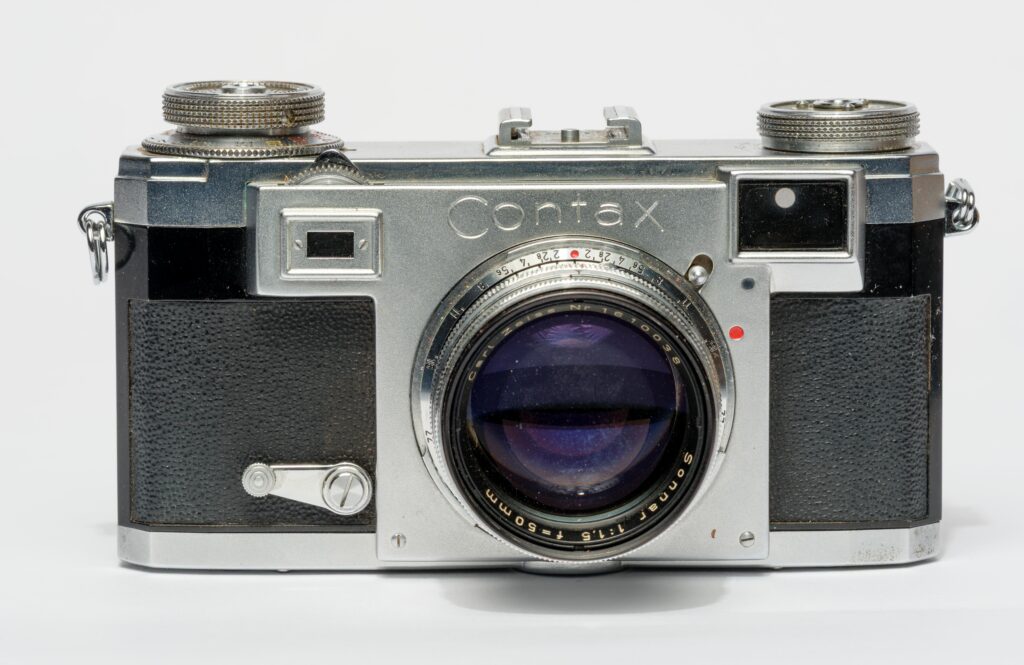
I have a soft spot for Contax so may perhaps one day, inspired by your article, find myself one.
Comment posted: 13/02/2026
Comment posted: 13/02/2026
Charles Young on Leica IIIa – Buying a Barnack Leica and enjoying it visiting Castles in the Loire Valley
Comment posted: 13/02/2026
I yielded to temptation and also acquired Russian Leica copies .... Fed 2 and 3. All great to use.
The castle photos are great ... stunning memories of the over-rich original owners. There is very little architecture like that in my part of the USA ... mostly ruins of mining operations here.
Chuck
Comment posted: 13/02/2026
JAMES LANGMESSER on Leica IIIa – Buying a Barnack Leica and enjoying it visiting Castles in the Loire Valley
Comment posted: 13/02/2026
Comment posted: 13/02/2026
Gerard on Leica IIIa – Buying a Barnack Leica and enjoying it visiting Castles in the Loire Valley
Comment posted: 13/02/2026
Thank for sharing
Comment posted: 13/02/2026
Markus Larjomaa on Leica IIIa – Buying a Barnack Leica and enjoying it visiting Castles in the Loire Valley
Comment posted: 13/02/2026
It's also amazing how you can pair these 90+ years old cameras with brand new lenses. The 40/2.8 Heliar is a really good fit: compact, looks really good on a Barnack, "Goldilocks" focal length that can still be easily shot with the integrated between-focal-lengths viewfinder.
Happy shooting! I think there is no better camera for the classic camera lover who prefers their cameras all-metal, all-manual and (nearly) pocketable.
Comment posted: 13/02/2026
Art Meripol on Leica IIIa – Buying a Barnack Leica and enjoying it visiting Castles in the Loire Valley
Comment posted: 13/02/2026
Comment posted: 13/02/2026
Comment posted: 13/02/2026
Comment posted: 13/02/2026
Ed on Leica IIIa – Buying a Barnack Leica and enjoying it visiting Castles in the Loire Valley
Comment posted: 13/02/2026
Thanks for taking the time to share your story.
Comment posted: 13/02/2026
Comment posted: 13/02/2026
Comment posted: 13/02/2026
Comment posted: 13/02/2026
Gary Smith on Leica IIIa – Buying a Barnack Leica and enjoying it visiting Castles in the Loire Valley
Comment posted: 13/02/2026
Thanks for your article and your fantastic images!
Comment posted: 13/02/2026
David Pauley on Leica IIIa – Buying a Barnack Leica and enjoying it visiting Castles in the Loire Valley
Comment posted: 13/02/2026
David
Comment posted: 13/02/2026
Andrew Moore on Leica IIIa – Buying a Barnack Leica and enjoying it visiting Castles in the Loire Valley
Comment posted: 14/02/2026
Your 'journey of choosing the camera' is great to read. And the images? I too remain largely true to 35mm - when film and processing costs allow me - and when I achieve the look like these I know I've done what I set out to do. Just as in recorded music, the 'accuracy' of digital is nice but can be merely that. The emotive 'feel' of analogue always wins for me. Thanks for showing your images.
Comment posted: 14/02/2026
Jeffery Luhn on Leica IIIa – Buying a Barnack Leica and enjoying it visiting Castles in the Loire Valley
Comment posted: 14/02/2026
I enjoyed your article and the photos. A very logical search and purchase story with great images. A fellow photo instructor at our college offered me his recently CLA'd IIIf Leica. I've always wanted a Leica so I tried it and found it to be an uphill battle. It amazes me to imagine how top photojournalists managed to use those cameras in the field. Loading that camera is a chore that I cannot do standing up, let alone walking or running. Having the body open to the elements for so long is difficult. Yes, it is a precision instrument, but it has so many obstacles. I'm going to sell it for him. I'm looking for the best platform in the US to list it. Final note to you: Kudos for making your camera work for you!
Comment posted: 14/02/2026
Keith Shearon on Leica IIIa – Buying a Barnack Leica and enjoying it visiting Castles in the Loire Valley
Comment posted: 15/02/2026
Comment posted: 15/02/2026
Paul Taylor on Leica IIIa – Buying a Barnack Leica and enjoying it visiting Castles in the Loire Valley
Comment posted: 15/02/2026
Comment posted: 15/02/2026