

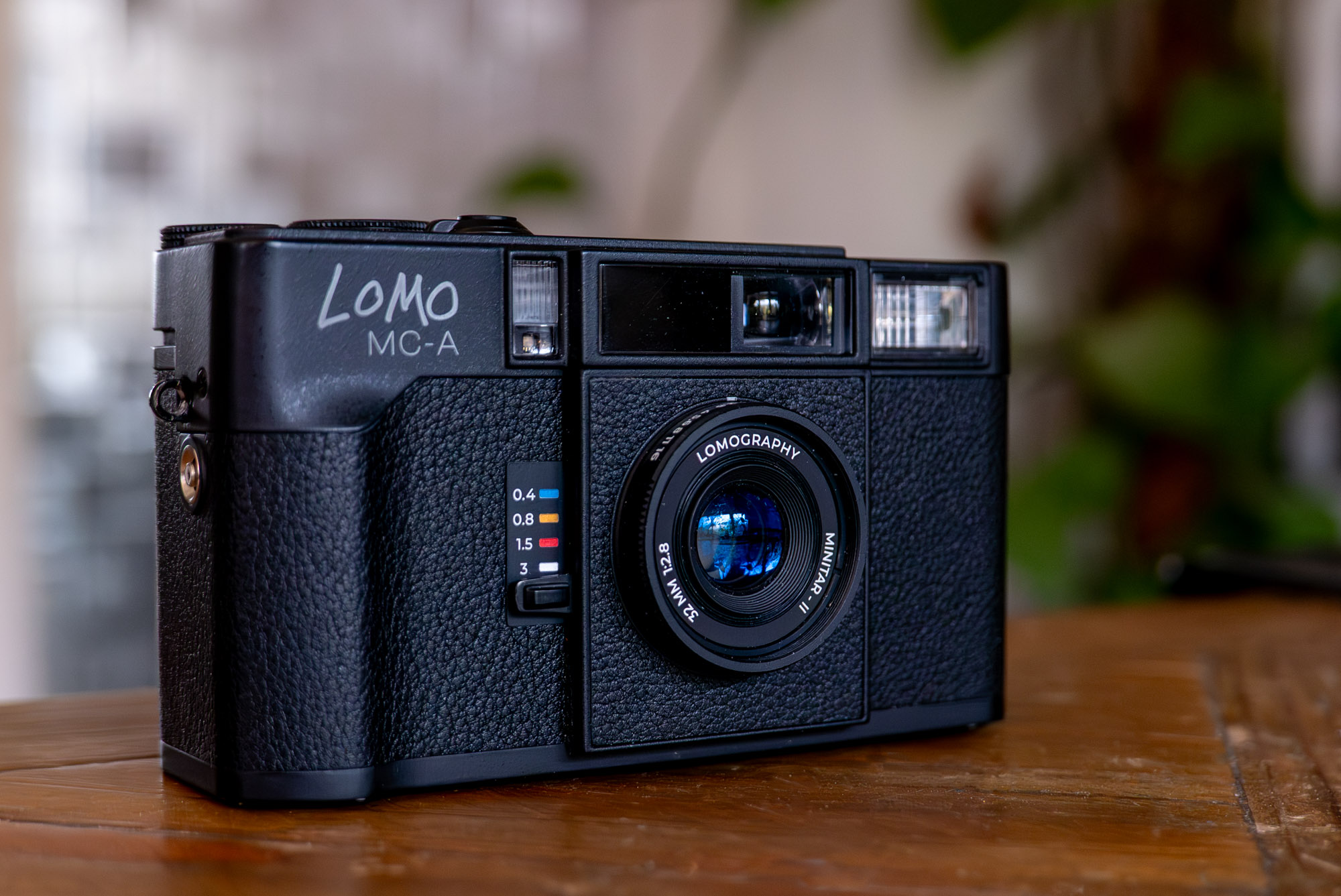
The end of last year was a particularly busy time for me… most times of most years seem to be, but the end of last year really hit hard. It seemed only a few days between me writing about the forthcoming release of the Lomography MC-A, me receiving one for review, and then pre-orders starting to land with people I know. In fact, this all spanned months… months that included a loan period that I far exceeded. My aim to release this review before Christmas also went completely out of the window. Still, here we are in 2026, plenty of people now have this camera in their hands, and I am finally getting around to putting this review together.
Despite it all feeling like it’s passed in a blink, I’ve gone through a few cycles of different feelings toward the Lomography MC-A in this time too. My first thoughts on it when I saw the information around its release were that it was going to be a giant killer. That is to say, its specifications looked like a tick list of solutions to all the bug bears and missing features that even the best of the advanced compact cameras of the early 2000s suffered. I was, as you might expect, excited to get my hands on one!
And then this review copy landed with me and I found myself feeling a touch frustrated. I almost immediately discovered a couple of shortcomings that made me realise it wasn’t going to be quite as awesome as I had hoped. As I will come to in more detail in a moment, it just felt like such a near miss as a camera. Fortunately, having spent a little more time with it, I’ve concluded that despite the factors I’m not so convinced by, it’s still an excellent and very enjoyable to use camera… it might not be the perfect giant killer I’d hoped when I read that original specification list, but being fair to it, when I look back at that list it didn’t promise to be either. Just me hoping it would be a giant killer doesn’t really justify me writing it off for not being one… though I am retaining the right to feel a little frustration at just how close it came!
Before I get into the actual review, I just want to share a little more context. For those who don’t already know, 35mmc was born out of my fascination with 35mm Compact film cameras. Back when I started it in 2013 I’d discovered an absolute joy in shooting these sorts of cameras. I was so excited about how much they had brought to my photography that I decided to start documenting my experiences. In time, I ended up reviewing many of the most well known of these cameras, not to mention a lot of less well known ones too. In the process of doing so I discovered a lot about the thinking behind the designs of these cameras in terms of how they looked, felt in the hand, how they functioned, how they were targeted in terms of a potential user base, and indeed how they were made in such a way that the wouldn’t eat away at the sales of the contemporary SLRs.
That final point is quite important to my thinking around the Lomography MC-A too. We live in a different time now. Back in the days of the Contax T2 for example, as a brand they wouldn’t have wanted to release a pocket camera that was so feature packed that it would stop customers from also wanting to buy an RTS III or whatever. They wanted to make a camera that customers would want alongside their more feature packed SLRs. Nowadays things are different, Lomography don’t (yet at least) make a feature-packed SLR, so really there was no reason not to give this camera as many features as they could possibly squeeze into it. And, short of the aforementioned miss, this is pretty much exactly what they’ve done!
Lomography MC-A (sometimes compared to cameras that came before)
Because of how I feel about this camera, I’ve decided to review it by sometimes comparing its features to cameras that came before, and in some case even explain how and why I think they are better, worse or equal.
Size and Handling
Size definitely matters to me when it comes to point and shoot type film cameras. For me, the best overall cameras when I came to the size and handling were the Ricoh GR1 series. These cameras managed to be small, but also had a nice enough grip on them meaning they didn’t feel awkward or too small in the hand. Don’t get me wrong, I appreciated the tiny size of the Contax T3 and Minolta TC-1, but when it came to pure ergonomic enjoyment whilst still remaining pocketable the GR1 series won.
The Lomography MC-A is no GR1 in terms of size or ergonomic shape. In fact, it’s much more like the Leica CM which by comparison is a lot more brick-shaped. Albeit a small(ish) brick.
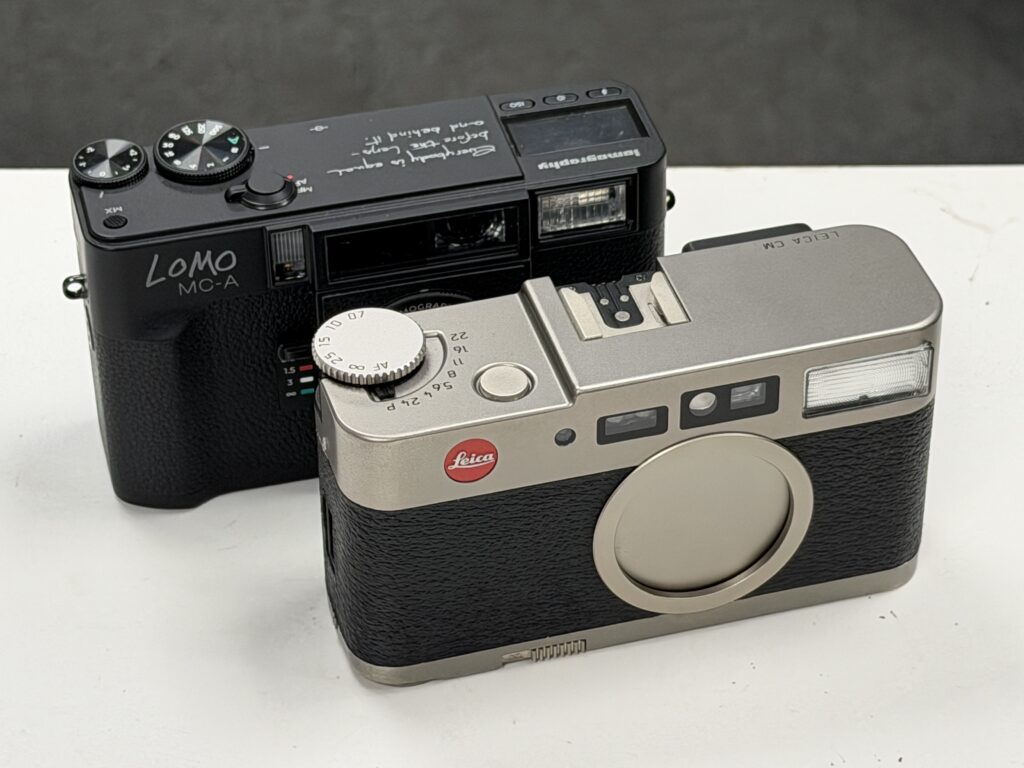
With that said, it is actually very comfortable to hold and use. I find my finger falls well on the shutter button and it feels nice in the hand without any sharp edges. The eye meets the viewfinder intuitively too. I’m also reviewing it in winter, so have had no issue stowing it in coat pockets, though come warmer months I think I’d prefer a small bag for it over a trowser-pocket-carry.
Lomography MC-A Build quality
Unlike the likes of the Contax T2 with its titanium body that feels very solid in the hand, the Lomography MC-A is a little less robust feeling. Funnily enough, I think I’m going against the grain a little here as I have read others saying it feels weighty and solid. It does indeed feel both these things, but there’s still something of the build that doesn’t quite feel as hard wearing as I would like. This feeling has been born out in the couple of marks that have happened to it whilst I’ve had it. I’ve certainly not mistreated it, in fact if anything I tend to be more careful with loan kit. But despite this it has gained a couple of marks to the exterior surface. I’d be interested to see what one of these cameras looks like after a year of heavy use…
Manual/Mechanical film advance
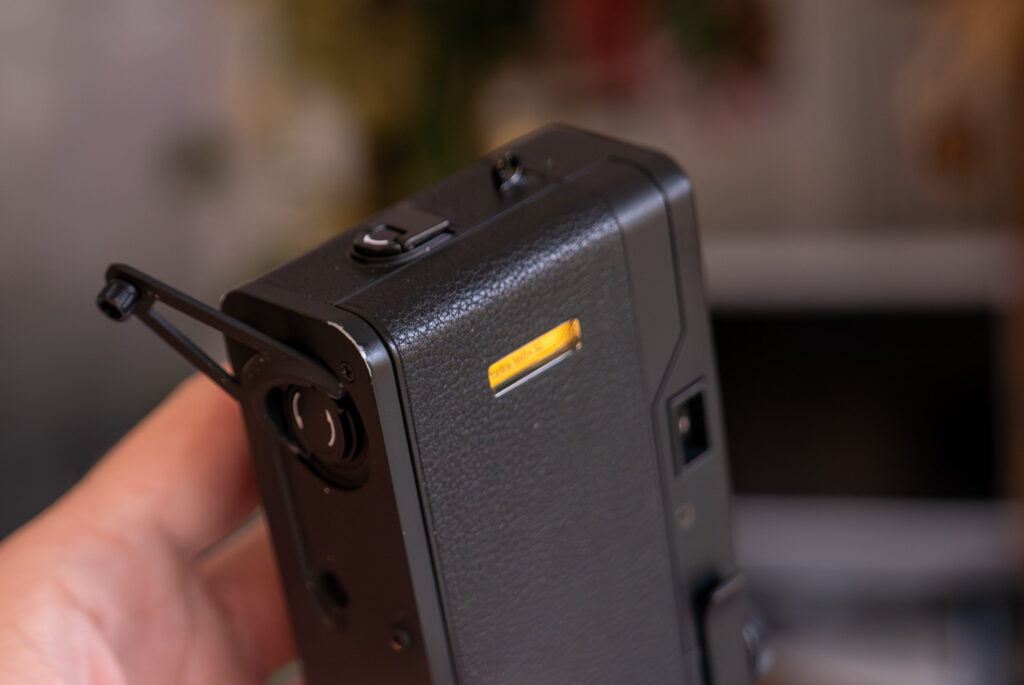
I really love a mechanical film advance. One of the big draws of point and shoot cameras for me is how they feel a little more discreet to shoot – they slip in a pocket, can be taken out quickly and a shot quietly taken. This of course falls apart entirely when the electronic film advance whirs noisily into life. I remember some time ago searching for a decent, easy to pocket point and shoot that was fairly small and had a manual film advance and autofocus. They are surprisingly uncommon. As such, even just on the basis of scarcity of similar cameras, this combination works for me.
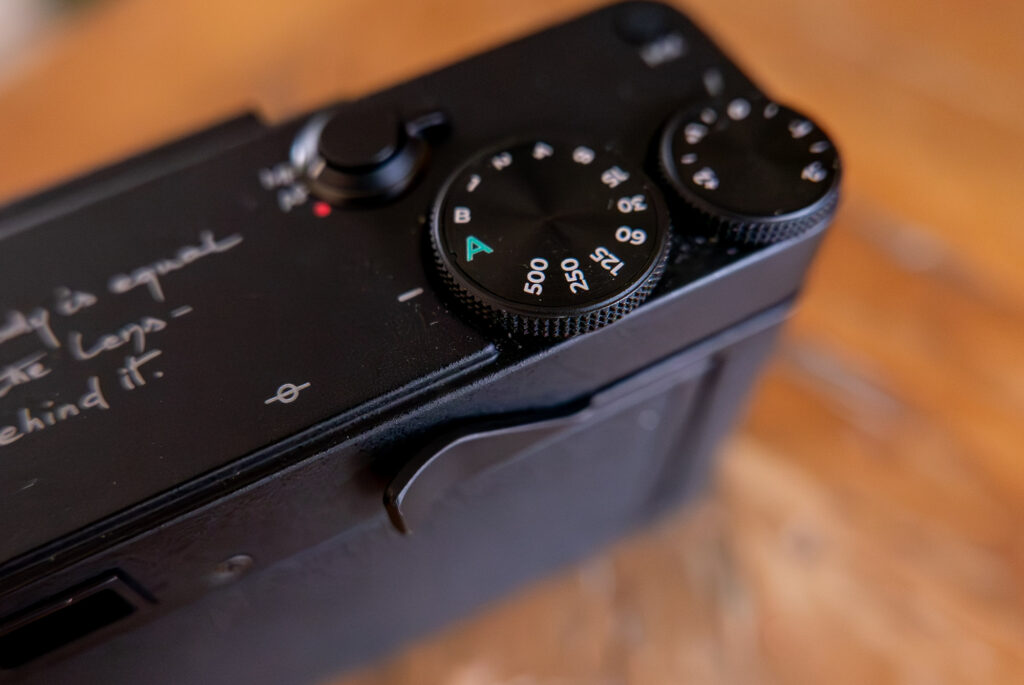
What I don’t like so much is that it doesn’t feel particularly positive and the advance lever is a little thin. What I mean by it not feeling positive is there is very little in the way of feedback – it just doesn’t feel like you’re advancing the film. It’s functional, but there’s no sense that it’s been designed to feel or look good. This is no real issue I suppose, but in a world where there’s a few digital cameras with fake film advances, it feels like a feature they could have leaned into more to add to the positive haptic feeling of shooting a new camera that actually takes film.
Film loading and rewind
As for the mechanical rewind, my thoughts are much the same as above really. I have no issue rewinding the film mechanically – it’s quiet and doesn’t take much time. But again, the lever feels a bit crappy and it doesn’t fold away into the base of the camera particularly positively.
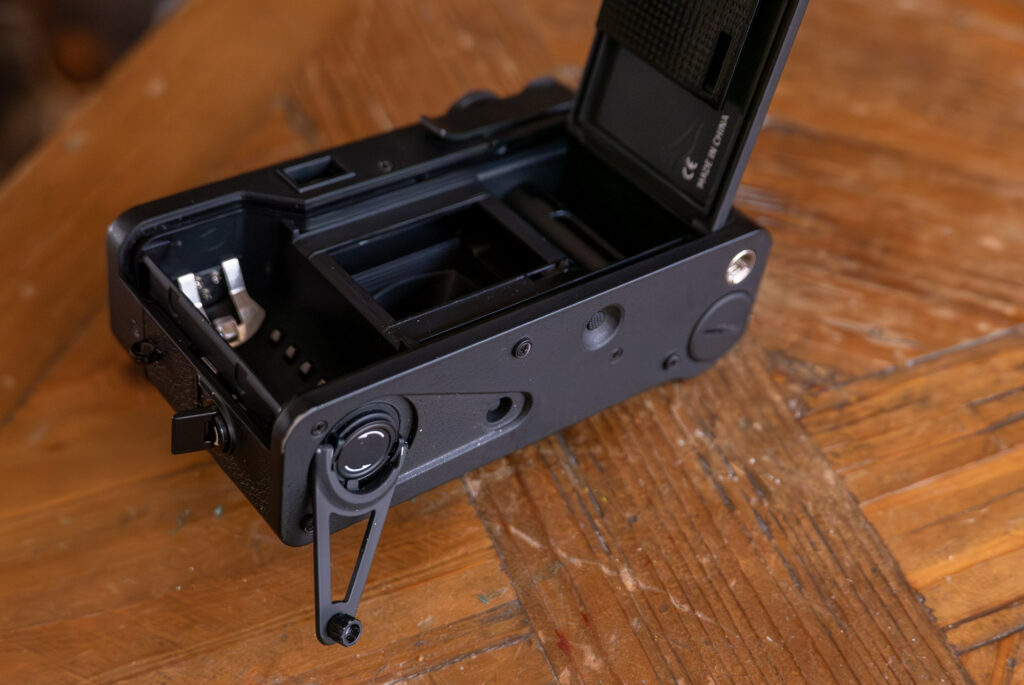
Loading the camera comes with an unexpected challenge too. In the base of the camera where the rewind lever mechanism meets the underside of the film, you have to be careful when loading to make sure they have interlocked. When I first loaded the camera, I managed to do so with the mechanism pushing against the film rather than interlocked into it. The result of this was that the film was slightly wonky inside the camera and it didn’t advance properly. It’s just worth taking a bit of care to double check the film is loaded as it should be.
The Lomography MC-A viewfinder
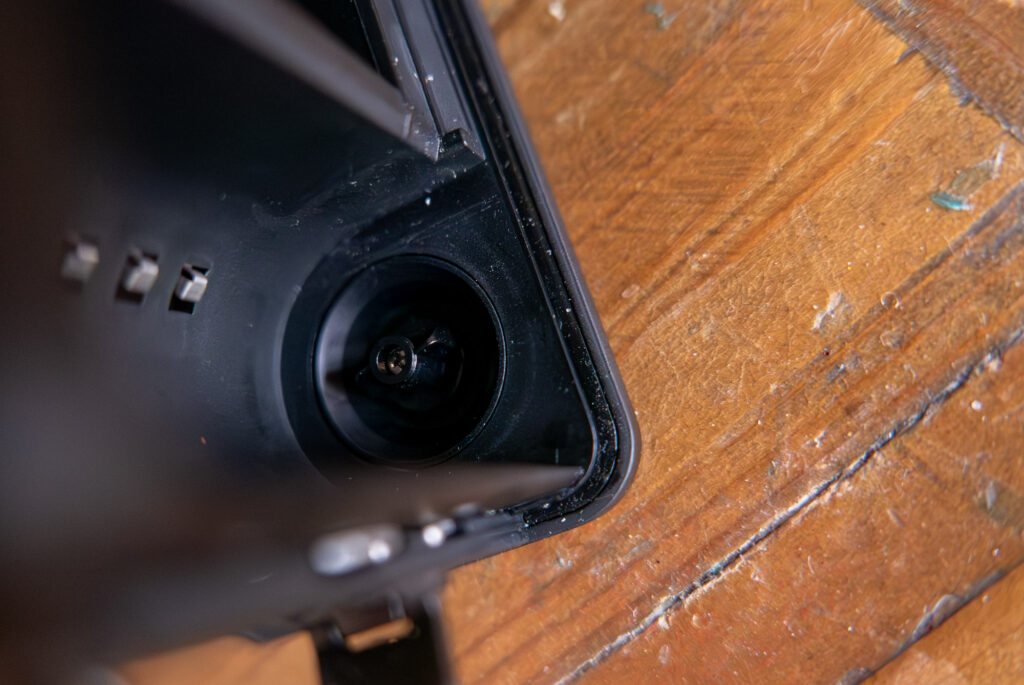
This is where the Lomography MC-A is really let down in my opinion. The viewfinder feels very basic to me. To kick off, there’s very little in the way of shooting information inside the viewfinder. There’s a couple of LEDs for basic information, and some frame lines, but that’s it.
Even more annoying is the internal reflections within the viewfinder. Looking through it you can see a reflection of the view in the inside top and bottom of the finder. I have got used to it, but I don’t like it. It’s also a bit small, and the chunky-sized frame lines are a bit ungainly too. There’s obviously no parallax correction beyond an extra line at the top of the frame lines either – the manual just says to use these when the camera is used at its closest focusing distance, but they are so chunky that they feel like they would be anything but accurate.
Compare this to the likes of the Contax T2 and you’re going to be sorely disappointed. Even the T2 wasn’t perfect with its very limited shutter speed readout, but the view through the finder is wonderful, the frame lines clear and there’s even a focus indicator. In the Lomography MC-A there’s nothing beyond the pair of aforementioned LEDs.
This for me feels like the greatest shortcoming of this camera. Had it been given a slightly bigger viewfinder with no internal reflections and nicer frame lines it would have made a big difference for me. If they’d gone one step further still and added in a shutter speed and aperture readout inside the finder alongside a meter readout for manual mode and this camera would have totally blown me away I think.
The viewfinder LEDs
There’s a few notes in the manual about what the LEDs mean, but unless I’ve missed it, no section the explicitly lists the functions. With that said, there’s not much to them:
- Blue constant: ready to shoot.
- Blue flashing: not ready to shoot. This might mean you haven’t advanced the film or that you are trying to focus too closely.
- Orange flashing: this means the shutter speed is going to be lower than 1/30th and therefore to consider using these flash.
Top screen
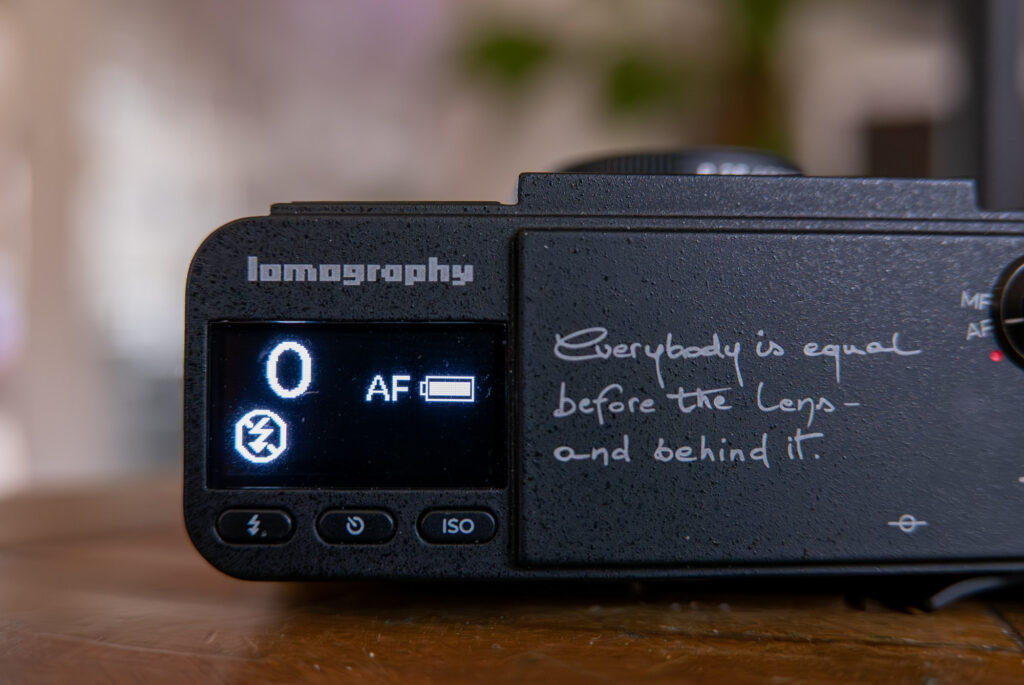
Thankfully there is a nice screen on the top which tells you all the shooting modes as well as what shutter speed and aperture you’re set at. This screen also has an up and down arrow system for setting the exposure manually – more on that in a second. It’s just annoying that in normal use looking through the viewfinder if I get an LED warning that my shutter speed is going to be below 1/30th, I need to look at the top to see exactly what speed it is going to shoot at… but, at least this information is available to me, which is pretty uncommon of a camera of this type and size!
Auto and manual exposure
Name me one autofocus point and shoot camera that’s this small and has both fully automatic and manual control over both aperture and shutter speed. Now find me one that also has DX film speed setting override and exposure compensation… The Lomography MC-A has all of these features. Though it does come with a few caveats.
Full auto
For most of the time I have spent shooting this camera I have used the full auto mode. I’m used to point and shoot cameras and how they meter so don’t often find a need to use manual controls. As with many cameras like this one, it’s also possible to lock in exposure by half pressing a reframing. Being really fussy, I’d possibly have liked an independent exposure lock button, as that would allow exposure and focus to be locked individually, but with the features the Lomography MC-A has otherwise, I’m not too disappointed.
Overall, I’ve found the autoexposure to be pretty good too. Seeing as I am quite familiar with how to get decent exposures out of point and shoot cameras, I’m also going to give myself some credit here, but regardless, I’ve not been disappointed.
Wider aperture favouritism
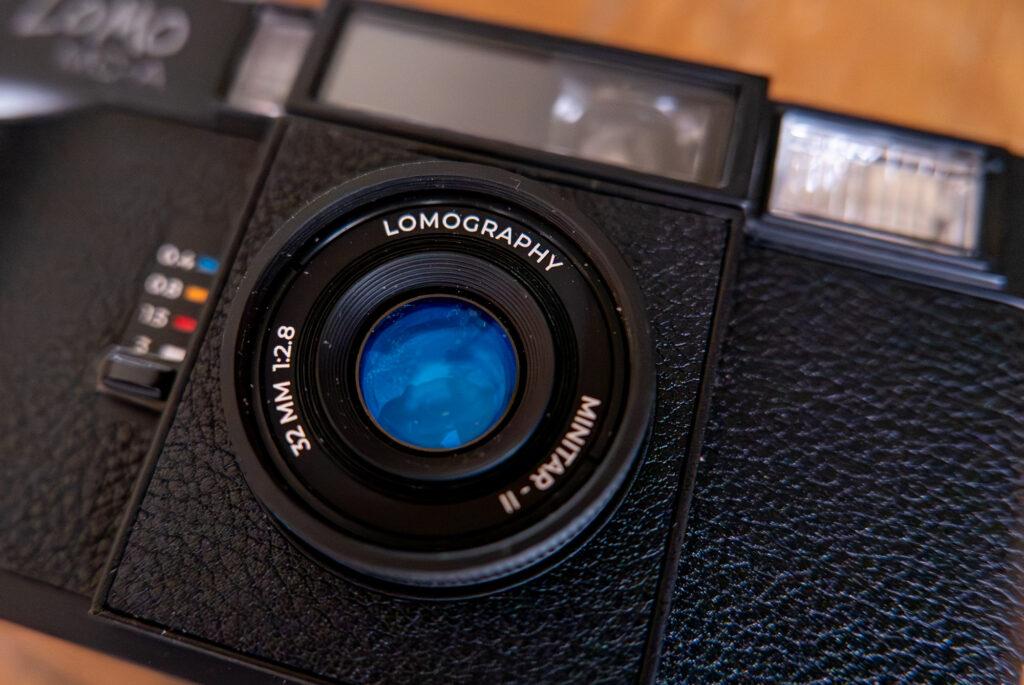
One thing I have noted that I like is that the camera also seems to favour wider apertures over slower speeds. Some cameras like this one favour the use of slower speeds which can increase the chance of motion blur. This is particularly annoying when in a situation where either f2.8 and 1/60th or f/4 and 1/30th will give accurate exposure and the camera goes for the slower shutter speed option. Having dug through a lot of point and shoot cameras manuals over the years looking at their program auto settings graphs I can tell you that you might be surprised at just how many cameras would choose the f/4 and 1/30th option too. Fuji point and shoot cameras pretty much all do it. Olympus largely went for the more sensible 2.8 and 1/60th approach. The Lomography MC-A, thankfully, has followed the Olympus path – though annoyingly they don’t publish their program auto settings graph in the manual. With that said, it does seem to stick to f/2.8 quite a bit – when I asked Hannah (Marketing Manager) at Lomography UK about this, the word she got back from Austria was that “P mode is optimized this way to create a Lomo LC-A style image”, I will come back to that particular comment in my lens quality section below, but if you want my advice, if you’re looking for greater depth of field or wish to take advantage of the higher quality results achievable when stopping down, setting the aperture manually might be worth considering.
Aperture priority
With the shutter speed dial set to auto, the aperture dial can be set manually. I’m a big fan of shooting aperture priority, and have enjoyed this option on Fuji cameras (eg the Klasse) when it’s been useful to override the program mode (see above). Here that isn’t a specific need, but being able to have control over the aperture for the sake of depth of field control is a nice feature for sure! As I will come to, this feels especially relevant in a camera that can also be shot in a manual/zone focus mode.
Shutter priority (lack there of)
This is one of the big caveats here. The Lomography MC-A doesn’t have a shutter priority mode. If you set the shutter speed manually, the aperture will not automatically set. In fact, if you leave the aperture on ‘P’ with the shutter speed set manually, it will just default to f/2.8. In short, if you want to use a manual shutter speed, you need to set the aperture manually too. I’m sure there’s some reason for this in how the camera is programmed, it just feels like a shame that it can’t allow shutter priority mode given that it has the control layout to allow it to.
Manual mode
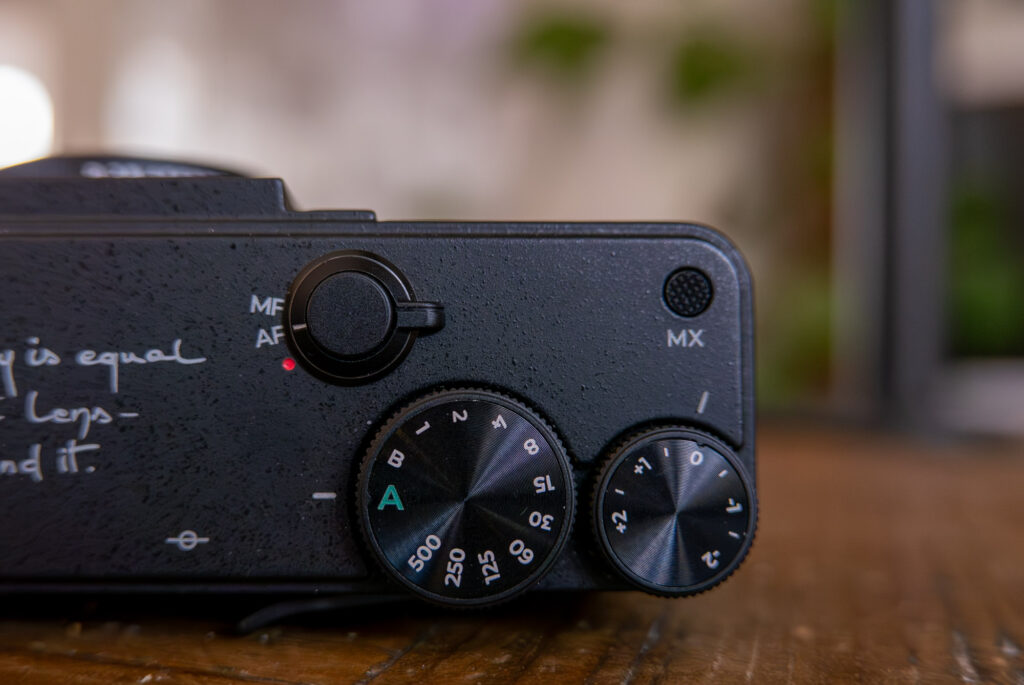
But, it does have manual mode and a proper meter readout on top of the camera. Of course you do need to understand how the camera meters to get the most out of this, or indeed just use an external meter, but the fact that it’s available as an option is definitely a bonus… albeit a bonus with a few caveats. For a start, obviously, the settings are limited. It’s a leaf shutter, and with that there’s no speeds above 1/500th. And, if you do set the shutter speed to 1/500th, the maximum aperture is f/4. The fastest it can be shot at f/2.8 is 1/250th.
It’s also worth noting that the B (for Bulb) shutter speed option only allows a maximum of 20 seconds. There’s also no shutter release cable socket or way of triggering and holding the shutter open for this amount of time without just holding your finger on the shutter button. If you want that level of control over longer exposures, then I would recommend the Fuji Klasse S or W.
Multiple exposures
That said the manual does say that if you want to capture a longer exposure than 20 seconds, you can activate the MX (multiple exposures) mode. You just need to wait 10 seconds between each exposure so as to avoid overheating.
And of course, multiple exposures are possible for all the other ways in which people enjoy them as a creative option for their photography. I didn’t try it, I must admit – it’s not really my cup of tea – but I have seen a lot of photographers doing very cool things with multiple exposures, and, as a feature, it’s very much the sort of thing the “Lomography crowd” appear to be into, so it’s great to see it as an option here!
The multiple exposure mode is activated by pressing the MX button after the first shot and before advancing the film. It seems it’s possible to layer up as many shots you feel inclined shooting like this, though the manual warns that doing so might require some consideration to exposure by perhaps using the exposure compensation dial. Personally, I’d probably just choose a film with loads of exposure latitude… but as someone who doesn’t shoot like that, I should probably stick to my lane and suggest doing your own research before experimenting.
Exposure compensation
There’s also an exposure compensation dial. The most a lot of cameras of this size and type have is a +1.5EV button for boosting the exposure for backlit shooting situations. The Lomography MC-A goes a step further by having a proper exposure compensation dial with -/+ 2EV in 1/2 stop increments. Having this and the DX film spreed override alongside the aperture priority and manual modes definitely gives a lot more control over exposure. There are very few point and shoot cameras with this level of control!
Other Modes and buttons
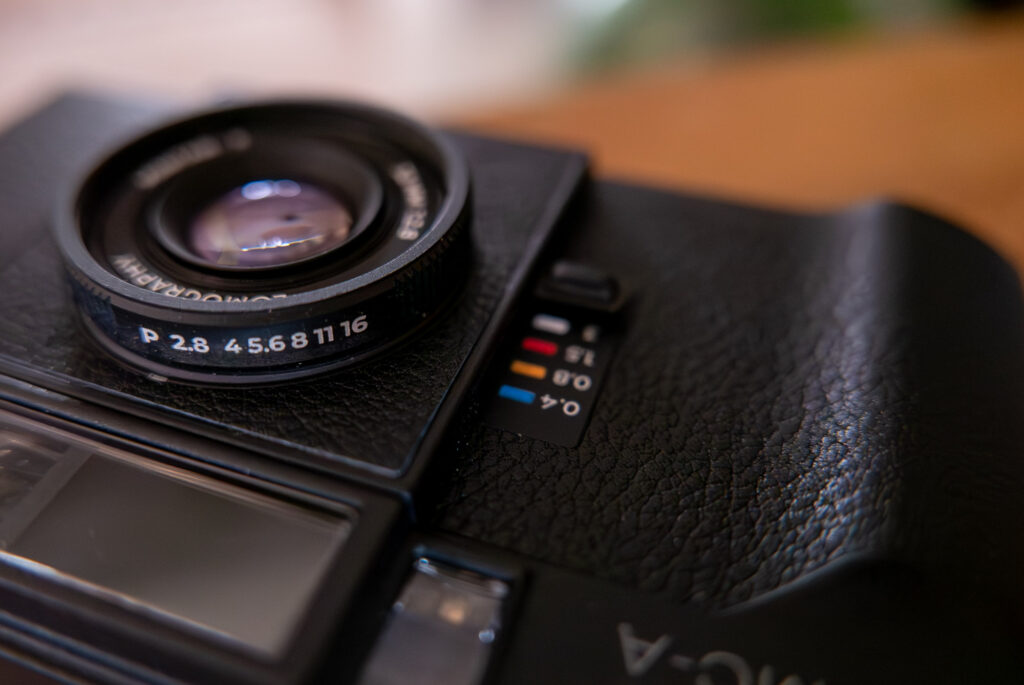
There’s two other buttons for controlling the camera’s mode on the Lomography MC-A too. There’s a self timer – fairly self explanatory – and a flash button.
The first thing to say about the flash on this camera is that its default state is off. This is a wonderful feature for someone like me who doesn’t use flash much and found the constant need to turn the flash off on cameras like the Yashica T series and Olympus MJU series cameras really bloody annoying. With the MC-A whatever you do with the flash when the camera is on, when you turn it off, the flash resets to the default state of off!
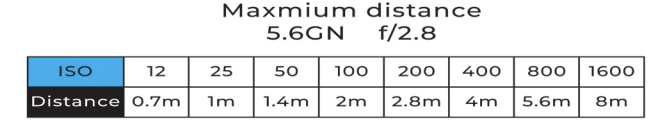
Of course, if you’re a regular shooter of flash modes, this might feel like a negative, as each time you want to use the flash you have to turn it on to the mode you wish to use. But at least it’s a purposeful choice to use the flash, and it won’t go off by accident. Beyond that, it has a GN of 5.6 – here’s a screenshot of the manual for info.
There are 3 flash modes, flash on, and two “creative” modes. The flash on mode is poorly described in the manual as “flash on auto mode”. In pretty much all other cases of flash functionality I can think of in point and shoot cameras “flash on” and “auto mode” are two distinct things. Flash on means the flash will fire regardless; this is used for fill flash. Auto mode means the flash will fire when the camera determines that it is needed, eg when the shutter speed would otherwise dip below 1/30th. What seems to be the case with the Lomography MC-A is that that this mode is just a flash on mode, i.e. it will flash regardless of the ambient light. It will also limit the camera to a slow shutter speed of 1/30th in this mode.


“Creative” flash modes
The Lomography MC-A has two (what the manual calls) “creative” flash modes. Mode one is a slow sync (first curtain) mode, mode two is a rear curtain mode. In both modes the shutter will stay open for the duration of the selected speed on the dial and can be held open to its 20 second maximum (in Bulb). It will also apply a +1EV bump to the exposure in program mode when it’s shot in low light (between EV0 and EV4) for an “optimised photo effect” – I guess this will just give a bit more drag to the shutter drag effect…? I’ve not explored this, so if anyone has or wants to link to anyone who has, I’d be interested to see results!
Flash gels
The Lomography MC-A also comes with some coloured gels for added creative experimentation. This again is not really my area of creative interest, but it doesn’t surprise me that it’s something Lomography would include in a camera. Personally I think this sort of added feature is a brilliant inclusion – it takes nothing away from the camera for someone like me who would likely never use the feature, but for people who will use it, it’s an option. I often get frustrated at cameras that have niche features when they get in my way somehow, but this doesn’t get in the way. If you don’t want to use the gels, you’d not even notice that they can be slotted into the camera’s flash. And with all the slow and rear curtain flash potential, for those who enjoy creative flash photography, there’s loads of potential here. But yeah, just not for me.
External flash
For even more flash fun, there’s also a pc sync socket. Again, obviously, I’ve not played with this, but I’m impressed by the added option it gives for those who might!
Auto and manual focus
Having both is brilliant. To be honest, I have just snapped away in autofocus, but the ability to set the aperture and a focus distance manually makes for a very interesting proposition for people who enjoy zone focusing. The manual even contains a handy chart:
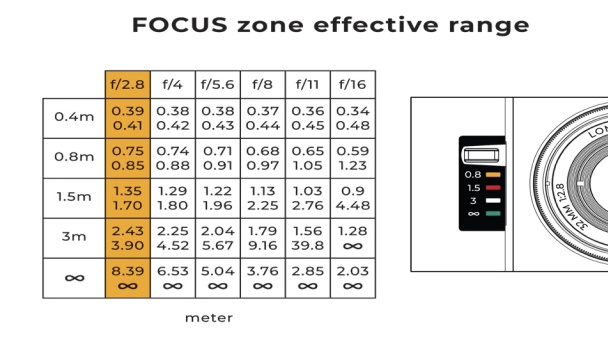
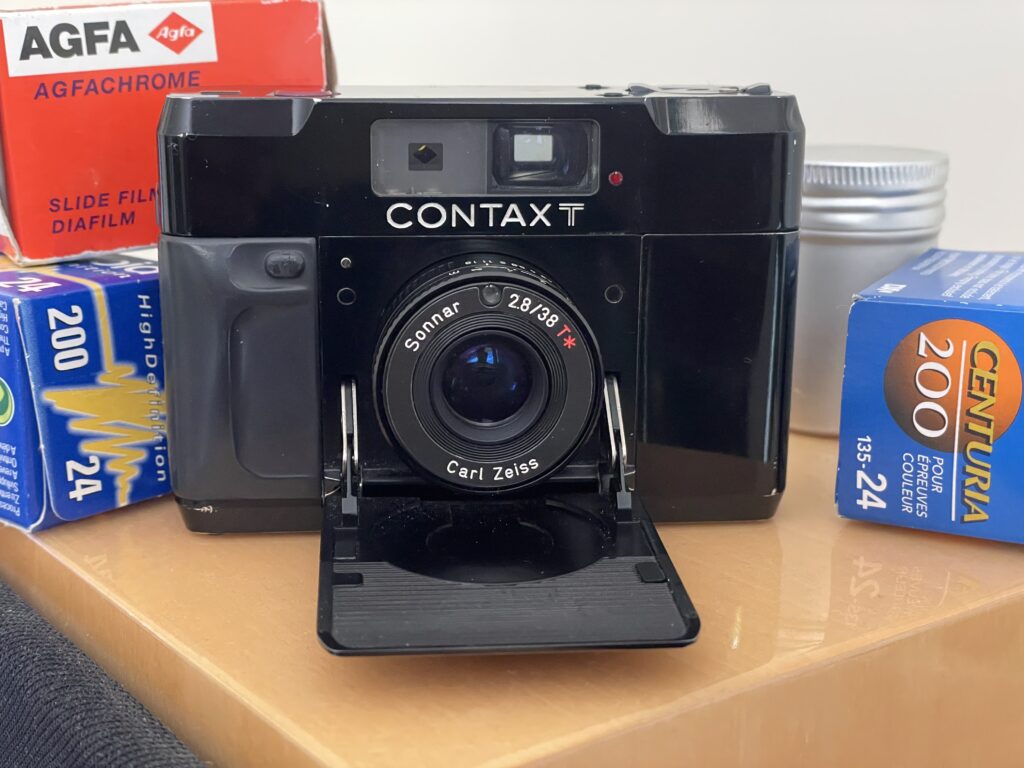
This reminds me a little of the Contax T2 which also allowed the setting of an aperture and manual focusing, though it’s a little more primitive here. The Contax has a distance indicator inside the viewfinder to help you achieve accurate focus. There’s no help in this viewfinder, this is experience is less like a rangefinder and much more like a zone focusing camera in that sense.
Perhaps a better comparison would be with the snap mode on the Ricoh GR – the purpose of that was to allow the autofocus to be overridden and a hyperfocal focus distance used instead. This is often favoured by street photographers for example who just like to be able to quickly snap but ensure an in focus subject. There’s more control over the set focus distance and aperture with the Lomography MC-A, but the principle is the same I think. Being able to set a fixed focus distance allows for a type of shooting where what the camera decides to focus on doesn’t need to be a concern. I can see this feature being a big hit with people who like to shoot that way.
Autofocus capability
I’ve read that the Lomography MC-A uses a LiDAR-based AF system. I’ve no idea how true this is, but I can believe it is. This sort of modern tech has to be an advantage when compared with older point and shoot cameras – it certainly seems to be pretty good, as I’ve only had a few shots where it’s missed in the few rolls of film I have shot. It should also be good in lower light too. One thing to notes is that LiDAR systems don’t allow you to AF through glass in the way the old passive AF systems used to – this is another advantage of the manual focus option this camera offers, I guess!
Filter thread
The final feature I wanted to point out is that the Lomography MC-A has a filter thread. According to the manual this also allows it to be used with a Splitzer – more Lomography style creative fun that’s of little interest to me but makes no difference to me that it’s included either. What’s more important for the potential success of this camera is that will be fun for a certain target audience. Again, kudos to Lomography for ensuring compatibility with these sorts of add-ons.
Battery
The battery the Lomography MC-A uses is just a CR2. But, cleverly I think, they have included a rechargeable CR2 in the box. At first I thought this a little odd, as I couldn’t see a charger in the box, instead there was just a USB-C cable. I then spotted the battery has a USB-C port on it. I don’t even know these things existed, but it’s a USB-C charging CR2. I love this!
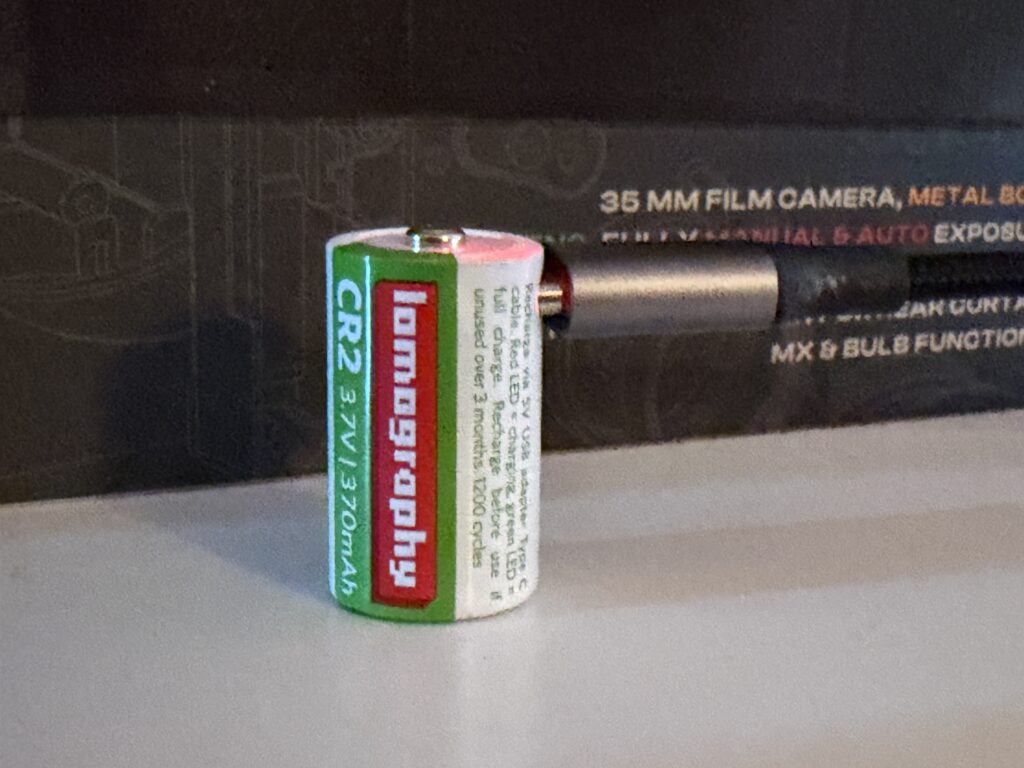 The only issue I have found is that it doesn’t seem to last as long as a standard CR2. I’ve also had a couple of occasions where the camera is gone dead on me despite it not telling me it was about to run out. Interestingly, on both occasions, taking the battery out and optimistically and vigorously rubbing it in my hands has brought it back to life. This might just be a case of it being winter when I’ve been using it though. Either way, I still like it as it allows the camera to be charged whilst still keeping the possibility of using a spare standard CR2 battery available. When I give this camera back, I shall be buying one or two of these batteries for my other CR2 cameras!
Lomography MC-A – Lens quality
I’ve left this section to last as I’ve written quite a lot of this review based on user experiences before getting the results. I must first say, I really like the results from the Lomography MC-A. For a camera that favours wider-open aperture shooting, the lens doesn’t let it down too much. It certainly seems to be a step up step up from the LC-A lens, though it’s very hard to quantify that as I there’s some copy variance across the various iterations of the LC-A. If you asked me whether or not these are the same optics Lomography use in their modern incarnation of the LC-A, or indeed their M-Mount Minitar lens… well, I certainly wouldn’t want to bet my life on it being different, as it definitely has – lets call it – the house style! But, it does seem to be better quality, and Lomography say it is an updated optic, and I have only shot 3 rolls through it, so who am I to doubt them?!
One thing is for certain, like the LC-A lens, at wider apertures – which are as mentioned what the camera likes to shoot at – it is softer and has a pretty strong vignette. It’s also softer into the corners, and has an occasional, but by no means dramatic, propensity to flare. With that said I haven’t been disappointed by the results, they do just definitely have something of a “Lomography” look to them, or more specifically a Lomo LC-A look – especially, as promised, when shot wide open… in short, exactly what Lomography HQ told Hannah in the UK to tell me.
Is this lens a Contax T2 beater? No. In fact, I don’t think it would out-and-out win against any of that era of premium 35mm compact cameras if measured in objective terms. Am I disappointed to be telling you this? Not in the slightest! This is a Lomography camera, it has a Lomography lens. Whether it’s the same lens as the LC-A, an updated version thereof, or whatever, it’s still possibly the objectively-best Lomography lens I have shot with, and still has a whole load of the house style – I couldn’t really ask for more!
Photos
(Thank you again to Analogue Wonderland for the fantastic job they have done of developing and scanning my photos!)
First some Portra 160 – it was arguably a little dim out for such a film choice, but there we are…


Some Portra 400


Ultramax 400 – I think these sorts of more consumer films with their stronger colours and contrast are well suited to this lens!


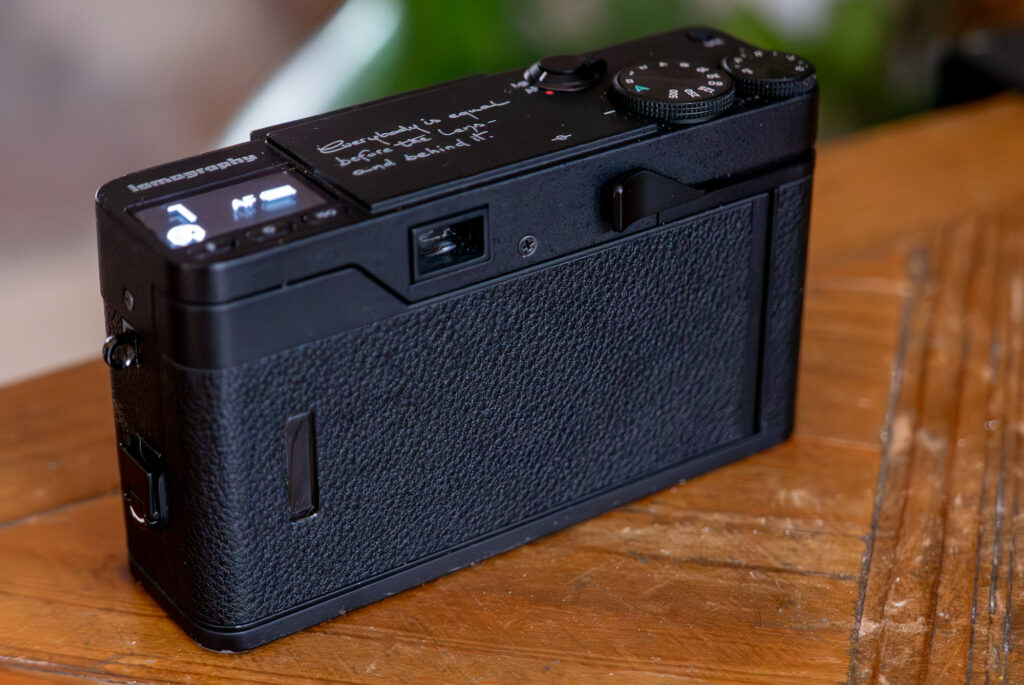
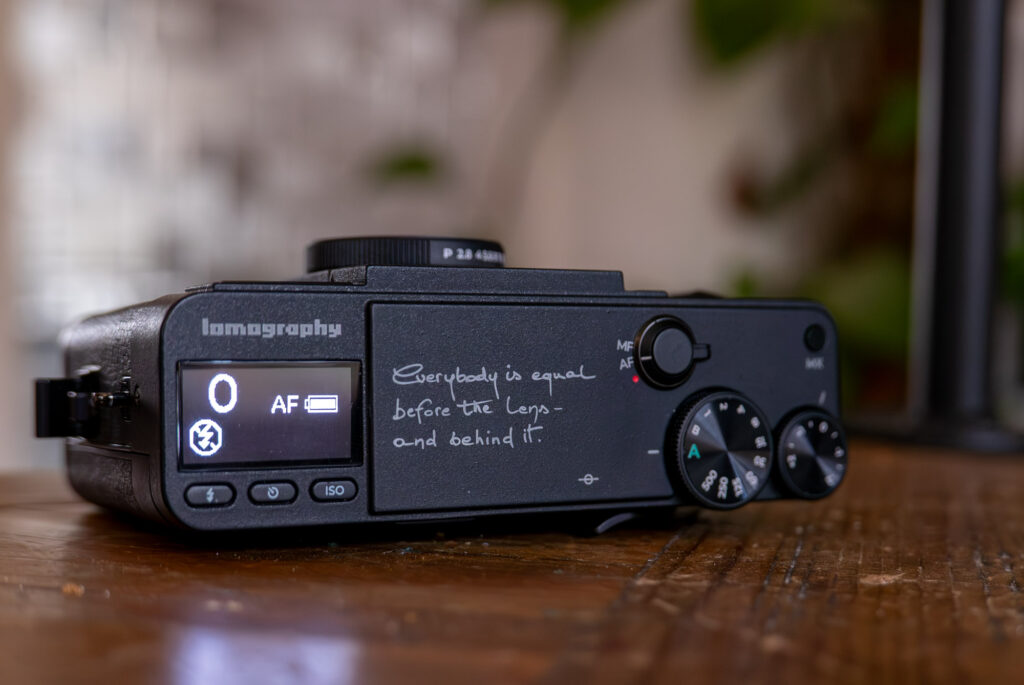
The script on the top… and all the damned fonts
I’ve left this to last. I don’t want my thoughts here to be taken too seriously, as really it makes no odds to the camera… but I do wish it didn’t have the bit script on the top. I hope they make a special edition without it actually. As it is – however well meaning or otherwise the message – I’d be getting myself a little bit of black tape to cover it over. Even the choice of font annoys me. There’s already enough different fonts used on the camera, not least the crappy one in the “Lomo” logo which bears no resemblance to the original Lomo logo. So why add yet another font to the top of the camera. I guess I am getting old… though I do also run a design agency, and if I was involved in the design of this camera, there is no way would not let this mess of fonts out the door…!
Final thoughts on the Lomography MC-A
As I said at the beginning of this review, the spec list set my expectations too high. I’d made too many assumptions, or perhaps didn’t think hard enough specifically about about the viewfinder and what it might be like to use. So when I received the camera I found myself quite disappointed.
I’m still not entirely over that disappointment either. I really wanted this camera to effectively make most, if not all, of the now extremely overpriced cameras from the 90s and early 2000s seem somewhat redundant. I love so many of those cameras, but they are just too valuable for me to consider owning now – especially as they are becoming increasingly prone to break and become expensive paper weights.
A new-to-market camera that not only matched their features and capabilities but exceeded them would feel like a massive win to me – I would buy one in a heartbeat. As it is, the Lomography MC-A comes very close to that, but thanks to the viewfinder being not quite as good as I think it could or should have been, it just feels like a near miss. In a world where the brand that makes it aren’t going to be worried about it competing with their higher-spec bigger cameras, this feels almost even more of a shame.
But, and this is a big but here, it’s important to remember that this review is being written by someone who is something of a point and shoot camera snob. I’ve tried almost all of the well respected and now cult point and shoot cameras from the peak of their era, and I can find just as many faults with any one of them too.
Of course, it is worth noting that anyone looking at this camera as a serious contender against the elder point and shoot cameras that it sits alongside, is definitely going to want to take into account the propensity it has to shoot wider-open, and indeed the character of the lens. But I would argue that whilst many of those elder cameras possibly have objectively better quality lenses, they still all have their optical quirks that need to be weighed up against what’s on offer here. And, what’s on offer here is both an arguably decent-enough lens for point and shoot needs, and is also one that produces subjectively very attractive results. Yes, it has the Lomography house style, but in the context of this type of camera, you’d have a job to convince me that is a con, rather than a pro!
 What Lomography seem to have achieved here is to make a camera that – when weighing up its pros and cons – is at least as good as any one of those cameras. It might not best them all, but it makes very strong arguments for its self when compared with any of them, which I cannot help but be impressed by. Not least, because at its price point, it’s also a hell of a lot more cost effective than a lot of those older cameras. It’s also worth remembering that with it being a new camera, it also has a warranty, and is hopefully less likely to break down too!
Finally, I think it’s also worth noting that Lomography have somehow managed to make a camera that is compelling to someone like me, as well as the folks who are into the Lomography vibe. I’m not interested in all the weird and wonderful ways the “Lomography crowd” like to experiment with coloured flash and splitzers and the like, so in theory might find a camera like this irritatingly overburdened with superfluous-to-me features. As it is, they have managed to design a camera that’s includes those sorts of features I have no interest in, but none of them get in my way when shooting this camera. In fact, if it wasn’t for the needless bit of script on the top of this camera, I could almost believe I was the exact target audience for it.
In short, the Lomography MC-A isn’t the perfect advanced point and shoot camera I’d hoped it might be when I first got over-excited reading the spec list when it was announced. But, hoping it might be was probably a fault on my part rather than anything to do with the camera itself. I have to give it back now – I haven’t decided if I want to buy one yet, I’m just not shooting these sorts of cameras as much at the moment, but I will definitely miss it. Good job Lomography, I am – despite myself – pretty impressed with the Lomography MC-A
You can read more on the Lomography website where you can find the camera in black here, and silver here.
I’ll add some more reviews from folks I know as they appear here too:
Steve’s first impressions on Kosmo Foto here
Finally, thank you again to Analogue Wonderland for the fantastic job they have done of developing and scanning my photos!
Share this post:




Comments
Ibraar Hussain on Lomography MC-A Review – The Camera is about Equal too!
Comment posted: 26/01/2026
I can’t find any info on whether it’s a
Plastic or metal camera ?
What’s the sound of the shutter like?
And is the wind on lever have a satisfying ratchet and feel?
I like small compact camera and with with AF/MF feature along with Aperture control
It looks appealing
But the sub par view finder (the VF being the single most important factor for me which makes or breaks a purchase if all other boxes are ticked) and too wide yet not wide enough strange 32mm lens make it difficult to want to spend almost £500’on this.
Huss on Lomography MC-A Review – The Camera is about Equal too!
Comment posted: 26/01/2026