

This article will save you money. Maybe. If you’re here for some photos, scroll to the TLDR and the photos at the end.
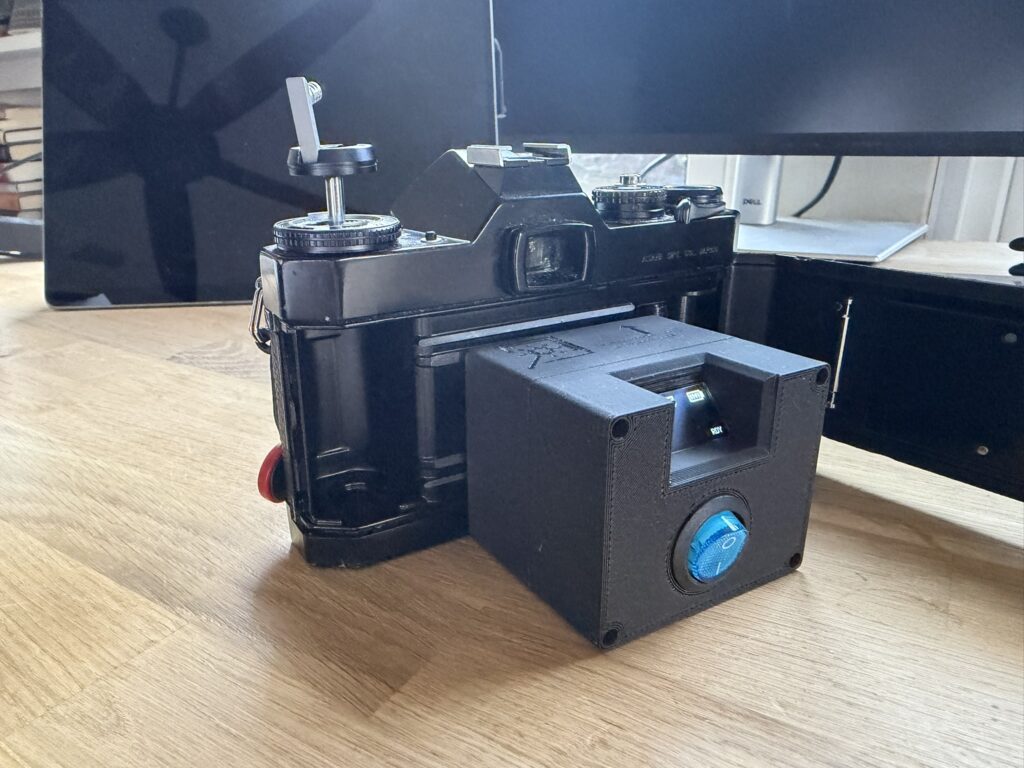
Last year I came across this review by Dan Cuny of the FAST Box One, a shutter speed tester that is manufactured in Poland. For the price it is hard to beat without investing time in building one for myself. I know that there are alternatives, for instance it is possible to record your shutter in slow motion and count frames, however I find this process beyond tedious. Furthermore, what appeals to me most about having a dedicated shutter tester is its ability to produce several accurate results in quick succession. This article is not about the FAST Box, but rather what it does. I want to discuss shutter testing and how you can use data to help you with old cameras.
Since getting into film photography I have found myself drifting towards (mostly) mechanical cameras. I don’t trust old electronics and have eschewed any camera that relies too much upon them.
The issue with everything in the physical universe is entropy. Over time screws become loose, springs lose their springiness and grease congeals to gum up the works. When buying old cameras you have to come to terms with this. We all get old, and we should respect that cameras do too. This ain’t Hollywood; rather than expecting age to pass it by we should instead meet a camera where its at.
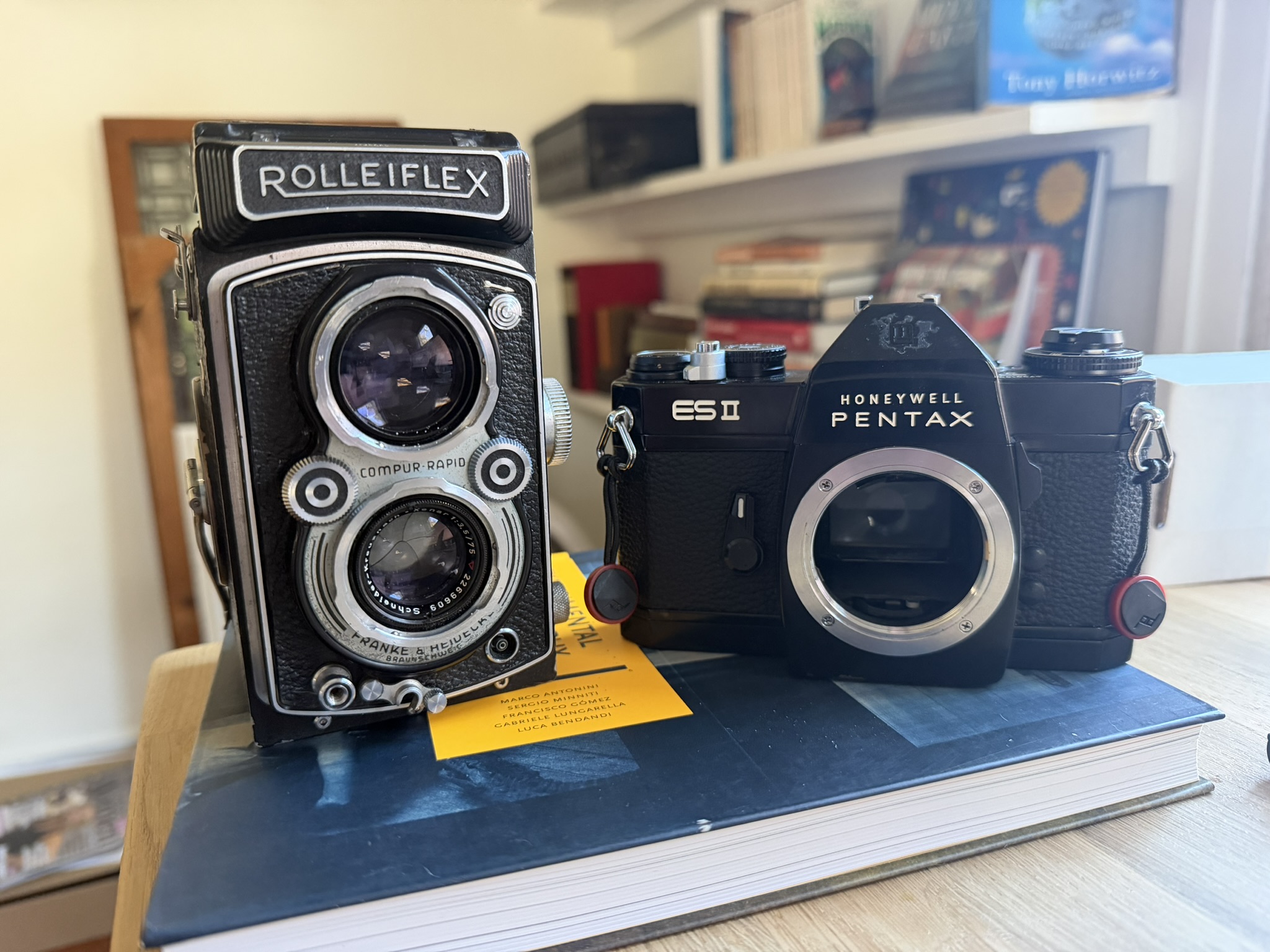
I decided to test two of my cameras that currently aren’t loaded with film. The first was my Honeywell Pentax Spotmatic. The meter in this thing is busted, and so without automatic mode it has six manual shutter speeds including bulb. The slowest speed is 1/60th which leaves a lot to be desired. After 50 years I was curious to see how true those speeds actually were.
To test them I aligned the FAST Box with the center of the camera and recorded twenty actuations at each speed. This is what I found.
Terminology
Before we begin lets clear up some terms. These terms made sense to me as I see them but they may not be accurate or abundantly clear to you.
Mean – Average of values
Variance – Difference between stated shutter speed and the mean
Spread – Difference between the maximum and minimum values
StDev – Standard deviation from the mean
Stop Diff – Difference in stops over/under correct exposure
LM Calibration – Light meter calibration number, taken as the fastest recorded shutter speed
Spotmatic Results
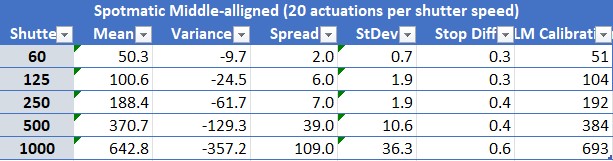
As you can see every shutter speed is slower than advertised, the degree to which it is off increases with the speed of the shutter. So too does the consistency with faster shutter speeds having a greater range of possible values per shot than slower ones.
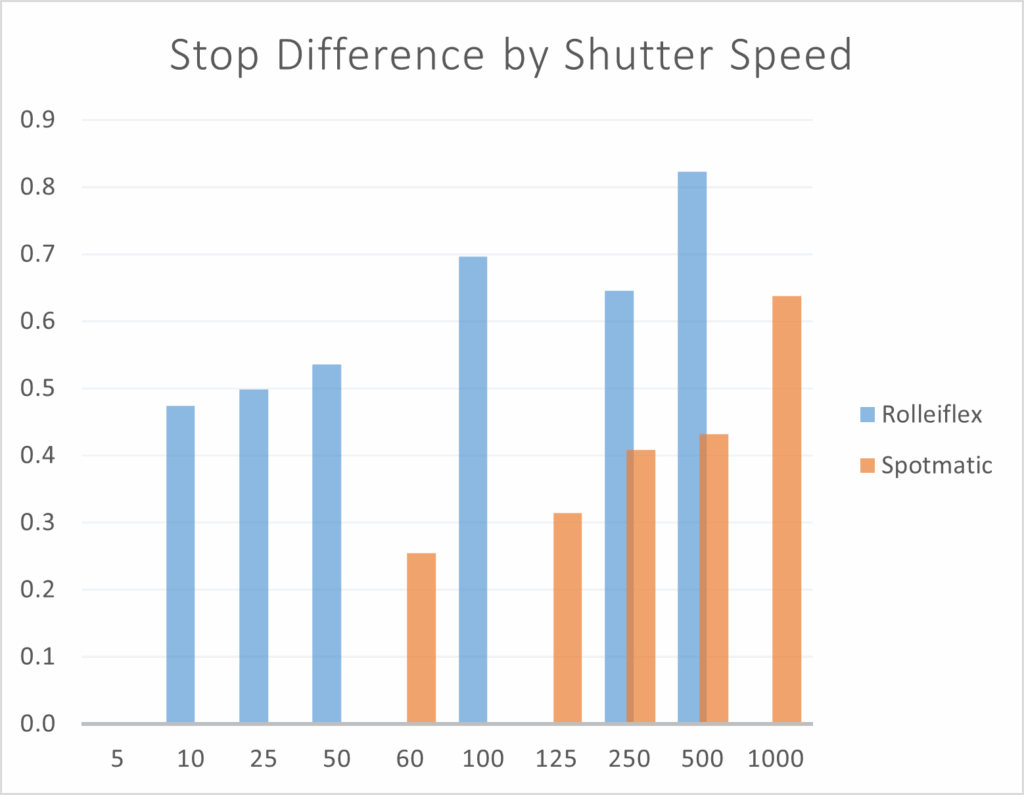
To better understand these numbers I calculated the difference in terms of stops. At all speeds the difference is negligible, ranging from 1/3 to 2/3s of a stop in the right direction i.e. overexposure.
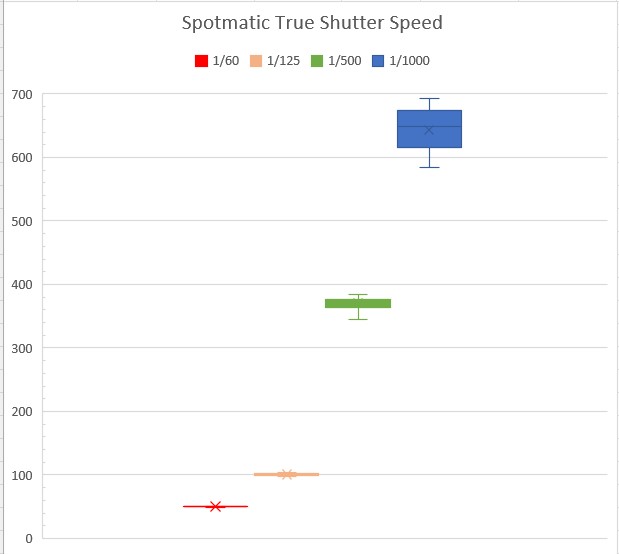
Below you can see each speed, with the range of values represented by the size of each box.
Rolleiflex 3.5 Results
The Rolleiflex that I own is a certified dinosaur produced between 1949 and 1951. I decided to test each speed only 10 times out of an abundance of care.
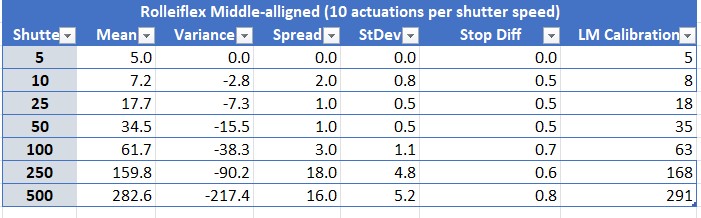
Curiously the results show a similar trend. As we know correlation always equals causation and with a whopping sample size of two I am ready to draw some conclusions.
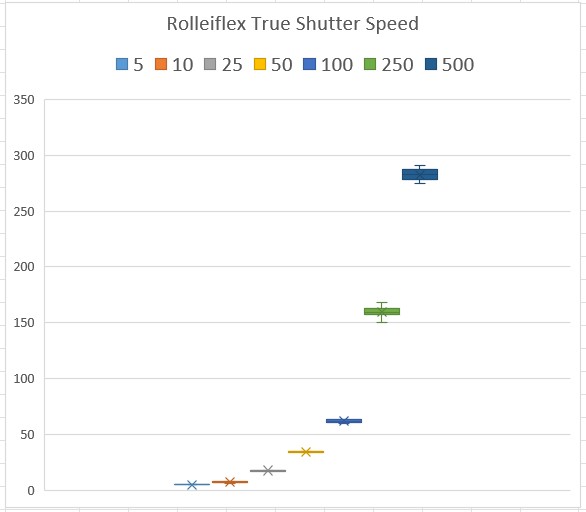
The data shows that the Rolleiflex suffers in much the same way. It is definitely more consistent, which is a testament to its engineering considering it was already old enough to drink by the time the Spotmatic was produced.
The stop differences are more pronounced ranging from 1/2 to 4/5s of a stop (which you can round up to 1 stop if you hate fractions). The values for the Rolleiflex are also closer to bleeding into one another. For example 1/100 has a mean of 1/61, much closer to 1/50 than its stated speed. However 1/50 has kindly dropped to 1/34 to make room.
Again, you can see the consistency of each speed and how much tighter each range is on the Rolleiflex.
You said I could save money?
Well the first way you can save money is to not buy a shutter tester unless you really really want one. There are however, some practical reasons for why you might justify getting one.
Cameras are a bit like people in that they get slower not faster with age. Based on the hard science above, we can assume that your camera’s shutter (if inaccurate) is likely to be slower too. And that’s okay.
Negative film is very forgiving to overexposure. Even with slide film 2/3s to 4/5s of a stop is still within the margin of error, albeit giving you less room to avoid bungling the exposure on your own. The proof will always been in the negative. If you measure 1/125 and shoot what you think is 1/125 and the negative comes out fine, the shutter speed is fine too.
So why test at all?
More accuracy never hurt anyone accidentally.
I use my phone as a light meter and the app I use allows me to set custom shutter speeds. To do this I took the fastest shutter speed from each group of values. For example, the fastest shutter speed at 1/1000 on the Spotmatic was 1/693. This means that the other 19 shots received more exposure than this. Overexposure is good, underexposure is bad. By setting my custom shutter speed reading to 1/693 I could be sure that most shots would fall above that number instead of pretending this camera is ever capable of 1/1000 again. This improved accuracy allows me to make even greater mistakes elsewhere and still get usable results.
Shutter testing can help you avoid wasting money on crap cameras. As we learned slower speeds are fine and are easily accounted for; even if you are lazy your film will pick up your dirty socks and put them in the hamper. However, a dedicated shutter tester can tell you how consistent a camera is. To me this is the most important factor when inspecting a camera, as an inconsistent shutter may be indicative of more serious (and expensive) issues.
TL/DR
Shutter tester good and help save money.
- Saves film by giving you more latitude to screw up the exposure yourself.
- Helps detect crappy cameras.
- By not buying one you save money too.
Photos
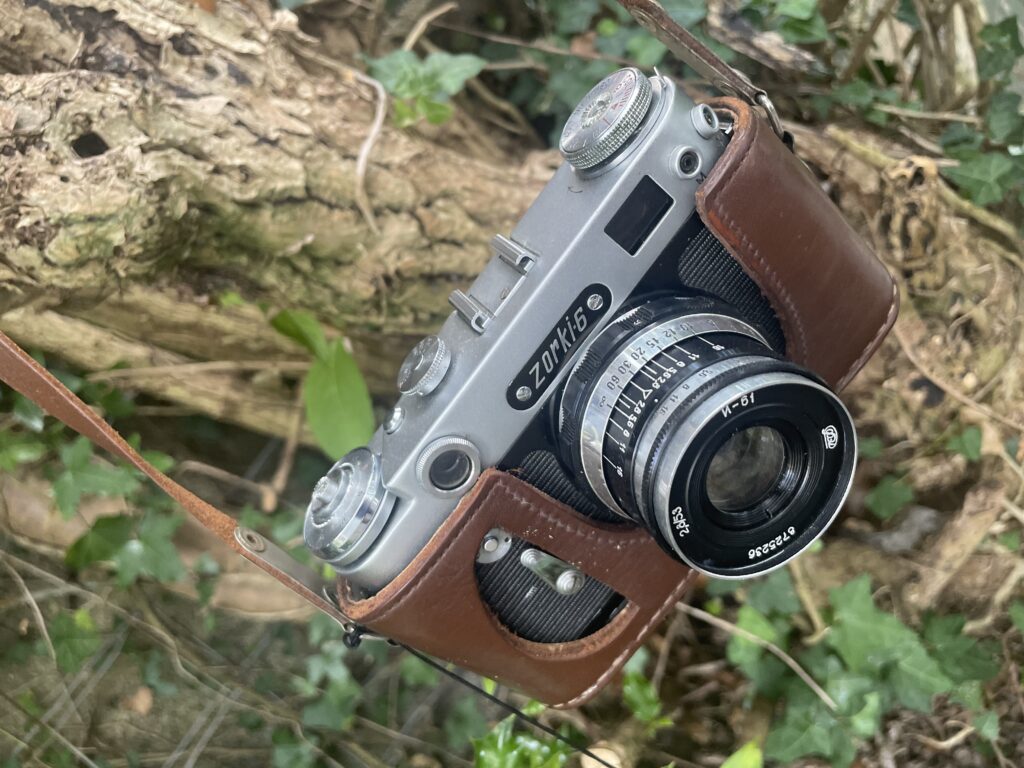
Since this is a photography website. Here are two photographs.


Share this post:



Comments
Gary Smith on Metering Them Where They’re At – Shutter Speed Testing a Pair of Mechanical Cameras
Comment posted: 26/03/2026
Thanks for your post!
Paul Quellin on Metering Them Where They’re At – Shutter Speed Testing a Pair of Mechanical Cameras
Comment posted: 26/03/2026