

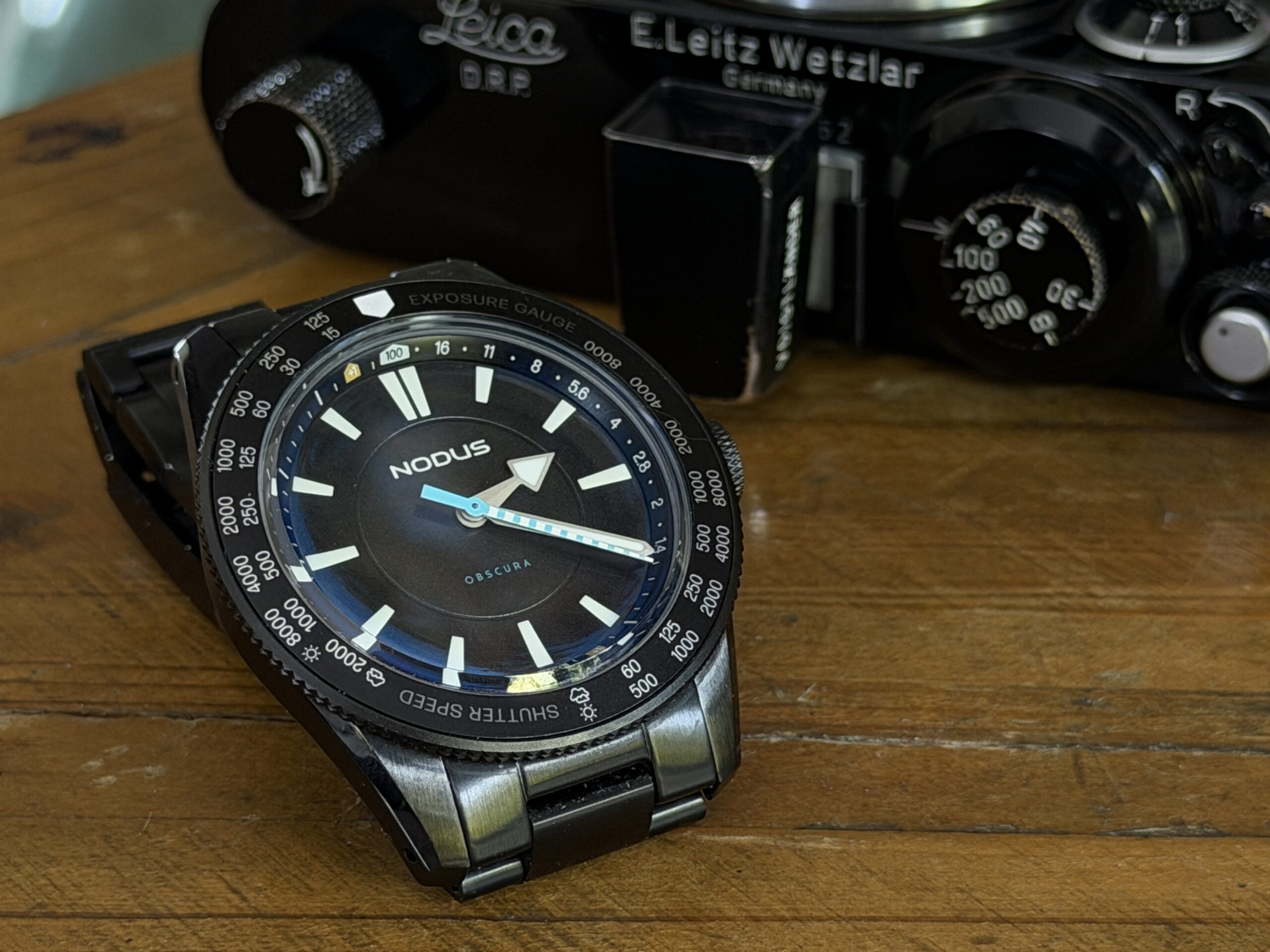
This is a review of a watch – the Nodus x Beers & Cameras ‘Obscura II DLC’ to be precise. I wouldn’t normally write about watches, but this particular watch has a place on 35mmc as it has a photography themed complication (mechanical feature) in the form of a sunny 16 exposure gauge. I also really like watches, so it felt like a good excuse to write about one.
A bit of brand background
Nodus Watches are a LA-based watch micro-brand who seem to have a very good reputation for making high quality reasonably priced watches. They use good quality movements, which they use to hand assemble their watches in LA. I’m lucky enough to have borrowed the watch for review as I also happen to have known (at least in a remote/online sense) Juan Martinez since pretty much day one of his Beers & Cameras meet-ups. Going back maybe as much as 10 years, I brought the B&C brand to the UK in the form of a meet-up in Worcester where I live, though covid stopped me running them and I’m yet to find the time to restart them. Regardless, me and Juan have kept in touch on and off over the years. Actually, our most recent catchup has been after what must have been a year or so – he initially got in touch to talk about an Omnar Bertele lens visiting Beers & Cameras, but after a brief chat where he also introduced me to the Nodus Obscura, we decided a little temporary exchange would work well. I could play with this intriguing watch for the sake of a little review, and he could show the Bertele around some of his group in California.
Watch reviews on 35mmc
Unfortunately for me, watch reviews are unlikely to become a part of 35mmc moving forward… saying that, I expect I’ll be taking a look at the Increment Labs watch at some point, but that again is a photography-based watch. I do occasionally dream of setting up a little website reviewing the things as it would give me an excuse to buy loads more of them. Personal finances (and personal sanity) prevent that particular endeavour though – this website takes up plenty enough of my spare time as it is! As such this review feels like something of an indulgence. I don’t know a massive amount about watches really, but I do like them, and I have a small collection of the things – so just bear in mind if you’re a full-on watch fanatic, this is a review written by someone who isn’t really an expert, and is writing for an audience of photographers rather than watch fanatics – please feel free to correct me on anything I might misstate in the comments below.
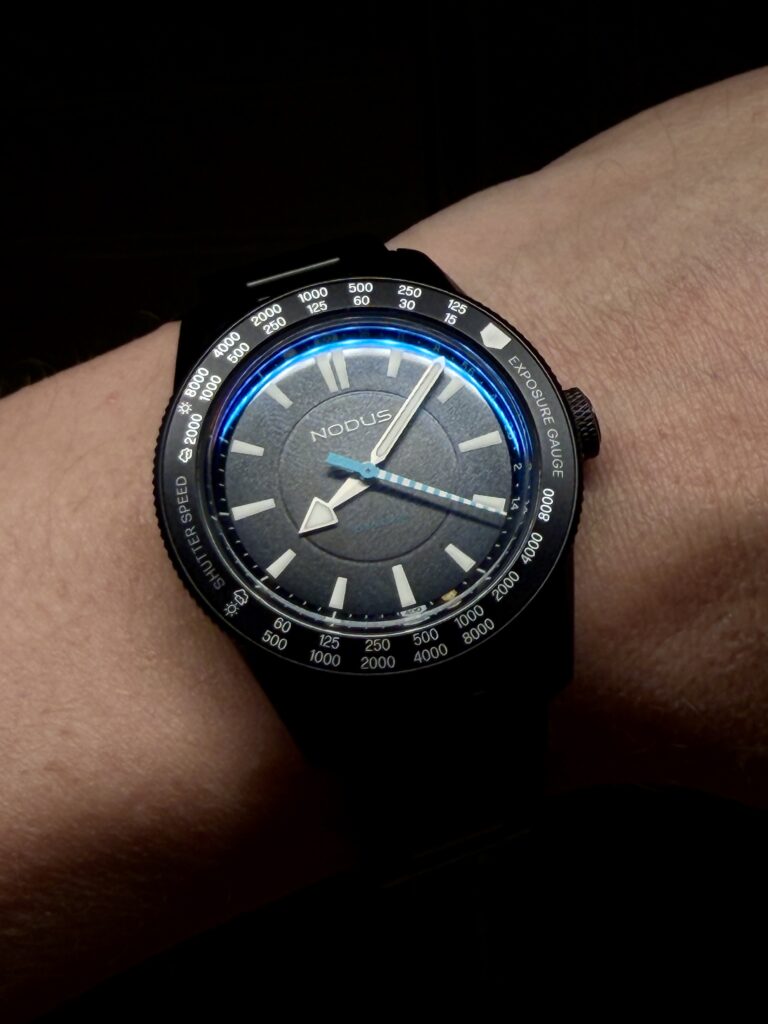
The Nodus x Beers & Cameras ‘Obscura II DLC’
Ok, so the basics first. The Nodus Obscura II DLC is a self-winding automatic watch, meaning it’s powered by the movement of the wearer. The movement is a TMI NH38 which is seemingly manufactured by Seiko – it’s a 24 jewel, non-date (there’s no date display on the dial) with a 41 hour power reserve. Aside from when it arrived with me when it had stopped, it’s kept on ticking and seems to have kept time pretty well – there’s been a tiny amount of loss over the few weeks I’ve been wearing it, but nothing to speak of really. This is probably fairly standard for a watch of this quality, but it’s certainly noticeable to me as someone whose own automatic watch is a 1960s Mondaine dress watch that even after a service looses a noticeable amount every day, and often needs bringing back to life with a fairly aggressive shake even after being off my wrist just over one night.
Hard wearing and water resistant
The Obscura II DLC has a stainless steel case and strap with a black DLC (diamond-like carbon) coating which apparently makes it very durable. I’ve been wearing it for a few weeks and there’s not a mark on it – which is more than can be said for my most recent Casio purchase (though perhaps that’s not saying much). It’s also a review copy, so presumably it’s done the rounds a bit too and still looks brand new. Juan was also keen to tell me that the crown and bezel are both made of bronze, so whilst they too have the very strong DLC coating, eventually they might start to wear through to a bit of a “brassed” appearance. For now though, as I say, there’s not a mark on the copy I have here. There’s also a non-DLC Obscura II which has an uncoated stainless steel case and strap, but still has the black DLC coated bronze bezel and crown.
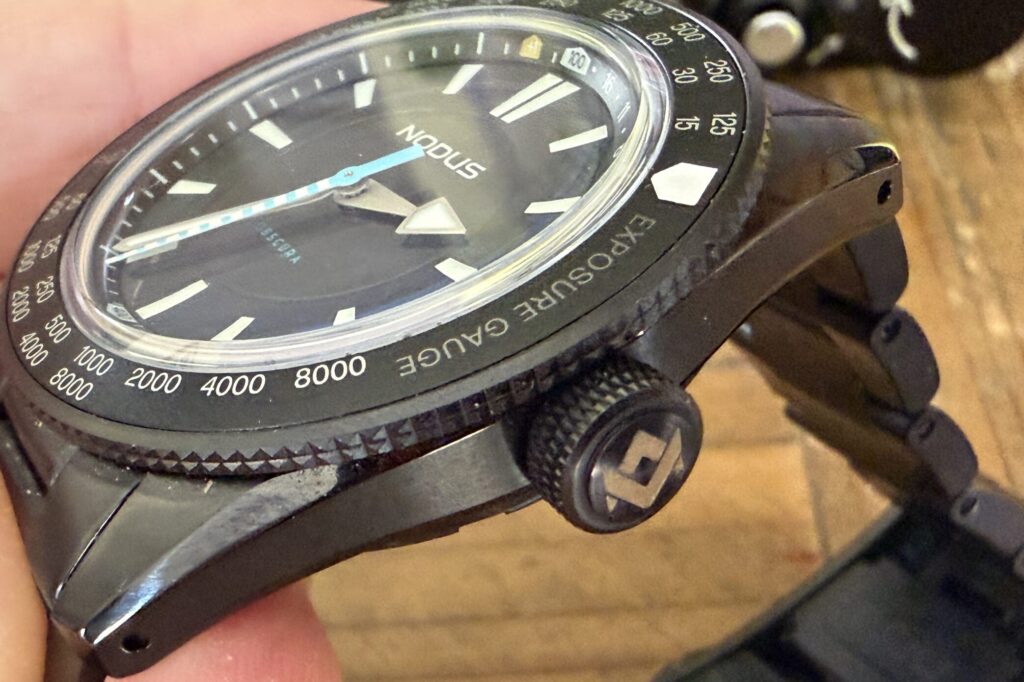
The crown also screws down which helps keep out dust, water etc. It’s apparently 100m water resistant, though I’m used to wearing my vintage watches that I don’t even let get wet in the rain, so 100m water resistance is pretty serious overkill for me.
The glass
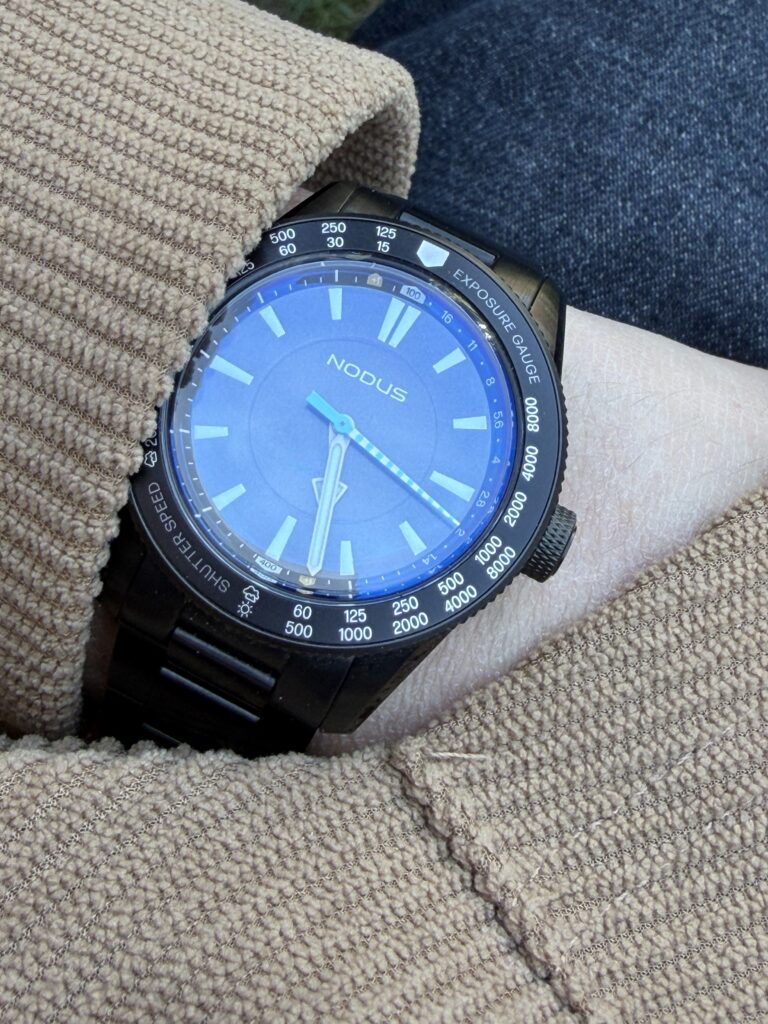
The sapphire glass has quite a nice feature – it seems to be AR coated. I’m not sure how useful this is in watch glass as a lot of the time it just reflects blue, but it does look cool. Looking at their website, it seems they use coated glass on all their models, but it feels like a nice photography nod in the context of the Nodus Obscura too.
Readability
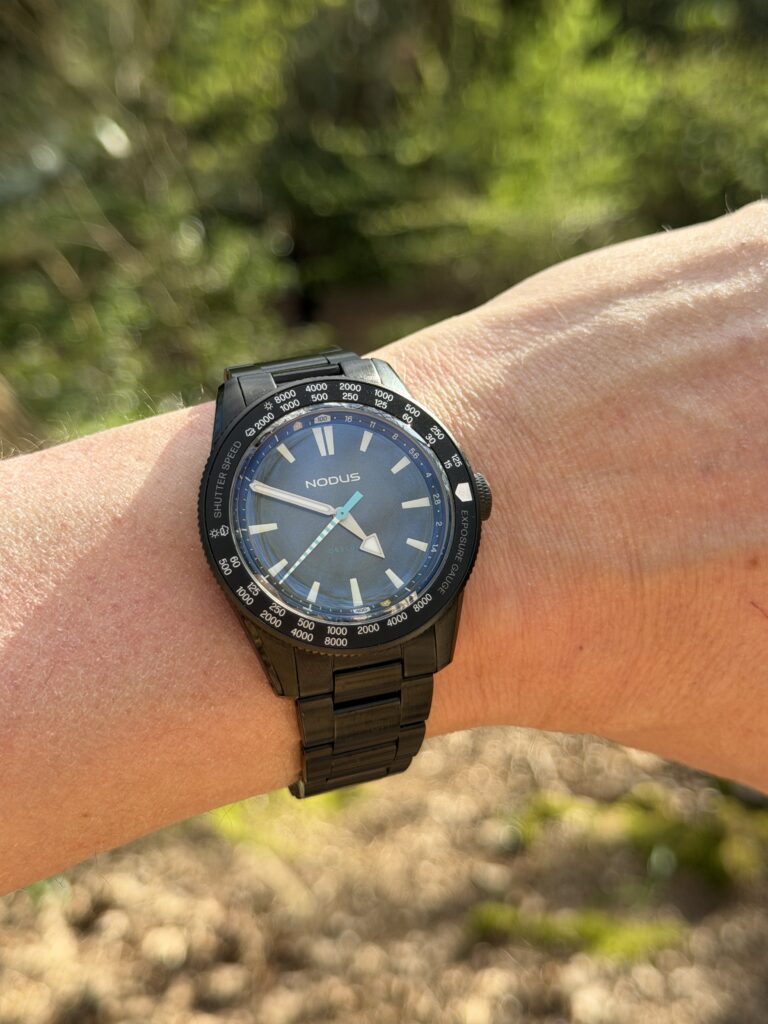
The watch is very easy to read – I’m not sure if this is even a factor in reviews of watches elsewhere online, but it makes sense to me to point it out. The markers indicating the time are non-numeric with the 12 having a double-marker. The hour and second hand are both quite chunky and the second hand has a blue striped pattern.
The Lume (new word to me – it’s the glow-in-the-dark stuff on the hands and non-numeric markers) is also really bright even after just a short spell in the light. This is all new info to me, but it’s apparently made of something called “Super-LumiNova® BGW9 Grade A” which according to a quick google can glow for 6-10 hours. I’ve definitely not been in a dark environment where I have continuously needed to be able to read the time for that long, but the point is that it seems to be another high quality material being used in the manufacturing of this watch.
The case and strap
The case is 38mm with a 40mm bezel. It’s 47mm lug-to-lug x 20mm lug width. I have a couple of larger watches, but I don’t tend to wear them often. Most of mine are around 35mm, as I prefer smaller watches as a rule. I was a little nervous when this one was on the way that it was going to look/feel huge on my wrist, but actually I quite like how it looks – obviously this is very subjective, but I was pleased when it arrived and I tried it on to find that it was a good size for me.
The strap is a 20mm to 18mm tapered design. I don’t have massive wrists, so I had to take a fair few sections out of it. This was pretty easy to do as it just required a little screwdriver to undo a few tiny screws – though it is worth making sure these screws are done up tight, as I did have one come slightly lose on me at one point. The strap also has what Nodus call their NEM (Nodus Extension Module).
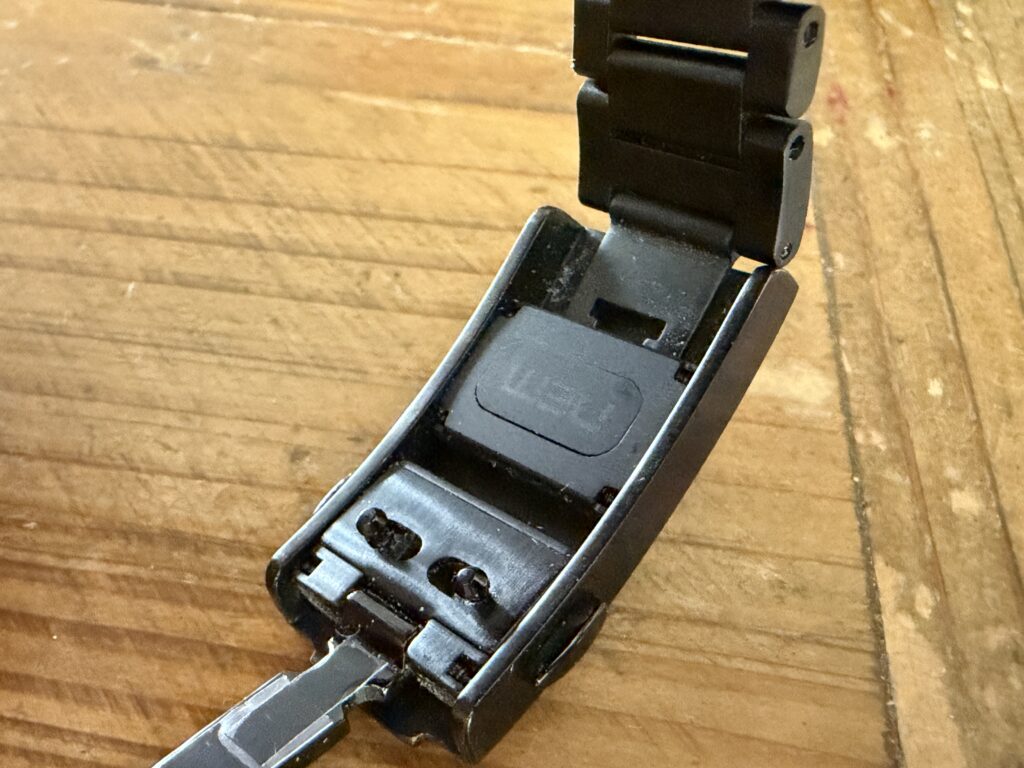
This is essentially a mechanism for adjusting the size of the strap to make it slightly bigger of smaller. I tend to have my metal straps slightly loose so as to avoid them becoming too tight. With the NEM I’ve been able to adjust the fit perfectly even over the course of a day.
Weight
It’s not a light weight watch – being all metal and quite chunky, I suppose this isn’t entirely surprising. It’s certainly heavier than, well, any of my watches. I must admit, it did take me a little bit of getting used to. And of course, it could be made lighter with a cloth or leather strap of some sort. As with anything though, your mileage will definitely vary – I imagine if you’re used to wearing larger high quality watches, it probably isn’t an unusually heavy watch at all.
Overall
In short – outside of the Sunny-16 complication – it’s a the Nodus Obscura II DLC is a very smart, seemingly very hard wearing watch with a clean, easy to read design that keeps time well. It’s slightly heavy by my standards, but as someone who is used to cheap Casios and small vintage dress watches, this is probably no surprise!
The Sunny 16 Complication
All that standard watch stuff out of the way then, what about the sunny 16 exposure guage complication? So first off, as mentioned, a “complication” on a watch is mechanical feature. So for example a watch that has a mechanical way of displaying the date has a date complication. There’s loads of others including chronographs (stop watches), tachometers for calculating speed, various more in depth date/calendar complications, ones that give a readout of your pulse, all sorts! But to date none that have indicated the sunny 16 rule for photography. That is until Jaun Martinez invented and patented the idea and then teamed up with Nodus to make the idea a reality.
I’m sure most reading this know what the Sunny 16 rule in photography is, but in case you don’t, the basic principle is that on a bright sunny day, outside of any shade, at f/16 if you set your ISO to the same number as your shutter speed you will get a perfect exposure. So, f/16, 100ISO, 100th of a second, or f/16, 400ISO, 400th of a second. Of course, from there, using the reciprocal rule, there’s loads of other possible settings that can be calculated. It also works as a starting point for other settings based on differences in light. So if there is slight/fine cloud cover, use f/11, if it’s a grey day, use f/8, if it’s heavily overcast use f/5.6, dawn or dusk, use f/4. Or, of course, given any of those settings you can calculate further reciprocal settings too. The calculation of those reciprocal settings is exactly what the Nodus Obscura is designed to do, and it does it for both the bright sunny day and heavily overcast settings for EI100 and EI400. There’s also a +1 EV indicator which I will come to in a moment. It takes a second to get your head around, but once you do, it’s really simple.
Using the complication
So, the first thing to understand is that for EI100 shooting you’re looking at where the upper numbers on the rotating bezel interact with the ‘100’ above the 12 o’clock markers on the face. For EI400, you’re looking at where the lower numbers on the bezel interact with the ‘400’ below the 6 o’clock marker. The bezel only rotates 120 degrees – as such it can’t get misaligned. Also on the bezel is two pairs of series of numbers that represent shutter speeds. The outer numbers represent bright sunny and the inner are heavy overcast.
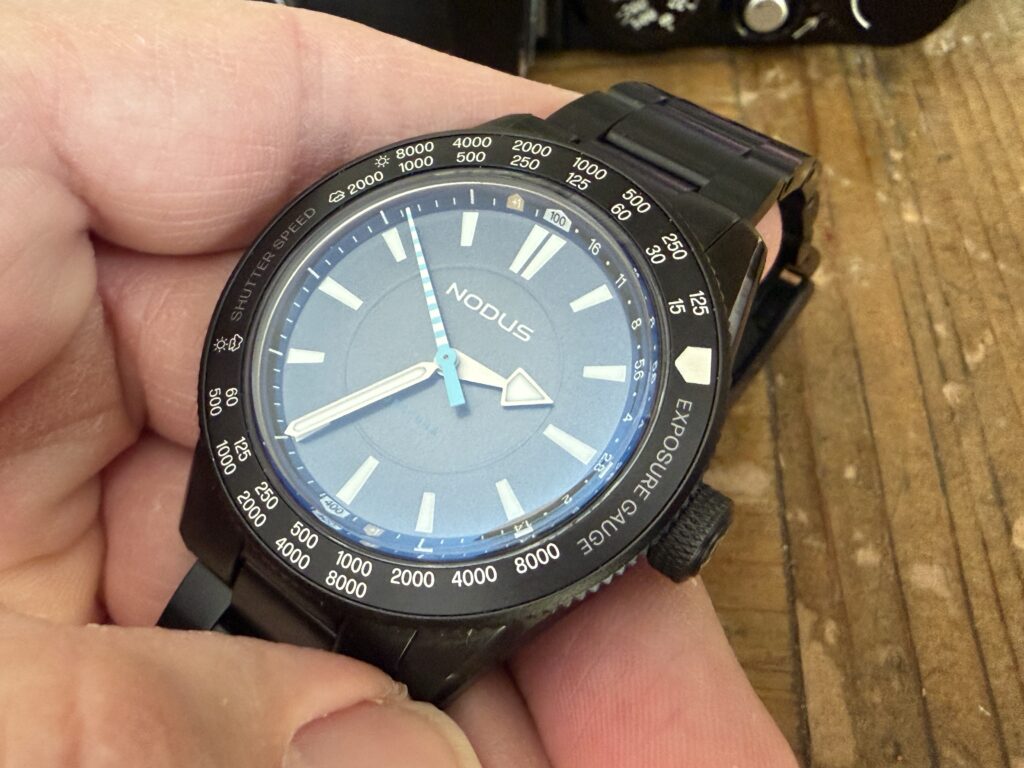
Now, at this point I want to mention my only sort-of-quibble with the whole concept and that’s the choice to use modern shutter speed numbers on the watch. The Sunny 16 method is based on hypotheticals. The system in the watch has taken the hypothetical and rounded it to the modern shutter speed values found on most cameras made after the 1950s. The range of shutter speed values found on the watch are: 15, 30, 60, 125, 250, 500, 1000, 2000, 4000 and 8000. As you will see in a moment, this means that the watch gives a reading that’s 1/3rd of a stop out from a true sunny 16 reading. I say “sort-of-quibble” as there is a bit of me that would have liked it to stick to the sunny 16 rule proper. The issue with that would have been that the shutter speed numbers on the dial would have felt potentially slightly alien – 15 (12.5…), 25, 50, 100, 200, 400, 800, 1600, 3200, 6400 are the more perfect shutter speeds to match EI100 and EI400, but those aren’t speeds we commonly see on most film cameras. But really this is just an anomaly of the scales we have come to use. Camera history has chosen a slightly offset scale of full stop shutter speeds to full stop ISOs which is reflected in how we set exposure index (EI) relative to shutter speed. The Nodus Obscura is just a reflection of this anomaly. As you will see, if you use the shutter speeds the watch suggests, your exposure will be 1/3rd of a stop under. But, what’s quite clever about the design is how it also illustrates a ‘+1’ with a yellow marker which effectively gives the 2/3rds over exposure.
That out of the way, the first step to read the complication is to point the big white arrow on the bezel at the aperture value you wish to shoot at. The values are printed on the face of the watch around 115 degrees from between the 12 and 1 o’clock markers round to the 4 o’clock marker.
If you want to shoot at f/16, rotate the arrow to 16 on the face. Now read the shutter speed next to the 100 marker at the top of the watch face for EI100 or 400 at the bottom for EI400. As mentioned, the outer shutter speeds are for bright sunny, and the inner for heavy overcast. As you can see, the watch reads 1/125th for bright sunny and 1/15th at EI100 and 1/500th for bright sunny and 1/60th for EI400. As mentioned above, these are 1/3rd under values, but you’ll also see the yellow pointer gives a +1 value for 2/3rds over too.
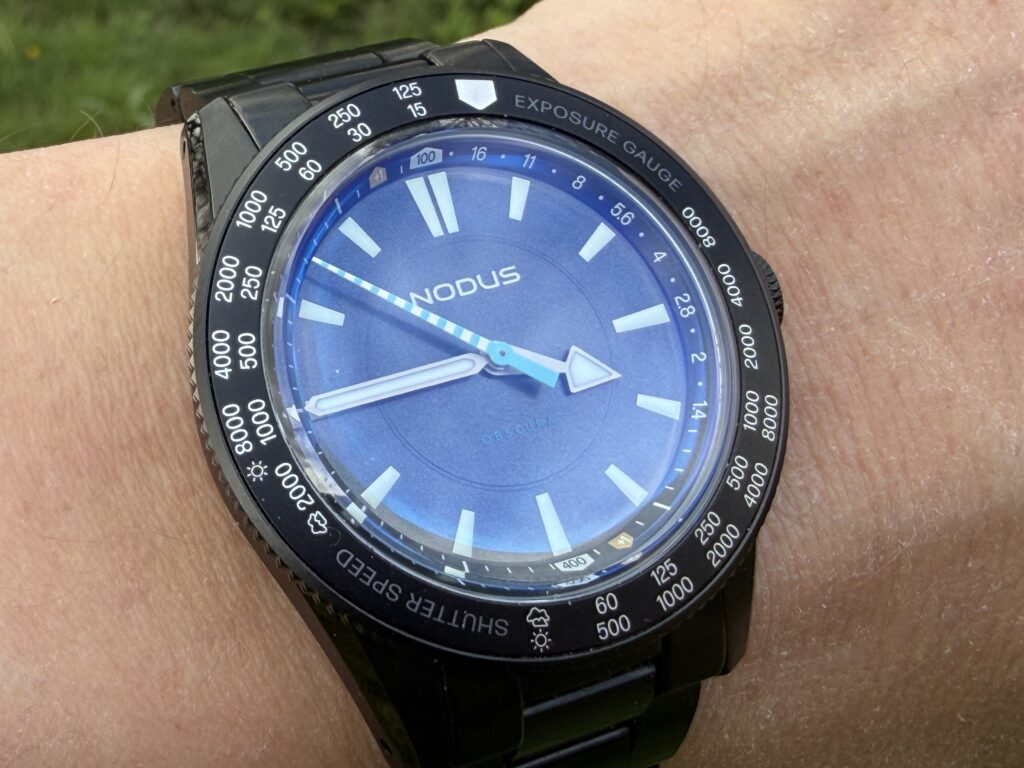
Then – and this is the bit that feels clever/most useful – if you want to know the reciprocal settings for any other aperture, you just rotate the bezel so the big arrow points at your chosen aperture. For f/5.6 for eg, the watch reads 1/1000th for bright sunny and 1/125th at EI100 and 1/4000th for bright sunny and 1/500th for EI400. Again, the yellow pointer can be used for a slightly over rather than slightly under exposed reading.
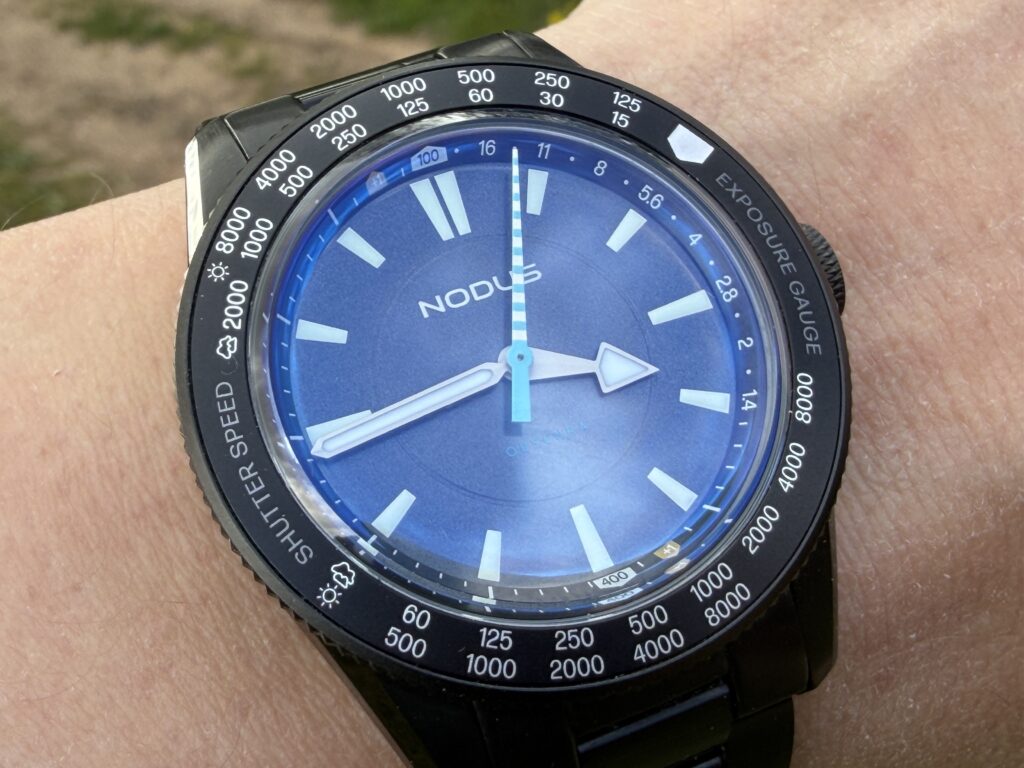
The shutter speeds max out at 1/8000th so there’s no readings for bright sunny beyond f/2 on the EI100 scale and beyond f/4 on the heavy overcast scale, but such are the limitations of shooting at EI100 and 400 in very bright light, I suppose.
It really couldn’t be more simple and genuinely does feel like a nice little aide-mémoire to the sunny 16 system. And despite my calling it a ‘sort of quibble’ I 100% get the justification for choosing more familiar shutter speed values. If I’m like others when it comes to using the Sunny 16 system, that choice of slightly over or slightly under is just one I make in my head depending on the film, subject matter, lighting etc. It initially feels slightly jarring when the bit of process that usually just happens in my brain when I’m shooting is illustrated on a piece of equipment that isn’t a camera, but I soon got used to in in practice.
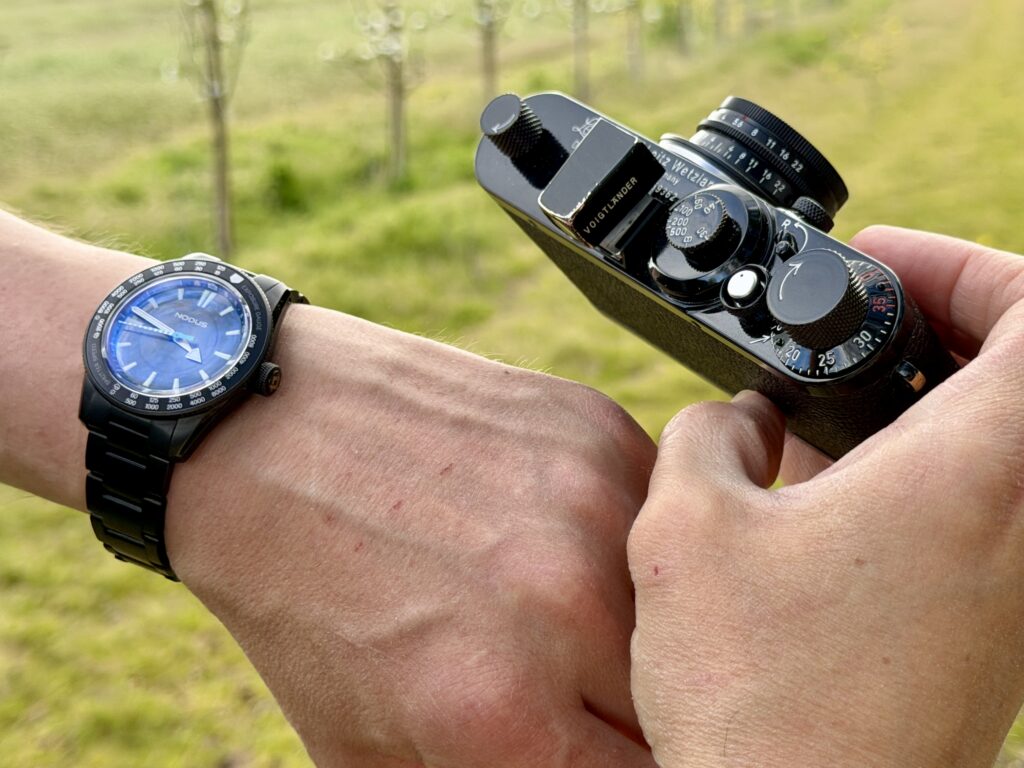
That said, I say in practice, as actually the funny thing is, when trying this watch out “in the field”, I actually used it with my old Leica Ic which has the older shutter speed values… and moreover, there was more than one occasion when I was selecting the settings I wanted and doing my usual trick of counting clicks on the aperture or shutter speed dial before I remembered I had the watch on my wrist to help illustrate what I was trying to achieve. Old habits die hard I suppose…
Final thoughts
I really like the Nodus Obscura II! I had it for about 4 weeks before I had to send it back, and I was very sad to see it leave. I am utterly skint at the moment (I don’t recommend running a small creative business in today’s economic climate – especially with all the AI around) else I would be buying one for sure! Just as a watch alone, it’s really a very nice bit of kit. It feels extremely hard wearing, and looks great with it – I got very used to seeing it on my wrist! And then there’s the sunny 16 complication – I suppose it would feel like a bit of an overstatement to say that it’s incredibly useful or would specifically have a big impact on my photography experience were I to buy one of these watches. But then, the same can probably said for most mechanical complications on watches – or any feature for that matter. Beyond telling the time, added features are often just occasionally useful to the wearer. The sunny 16 exposure complication would be just occasionally useful to me, but over and above that, as a photographer, it feels like a complication that’s specifically relevant to my primary hobby of photography – and on that basis, I just really like it!
You can find more about the Obscura on the Nodus website here
Share this post:


Comments
Ibraar Hussain on Nodus x Beers & Cameras Obscura II DLC Exposure Gauge Complication Watch Review
Comment posted: 27/04/2026
It’s something I’d wear even if I didn’t give a toss about cameras and photography
Has a field watch vibe with interest
Size is also right
Grrat review
Gary Smith on Nodus x Beers & Cameras Obscura II DLC Exposure Gauge Complication Watch Review
Comment posted: 27/04/2026