

During my pre digital life I was mostly a Pentax fan, using their SL, SP, ES, ME, MX, LX, 67 and 645…all long gone. The last three I bought whilst I was in Hong Kong for a few years and I even carried the 67 and Benbo mk.1 tripod up Mount Kinabalu in Sabah. Slides from the 67 on Fuji Velvia 50 printed with Cibachrome were as good as anything digital. I sold the complete system to a dealer and he got me a new Leica M6 and 35/90/50mm Noctilux which seemed a handy minimal outfit but wearing spectacles I struggled to focus. Sold them and got a Canon EOS 5 autofocus with a 28-200 zoom. Great until stolen.
Next digital came along and I tried several Fuji finepix models then a four-thirds Olympus E1. Then, because I didn’t want any more systems with all the accessories and lenses I began to try the bridge cams by Fuji, Sony and Nikon. Last one was the excellent Nikon P900.
Last year I got into collecting old manual cameras after visiting the Camera Museum in London. I began with 35mm Exaktas, Exas, Zorki 1 and 4K and Kiev rangefinders and a Pentax ES again. Towards the end of last year medium format TLRs attracted me. I tried a Lubitel 166B but didn’t like it and sold it on eBay. Next I got a Yashica D, Rolleiflex Automat X K4, Rolleiflex old standard, Yashica Mat, several Rolleicords, Minolta autocord, Minoltacord, Richoflex, Richoflex dia L.
I usually buy from charity dealers on eBay who mark everything as untested spares and repairs, so bargains are to be had. Naturally one finds some are unusable in various ways. Shutter problems are common. As they say, you pays your money and take a chance. I can’t afford to pay £300++ for a CLA on a camera that only cost me £40-60. So I worked my way through them film testing and weeding out some to sell again.
I’ve not been able to afford a decent Rolleicord V yet. Most of the Rolleicords are 2’s which have that horrible little button to set the film counter to 1 after loading film and moving to 1 in the red window. I don’t know why they changed it from the beautiful 1933 Art deco Rolleicord which also uses the red window but then you press a button on the left side beside a nice big counter which is easier to see the frame numbers.
I finally got a working Minolta autocord after two with jammed focus levers.
I got two Yashica Mats as one was missing its winding handle and the other was jammed so I did a swap of parts. One okay and one for parts.
Then a recent acquisition was two Richoflex. The one with no meter I tried loading a roll of film to test it and it doesn’t stop between frames so I ended up winding all through. I ordered a changing bag from Amazon to rewind it back onto a spool.
The other was a Richoflex dia L which had a meter which worked okay… but, the shutter when cocked just fired without the shutter button being pressed.
Life is certainly interesting.
I don’t really want lots of paperweights and like to be able to use all my cameras. The subtle differences in winding, focusing etc. between the different makes and models was nice. I don’t have the space to keep a collection nor display it so I’m more of a tester than a collector. I film test the cameras which work and when I sell again on eBay can provide photos as evidence.
Early this year I got a Mamiya C3 which was my final play with TLRs. I got interested in medium format SLRs and acquired a Primarflex ll, three Corfield 66s, Kiev 88, Salyut S, and after two Kowa Six MM failures a good Kowa Six.
I turned back to 35mm including folders and got a couple of Agfa Karats. Lovely cameras but without darkroom facilities I gave up on their strange cassettes. A Zeiss Ikon Contina MIB came along following a little Werra 1. Two Mamiya 6 models gave great results and are still with me.
Two Plaubel Makina ii bellows 6×9 appeared and I put several films through them including one using a 6×6 back from a Corfield 66 which fits okay but didn’t lock in place.
I’ve gone through three Corfield Periflex 1 type 3 which are cute, if you can bother with cocking both shutter and wind on with separate knobs and trying to focus through the tiny periscope. I’ve kept one and can even use the LTM lens with a recently acquired Canon VT deluxe which has a similar trigger attachment to the Leica Leicavit but isn’t removable.
I got a Zenit C slr which is really like a Zorki 1 with prism finder instead of rangefinder. Only problem is that although it is 39mm thread it can’t use ltm lenses because of the focusing distance inside. Takes good photos though.
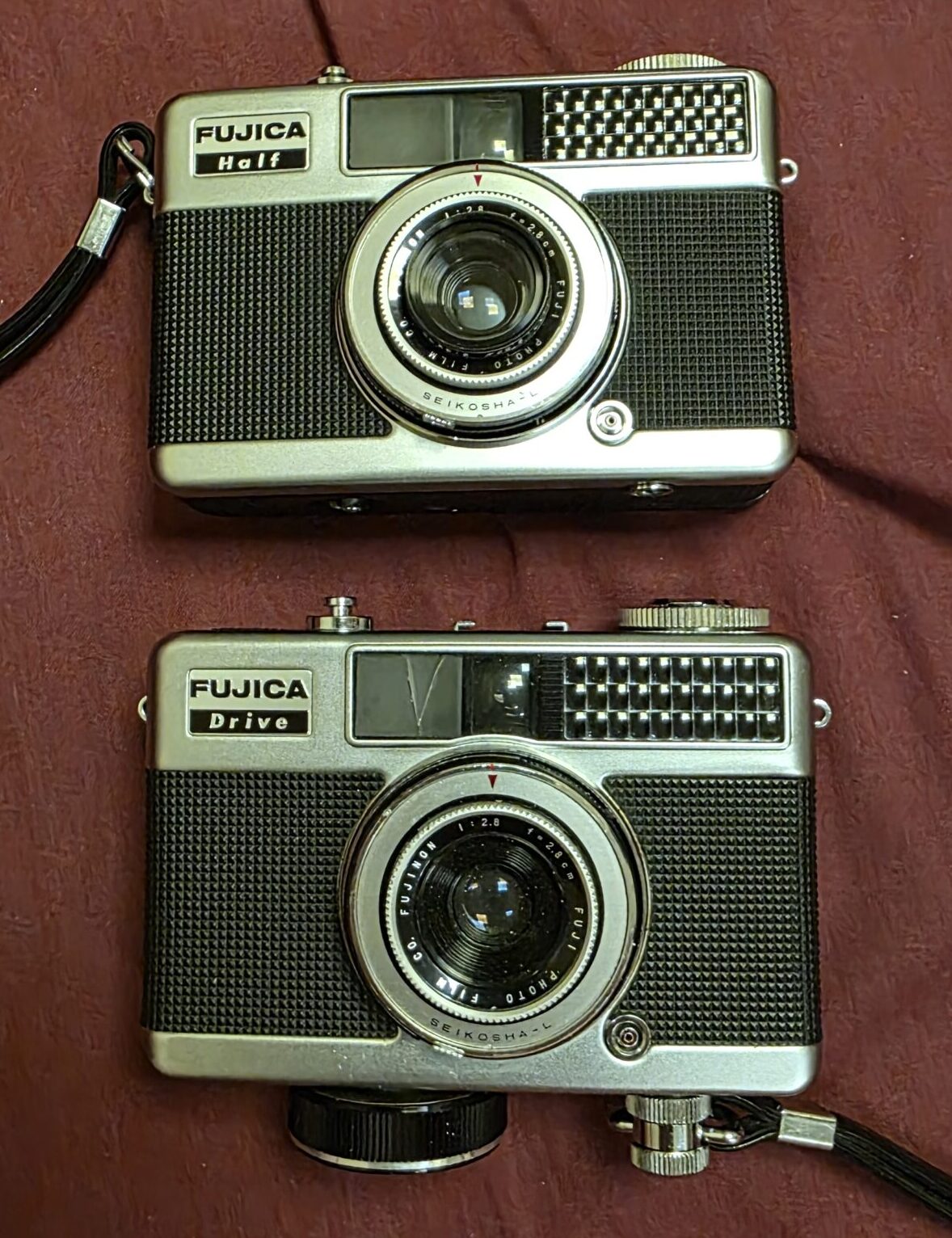
I liked the strange look of the Canon Dial clockwork half-frame 35mm and got a 35-2 to try out. I took it along with me when I visited the Cameras London stall on Portobello road market and he showed me a Fujica Drive half-frame clockwork so I took it for a bargain £20. To round off this post, I thought I would share something I recently posted on one of several camera related groups on Facebook where I compared these two cameras.

Half-frame 35mm clockwork compacts shootout with Ilford FP4 in Fujica Drive and Ilford HP5 in Canon Dial 35-2.
My previous colour films in these two shows the Drive in a better light (pun intended) being sharper but that time the Dial had an expired Truprint film twenty years old so the 200 asa was reduced to 50 asa. I wondered if camera shake was a factor so put the faster film in the Dial.
I got many more shots which came out than these collages, but these were the best of the bunch.
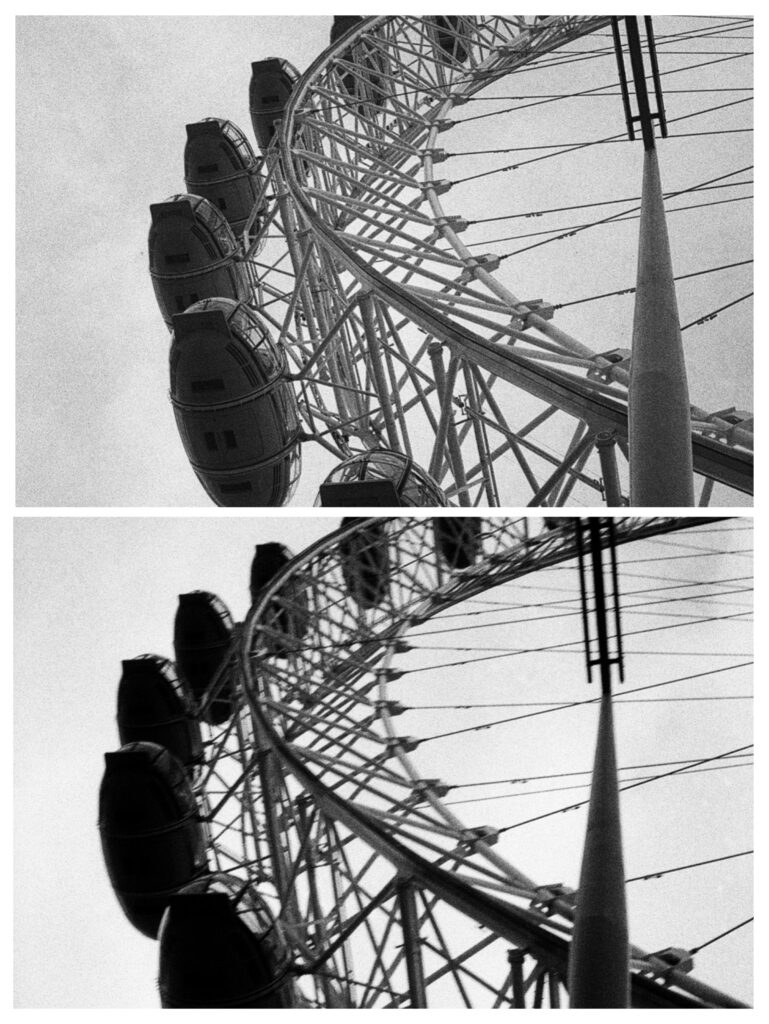
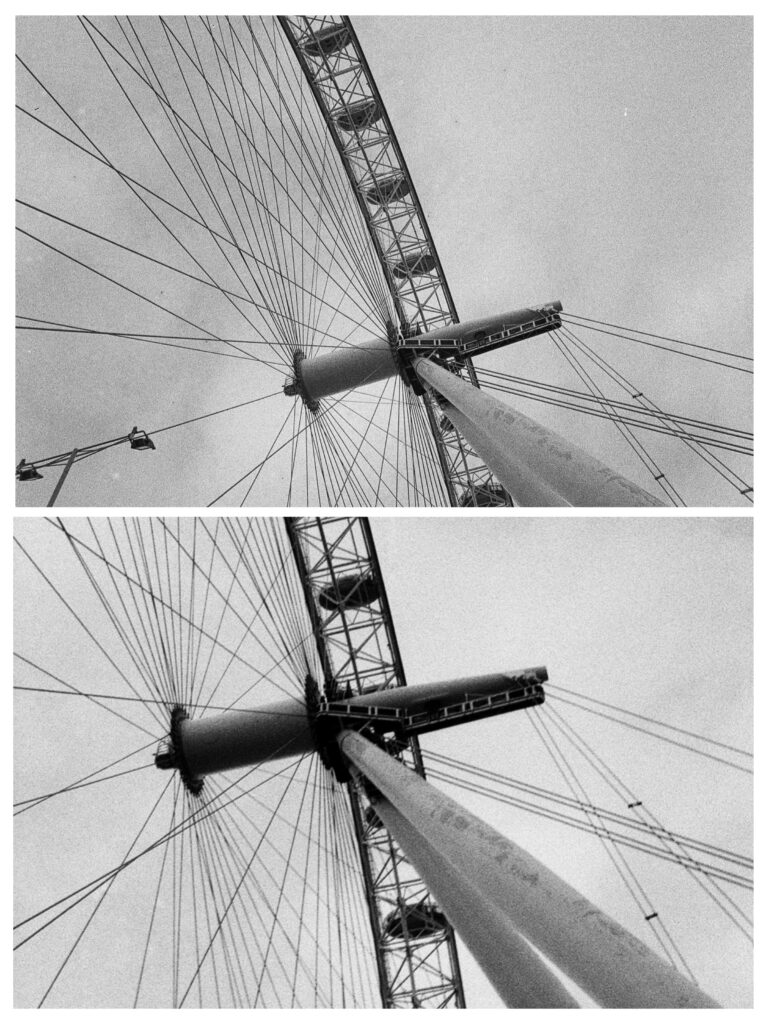
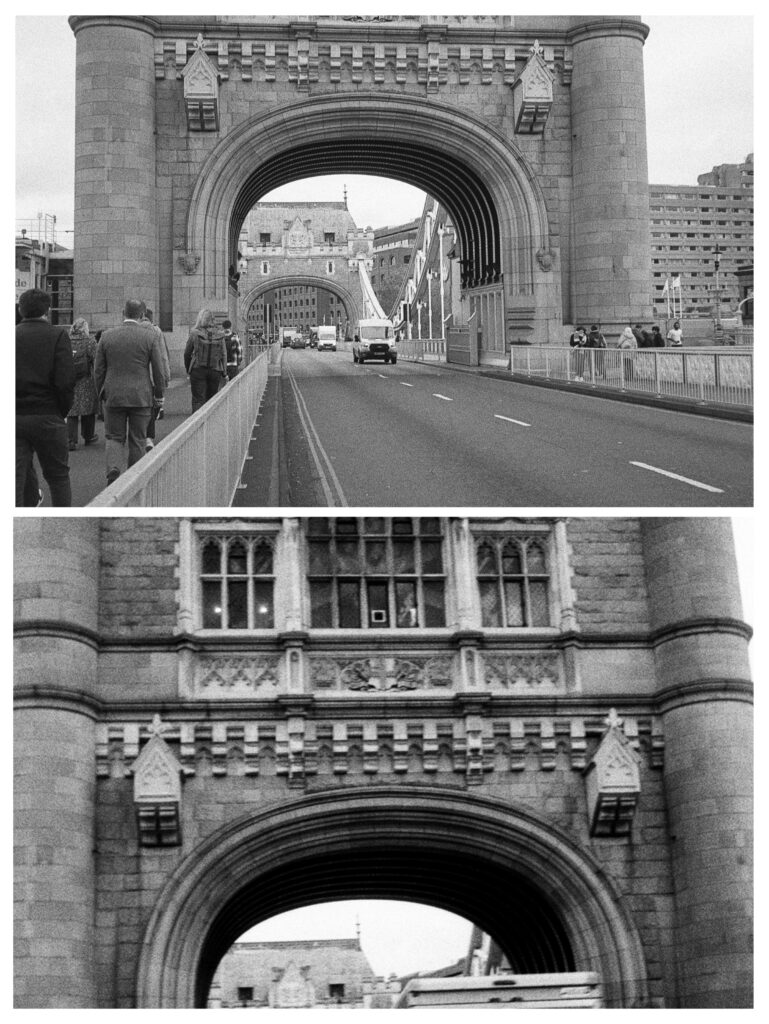
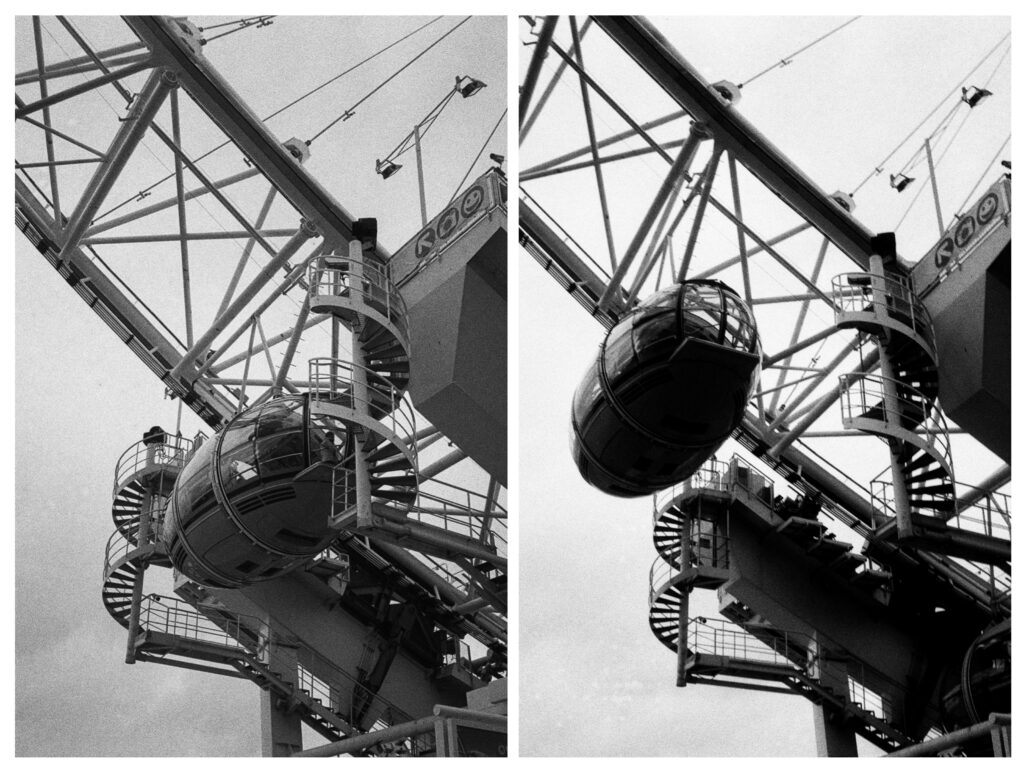
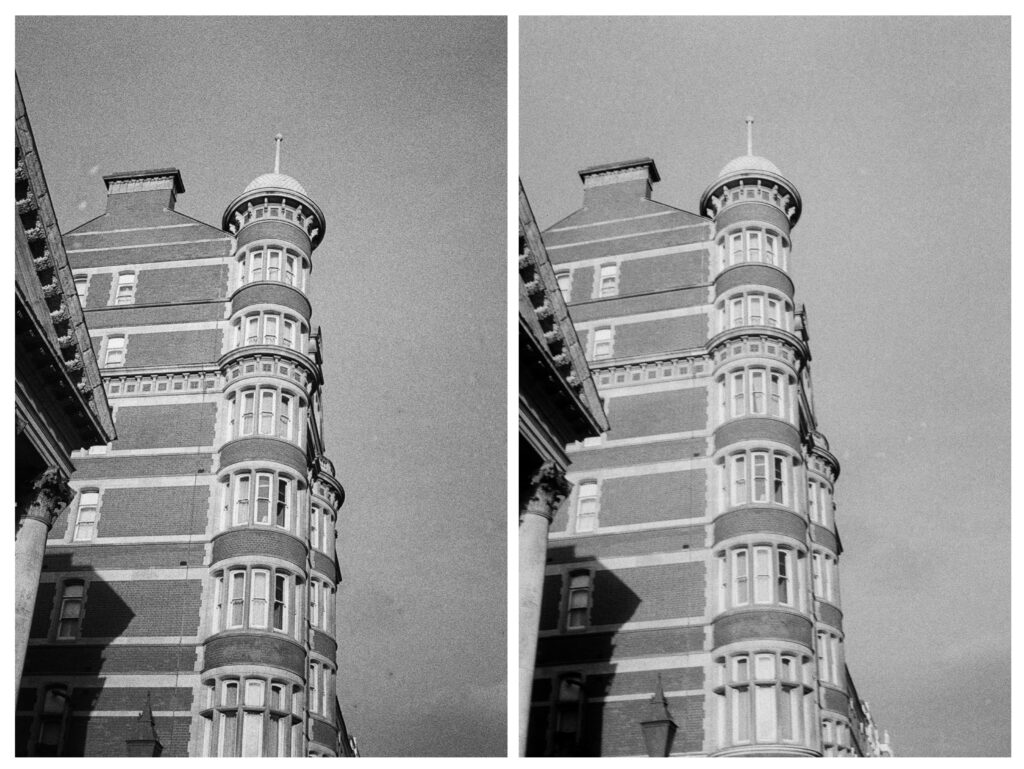
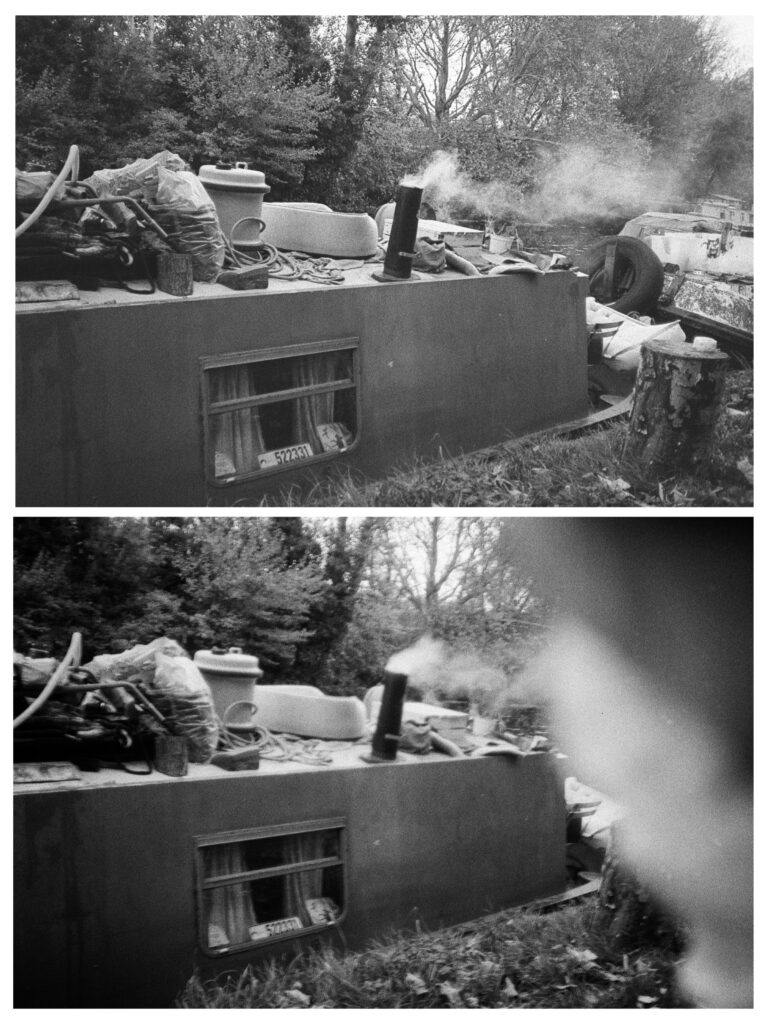
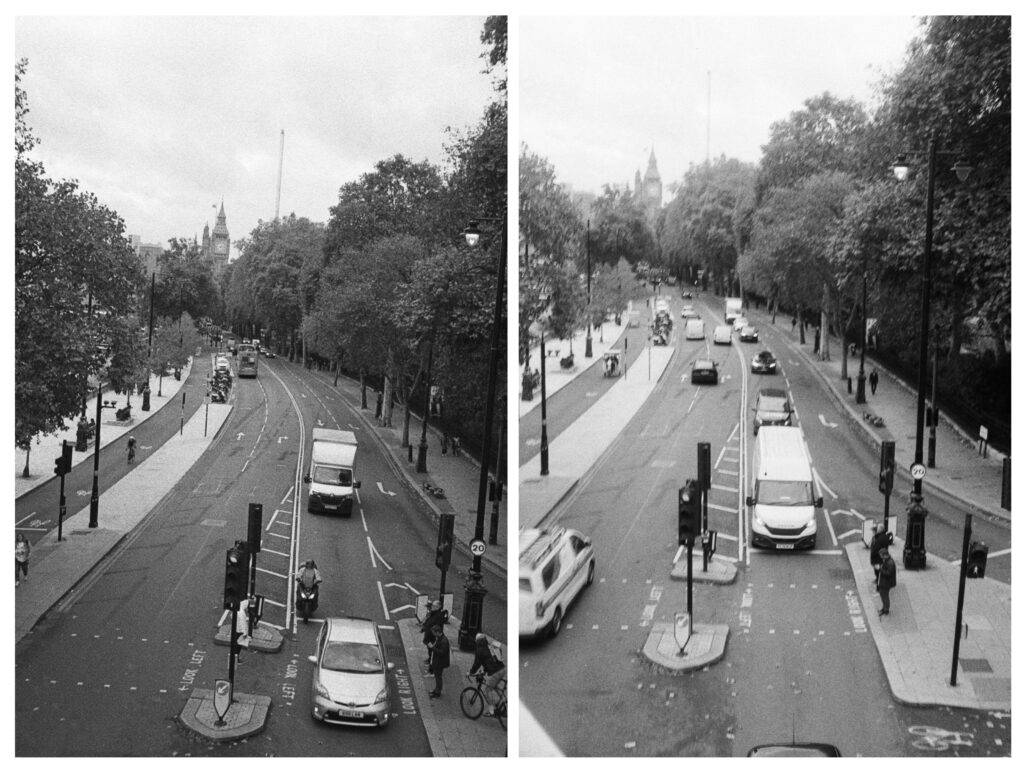
I was pleased with the results from the Fujica Drive, so I got its sibling the Half, virtually identical but with cocking lever instead of clockwork, and have a film in it at present.
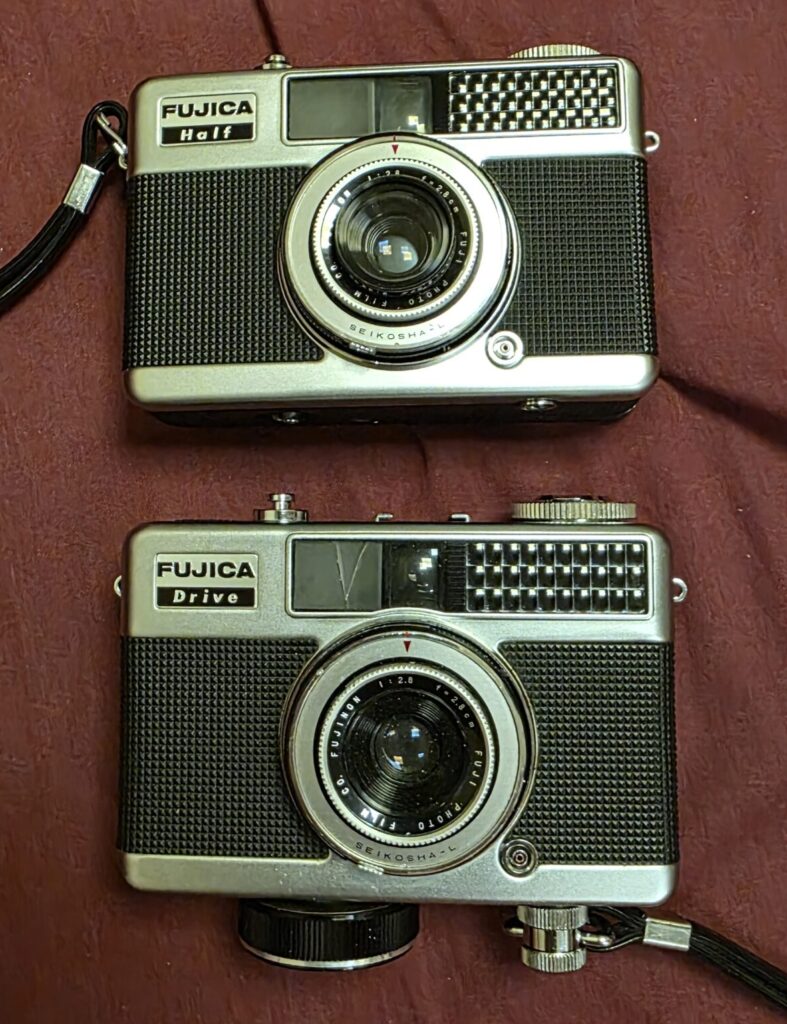
I also discovered that there’s a Fujica Rapid, almost identical to the Half, and a Canon Dial Rapid, a sort of cross between the Canon dial 35 and the Fujica Drive, both taking the awkward Agfa Rapid cassette system and thus immediately intriguing me.
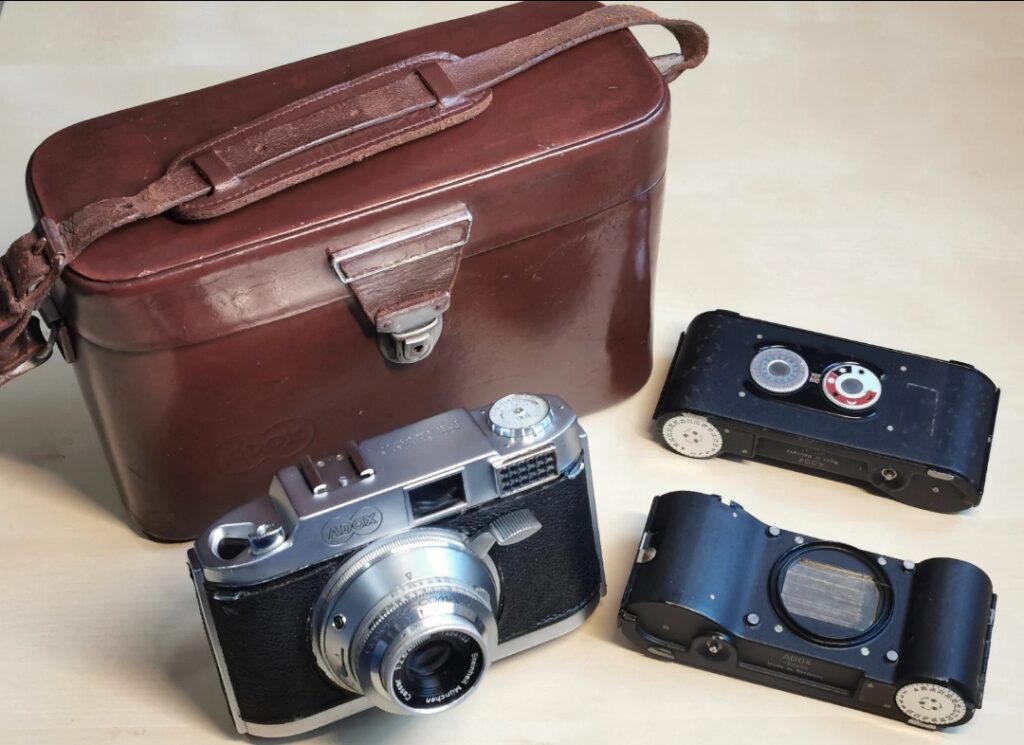
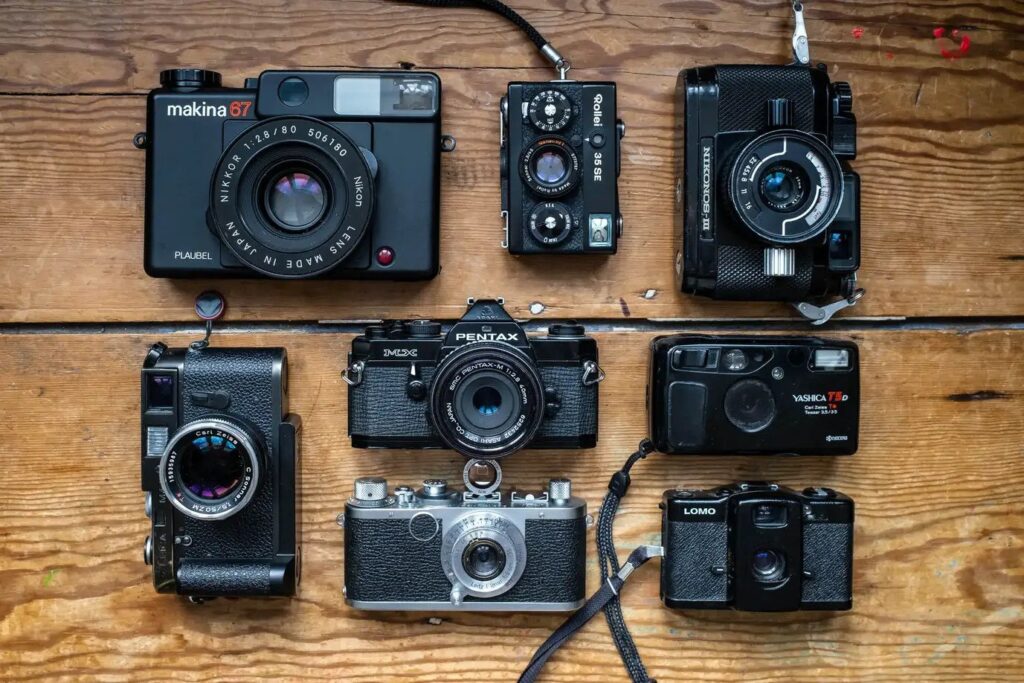
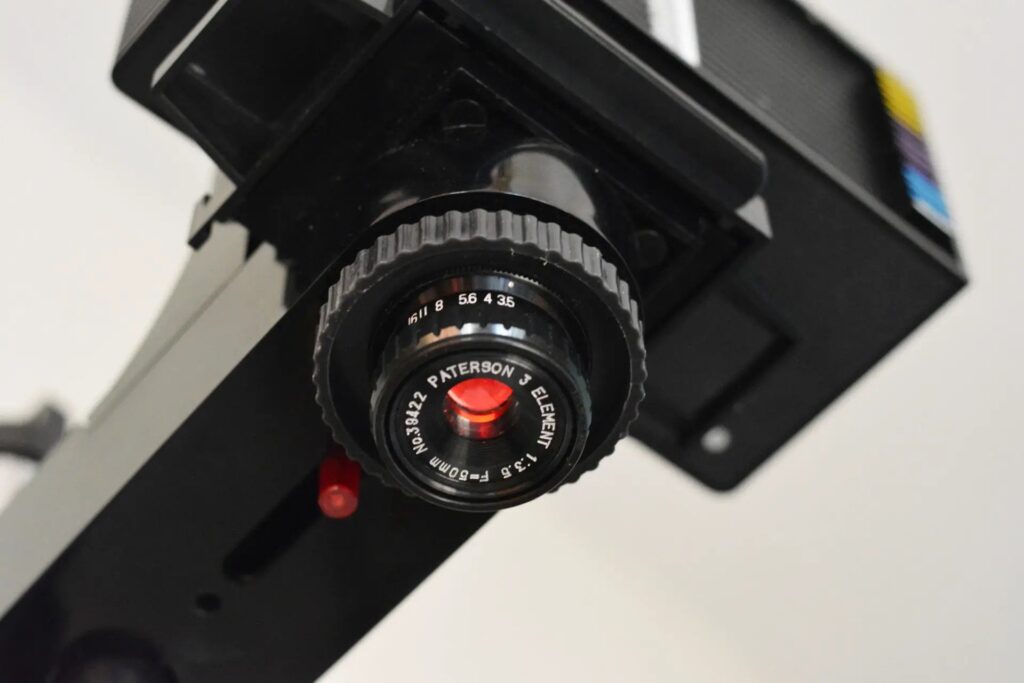
That’s my journey so far, but I haven’t reached the end yet, I’m certain… For instance, this Adox 300 set has also got my attention:
Share this post:

Comments
Marco Andrés on A Potted History of the Last Two Years of my Return to Film Photography
Comment posted: 28/12/2025
Excellent introduction to a panoply of « odd » cameras, which are definitely worth exploring.
The Adox 300 is particularly rare and intriguing (manual: https://mikeeckman.com/media/Adox300Manual.pdf). Found one online for 300$US with two magazines plus extras. The Adox reloadable film magazine is rather expensive. At 85$US it seems like a good candidate for 3d printing. The film magazine also works in a Leitz Orthomat [microscope camera].
Not many cameras use the Adox film magazine. In contrast, many cameras use Agfa Rapid Cartridges, an alternative to 126. Example – Minolta 24 Rapid (https://www.35mmc.com/10/08/2024/5-frames-going-square-with-35mm-film-in-a-minolta-24-rapid/). No need for a darkroom. In a dark bag (or completely dark room), just load about 60cm (enough for 12 exposures) from a 36 exposure 135 film (155cm long) Remove exposed film from cartridge in the dark, place film in a light-proof container (black plastic container for 135 film cassette), tape, label and send out for processing. Most labs will.process.
3d printed version: https://www.printables.com/model/545261-film-cartridge-for-agfa-rapid-camerasm Just add felt from a used 135 cassette to make it light-tight.
Consider 126 cameras, which democratised photography in the mid 1960s and beyond.
Comment posted: 28/12/2025