

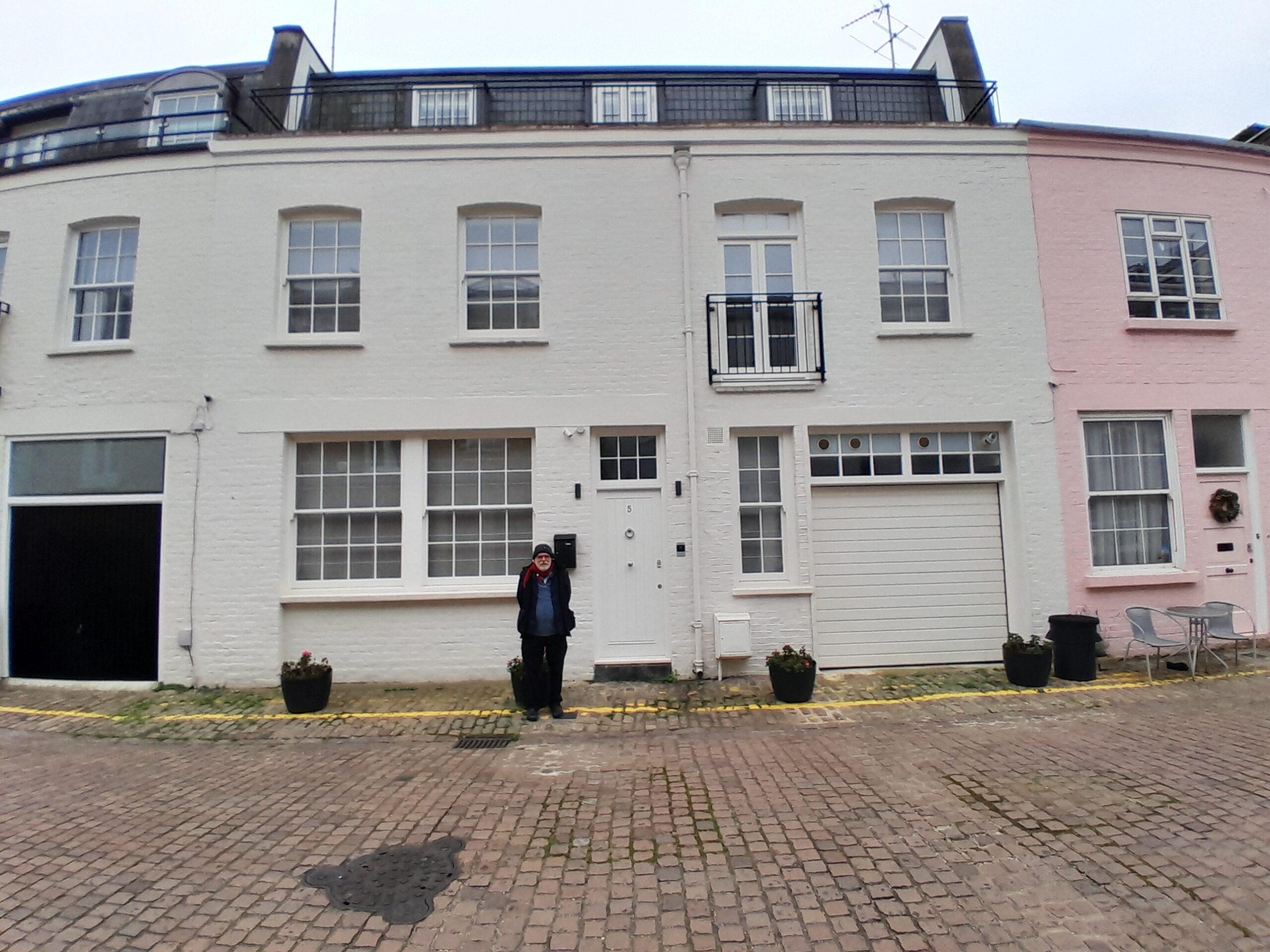
Before diving into the story, a brief explanation of what this – wholly unremarkable – image portrays. This is a London “mews house”, a type of property built by/for wealthy, quite likely aristocratic, families (you’re familiar with Downton Abbey, right?) to house their transportation and associated servants. Whereas as the domestic staff tended to live in poky little attic rooms in the grand mansions, the mews was where the horses and carriage were kept, with the grooms, drivers etc. living in accommodation above. In later years of course, the horse and carriage were superseded by the motor car, and it was the chauffeur who lived upstairs. In big cities like London, mews that served a number of big houses in an area were all built in one location.
All of this brings me onto my great-grandfather, Charlie Wright. He was a chauffeur, and in the 1930’s and 40’s (perhaps earlier), lived here – 5 Princes Gate Mews. This is in one of the very best parts of London, the Royal Borough of Kensington and Chelsea, off of Exhibition Road, alongside the Victoria and Albert museum, opposite the Science and Natural History museums and close to Hyde Park.
You can see that now there are windows in the roof, as the attic has subsequently been converted into an additional floor, but in those days, the car/cars was/were garaged on the ground floor (my mother, who was a frequent visitor as a child, says Rolls-Royces in the plural), where the stables had been, and Charlie and family lived above. In those days, the stairs went up to a landing which doubled as a rudimentary kitchen, with the sink providing the family’s washing facilities (doubtless there was also a tin bath with the water heated on the stove) and also featured a cupboard containing a toilet – a luxury in those days.
As an aside, and to provide perspective, the first house that my wife and I bought in 1978 was also without a bathroom, and the toilet was outside, in the backyard (although this was generally uncommon by then). Once a week, we used to go to the municipal baths where for 25 pence you got a small cake of soap, a clean but threadbare towel and a cubicle with an enormous bath filled to the brim with hot water; you weren’t trusted with the taps however, and as the water cooled, you’d have to shout “more hot in number six please”, whereupon an attendant would operate the tap on the outside of the cubicle!
Anyway, as well as the kitchen/landing, there was a living room with fireplace and piano (how did that get up there?), and three small bedrooms, for my great-grandparents – she was a char-lady (cleaner), although I don’t whether or not she worked for the same family as Charlie – and the youngest of their offspring, Eve and George; the oldest was my grandmother, who’d married and left home in the mid-30’s – my mother was born in 1938. Auntie Eve worked as a shop-girl in the famous and prestigious Harrods department store, just up the road in Knightsbridge, and drove an ambulance during the blitz – despite having never taken a driving test. I don’t know whether or not Princes Gate Mews was bombed, but the Victoria & Albert just next door definitely was – some of the damage has been deliberately left unrepaired as a reminder, with a helpful notice explaining why (with apologies to our German readers).
Sometime in the late 40’s, Charlie’s job came to end for some reason, although it’s quite likely that he simply retired. I was born in 1958, and never knew my great-grandmother (I think she was called Alice), but Charlie mostly lived with my grandparents when I was a child, so I knew him quite well, and he died when I was around eight or so, at the age of 93.
And now we get to the crux of the story. When the job finished, Charlie was offered the opportunity to buy the mews house, for the the sum of £125 (that’s my recollection of the story of the asking price, although my mother’s unsure of the amount). However, my great-grandmother apparently said “we’re not paying that much for this place!”, and that was that. Ever since the – somewhat amused, but disgruntled – feeling in the family is that our birthright and legacy was given away!
This is after all, very prime real-estate – a fairly large house in one of the best areas of the most expensive city in the country, with a (very rare) garage. I’ve done a little digging, and the house was last sold ten years ago in December 2015 – when it was described as having four bedrooms (remember the attic conversion) and three bathrooms – for £3,025,000; today it’s back on the market – although it’s now got four bathrooms, but only three bedrooms, as one has been converted into a home gym (as you do) – reduced to a mere £5,950,000, although stamp duty (the tax payable on purchase of a property) would add nearly £700,000 if this was your sole residency, or almost a million if you had multiple properties. Just think – I could be buying the newest, latest and best Leica gear, instead of digging for vintage bargains on eBay (I’ve just bought a Jupiter-11 lens for £27), although maybe that’s more fun!
I can offer another story about Charlie, although this one’s a family legend and can’t be directly verified despite my mother’s prodigious memory, as it happened long before she was born. It appears that Charlie was always a chauffeur; before and during the early part of the first world war, he worked for a certain Winston Churchill, who you may have heard of. Churchill was an MP (Member of Parliament), and also the First Sea Lord, which meant that he was in charge of the Royal Navy, and a member of the War Cabinet. He was responsible for devising and implementing the catastrophic Gallipoli campaign, in which tens of thousands of Allied troops were killed (not to mention the opposing Turks) and ended in abject failure. Because of the ignominy, he “fell on his sword” and resigned from the Admiralty, choosing to take a senior commission in the Royal Scots Fusiliers (as a young man he had been a junior cavalry officer and served on the North-West Frontier of India – more or less the ancestral homeland of Ibraar’s family? – and was in South Africa for the Boer War).
Before taking himself off to the front line in Flanders (accompanied by a tin bath), he gave Charlie the honour of becoming his batman (officer’s servant). However, after a few months, Churchill decided that he didn’t like the trenches very much, and returned to parliament, leaving poor Charlie behind, until he was badly injured by a gas attack on the Somme and invalided out (although remember that he lived until 93, so it didn’t do him permanent damage!).
The featured image was made on my birthday at the end of December when we had a day trip to London – we live 200 miles north – to see an exhibition of Banksy’s art (seriously recommended), which was conveniently only just down the road from Princes Gate Mews. The picture was taken by my wife on her ‘phone; obviously I’d taken a camera with me – in this case my little Leica ii, but it’s frame counter is unreliable (it’s going for a CLA soonish), and it turns out that it was at the end of the roll, and I didn’t have a spare in my pocket!
I’d actually visited Princes Gate Mews once before, when I’d taken my daughter to the Science Museum across the road, about 30 years ago. On that occasion, I didn’t know the house number, so have a snap of her stood in front of a random building.
Share this post:



Comments
Gary Smith on How my family lost their birthright and fortune – a one shot story
Comment posted: 19/03/2026
Having been born in 1954, the only use of "mews" on this side of the pond is by real estate agents hoping to provide a certain mystique to a property development.
Comment posted: 19/03/2026
Andrew Moore on How my family lost their birthright and fortune – a one shot story
Comment posted: 19/03/2026
I question the idea that this picture - or indeed any - is 'wholly unremarkable' when it has an interesting narrative to go with it. Loved the family history, and the photo; thanks.
Comment posted: 19/03/2026
Tony Warren on How my family lost their birthright and fortune – a one shot story
Comment posted: 19/03/2026
Steve Abbott on How my family lost their birthright and fortune – a one shot story
Comment posted: 19/03/2026
Tim Bradshaw on How my family lost their birthright and fortune – a one shot story
Comment posted: 19/03/2026
Comment posted: 19/03/2026
Jukka Reimola on How my family lost their birthright and fortune – a one shot story
Comment posted: 20/03/2026
Comment posted: 20/03/2026
Colin O'S on How my family lost their birthright and fortune – a one shot story
Comment posted: 20/03/2026
According to ChatGPT, "A “smallish” house in Kensington or Chelsea in 1945 would likely have cost on the order of £2,000–£5,000" (with further explanation how that figure was calculated). I wonder if there is more to this story that has been lost in people's memories, or perhaps some details mixed up over time.
£2000 in 1945 would have the same purchasing power as £75,300 in 2026.
£5000 in 1945 would have the same purchasing power as £188,300 in 2026.
Comment posted: 20/03/2026
Erik Brammer on How my family lost their birthright and fortune – a one shot story
Comment posted: 21/03/2026
Comment posted: 21/03/2026