

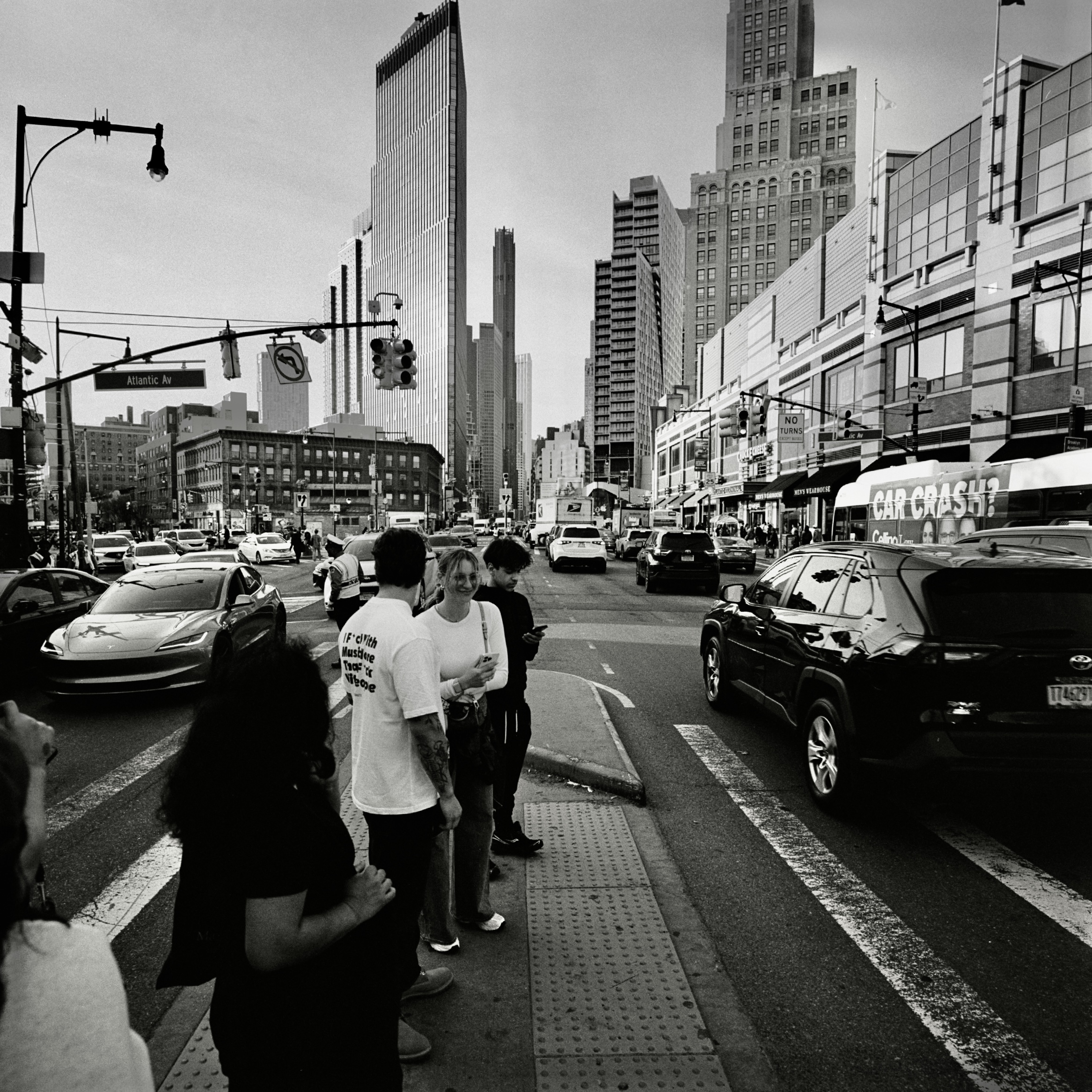
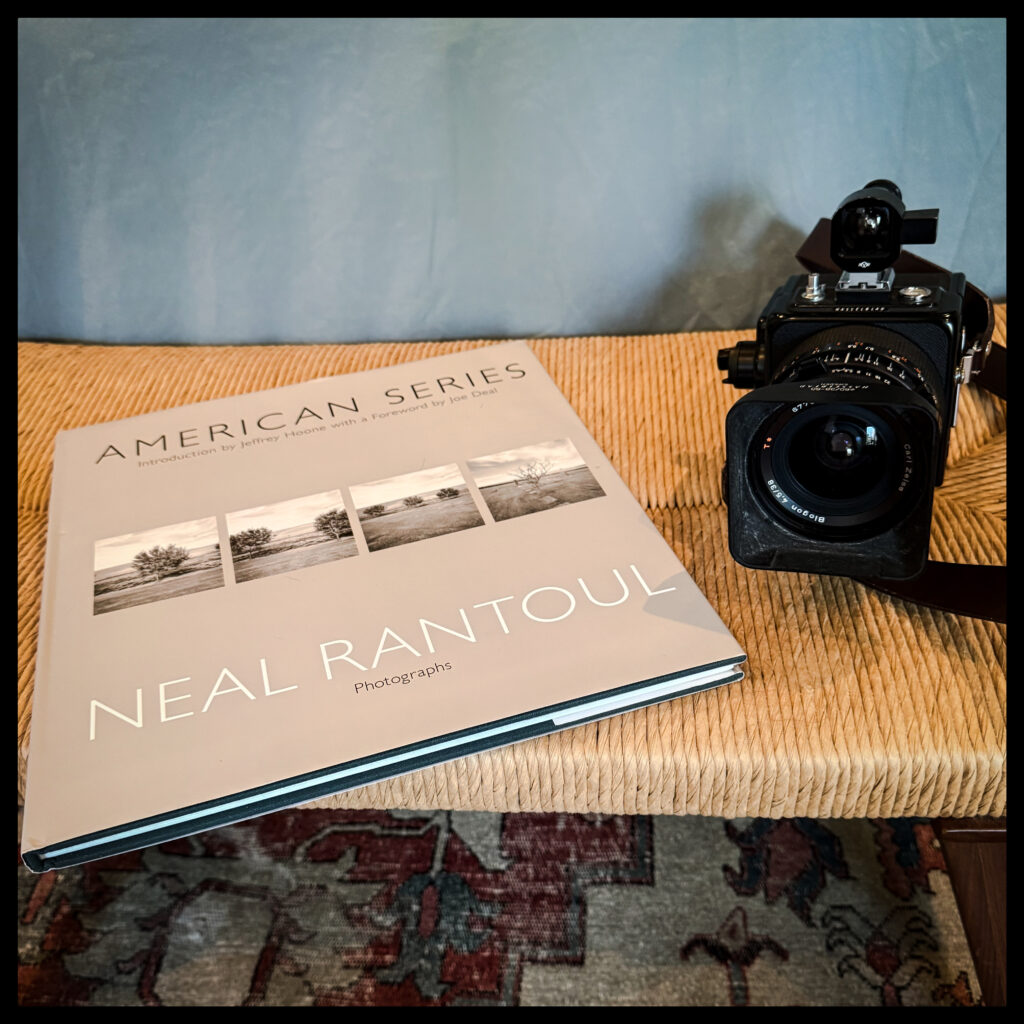
This photo is from my first roll with a new camera, a 1985 Hasselblad SWC/M that just arrived here last week. Given my love for my Rolleiflex, I have long been curious about how Franke & Heidecke tackled wide angle photography, though the somewhat mixed reputation and the stratospheric prices of the 55 millimeter Rollei-Wide have kept me on the fence. As an alternative, about two years ago I began researching the SWC, the “Super Wide” Hasselblad purpose-built starting in the mid-1950s around the storied 38mm Zeiss Biogon f4.5 lens. (Thirty-eight millimeters on a 6×6 cm camera is roughly equivalent to a 20mm lens on a 35mm system). The camera has been a favored tool of photographer Neal Rantoul among many others and also perhaps most famously later in their careers by Harry Callahan and Lee Friedlander.
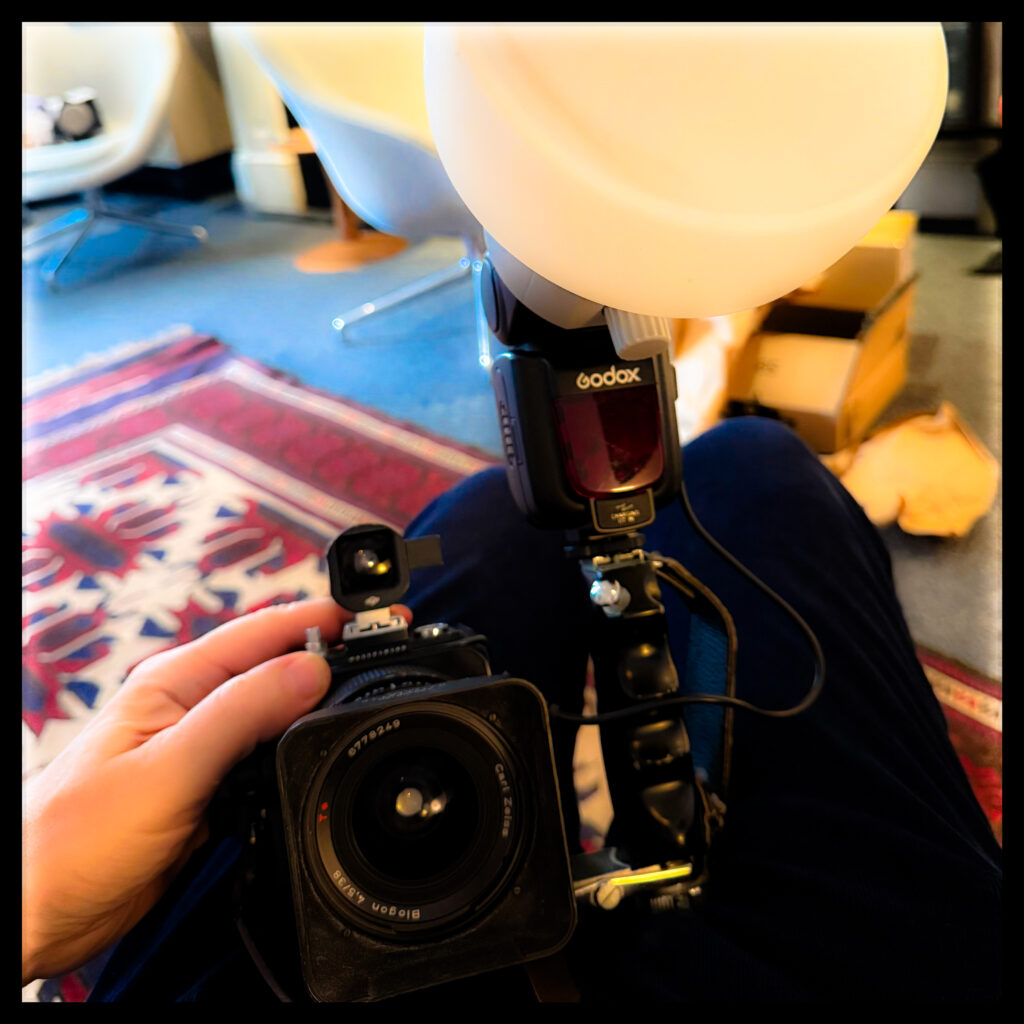
I began with a classic chrome version from 1961 from a Midwestern photography shop, but that camera arrived with its Compur shutter frozen—an issue that unfortunately persisted even after the camera went back, had a CLA, and came back again (I gather some mismatch with the film back may have been at issue the second time around). For my next attempt I went with a more reliable mid-1980s black SWC/M from a different dealer. I’ve read that the Prontor shutters of these recent SWCs are more robust than those on earlier versions, and are easier to repair when such things are needed. So far, the camera is working as expected.
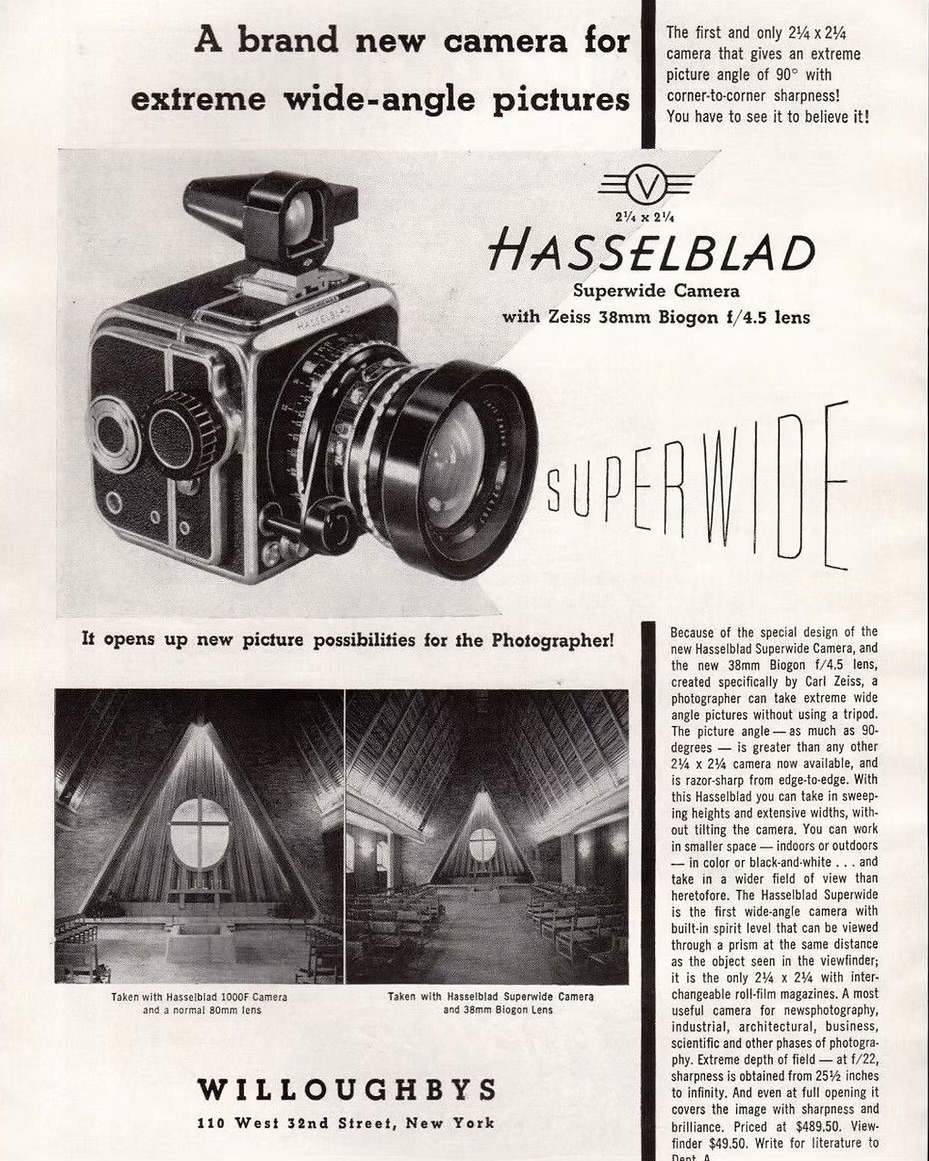
Although the camera is functioning well, after my first roll I have some questions about whether it will be right for me over the longer term. With the Rolleiflex it’s second nature at this point to identify my subject, set up the frame and pull in enough context to ground it. The SWC, on the other hand, is a camera where—as the advertisement says—absolutely everything is in focus edge to edge without visible distortion. A selling point for sure, but one that raises the question: how does one tell a story without the built-in hierarchy a more standard lens creates?
My first outing was disappointing. I was too far from my subjects and too up in my head to lean into most compositions. The featured image, the only decent frame on that roll, nonetheless hints at the possibilities. I’m blown away by the immersive effect the Biogon creates. Looking at the photo, it feels like I’m back out there on the curb in the middle of that intersection, looking past crowds and traffic and the tall buildings that suggest the Manhattan skyline rising in fact just out of sight in the distance.
Yet in an optical world where everything pops from horizon to horizon, there’s a danger that nothing does. Working with the SWC is already forcing me to assemble my photos differently.
One small annoyance is the bubble level on the top of the camera. It’s a feature which every commentator since 1954 insists is essential if you want to make the most of the Hasselblad’s spectacular glass. Tilt the camera off-axis, they warn, and your perfect Biogon geometry will bow and distend. As of today, it is the one aspect of the camera that I seem utterly incapable of using. I find myself standing there in the street, jiggling the camera like a snow globe, trying to nudge that little bubble into the center of the bullseye. It’s not a good look. If I want to use this camera in public on a regular basis, I’ll need to practice.
Still, I’m optimistic. I’ll keep on with the SWC/M—a year should be a good trial interval—in the meantime bearing in mind the advice of nearly every photographer who’s ever sung its praises:
“Take a few steps closer…and then closer again!”
Addendum
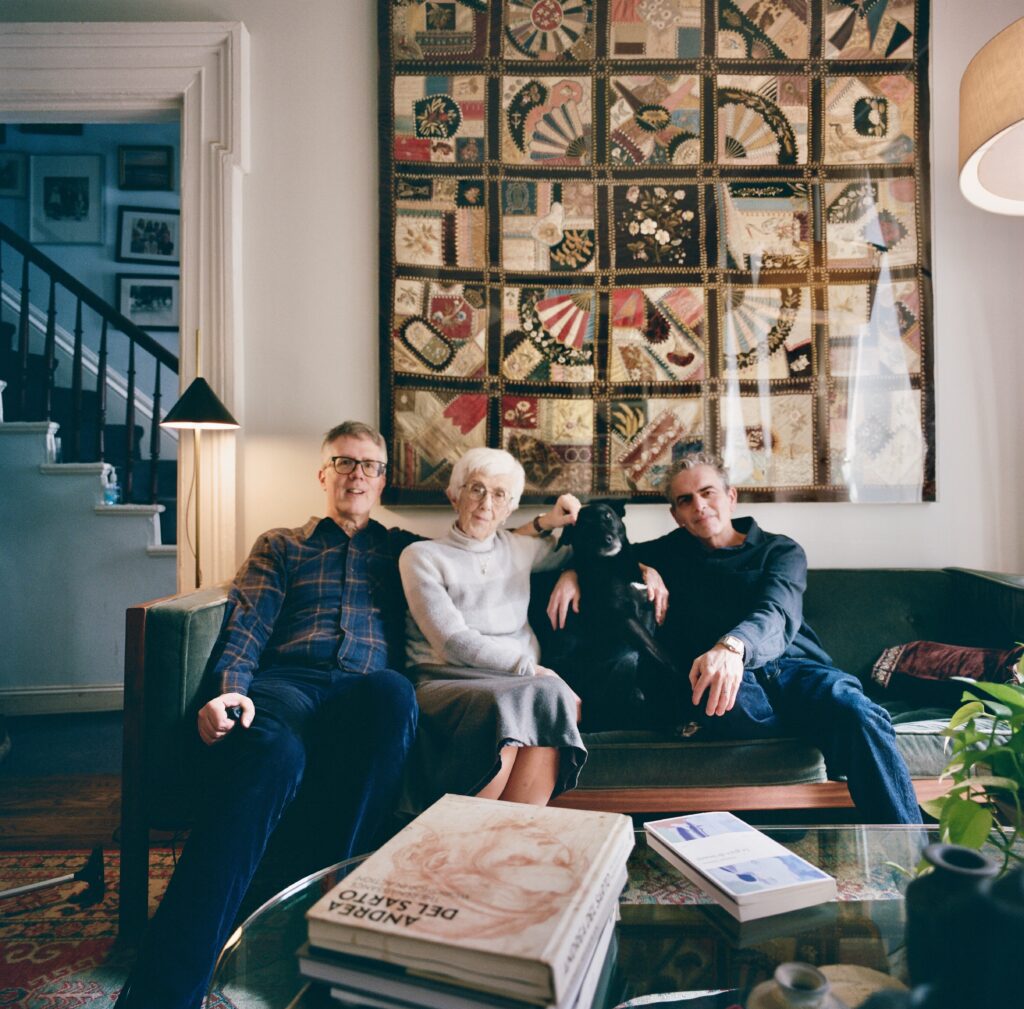
While waiting for this article to appear, I’ve continued using the SWC/M, and to my surprise got one worthwhile couch portrait with my Mom, husband and dog. The wide view feels appropriate here and not gimmicky, and the depth of field is impressive (I shot this in natural light at f5.6 with the camera set on a tripod about 6 feet / 2 meters away). The large crazy quilt behind us was made in 1880 in Bethany, West Virginia by my maternal forebear, Lavinia Pendleton (my 97 year-old Mom’s great-great aunt). Lavinia P. could scarcely have imagined the plexiglass mount it currently occupies, made in 1994 by a textile conservator at the American Folk Art Museum (some of the fabrics are worn gossamer-thin and easily shredded…hence the protective enclosure).
Thanks for having a look.
You can see more of my work at my website, leica1933.com
FEATURED IMAGE: Downtown Brooklyn. Hasselblad SWC/M, Yellow Filter, Kodak Tri-X 400.
Share this post:

Comments
Neal Wellons on Going Wide – A One Shot Story
Comment posted: 01/06/2026
My camera I have does not have a view of the bubble in the viewfinder. You can put it on a tripod or ignore the viewfinder and shoot waist level to see the bubble. I don't like those options and have never used them. So I've never used the bubble. I just level as well as I can in the viewfinder and shoot. It is spontaneous and much more fun than the options I have available. Perhaps you could try a roll ignoring the bubble and see how well things come out. Please don't be too critical until you have shot more rolls. It doesn't fit every situation but when it does, it is so much fun to shoot and does such an amazing job.
Comment posted: 01/06/2026
John Bennett on Going Wide – A One Shot Story
Comment posted: 01/06/2026
I bought — and then traded away — an SWC/M which I wrote about for 35mmc a few years ago. Link follows.
Missing the camera, I later bought another one, which I still have. It’s about the same year as yours, I believe.
I don’t use it every day, but when I do, I’m always happy I have it.
https://www.35mmc.com/05/07/2022/5-frames-a-year-with-my-hasselblad-swc-m-by-john-a-bennett/
Comment posted: 01/06/2026
Jeffery Luhn on Going Wide – A One Shot Story
Comment posted: 01/06/2026
I love the Hasselblad SWC!!!! Sadly, I no longer have mine. The first one I owned had 'Wide Angle Supreme' printed on the face plate. Probably from the mid 1950s. Not multi-coated and showing lots of brassing. That camera was the cornerstone of my architectural work and performed flawlessly for 20+ years until I sold it with my studio. I rarely used it for people shots or street shooting. My best strategy for shooting interiors was to raise the camera to a point that was midway between floor and ceiling. This always required a ladder, or shooting over the railing of a mid-level floor for hotel interiors. That showed more floor and less ceiling. Clients absolutely loved the results. That model had some falloff on the corners, which was good for shooting chromes. I did a number of shots for Architectural Digest. Years after selling my studio, I was asked to sell a bunch of Hasselblad stuff for a friend. I coulda, woulda, shoulda, kept that newer SWC, but I figured film was going away, so I sold it. Boo hoo! I'm quite sure you will express your considerable talents with that SWC. Getting to the midway position for your scenes will help. Even for people. GET CLOSE!
Comment posted: 01/06/2026
Comment posted: 01/06/2026
Comment posted: 01/06/2026
Walter Reumkens on Going Wide – A One Shot Story
Comment posted: 01/06/2026
Two stunning photos at the start and end, taken with the Hasselblad SWC/M, and the one in the middle sparked my interest in Neal Rantoul, whom I’d never heard of before. I’ve just had a look at his website, as well as a longer video on YouTube featuring an interview about the self-publishing of his books. I like his photographic style, and I’ll see if I can get hold of one of his books here in Europe. A very likeable, reserved, down-to-earth person who, like most famous photographers, has more to say about the pictures than about the equipment he uses.
He apparently owned an SWC on two occasions; the second one was his constant companion for a while, though he also spent a long time taking photographs with 8 x 10-inch cameras. He scanned the negatives for his books, often reducing their size in the process to ensure his books didn’t become too large and remained affordable for the public.
I’ve always fancied a Hasselblad, but it was always too expensive for me, and the SWC always caught my eye when I was flicking through the brochures. However, I see its main use as being in nature and landscape photography, which is where Neal Rantoul mostly used it. On his website, alongside the Hasselblad, he mentions another camera that later became his main camera: the Nikon D3s with the AF Nikkor 14-24mm f/2.8 lens. And in that respect, I’m a bit like him, without having to make such an expensive purchase. I’ve owned the D3s for years now, though with two prime lenses: 20mm and 24mm. I simply use the Hasselblad SWC/M more often, getting to know the Biotar’s characteristics better in the process. It’ll probably be hard to part with it then. All the best, and enjoy it.
Comment posted: 01/06/2026
Comment posted: 01/06/2026
Comment posted: 01/06/2026
Comment posted: 01/06/2026
Comment posted: 01/06/2026
Comment posted: 01/06/2026
Gary Smith on Going Wide – A One Shot Story
Comment posted: 01/06/2026
Comment posted: 01/06/2026
Scott Ferguson on Going Wide – A One Shot Story
Comment posted: 03/06/2026
I love the two shots in your One Shot Story as well as your reflections on what appears to be a fascinating camera. I've seen people out an about with SWC's, notably as I recall on the day we went out to Coney Island to shoot the Polar Bear Plunge.
I'm very intrigued by the idea of "Deep Focus Photography", and how that differs in terms of how and what you shoot from longer lenses where the depth of field becomes an aesthetic tool to draw attention to the subject and at times to create interesting somewhat abstract effects in the bokeh. When I think of Deep Focus, I think of Orson Welles, who famously employed Deep Focus Photography on his masterpieces Citizen Kane and The Magnificent Ambersons in collaboration with the great cinematographer Gregg Toland. Many great filmmakers have used foreground, middle ground and deep background elements to brilliant effect, some that come to mind are the rugged Mediterranean island search party sequence in Michaelangelo Antonioni's L'Avventura, and many sequences in Andrei Tarkovsvky's masterpiece, Andrei Rublev. However, it's harder to create frames like that when you are out and about in the streets grabbing shots of what you see. But your feature image has remarkable depth and interest between the cluster of foreground people and the receding traffic into the Brooklyn skyline. The closest I've come to that kind of depth are times I've used my 21mm on the Leica to shoot landscapes in Canada. I haven't really tried it in the city.
I also struggle with leveling my shots on both 35mm and MF, in part because my current shooting style is very fluid and moment and timing based, as opposed to creating a precision setup. I usually feel good about catching some spontaneity, mood and feeling at the cost of a level frame. Sometimes I like things just a bit Dutch, as it gives an interesting imbalance and energy to the frame, but when it's too much or feels wrong, I'll level the frame in post. Often I don't notice a shot is a bit Dutch until a friend points it out. This happens frequently enough that I sometimes wonder if my brain doesn't 'see' level as much as other people do. When you have time to do a proper set up, and the family group shot, the camera is amazing and allows you to get a full background like the quilt that might not be possibly with a longer lens. I had a situation like that the other day when I passed a landmark building (the building that is the cover image on Led Zeppelin's Physical Graffiti album) hon St. Marks and couldn't do a square head on image, but had to move down the street to get an oblique angle. I wish I'd had an SWC or my M3 with the 21mm that day!
David Pauley on Going Wide – A One Shot Story
Comment posted: 04/06/2026
Thanks so much for your comment and reflections. I think the comparison to your super angulon on the Leica is apt, with the only difference being the square aspect ratio on the Hasselblad (you get a lot more north and south as well as east and west real estate with the SWC!). I hadn't thought of how filmmakers tackle similar questions, but of course they do! I need to watch C.K. again one of these days. Not just for the deep focus photography though that's an interesting layer I didn't know about. As for leveling, I've never sweated it much with any other camera; a bit of tilt can actually create atmosphere. But with this beastie things can get weird pretty quickly! I just developed a shot of some public art and skyscrapers in midtown where I definitely pushed the envelope. Can't decide whether I love it or hate it, though I'm leaning toward the latter and won't deliberately chase that look much. Also I do remember the SWC guy from the Plunge. I'm not an active Flickr user but I do browse from time to time and his photos from that day, with that camera, are on there. Maybe we'll see him again next January 1...!