

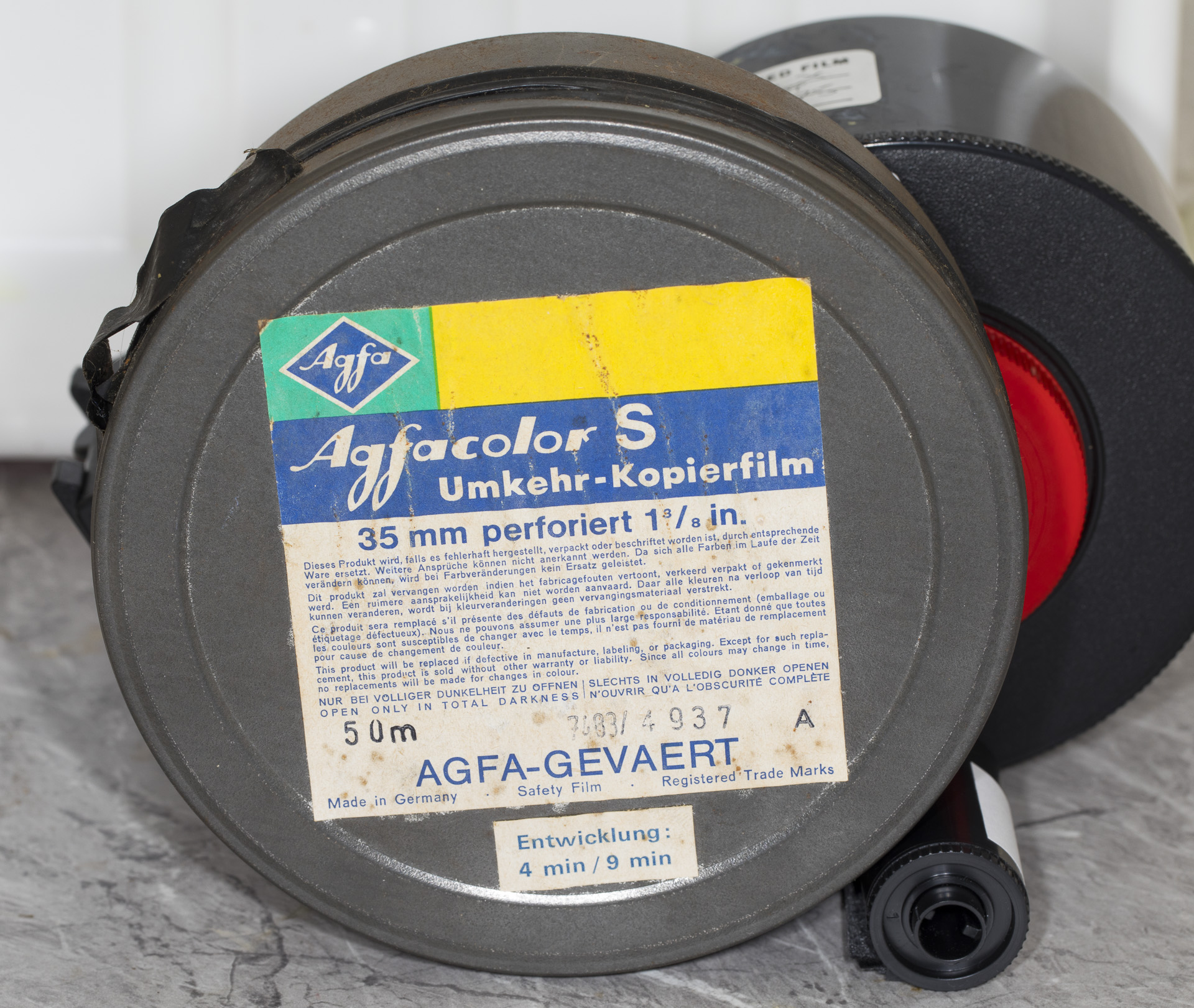
I have acquired a 50 metre roll of expired 35mm slide film that I would be happy to pass on to someone else in exchange for postage and a donation to 35mmc. Just how substantial a donation you will have to discuss directly with Hamish.
Before anyone gets too excited there are quite a few things to take into consideration, not least that I don’t know exactly what it is or how old it is. It is labelled Agfacolor S reversal copying film, in other words a dedicated film for making duplicates of slides. This is the label:
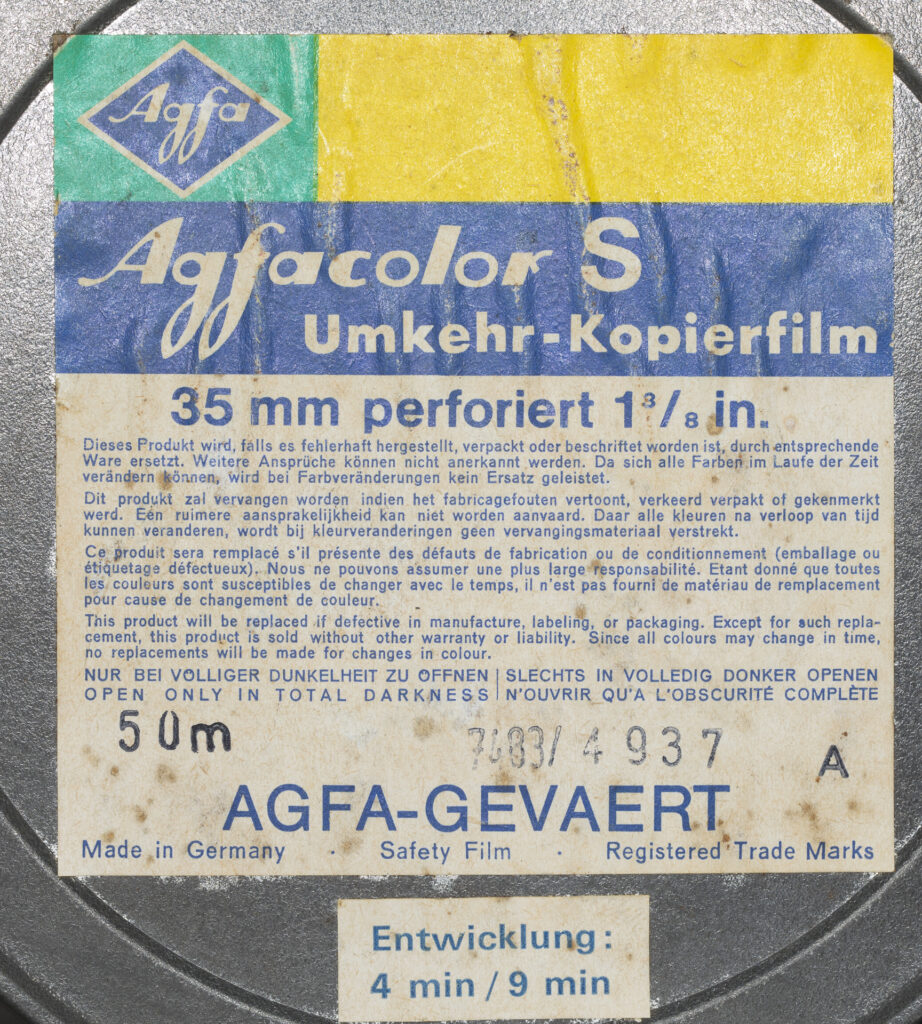
So now you know as much as I do.
Slide copying film is as the name suggests for making copies of slides. There were lots of reasons for doing this, many of us are old enough to remember when visiting a holiday location or tourist attraction gift shop there would be sheets of slides taken on sunny days for sale along with the postcards and tea towels. These you could then slip in with your own Kodachromes to try and convince friends and relatives who had holidayed in the sun of the Costa del Sol that it hadn’t rained for the whole of your miserable week in Llandudno.
Slide film is always high-contrast anyway, making duplicates with ordinary slide film increases the contrast even further and from experience rarely produces good results. The ‘4 min/9 min’ on the label likely refers to varying the length of one of the development stages in order to control contrast depending on the slide being copied. All I can find in addition is that Agfa copying film was available to selected laboratories only in 50m or 100m rolls and never in 135 cartridges. Clearly this film was intended for use in machines that could copy a single slide in large numbers and also duplicate a large number of original slides. There were also dedicated slide duplicating films made by Kodak and Fuji which seem better known than the Agfa film.
It is a 50 metre roll so will either need re-spooling to fit in an AP or Computrol type bulk film loader or to have access to a professional film loader or a large darkroom. The good news is the tin appears to have the original seal even though one end of the tape is frayed. The tin weighs 500g which is about right for tin + 50 m of 35mm film, so I don’t think it is somebodies sandwiches inside.
I don’t know exactly when it was made and have no idea how it has been stored for the last 50 years or so. The number 7483/4937 on the tin could relate to the manufacturing date and a batch number and if so would tie in with the tin of FP4 that came with it and that has a 1978 expiry date. The good news is that the FP4 is in excellent condition, but also take note of the “colours change with time” on the Agfa label.
Development will not be E6, I have no idea if it would be even possible in E6 chemistry. The Agfacolor reversal development process was quite involved, and this film may even have had it’s own dedicated developer. There might be more details inside the tin when someone unseals it.
At least there is plenty of film here for experimenting with.
If you are still interested after the above please get in touch with Hamish in the first instance. I am happy to post within the UK, or possibly it can be collected from mid-Wales or Worcester. For overseas it might be best to arrange your own courier. Definitely no returns on this, it will have been a donation after all.
Share this post:



Comments
No comments found