

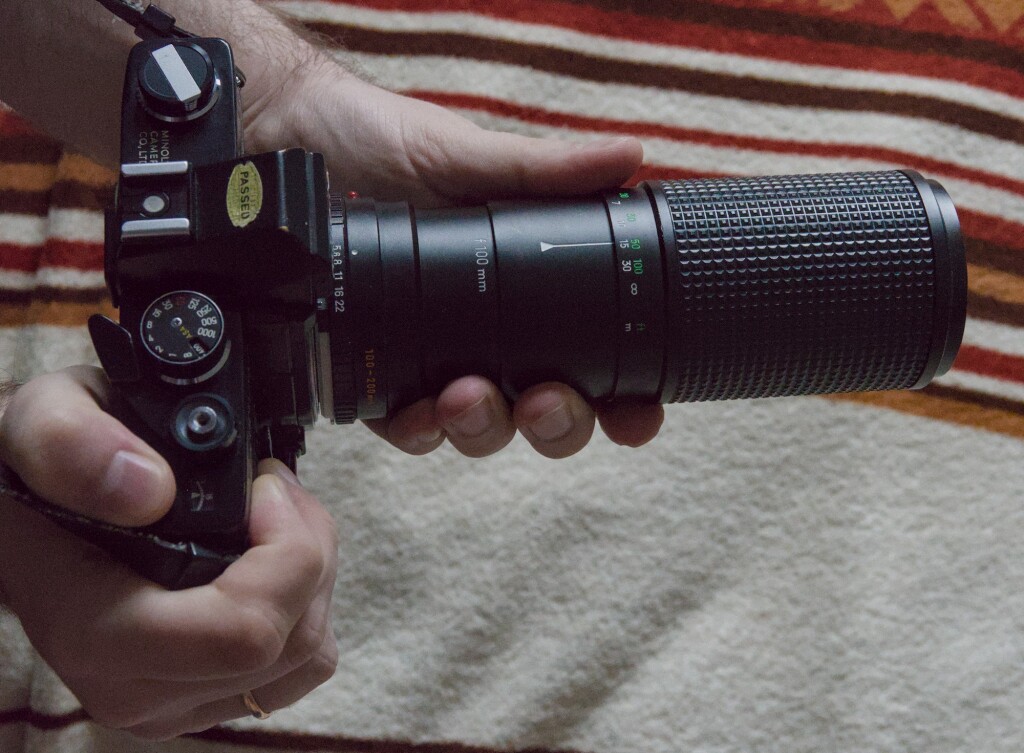
When I bought my first Minolta camera, it came both with a standard MD 50 mm 1.7 and a MC Rokkor 100-200mm zoom lens as a bonus. The camera was an SR-T 303 and quickly became my favourite. It’s beautifully minimalist yet ergonomic, and the nifty fifty has a pretty design, a perfectly damped focusing ring and an aperture ring with very practical stops and a nice feel. However, my relations with the zoom lens were more complicated.
Minolta is well-known for their high-quality lenses, and this one is not an exception. However, it’s an early zoom design with a, let’s say, number of peculiarities.
Throughout the post is a number of (admittedly bad) sample photos which I made with this lens. All of them are made with the Minolta SR-T 303 camera on different film stocks. The images were cropped only to remove dark edges after scanning.

Technical data
Minolta MC Zoom-Rokkor 100-200 mm is an early-generation zoom. It’s a push-pull design with the constant maximum aperture of 1:5.6. The focal length range is from 100 to 200 mm. Aperture stops are from f/5.6 to f/22, with half stops between f/8 and f/16, which is typical for Minolta lenses. Minimum focusing distance is a rather large 2.5 m. The lens is fairly narrow and long, with a common Minolta filter thread of 55 mm. The length of the lens varies from 175 (100 mm, focus at infinity) to 228 mm (200 mm, focus at MFD). Its mass is a hefty 581 g.
There were multiple versions of this lens in almost all generations, including the Celtic series. The optical design seemingly remained the same, and the different versions had only superficial changes like a clip-on hood instead of a threaded one in the latest model.

My experience
I have only used the Minolta MC Zoom-Rokkor 100-200mm from time to time. While optically it performs great, its handling is frankly subpar. Sometimes it didn’t get into my photo bag just because of its immense size.
Practically, it has quite a number of shortcomings. First, the consequence of the lens design is that it’s narrow and long, and the center of mass is pretty far forward. It gets worse at longer focal lengths, but is noticeable even at 100 mm. Heavier cameras like SR-Ts somewhat improve handling, however not by much. I can only imagine how much of a nightmare it would be on lighter cameras like XG. I couldn’t effectively use the lens handheld at shutter speeds slower than 1/125 at 100 mm, even when using additional support. All the optical elements are mounted in a traditional helicoid completely below the focussing ring (see the title image), and that glass is really heavy.
Second, it’s quite dim which makes focussing harder. Microprisms are obviously useless because of small aperture, which is really a shame as otherwise I strongly prefer them. But even using split-image isn’t straightforward – often you have to adjust your line of sight to make both halves bright enough. Maybe it’s easier without glasses, but it’s hard for me to actually check that – contact lenses make my astigmatism worse, and focus hunting with the split image becomes a real pain.
Third, a pretty small maximum aperture and a rather large MFD makes it somewhat cumbersome for portrait work, at least at the lower focal length end.

On the bright side, it’s still a Minolta lens. Of course it’s quite sharp at all apertures and focal lengths, and it truly feels like a quality product. In fact I’ve never seen any noticeable vignetting or sharpness loss at all, at any apertures.
Still, I’m not sure if I’m going to use this lens a lot. Its awkwardness is most likely the reason why this lens sells for a very low price. And, all in all, I prefer fixed lenses because of their lower weight and higher speed. Well, at least this lens looks great on a shelf.



P.S. The photos and the text are under the Creative Commons BY-NC-ND license.
Share this post:





Comments
Peter Roberts on Minolta MC Zoom-Rokkor 100-200mm – the Best Worst Minolta Lens
Comment posted: 04/01/2026
For something more manageable I would recommend a Rokkor 135mm, both the f/2.8 and f/3.5 give excellent results and obviously give a brighter image in the viewfinder.
Comment posted: 04/01/2026
Leonel Leyva C on Minolta MC Zoom-Rokkor 100-200mm – the Best Worst Minolta Lens
Comment posted: 05/01/2026
I had the same experience as you in the early 80s when I bought a Sigma 55-200mm zoom lens for my Ricoh KR-10Super... The lens seems large, slow, and impractical to carry around. However, I found a great use for it: portraits...
If you mount it on a tripod or attach a strap to your camera, the lens stays stable enough to take good portraits.
I encourage you to try using your zoom lens that way. I think you won't be disappointed...
Thanks for posting this article.
Cheers!
Walter Reumkens on Minolta MC Zoom-Rokkor 100-200mm – the Best Worst Minolta Lens
Comment posted: 05/01/2026
I'm not saying that Minolta made bad lenses. On the contrary. The "Minolta MD-Zoom 35-70mm F/3.5" was even relabelled by Leitz/Wetzlar as a Leica Elmar, even if some Leica fans don't want to read it. I also appreciate the Minolta SRT 303, which I have owned for several years and still enjoy using today with the aforementioned handy zoom and focal lengths of 50mm, 100mm and 200mm (MC/MD).
Thank you for the article, Alexander.