


For reasons I may not be able to fully explain (even to myself), but many 35mmc regular readers and contributors will understand, I own four different Leica 50mm lenses. Leica cameras have remained the dominant high end range finder camera through the entire 100 + year history of 35mm still photography, which began at Leitz Camera when Oscar Barnack decided he would create a small device to test film emulsions for their motion picture cameras. Barnack saw potential in a small lightweight handheld still camera, one thing led to another, and the rest is history.
Obviously, a huge part of the draw of the Leica system is the style, engineering, ergonomics and durability of their cameras, but there is also a tremendous amount of lore and opinion about the large number of lenses that Leica made over that 100 year period, most of which are fully compatible or easily adaptable with any M film camera made since 1954. Delving into that lore has lured me into buying and trying different lenses, including a wide range of focal lengths from 21mm to 90mm, and (up to this date) four different 50mm’s.
As I’ve discovered since joining the 35mmc community, I love a ‘project’ (some call it a ‘rabbit hole’) and the idea of doing some kind of lens tests/comparisons with my 50mms started to hatch during the long stretches of bitter cold weather and record snowfall of the Winter of 2025/26. At the start, I’d like to say that these are all amazing lenses, so any conclusions I might make are a matter of my personal taste as opposed to a universal objective evaluation of technical quality. Other photographers are likely to come to their own conclusions for excellent reasons, or have other lenses made by Leica or other great companies that they prefer. That’s why I’ve called this exercise the “Goldilocks” challenge. I’m looking for the lens that is “just right” for me.
The idea of a ‘battle of the 50mm’s’ seemed like a bit of fun and a good way to get some use out of those lenses, a few of which had not been in regular rotation for a good while. I thought I might learn some interesting things and see things a little differently than when I first tried them, having built up a good deal more experience shooting and looking at photographs. If this is valuable to readers who don’t share my visual aesthetics, it might be to get a feel for lenses they haven’t tried themselves or help someone who’s trying to figure out whether to invest in one of these lenses before they buy.
First, about the lenses — in order of acquisition, borrowing the “$” code for relative prices from restaurant reviewers:
$$$ – 1960 Summicron f2 Dual Range

This was the first Leica lens I purchased, heavily influenced by Ken Rockwell’s review calling it “the greatest lens ever made by LEICA” and going on to state that, “Its mechanics are significantly more solid and more precise than any other lens made by anyone — ever. ”
How could I resist?
However, my early efforts with the greatest lens ever made were not the greatest photos ever made. Of the few that were good, it was more by ‘right time, right place’ luck than talent, intention or technique. While the most important place to look to improve was on my side of the viewfinder, i.e., my photographer’s eye and brain, at first I sought external technical solutions to make my photos better. If a roll of Tri-X came back looking a bit muddy and flat, it was time to try another film stock as opposed to figuring out why my results were subpar on a film that has been loved and trusted by great photographers for over 75 years.
Another place I looked to improve was by exploring different lenses, so I decided I would try to solve my problems by splurging on a high end contemporary lens.
$$$$ — 21st Century Summilux f1.4 ASPH

After doing a lot of internet browsing, including listening to Youtube videos by well known Leica-themed reviewers like Matt Osborne, I settled on a second hand Summilux f1.4 ASPH. It was a $-stretch for sure — not quite as stratospherically unreachable as the $$$$$ Noctilux f.95, which will have to be reviewed by someone in a different tax bracket — but more than I ever thought I would pay for a single lens. I was comforted by the idea that Leica gear has such a robust resale market that it would likely hold its value, if not appreciate.
However, I didn’t immediately become a better photographer with the Summilux. If anything, I got a little worse at first because I wasn’t hitting focus in low light with that lens’s punishingly narrow depth of field at the open end of the aperture dial. And I was always trying to shoot in much lower light with the ‘Lux if I didn’t yet have the chops to get decent photos in those conditions. Why have f1.4 if you aren’t going to use it? Worse, I hadn’t learned to ‘see’ a potential photograph in terms what would make for a good composition or how the highlights and shadows would play on film. I was just firing away at anything in front of the camera and not always loving what was coming back from the lab, except for the occasional shot that worked for reasons I still didn’t fully understand or know how to reproduce in another time or place.
As I improved, I found that I was impressed by the Summilux, but I wasn’t sure I was in love with the Summilux. It felt like it had a kind of ‘cool’/cold precision and maybe had a bit of a ‘digital’ feel, even on film. But I really wasn’t in the market for another 50mm…
$ – 1949 Summitar 5cm f2

Having surfed too many camera-themed websites toward the end of 2024, I was talking myself into wanting a Barnack, and the local Calgary camera store had a very nice looking iiif. Their deal was that if I bought the camera, I had 24 hours to try it out and return it, no questions asked if it wasn’t for me. While we had a couple of Leica Thread Mount (LTM) lenses back home in the US which I could pick up over the Xmas holidays, I needed an LTM lens for the 24 hour ‘trial run.’ So, solely for the purposes of testing the Barnack, I “bought” a Summitar 5cm thinking I would return it and keep the camera.
As it turns out, I returned the camera and kept the lens, because the photos looked pretty cool but the Barnack user interface wasn’t so cool in the ice cold Canadian winter weather, at least for me. And the price was right, a fraction of the cost of my other Leica 50mms.
In the beginning, I just liked the idea of the Summitar, a Cold War-era diamond in the rough. It’s a little overlooked in the Leica lore between other more famous lenses and looks like a cross between Steampunk and early Space Race, with its solid brass collapsible construction and odd conical hood that looks like it could be made from the same material as the nose cone of a high altitude reconnaissance plane. LTM lenses are easily adapted to an M mount camera and once I put it on my M3, I was taken with the compact collapsible design which allows the fully assembled camera to slide nicely into a coat pocket — the world’s best pocket camera…
Oh, and roll after roll, the photos looked great!
Between ease of use and consistently great results, 5cm Summitar became my default lens for shooting on the streets of NYC. It is the lens on which I became truly at home on the M3, and where I developed my current style of shooting. Before long, the Summicron and Summilux were mainly used for special situations, like super close up shots with the Summicron’s Dual Range attachment, or low light situations with the ‘Lux.
That Summitar was the first Leica lens that I truly fell in love with!
$$ – 1957 Summarit (made by Taylor Hobson for Leitz) f1.5

Having developed a penchant for vintage lenses, I started to look into other makes and models that might be interesting to try, particularly from Leica’s chief rival in the 35mm range finder market, Zeiss. I spent a week or so doing a deep R&D dive into a Cold War era Zeiss Biotar 75mm f1.5 lens (in)famous for its wild, swirly and bubbly bokeh. In theory, I liked the idea of a fast 75mm that would give me something different from what I already had, a longer ‘portrait’ lens that would be good in low light. But the Biotar was pretty pricey and collectible, attracting people who want that quirky look for influencer videos. Hamish also tipped me off about some challenges adapting the Biotar to an M, and gave me some wise advice, ‘Quirky and cheap is fine, but I’m not sure quirky and expensive is a good idea.’ I decided to steer away.
We also talked about the Leica Summarit f1.5, which is known on the Leica roster for being the life of the bokeh party, but a much safer choice than the Biotar in Hamish’s opinion. But I wasn’t really thinking I needed yet another 50mm. That was until I came across a very nice looking Summarit at one of the big NYC camera stores for a pretty decent price. It was Christmas season, and it felt like a good way to kick things off with a bit of a self-present. Ok, while I don’t think I have GAS (Gear Acquisition Syndrome) when it comes to collecting cameras, I guess I do when it comes to 50mm lenses!
I understand that the Summarit’s lively bokeh is not everyone’s cup of tea, but it has a very different look and feel from any of my other lenses. To go with the bokeh, it’s lower contrast and a bit softer wide open, all of which contribute to a very vintage ‘lost film’ vibe. I’ve been having a blast with it!
And then there were four.
At least for now…
In terms of methodology for the “Goldilocks Challenge”, most important was that I wanted to compare the lenses in “live” shooting situations, using them the way I’d be using them on any other day. That means out and about mixing with people on the streets of NYC. And one of my favorite spots for that kind of shooting is Washington Square Park in the heart of Greenwich Village, which is a magnet for all kinds of fun people doing fun things.

I wanted to match the quality and conditions as best I could between all four lenses, so I decided to shoot everything on the same emulsion – Ilford Delta 100. I chose a slower ISO stock because I wanted to shoot a range of f stops from f8, where most lenses perform at their best, to wide open where the real character and ‘personality’ of a lens is revealed. Late afternoon into dusk is my favorite time for shooting, and also the perfect time to roll through the widening apertures.

I knew I would have gotten deep in the weeds trying to do all four lenses at one time, so I decided to shoot the lenses in pairs, side-by-side with two cameras so I could see how the lenses looked in more or less matching shots. After some internal deliberation, I decided it made sense to match up the maximum apertures, so it would be Summilux vs Summarit in one session and Summicron vs Summitar in the other.

While I enjoyed the thought exercise of coming up with the methodology for doing these lens comparisons, once I had settled on a plan, I ended up hesitating for a couple of weeks. In part, I was waiting for the weather, but also I was feeling anxious about asking people to sit for me while I shoot more or less identical photographs of them with two different cameras. It felt a little self-indulgent. When I did that kind of A/B side-by-side shooting on my B&W emulsion tests, at that stage of my development in the spring/summer of 2025, I was shooting mostly inanimate subjects and it was easy to swap backs on my Hasselblad 500CM on a tripod. Given where I’ve gone in the last seven or eight months since then, that approach wasn’t going tell me what I needed/wanted to know about how I was going to use my Leica 50mm’s in 2026 +. I had to do the tests out and about with live people as my subjects!

I toyed with different ideas for shooting a single camera and swapping lenses to avoid asking people for repeated parallel shots, but nothing seemed like it would be as informative as getting two ‘live’ shots as close to each other as I could by swinging a camera strap on each shoulder.


Then toward the end of February, I had plans to be in NYC for a couple of days with matching forecasts of sunny and unseasonably warm weather. I knew that people would be coming out to enjoy the weather and thought it would make for some fun shooting, and I could try out all four lenses in pretty similar conditions over two consecutive afternoons.
So if I was ever going to do it, that was as good a window as I was going to find.
I wasn’t disappointed!
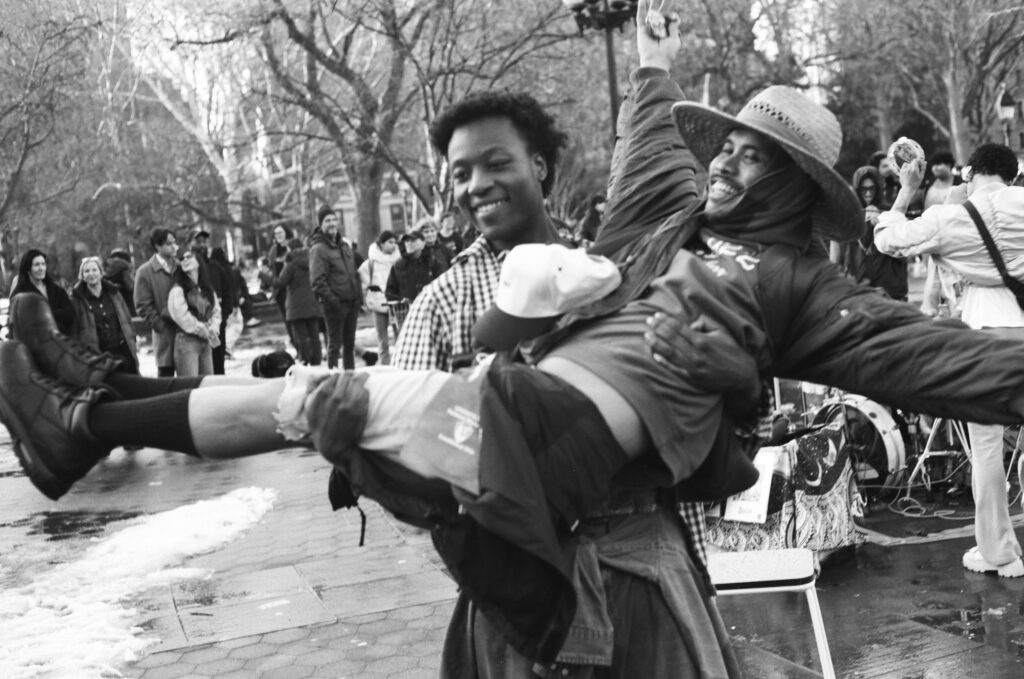
Stay tuned for the next installment in the “Goldilocks Leica Lens Challenge” — Summarit f1.5 vs. Summilux f1.4 ASPH!
Feature Image: NOLA SUPERSTAR, Leica M3, Leitz Summicron 50mm f2, Ilford Delta 100
Share this post:






Comments
David Hill on Leica 50mm Lenses – The “Goldilocks Leica Lens Challenge” – Introduction
Comment posted: 06/04/2026
I am doing a similar, much smaller, exercise, comparing my 1985 50mm f2 Summicron M with my 1942 5cm f3.5 Elmar (+ adapter); and my 1954 Summaron 35cm f3.5 with a modern Voigtlander Nokton VM MV II. I am using a range of subjects and lighting conditions, but unfortunately most of the shots are still in camera! I do like the results the old Elmar gives with my IIIc and am interested to see the difference with the Summicron.