

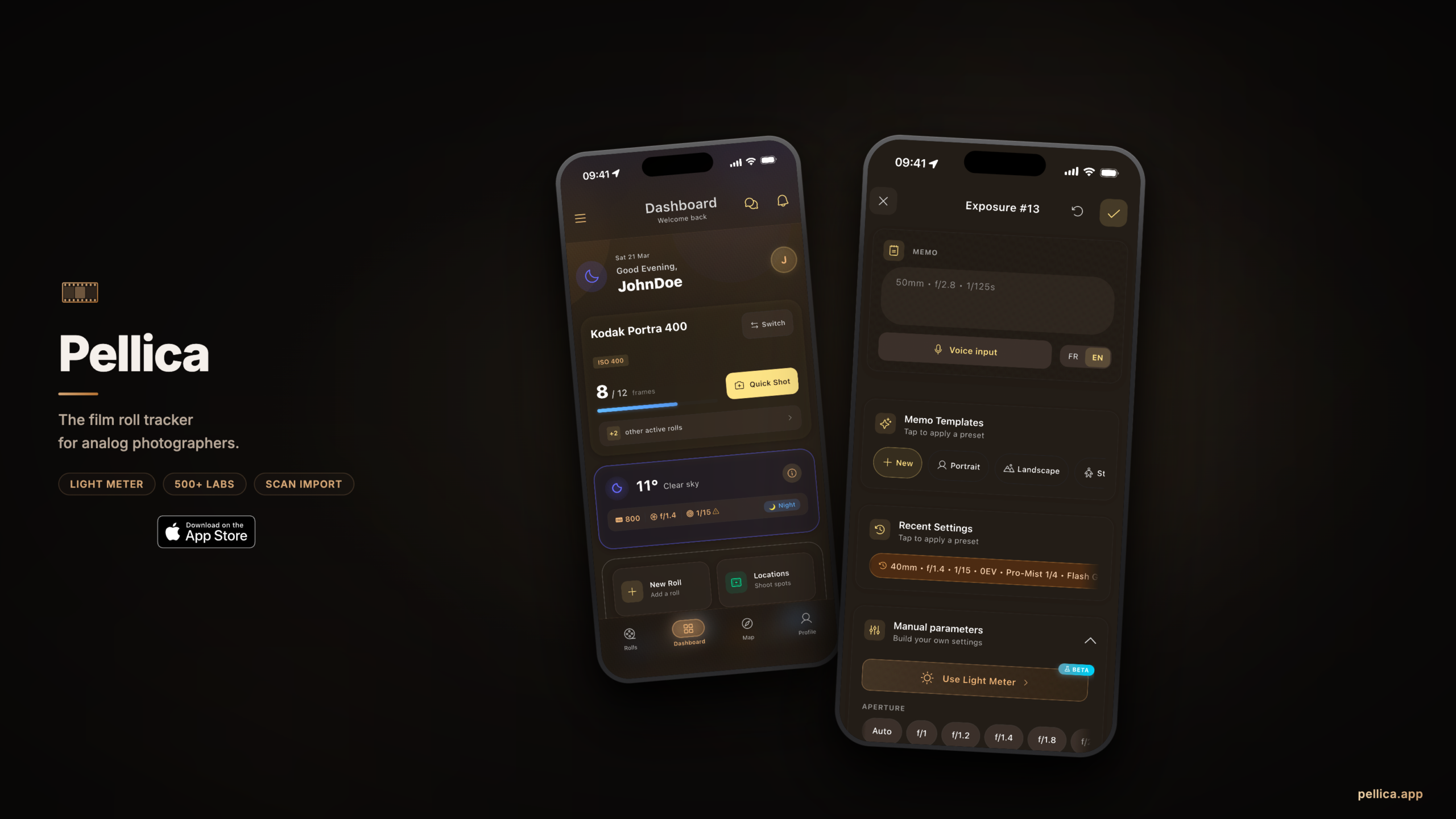
Last November I sent three rolls to my lab and more or less forgot about them. When the envelope came back three weeks later I spread the negatives on my desk and tried to work out what I’d shot. Frame 14 was a cafe window on the Rue de Bretagne — soft light, a woman reading, the kind of frame I’d been chasing for months. I had no idea what settings I’d used. I’d pushed the roll, I was sure of that, but by a stop or two I genuinely couldn’t tell you. My notebook was at the bottom of a bag somewhere and when I eventually dug it out, half the entries were smudged and most of the rest turned out to be from a different roll I’d shot in October.
I looked at that cafe frame for a long time. I couldn’t remember how I’d made it, which meant I couldn’t make it again, which meant I hadn’t really learned anything from it. That was the thing that got me building Pellica.
Why nothing I’d tried had worked
I’m a software developer and I shoot film. Mostly 35mm. Tri-X when I want grain with some weight to it, Portra 400 when the light is doing something unusual, and expired stock from the Saint-Ouen flea market when I’m feeling relaxed about the outcome. I’ve been at this for around four years, which is long enough to have opinions and short enough to still get things wrong on a regular basis.
Like most film shooters I know, I’d tried a lot of ways to keep track of exposures. A pocket notebook I once got caught out with in a Belleville downpour. A Google Sheet I’d open with good intentions and then never fill in. Two or three apps that each did one slice of what I needed but that couldn’t talk to each other. And an awful lot of entries in my iPhone notes that read something like “f/8, maybe 1/250, cloudy??” — which isn’t really data, it’s guessing with extra steps.
The real issue wasn’t that I was lazy. It was that none of these tools fit the rhythm of shooting. You see the light change, you meter, you press the shutter, and the scene has already started to move on. Nobody is going to pull up a spreadsheet in that moment. I wanted something that understood that a logging app has about five seconds of your attention before it becomes a nuisance.
A weekend project that wouldn’t stop
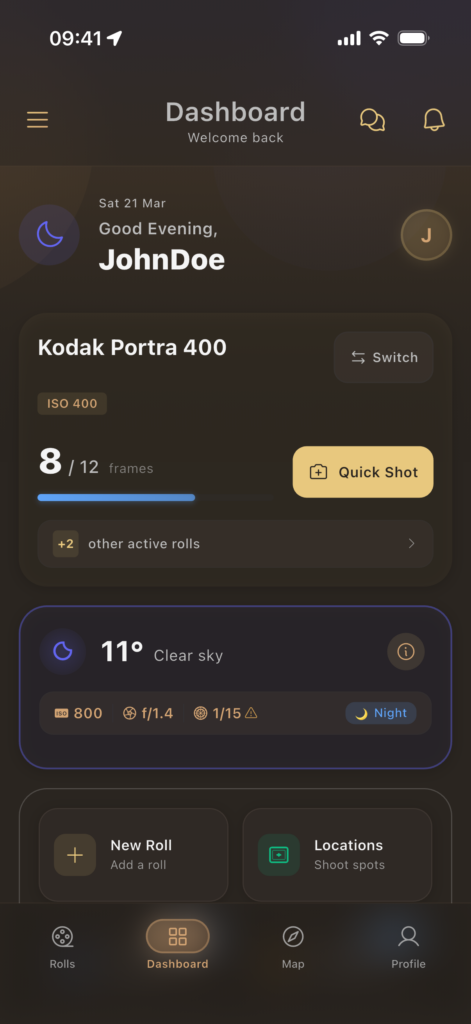
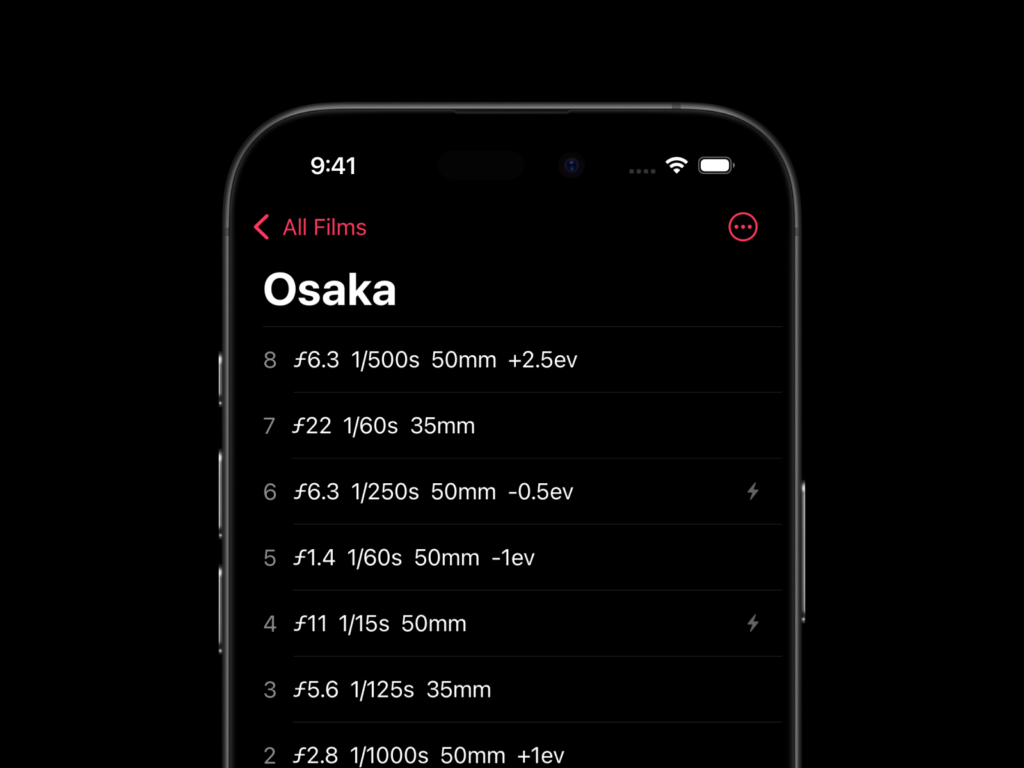
I started on a Sunday in April 2025 with something very simple — tap in aperture, shutter, ISO, move on. That was the whole thing. I used it for a week, then added GPS because I kept forgetting where I’d been standing. Then weather, because my shadows in January and my shadows in June were telling very different stories and I wanted to see why. Then scan import, so I could line up each exposure with the image it produced and finally close the gap between what I’d done and what I’d got back.
Every roll I shot added something to the app. I don’t think I ever sat down and wrote a roadmap. It grew more like a garden does when you keep pulling out whatever bothers you and planting something better in its place.
What a shooting day looks like now
Here’s a concrete example. Last Saturday I was out with Tri-X pushed to 1600, overcast afternoon, around 8°C. I see something — guy on a bench reading the paper, nice rim light coming from a shop window behind him. I meter, I shoot, I tap the screen twice. Aperture, shutter, done. GPS and weather go in on their own. I don’t think about it again until the scans come back.
Three weeks later each frame is sitting next to its data. The one I like — the bench shot with the blacks that almost touch and the highlights that cling to his newspaper — was f/2.8 at 1/60, metered off the shadows. The one two frames over that looks flat and muddy? Same settings, but I’d metered off the window. Seeing those two frames next to each other with the decision I made made visible is where you start to learn properly instead of hoping. That’s how it works for me, anyway. I realise some people enjoy the mystery of not knowing and I won’t tell them they’re wrong.
The five apps I don’t open any more
Before Pellica my film workflow was scattered across at least five things. A notes app for exposures. A separate light meter. Google Maps searches whenever I needed to find a lab in a new city. A spreadsheet for stock I had in the fridge. And a kitchen timer for home development, which worked about seventy percent of the time and failed in creative ways the rest of the time.
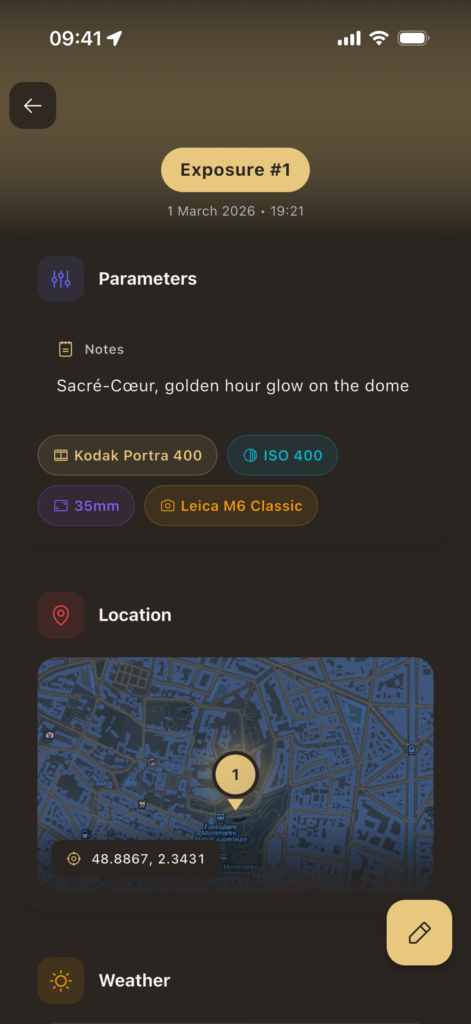
I didn’t set out to replace any of them. I just kept running into the seams between them, and fixing each seam turned into another feature. There’s a built-in light meter now with reciprocity tables for 48 stocks, which I use more than anything else when I’m doing long exposures on Acros. There’s a map of over 500 development labs worldwide with community ratings, which came directly out of a trip to Lisbon where I nearly ruined two rolls trying to find anyone who still processed E-6. And there’s a development timer for C-41, E-6 and black and white, with agitation reminders that have saved me more than once from forgetting an inversion on HP5.
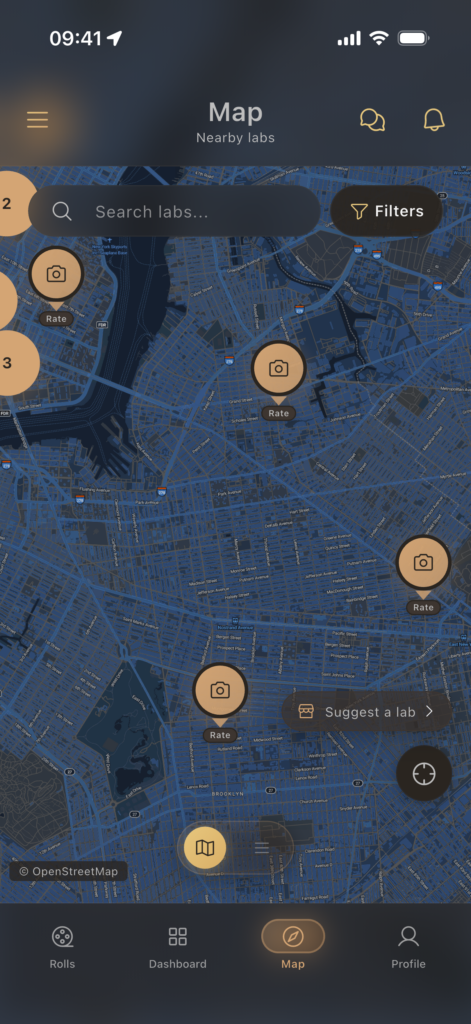
None of this was planned. Each piece exists because I hit a problem and thought, I can fix that before the next roll.
What I owe this site
I should be straight about one thing. 35mmc played a direct role in Pellica existing.
This is where I learned to meter for pushed Tri-X. This is where I first read that overexposing Portra by a stop isn’t a mistake, it’s a choice. The way I think about film was shaped in large part by the articles on this site, and that thinking is baked into how the app works.
Pellica doesn’t tell you how to shoot. It doesn’t grade your exposures or recommend settings. It makes it easier to remember what you did so you can draw your own conclusions from it. That’s pretty much the philosophy I picked up reading here over the years — look, try, look again, adjust. Nobody’s going to hand you the answer and honestly the app isn’t trying to either.
One person, working evenings
There’s no company behind Pellica. I’m not raising anything, I don’t have a team, I haven’t written a pitch deck and I don’t plan to. It’s me, between shooting sessions, trying to make the app a little better each week. Some weeks I do a lot. Some weeks I just shoot instead.
It’s free to download on iOS, with a Pro tier that lifts the roll limit for people who shoot more than a handful a month. It works offline, which matters to me because I’ve shot in parts of the Pyrenees where my phone hasn’t seen a signal in hours. Your data stays on your device unless you choose to sync it. There’s support for six languages right now and the Android version is with Google for review as I’m writing this.
If you try it and something feels off — a flow that’s clunky, something missing, an opinion about how film logging should work that I’ve clearly got wrong — I’d like to hear from you. I read every email that comes in. It’s still small enough that I can.
Pellica on the App Store · pellica.app
I am Imad Djebarni and I shoot 35mm in Paris. You can reach me at co*****@*****ca.app.
Share this post:

Comments
Jukka Rrimola on Pellica – Why I Built an App to Track My Film Rolls
Comment posted: 06/05/2026
Comment posted: 06/05/2026
Bradley Newman on Pellica – Why I Built an App to Track My Film Rolls
Comment posted: 06/05/2026
Comment posted: 06/05/2026