Experimenting with IR filters

By Roger

Hamish’s recent post of the brown, dried grass on Old Hills reminded me (very slightly!) of the surreal false colour effects that can be got with IR converted cameras and it also made me wonder what IR would do to dried-out grass. I already thought I needed more practice at using one filter I have never managed to get satisfactory results with. I have taken plenty of IR photos using a conventional 720nm filter that have produced moody monochrome images, but have found false colour more difficult. So I went out to compare the results with a group of filters.

The cameras were full-spectrum conversions (ie the manufacturer’s IR/UV cut filter has been removed and not replaced with anything else, so you need to add the required filter). The filters I decided to test were the ones that give false colour: Kolari IR Chrome; ZB2 “deep blue” filter; Hoya Orange O(G) filter (around 590nm); and a Kolari Hot Mirror IR/UV cut filter (ie visible light). Because the IR Chrome is 67mm and the Deep blue and Orange are 49mm, I decided to reduce changes by taking two cameras, a Sony A7R2 with Tamron 17-28 (great for IR because it has no hot spots, and a rather older Nex 6 with Sony 18-55. Files were processed in ON1, but I used DXO PhotoLab to do the equivalent of channel swapping.

The essence of work with such filters is processing to get the results you are looking for, so showing pure, unprocessed images would not be much use. I started with a shot I thought should help me see the differences clearly. The visible light filter shows the colours that were there, though I remember the trunk of the silver birch as standing out a bit more. Maybe a cloud went over the moment I took this, or perhaps it just needs a slight tweak to the brightness. Unlike the Old Hills, in Hamish’s post, there is still green here, due to the gorse and other shrubs i the dried out grass.
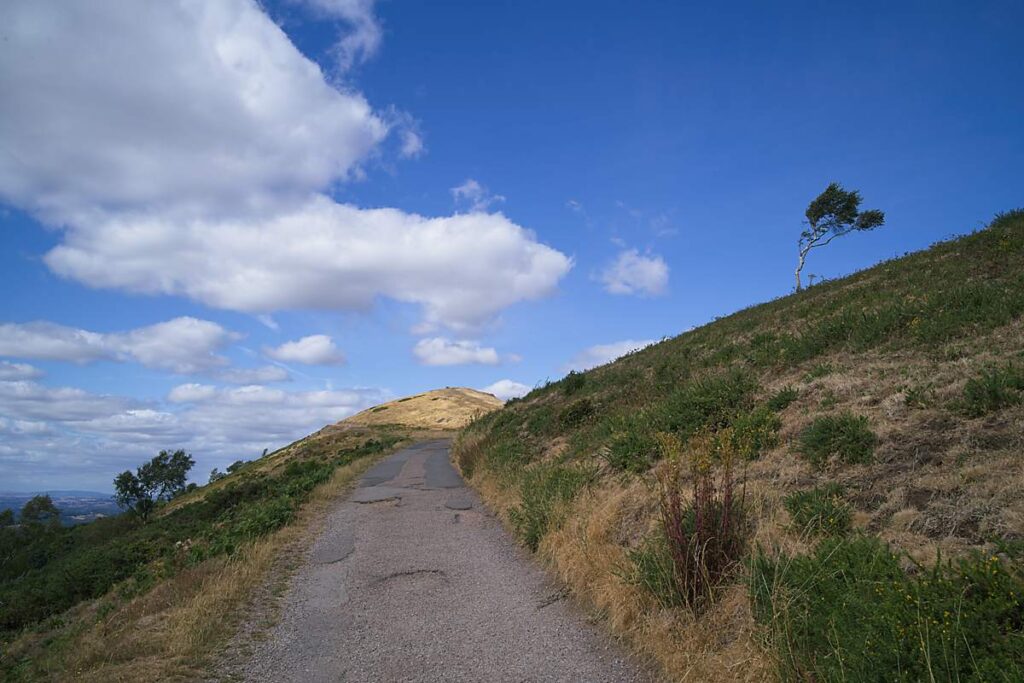
Visible light

For the following two images, I decided to normalize by setting the white balance using the white patch of the cloud nearest the centre of the image. The browned grass
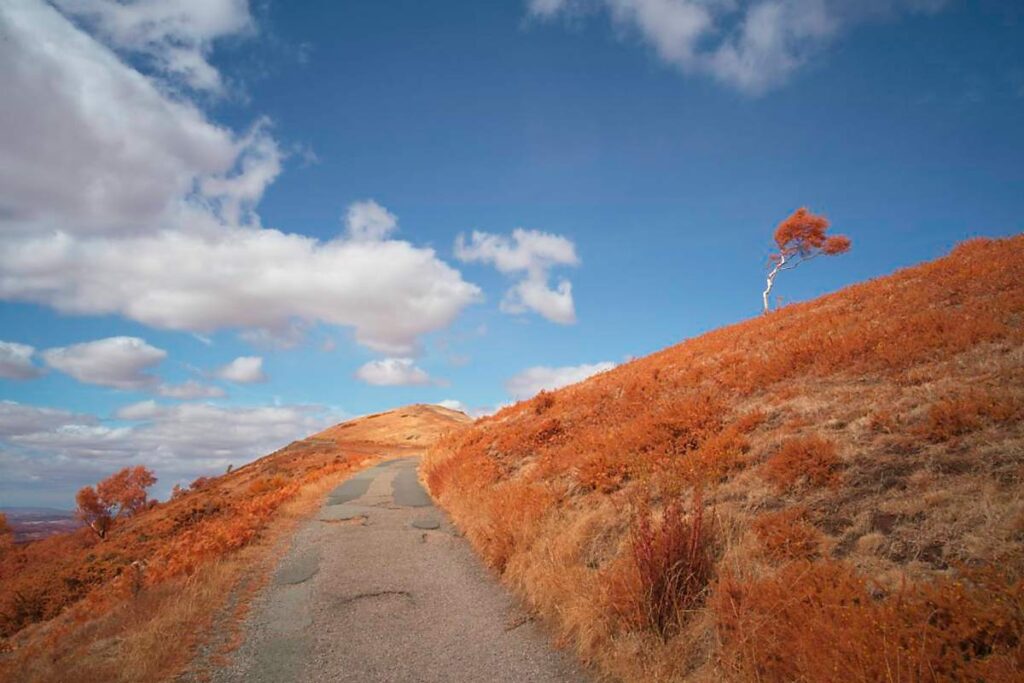
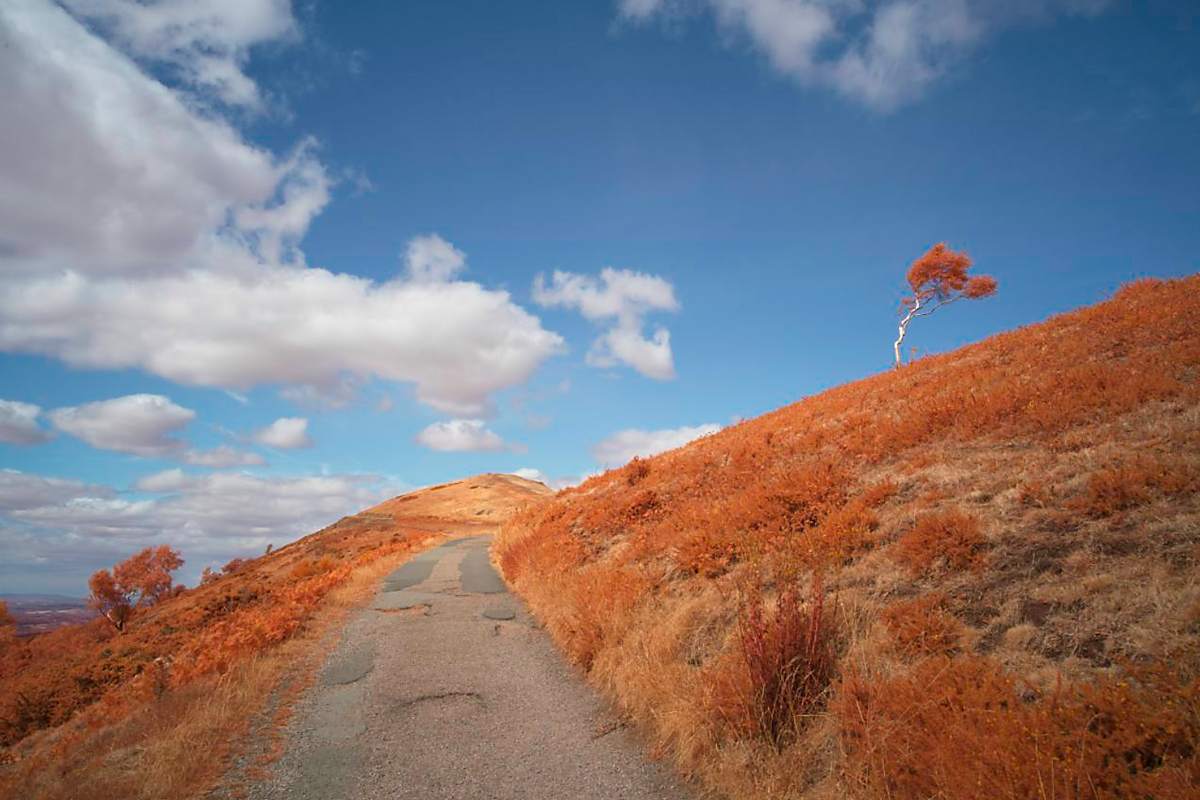
Kolari IR Chrome filter, white balance set on central cloud (also featured at the top)
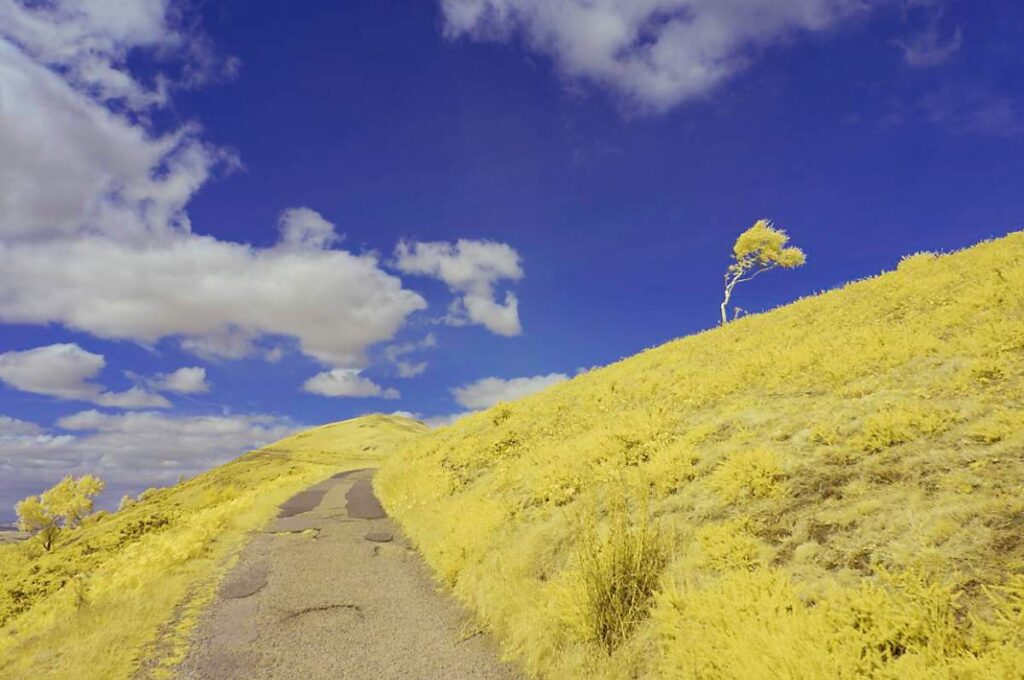
Deep Blue filter, white balance set on central cloud

Quite a difference. The yellow could be adjusted to give a result more like the other but, if it is possible to make them the same, it is beyond my skill level. They are different. There doesn’t seem to be the same range of tones in the vegetation. An alternative strategy is to set the white balance using one of the tones in the vegetation. In the past, I have had interesting results this way, with the foreground in monochrome, as looking much as if it were a regular IR image converted to mono but with a dramatic blue sky. However, in this image there is too much contrast between the green and brown vegetation for that.
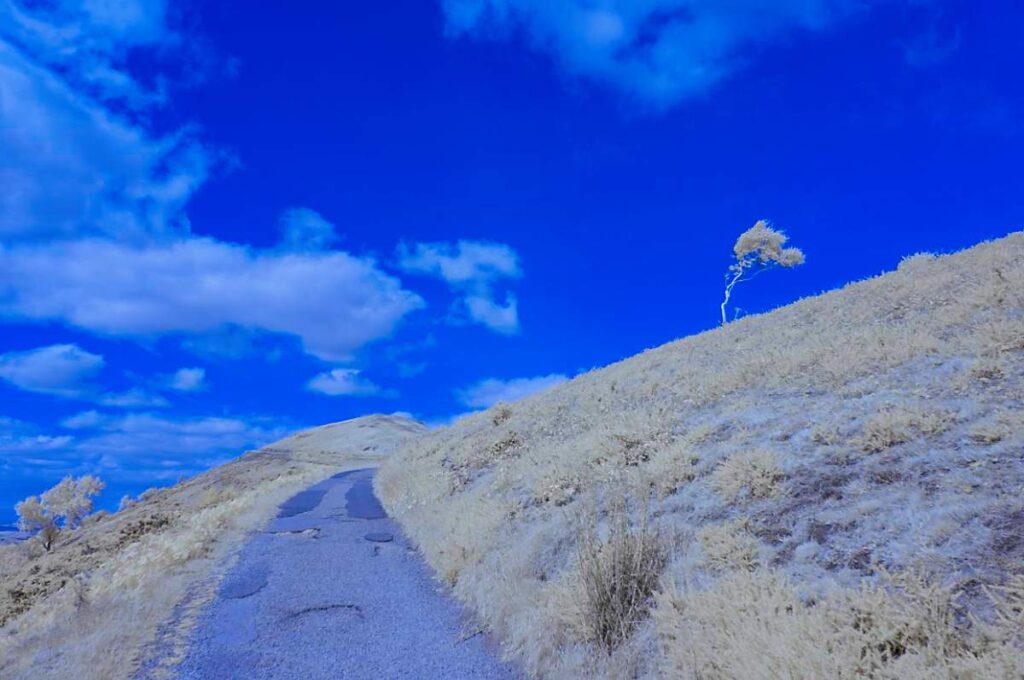
Deep blue filter with white balance set on piece of vegetation

Next, an image taken with the orange filter that will be familiar to B&W film users. This needed a bit more processing (equivalent of channel swapping). Three stages (learned from Alan Burch’s infraredcameraconversions web site). First set the white balance on the clouds, then change the sky to as natural a blue as possible, and then turn the vegetation to the desired shade of orange or pink, according to taste.
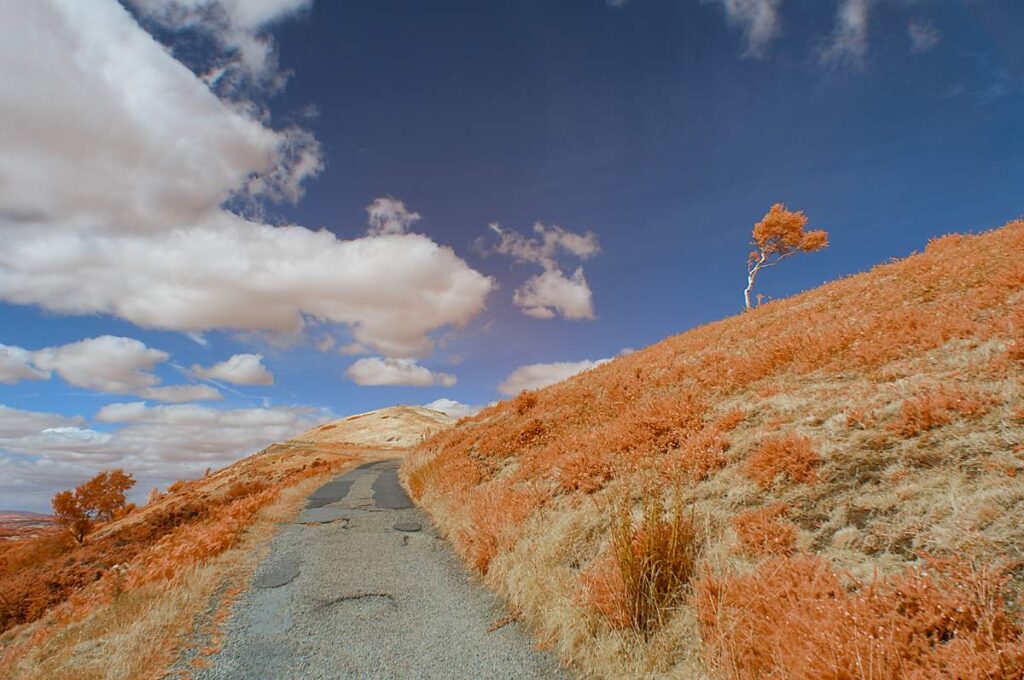
Hoya Orange filter

Of this series, this is probably the one I would go for, though the IR Chrome colours could be better in some shots.

For a different type of lighting, I also tried a view under some trees (my choice of locations on the hills was limited).
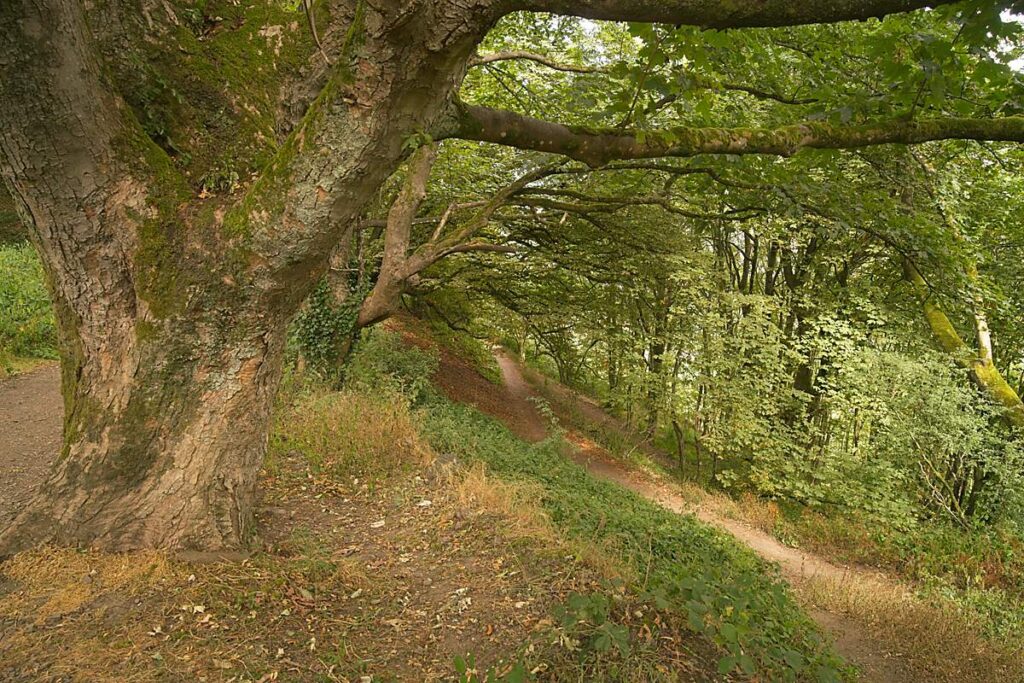
Visible light

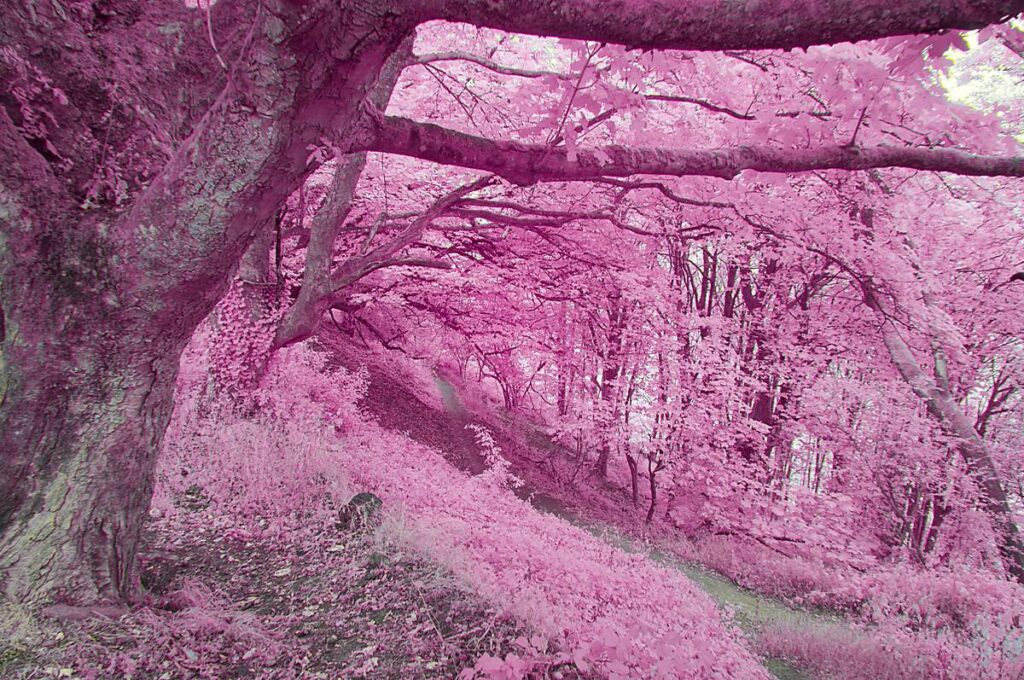
This time, the unprocessed (camera set to AWB and colour setting on normal) IR Chrome shot, and one processed to do the type of pink vegetation I associate with David Clapp (though not in the same league as his!).
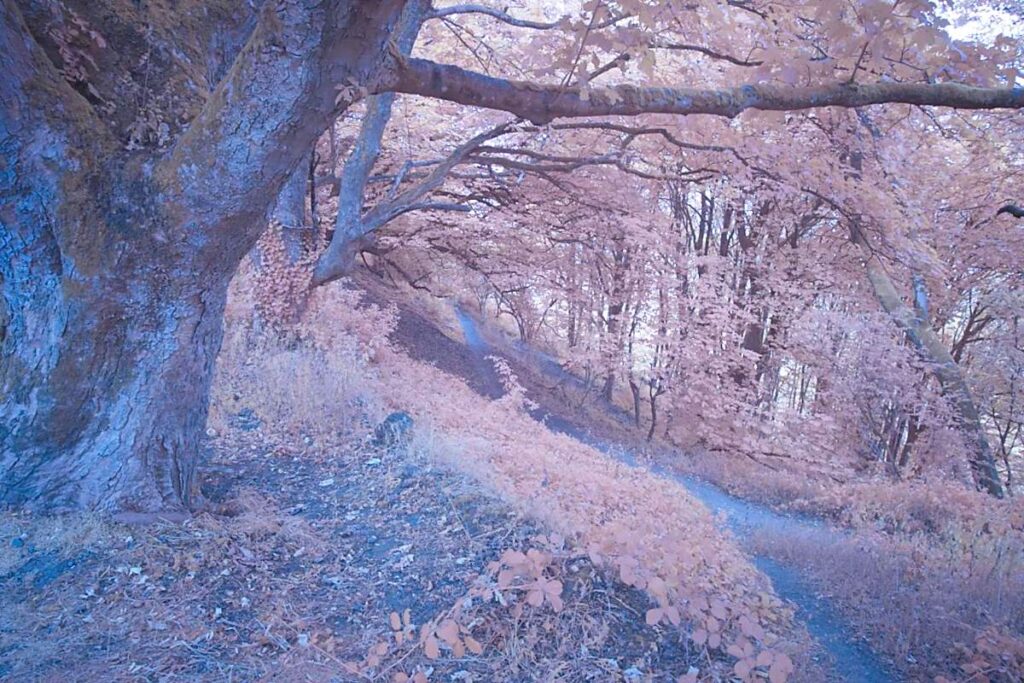
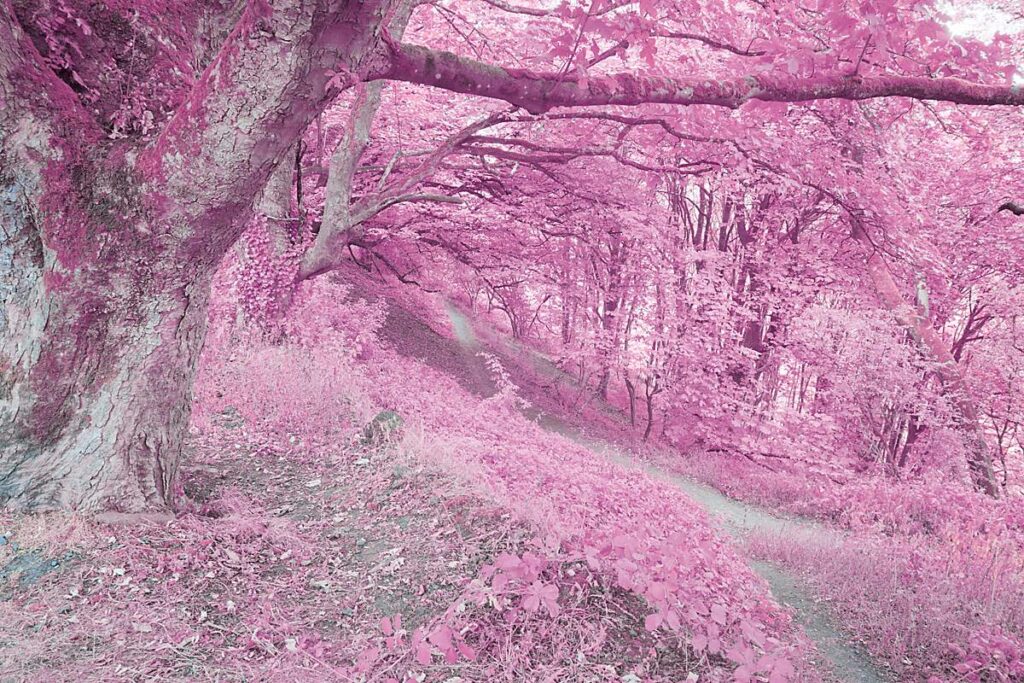
IR Chrome filter (AWB, normal, out of camera)
IR Chrome filter with adjustments

Here, its almost as though these trees have sprouted cherry or plum blossom, and the blue cast on the ground and trunk has gone. With this view, a similar effect can be obtained with the Deep Blue filter.
Finally, a more conventional IR for comparision. Converted to mono and adjustments made to contrast.
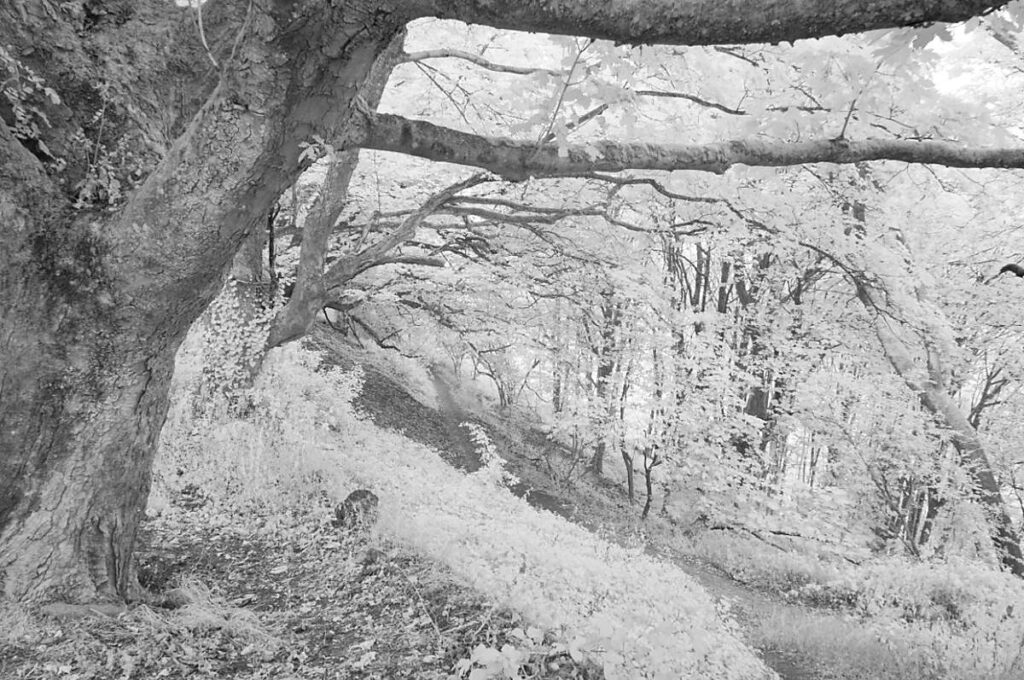
These aren’t great images, and I’ve still a lot of work to do working out how to use these filters, but I hope they show some of the effects that can be obtained.

Share this post:

Find more similar content on 35mmc

Use the tags below to search for more posts on related topics:

Donate to the upkeep, or contribute to 35mmc for an ad-free experience.

There are two ways to contribute to 35mmc and experience it without the adverts:

Paid Subscription – £3.99 per month and you’ll never see an advert again! (Free 3-day trial).

Subscribe here.

Content contributor – become a part of the world’s biggest film and alternative photography community blog. All our Contributors have an ad-free experience for life.

Sign up here.

Make a donation – If you would simply like to support Hamish Gill and 35mmc financially, you can also do so via ko-fi

Donate to 35mmc here.

Comments

Hamish Gill on Experimenting with IR filters

Comment posted: 10/09/2026

I'm pleased this is where your mind went. I did go off in a tangent about the abstraction of shooting black and white and how the grass being the wrong colour reminded me of that - this feels like the logical end point to the conversation.

As an aside, did you watch the recent Lord of the Flys adaptation - they used Kolari IR chrome filters in it to really great effect, I thought!
Reply

Leave a Reply

Your email address will not be published. Required fields are marked *

Roger on Experimenting with IR filters

Comment posted: 10/09/2026

No, I have not seen the film. I am intrigued that someone would use such a filter for a movie. But this serves as a reminder that this has been a strange summer visually as well as in other ways.
Reply

Leave a Reply

Your email address will not be published. Required fields are marked *

Hamish Gill replied:

Comment posted: 10/09/2026

There’s a lot of use of abstraction in the series - IR for one, but lots of use of ultra wide, fish eye and anamorphic lenses. I got a lot of bad reviews for it, but I thought it was a brilliant use of abstracting techniques to build on the vibe.

Reply

Leave a Reply

Your email address will not be published. Required fields are marked *

Jeffery Luhn on Experimenting with IR filters

Comment posted: 10/09/2026

Very informative article! Nice images. Thanks!
Reply

Leave a Reply

Your email address will not be published. Required fields are marked *

Gary Smith on Experimenting with IR filters

Comment posted: 10/09/2026

Thanks for your article. Some time ago I had my gx85 converted by Kolari to 590nm and in hindsight maybe I should have gone with full-spectrum and filters. 590 seems to be a one trick pony. I recently revisited Kolari and noticed that they now have quite a few pre-converted cameras (older point-and-shoots) available.

@Hamish - I had recently started the new Lord of the Flies but didn't finish it. As a result, I never noticed the use of IR (assuming it wasn't in the earlier installments).
Reply

Leave a Reply

Your email address will not be published. Required fields are marked *

Hamish Gill replied:

Comment posted: 10/09/2026

What made you stop? You would know it if you saw it - low key shots with very red leaves

Reply

Leave a Reply

Your email address will not be published. Required fields are marked *

Gary Smith replied:

Comment posted: 10/09/2026

Lost interest, I guess. I know I had to read it as a kid in school and I vaguely remembered parts but for whatever reason, it just didn't pop for me.

Reply

Leave a Reply

Your email address will not be published. Required fields are marked *

Roger replied:

Comment posted: 10/09/2026

Full spectrum is obviously more versatile but you can still put a 720nm or 850nm filter over the top of it and get the same results as with the 720/850 on its own. So your gx85 is at least a two-trick pony. I just checked and I got the same exposure time with orange+850 as with 850 on its own. (I hope it is not too off-topic, but as for the choice between 720 and 850, the most important factor is whether your camera has PDAF; if it does, then avoid 850nm as it will give you unsightly sensor lines in plain areas, though in some images you might have to up the contrast to see them. This is one reason why the Sony A7R is better than for conversion than the A7R2 or later models; it is not such a good camera overall but it does not have PDAF.)

Reply

Leave a Reply

Your email address will not be published. Required fields are marked *

davesurrey replied:

Comment posted: 10/09/2026

That's a very useful tip to avoid converting any camera that uses PDAF. Thanks

Reply

Leave a Reply

Your email address will not be published. Required fields are marked *

Roger replied:

Comment posted: 10/09/2026

I'd say definitely avoid converting a PDAF sensor to 850nm, but other filters appear to be fine. My A7R2, with PDAF, is the camera I use most for IR. Some people say that 850 nm gives B&W results with more contrast and needs less processing than ones taken with 720 nm, but my reaction is that there is in practice not much difference (other than the absence of sensor lines). Of course, maybe I am not sufficiently discriminating! Modern sensors are sufficiently good that it is usually easy enough to boost contrast if this is wanted.

Reply

Leave a Reply

Your email address will not be published. Required fields are marked *

Michael Murray on Experimenting with IR filters

Comment posted: 18/09/2026

The effects are certainly interesting, but the selection of scene is what stands out to me. That first image is a great scene for this type of photography. Great eye.
Reply

Leave a Reply

Your email address will not be published. Required fields are marked *

Leave a Comment

Leave a Reply

Your email address will not be published. Required fields are marked *