

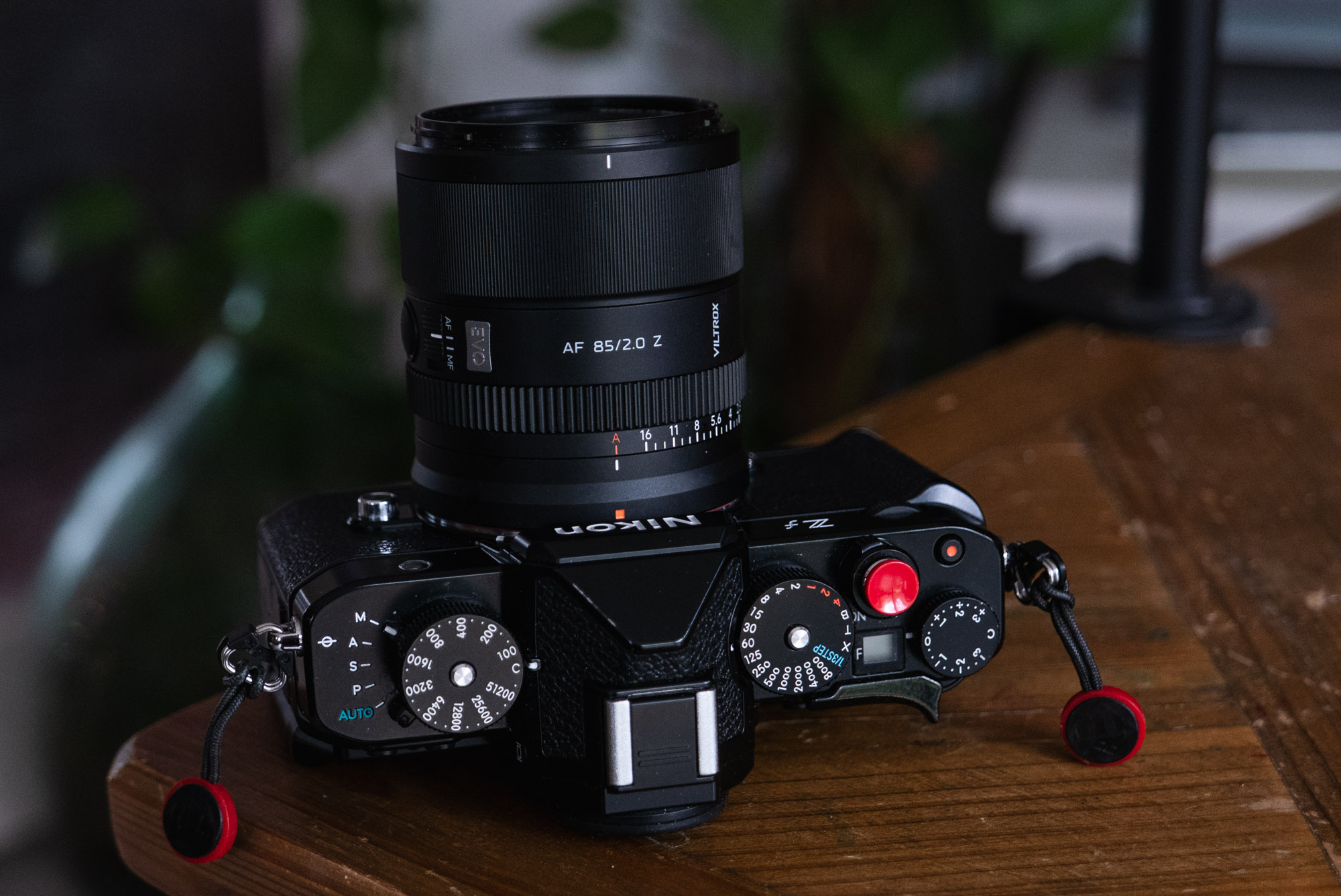
The Viltrox 85mm f/2 Evo is the lens I wished I was reviewing when I was writing about their 85mm 1.8. I really liked that lens, but there was something about its bokeh, its larger size and the lack of aperture control that combined to just put me off from it being the ideal carry-everywhere. As someone who prefers a short tele lens over any other focal length, it felt important for me to find a near-perfect lens for this role on my Nikon Zf. Half way through the review I was made aware of the forthcoming Evo lens first in Sony mount but also coming soon in Z mount. I pored over the initial limited information, and then lapped up what I could read about it as copies started landing with reviewers. Could this lens be the perfect AF carry-everywhere lens for my new Nikon Z mount adventure…?
Well, spoiler alert, the answer to that question is yes, it turns out it is. But, more than that, for the shockingly small amount of money this lens costs, it feels to me like it even further challenges any need to look at 1st party lenses than I felt the f/1.8 lens did!
Now, to be fair, I think what might be happening to me here is that I am just further catching up with something that’s been going on for a quite a while now. These days 3rd party lenses are offering a much more serious alternative to the 1st party offerings. Actually to give myself some credit, I’ve not been totally in the dark about this. Some years ago now – before I even stopped shooting my Nikon digital SLRs in favour of Sony mirrorless cameras – I had bought myself a Sigma 50mm 1.4 Art lens which optically at least seemed to me to be higher quality than anything from Nikon at the time. I could list a good few other examples since, but all would be from much more longstanding brands so perhaps it shouldn’t come as too much of a surprise that they are now able to challenge what the 1st party brands offer. What’s changed more recently is that the likes of Viltrox have arrived on the scene.
The first I really heard about Viltrox was from Dustin Abbot when he talked about their 16mm 1.8 here. Bastian has also reviewed it here with similarly glowing comments. What’s really quite remarkable about Viltrox having brought that lens to market was that they were a relative newcomer to the marketplace and were releasing lenses that had features and qualities that placed some of their lenses on par with – if not in advance of – the 1st party equivalents, and at a much lower cost to the consumer.
Now, as I’ve talked about in all my reviews of 3rd party AF lenses, the one variable it’s hard to really measure is how well these new lower cost 3rd party lenses will stand up to the rigours of time and heavy use. In another life, I am a professional photographer, and when in that mindset, I still often prefer to use 1st party lenses as – though they’re not immune to failure – I do have more trust in them to not let me down… Which is much more important to me as a photographer who’s being paid. But, the more I use these 3rd party lenses – especially those from Viltrox – the more that bias is being chipped away. In the meanwhile though, I am very happy using them for my hobby!
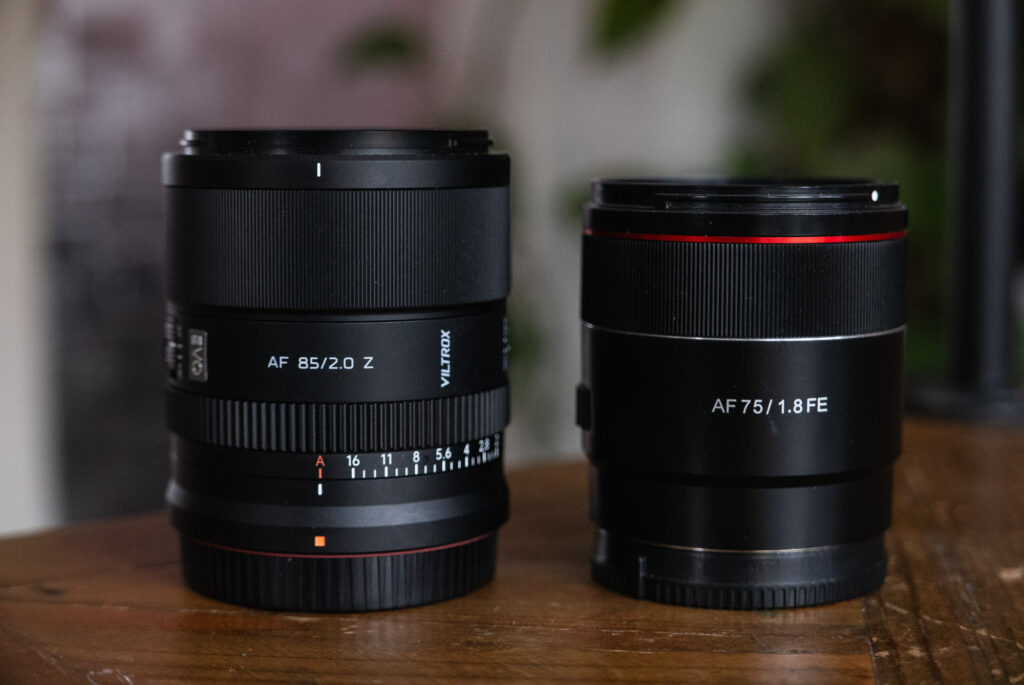
The Samyang factor
Before I get into this review, I have one last bit of context to talk about, and that’s my beloved Samyang 75mm 1.8. This lens was a revelation to me! It’s small, light weight, high optical quality… at least my copy is (apparently copy variance is a factor with these lenses). It’s a great lens, and when I swapped to Nikon from Sony having the adapter to allow me to carry on using it on the Nikon was a big deal to me. The 85mm f/1.8 was never going to replace it either. When I was reviewing that lens, I often thought about having the Samyang to fall back on. It’s not a perfect lens though. The AF is a bit shit (terrible for video), it doesn’t have an aperture control, and I found the button and mode switch on it pointless and annoying to the point I thought I would never use lens function buttons. But for its size and quality, I loved it and was convinced I wouldn’t sell it. This Viltrox 85mm f/2 has definitely convinced me otherwise… it has even converted me to the benefits of lens buttons! (More on that below). Let me know if you would like to buy my Sony mount Samyang 75mm…
The Viltrox 85mm f/2 Evo build
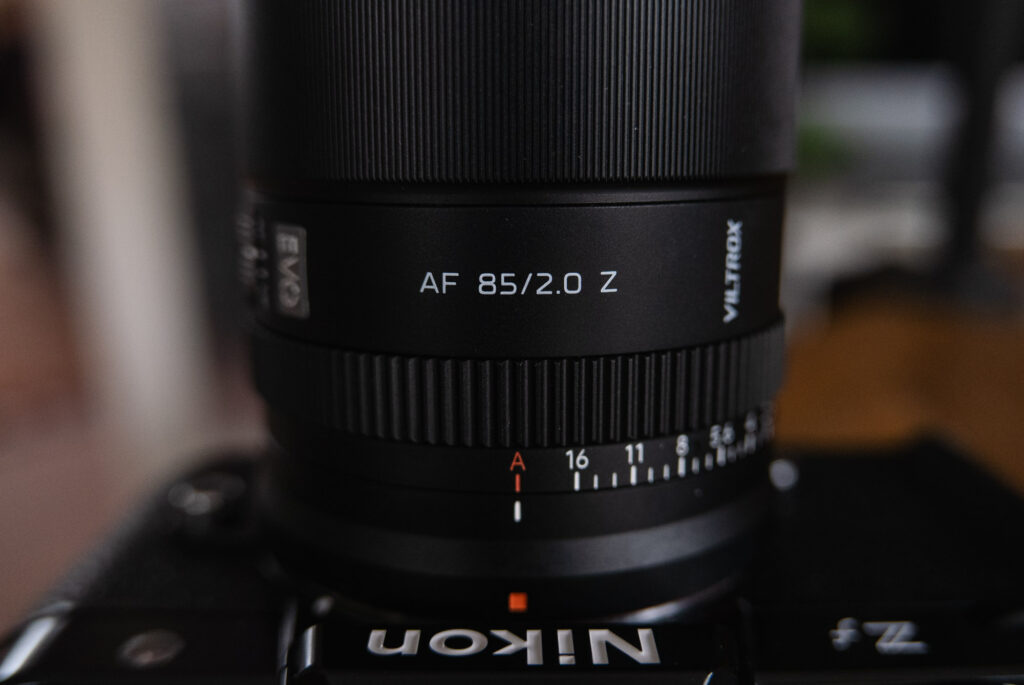
Ok, I’ve set your expectations quite high now, so I’m going to start by telling you the single thing I specifically don’t like about the Viltrox 85mm f/2 Evo… I don’t like the colour of the materials it’s made out of. Perhaps this is petty, or nitpicking, or whatever. But really, I have struggled to find much else negative to say about it. It’s just not quite black enough and as such is not a great aesthetic match to the Zf. With that said and done, otherwise I have no real complaints about the feel and build quality of the lens.
A tour of the lens
Starting at the base of the lens, it has a metal lens mount. As is often the case with 3rd part lenses these days, it also has a USB-C port for updating the lens firmware.
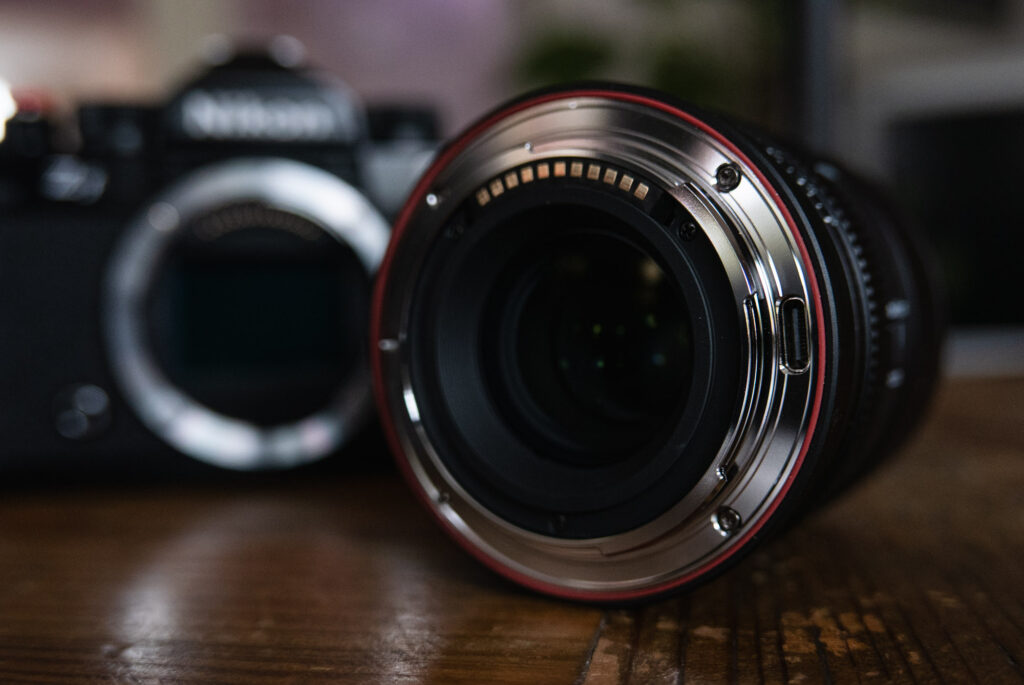
Unlike the 85mm f/1.8, this new Viltrox 85mm f/2 Evo also has a weather sealing rubber ring. I read somewhere else online about this that it might not indicate full weather sealing of the rest of the lens, though I guess at least it would help reduce water ingress into the camera mount. I honestly, don’t even know how well the Nikon Zf is weather sealed either, and am not really that keen in being out in the rain to take photos, so none of this is particularly relevant to me. If this is relevant to you, based on what I have read elsewhere, I would suggest doing more research before assuming that this rubber ring means you can take it out in a deluge of rain!
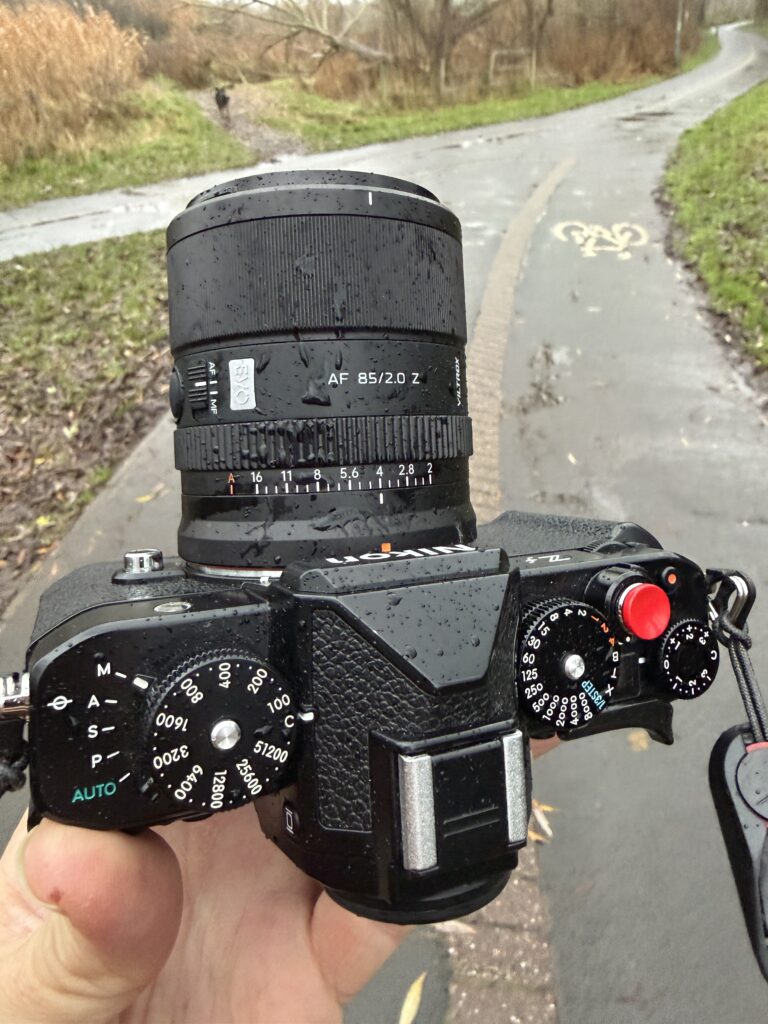
Moving up the lens, the next part of the body seems to be metal and feels nice and solid. Then we have the aperture control which I think is also made of metal. There is a switch to set it to either click or not. With it set to click, it clicks nicely and (unlike the 7Artisans 35mm) each of the intermediate 3rd stop markers actually relate to a 3rd stop. If it’s set not to click, it also rotates nice and smoothly.
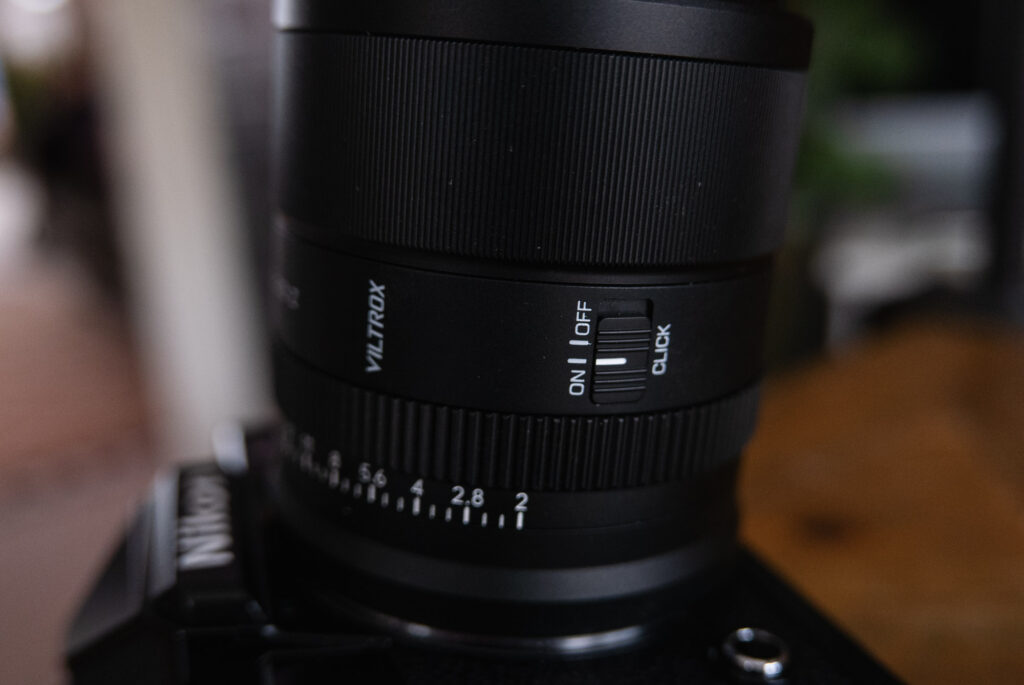
The next section of the lens between the aperture control and focus control is made of plastic. This bit feels more hollow when you tap it – though it doesn’t necessarily feel cheap. This is also where you find the click switch for the aperture control, the AF/MF switch, and also a function button, all of which feel perfectly satisfactory to click/press. I will come back to their use in a moment.
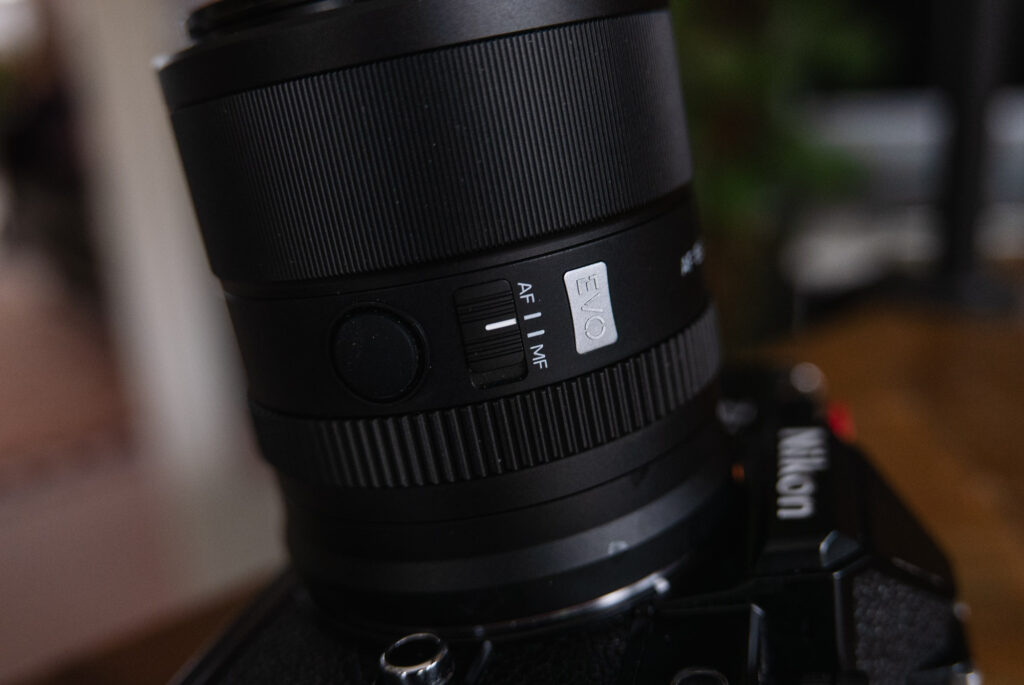
Next is the focus control which again I think is made of metal. This really is very smooth to rotate – though not quite as satisfying as a “proper” mechanical focus control, for what it is, it’s very nice!
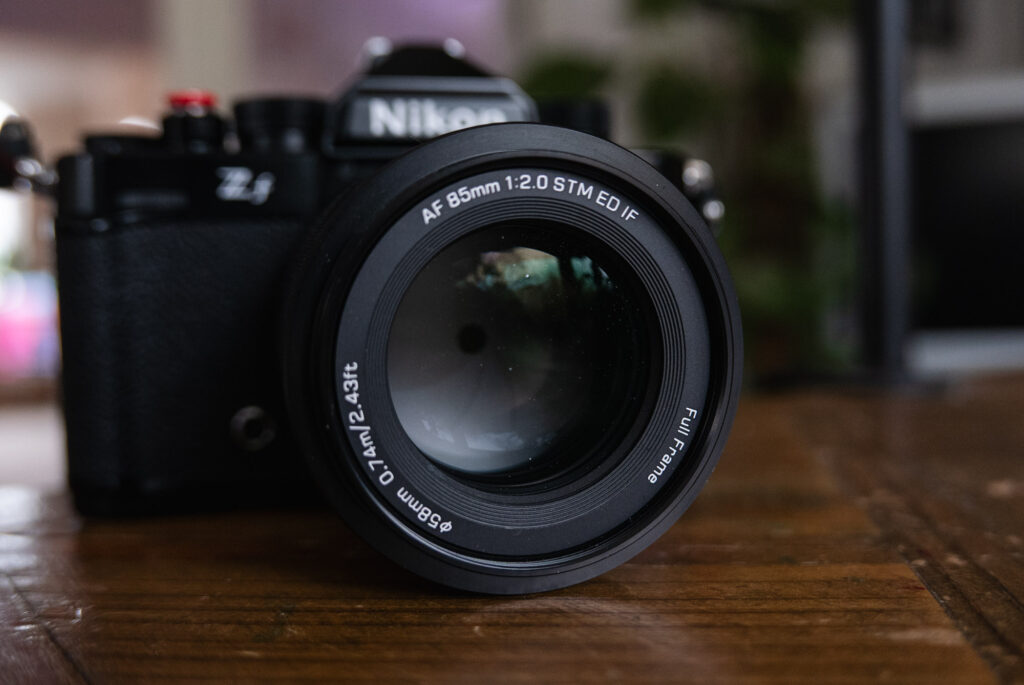
Forward of the focus ring, the front most part of the lens is also made of metal which also includes a bayonet mount for the plastic nicely fitting hood. I actually have one small quibble with the lens as you look at it front on, and that’s the little bit of text that indicates the lens is “full frame” – I’m just not sure who Viltrox thinks needs to know this by reading it off the front of a lens…?
Features
As is probably clear from the above, the Viltrox 85mm f/2 Evo has a few more features than the f/1.8. It also has a few more features than many of the Nikon 1st party lenses too. For me, this is a bigger deal than I probably thought it ever would be.
Since buying the Sony 24-70 GMii at work, I have grown to really appreciate an on-lens aperture control. Since picking up the Zf, I missed one on the 85mm 1.8 and really appreciated it on the 7Artisans 35mm 1.8. When this lens was released, I was very pleased to see it as a feature. An on-lens aperture control just makes sense to me – I don’t think that this is through some sort of nostalgia for older kit, I just find being able to change the aperture with my left hand on the lens and shutter/exposure compensation with my right hand on the camera more of a comfortable/logical shooting experience. I’ll talk about this more when I review/write about the Zf.
I don’t really use the aperture click switch – I am sure some people who shoot some sorts of video do, but I just leave it clicked as in this use case it makes more sense when clicking through the settings and looking through the viewfinder of the camera seeing the settings change.
I also don’t use the MF/AF switch. I have my Zf set up so the AF is activated by a separate button press from the shutter button, so I don’t need to be able to switch a lens to manual focus. I don’t really manual focus with AF lenses much anyway. Again, this is more fodder for the Zf review.
A feature I am learning to love is the on-lens Fn button. I am currently juggling options around whether I use this for an additional AF activation button or a AE-L button. Yet more fodder for the Zf review – once I have figured out what setting works best for me… but the point is, having this button on the lens is definitely proving itself as something beneficial to my shooting experience. As someone who usually finds more buttons and features annoying, this comes as a surprise even to me to be honest, but I’m very happy it’s a feature here nonetheless!
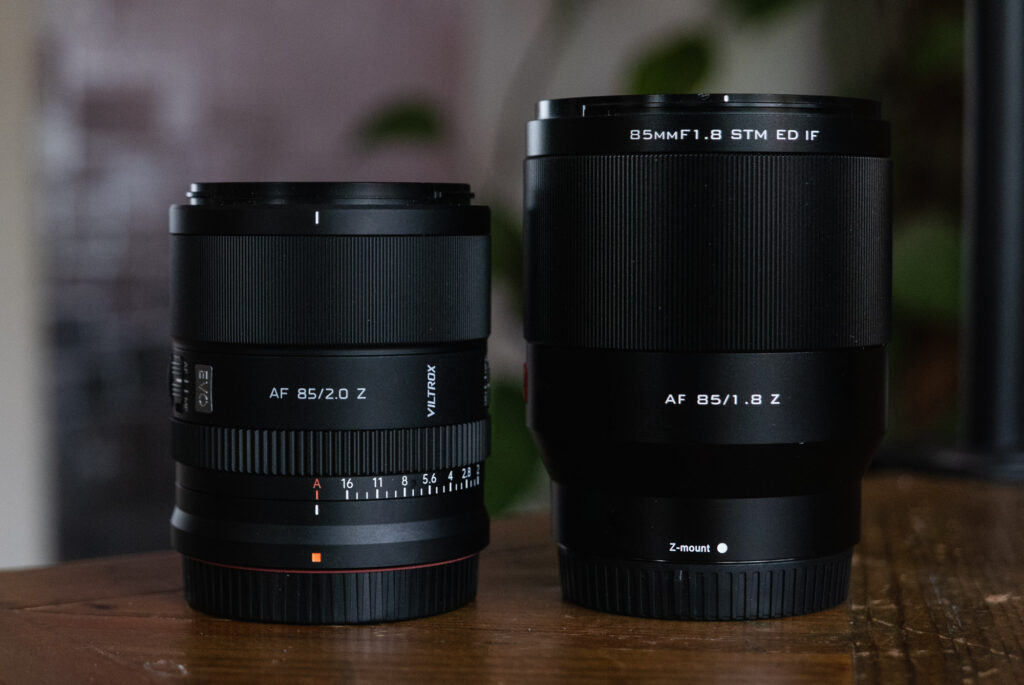
Small size
Pretty much above all this though is the small size of the Viltrox 85mm f/2 Evo. I have a huge bias toward smaller camera equipment – the original purpose of this website was to talk about compact film cameras, and whilst that purpose has somewhat slipped, my personal interest in smaller kit has never changed. The Zf isn’t a tiny camera by any means, so having smaller lenses for it feels almost essential to me enjoying it as a camera!
AF Performance
As I’ve talked about in my other two Z-mount AF lens reviews, my comparisons have mostly been with Sony cameras and lenses, most notably the 24-70 GMII, which is a truly remarkable lens when it comes to AF performance, especially when mounted on the Sony A7iv I have been using it on. I’m also discussing the AF capabilities of these lenses in the context of use on the Zf, which happens to have really quite exceptional AF capability itself. Essentially what I’m saying is that comparisons are with very high end lenses, but I’m also giving these lenses a bit of a leg up by using them on a very good camera.
I have found the Viltrox 85mm f/2 Evo to have pretty impressive AF performance on the Zf. For all of my usual requirements, it’s worked great. That said, when I have pushed it, I can see its limitations. In lower light I found it a little more sluggish – not to the point of it not working, it just seems to work slightly more slowly. I also found the tracking performance not to be quite as high compared to the Viltrox 85mm f/1.8 when trying to take photos of my daughter on her go-kart – I still got great shots, but the hit rate was slightly lower. Now I must admit that I haven’t done any precise side-by-side comparisons, and indeed I would have expected this newer smaller lens with lighter weight optics to perform better than the older bigger lens, so the issue might simply have been that I was taking snaps of her on the go-kart in slightly lower light with this lens.
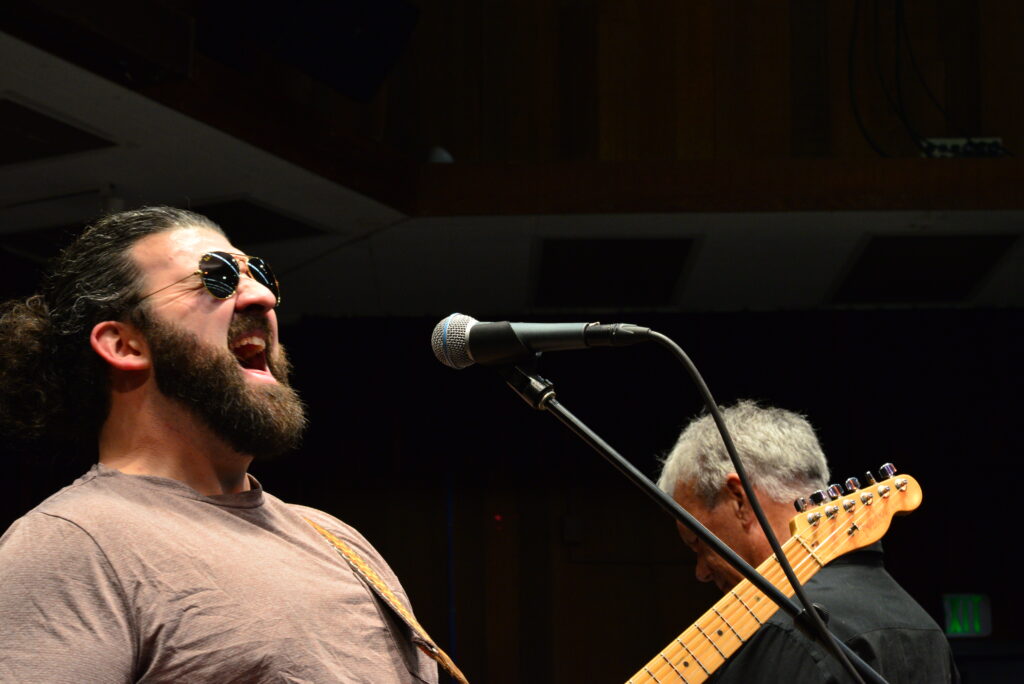
 One way or another, as I say I have found and come up against the limitations of autofocus system in the Viltrox 85mm f/2 Evo a couple of times, but importantly for my use case as a hobby photographer with this lens, none of those cases make up anything like a significant volume of how I am likely to use this lens. For normal day-to-day snaps of the family (even moving around a bit), and the more general way I use an 85mm lens I have found it to be totally fine. I’ve even used it for work a couple of times at events and found it to keep up with me more than adequately. Where it would fall apart for me is within what I think of as the most difficult use case within my photography which is when I am moving around on stage taking photos of performers that are also moving around on stage. Anything that involves fast or erratic moving subject matter is where I think the most advanced modern AF systems are useful. For most other things, lenses as good as the 85mm Evo are perfectly adequate!

Image Quality
If you ask me what sort of lenses I like, overall I would tell you I have a preference for what I call character-lenses; lenses that impart something quite obvious of themselves into my photography. I run a company that makes these sorts of lenses and market them toward an audience that understands that there’s more to photography than seeking or aspiring toward some sort of objective form of perfection that’s defined through factors such as corner to corner sharpness, etc.
The reality is though, I find pretty much all lenses fascinating. It’s a little too easy to write modern lenses off as lacking character or being clinical – I’ve done it myself many times. In reality, all lenses have some sort of character to them, it’s just a case of getting under their skin a bit and seeing what they do in different shooting conditions. Modern lenses with the increase in precision in manufacturing are possibly harder to tell apart, but the differences are still there. At no time in my career as someone who reviews lenses has this been more clear to me than through the process of reviewing two 85mm lenses from one brand in quick succession. This comparison has also made it even more clear what characteristics I prefer in modern lenses. In short, whilst I was impressed by the 85mm 1.8, I was left feeling a little like it wasn’t perfectly my cup of tea, whereas this Viltrox 85mm f/2 Evo very much more is. As I have talked about above, there is definitely an element of bias toward this lens because it’s well built, has features I like, and is small, but I believe the image qualities it produces are also much more appealing to me.
Sharpness
The Viltrox 85mm f/2 Evo is always sharp. Of course it’s slightly softer wide open, diffraction kicks in stopped down, and corners are softer wider open. All of these normal traits apply, but wider-open softness and corner issues are so slight that I have genuinely struggled to notice them in my results.
I was out on a dog walk a few weeks back enjoying taking photos of silhouetted trees in low light. I was just shooting at f/2, not really thinking about what I was doing particularly, and then later looking at them on the computer noticed that the sharpness fall-off in the corners is really not all that noticeable at all.
 And then have a look at this shot with Norah’s eye/eyelashes centre frame at f/2.
 Whilst the Viltrox 85mm f/2 Evo always sharp though, I don’t find it to be inorganically or clinically so. That is to say, I don’t feel like it enhances people pores in their skin in the way some lenses do (the Sony 24-70 GMII is one that comes to mind).
In summary, this is a lens that absolutely no consideration is required toward whether or not it is going to perform well in terms of sharpness, anywhere within the frame, at any aperture, at least until it’s stopped down enough for diffraction to kick in. Now, as I’ve said, I am not too fussed about lenses being specifically corner-to-corner sharp for a lot of my uses. I don’t often aspire to the sort of photography that requires such a feature from a lens. But, when I can have this level of objective quality at my disposal for just normal day-to-day snaps when I don’t want to think about wrangling character traits… well, I’m certainly not going to quibble it. Especially when it’s from a lens that’s this size, and indeed costs what it does!
Bokeh
I really wanted this lens to have nice bokeh – especially having come from reviewing the 85mm 1.8. As I said in the f/1.8 review, the bokeh is very impressive, but I just felt like it is a bit too objectively perfect. What I found with that lens is that everything was smoothed over the point of almost looking artificial. The result was often that images looked like there was no depth. There was an in focus plane, then a flat out of focus plane behind it. I know full well this is what a lot of people seek these days, but I think being a bit of a vintage lens geek, I am so accustomed to bokeh with some level of imperfection, that when it’s not there I just don’t like what I see. Nice bokeh to me is imperfect bokeh. And that’s what I wanted to see from the Viltrox 85mm f/2 Evo. And fortunately that’s what I got!
 Now, I should add, this is no 1930s Sonnar lens. We are still well within the realms of modern looking out-of-focus rendering. There is just enough in the way of busyness to how out of focus highlights and complex backgrounds are rendered to remove that sense of just a flat plane of out of focus.
There’s also some vignetting that makes for cats-eye shapes toward the edges that don’t create a swirling effect (at least that I have seen) but do have the impact of framing and drawing an eye to the subject somewhat.
 In short, we aren’t talking crazy bokeh here. But we are talking about just enough character to render an image without it feeling flat or clinical. In short, as with the sharpness factor, I can shoot with the lens in pretty much any given situation without having to think about the bokeh letting me down or causing any sort of unwanted impact on the final image.
The whole image
When I wrote this section in the 1.8 review, I was motivated to quickly point out how artificial some shots taken with that lens could look. I am equally motivated here to point out the opposite. It’s always sharp, though I’ve not noticed or felt it to be clinically or unattractively sharp. It just consistently good. Combine this with bokeh that’s not perfect, but never particularly overly distracting or in your face, and again I am left with a feeling of it being consistently good. As I’ve said, what this makes for is a lens that in terms of what’s in focus, and what’s out of focus, at pretty much any distance at any aperture, I know I am going to get a consistency of goodness! So what about other characteristics then?

Flare
To begin with I wasn’t seeing much flare at all. I think in most shooting situations it’s pretty bulletproof to be honest. I did get these shots out of it though.

I bit of low winter sun and I got the really attractive veil to kick in with just a hint of a ring of ghosting. This is the sort of lovely stuff I enjoy with some of my vintage lenses by pointing them in the vague direction of a 5 watt lightbulb. You have to really push this lens to do it – just the right angle of sun light, but when it happens, it’s very pretty if you ask me!
Vignetting
Yes, there’s quite a bit of vignetting here I think. There seems to be more than the 1.8. You can see in shots like this one where it gets really quite dark into the corners. I’m sure this will be an issue for some, but I like it, and it’s not like it can’t be corrected for in post. I guess this is a product of the lens being so much smaller.

Distortion and other aberrations
In terms of distortion, I can’t see any. In fact, aside from the vignetting, I can’t see anything that might cause any offence to anyone shooting the Viltrox 85mm f/2 Evo in normal, i.e. not test conditions.

Overall character
I’m going to be repeating myself here, but I just want to hammer home that aside from the vignetting that some people might have issue with, this lens imparts very little of itself without feeling clinical. It’s just good or excellent at everything, without its good or excellence feeling forced or artificial. It is, to me, a fantastic lens that I can use without any thought to how it’s going to render the images, and on that basis I see it as an ideal carry-everywhere 85mm lens.
More example photos


Final thoughts
There’s a phrase I like: Perfect is the enemy of good. Conventionally this phrase speaks to the idea that seeking to perfect something can obstruct the more sensible goal of finding a solution that is good enough. What I like about the phrase is that it reminds me that good enough can actually be the perfect solution when perceived holistically. That is to say, seeking perfection usually has negative consequences, whereas seeking good enough can actually amount to a perfect balance of compromises.
Of course, one persons perfect balance of compromises could be meaningless to the next person. And to make things more complicated, as I talked about in my post about what makes the “perfect” lens, any lens can be perfect given the right combination of all the other variables within the creative process. But, with that all said, I am going to claim the Viltrox 85mm f/2 Evo is the perfect carry-everywhere AF short telephoto lens for the Z system… for me. Because, for me, it is the perfect balance of compromises.
The fact is, I have no interest in spending lots of money on modern objectively good lenses. I would, and have, spent a fortune on lenses that I think contain some sort of “magic source” when it comes to their optical characteristics. That’s where lenses are truly fun and interesting for me. For the sort of photography where I don’t really care for obvious optical character traits, where I want a modern AF lens just to get out of the way and do job of taking objectively decent photos, I’d prefer not to have to spend a lot of money. This is exactly why I am so much more happy to lean into the 3rd party, lower cost part of the market place.
Of course, I acknowledge that there is a possibility that a Nikon lens would be longer lasting, or might be better weather sealed, and indeed might autofocus quicker and more effectively in lower light. But buying something for less money and not getting that level of peace of mind or capability is a compromise I’m happy with since this lens isn’t going to get the hammering my work kit gets. The Viltrox even has more features that I have learned I like than the Nikon equivalent does anyway too!
I also like smaller lenses and I don’t mind if they suffer in terms of their optical characteristics because of their small size. And aside from the slightly less perfect bokeh and vignetting – which I actually like anyway – this lens doesn’t really suffer optically anyway.
Ultimately, the Viltrox 85mm f/2 Evo is well featured. It’s sharp, but doesn’t feel clinically so. It has bokeh that’s not flawless, but that appeals to my eye. It otherwise gets out of the way of my hobby photography because it brings little else to the table in terms of obvious optical traits and is small, pretty light and easy to carry.
And as well as all that, it’s also incredibly good value for money at less than £300. I don’t really like talking about money on this website, everyone’s perception of the value of money is different. But the cost is a real factor here. This lens does everything well enough for me. If it was 5x the cost, I’d still be impressed, but not be nearly as taken with it as I am at the price it is
As it is, overall, taking into account everything it offers at the price point it is, as I have said, I genuinely think I have found the perfect carry-everywhere short tele for the Z system for me… I mean, I literally have been carrying it everywhere since it landed on my desk! If you’re cut from the same sort of cloth as me when it comes to your needs from lenses, I really can’t recommend the Viltrox 85mm f/2 Evo more – this lens really is a superb balance of compromises, and is absolutely good enough for my hobby photography needs!
Share this post:



Comments
Thomas Wolstenholme on Viltrox 85mm f/2 Evo Review – A perfect balance of compromise for me!
Comment posted: 22/12/2025
I look forward to your review of the Nikon Df, (as there is now a 3rd party converter available that permits Nikon F-mount AF-D lenses to be used as they were intended on Z-mount cameras). While the Df reviews I have read are generally positive, they don't seem to reflect my own approach as much as you do.
Comment posted: 22/12/2025
Gary Smith on Viltrox 85mm f/2 Evo Review – A perfect balance of compromise for me!
Comment posted: 22/12/2025
Nick Orloff on Viltrox 85mm f/2 Evo Review – A perfect balance of compromise for me!
Comment posted: 23/12/2025
Great review.
I added one of these lenses to my Nikon Zf kit a week or so ago. So far I've only used it once, but very happy with the results. I'm looking forward to testing it out over the next month or so.
Sroyon on Viltrox 85mm f/2 Evo Review – A perfect balance of compromise for me!
Comment posted: 23/12/2025
Mario on Viltrox 85mm f/2 Evo Review – A perfect balance of compromise for me!
Comment posted: 23/01/2026
I agree with every single sentence of your review
Even when you write: "It’s just not quite black enough and as such is not a great aesthetic match to the Zf"
I think that the matte black of the lens pairs better with the Silver ZF
Let us see what this 2026 will bring to the market from Viltrox, I'd like a compact 28mm EVO
Comment posted: 23/01/2026