

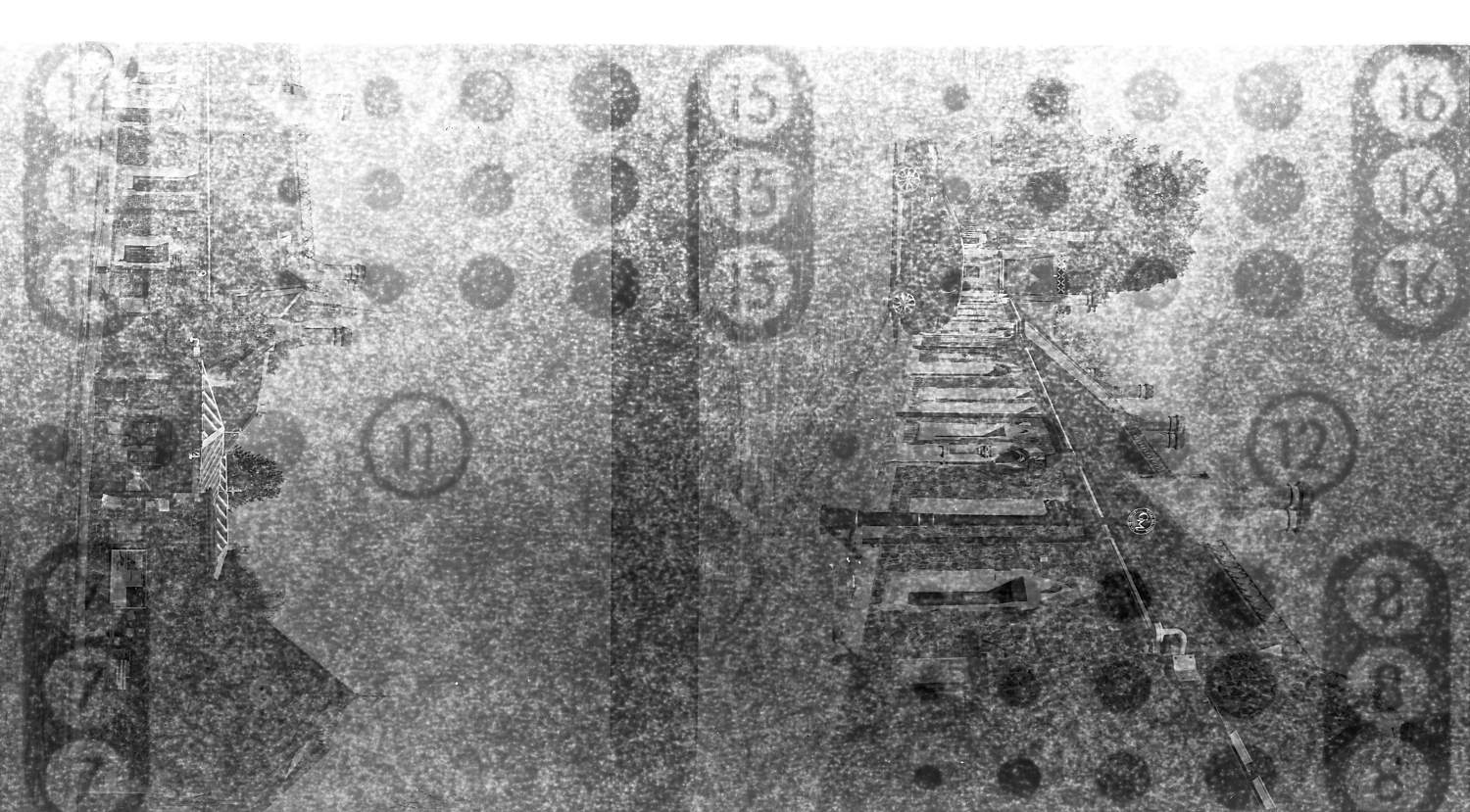
A mint condition Lubitel 166 for a reasonable (very low) price at a flea fair turned out to have a half-exposed film in it. I have other TLRs and I have no doubt that they are much better, but I was curious as to what, in the film days, was widely seen as the affordable way into medium format. Compared with Minolta and Yashica TLR’s it is small and lightweight, so maybe it would sometimes find its way into a corner of my camera bag.
Not knowing what the film was, I guessed that over-exposure was safer than under-exposure, so exposed at roughly ISO 100. When I opened the camera and discovered that it was Ilford XP1, I immediately decided that it was not worth paying for processing, so after searching the web I found that the Massive Development Chart gives a recommendation of Rodinal 1:100 stand developed for 60 minutes for XP2 exposed at ISO 200. Lots of people seemed to find that such processing worked, so I went ahead. I knew the film must be old (it was sold only from 1981-1993 before it was replaced by XP2) but thought the extra stop might compensate a bit for this. And 5ml of Rodinal is much less expensive than 500ml stock solution of ID-11. So I went ahead.
You can obviously blame me and my cross-processing for part of the problem, but something I had not expected was seeing the numbering from the back of the backing paper – maybe C41 processing would have brought it out even more clearly. Presumably in the 40 odd years spent rolled up, the ink on the backing paper reacted with the emulsion it was in contact with – that the ink was not as inert as one might hope. Or perhaps the ink came off and acted as a mask during development, though I find it hard to believe that it would not have been washed off quickly.
I thought this might be of interest because, in the hundreds of pieces I must have read on using expired film, I have never come across anyone reporting this problem. So the Lubitel now needs a proper test with fresh, correctly processed film.
Share this post:




Comments
Bob Janes on A cautionary tale with a long expired film
Comment posted: 24/04/2026
Comment posted: 24/04/2026
Comment posted: 24/04/2026
Comment posted: 24/04/2026
Mike Breen on A cautionary tale with a long expired film
Comment posted: 24/04/2026
I have a 9 pack of 120 Ilford PanF (used one discovering this issue). I was thinking about removing the backing paper in a dark bag and washing the film. I'd then back it with some 'fresh' backing paper and re-roll.
I've seen this most often on Eastern European films.
Comment posted: 24/04/2026
Chuck on A cautionary tale with a long expired film
Comment posted: 24/04/2026
Charles Higham on A cautionary tale with a long expired film
Comment posted: 24/04/2026
Comment posted: 24/04/2026
Comment posted: 24/04/2026
Russ Rosener on A cautionary tale with a long expired film
Comment posted: 25/04/2026
David Brancaleone on A cautionary tale with a long expired film
Comment posted: 25/04/2026
Comment posted: 25/04/2026
Jeffery Luhn on A cautionary tale with a long expired film
Comment posted: 25/04/2026
NICHOLAS HOWE on A cautionary tale with a long expired film
Comment posted: 28/04/2026
Comment posted: 28/04/2026