

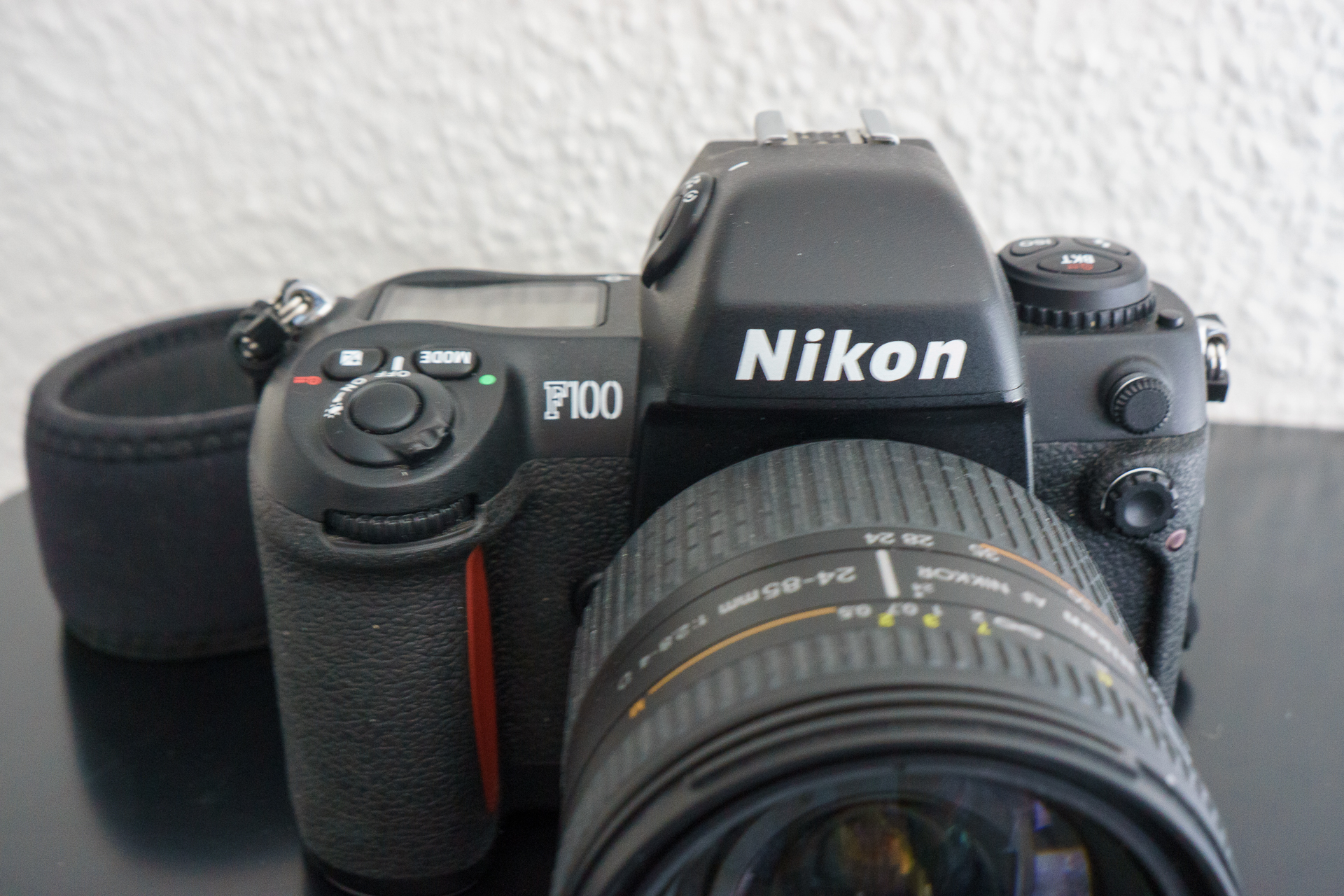
The Nikon F100 was produced from 1999 to 2006 and was widely regarded as Nikon’s second-best analogue SLR with autofocus, after the F5 for professionals. I’ve only owned it for 12 years, having bought it after selling my Nikon F4s, which eventually became too big for me and, with the fixed battery grip, too cumbersome to handle. I have not regretted this ‘swap’.
It was chosen more or less by chance for a roll of unexposed film – Kodak Ultramax 400 – of which I had bought several cans to replenish my stock. My rather extensive collection is stored in cupboards, cases and bags, which I unfortunately never labelled. So I happened to look into a bag that was in my way, saw the F100 and decided to use it for my next roll of film, fitting it with Endeloops rechargeable batteries and the Nikon AF Nikkor 24-85mm f/2.8-4 D lens, which is in its original box in a cupboard and easy to find. I don’t know when I last used the F100, but first of all, it worked perfectly. This combination, complete with lens hood, wasn’t too big for my LOWE Pro waist bag, which I like to carry for my kit on my bike rides.
I won’t go into the technical details of the camera and lens in any great detail. Nikonians are familiar with this camera and the lens. If you’re interested, there are plenty of reviews and information about them online. Even after such a long time, I found the F100 easy to use, as it is very similar to my Nikon D750. The lens can also be used on both cameras without any issues and even works on the DSLR without any AF problems, contrary to what was recently claimed by an author here on the blog. And I wouldn’t want to be without this lens either.
The Kodak Ultramax 400 is one of the more affordable 35mm colour films here in Germany; I’ve been using it since the Fuji X-TRA Superia 400 was discontinued. I’d been disappointed by that, but I’m now happy with the Kodak; I use it even in sunny weather around midday and expose it at box speed. If I want pastel-like colours, I overexpose by one stop. The photos shown were exposed using the camera system, after I had taken a comparative reading with an external light meter beforehand, just to be on the safe side. The film was developed using the C41 standard process with Fuji chemicals at a specialist lab, where it was scanned at 4K resolution. I made minor adjustments to the gradation of the images in LrC.
As already mentioned, the photos were taken on a 16 km cycle ride in my local area.
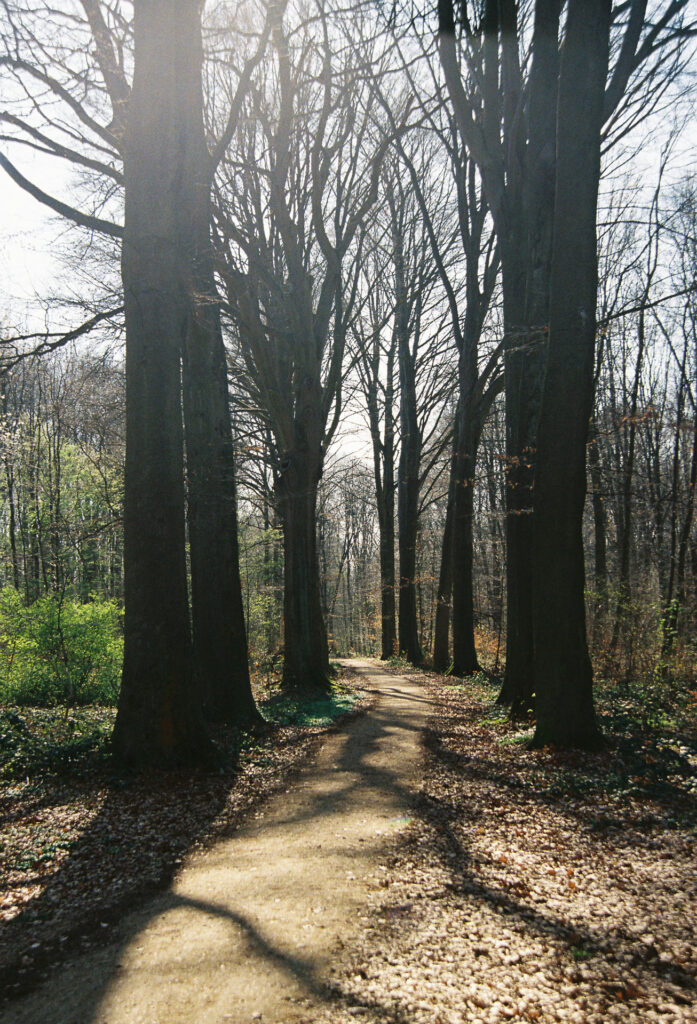
This is the second wooded area I had to cycle through on my short trip. I live on the outskirts of a major city, and the first wooded area is just 300 metres away. They aren’t huge, but they’re still relaxing for someone from the city, as you don’t come across many people – often just walkers with their dogs or cyclists. Here, the backlighting and the shadows it cast inspired me to take this photo.
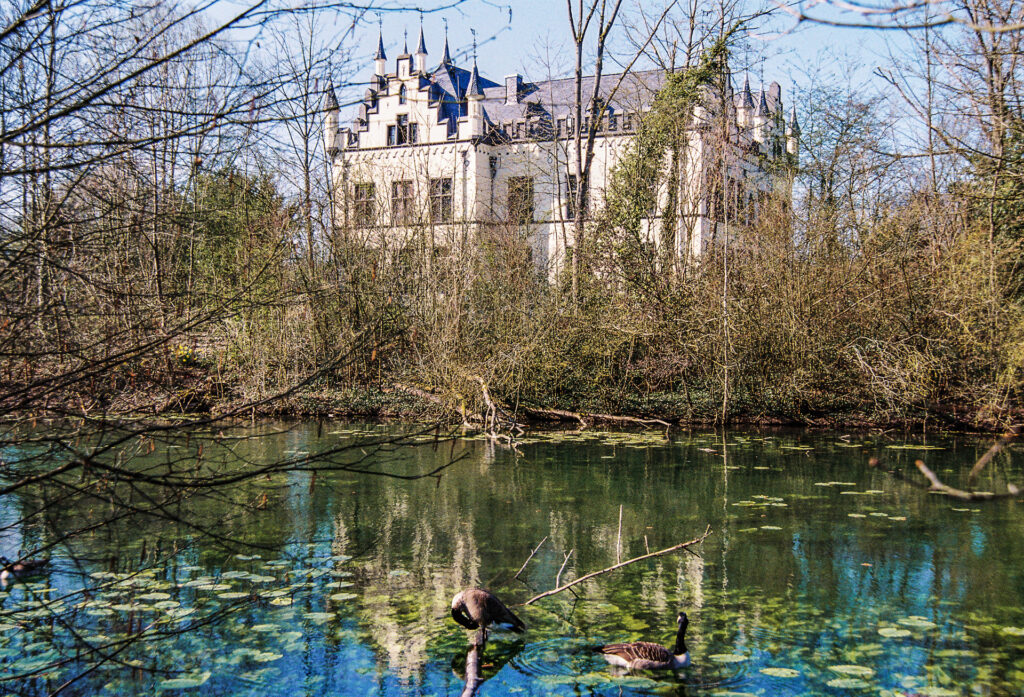
I then continued on to ‘Haus Horst’, situated in the woodland and surrounded by a pond where waterfowl thrive. The former manor house now houses a sleep clinic.
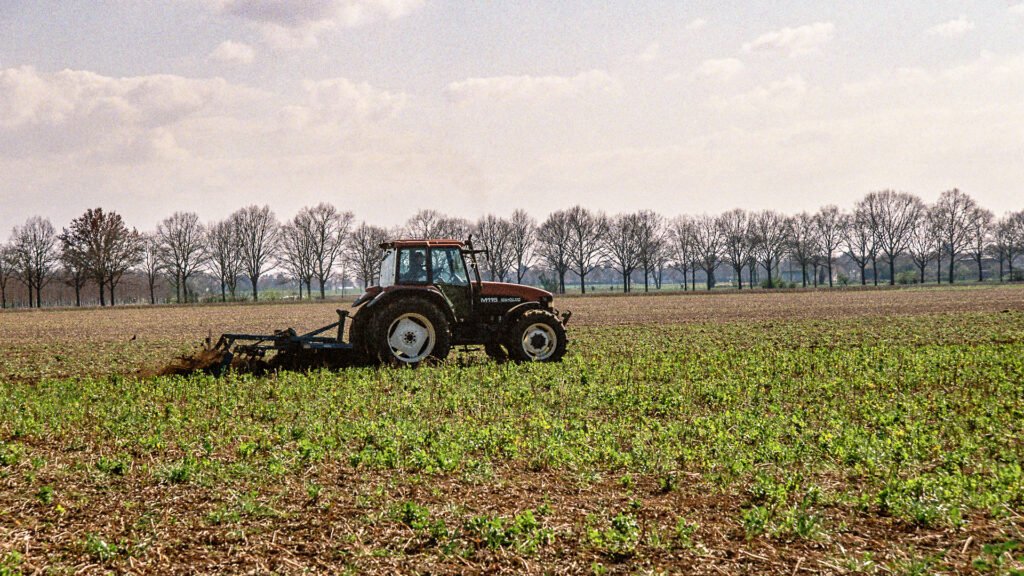
After leaving the woodland, I saw this tractor and its driver working in the fields in the spring. Here, too, I have a side view from the front, which has its own charm.
I continued along the avenue running in the background and reached the outskirts of Liedberg-Steinhausen, which administratively belongs to my neighbouring town.
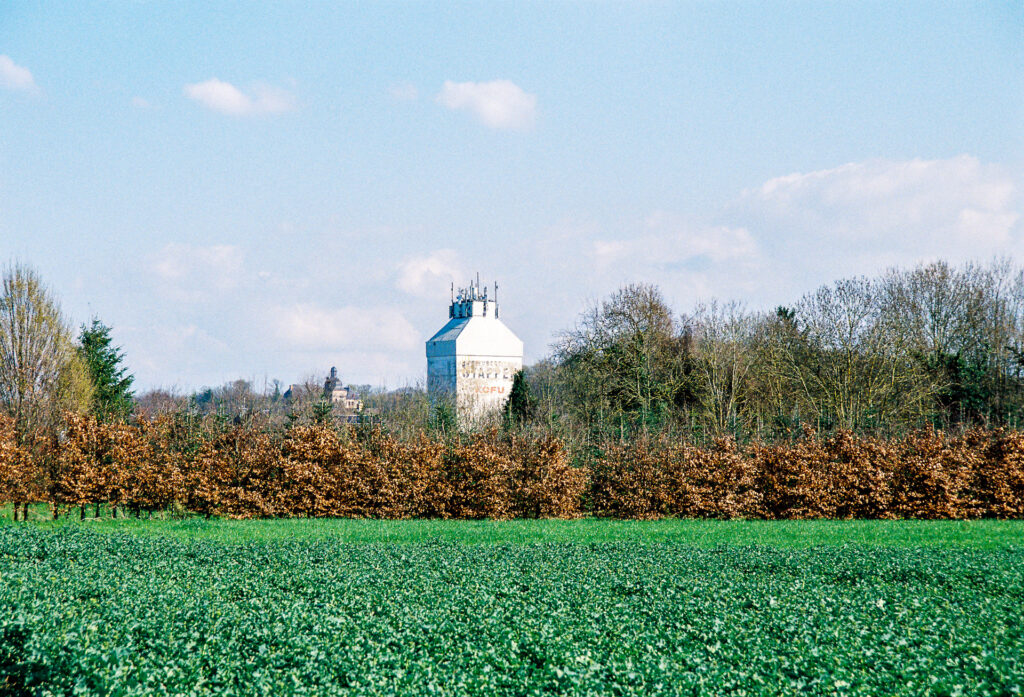
Between this grain silo and “Liedberg Castle” – which can be seen in the background, is privately owned and has been restored in recent years – lies a quiet little residential area, consisting mainly of detached houses and the odd farm here and there.
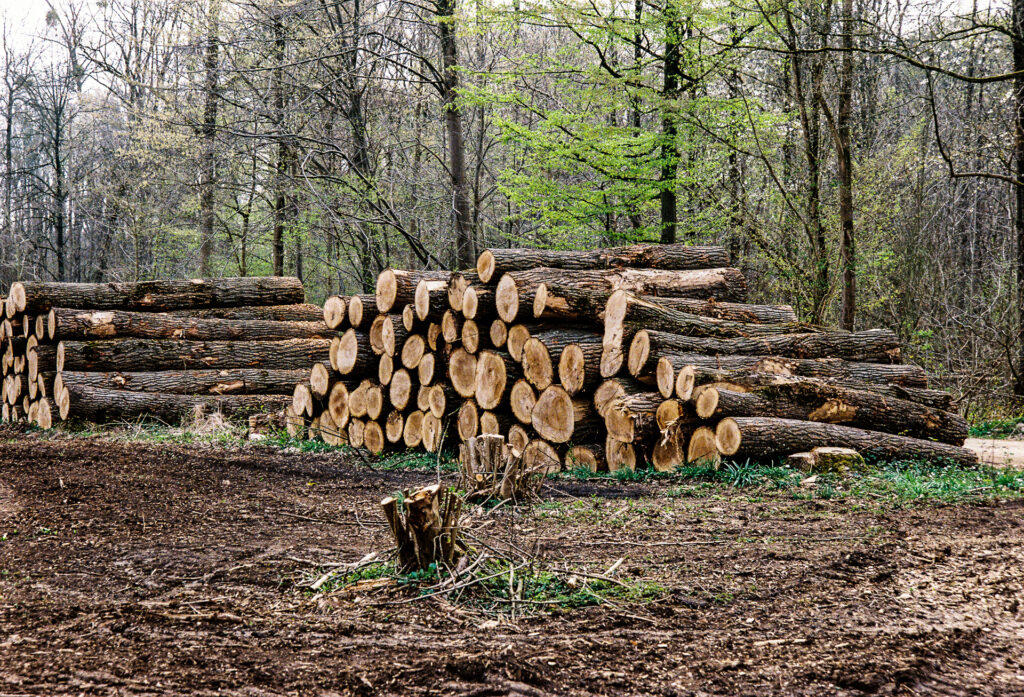
I am now on my way back from my short walk. Clearing work is currently taking place in a landscape and nature conservation area. As it should be, everything has been tidied away properly, and many new trees have even been planted as replacements – species that are less susceptible to the bark beetle that inhabits this area.
Still in the neighbouring village, but situated right on the outskirts of Mönchengladbach, lies ‘Myllendonk Castle’.
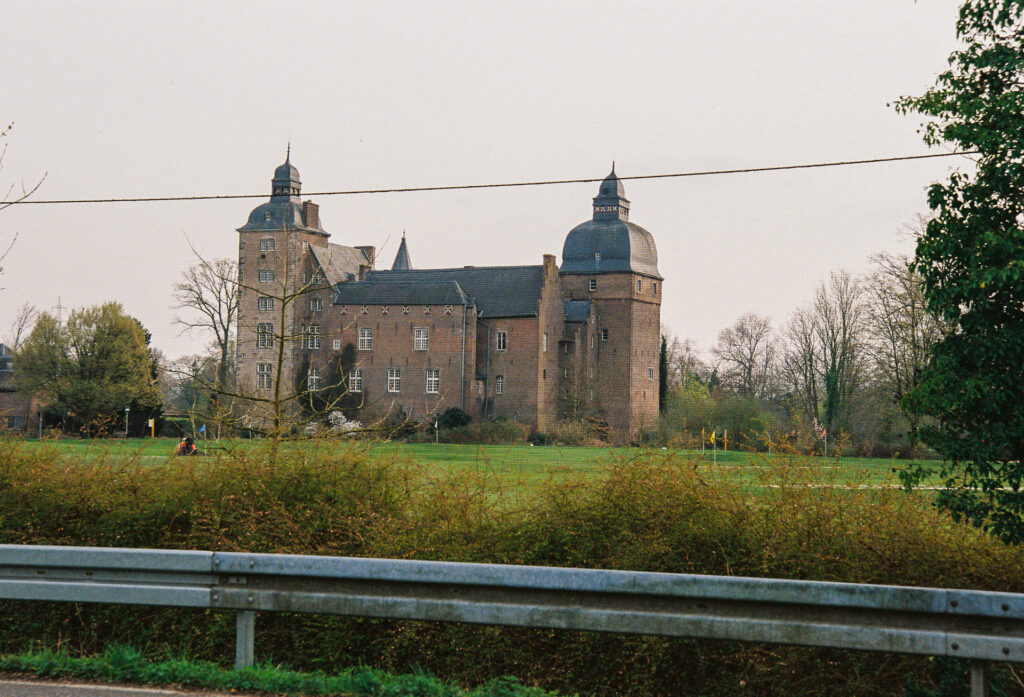
The castle is privately owned; the extensive grounds include an 18-hole golf course belonging to a golf club, which is also permitted to use the outbuildings for its own purposes. I took the photo from the cycle path of a district road that runs alongside the grounds. This is the only spot from which you can photograph the castle in its entirety. It’s not a telephone line that spoils the photo, but the edge of the ball-catcher net. Golfers do have the odd wayward shot, and analogue photographers don’t have to retouch everything away.
I hope I haven’t asked too much of you, and that everyone can get a sense of the camera, lens and film. And of a little piece of my home. Thank you!
Share this post:

Comments
Ibraar Hussain on 5 Frames with a Nikon F100, AF Nikkor 24-85mm f/2.8-4 D & Kodak Ultramax 400
Comment posted: 26/04/2026
The F100 was on my radar once, as was the F6. But never did go down the Nikon route
Really enjoyed the read and photos
Would love to explore these parts
Thanks my friend
Comment posted: 26/04/2026
Comment posted: 26/04/2026
Comment posted: 26/04/2026
Comment posted: 26/04/2026
Comment posted: 26/04/2026
Miguel Mendez on 5 Frames with a Nikon F100, AF Nikkor 24-85mm f/2.8-4 D & Kodak Ultramax 400
Comment posted: 26/04/2026
Comment posted: 26/04/2026
Charles Young on 5 Frames with a Nikon F100, AF Nikkor 24-85mm f/2.8-4 D & Kodak Ultramax 400
Comment posted: 26/04/2026
Comment posted: 26/04/2026
David Pauley on 5 Frames with a Nikon F100, AF Nikkor 24-85mm f/2.8-4 D & Kodak Ultramax 400
Comment posted: 26/04/2026
Thanks for this post and the chance to visit your corner of Germany. I'm impressed by the lushness of everything and by how well that came through in your photos. For this fellow city-dweller the landscape was also quite soothing. In the summer I expect to do a fair amount of cycling in upstate New York. Often I don't take a camera along with me but your post is inspiring, so that may change. Unless GAS gets the better of me, it won't be a Nikon -- I don't at present have any of those on the shelf! -- but your post makes a good case for the F100. So glad that the warmer season is finally approaching. Thanks again, -David
Comment posted: 26/04/2026
Andrew on 5 Frames with a Nikon F100, AF Nikkor 24-85mm f/2.8-4 D & Kodak Ultramax 400
Comment posted: 26/04/2026
Mind you, so does everyone around you. And here in the UK, the price of film plus developing and printing means that “clunk-whirr” just cost you about £0.80. That, if nothing else, makes you slow down and consider each picture very carefully.
If only film was about 1/3 the price I would use my old Nikon far more!
Comment posted: 26/04/2026
John Andrews on 5 Frames with a Nikon F100, AF Nikkor 24-85mm f/2.8-4 D & Kodak Ultramax 400
Comment posted: 26/04/2026
Comment posted: 26/04/2026
Gary Smith on 5 Frames with a Nikon F100, AF Nikkor 24-85mm f/2.8-4 D & Kodak Ultramax 400
Comment posted: 26/04/2026
It's good to get out with a camera!
Walter Reumkens on 5 Frames with a Nikon F100, AF Nikkor 24-85mm f/2.8-4 D & Kodak Ultramax 400
Comment posted: 26/04/2026
Graham Line on 5 Frames with a Nikon F100, AF Nikkor 24-85mm f/2.8-4 D & Kodak Ultramax 400
Comment posted: 27/04/2026
Comment posted: 27/04/2026
Curtis Heikkinen on 5 Frames with a Nikon F100, AF Nikkor 24-85mm f/2.8-4 D & Kodak Ultramax 400
Comment posted: 27/04/2026
Comment posted: 27/04/2026