

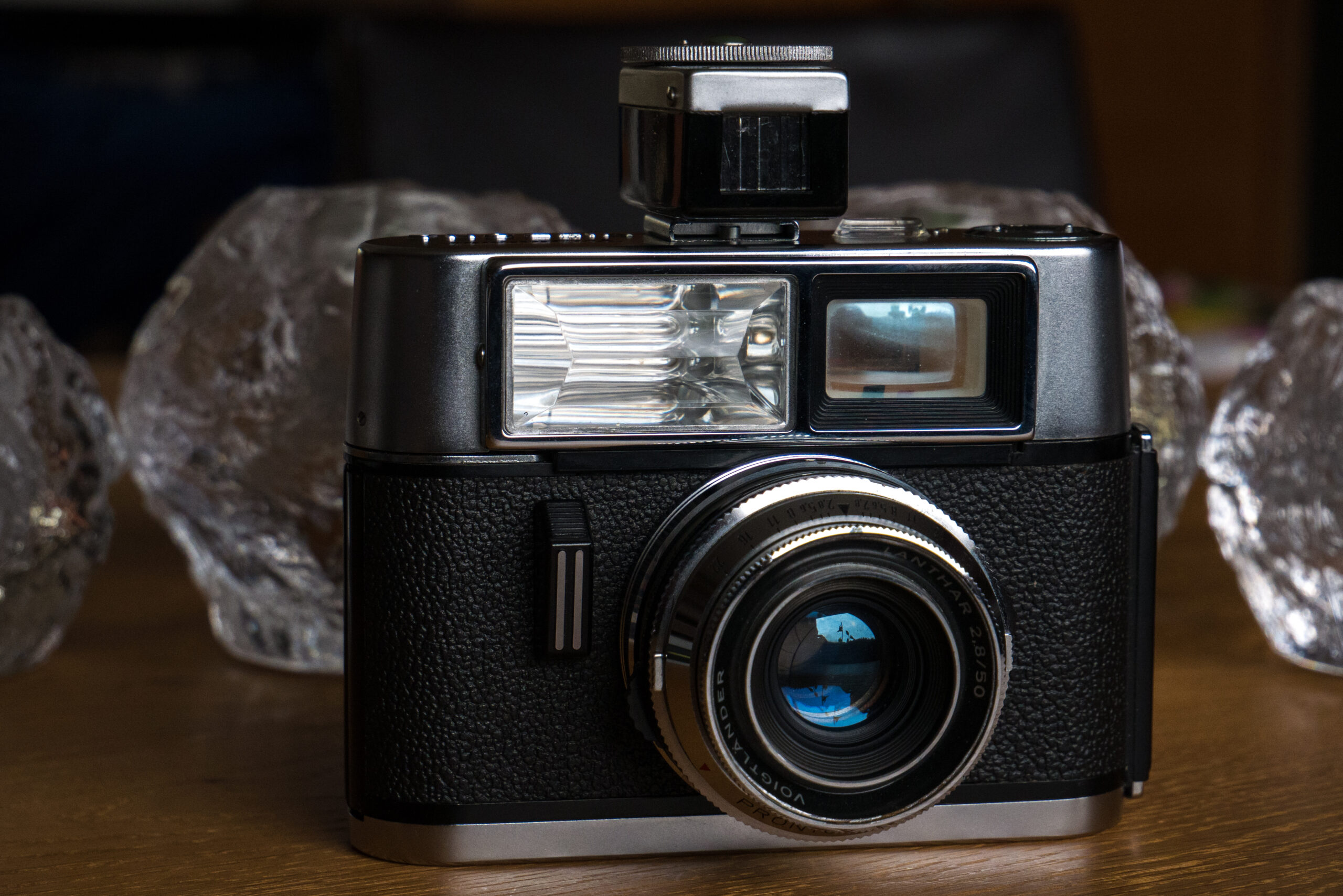
We all have a little digital camera in a drawer somewhere. We occasionally take it out for family gatherings to take simple, well-lit photos indoors. Set the flash to automatic and off we go. And if we forget the camera, we just use our smartphone. Always correctly exposed and lit. That wasn’t always the case. In 1965, my grandfather may have decided that his growing number of grandchildren should finally be photographed properly indoors. Especially since a future camera collector was due to be born that year and a special, a very special world premiere was needed for the occasion. No cumbersome flash to attach to the accessory shoe (often still without a center contact), no cables to connect, no aperture or guide number to set, just start shooting. An electronic flash built into the camera. Powered by batteries housed in a practical handle. An absolute world first. But no one really noticed, except my grandfather, of course. A total of 22,600 units of the little Voigtländer Vitrona
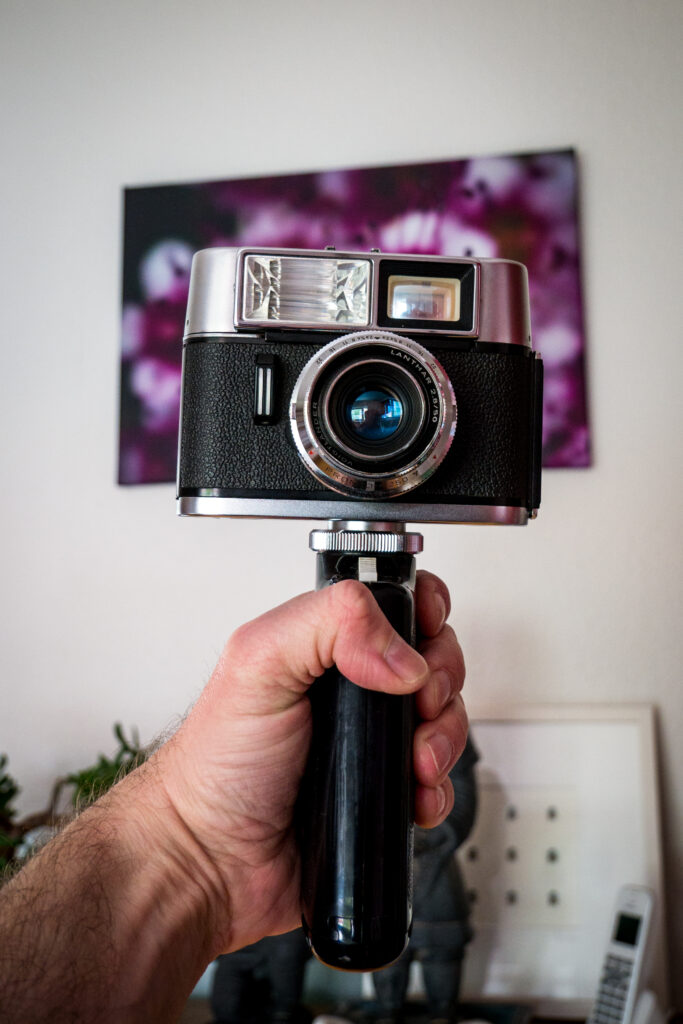
Today, no one would want to do without artificial light! Imagine the climax of a concert (you still know what that is, right?!) by your favorite band without thousands of cell phone lights held aloft. Imagine a night of partying (you still know what that is, right?!) without properly exposed “Whoooo” photos. It all began with the Vitrona, the world’s first electronic flash camera.
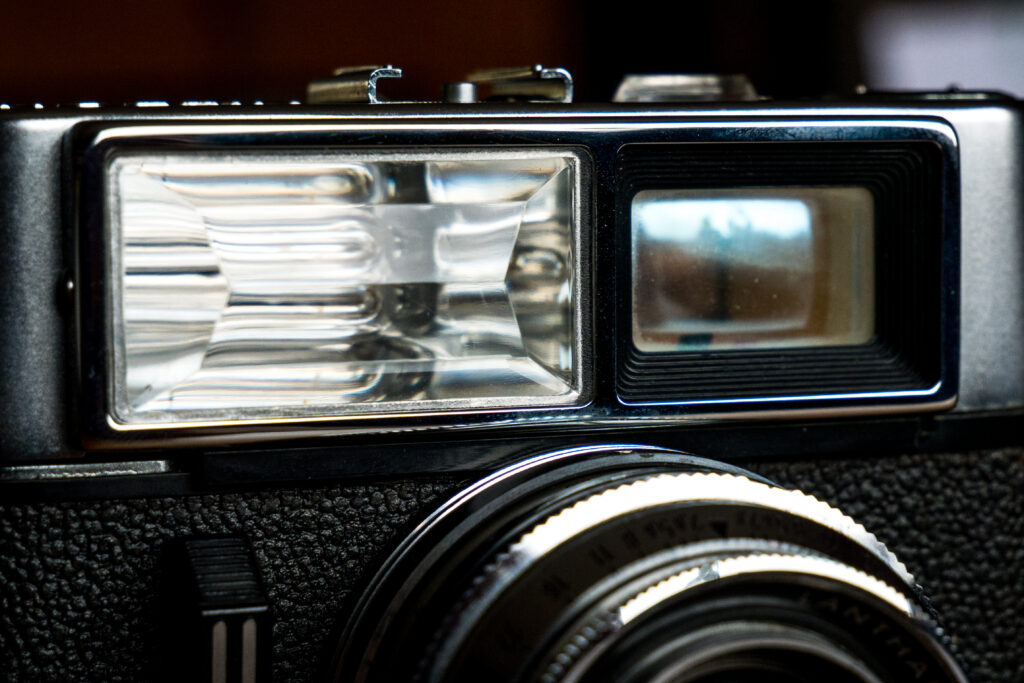
And yet it wasn’t a sales success? Perhaps it was due to the simple Vito C base, which was already outdated in 1965. No exposure or distance meter, a simple Prontor shutter, first the Prontor V250, then the Prontor V300 from October 1965, and a simple Lanthar lens. All this according to the price list from January 1965 for DM 285. It does not appear at all in the price lists of the Zeiss Ikon/Voigtländer sales company, founded on August 1 of that year, between 1965 and 1967, and even at photokina 1966, the “sensational new development” was nowhere to be found. The confusing model and product policy of Zeiss Ikon/Voigtländer was probably partly to blame for the Vitrona’s short appearance. Although the flash system was innovative and certainly deserved a longer life. For example, the red mark in the viewfinder indicates whether the distance selected exceeds the flash range when using the “automatic” setting. The flash duration can be preselected and the automatic aperture control takes care of the rest. Flash readiness is indicated both in the viewfinder and on the top of the camera. The timeless industrial design with its rounded shapes makes the Voigtländer Vitrona a visually appealing camera.
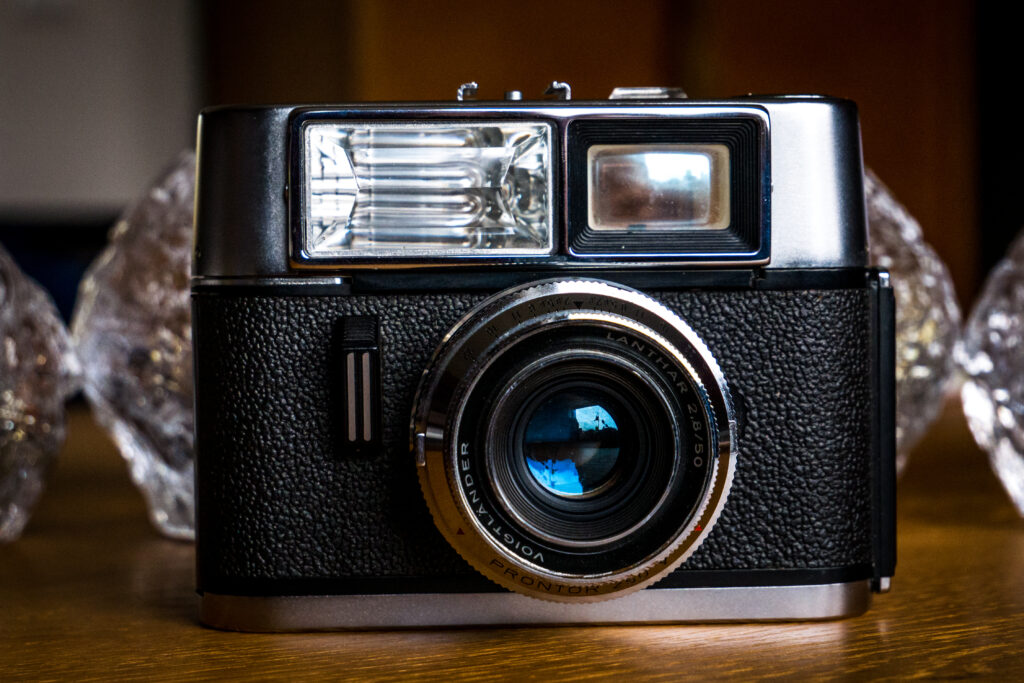
My grandfather’s Voigtländer Vitrona dates from the first half of 1965, as it is still equipped with the Prontor V250 shutter. It also has the serial number 504994. It may be one of the first 5,000 Vitronas produced. Incidentally, the Bakelite handle is even rarer than the camera itself. If dropped, the material shatters into a thousand pieces. This is another reason why the Vitrona has become a real display camera for me. I don’t dare to load the handle with batteries and try out the flash. Too much potential for destruction. After all, the Vitrona is my age, and I don’t party every night anymore.
Share this post:


Comments
Dave from Heritage Cameras on Voigtländer Vitrona – World premiere of something we now take for granted
Comment posted: 24/01/2026
The infamous Traid Fotron had one, and was introduced earlier according to several sources including this one:
https://mikeeckman.com/2021/01/traid-fotron-1962/
Gerard on Voigtländer Vitrona – World premiere of something we now take for granted
Comment posted: 24/01/2026
It's a bit like Philips, inventors of so many audio, and audiovisual equipment, but which were highjacked, slightly altered and conquered the world. The Video 2000 system could only be beaten when Sony and other companies decided not to be as prude as Philips ( a Dutch company), and pornography could swarm out over the world.
BTW, In 1965 I got my Kodak Instamatic, for my 12th birthday.
Comment posted: 24/01/2026
Comment posted: 24/01/2026
Alex on Voigtländer Vitrona – World premiere of something we now take for granted
Comment posted: 08/02/2026
And that's why it has rightly been forgotten.