

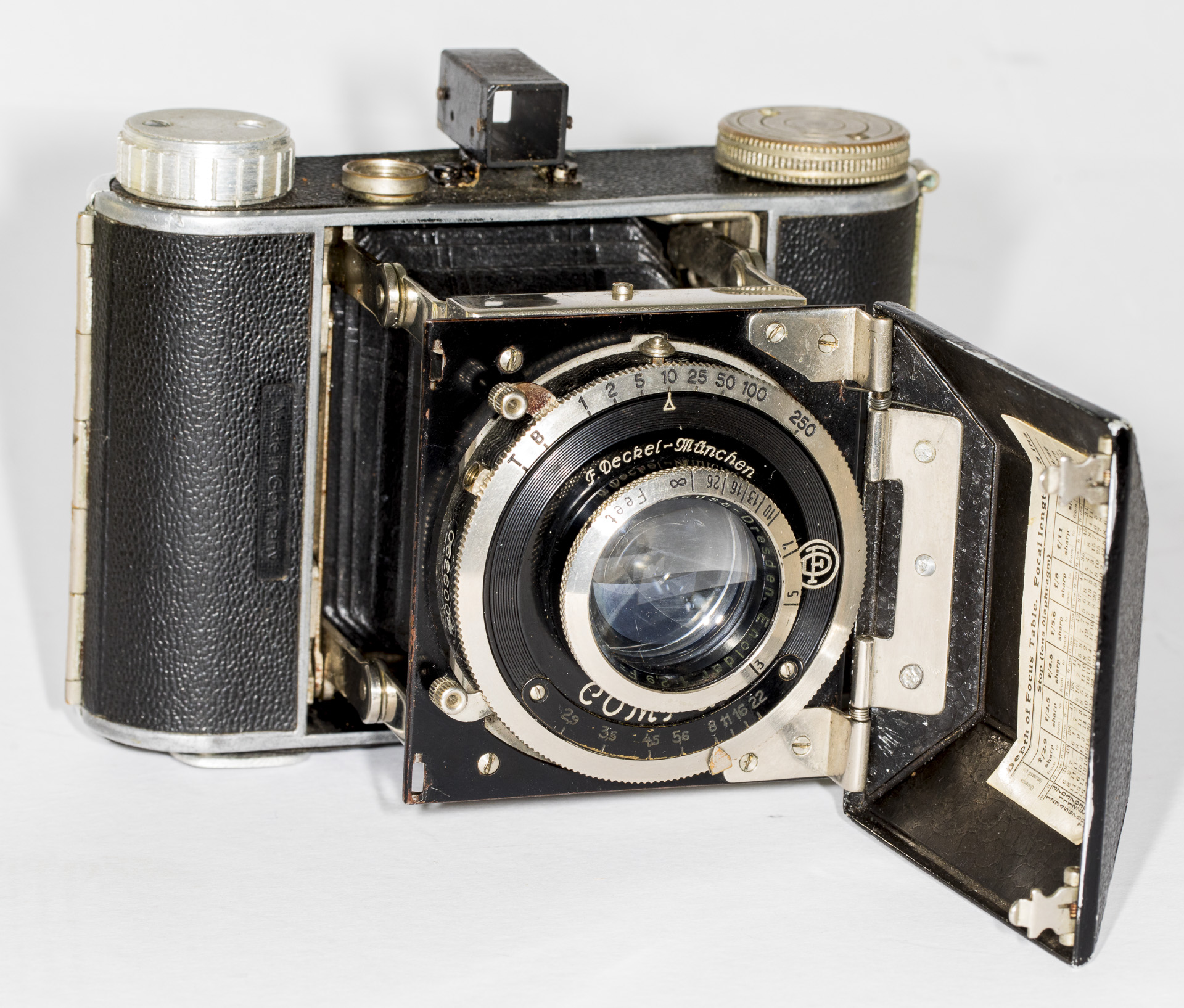
The Kochmann Korelle 6×4.5 was a German strut-folding camera taking 16 negatives on a roll of 120 film, available from 1933 they were made up to the start of WW2. Apart from the way the front door fixes to the lens plate it was a fairly conventional folder of the time with Compur shutter, 75mm f/2.9 Ludvig Enoldar lens (must be good – it’s German and ends in ‘ar’) with front element focusing etc. and a 6X6 version was available as well. On the back of this one is a faded Wallace Heaton transfer, showing it was originally sold in London.
It must have been a quite heavy and somewhat awkward camera to use compared to the ‘half-frame’ competition from the same period. And one with a quite alarming method of unfolding. Push the button forward that releases the opening mechanism and if your hand is not holding the front plate it shoots forward at speed often with the lens cover flying open as it reaches the fully extended position with a thump, surprising enough for the user, scary for anyone standing in front of it. It reinforces my belief in treating cameras like guns, that is always make sure you are standing behind them.
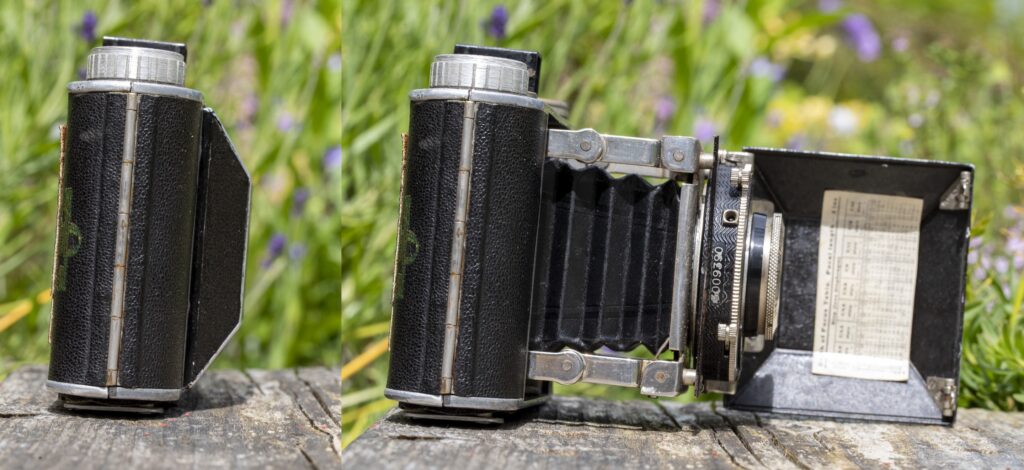
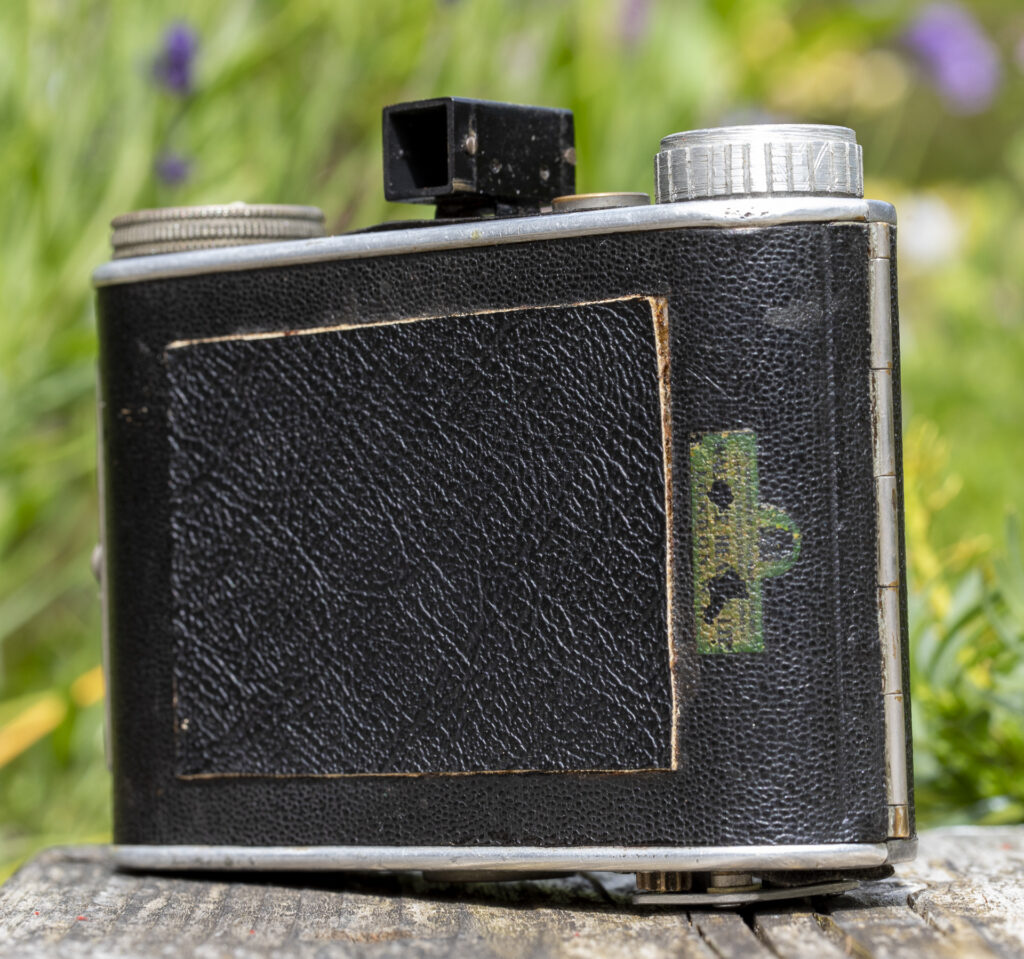
I saw this one on Ebay and was puzzled by the extra knob on the top plate, and by the strange contents of the film chamber, it didn’t cost me very much so others were probably equally as confused. On its arrival my suspicions were confirmed; the camera had been converted to take 35mm. When? Where? and especially Why? It had clearly been a lot of work using a mixture of parts from other cameras and a variety of bits and pieces to make the film guides and masks, hold the 135 cartridge, and so on
To do this the film has been made to run the opposite way to the 120 film the camera was designed for, the wind-on knob repurposed for rewinding and the camera body drilled through top and bottom to take the new winder and 35mm spool. I thought at first the supports for the film canister were wood, but they are probably Formica as are the film guides and masks. These are sheets of black-painted Formica which both mask the film gate and hold the film in position. The camera would originally have had a pressure plate but this was removed and replaced by a rectangle of vinyl, I have not managed to work out if the film plane is in exactly the correct position, and if it isn’t may be why none of the photos seem properly in focus.
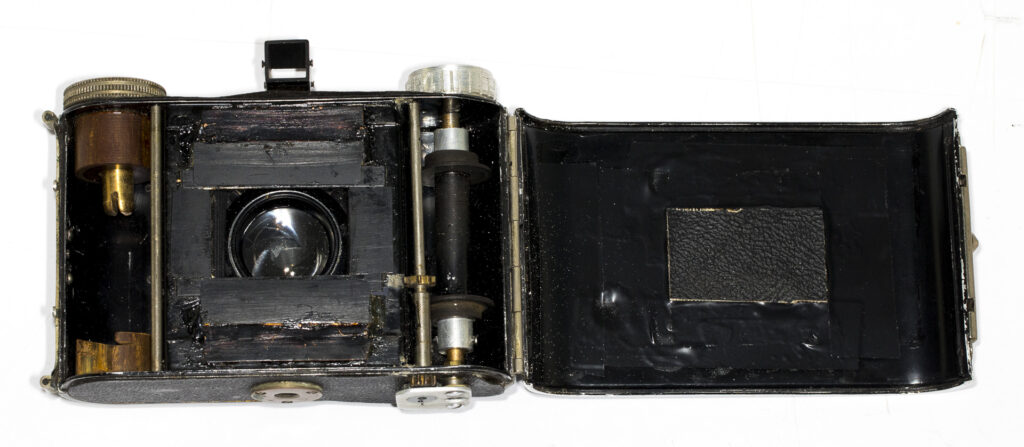
The right side 120 film roller has been extended through the base of the camera and has had a sprocket for 135 film perforations grafted in. Moving the film turns the sprocket and roller which is attached to a gear outside the base plate, which in turn meshes to the indicator gear with it’s single dot. One full turn of the dot and the film has moved to the next frame, at least that seems to be the idea as it is not exactly precise. The take up spool has also come from a 35mm camera, and yes that is a nail connecting the spool to the shaft, confirming that the conversion took place in Britain as where else would precision instruments be made with nails? The viewfinder looks to be the original reverse-Galilean one with the lenses removed so it is now just a metal tube. Surprisingly it seems to be accurate enough.
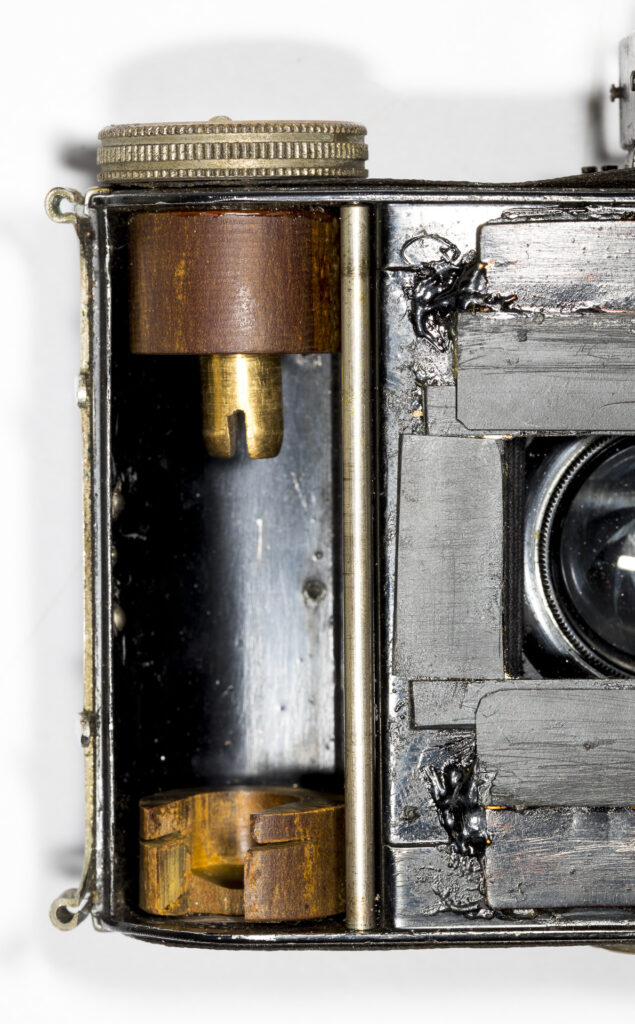
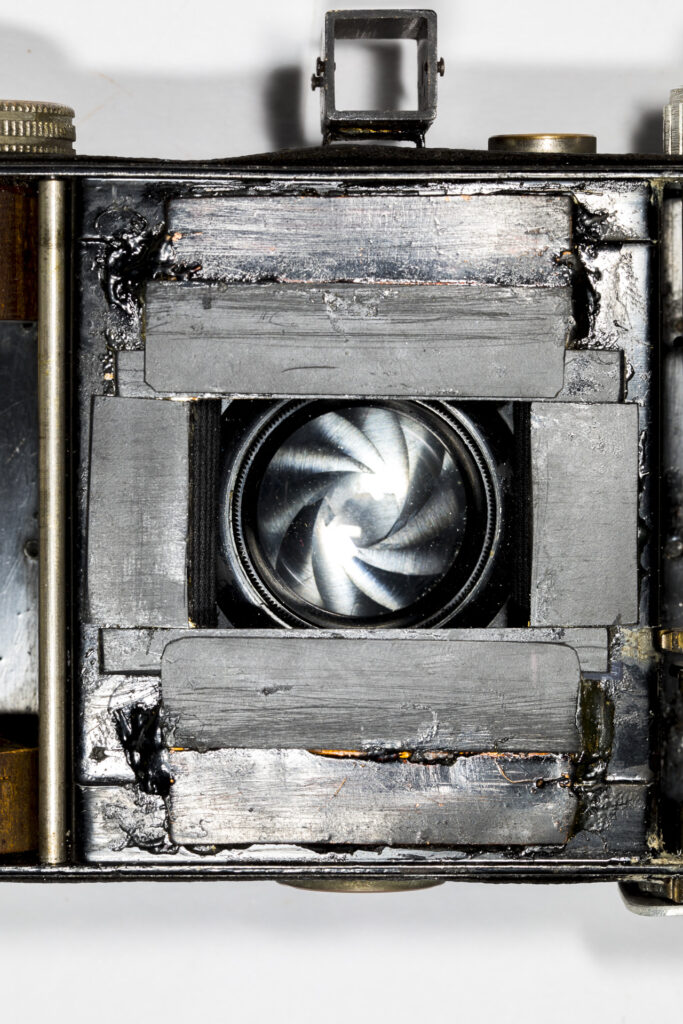
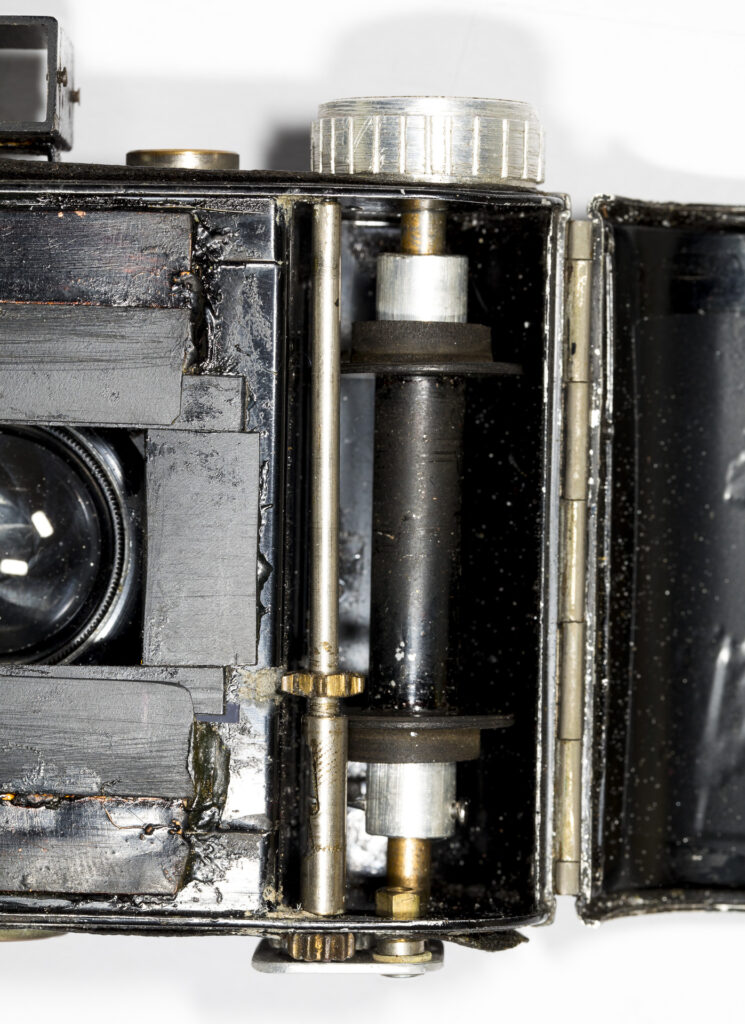
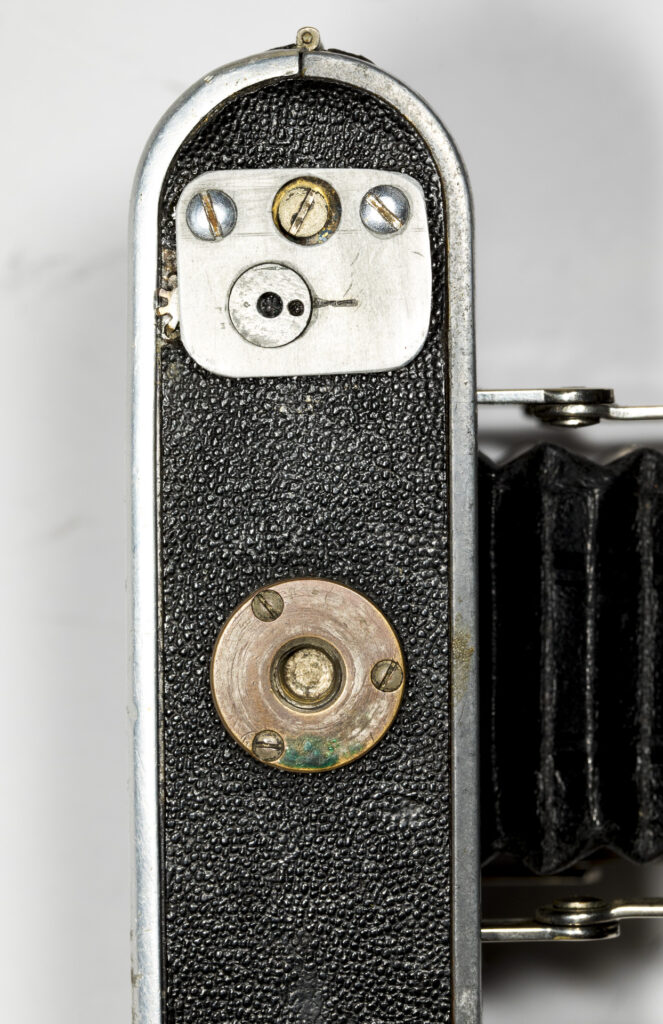
The lens and shutter block remain unchanged with front cell focusing, manual shutter cocking, and shutter release via the lever on the shutter housing.
The materials used may give a clue to when the conversion was made. The parts from a 35mm camera look to be from an early machine, similar in age to the Korelle so probably 1930’s. This together with the use of Formica seems to suggest the work was done in the 1940’s or the 50’s at the latest.
As to why it was made I have little idea. I have come to the conclusion that there are really only two broad reasons why someone might have put so much work into converting a 120 camera like this one to 35mm; because he could or because he had to (I am assuming here that the culprit was male, but who knows?).
If it was wartime then maybe the owner had a supply of 35mm film but no 120 for his Korelle? So he decided to take parts from a broken Retina or similar and combine the two. Alternatively it could be just an exercise to see if it were possible to do; “what if I were take one crap old German camera and just to use the middle of the lens to get a sharper image and a longer focal length?” Whichever it was to build it from scratch required engineering skills, decent tools, and a lathe, and cannot have been an easy job.
Is it unique? are there plans somewhere? In an Amateur Photographer from 1943 perhaps “How to help the war effort by converting your German camera to miniature film format”. However it came to be converted I don’t think it has had a lot of use. Cleaning the camera I realised a lot of the ‘dust’ that I was removing from the inside was brass and aluminium filings and even after that the film I ran through was very scratched.
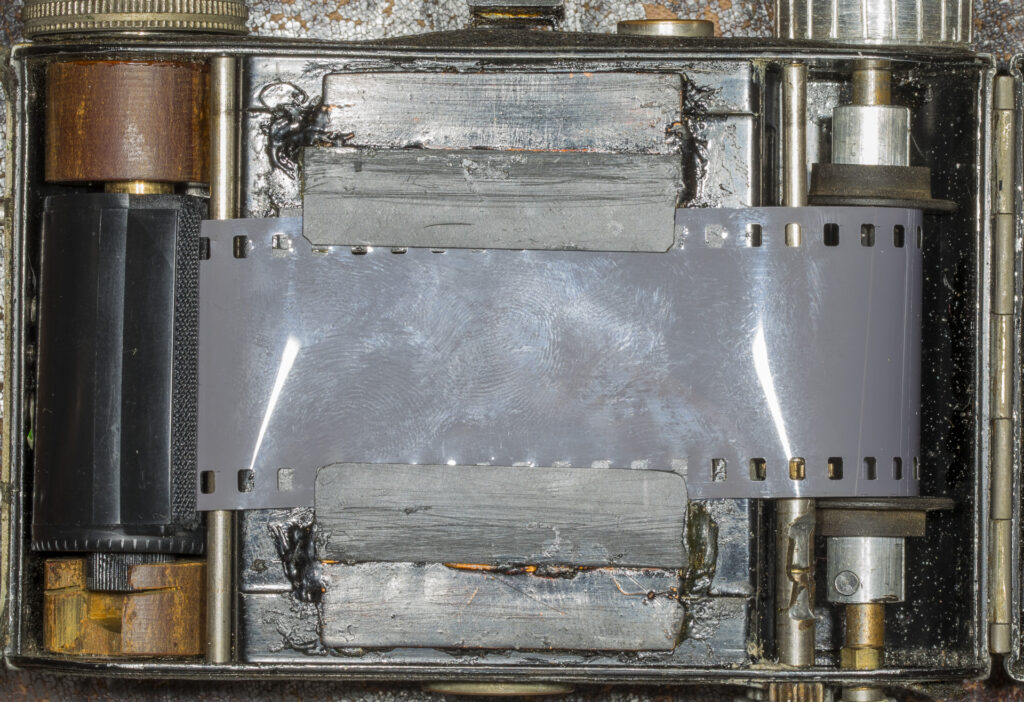
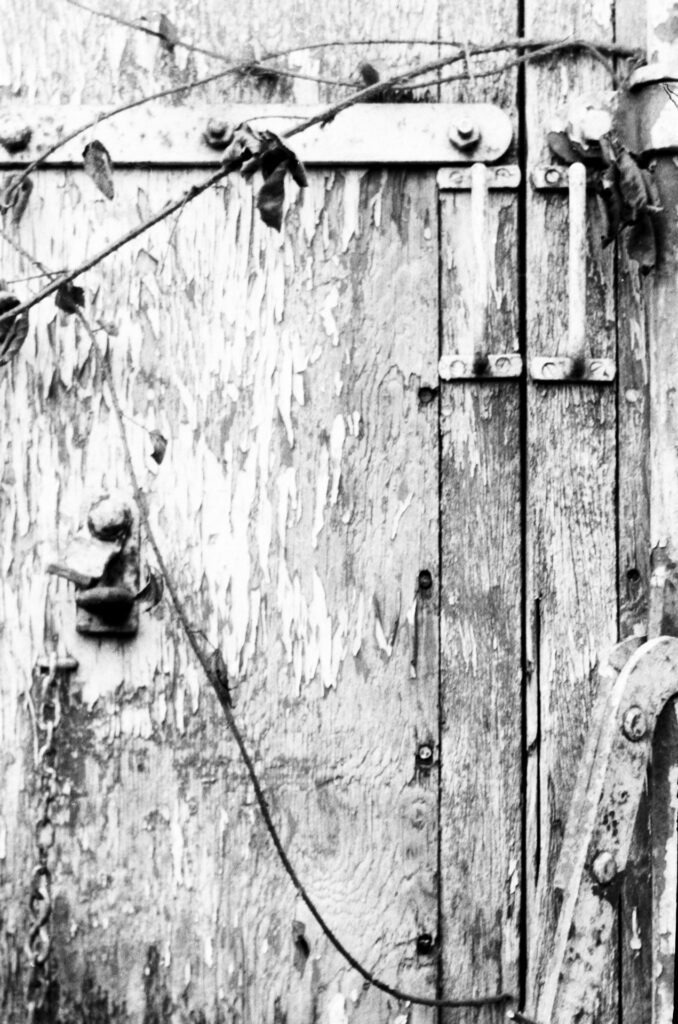
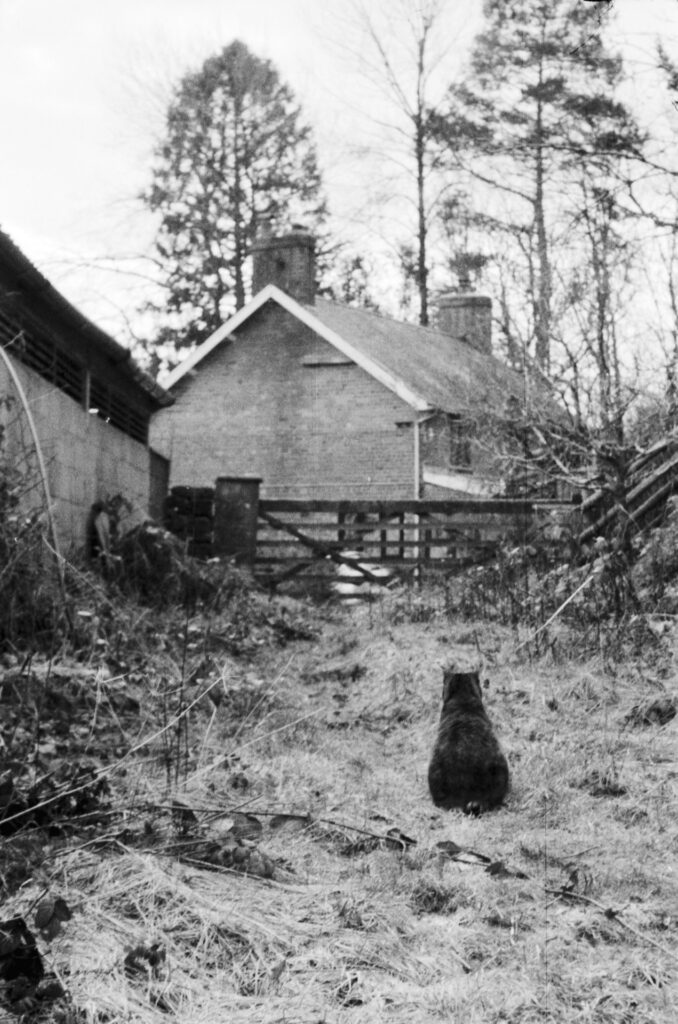
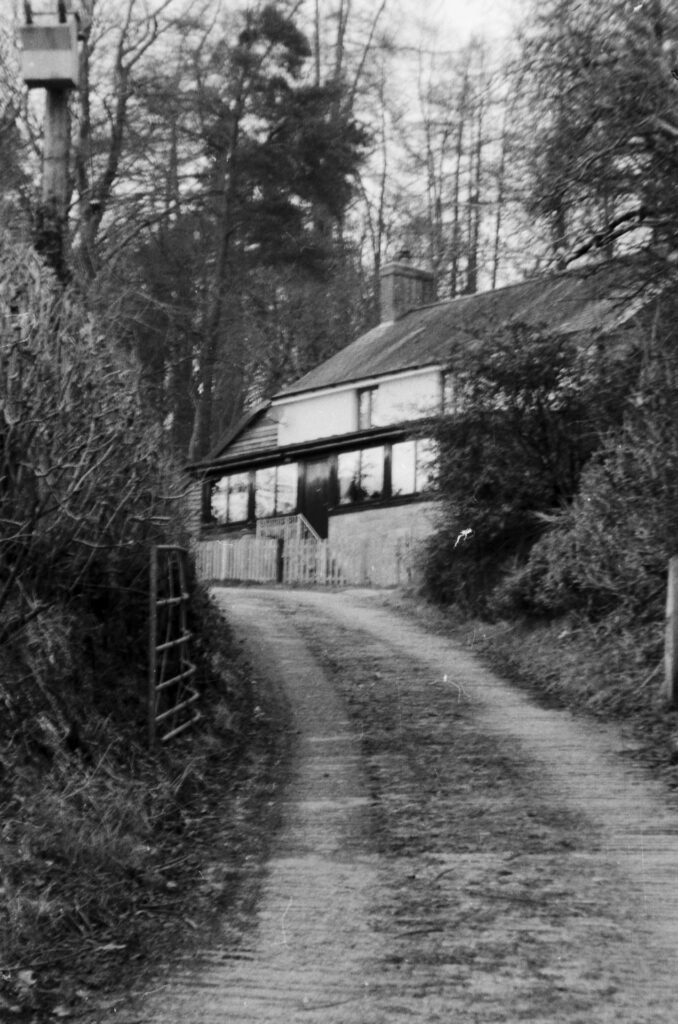
I have used just the one film with the camera, and don’t intend to try again. Thirty-six frames is a lot knowing how bad they will turn out, and with the first I felt the film starting to tear after about frame 27 so stopped and rewound. The results from that roll were some strange photos, all are very soft, while some seem to be in focus others have a second ghost-image superimposed as if being reflected back onto the film. This could be camera shake from the awkward and front-heavy camera, but I was aiming to use the faster shutter speeds. One issue is that the film doesn’t run as straight and flat as it should, this was likely the cause of the film tearing, and possibly some of the other problems. I have also wondered if the soft images could be from multiple reflections coming back from the patterned vinyl behind the film, though probably it is largely down to the lens not living up to the name and source. I might have to accept that being German and ending in ‘ar’ may not be an infallible guide to lens quality.
If anybody has a Kochmann Korelle 4.5X6cm and would like to have go at converting it to 35mm I am happy to take more photos and some measurements and pass them on. I look forward to seeing the results here on 35mmc.
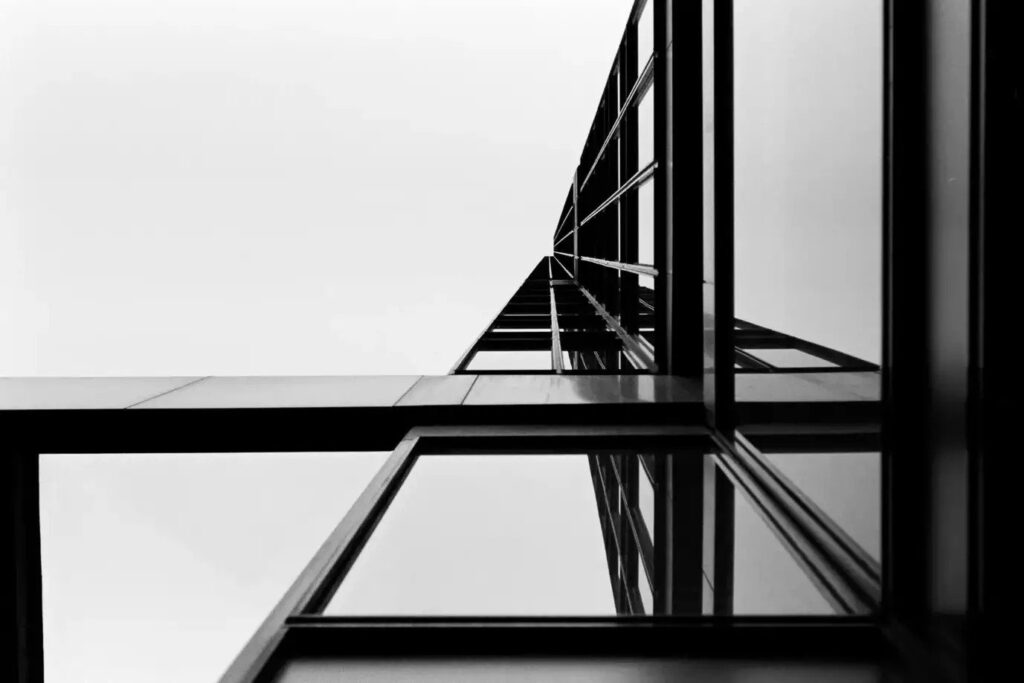
Here are some of the photos taken with the camera, Delta 400 developed with Rodinal (Fomadon R09).
Share this post:


Comments
Dann in Indonesia on Kochmann Korelle 6×4.5cm Converted for use with 35mm Film
Comment posted: 21/07/2026
I have at home in Australia, an impressively large carton of otherwise useless old cameras, that would lend themselves well to such experimentation.
If you would care to pay for postage and packing - we can negotiate.
Sarcasm not intended, more so amusement, and yes, definitely, admiration for your creative talents... May I congratulate you on a most interesting article, well out of the 'norm' of most picture-taking pieces I read nowadays.
Comment posted: 21/07/2026
Comment posted: 21/07/2026
Comment posted: 21/07/2026
Jeffery Luhn on Kochmann Korelle 6×4.5cm Converted for use with 35mm Film
Comment posted: 21/07/2026
That was a good read. It seems that 'Gramps had a lot of extra time.'
I had a friend that loved putting together odd parts. He was very proud of his Hasselblad with a zoom lens from a Kodak slide projector. A more successful 'invention' was a stationary bicycle that powered a small b&w television. His twin boys were overweight and making them pedal for tv time was brilliant. One became a lifelong cyclist. Many inventions come from wacky ideas. Your Korelle is probably not one of them. It is, however, fun to look at!
Comment posted: 21/07/2026
Gary Smith on Kochmann Korelle 6×4.5cm Converted for use with 35mm Film
Comment posted: 21/07/2026
Comment posted: 21/07/2026
Ja on Kochmann Korelle 6×4.5cm Converted for use with 35mm Film
Comment posted: 21/07/2026
My guess for both these formats would be for use in slides.
Comment posted: 21/07/2026