

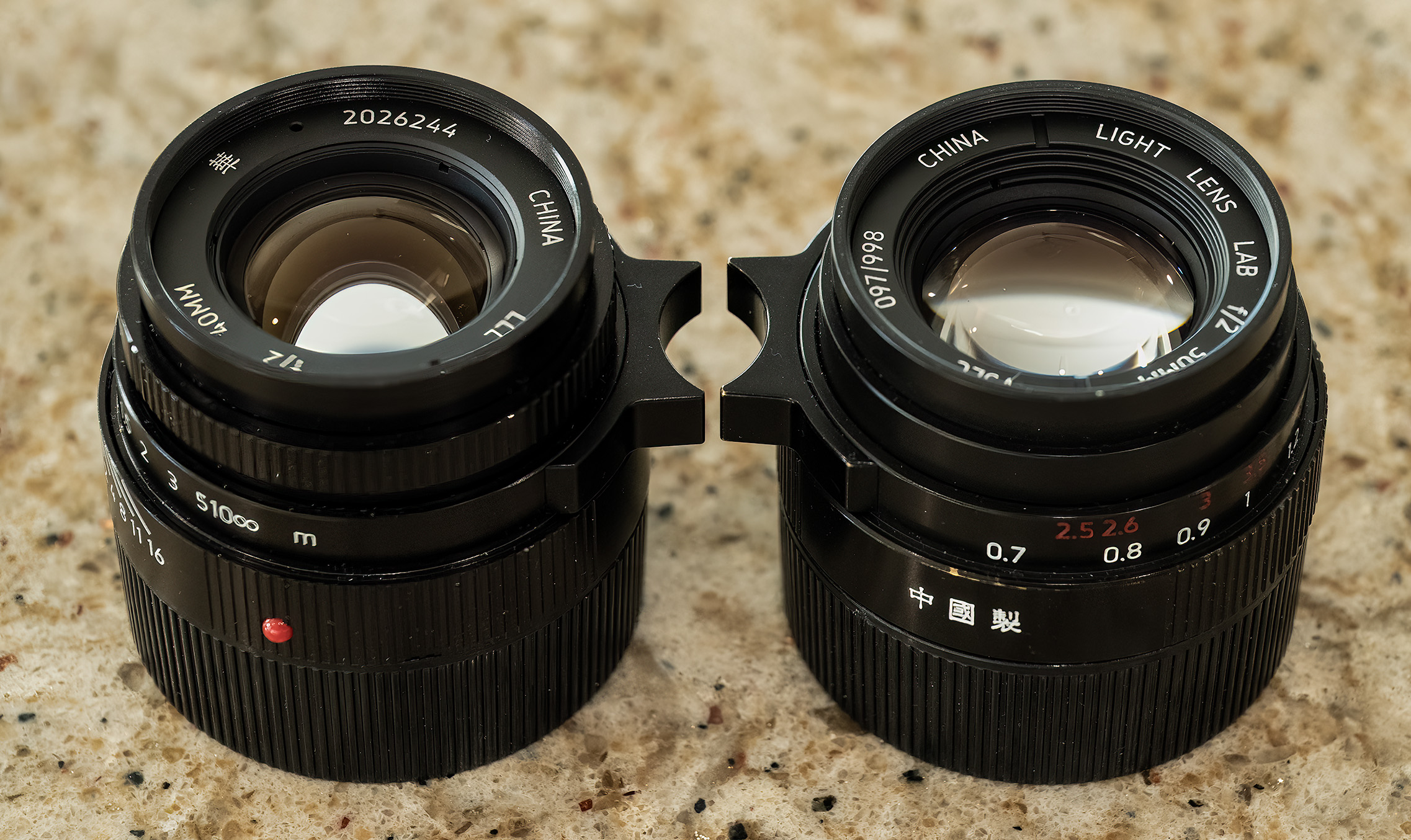
Light Lens Lab’s David Chen offered me the opportunity to obtain the 40mm F2 Hua before its release. A 40-45 mm lens fits the human eye view, whereas 35mm often is a bit wide and 50mm often seems just a bit telephoto on some subjects. The odd 43mm choice for the Leica Q actually lands in the eye’s sweet spot of what you see is what you get.
The 40mm f/2 Summicron lens is part of the convoluted history of 1970s Leica when financial issues resulted in various attempts to produce cameras more economically resulting in the M4-2, and in a partnership with Minolta from which emerged the Leica CL and Minolta CL which were essentially the same camera with different branding. The standard lens of the twin CLs was a 40mm f/2 double gauss Summicron with minor differences of the Minolta having a 40.5mm filter thread and the Leica 39mm, both single coated, with a second version of the Minolta lens being produced later with multi-coatings. These lenses are among the smallest Leica lens with a weight of just over 100gm. The dual Leica/Minolta 40mm f/2 M-mount lenses had and still have a good reputation for an everyday carry lens.
Leicas, especially Barnacks, and some Ms have long been copied. Beginning in 1984 China produced an entry level range finder designated Huaxia 822 with a fixed 40mm f/2 lens 6 element 4 group Hua lens that has the appearance of being a copy/adaption of the Leica/Minolta lens. The 822 was designed as a camera for the masses had construction and performance compromises for economy such as limited speeds from bulb to 1/300. Production of Huaxia cameras continued for years with the last model 841 including an internal light meter. This appears to be an example of a basic mass-market camera whose designers chose to adapt the design of a capable Leica/Minolta lens in their engineering plan. Photos in the public domain show the Huaxia 882 and fixed Hua 40/2 to be a quite good film lens that corresponds to its Leica/Minolta parentage.
For more than a year Light Lens Lab has teased that they have a special mystery 40/2 lens yet to be released. On-line leaks from established Light Lens Lab resellers show this lens to be termed a “Hua 40/2” indicating that it is a M-mount version of the 822 fixed lens. This would fit well with the established business model of Light Lens Lab to reproduce and improve older designs.
While vintage Hua 822 40/2 lenses might have just been rehoused into a M-mount, Light Lens Lab took a different path. What sets this lens apart from any prior Light Lens Lab offering or indeed about any other lens offered by any company is that it is a chimera. The lens has both new and vintage elements derived from a stock of Huaxia 822s assembled in a newly designed helicoid for M mount. This lens chimera is not a single lens type, there are a mix and match of vintage and new elements of the six element four groups that means there are two or more variants this lens with different sourcing that likely imposes some interesting quality control issues that they needed to overcome.
My lens arrived in a box without any documentation or case but included the usual high-quality metal lens caps. The build quality is consistent the high standard of Light Lens Lab lenses. The lens has a striking resemblance to the 50/2 Elcan although much lighter at 161 compared to 230gm in black, a difference that obvious in hand. The 161gm of the Light lens Lab is heavier than the Leica/Minolta lens due to the greater weight of the glass elements and its size with an outer lens barrel made of aluminum alloy and internal brass construction. Length and width of the 40/2 and the 50/2 are close, the Hua being a mm or two longer and both have what appears to be the same focus tab. The lenses being very similar in dimension leads me to suspect the weight difference of the lighter 40/2 is due to the glass type used that is likely not the heavy metal lanthanum or lead glass used in some Light Lens Lab lenses. Missing is the small tab on the aperture ring of the 50/2 Elcan and the aperture turns in the Leica rather Nikon direction over its f/2-16 travel. The 40/2 has full aperture stops rather than the half stops of the 50/2 and although the aperture travel is smooth it lacks the same clicky stops of the 50/2 Elcan. The focus throw is smooth, slightly stiff typical of a new lens. Overall, the lens gives the impression of its housing being a modest adaptation of the 50/2 Elcan helicoid. The ten aperture blades of the 40/2 yield much rounder shape than the 50/2 Elcan. My copy of the 40/2 had clear glass without dust and inclusions such as air bubbles common to glass prior to routine use of ultrasonics. This is to be expected with modern lens elements produced in 2026 but given that this lens is a chimera mixing vintage with modern elements it is a concern that the vintage elements now decades old could exhibit flaws.
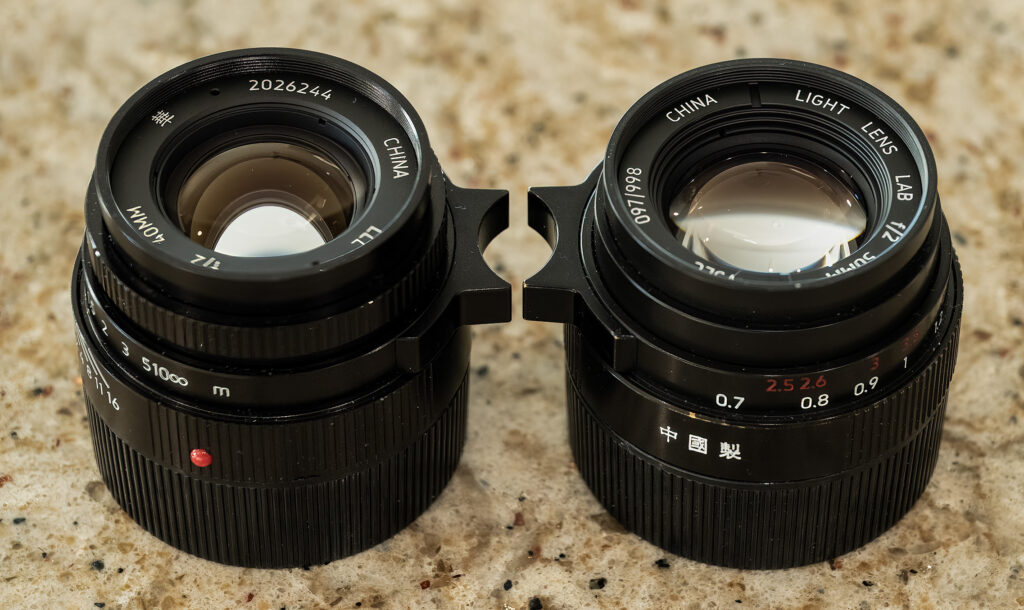
However, all of the vintage elements have been cleaned, stripped, and recoated with modern coatings. My LLL 40mm Hua appears completely new. Looking through the lens with a strong light I did not observe any of the common flaws often seen with vintage glass. Capturing images with a M11 EV1 wide open at f2 the corner vignetting is rather severe with dark corners, with reduced contrast across the entire field of view. The images clean up rapidly by f/2.8 and by f/4 the full character of the lens is apparent.
Light fall-off is much reduced providing a good field of view and sharpness, with the centers being quite sharp and even the corners of the image sharp enough. The lens has no visible distortion or chromatic aberration. What is delightful about this lens is its capacity render producing filmy appearing vintage imagery out of camera without using film presets. Street scenes in Anchorage Alaska look as if captured decades ago. The lens is lower contrast pulling out shadow details that yields a dynamic range that more parallels my eye view along with its eye view field of view. The Light Lens Lab chimeric iteration of the 40/2 lens through Hua design and refinment produces a lovely filmy decades-old look could be a great single carry choice.
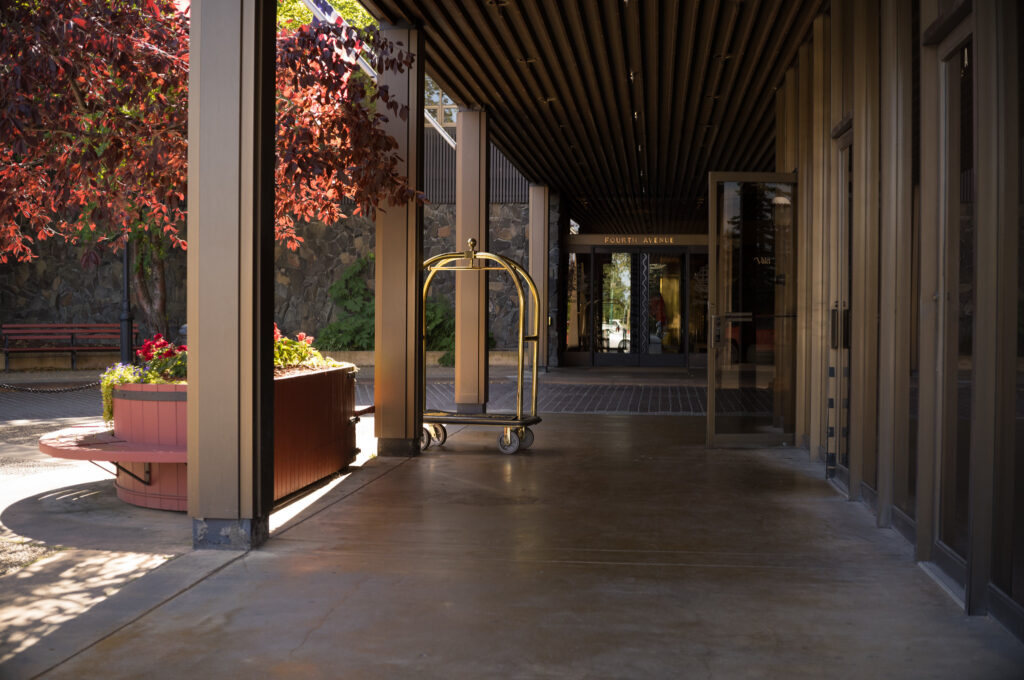
The entrance of the Captain Cook Hotel in Anchorage is an ordinary scene, but it illustrates some of my observed characteristics of this lens. The low contrast of the lens yields an excellent dynamic range bringing up shadow detail of the entrance that results in a three-dimensional appearance from light to dark. Even some of the details inside the hotel are visible through the glass door. The courtyard adjacent to the entrance is bathed in light, yet the highlights are not blown out and the interplay of shadow and light gives the image more of an eye’s dynamic range view. By the beginning of September it is autumn in Anchorage, the leaves have turned color with the daylight filtering through tree again the dynamic range yields a pleasing image. There is a brass baggage cart in light and shadow by the entrance and lens renders the brass as a natural brass glow. Above the luggage cart is one of the hotel windows that has foliage and sky reflected in the glass, again the contrast and the dynamic range of the lens that brings all of the varying illumination in a coherent whole.
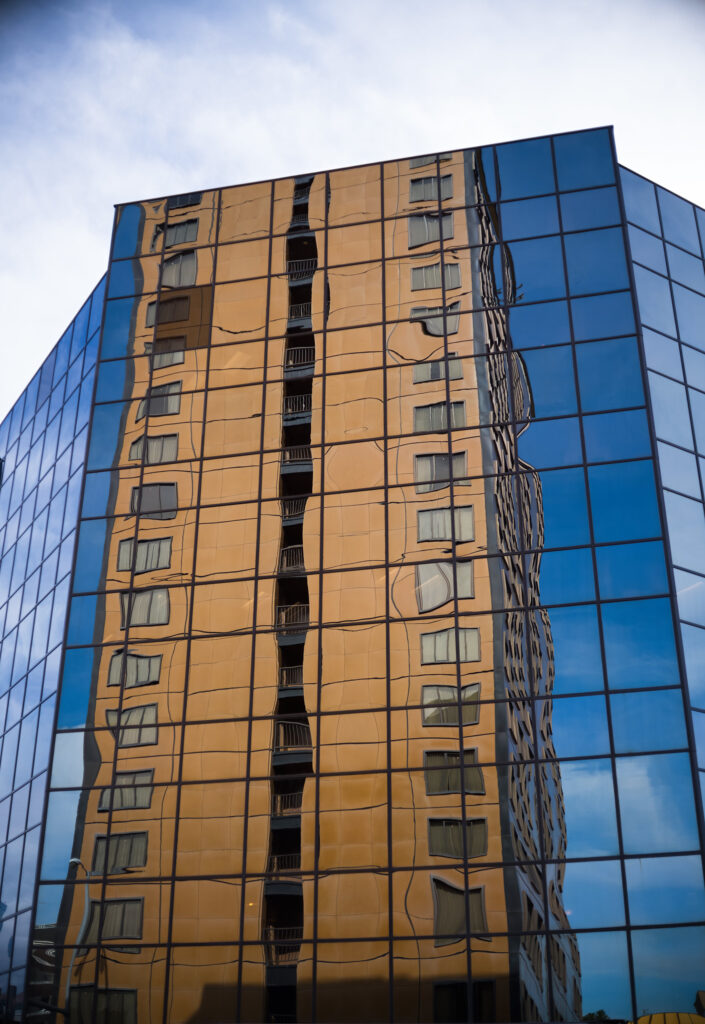
The Captain Cook Hotel in Anchorage mirrored in an adjacent building. The building’s windows render the hotel into fun-house distortion but straight lines of the building’s framing shows that the Light Lens Hua has little distortion. The hotel rose out of the reconstruction of the great earthquake of 1964 as symbol of recovery and is now a landmark.
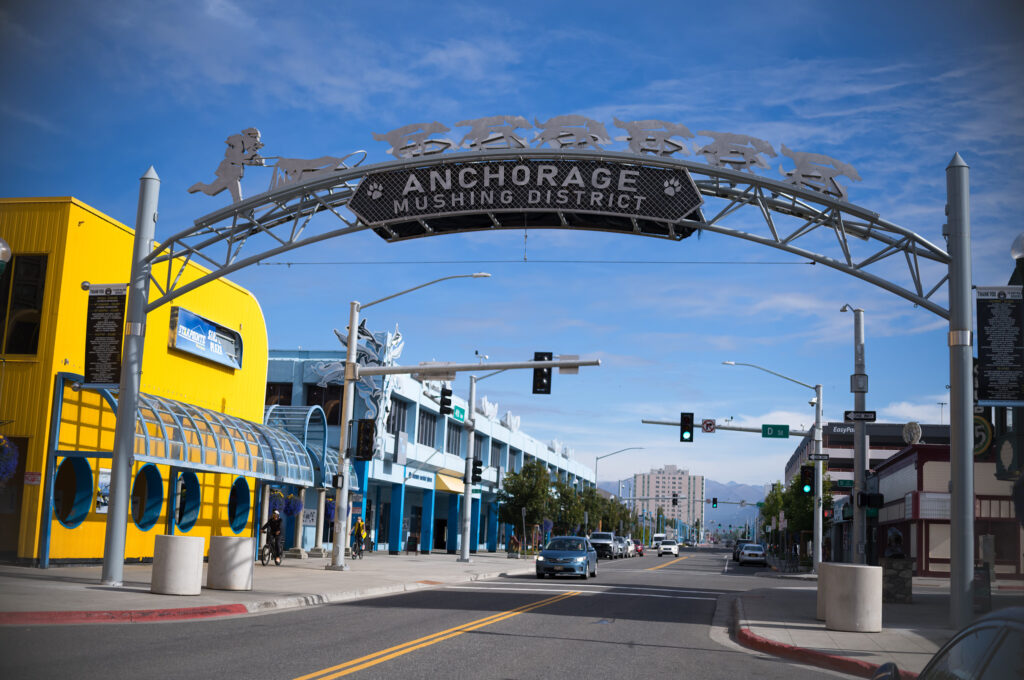
Anchorage street scene of the ceremonial start point of the Iditarod dog race. The Hua lens renders the scene as filmy vintage and looks like it was captured decades go until the current modern cars are noted.
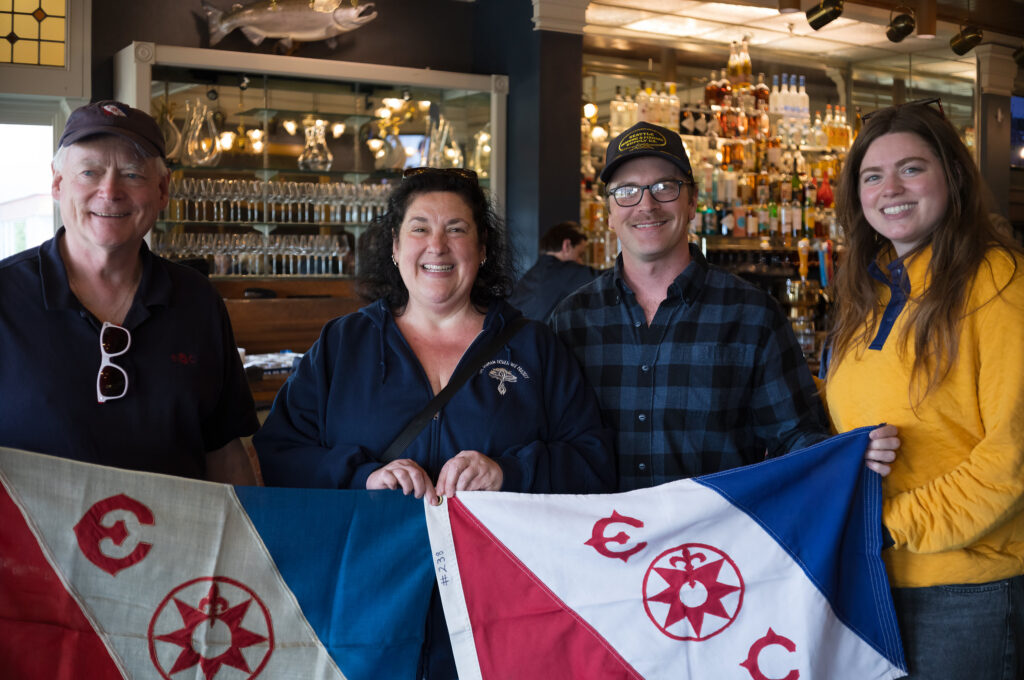
Hua 40/2 portraits from a luncheon of the Alaska Chapter of the Explorers Club who are conducting two flag expeditions, a prestigious honor. From left to right, Explorers Club Alaska Chapter Chair Mead Treadwell, Lt. Governor of Alaska 2010-2014 Dr. Constance Scharff, Explorers Club Flag No. 12 carrier and Founder/Principal Investigator of The Human Resilience Project, Casey Pape, and Natalie Treadwell, holding the Flag for their expedition to commentate the centennial of the 1926 Norge Airship Expedition that was the first flight over the north pole.
Author: My name is Eliot Herman, I am a retired university professor and now serious photographer, flyfisherman, and amateur astronomer living in Alaska and Arizona living my hobbies and interests. Photography has been a central feature of my life since childhood when I first learned capturing images with my father’s 1940’s vintage Mercury LTM half frame range finder and DIY black and white phootgraphy. More information about me and my photography is available on my website
Share this post:

Comments
No comments found