

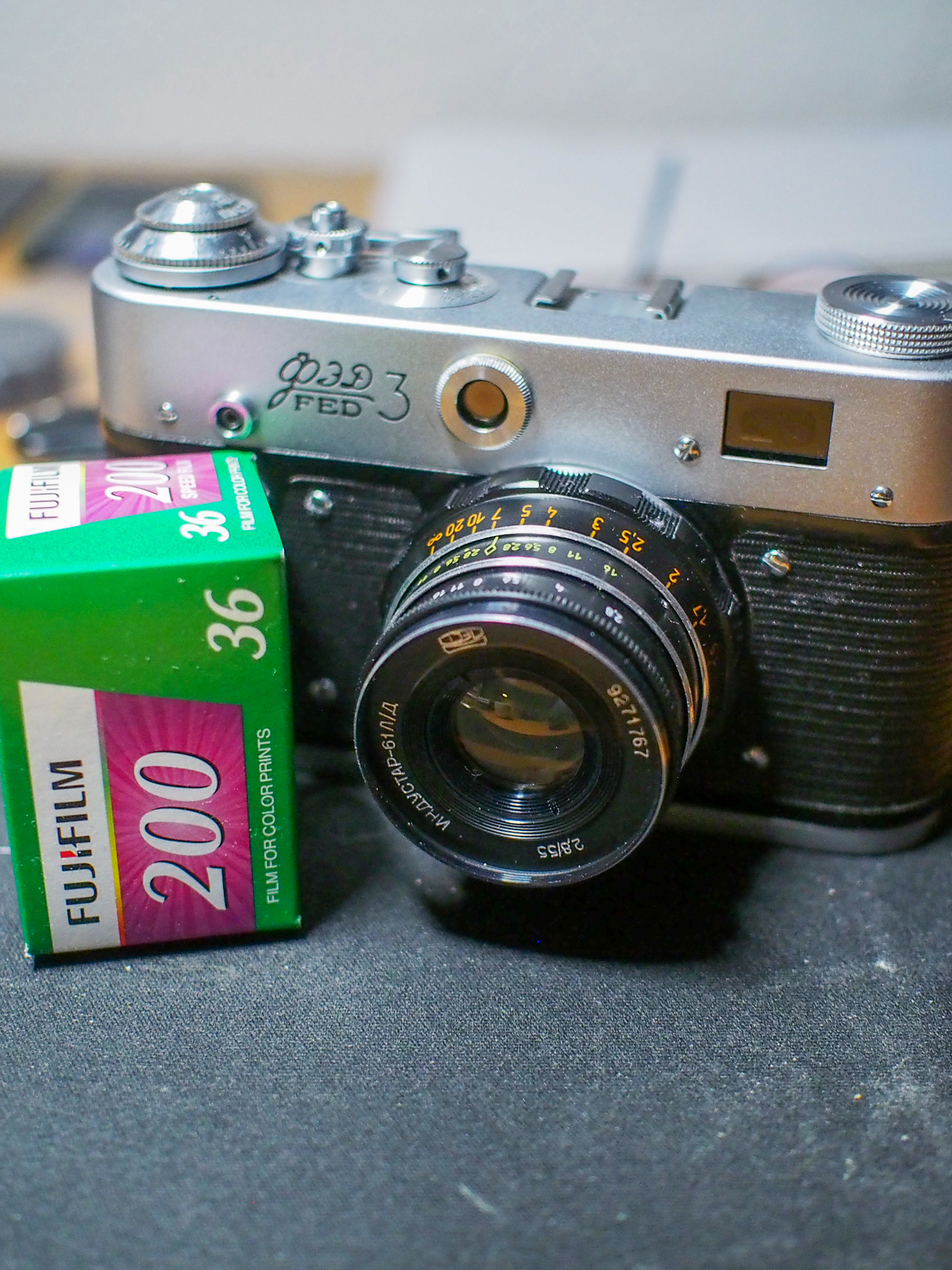
In mid-2025, I added a Soviet 35mm rangefinder camera, an FED-3 with an Industar 61 L/D 2.8/55mm lens, to my collection. The camera and lens had been freshly CLA’d and were offered for sale on eBay by a dealer in Ukraine. It wasn’t my first purchase from this dealer, whom I had come to know as reliable. Although he lives near the war front, delivery was very quick and hassle-free. I had the camera and lens in my hands after just one week.
The FED-3 is a very handy camera and can be operated like a modern camera thanks to its quick-release lever. Manufactured between 1961 and 1979, it was a mass-produced product with over 2 million units built. It has a 39 mm screw thread and shows similarities to the German Leica. It was manufactured by FED in Kharkiv, now located in Ukraine. The Industar 61 L/D is considered one of the best lenses ever produced in the Soviet Union. It has a long tradition; the earliest Industars were Leica Elmar-type kit lenses derived from Carl Zeiss Tessar, which were mainly adapted to the Soviet Leica copies of the time, namely the FED-1. It continued to be manufactured until the fall of the Iron Curtain and is a winner. The 61 L/D version features lanthanum glass elements, which have a higher refractive index to improve sharpness and resolution. The build quality does not set the global standard, but the lens quality does not differ much from other lenses from competitors. One can be very satisfied with it, especially at the price. I paid £65 for the newly serviced lens in mint condition.
For my first film role, the camera was loaded with Fujifilm 200. The shots were taken near my flat at Rheydt Castle in Mönchengladbach. The film was exposed at ASA 200. The exposure was measured using a Sekonic L-208 Twinmate with light metering (calotte). Development and scanning took place in a minilab near my home.
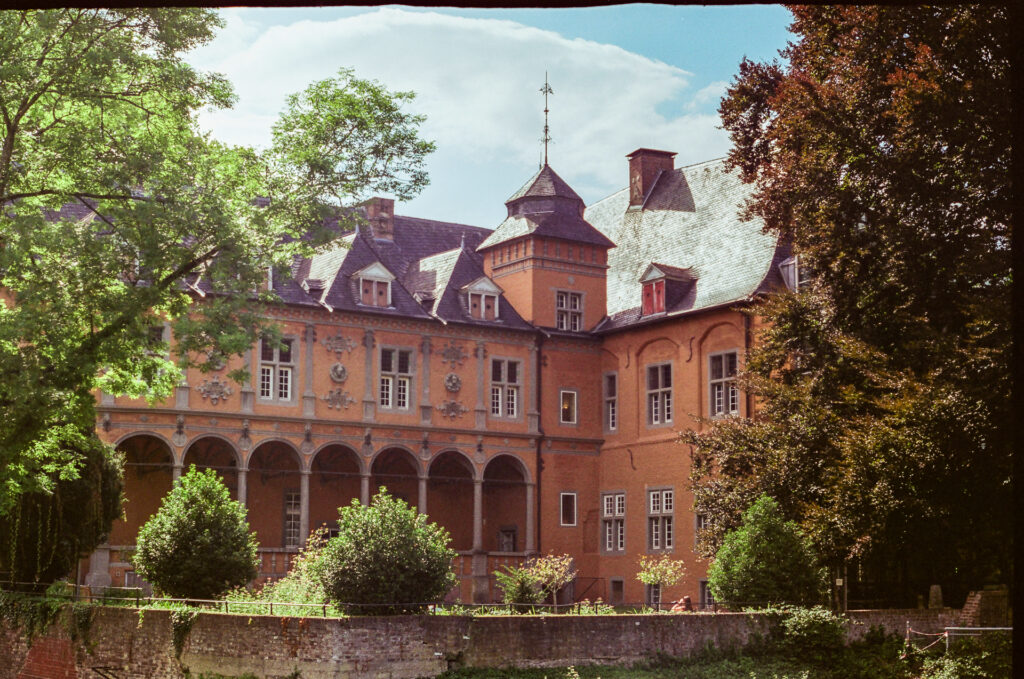
Here you can see the rear of the Rheydt Castle mansion in Mönchengladbach with its arcade. On this particular Monday, the museum housed there was closed, so there were only a few visitors. After my first publication here in 35mmc, there were comments about the few people pictured. I must say that it has become difficult to photograph people in Germany. According to EU and German law, consent must be obtained for both photography and publication. When you ask, you usually don’t get permission. A country without people is hard to imagine when I look at the old picture books by American photographers and Henry Cartier-Bresson.
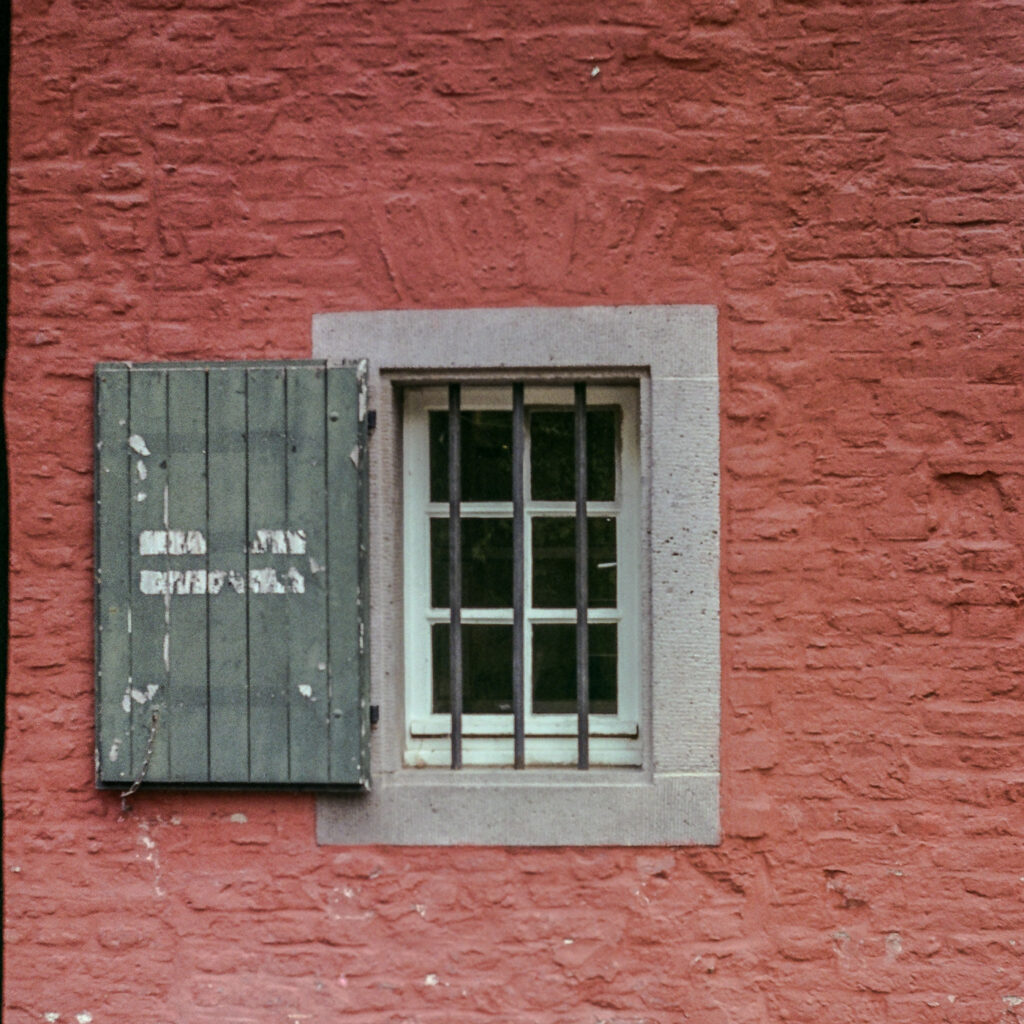
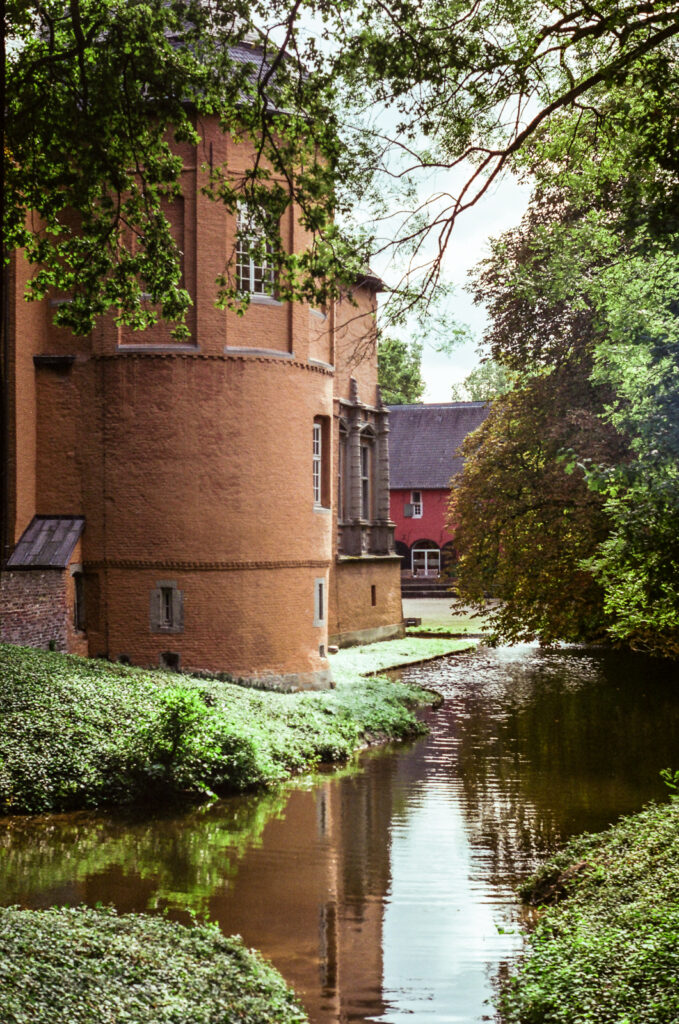
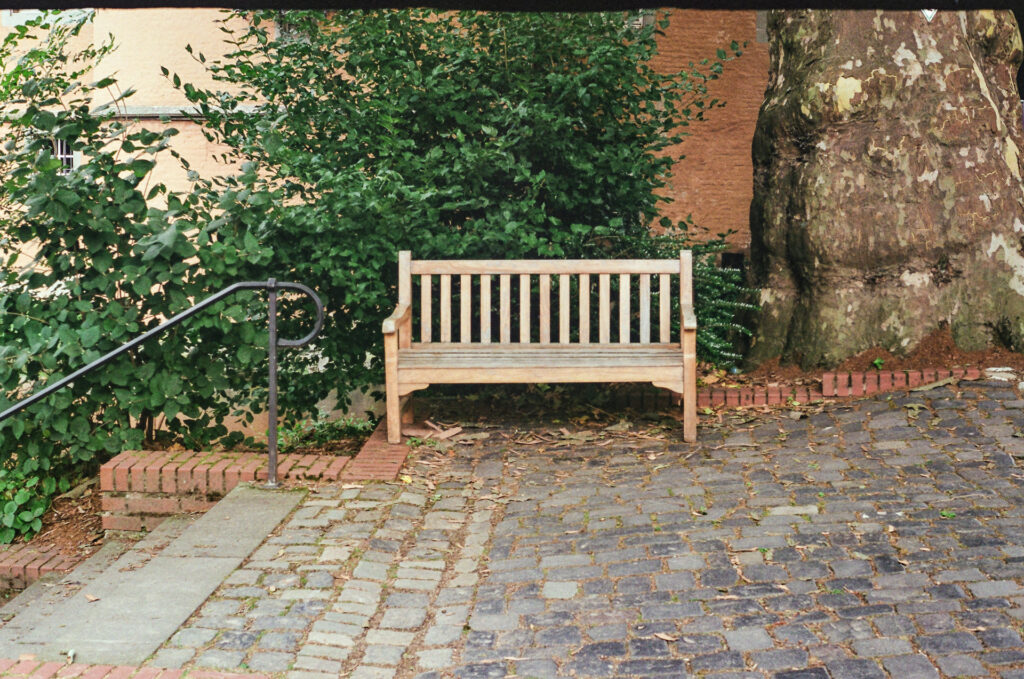
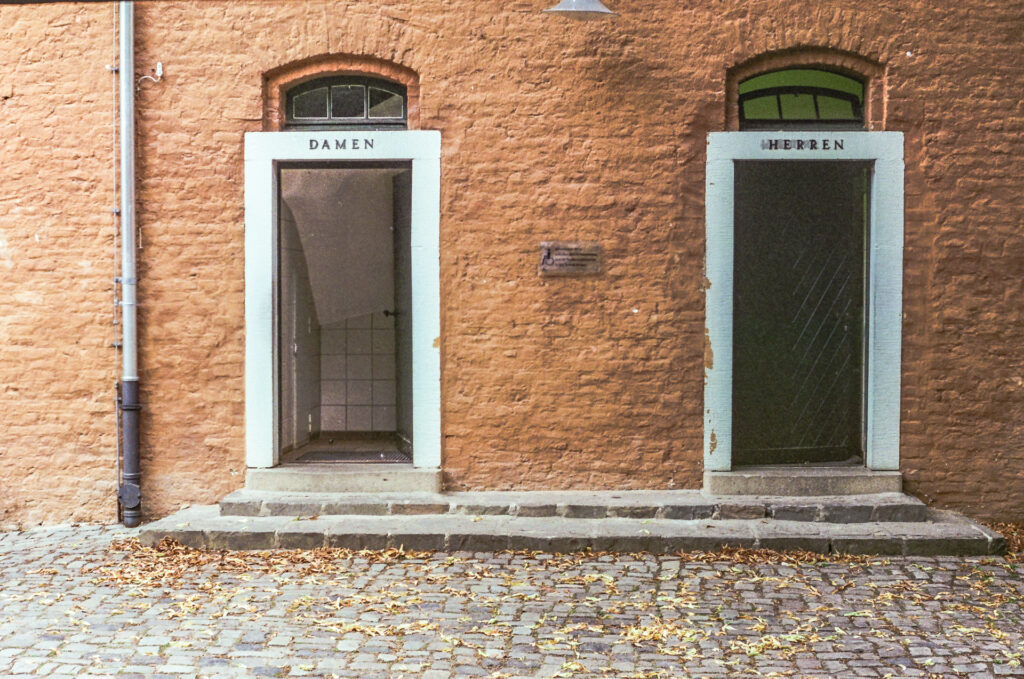
This building is painted red, in contrast to the manor house. Finally, here are two photos of the castle’s inner courtyard with a bench and the toilet facilities. The three building complexes belonging to Rheydt Castle are surrounded by a moat. You can walk around the grounds both inside and outside the pond. Now for three more impressions.
Thank you very much for your interest.
Share this post:

Comments
Charles Young on 5 Frames with a FED-3 Rangefinder with Industar 61 L/D 2.8/55mm
Comment posted: 02/12/2025
I really like my Fed 2 and Fed 3. Have a bit of preference for the Fed 2 'cause it looks the most like my Leica IIIg. Lucky us to have discovered these good old rangefinder cameras that don't use batteries!
Chuck
Charles Young on 5 Frames with a FED-3 Rangefinder with Industar 61 L/D 2.8/55mm
Comment posted: 02/12/2025
The tape comes off the take up spool clean when I rewind the film back into the cartridge.
Comment posted: 02/12/2025
John Andrews on 5 Frames with a FED-3 Rangefinder with Industar 61 L/D 2.8/55mm
Comment posted: 02/12/2025
Comment posted: 02/12/2025
Fred Nelson on 5 Frames with a FED-3 Rangefinder with Industar 61 L/D 2.8/55mm
Comment posted: 02/12/2025
Comment posted: 02/12/2025
Christopher Welch on 5 Frames with a FED-3 Rangefinder with Industar 61 L/D 2.8/55mm
Comment posted: 02/12/2025
Comment posted: 02/12/2025
Andrew on 5 Frames with a FED-3 Rangefinder with Industar 61 L/D 2.8/55mm
Comment posted: 03/12/2025
I had to buy a complete FED 5B camera (in working order minus the rangefinder) just to get the lens, but at a total cost of £22 it was a bargain and way cheaper than the lens on its own.
A word of warning too- there are many of these lenses advertised on eBay, but take a close look at the front view. Most advertised by U K sellers (no matter what the advert says) are (Cyrillic) N-61. These don’t have the lanthanum glass and are reputed not to produce such a sharp image.
Comment posted: 03/12/2025
Comment posted: 03/12/2025
Omar Tibi on 5 Frames with a FED-3 Rangefinder with Industar 61 L/D 2.8/55mm
Comment posted: 14/12/2025
Comment posted: 14/12/2025