

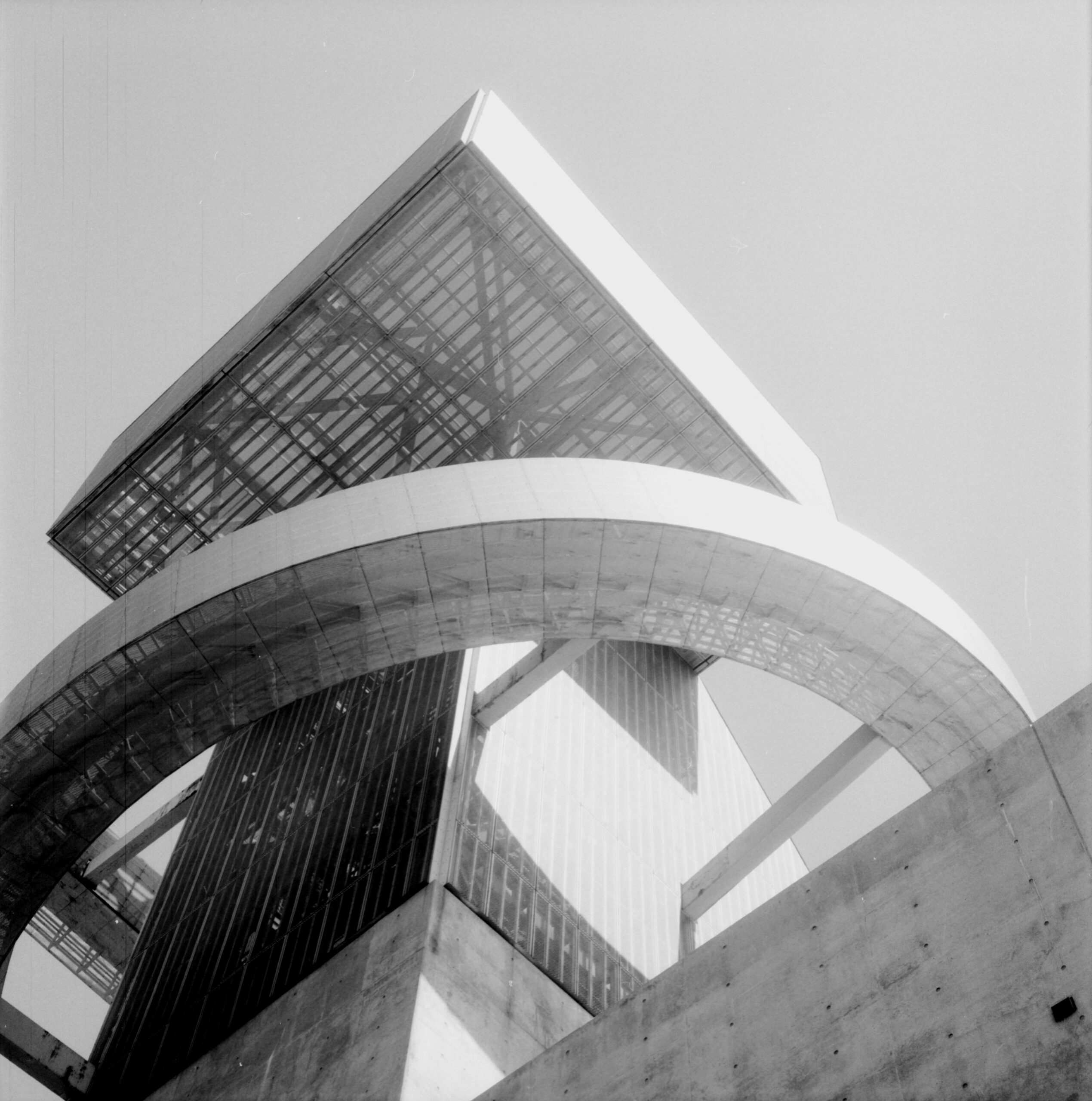
Featured image: Ramon C. Cortinés High School of Performing Arts, HMC (executive architect) and Coop Himmelb(l)au (design architect)
How do people experience great works of architecture?
In the past
Some people visited famous works of architecture frequently, returning with a souvenir – a painting, sketch, plate or drawing. More often than not, they would see them in books, museums, art galleries. Photography was instrumental in promulgating architecture.
Now
One word – cellphone.
People still mostly experience great works of architecture through still and moving images. Only a very few actually visit the buildings and inhabit the interior spaces. Some interiors and even exterior zones are closed to the public. While the exterior of the Great Pyramid at Giza in Egypt can be viewed and only partially climbed, the interior is strictly off limits. And Stonehenge is only partially accessible, as the website states :
Get up close to the iconic Stone Circle and take the perfect picture.
This implies that you cannot go inside the circle, which I did years ago.
While the Great Pyramid at Giza in Egypt and Stonehenge are open to the public, albeit for a fee, private residences and other buildings can generally only be seen from afar or are hidden behind walls and gated gardens. Interiors are frequently accessible only during special events.
During high school in Rochester New York, I saw only the exterior of the Boynton House, designed by Frank Lloyd Wright in 1908. It’s not far from the George Eastman House, the former residence of the Eastman Kodak founder, now a museum. I only saw the interior of the Boynton House in a thesis borrowed from a library.
Up close and personal
Frank Loyd Wright
During senior year in high school, visited Swathmore College in a hunt with mother for prospective universities, Decided just to knock on the door of the 1939 Frank Lloyd Wright, quadraplex Suntop Homes. I managed to convince the homeowner to show us the interior.
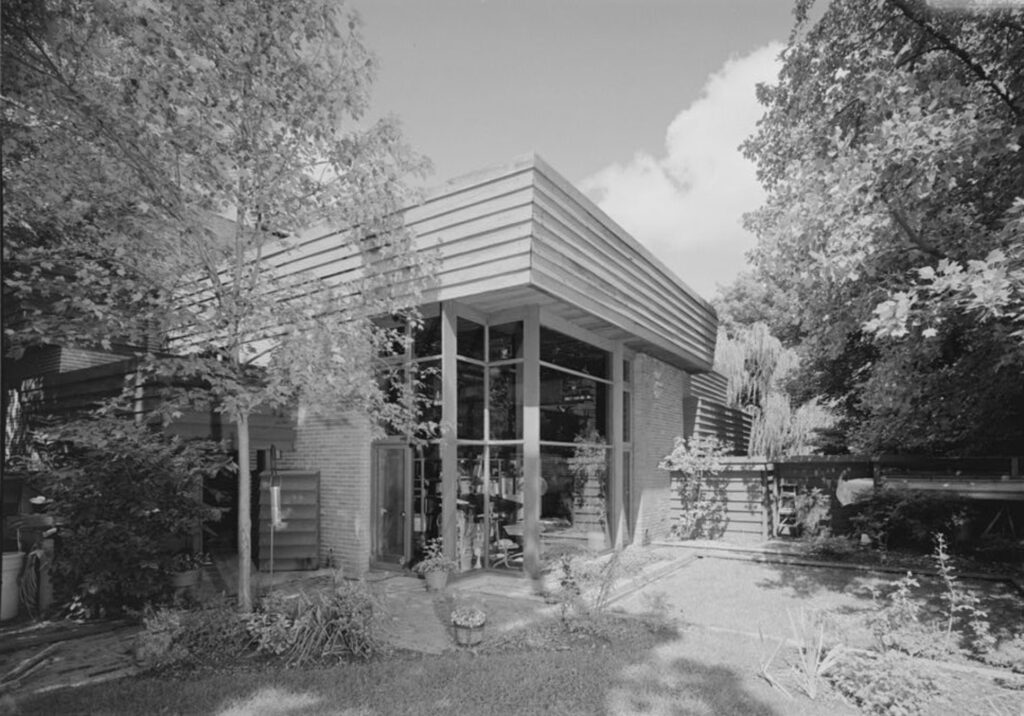
Schindler and Neutra
I went inside other private buildings designed by two seminal architects – Richard Neutra and Rudolph Schindler. Architecture has become a life-long obsession.
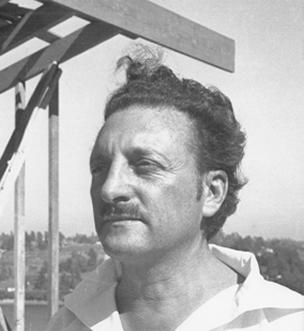
By http://www.pushpullbar.com/forums/showthread.php?1774-USA-Rudolph-M.-Schindler, Fair use, Link
The two Austrians worked for Frank LLoyd Wright. Neutra decamped to Los Angeles. Schindler oversaw the construction (1919 – 1921) of the Frank Lloyd Wright Hollyhock House in Los Angeles, and then joined Neutra. The two along with their wives had an unusual living arrangement, sharing a house on Kings Road, near our apartment. Their tempestuous relationship is documented here and their imagined reconciliation in The Princes of Kings Road.
I visited a friend who lived in the 1937 Richard Neutra Landfair Apartments. Went inside several Schindler buildings not open to the public – two houses and one apartment. Acted as a docent at one house – the 1934 Buck House, while the other house belonged to a UCLA architecture professor – the 1925 Rudolph Schindler James Eads How House, which had a Richard Neutra garden. That house is now an Historic-Cultural Monument. The third was the apartment of one of the actors in the 1939 Schindler Bubeshko Apartments. The actor played Schindler in The Princes of Kings Road.
But for most people, these up-close-and-personal visits are increasingly rare.
Architectural photographers – Julius Shulman and Ezra Stoller
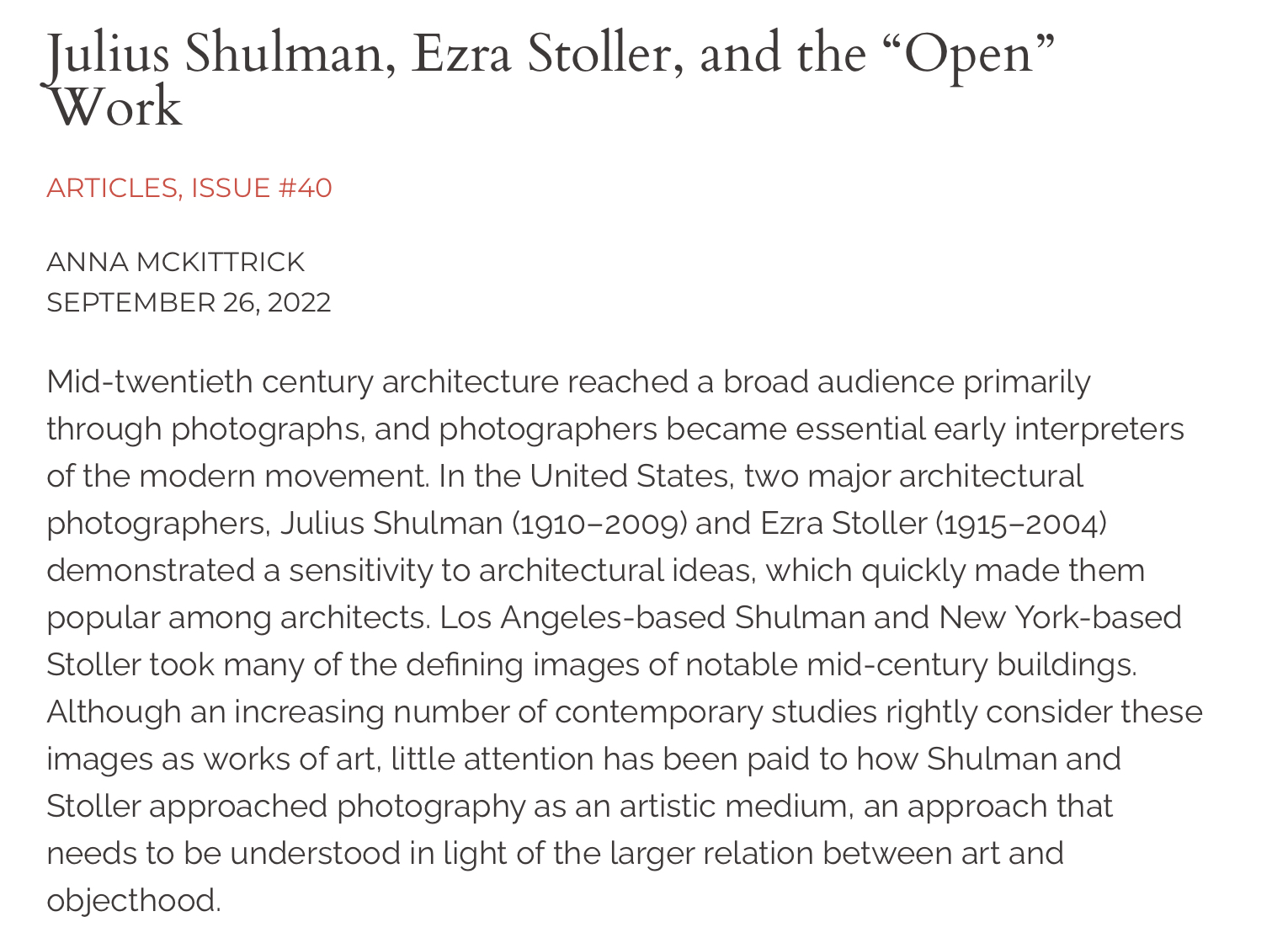
From Julius Shulman, Ezra Stoller, and the « Open Work , which aptly describes the influence of Julius Shulman and Ezra Stoller as interpreters of the mid-century modern architecture movement. For details on Ezra Stoller see Curbed and on Julius Shulman see Dezeen. Ezra Stoller was from New York City, Julius Shulman from Los Angeles.
I mainly experienced great architecture through books from public libraries. My two favourite architectural photographers were instrumental in communicating the message of mid-twentieth-century modern architecture to the public. And I heard it.
The next three images still resonate.
Ezra Stoller
This is the iconic Ezra Stoller image of Fallingwater, Bear Run, Pennsylvania, architect – Frank Lloyd Wright [1936-1937].
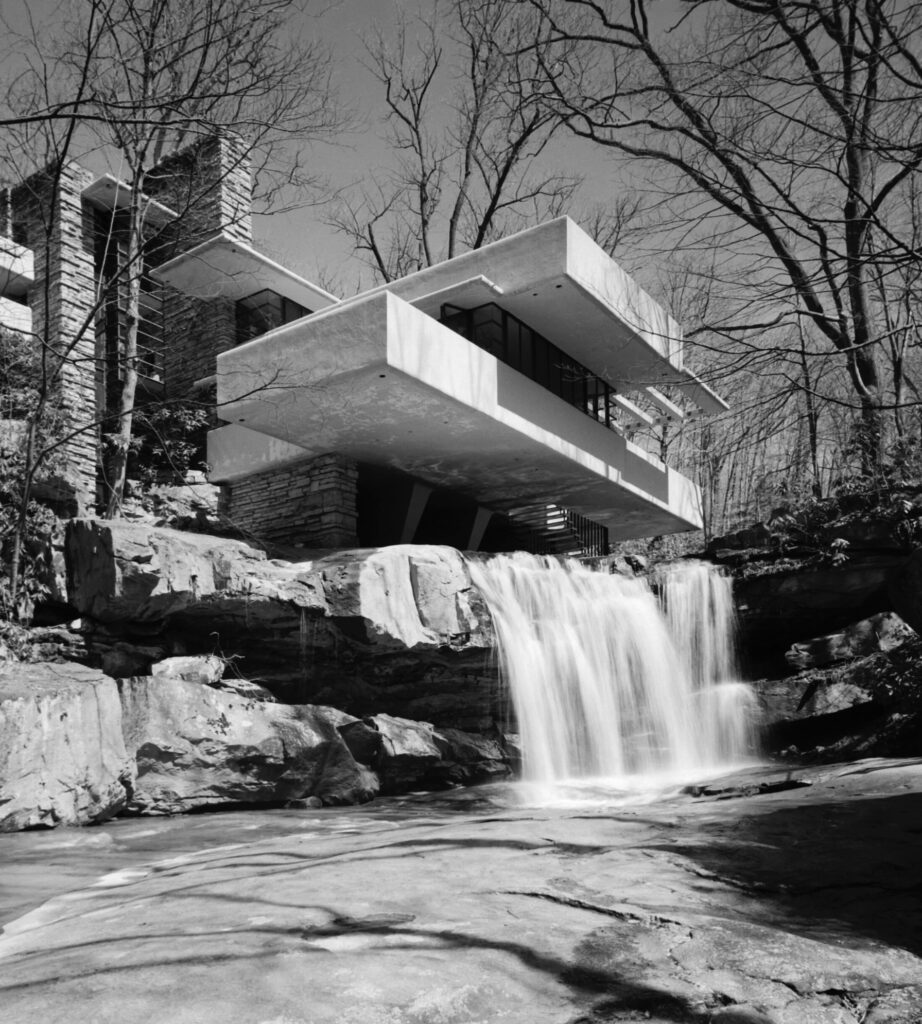
Edgar J. Kaufman Sr. built the house as a weekend retreat near Pittsburgh where he owned Kaufmann’s department store. He engaged another famous architect for his Palm Springs California retreat.
Julius Shulman
Case Study House no. 22
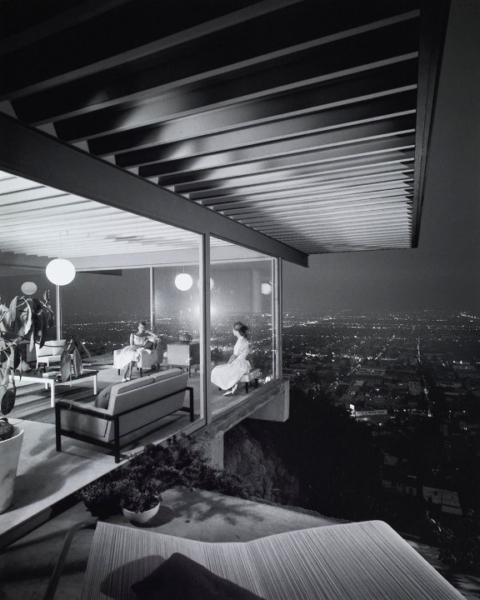
The best known image by Julius Shulman is Case Study House no. 22 (1960) in the Hollywood Hills, Pierre Koenig architect, evoking the glamorous Hollywood modern style. Koenig designed the house while enrolled at USC.
The house, on the list of Los Angeles Historic-Cultural Monuments, is currently threatened by changes on the hillside below to accommodate a new residence. In November, i signed the petition to stop it.
Kaufman Desert House
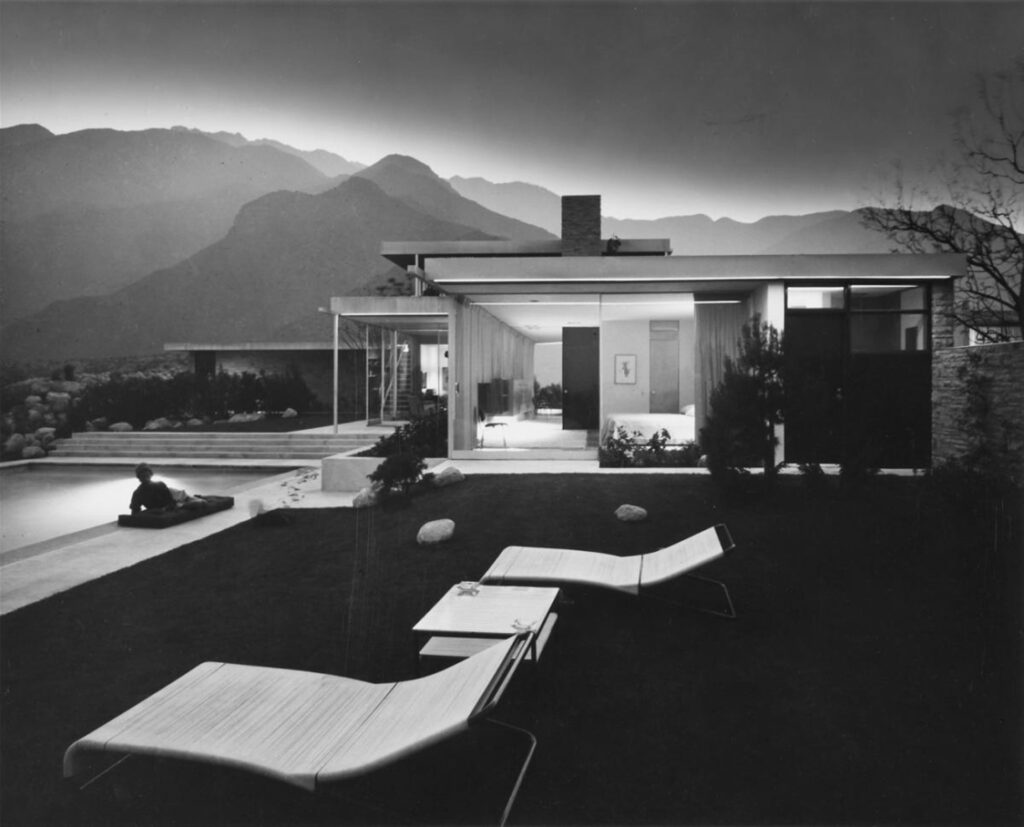
© J. Paul Getty Trust. Getty Research Institute, Los Angeles
Richard Neutra designed a winter retreat for Edgar Kaufmann in Palm Springs California, dubbed the 1946 Kaufman Desert House. Julius Shulman photographed the house in 1947 while, in 1971, the socialite photographer Sim Aarons made an iconic colour image – Poolside Gossip,
In the mid 1990s, I met Beth Harris, when we were both teaching at UCLA. She was one of the owners of the Kaufmann Desert House. Of course I knew about the iconic house. Having remained vacant for several years, the house was in great disrepair and had had several price reductions. The couple bought it for 1,5m$. Palm Springs was dead then, after flourishing up to the 1970s. Harris pursued a Ph.d. in Art at UCLA, specifically to have access to the Richard and Dione Neutra Papers there. She was also granted access to the Julius Shulmann archives to never-published images for interior images. Both archives were definitely useful during the restoration.
When we met, she was in the midst of restoring the house, having engaged the architect Marmol Radziner for the restoration. The firm had already restored the iconic Richard Neutra 1936-1937 Josef Kun House.
The the restoration’s completion in 1998 signalled the beginning of the Palm Springs renaissance. The area is a treasure trove of mid-twentieth-century modern architecture. For a provocative take, see Midnight Modern: Palm Springs Under the Full Moon, Tom Blachford, 2017. The book contains the story of how, without pre-planning, the Australian Blanchford managed to photograph the Kaufmann Desert House, arriving precisely at 19h29.
During the divorce, in 2022, the couple sold the house or just north of 13m$.
Conclusion
Where would modern architecture be without those pesky foreigners who eventually settled in the states to practice architecture?

Ten famous mid-twentieth-century architects who emigrated to the states
And where would it be without – Julius Shulman and Ezra Stoller> Netween them, they photographed at least one building by each of those architects.
And how would we have grown to know modern mid-20th-century architects without those monochrome photographs reproduced in books that morphed into films/videos and colour?
Photography can encourage, provoke, lobby and more. It’s not just snaps. And snaps can also not just be snaps [Andy Warhol]. And the quotidian cannot only be banal but the source of a dialogue, for example, between the photographer Peter Hujar and the writer Rebecca Rosenkranz, realised in Peter Hujar’s Day (2025).
Johann Wolfgang von Goethe writes
Music is liquid architecture; Architecture is frozen music.
Conversations with Eckerman (1836);
Frequently people who quote Goethe omit the first part, which is central to the idea of a strong connection between music and architecture. Landscape architecture is a totally different experience, not frozen but full of growth, seasonal movement and change.
The architectural photographer can be the performer/interpreter of that frozen music, investigating and provoking.
Share this post:


Comments
Gordon Ownby on Photography experiencing architecture
Comment posted: 05/01/2026
Comment posted: 05/01/2026
Gus on Photography experiencing architecture
Comment posted: 09/01/2026
Comment posted: 09/01/2026