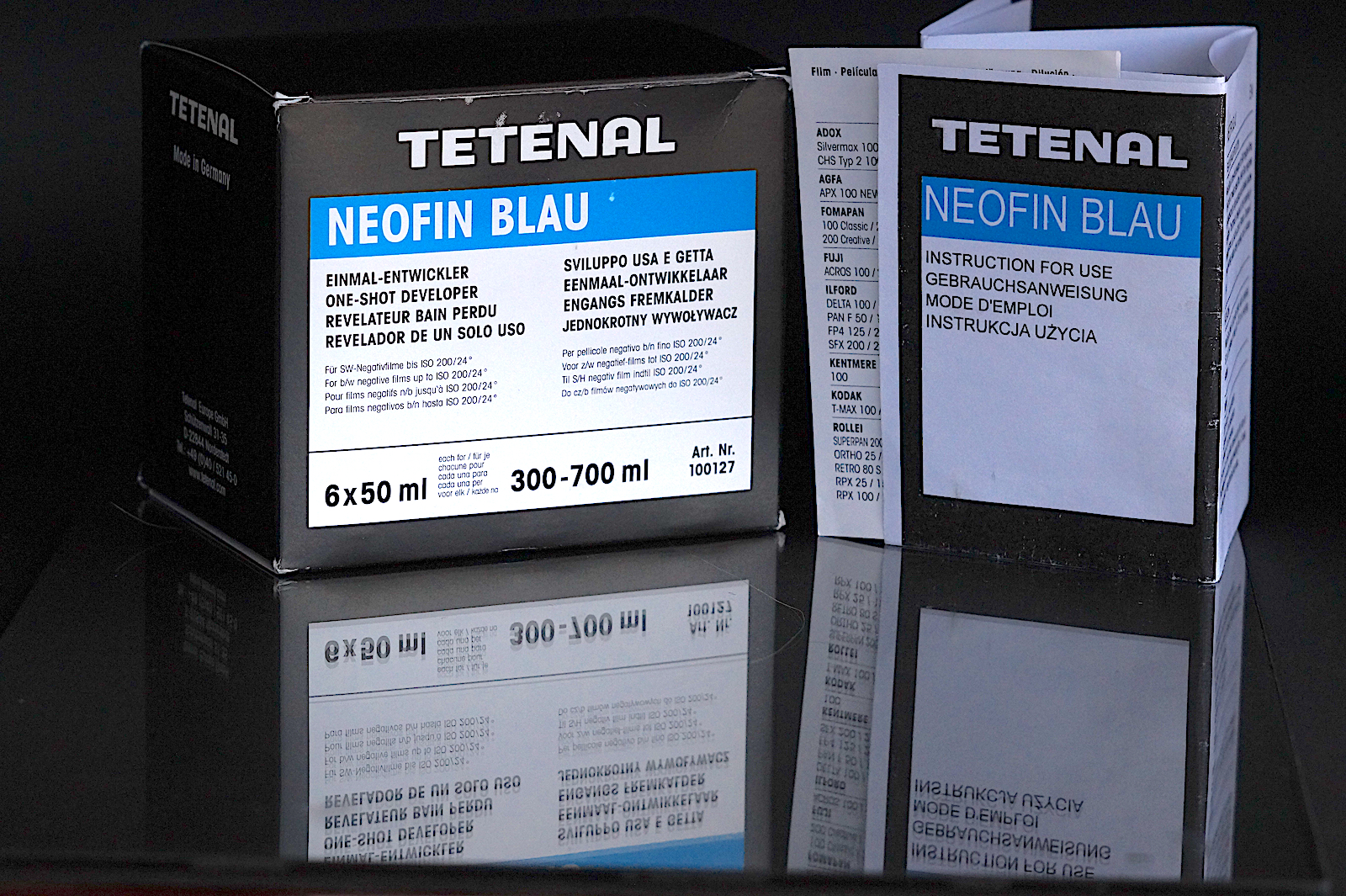
Neofin Blue – A Developing Emergency

By Tony Warren

Changing from ID-11 to Rodinal a while back I found that using that near 130 year old formula compared to more conventional developers is so much more flexible, convenient and economic. When my last bottle ran out I was devastated to discover that I couldn’t find a sensibly priced replacement anywhere in Australasia, while getting it from anywhere else in the world removed the economic benefit significantly.

Neofin Blau/Blue

In my searches I came across Walkens, an Australian supplier of a wide range of photographic goods. They list among their developers Neofin Blue, a developer intended for slow to medium speed films that comes in convenient 50ml bottles for one shot use. I used the similarly convenient Neofin Colour kits in days long gone by for C41 film processing so I thought I would give it a try, despite the shipping cost. The bottles were a definite improvement on Colour’s lab style, snap off glass phials that I was terrified of cutting myself on and splashing colour chemicals over the wound! It never happened thankfully.
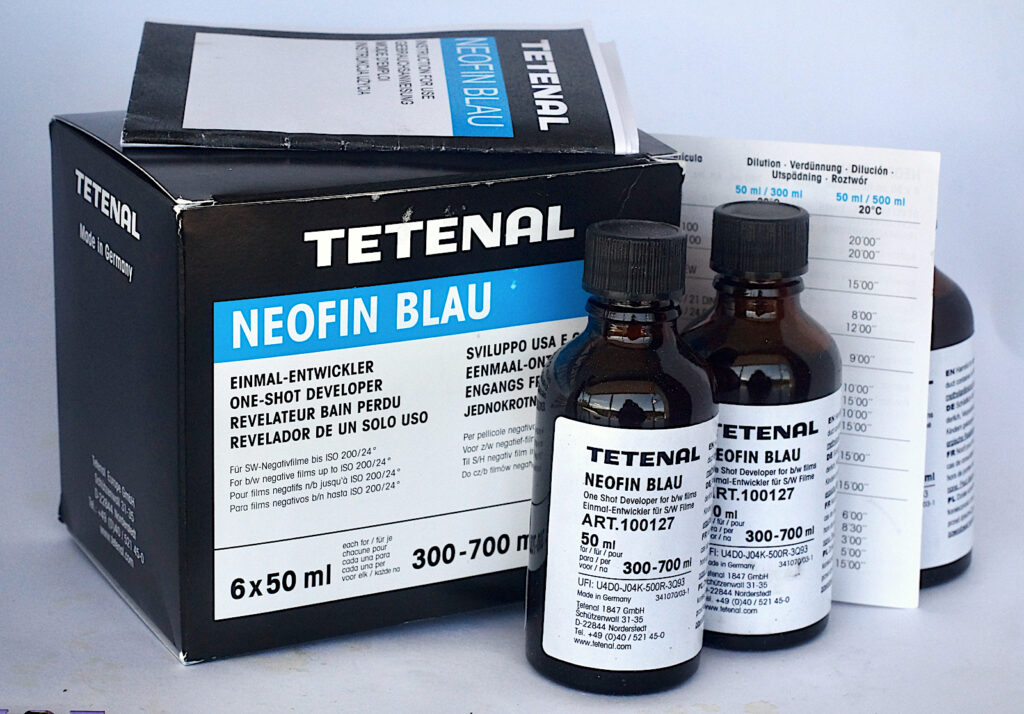
Box contents.
Box contents.

The six 50mm bottles in the kit are each one intended for single use. Times are given for two dilutions, mixing one bottle with water to make either 300ml or 500ml. There are instructions to increase times by 1.5x for a 700ml mix but the two listed times cover most tanks taking 35mm and 120 films.
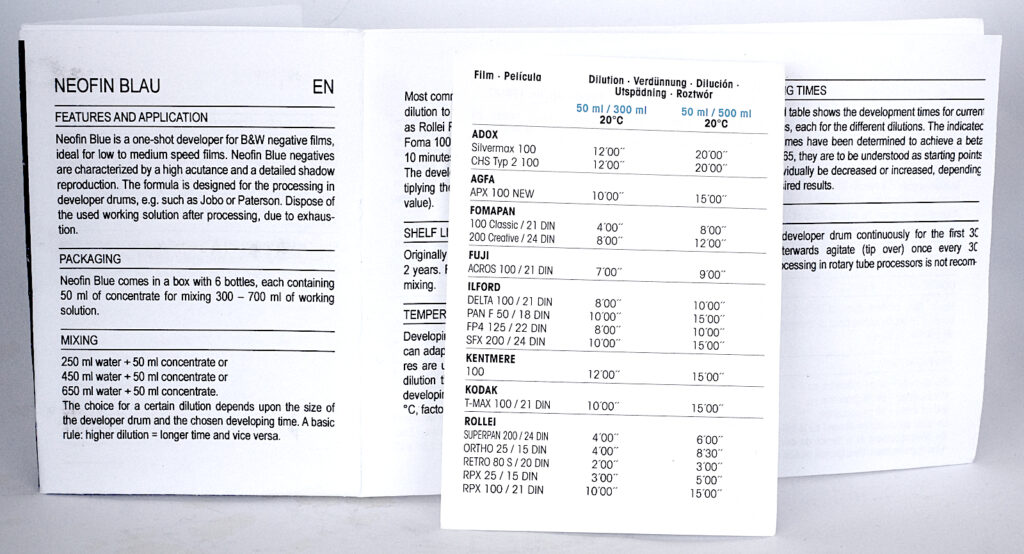
Instructions.
Instructions.

Specific agitation guidance is included, very similar to most manual tanks. Initial 30 seconds continuous then one inversion every 30seconds.

Development times vary widely, with my current Rollei Retro 80S being dauntingly short, 2 minutes for 35mm and 3 for 120. Pan F and FP4+ are going to siut me better.

First film
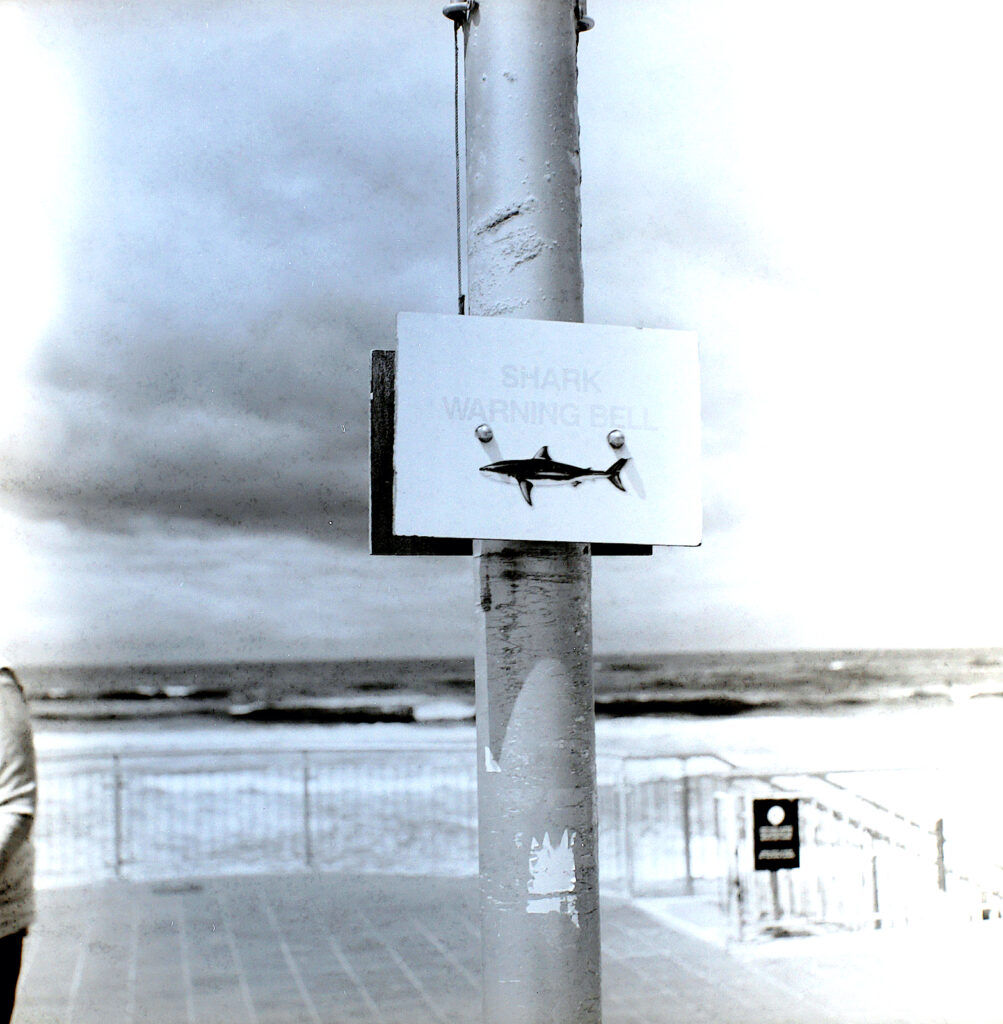
Uneven development.
Uneven development.

My first film was a 120 Rollei RPX 25 I shot on my Kalloflex TLR. With a fairly short time of 5 minutes at 20ºC I decided to agitate with the central rod of my Paterson tank for the first 30 seconds.

Big mistake!

Inversion agitation is essential to ensure even initial coverage of the film and I had some badly unevenly developed negatives as well as some good ones.
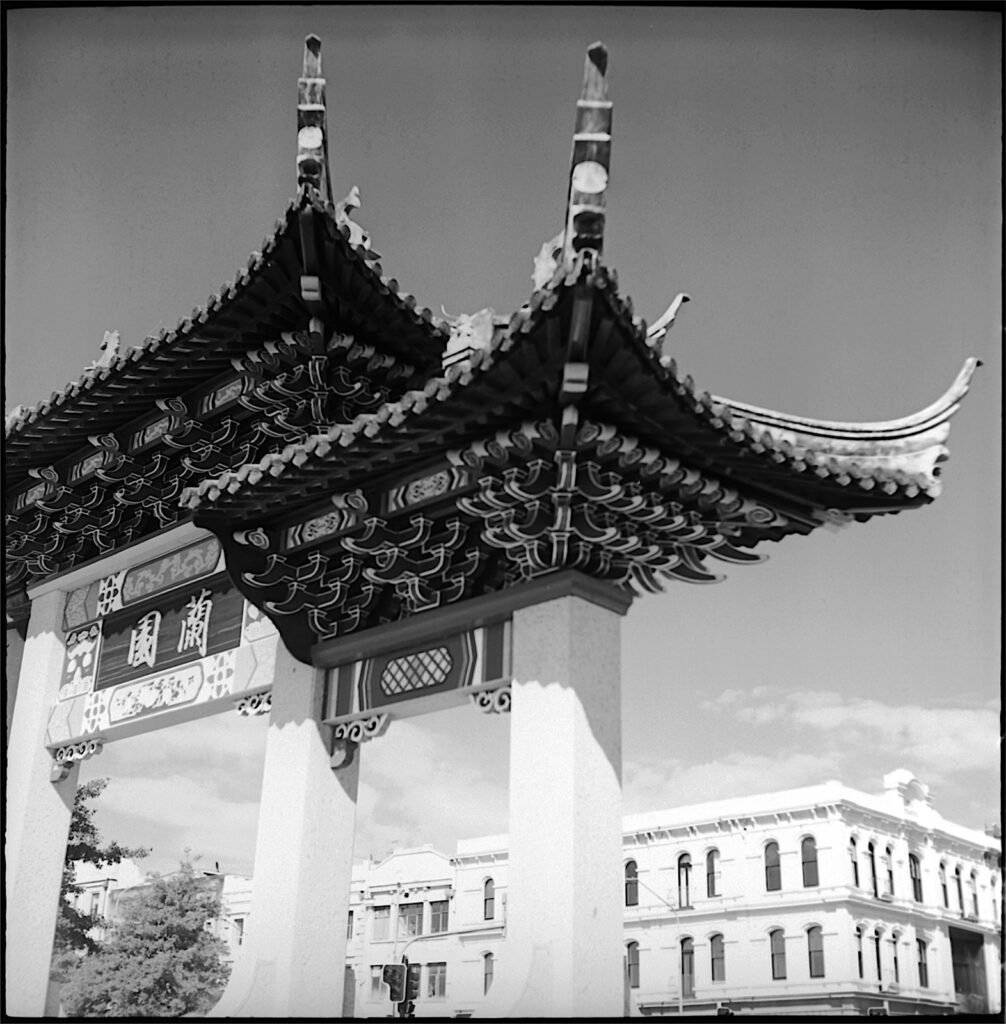
One of the better negatives. The entrance to Dunedin’s Chineses Gardens, a regular subject.

Second film

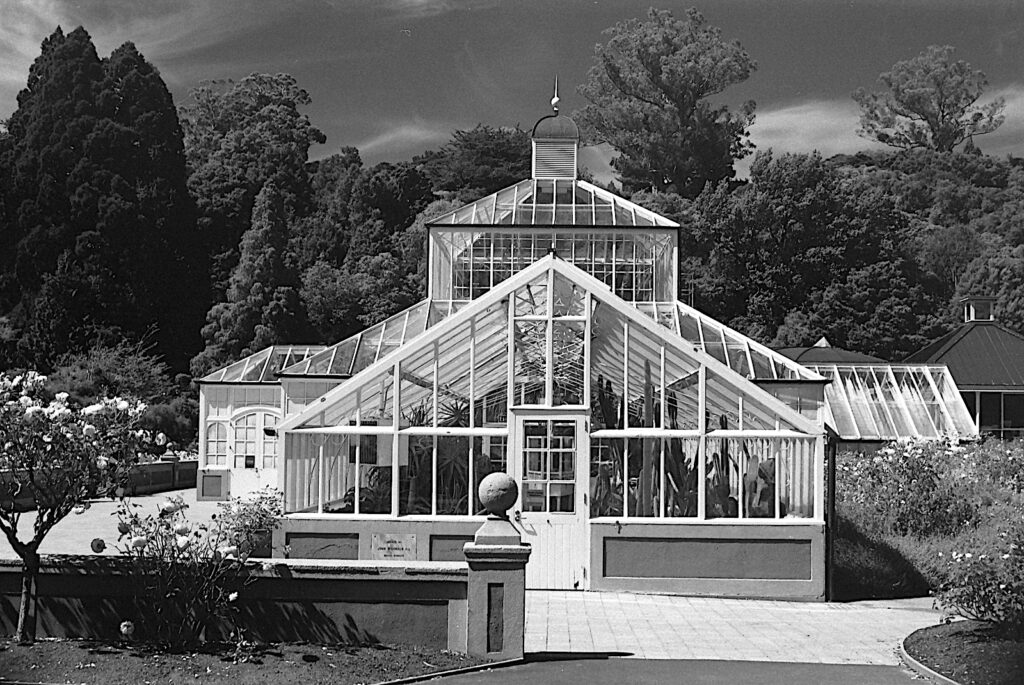
The Winter Gardens Building in Dunedn’s Botanic Gardens taken with the Olympus.

My second film was Rollei retro 80S 35mm in an Olympus IS-5000. Learning from my earlier mistake, and because the time is shorter for the higher concentration of 35mm and only 2 minutes for Retro 80S, I used inversion agitation from the start. This is definitely the way to go. I had a strip of negatives with just a hint of unevenness so inversion must distribute the developer quickly and evenly but maybe two inversions are needed.

Third film

A third film, an Ilford HP5+ 120 was exposed in my Kalloflex TLR. This isn’t listed in the instructions because this developer is designed to work best with slower films. The now obslete Neofin Rot/Red was the developer for faster films. There is a time in the Massive Development Chart (http://www.digitaltruth.com/devchart.php) however, which is what I used with good results. There was a hint of uneven development but very minor compared to the first film. Like the 35mm comment, two inversions at intervals would be better.
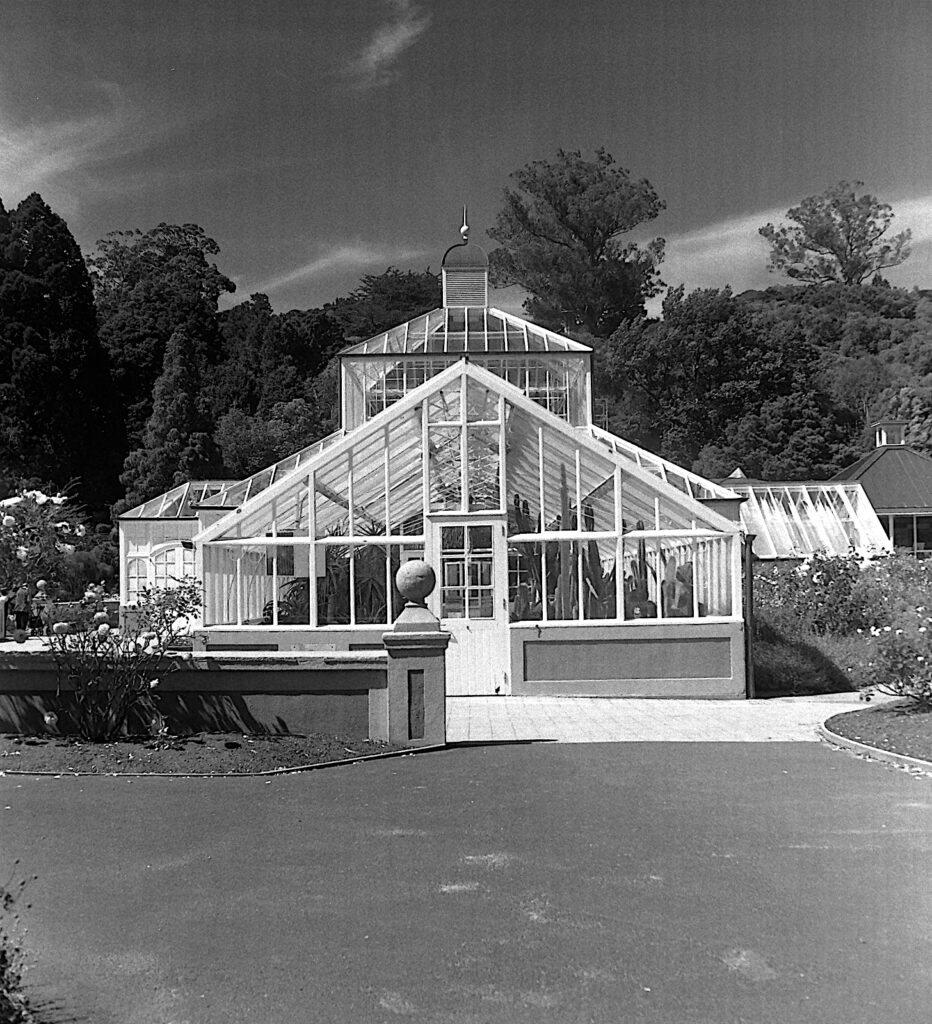
The Winter Gardens building again, taken on the Kalloflex fro the same position.
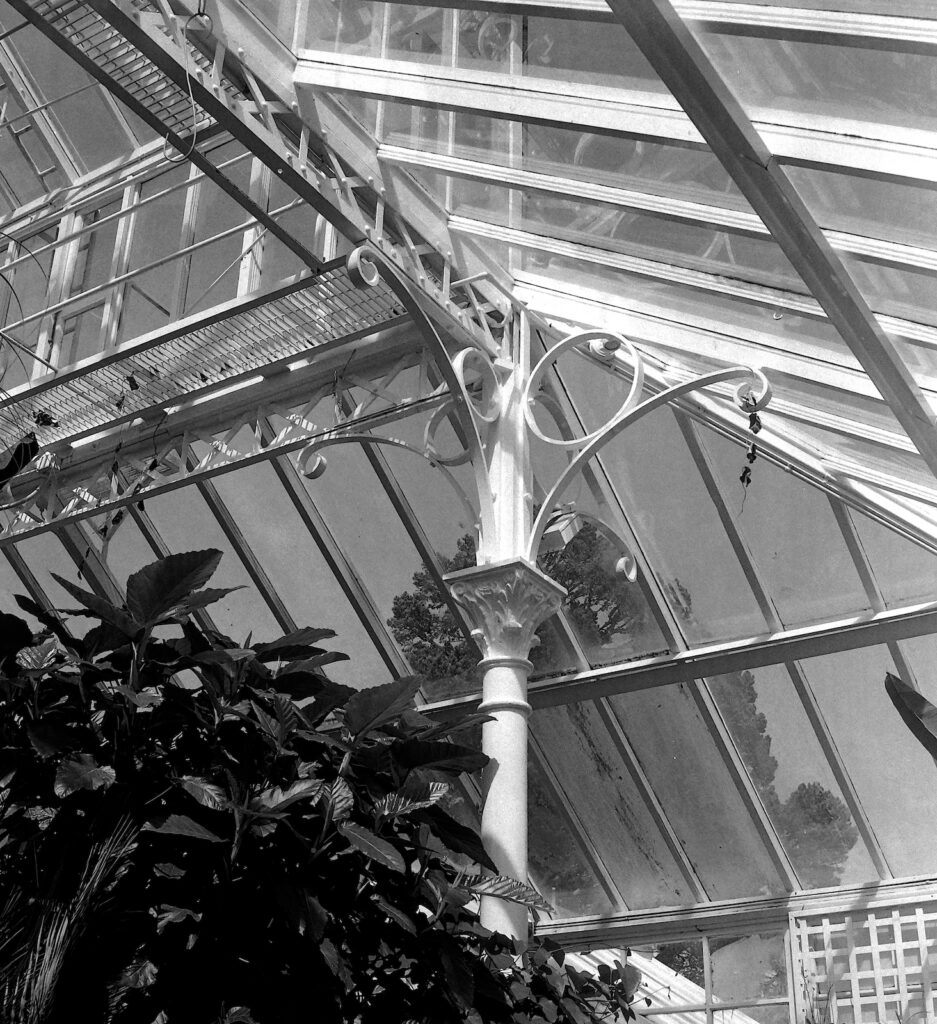
Interior of the central Tropical house in the Winter Gardens.
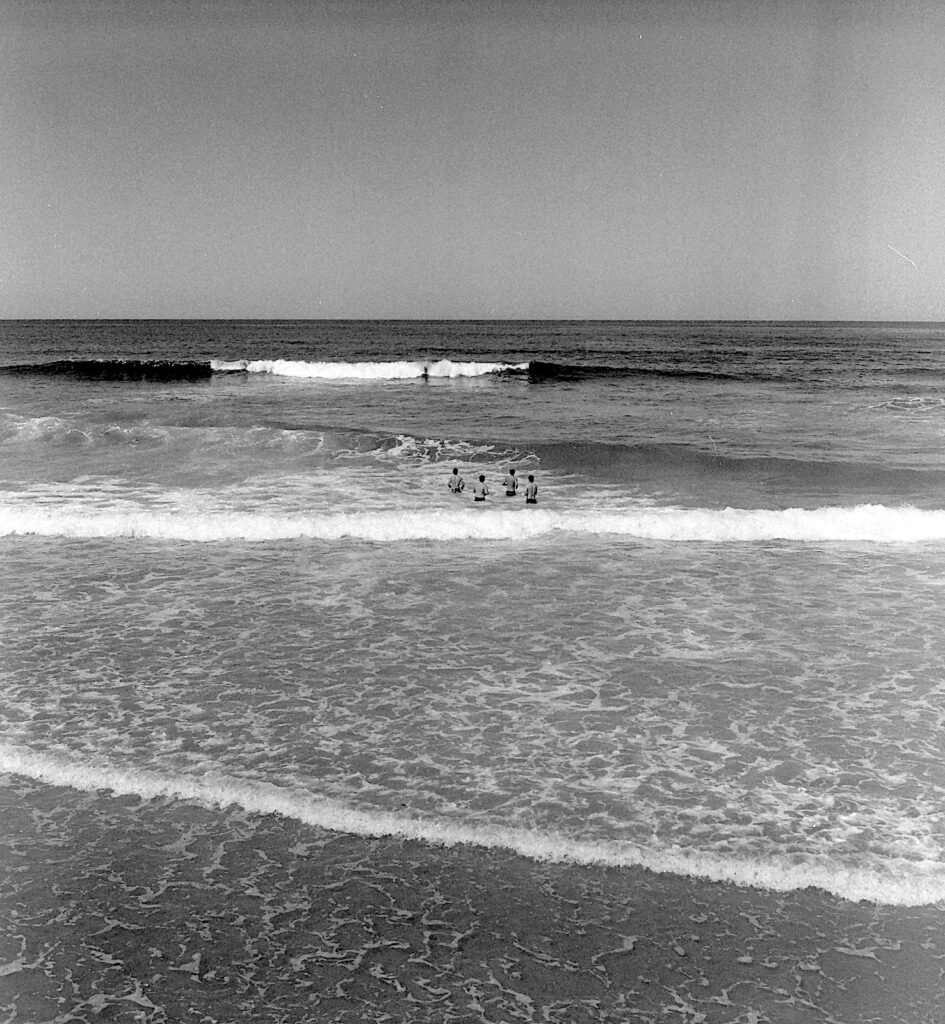
Four men face the mighty Pacific oceon.

Post-processing benefits.

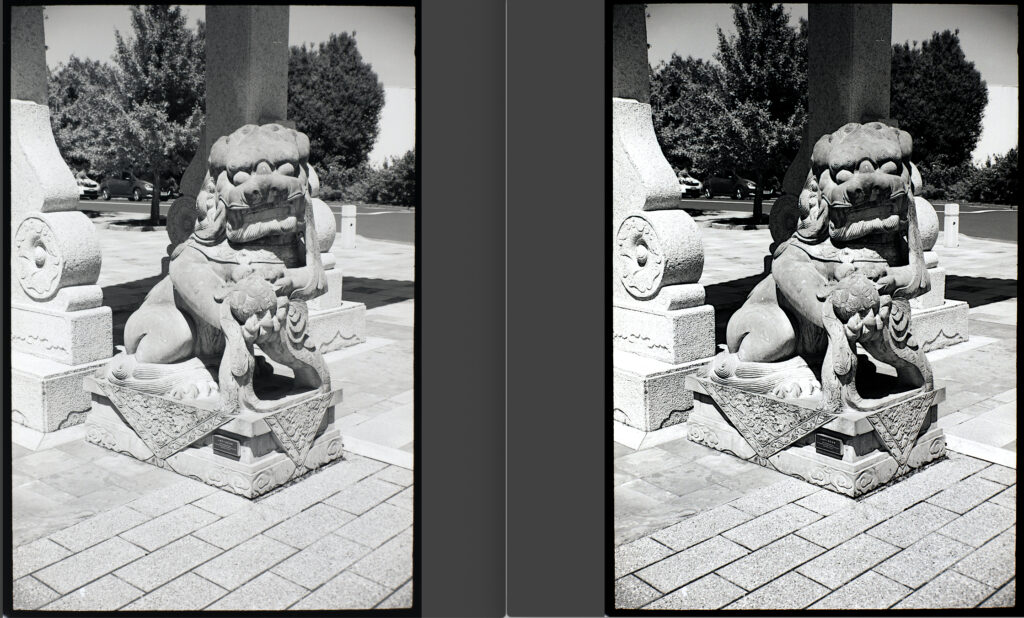
Original RPX image before and after post.

Compared with negatives from Rodinal and ID 11, Neofin Blue produces a less contrasty result but with finer grain.
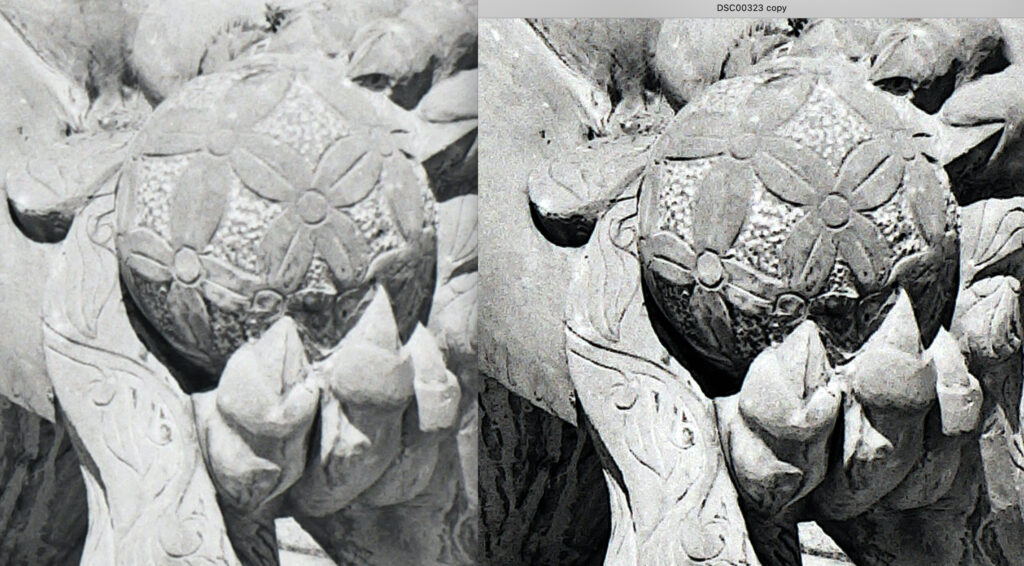
Details from above.
Details from above.

The low contrast and very fine grain means that contrast and sharpening can be applied in post with little or no effect on quality.

A group of cacti.
A group of cacti – Kalloflex.

Outside the box (instructions)

I do like a steady, quiet life and some of the development times here really push up my blood pressure. I wondered if other dilutions would produce a little more flexibility with the short times using a split bottle. I have a small pottle which takes 30ml filled to the brim to use as a decanter to help keeping properties.

This gave me the chance to try two other film/dilution combinations, 20:300 or 1:15, close to the 700 timing, and 30:300 or 1:10 which is the same as for 120, both with 35mm Rollei Retro 80S. With 120 these would be 1:25 and 1:17 respectively so maybe 2.5x and 1.5x for these extrapolated from the 1.5x increase for 700ml. Not a huge extension in times but a chance to see if it was worth pursuing further.

I shot part of a 35mm Rollei retro 80S in my Retina IIc using the 20ml mix for 3 minutes. I had left my exposure meter on 200 by mistake but there were not many completely un-useable frames.
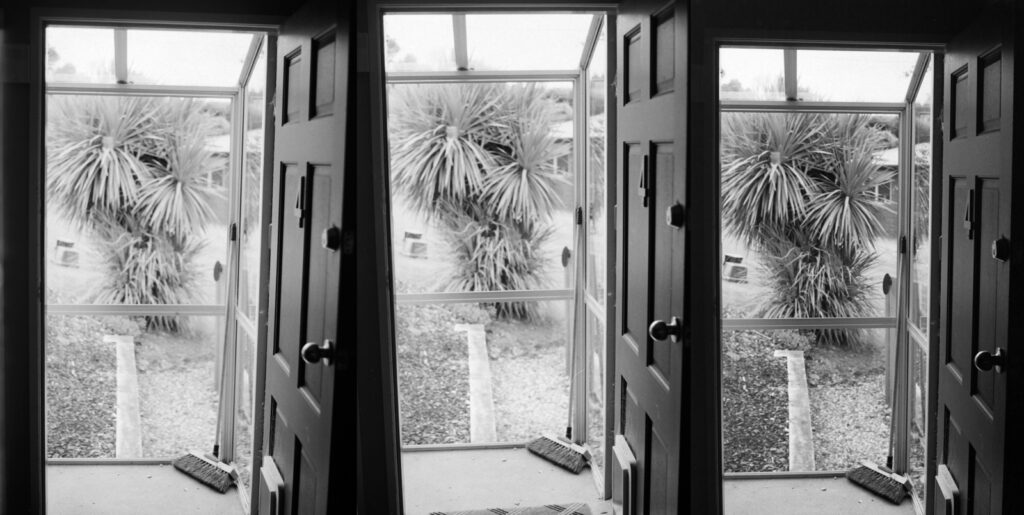
Example of speed tests exposed according to my phone app at -1/1/+2x recommended.

I finished off the film in my Canon 7 with the Industar 26M with the 30ml mix for 3 minutes. Despite shooting on a dullish day, I think the sun affected things here.
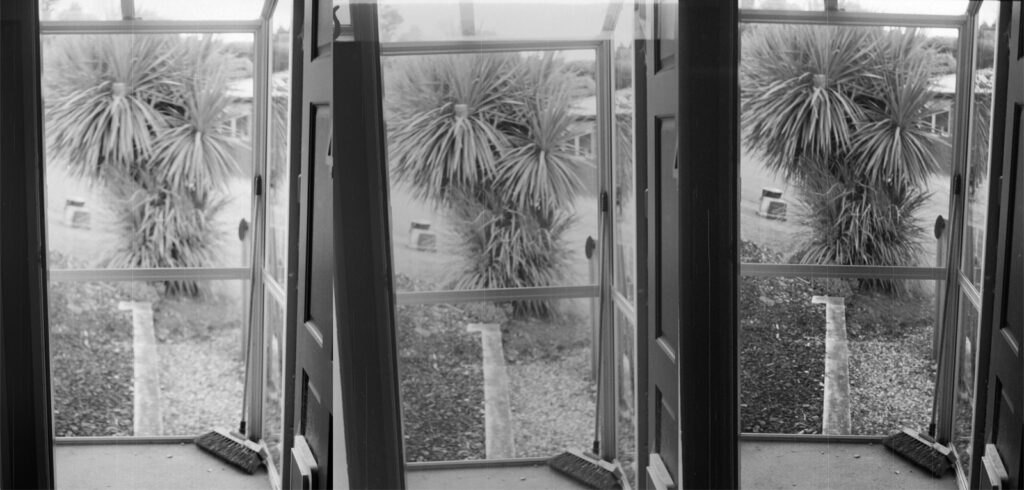
Example of similar speed test to the above.

The edge markings from both dilutions were well defined so development is adaquate. Probably using two lots of 25ml, 1:12, and developing for 3.5 to 4 minutes for 35mm might give a slightly more ‘robust’ negative.

Other examples

One of the Peter pan themed bronzes in Dunedin’s Botanic Gardens - Olympus/80S in 20ml, underexposed but emphasises the faces nicely.
One of the Peter pan themed bronzes in Dunedin’s Botanic Gardens – Olympus/80S in 20ml, underexposed but emphasises the faces nicely.
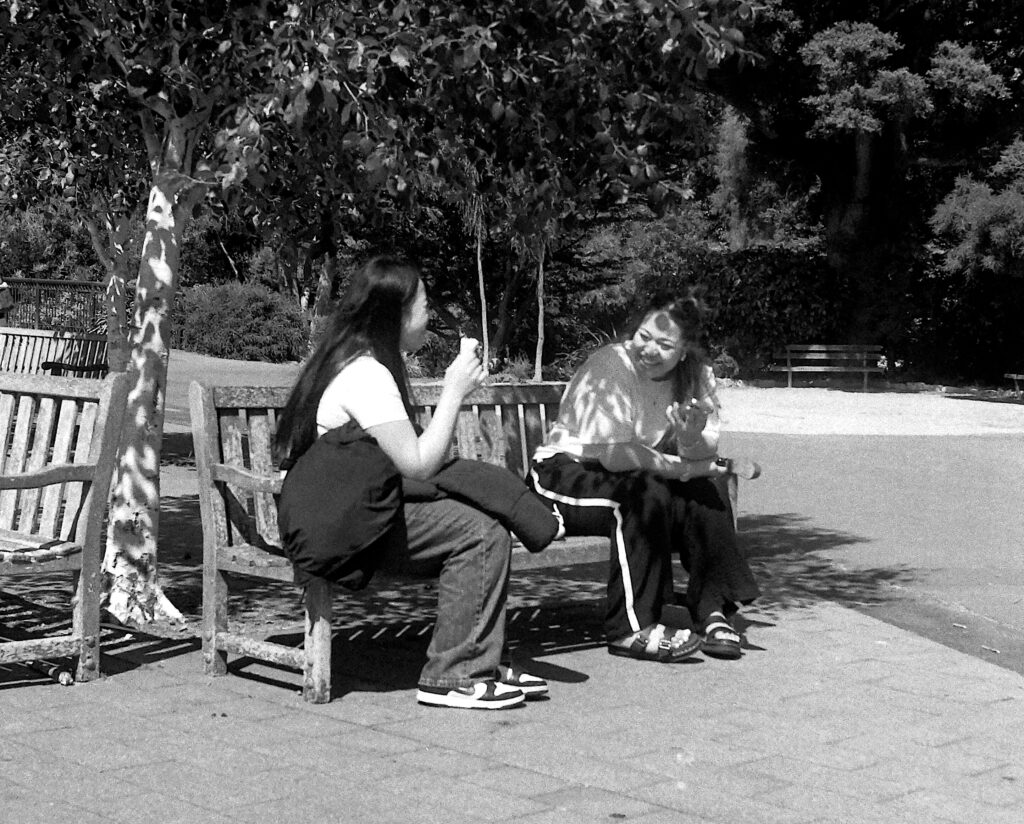
Chatting - KalloflexHP5+, cropped.
Chatting – KalloflexHP5+, cropped.
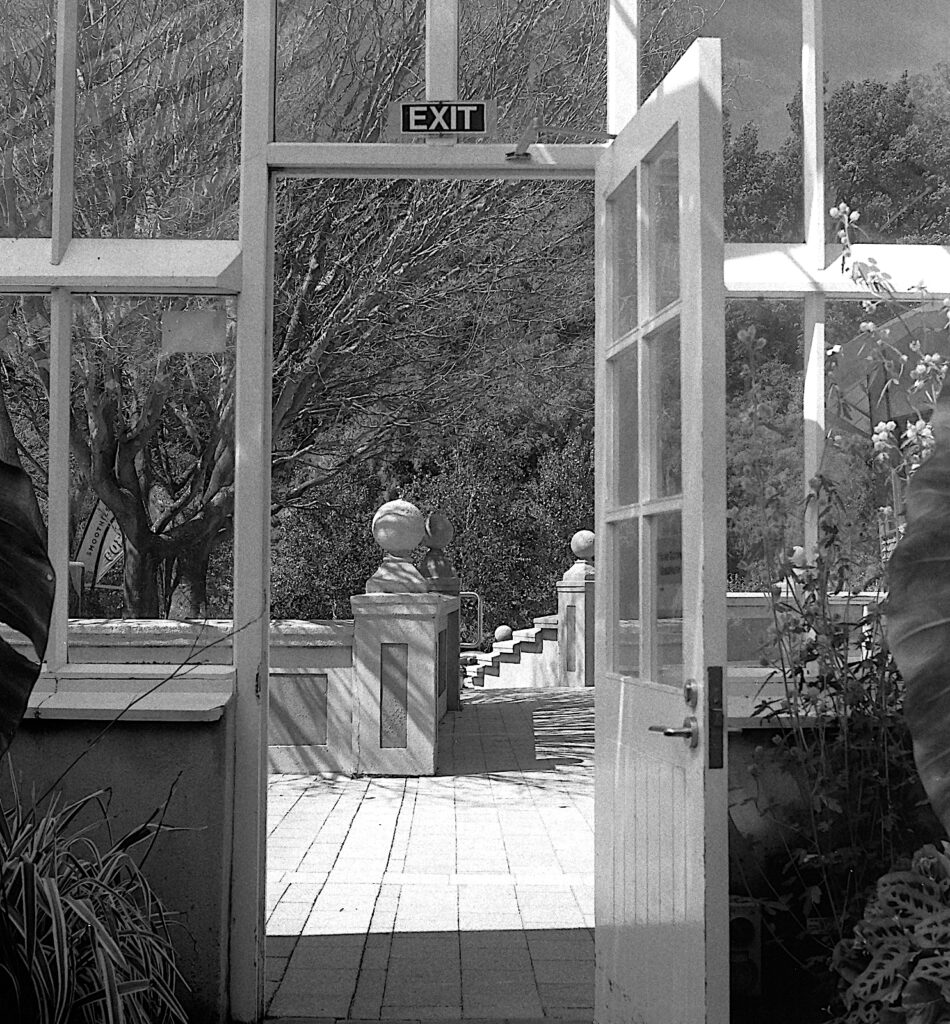
Exit - Kalloflex.
Exit – Kalloflex.
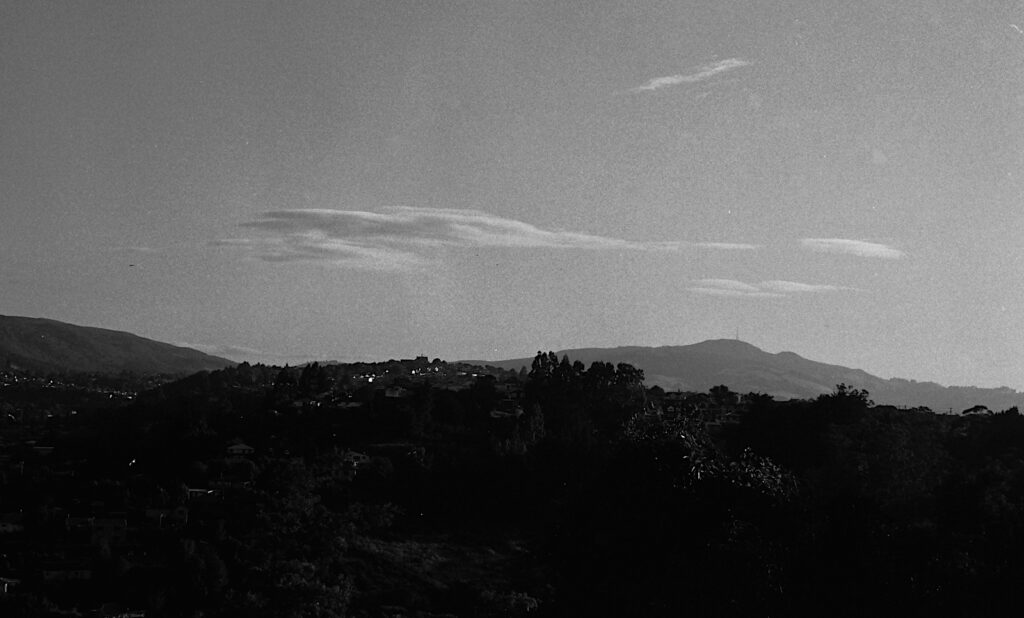
Early morning light, cropped - Retina/80S. Very harsh sharpening has brought out the grain a little but still very fine.
Early morning light, cropped – Retina/80S. Very harsh sharpening has brought out the grain a little but still very fine.
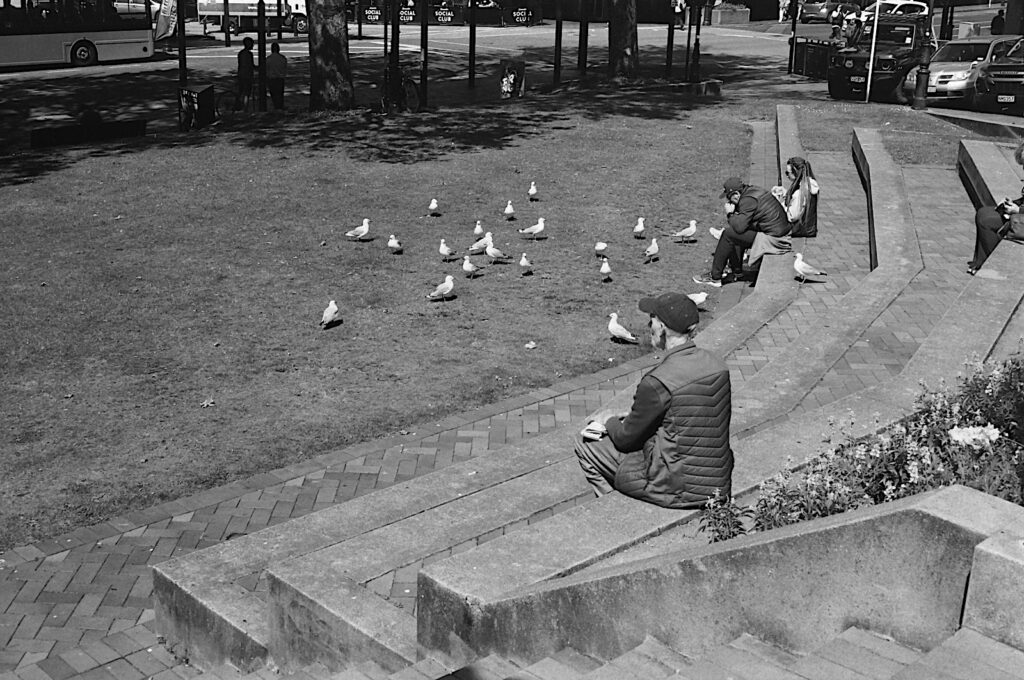
Hopeful spectators at lunchtime, The Octagon, Dunedin - Olympus.
Hopeful spectators at lunchtime, The Octagon, Dunedin – Olympus.
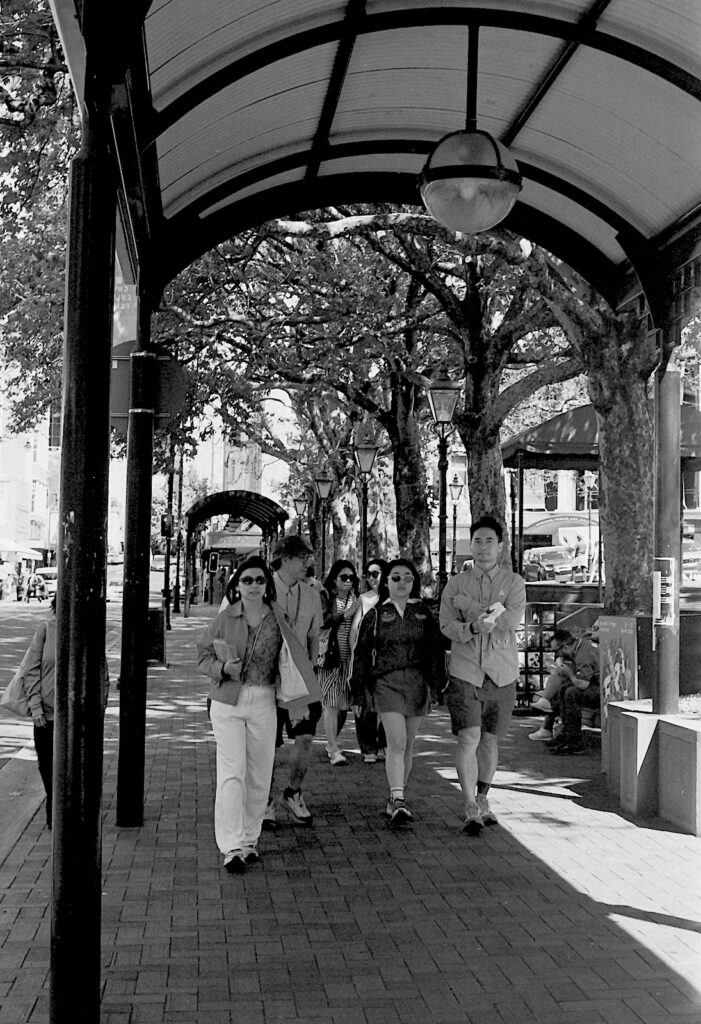
Covered walkway in the Octagon in the centre of Dunedin - Olympus. A good example of the wide latitude possible with this developer.
Covered walkway in the Octagon in the centre of Dunedin – Olympus. A good example of the wide latitude possible with this developer.

Conclusions

Just from this unscientific, practical level test it is clear that this is not a developer to replace Rodinal for the same convenience, look or economy. And the short development times for one of my favoured films makes fine tuning less precise, calling for adjustments in seconds rather than minutes. But post processing is very forgiving and grain is fine if that is what is needed so worth having as an option.
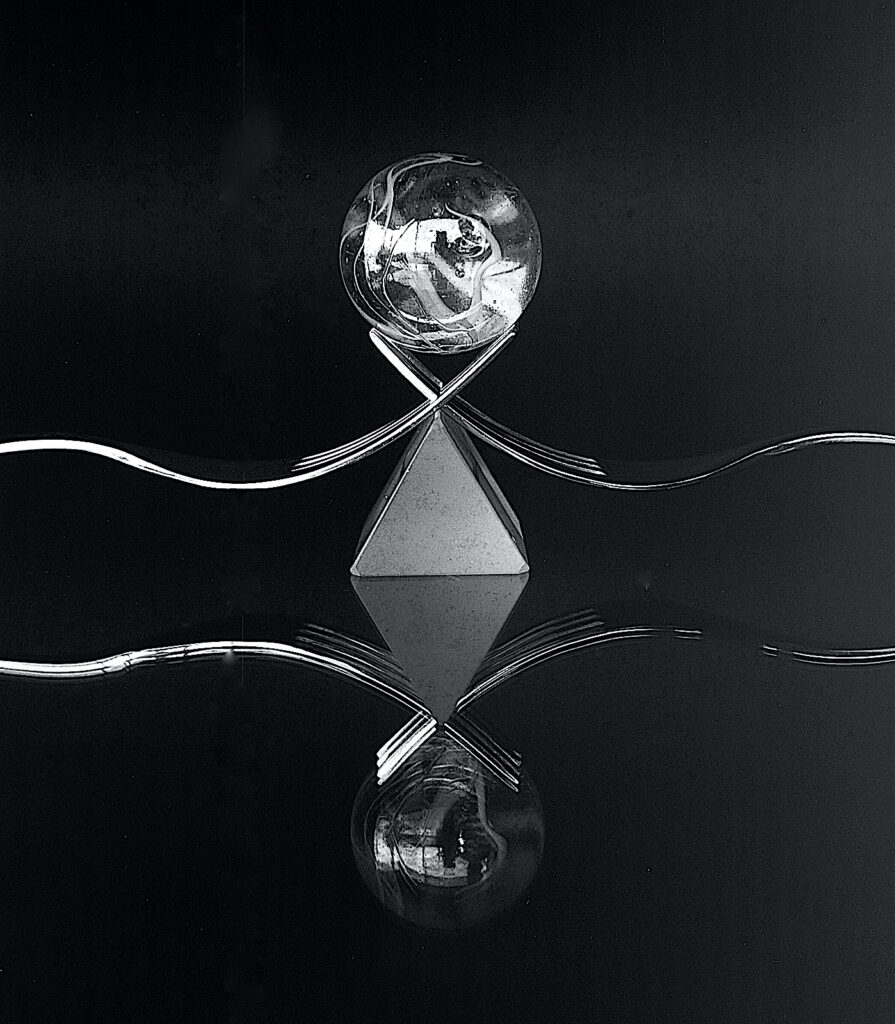
Taken with the Olympus set to Macro, sharpened far more than I would normally and cropped.

In the few weeks it has taken to put this together I am pleased to report new stock of Adonal has reached this far flung corner so I am happy again and my remaining Neofin Blue will be kept on hand ready for a suitable use I have in mind.

Share this post:

About The Author

By Tony Warren
In my 60 or so years of serious involvement in photography I have seen the demise of the viewfinder, the rise of the SLR and the eclipse of them all with the meteoric development of the digital camera. Through it all, however, and above all else, the image is what it is all about so I now use film alongside digital. Whatever is the most appropriate or practical. My contributions will hopefully be useful for anyone interested in using film and also how a died-in-the-wool antique like me is continuing his life-long addiction in the digital age, using both platforms. The major benefit of an extended retirement is that I can spend most of my time nowadays with photography and writing about it.
Read More Articles From Tony Warren

Find more similar content on 35mmc

Use the tags below to search for more posts on related topics:

Donate to the upkeep, or contribute to 35mmc for an ad-free experience.

There are two ways to contribute to 35mmc and experience it without the adverts:

Paid Subscription – £3.99 per month and you’ll never see an advert again! (Free 3-day trial).

Subscribe here.

Content contributor – become a part of the world’s biggest film and alternative photography community blog. All our Contributors have an ad-free experience for life.

Sign up here.

Make a donation – If you would simply like to support Hamish Gill and 35mmc financially, you can also do so via ko-fi

Donate to 35mmc here.

Comments

Gary Smith on Neofin Blue – A Developing Emergency

Comment posted: 03/04/2026

Always interested in the experiments of others - I'll stick with D-76.
Reply

Leave a Reply

Your email address will not be published. Required fields are marked *


Tony Warren replied:

Comment posted: 03/04/2026

This was needs must Gary. And didn't you post something about a monobath?

Reply

Leave a Reply

Your email address will not be published. Required fields are marked *


David Pauley on Neofin Blue – A Developing Emergency

Comment posted: 03/04/2026

Hi Tony, as a fellow darkroom nerd, I found this a very interesting read. Although I know many folks swear by Rodinal, I've never used it, having settled into a routine with HC-110 when I want something contrasty and PMK Pyro for when I want a long greyscale or when I'm concerned about blowing highlights. Also, significantly, I rarely shoot slower than ISO 125 -- though your photos make a wonderful case for it! I'm so impressed with the tonal range you got from this unknown developer. Even before digital enhancement, the blacks are black and and the highlights shine without losing the subtle range in between. The Chinese garden and winter garden frames are outstanding. Thanks for bringing me and all of us in on this experiment.
Reply

Leave a Reply

Your email address will not be published. Required fields are marked *


Tony Warren replied:

Comment posted: 03/04/2026

Thanks David. I guess Willi Beutler wouldn't be well known in the US but he was well known in Europe. His developers were highly regarded. I used HC-110 for a while but having found Rodinal, I am more than happy with it. It will never match Pyro of course but it does just about everything I ask of it. And its flexibility, frugality and amazing durability make this Yorkshireman very happy. (We are said to be worse than the Scots where money is concerned.)

Reply

Leave a Reply

Your email address will not be published. Required fields are marked *


Jeffery Luhn on Neofin Blue – A Developing Emergency

Comment posted: 04/04/2026

Tony,
Nice photos in your test. I've never heard of Neofin Blue before. I don't think I could use a developer with such short times. Even with a pre-wet water bath, which I always use, it would streak for me. I'd have to dilute it quite a bit to make the development even. At least 6 minutes.
In case you get short of Rodinal, it's easy to make and as long as you use distilled water, the keeping qualities are quite good. Be careful with the lye.
An easier to make developer with longer scale and less grain than Rodinal is D-23. That is just Metol, Sodium Sulfite, and water. It's a compensating developer that's perfect for high contrast scenes. The results are very much like Pyro CMK. Although I usually use HC-110 because it gives me very predictable results and it's cheap, the D-23 does a better job taming slow films in high contrast scenes. I did find D-23 takes away some film speed, so I shoot HP5+ at 320 and FP4 at 80. Fabulous shadow detail. Keep testing and shooting! I enjoy your articles.
Reply

Leave a Reply

Your email address will not be published. Required fields are marked *


Tony Warren replied:

Comment posted: 04/04/2026

Thank you Jeffery. The only thing I have kept from chemical mixing days is the old pestle and mortar from the long gone club darkroom and I doubt I will go back there now. Rodinal by whatever name does reach here eventually thankfully. The short times really are a very trying aspect of Neofin Blue. Probably, I like to work the way you do and adjust film speed, dilutions and developing times. Two or three minutes is just too short for comfort. Thorough inversion initially seems to be the trick and Beutler was a press photographer I believe so speed would be a priority for him.

Reply

Leave a Reply

Your email address will not be published. Required fields are marked *


Bob Janes on Neofin Blue – A Developing Emergency

Comment posted: 04/04/2026

I'm always so impressed with your processing!
I'm amazed no-one is importing into NZ - I tend to pick up Fomadon R09 - do you not get Foma films either?
Reply

Leave a Reply

Your email address will not be published. Required fields are marked *


Tony Warren replied:

Comment posted: 04/04/2026

Thanks Bob. Rodinal does reach here eventually. It may even be that dealers work on "just in time" ordering and then suffer delays. I'm not sure I have seen Foma films down here but that doesn't mean they aren't available, just that I haven't felt the need to try them.

Reply

Leave a Reply

Your email address will not be published. Required fields are marked *


Walter Reumkens on Neofin Blue – A Developing Emergency

Comment posted: 04/04/2026

When I attended my first photography courses in the late 1970s and started developing and enlarging film, it was precisely this developer from Tetenal in Hamburg that I used. It later became my standard developer for black-and-white photography, until I shifted my focus more towards colour photography on slide film. In Germany, Neofin Blue had a very large following alongside Agfa Rodinal. Thank you for your comprehensive report and the really good photos, Tony.
Reply

Leave a Reply

Your email address will not be published. Required fields are marked *


Tony Warren replied:

Comment posted: 04/04/2026

Thank you Walter. Beutler seems to be little known outside Europe other than Australasia maybe. Neofin Blue can certainly gives nice results but needs careful handling. I have now looked up Willi Beutler and discovered he was very much an amateur photographer but deeply committed to photography. I hadn't realised he was responsible for Neofin Color I mentioned which I used extensively at one time.

Reply

Leave a Reply

Your email address will not be published. Required fields are marked *


Leave a Comment

Leave a Reply

Your email address will not be published. Required fields are marked *