

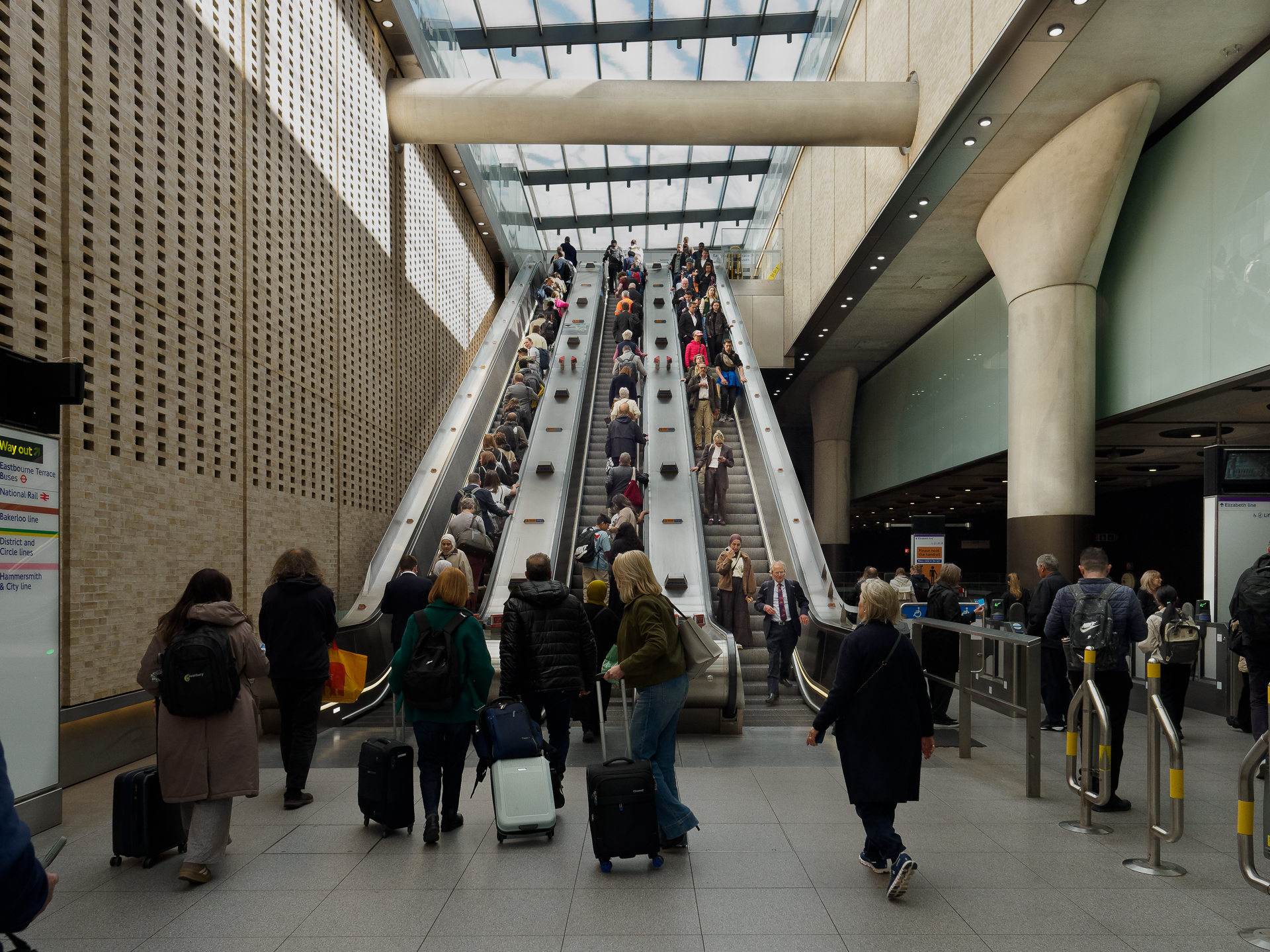
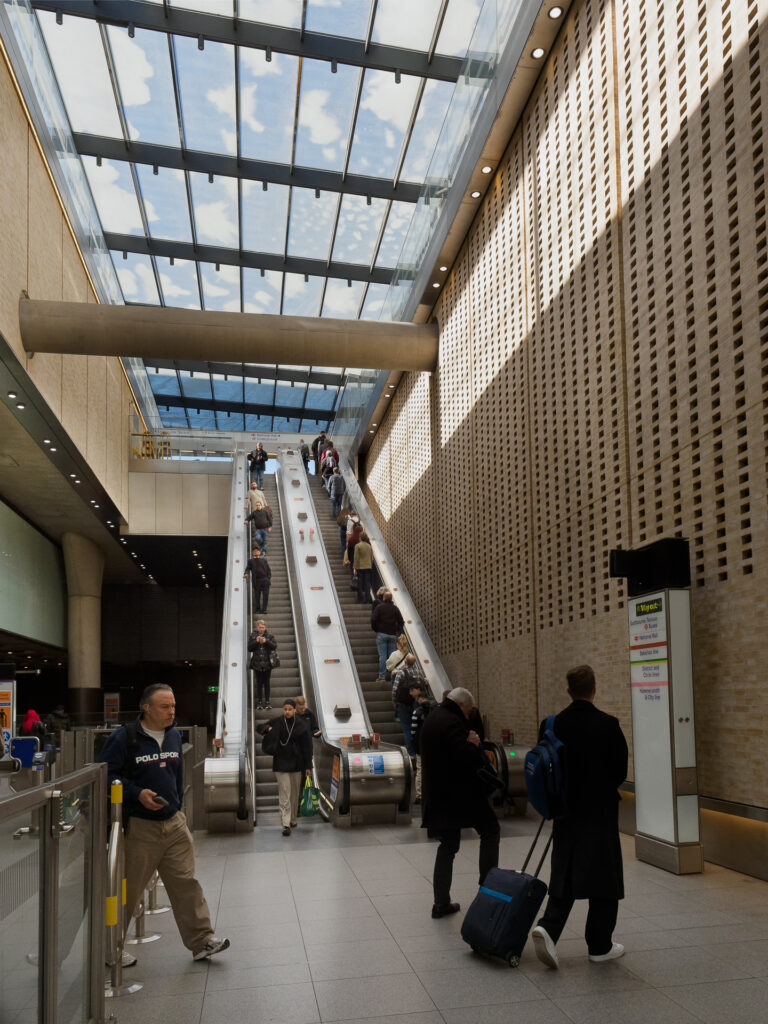
It began with a slight drop in the stomach, not fear exactly, but something closer to the sensation of standing near the edge of a height. I noticed this while using the Elizabeth Line on the London Underground, most often at Whitechapel and Paddington stations. Particularly at Paddington, the station appears to open beneath the body. Escalators descend through large vertical volumes, as though the excavation pit had been encased in concrete, rather than concealed, leaving the sense of an exposed depth that has been somewhat refined but not at all closed. Platforms are far below street level, and in such an open space, descent to them feels more like exposure rather than passage.
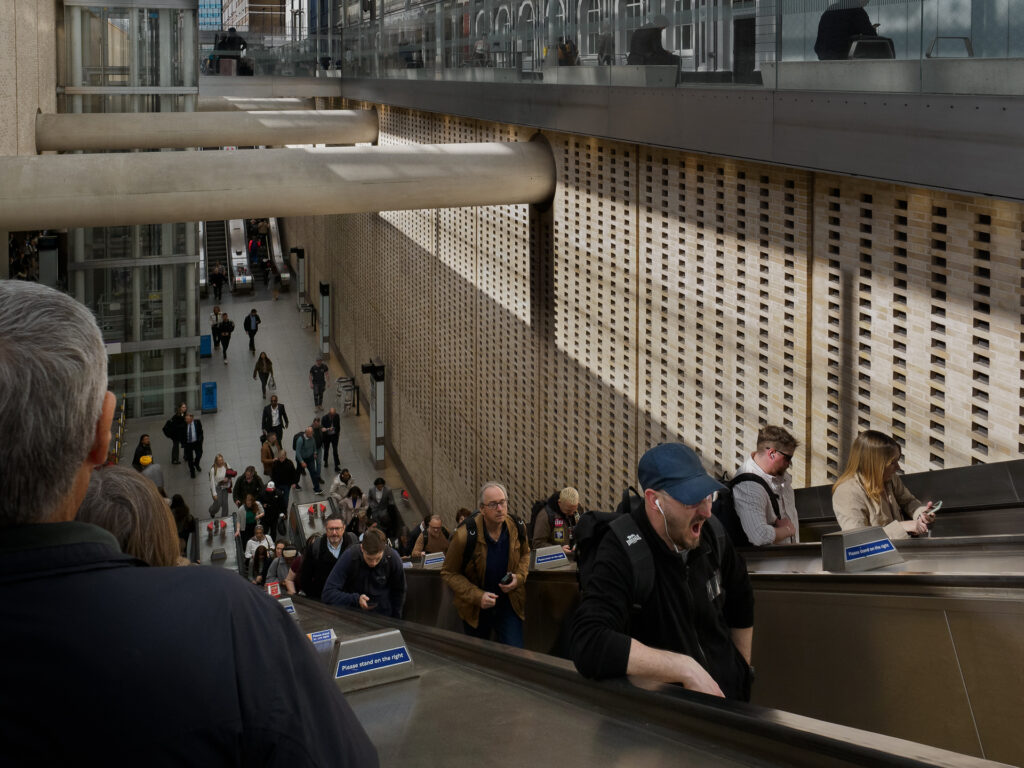
Looking down while travelling on the escalator, distance becomes physical rather than purely visual. At Whitechapel, changing from the District Line to the Elizabeth Line, I paused at the top of one descent and saw the circulation space fully exposed below. At Paddington Station, at the start of descent, I photographed a person on the upper escalator yawning, perhaps a blip that briefly interrupts the visual grammar of efficiency. For a moment, the machinery of movement gives way to what looks like the accumulated fatigue of city life.
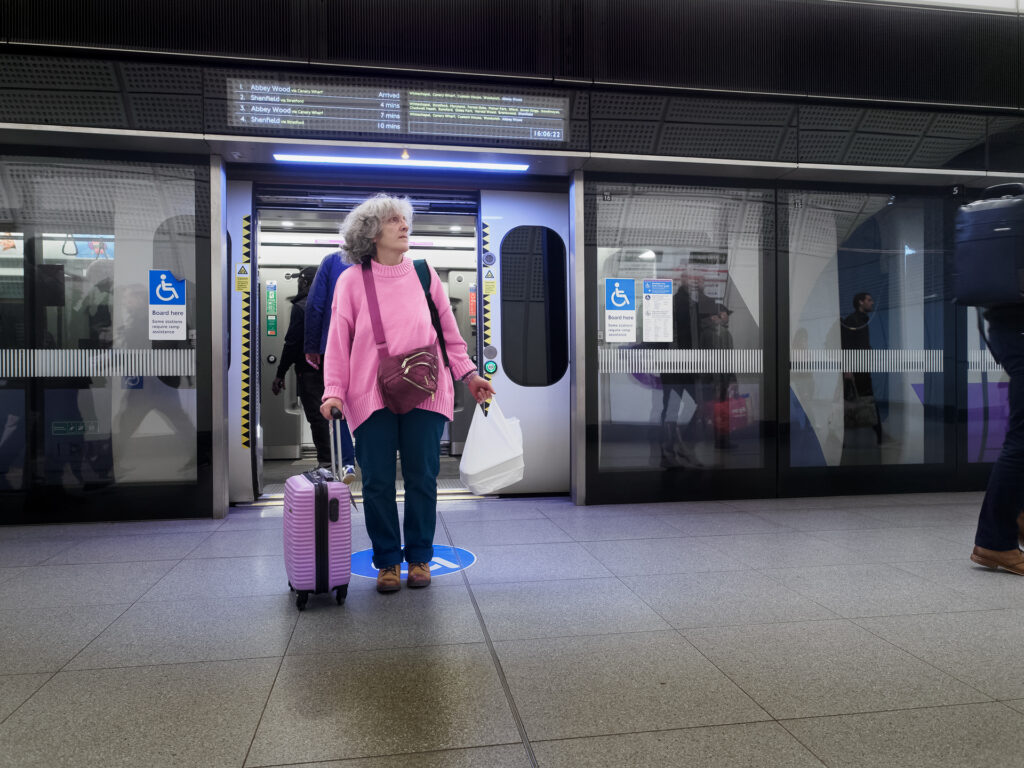
The experience led to another question: what kind of photograph would the public image of this station never produce? Not because the station lacks clarity, but because promotional imagery may depend on coherence and the removal of anything that might disturb it. Perhaps it would be someone who has just stepped off a train, looking left and right while trying to find her bearings before moving on.
Beyond the Public Image?
At first, I thought I was photographing architecture. What became visible through a series of images was a repetition of spatial conditions: depth, descent, exposure, long sightlines, and vertical movement. Deep escalators and voids return across the frames with a kind of insistence. I had assumed “the camera was observing the station.” Looking through the photographs afterwards, it seemed equally possible that “the station had organised what the camera would notice.” It participates in it, inheriting the direction of perception already organised by the environment. Even when people enter the frame, they are rarely outside that system for long; they are absorbed into flows whose organisation precedes them.
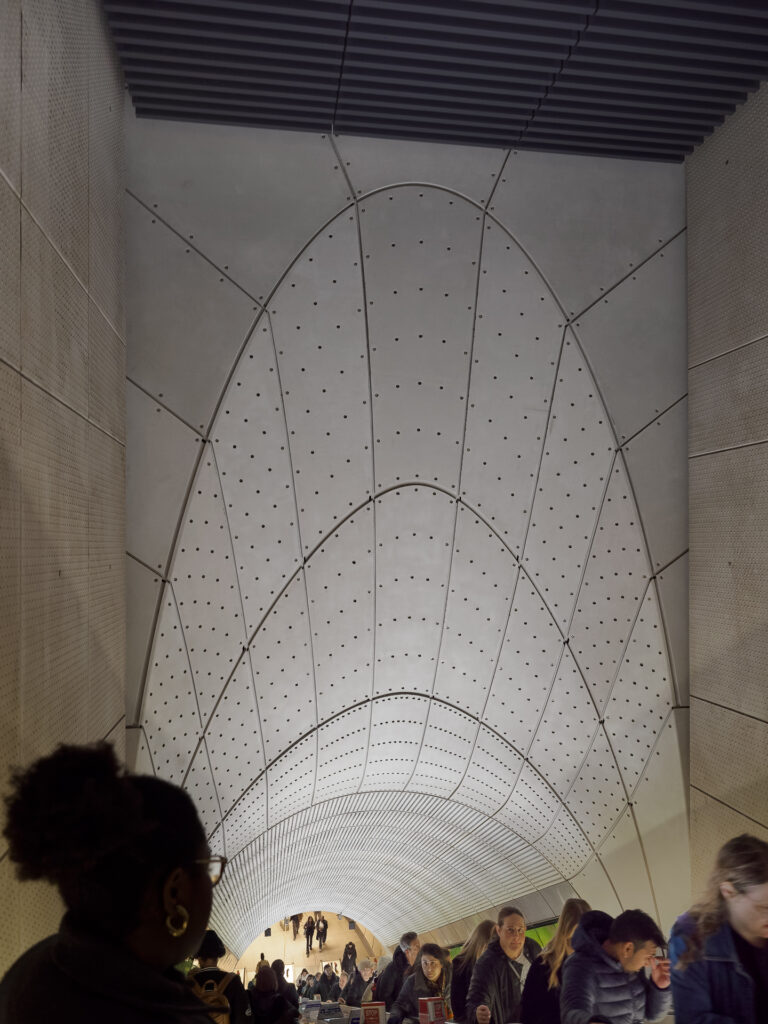
Architectural photography often presents buildings as finished objects. My interest was to photograph these stations as lived environments, where movement, maybe even hesitation, and ordinary use reveal aspects that such representations tend to exclude.
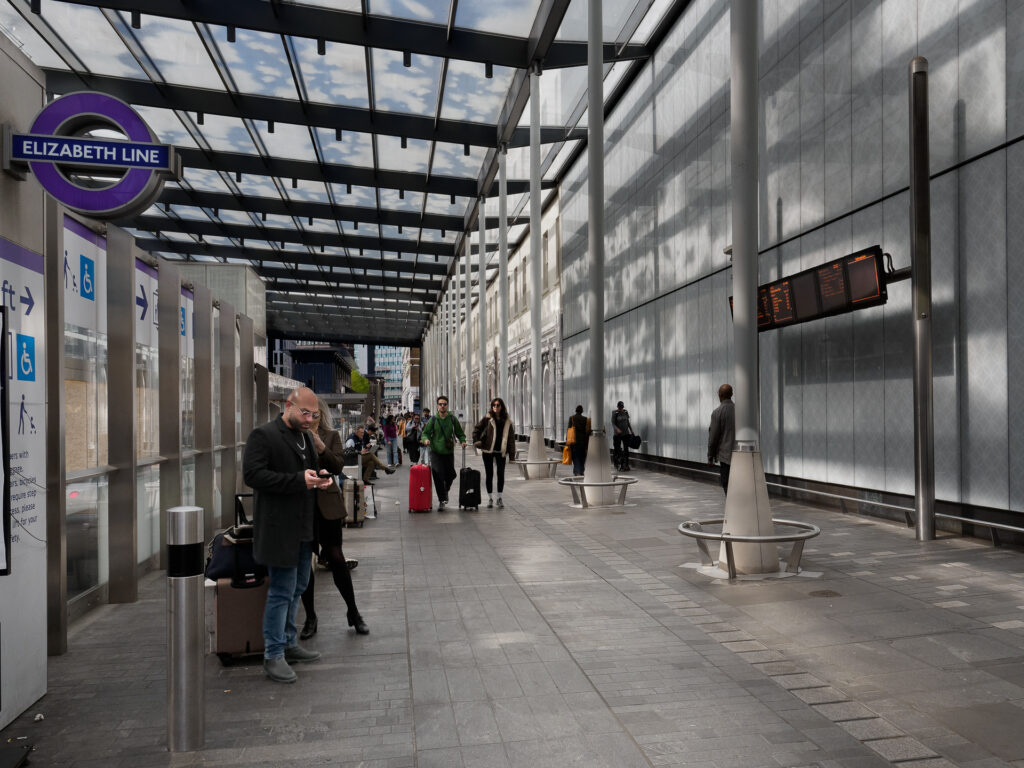
As I walked through the stations, I realised how the architecture had already organised the flow, and my photographs seemed to accept that organisation almost automatically. Whitechapel and Paddington on the Elizabeth Line operate as highly coherent constructions, where nothing appears accidental. A sort of material precision is present in those stations that seems to convey a sense that complexity has been fully mastered.
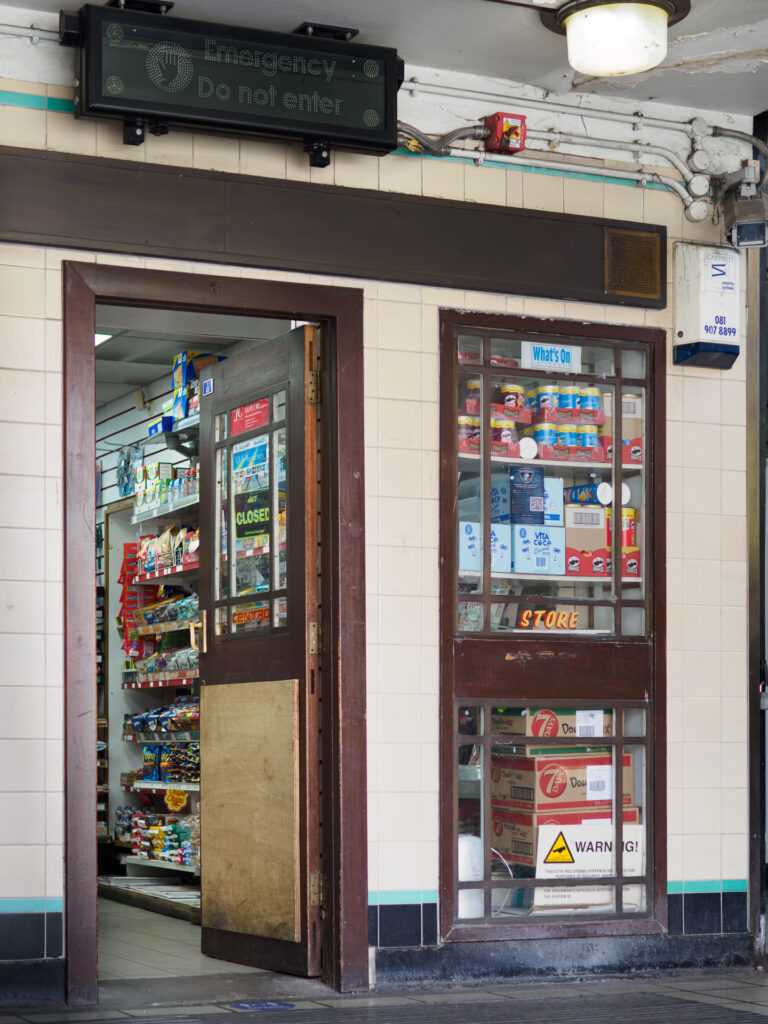
East Finchley Station is different. Take the small newsagent’s shop beside the entrance to the station, where the lower part of an elegant 1930s glazed door has been covered with boarding, perhaps after a break-in? It is not a dramatic intervention, but it changes the way things are read. An official photograph would probably celebrate the surviving modernist design and aim to remove such obstruction altogether. My attention settled on the coexistence of both: the ambition of the original architecture and the practical adjustments of everyday use.
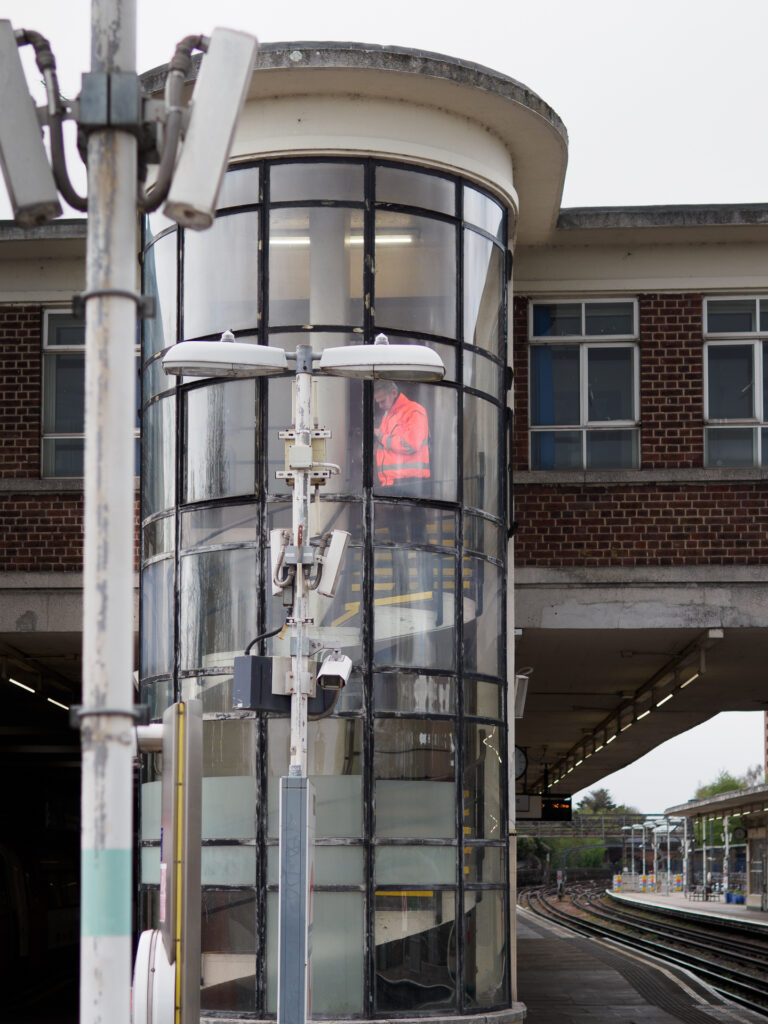
Inside East Finchley, the glazed staircase should offer a clear architectural statement, yet loudspeakers, signs, cables, and other pieces of station equipment interrupt the view. I photographed it precisely because the interruption had become more interesting than the intended composition. The station seemed less like a finished object than something continuously adapting to changing needs. My attention was moving away from architectural purity towards the traces of use that official images tend to edit away.
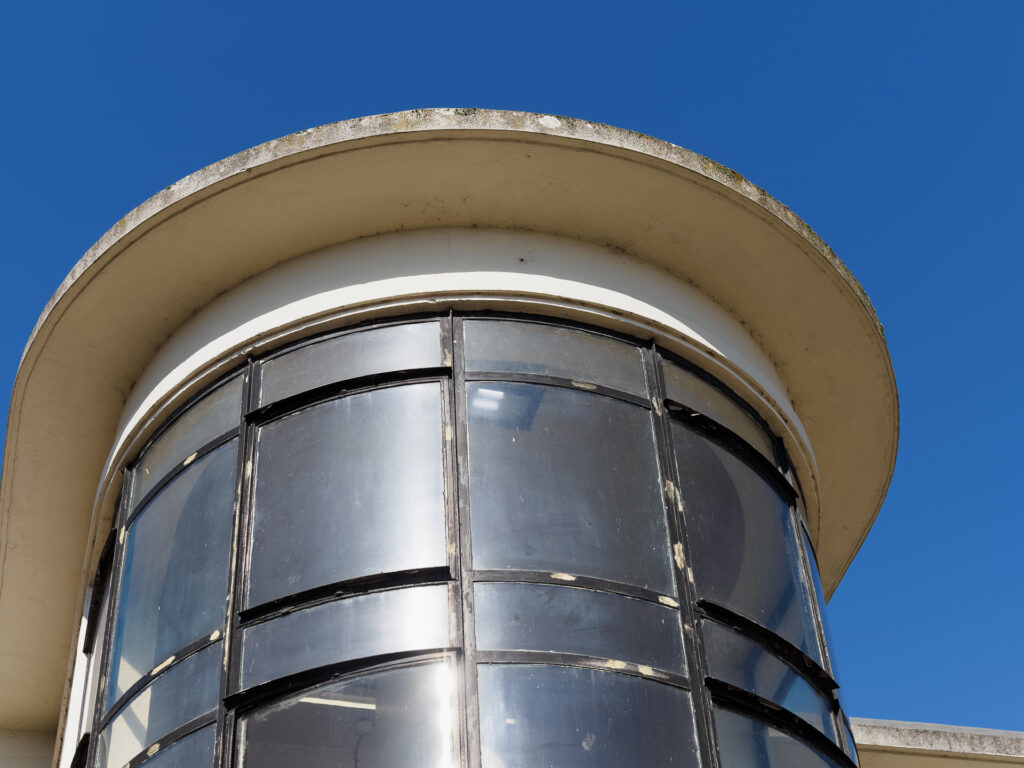
The Station as a System of Legibility
Whitechapel and Paddington on the Elizabeth Line seem to present the organisation of flow of passengers as something already legible before you even step inside. Descent, transition, and arrival are arranged in advance, so that orientation is immediate. The body is not so much asked to interpret the space as to fall into its structure, carried along by a logic already decided. What becomes interesting to photograph is not any resistance to this logic, but the moments in which it briefly reveals itself as something made rather. Thresholds, overlapping structures, gates and signage allow circulation to appear as something self-evident.
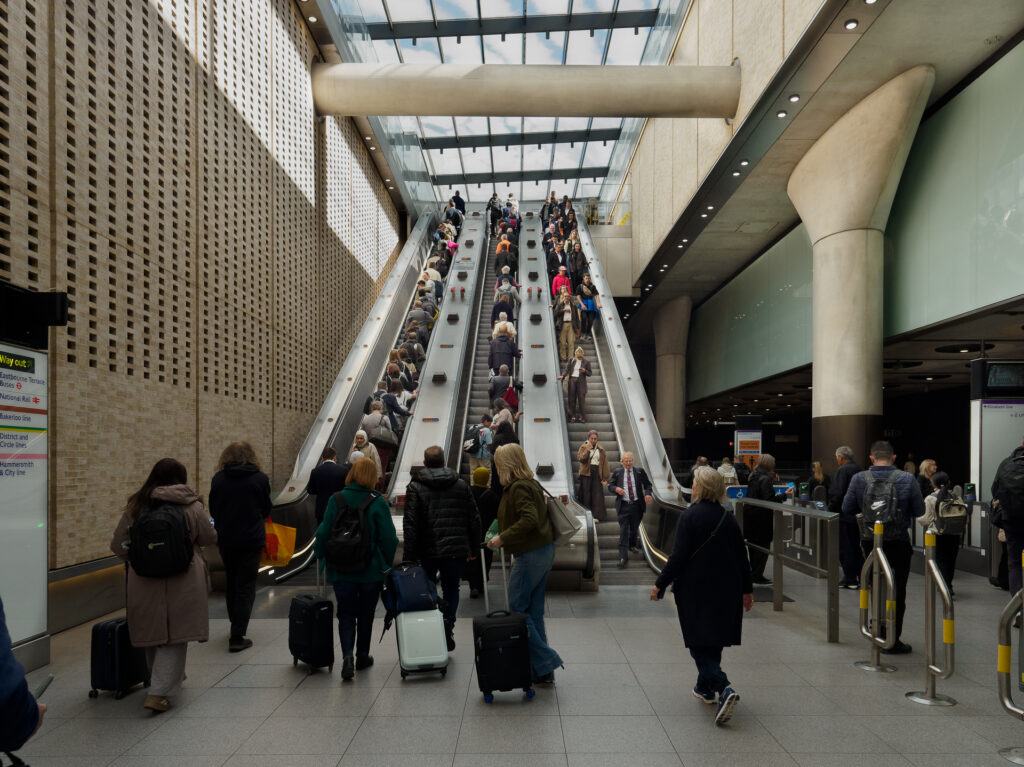
East Finchley Station and the Experience of Duration
Around the same time I was using the Elizabeth Line more frequently, I began passing regularly through the already-mentioned East Finchley Station on the Northern Line, where the experience of the user is immediately different. Movement unfolds horizontally rather than vertically. The platforms stretch outward instead of descending into depth, and the station meets the surrounding neighbourhood without strong separation or dramatic transition.
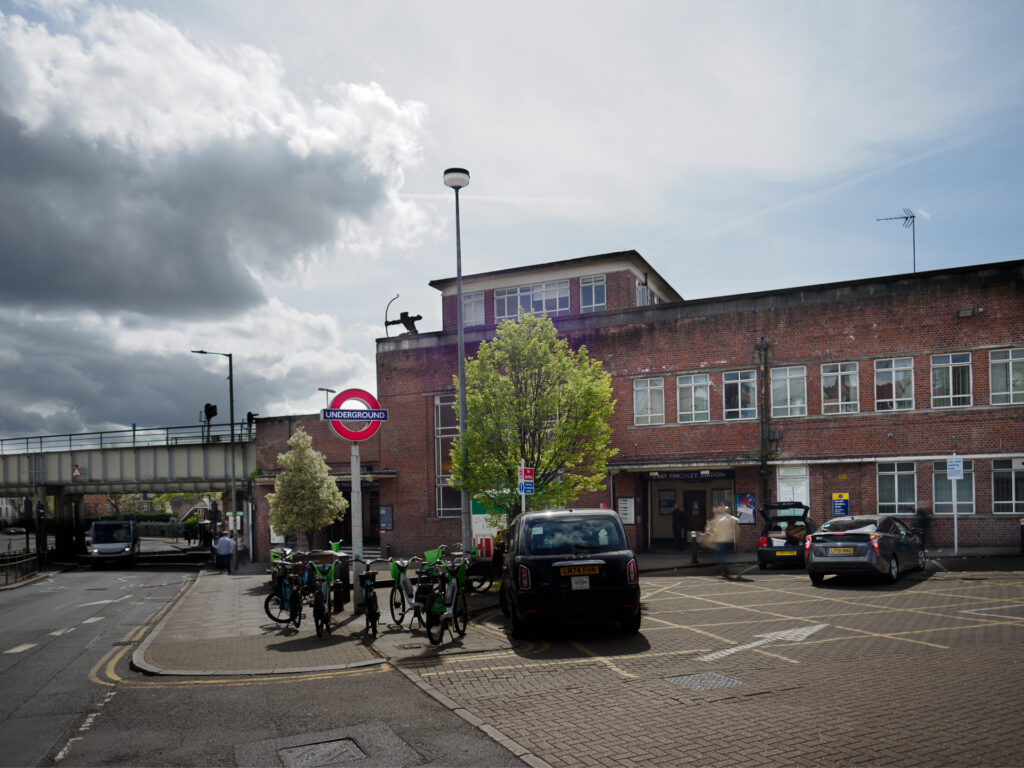
One image is made through the window of a train standing at East Finchley. The frame becomes layered: the carriage interior, reflections in the glass, the platform beyond, and the station stretching laterally across the background. There is no single commanding viewpoint. The eye travels horizontally across the image rather than into it.
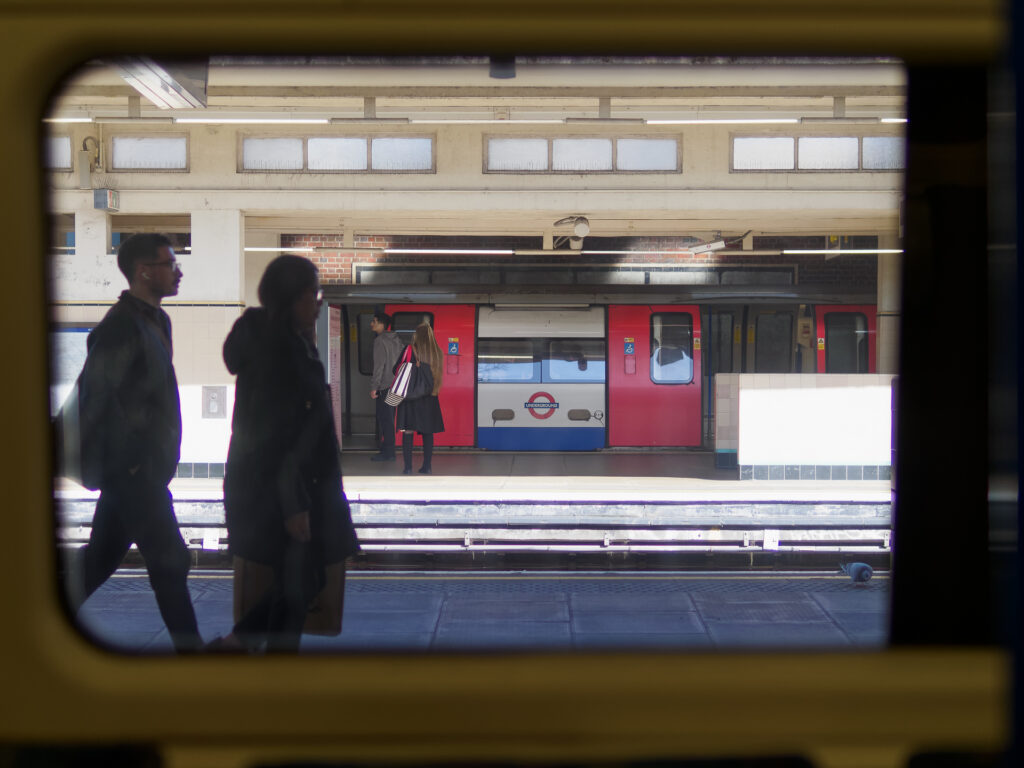
Space read through interruptions. Olympus EM1 mkIII, Zuiko 12-40mm f/2.8
The Archer, seen from the street before entering the station, was one of the few moments where my attention moved naturally upwards. Yet even here, the experience was different from the Elizabeth Line. The figure does not draw the eye into depth but anchors the building within the surrounding neighbourhood. It also signals horizontal travel.
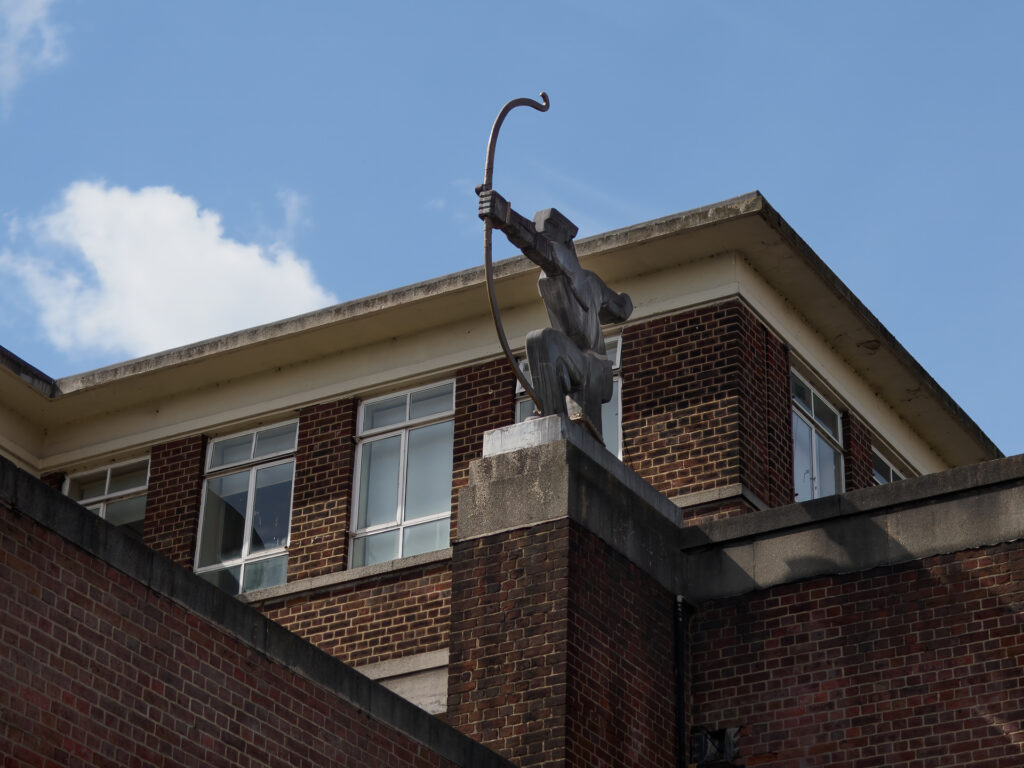
The difference is not only one of space but also of time. At Whitechapel and Paddington, the structure is understood before movement begins. At East Finchley, it reveals itself gradually, through repeated journeys and everyday use rather than through a single commanding view. Attention moves across surfaces rather than into depth. Brickwork, changing light, weathered paint, and the small ways people occupy the station become more noticeable than any grand architectural statement.
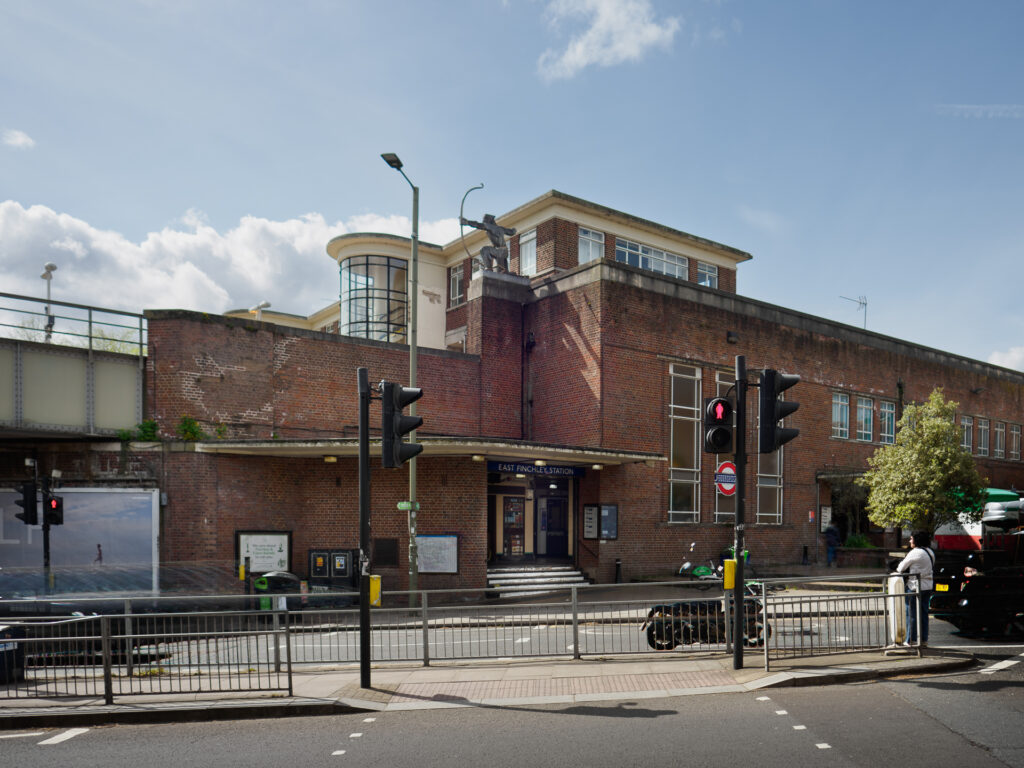
Photographing the station from across the road, I found myself including the street, traffic, and surrounding buildings rather than isolating the architecture. A conventional architectural image might have removed these distractions to clarify the design. Instead, I left them in because they seemed inseparable from the experience of the station itself. The photograph records less a building than the gradual transition between city and railway. It was only afterwards that I realised the station had encouraged me to think horizontally, allowing the surroundings to remain part of the subject.
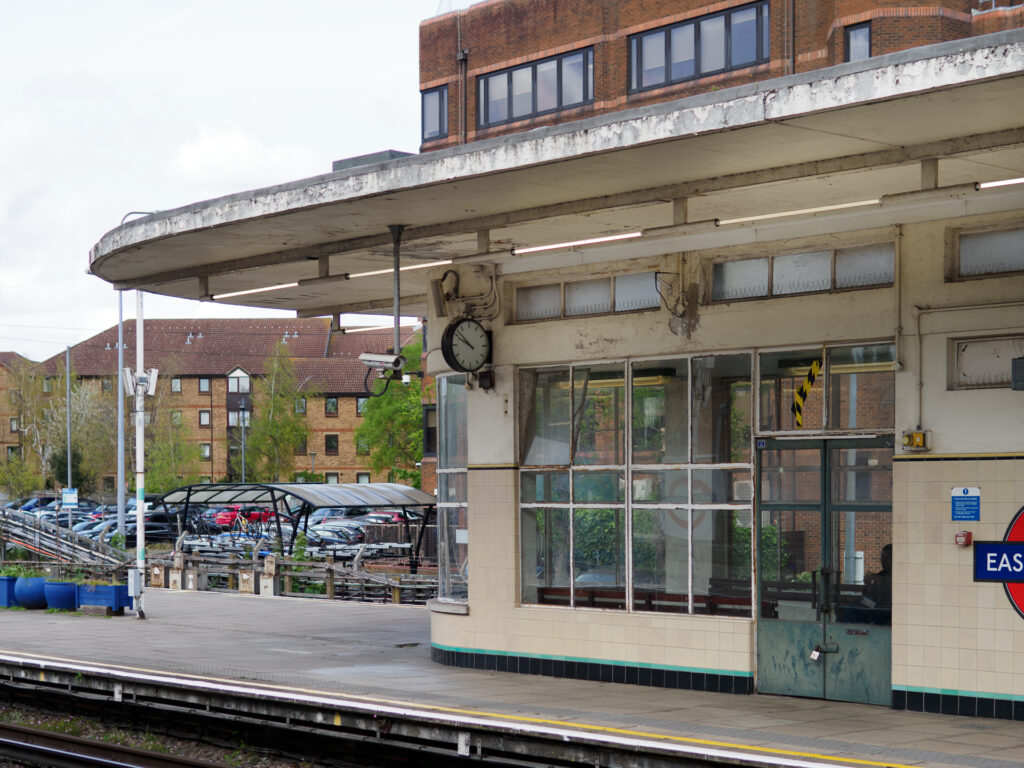
The station feels less like a system directing people.
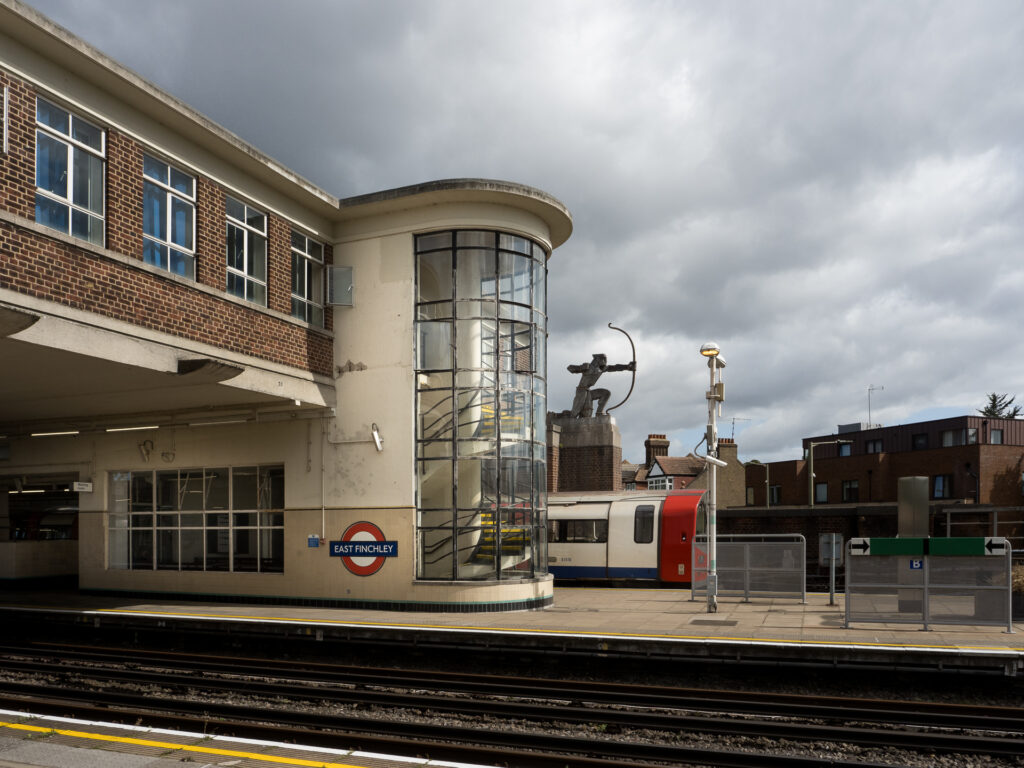
At East Finchley, I took a photograph from the far end of the platform, looking back towards the entrance. Unlike the Elizabeth Line, East Finchley carries visible traces of adaptation over the years: repainting, repairs, weathering, car park, space for bicycles, and other pieces of incremental change. These are not interruptions to the station’s identity but part of it. Its sense of permanence comes not from perfection but from the accumulation of ordinary use.
Two Architectures, Two Conditions of Attention
Across the three stations, two different ways of experiencing space by the user begin to emerge. One is organised around height. Depth, descent, and broad views allow the station to be understood almost immediately, so that the space appears already organised before the journey has properly begun. The other unfolds through extension.
These are not opposing kinds of architecture so much as different ways in which architecture directs attention and shapes what becomes immediately visible. In one, the eye is drawn towards the overall structure and the larger system. In the other, it wanders across details, continuity, and small variations that only become noticeable through repeated encounters. Both produce their own clarity, but they do so in different ways, shaping not only how we move through space but also what we are likely to notice while we are there.
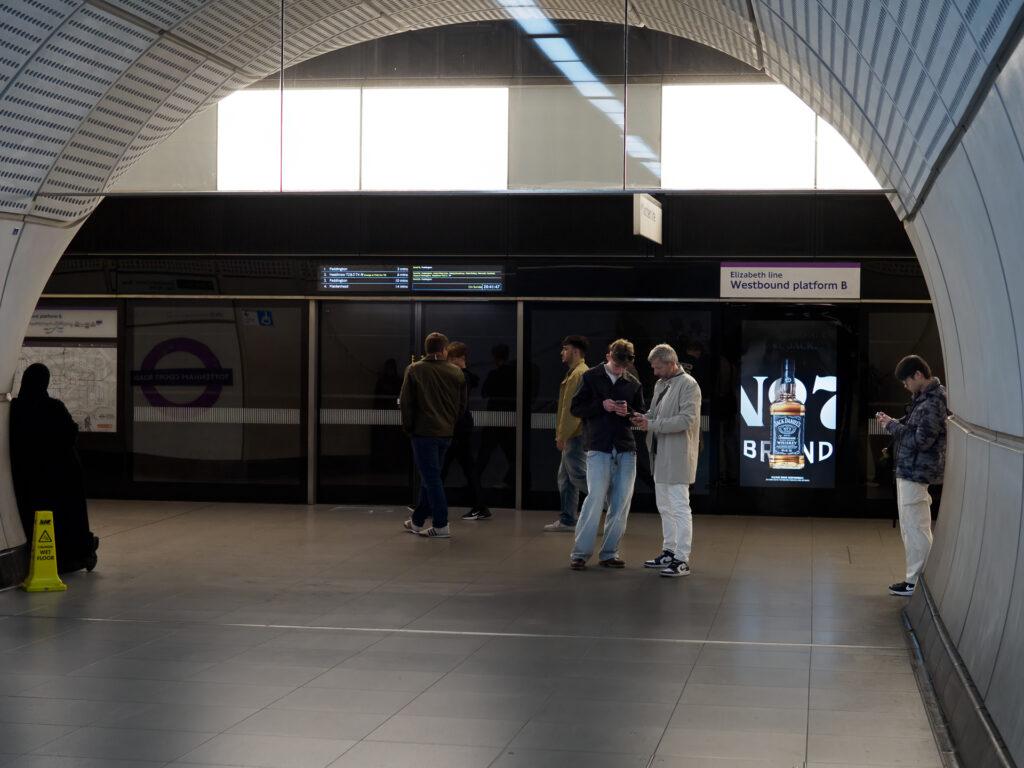
At Whitechapel and Paddington, my photographs repeatedly sought positions from which several levels of movement could be seen at once. The remarkable thing is that I never consciously set out to take such pictures. When editing, I noticed how insistently I had been drawn towards vertical organisation. The stations had influenced not simply what I photographed, but the kind of attention I was able to sustain. They had already taught my eye where to look before I became aware of looking.
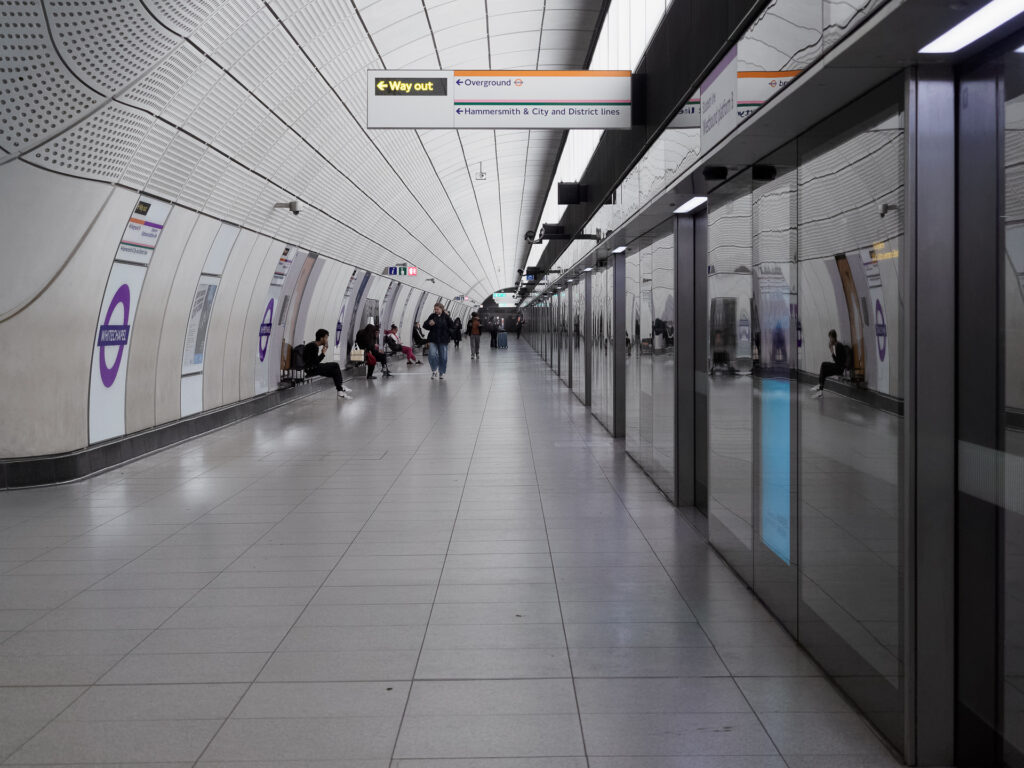
The photographs do not simply aim to describe three stations. Looking through them afterwards, I realised that they also recorded different ways of paying attention, shaped by the places themselves. In the Elizabeth Line stations, the camera is repeatedly drawn towards depth, long sightlines, and the clear direction of movement. At East Finchley, my attention shifts towards surfaces, repetition, and the small variations in materials that become noticeable over time.
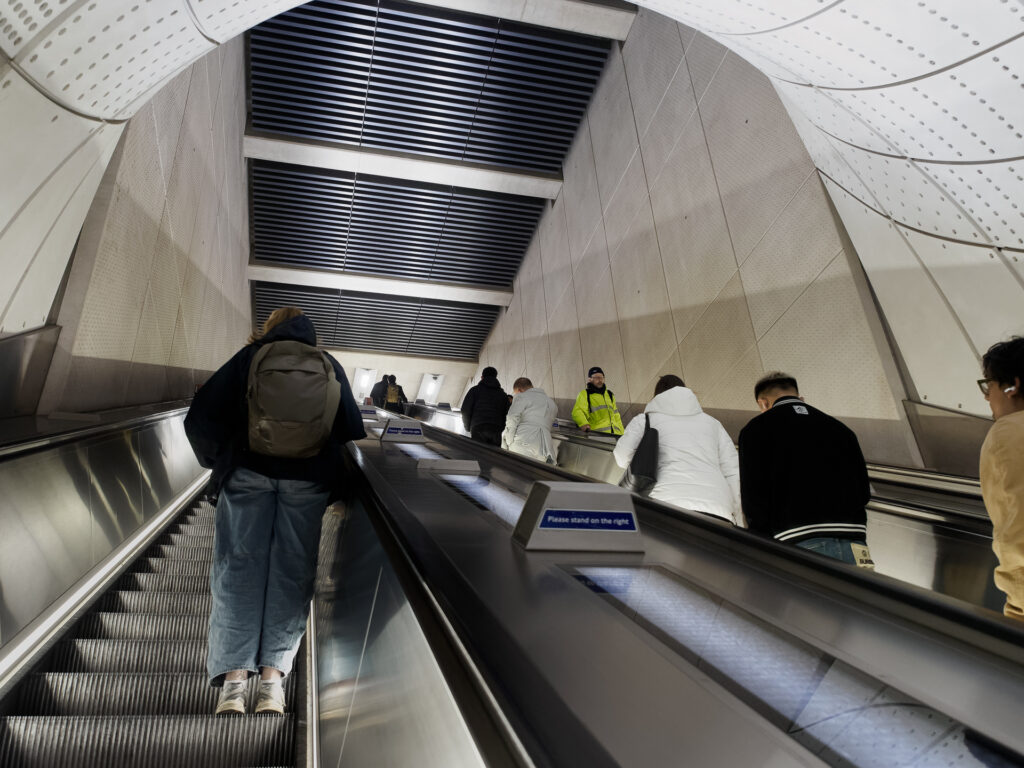
None of this was entirely deliberate. The pattern only became clear when the photographs were seen together. They suggested that the stations had influenced not only what I photographed, but what I was capable of noticing. Some things moved naturally to the centre of my attention, while others remained at the edges or escaped it altogether.
I thought I was comparing stations. Looking back, I no longer think I was simply observing these environments from the outside. The camera became part of the encounter, recording how each station organised my attention before I had consciously decided what to photograph.
Featured image: Paddington Station: the scale and verticality retain a sense of excavation. Olympus EM1X, Zuiko 12mm f/2.
Share this post:


Comments
Martin on Walking Underground Space – How Photographing Stations Shape the Way We See
Comment posted: 03/07/2026
Thanks again for taking us on a fascinating journey to the London underground!
Comment posted: 03/07/2026
Philip Bovey on Walking Underground Space – How Photographing Stations Shape the Way We See
Comment posted: 03/07/2026
Comment posted: 03/07/2026
David Brancaleone on Walking Underground Space – How Photographing Stations Shape the Way We See
Comment posted: 03/07/2026
In this contribution, I am more interested in the photographer's detailed, phenomenological in the best sense, analysis of relating to these architectural spaces as unusual spaces which are mostly overlooked and I am reminded of Henri Lefèbvre's book "The Production of Space".
Comment posted: 03/07/2026
Geoff Chaplin on Walking Underground Space – How Photographing Stations Shape the Way We See
Comment posted: 04/07/2026
Comment posted: 04/07/2026
Comment posted: 04/07/2026
Comment posted: 04/07/2026
Ibraar Hussain on Walking Underground Space – How Photographing Stations Shape the Way We See
Comment posted: 04/07/2026
Comment posted: 04/07/2026
Tony Warren on Walking Underground Space – How Photographing Stations Shape the Way We See
Comment posted: 05/07/2026
Comment posted: 05/07/2026
Jeffery Luhn on Walking Underground Space – How Photographing Stations Shape the Way We See
Comment posted: 05/07/2026
I really liked your photos! They give the viewer a sense of space and often crowded conditions. The newer stations are quite nice. They show clean efficiency.
As a native to California, my visits to New York, London, Paris, Bangkok, Sydney, Hong Kong, etc, have me wishing that our cities could have efficient ways to move people and get us off of the traffic choked roads. Of course using your underground systems for daily commutes could make me weary, but I'd appreciate the lower cost and reduced travel time. I also appreciate being able to navigate systems in cities where I don't speak the language.
Lastly, your compositions are working very well. My favorite shot was the pink lady. Classic!
Comment posted: 05/07/2026
Jeffery Luhn on Walking Underground Space – How Photographing Stations Shape the Way We See
Comment posted: 05/07/2026
Additionally: Those glassed in staircases....we could fry an egg in one of those in Los Angeles!
edmakesfilms on Walking Underground Space – How Photographing Stations Shape the Way We See
Comment posted: 09/07/2026
Thanks for sharing!
Comment posted: 09/07/2026