

There has been some nice discussion on 35mmc recently about panoramas. I like the way that people have been discussing the aesthetics of their creations and the various means by which this is done.
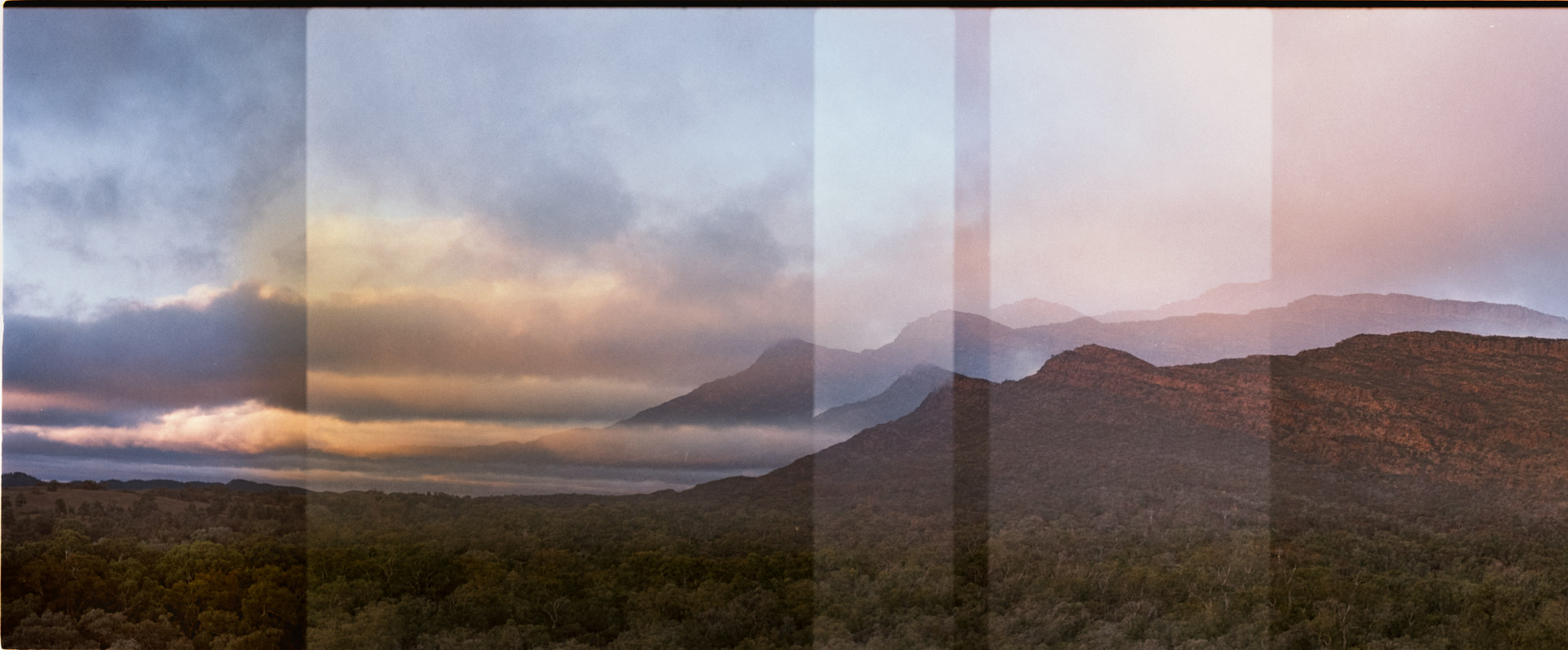
That, and a recent post I did about being in the Flinders Ranges prompted me to revisit a series of panoramas I made in the Flinders a couple of years ago. These were made on Portra 160 in a Nikon F2, using a standard 50mm f1.8 pancake lens.
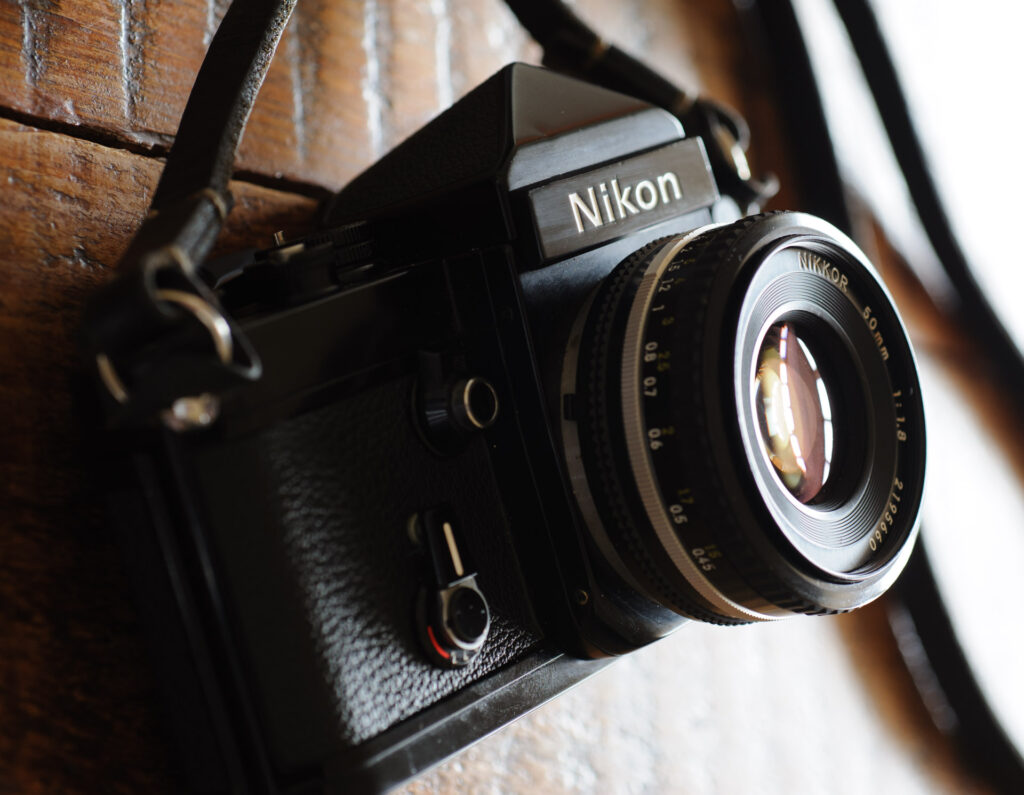 The F2 has been resting a bit lately, but it remains the 35mm SLR of which I am the fondest. It’s maybe not the most useful; if I had to take one camera and one lens on a holiday, I would probably take my FM2N because it has a light meter, but if metering was not a dealbreaker it would definitely be the F2.
It’s also the best camera I have for doing this kind of panorama and for that reason it was my main companion for a couple of years when this type of work was at the forefront.
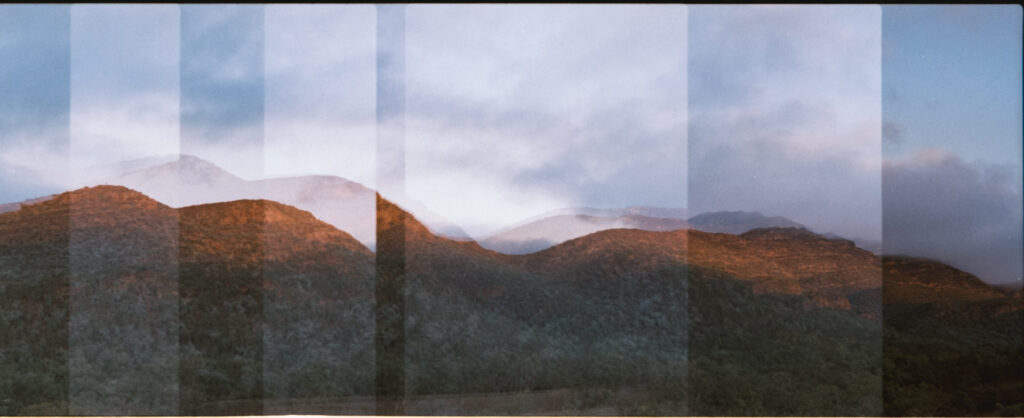 Looking back at this set, what I now remember most about this trip is the fact that I had an Achilles tendon injury at the time and it was really painful for me to walk. I was using a stick, and every morning I would walk from our room up to the same place at sunrise and make a panorama or two, and then again as the sun was setting I will walk up to the same spot and make a couple more.
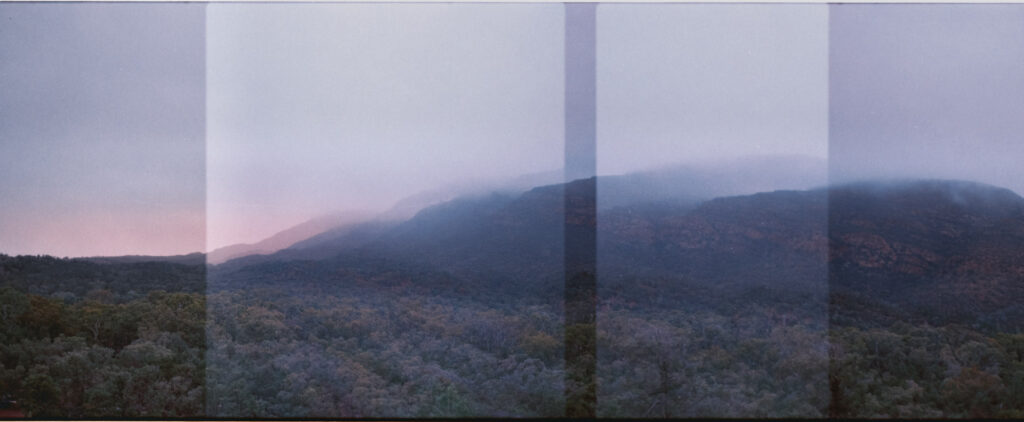 I’ve written more than a couple of posts here that reference this overlapping exposure technique; it’s done by hand-holding and partially winding on the film in between exposures and moving the camera slightly as this is done – making what I term an “in-camera pano.” You need to have one finger on the film release button on the bottom of the camera, and you press that when you’re part way through winding onto the next frame. In this way the shutter cocks while the film is only partly wound. I felt this might also be interesting because to me it highlights the way we actually look at things. To my way of thinking when we take in a big horizon or landscape, we don’t do it all one go. Our eyes move from one place to another as we scan and lock-on as we move across. So I think this idea of multiple exposures; each one little snapshot that make up a bigger image quite a realistic way of making a photograph. In a way it’s got some aspects of a Cubist painting. Another thing about it is the aspect of time. Instead of it being a 60th of a second or whatever – the process probably takes something like five or ten seconds. So if there are moving objects or people in the frame it can become pretty interesting. And if you think of what a Widelux does that’s the same thing with it sort of scanning – in a way that you don’t get using an X-Pan or something else that makes a single instantaneous exposure on a wide piece of film.
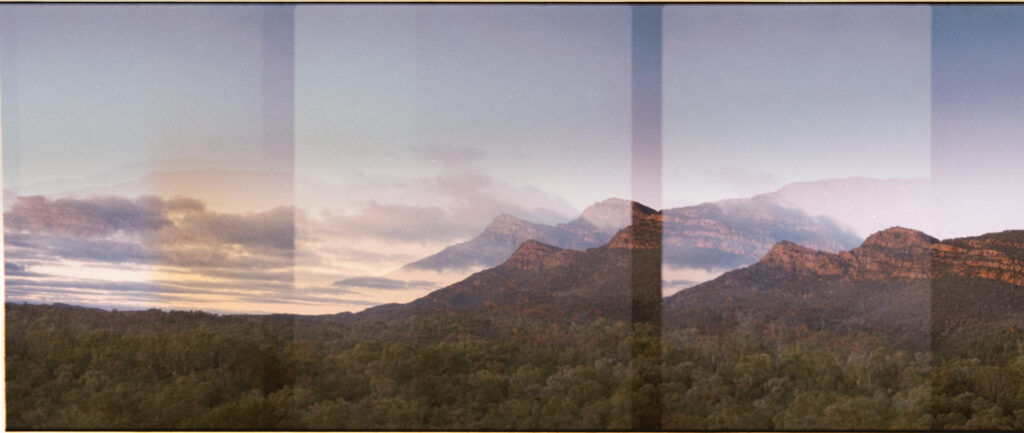 Anyway, the images are also interesting to me because they highlight a common theme that I also seem to have; returning to a particular place over time and seeing what happens. Seeing if that act of repetition will give rise to a series that is interesting.
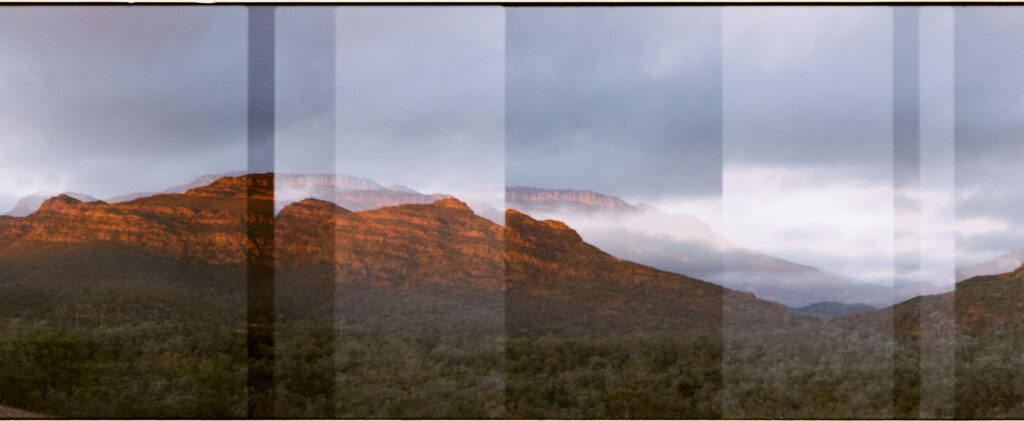
This series is also about digitisation and owning the final image. The images here are a record, but perhaps more so they are constructions. The film I used here is Porta 160 and I used it because I find it very forgiving in retaining its highlights, and that its grain is nice and fine. I digitised it by using a digital camera (X-Pro3 adapted to my Micro Nikkor 60mm AFD lens in this case) over a lightbox. These days I use my Nikon Df if I’m doing this. Then I converted those raw files into positive images using Neg Lab Pro. In order to make those files easier to work with. I then saved an intermediate working file as a tiff and did more final work on them in Lightroom. So I don’t think of these as Portra colours in a , “Man, those Portra colours!” kind of way. I think they are MY colours. Having said that, I did get shop scans back with the film and so of course I had a base reference of those and my previous experience with Portra160 in my mind.
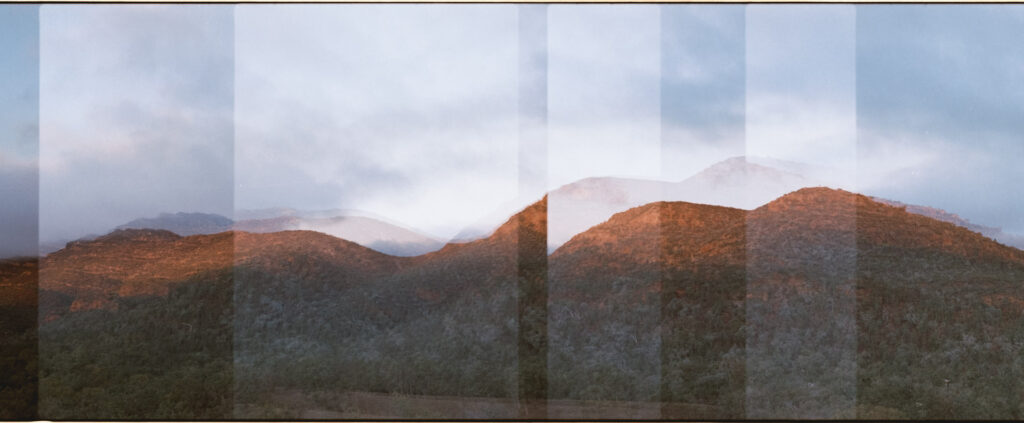
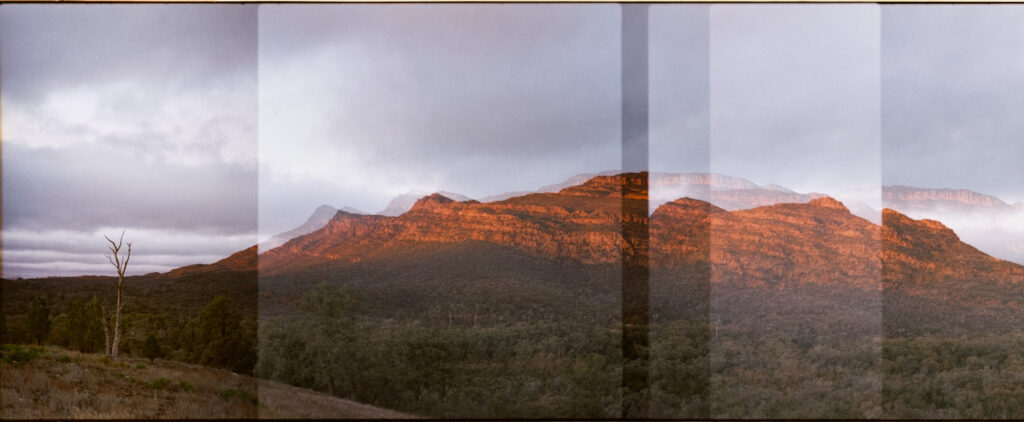
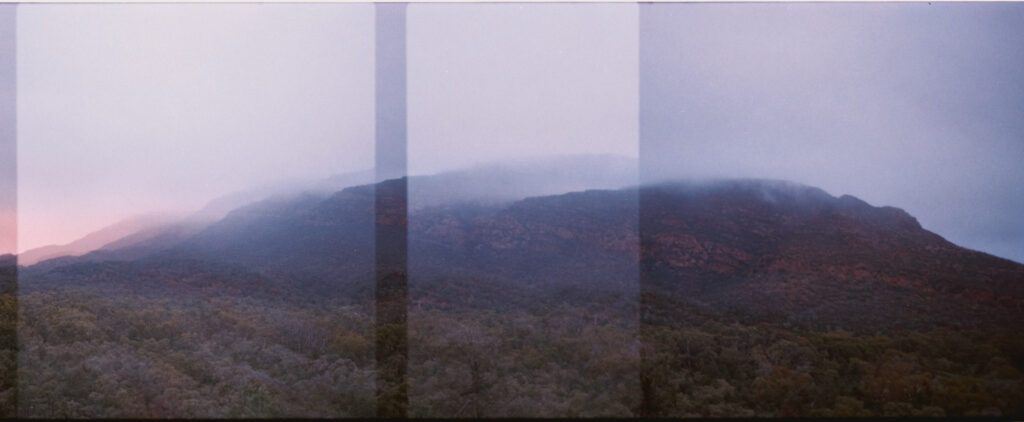 Looking back I feel these hang together quite nicely and I am currently pondering a number of projects in which they might be used. It was fun to bring these out and to think back over that rainy week with lots of nice skies and a very sore Achilles tendon.
Thanks for reading.
Share this post:

Comments
Michael Kaplan on Panoramas in the Flinders with a Nikon F2
Comment posted: 15/08/2026
Wow. There is a lot to unpack here. Firstly, the images are gorgeous. The essence of the landscape is captured perfectly by the subtle tones and variation that is native to each image. And your description of how the human eye records space as it pans across a vista is perfect. Unlike a panning camera, we “break” down an image into parts that essentially form the whole. As your images so succinctly represent. A finally, your process was extraordinary. Imagine manipulating the camera and film advance to such a degree that you could create these images. Wonderfully painterly and abstract and a fitting follow up to the beautiful images offered in the previous article. Thanks so much for sharing. I love it.
Comment posted: 15/08/2026
Gary Smith on Panoramas in the Flinders with a Nikon F2
Comment posted: 15/08/2026
Thanks for sharing.
Comment posted: 15/08/2026
Tony Warren on Panoramas in the Flinders with a Nikon F2
Comment posted: 15/08/2026
Comment posted: 15/08/2026
Comment posted: 15/08/2026
Alexander Seidler on Panoramas in the Flinders with a Nikon F2
Comment posted: 16/08/2026
Comment posted: 16/08/2026
Walter Reumkens on Panoramas in the Flinders with a Nikon F2
Comment posted: 16/08/2026
Comment posted: 16/08/2026
David Pauley on Panoramas in the Flinders with a Nikon F2
Comment posted: 16/08/2026
Comment posted: 16/08/2026
Sroyon on Panoramas in the Flinders with a Nikon F2
Comment posted: 17/08/2026
Also I like the sound of recent posts "discussing the aesthetics of their [panoramic] creations and the various means by which this is done". I don't end up reading all articles posted on 35mmc (more's the pity) but do you mind linking me to a couple of your favourites? Panorama aesthetics and techniques are something I'm also interested in!
Comment posted: 17/08/2026
Comment posted: 17/08/2026