

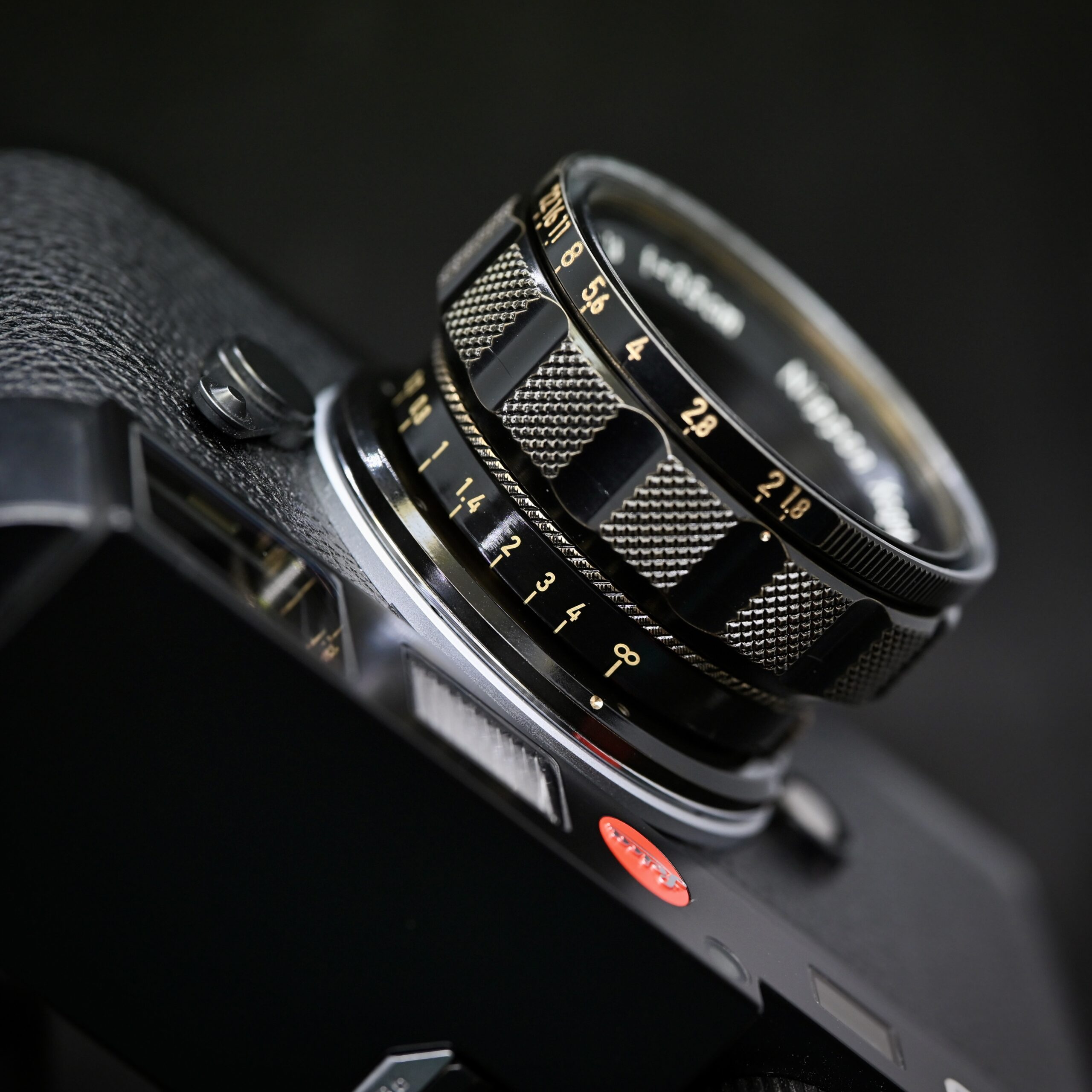
It all started with Sonnar Love. Like many regulars of 35mmc, over ten-years ago I was enlightened and soon began pursuing Sonnar-formula lenses because of community founder Hamish Gill’s multiple musings as he discovered and shared their special characteristics. The Sonnar was developed by the great lens designer Dr. Ludwig Bertele at Zeiss and patented in 1929 for a fast lens with relatively high quality for the time before coating technology was invented. Nikon lens designer Haruo Sato explains Sonnar lenses “in effect corrects aberration with more aberration” and this approach is in part what gives them a unique rendering due to aberrations, in a sense, being embraced.
It is said Zeiss has referred to them as having a “rounded sharpness.” Hamish calls it an “organic sharpness.” But more so, Hamish says “the way a (Sonnar-type) lens separates a subject from a background isn’t just about the character of the bokeh…thanks I suspect to the aforementioned under correction of spherical aberrations – what’s in focus seems to melt away to out-of-focus quite quickly” giving a rendering that can “capture a sense of atmosphere, something somehow organic, something entirely un-clinical, and despite the obvious dose of character, still uncontrived and real.” And of a vintage Sonnar lens he says the way the spherical aberrations soften the out of focus region “results in a glowy transition area and more gentle rendition of out of focus highlights, especially when very-slightly stopped down.”
In short, I find the Sonnar rendering provides feeling. And since I usually do not use wide-open apertures in my reportage work the Sonnar-type’s look coming through in those apertures too is very appealing to me. Also, stopped down they have more contrast at the focus point helping with separation, or dare I say “3D pop.” Interestingly, contemporary Nikon lens designers recognize the benefits of retaining some aberrations (in Japanese) to pursue “the natural expression of three-dimensionality…By placing importance on the continuity of bokeh from the in-focus position to the completely out-of-focus position, we have developed lenses that can create a sense of three-dimensional space within the two-dimensional world of a photograph.” And they continue; “This kind of blur is related to lens aberration.”
NOTE: I do not read Japanese or Italian, so wherever (in Japanese) or (in Italian) is noted I have used some form of Google Translate for the quoted English text.
In photography forums my Sonnar images have been described as honest, wholesome, along with what Hamish described, these are the qualities I want in my reportage photography. To be clear, I am not looking for some distracting wild “vintage” lens character either. And in the same way do not want the modern hyper micro-contrast with clinical sharpness that becomes such eye candy in images that the technical attributes diverts focus from the subject matter.
I’m also a fan of 35mmc because of the small form factor ethos here, and I now photograph with a Leica digital rangefinder kit for the native manual focus, and the small size of both the body and lenses it provides.
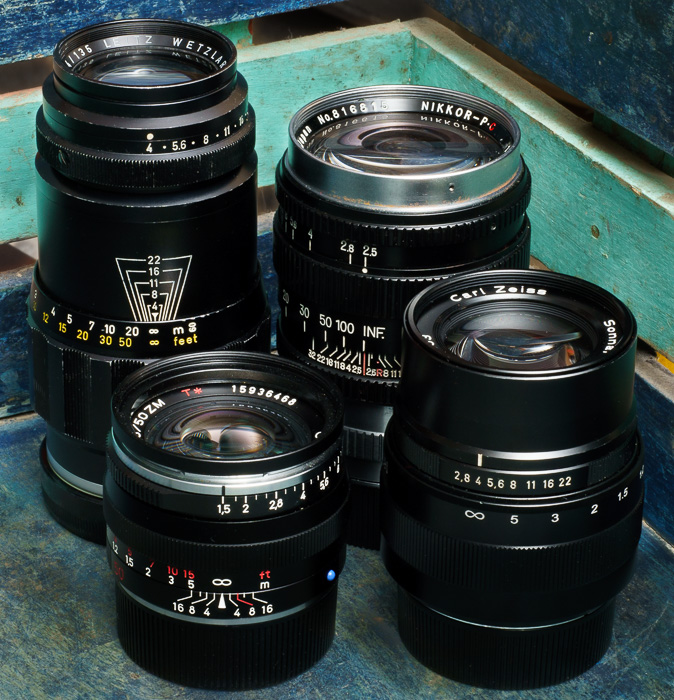
My current Sonnars (left to right above) are a Leica Tele-Elmar 135mm/4, a Carl Zeiss C 50mm/1.5 ZM, a Nippon Kogaku Nikkor-P.C 10.5cm/2.5 LTM (Leica Thread Mount), and a Carl Zeiss 90mm/2.8 Contax G converted to M-mount.
My most used focal length is 35mm, and currently use a Carl Zeiss C Biogon 35mm/2.8 ZM. It is a very good lens, but falls into the modern lens rendering. The Sonnar formula is best suited to normal and longer lenses, and I was not finding a true 35mm Sonnar in LTM or M-mount. So I asked Hamish in mid-June of 2024 is there a solid 35mm for M-mount that would complement my Sonnars? Hamish pointed me towards the Omnar NK35-18.
Enter the Omnar NK35-18 Conversion of the Nippon Kogaku W-Nikkor 3.5cm/1.8
The what!?!
I immediately did some web searching and read that the Omnar NK35-18 is a modern M-mount rehousing of the mid-1950’s S-mount version of the Nippon Kogaku W-Nikkor 3.5cm f/1.8 originally made for Nikon rangefinder cameras. Then I kept digging, and found that this mid-century lens is a legend:
“It employed rare earth lanthanum glass to improve spherical aberration and curvature of field, enhancing both sharpness and image flatness…The actual resolution of this 60-year old (now 70-year old) lens is nothing short of astonishing. Even more astonishing is, that in contrast to other lenses from that era the W-Nikkor retains this kind of performance over the whole frame. The Nikon lens is so impressively good it took Leica 40 years to match its optical excellence with the $5,000 Aspherical Summilux (introduced in 1991)…Ironic, then, that maybe the best 35mm focal length lens ever produced for the venerable Leica was made by Nikon.” –
Tim Vanderweert, on his Leicaphilia blog
And made by Nippon Kogaku who?
Towards the end of World War I in July, 1917 in Japan, the president of Mitsubishi Group Koyata Iwasaki merged the optical instruments division of Tokyo Keiki, the reflector mirror division of Iwaki Glass, and the Fujii Lens Manufacturing company to form Nippon Kogaku Kogyo Kabushiki Kaisha (Japan Optical Industries Co., Ltd.) – a company of about 200 employees. He had been tasked by the government, and especially the military, to address Japan’s lack of native optical glass and advanced optical instruments manufacturing. The crisis had come about from Germany going from being the source of these items to their war-time enemy, and supplies from their allies being slowed or cut off by German U-boats.
After the war one of the founders of Fujii Lens, Ryuzo Fujii, traveled to Europe and bought manufacturing equipment, examples of advanced optical instruments to be disassembled and examined, and to recruit German engineers for Nippon Kogaku. The German economy was in ruins and leading companies like C. P. Goerz were laying off staff, as they now could not manufacture their military optics which were banned by the peace treaty. Giulio Forti writes in his recent book Nikon A Japanese History “three specialists of the company accept a five-year contract. Max Lange, head of optical design for periscopes, Henrich Acht, microscopes and lens machinery, and Ernst Bernick” who was a leader in precision instrument technology. Later, from other German companies Ryuzo hired five specialists in lens design and computation, prisms, grinding, polishing, and technical drawing. These eight Germans arrived in Tokyo in January, 1921, with some of them taking lead positions within Nippon Kogaku. The corporate history webpage relates “the guidance of these engineers had a dramatic effect on improving the company’s technologies.” Three years in Max died, along with one of the specialists. Due to multiple reasons there was a downturn in orders and in 1925 all but one of the remaining German’s contracts were cut short and they returned to Germany. Henrich, “on the other hand, signed a three-year renewal to complete the work on photographic lenses” according to Giulio, which were prototyped after he left and named Anytars.
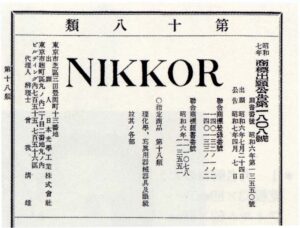
Then, in the early 1930’s the company registered the trademark NIKKOR (below) for their lenses, derived from; NIppon KOgaku and the letter “R” at the end, which was often used as a suffix for lens names at the time. However, these lenes, and many of their other optical instruments were not for the general public, but only for the military, medical and scientific institutions, therefore Nippon Kogaku was virtually unknown in Japan, let along in the rest of the world. Later in the decade that would begin to change.
In 1933 Seiki Kogaku Kenkyujo (Precision Optical Instruments Laboratory) was founded in Japan with the goal to build affordable cameras similar to the Leica Barnacks. In reality, they also borrowed heavily from Zeiss-Ikon’s Contax cameras too. For their second camera they turned to Nippon Kogaku for help with a new lens mount and a new rangefinder coupling. By 1936 this camera called a Canon, was for sale with a collapsible 50mm/3.5 Nikkor, the first Nikkor on a civilian camera. The next year Seiki Kogaku announced a series of Nikkor 50mm lenses would be available for their camera. Then, with the start of the second Sino-Japanese War in 1937, which rolled into World War II, Japan shifted to a military build up to the point Nippon Kogaku could no longer produce civilian lenses. Giulio says the blueprints of the lenses were considered military secrets and could not be transferred to Seiki Kogaku, so to get around the restrictions Nippon transferred some engineers and mathematicians to help out the company that would go on to change their name to Canon Camera Co., Inc. in 1947.
By the end of the 1930’s Mike Eckman writes on his blog Nippon Kogaku “was able to manufacture products equal to, and sometimes exceeding those being made in Germany by their top companies like Leitz, Schneider, and Zeiss.”
In Germany in the mid-thirties anti-glare lens coating applied in a vacuum was developed which was key to lowering the amount of light loss within a lens wherever there is an air-glass surface. Before then, Giulio states “the Zeiss Tessar lens with six air-glass surfaces suffers a loss of brightness of 34%” to reflections. Nippon Kogaku was able to adopt the coating technique in 1940. During World War II Nippon Kogaku was involved in “optical munitions” from battleship rangefinders, to periscopes, aerial cameras and their lenes, altimeters, and high powered binoculars. Mike says during this time their “biggest achievements were significant advancements in refining the raw materials needed to make glass for their lenses and lens coatings that would improve clarity and contrast. The processes for cultivating, refining, grinding, polishing, and annealing (cooling) the glass used in it’s lenses gave them a level of clarity and sharpness as of yet not achieved by the Germans.” In a different post, Mike shares “Nippon Kogaku developed lens coatings during World War II that were years ahead of what other companies had.” The company grew to 19 factories and 25,000 workers during the war.
Nikkors Among the Best of the Rangefinder Era
When World War II ended Nippon Kogaku had to scale back dramatically and find civilian products to manufacture as production of military items by Japanese companies was now banned. Initially they did produce three different lenses that had been designed before the war to be sold on Canon cameras in LTM, but that corporate relationship ended in 1947. Nippon Kogaku branched into many different fields, and eventually photographic lenses for their own Nikon cameras in their own S-mount. After the war Leica lost their patents, including the ones for the Leica Thread Mount (LTM), so there were several manufactures making camera bodies with the mount. Therefore, Nippon Kogaku eventually produced their lenses not only in the Nikon bayonet S-mount, but most also in LTM and Contax mounts, and one for the Kine Exakta mount too.
Nikon’s Camera Chronicle shares “In April, 1946, a soft optical coating was applied to the NIKKOR 5cm f/3.5; i.e., to the surfaces of the lenses inside the lens barrel, in order to increase light transmission…In the beginning, a soft coating of cryolite was used, then as of January, 1948 magnesium fluoride was used and further improvement was added as of September, 1950; i.e., the anti-reflection coating was changed to a hard coating.” During their first 30-years their optical munitions had to meet stringent military specifications, and to stand up in combat so they had stringent quality control procedures already in place. A continuation of this, the Chronicle goes on to detail the testing equipment they developed to test their lenses after the war through this time and the next decade. At about the same time, Giulio writes, the company established an advanced optical research laboratory in the Research Department in 1947 called Ashida Laboratories “for wide and high-speed lenses calculated with logarithms, the Tiger Calculator and soroban (abacus).”
Thus, at the beginning of the 1950’s their lenses were already of the highest quality of the time, but yet to really be known in the west. The June, 1951 issue of Modern Photography reports their gear was being used by professional photographers in the San Francisco area as early as mid-1949. Giulio shares a good number were also sold in Europe via Switzerland in 1950. The big breakthrough was in June of 1950 in Tokyo when magazine photographers Horace Bristol and David Douglas Duncan, working for Fortune and LIFE respectively, looked at prints of photos by Jun Miki, the first Japanese photographer working for LIFE. They were taken with a Nikkor 8.5cm/2 in low light. They were amazed at the quality of the images, and the very next day they went to the Nippon Kogaku factory to learn more. They meet with Dr. Masao Nagaoka, President of Nippon Kogaku at the time, and he randomly took a couple lenses from the production line, and with the testing equipment had quality tests performed on the spot for spherical aberration, astigmatism, and distortion saying every lens ‘”is subject to a strict control, so that everyone has the same degree of perfection'” according to Giulio.
Mike, in discussion with Robert J. Rotoloni, founder of the Nikon Historical Society (NHS) and author of the definitive collector’s book The Complete Nikon Rangefinder System, writes “the results were superior to anything they had previously seen by Leitz or Zeiss. Both Duncan and Bristol were so impressed with the quality and performance of the Nikkor lenses, that they left the factory with three lenses, the Nikkor 5cm/1.5 (the f/1.4 lens didn’t exist yet), 8.5cm/2, and 13.5cm/4 all in Leica Thread Mount. Barely a week after this tour of the Nippon Kogaku factory, war broke out in Korea and both Duncan and Bristol were sent to Korea to cover the war.” Within two weeks David’s first negatives “began arriving in New York, according to Frank Scherschel, LIFE’s assistant picture editor, they turned out to be the sharpest 35mm negatives the lab ever processed” as recounted in the March, 1951 issue of Popular Photography, which features a ten page spread of David’s Korean War photos with an extended story. LIFE took the Nikkors and competing German lenses to lens expert Mitch Bogdanovitch of Eastern Optical Company for testing and he is quoted as saying “‘The lenses are highly accurate and efficient’” in New York Times Camera Editor Jacob Deschin’s December 10, 1950 photography column. Mitch praised some of the Nikkors “for their resolving power and minimum aberrational faults” and said “‘Their lenses have excellent color correction.” LIFE soon made several orders of Nippon Kogaku equipment for their photographers, as well did other western news organizations.
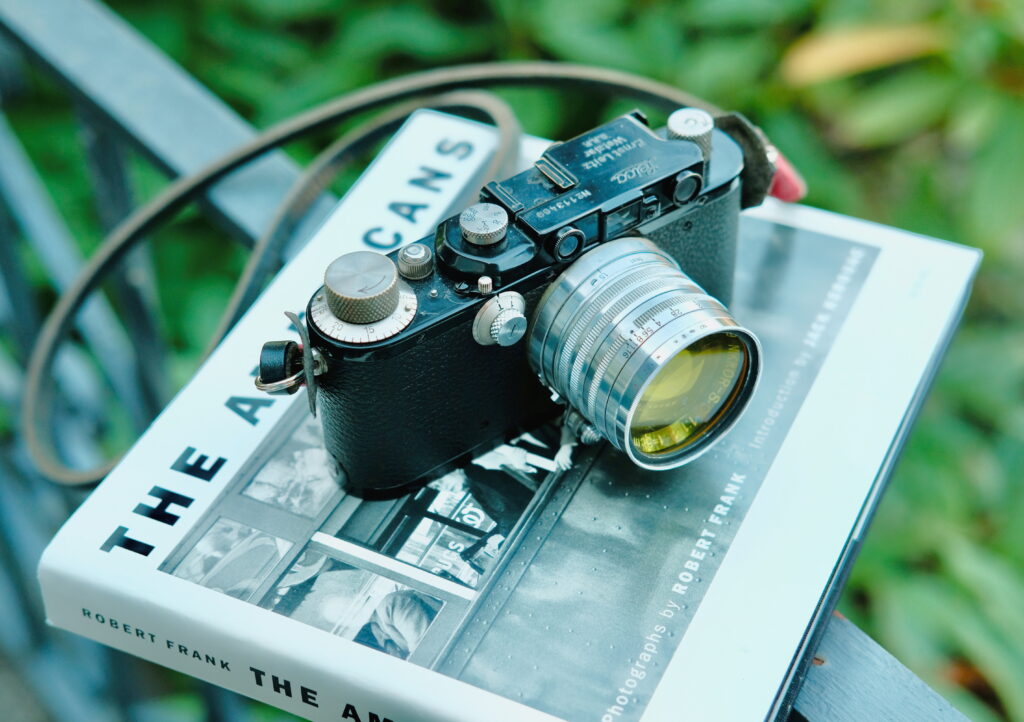
In October, 1950, with the introduction of the Nikkor 5cm/1.4, Nippon Kogaku produced the fastest lens in the world at the time. In June the next year Modern Photography published a much more thorough testing by Mitch and they concluded “The verdict was that the Nikkors which were tested were equal to the best of the miniature camera (35mm cameras) lenses, of any make.” Tim says “in the 50’s, many working photographers sought out Nikkor optics in preference to what was available from Leitz.” On his Leica III Robert Frank used a Nikkor 5cm/1.4 – a Sonnar – on his road trips in 1955 and ’56 that became his seminal book The Americans.
Since my lens search started with Sonnars, I want to add that Zeiss lost the patent on the Sonnar lens formula with the conclusion of World War II, but retained the trademark – be aware not all lenses they market as Sonnar are the lens formula. Many manufactures at that time then used and improved on the formula, including Nippon Kogaku for several of their 50’s, 85’s 105mm (pictured above) and 135’s. Giulio notes “between Germans and Japanese (lens manufactures) there are two schools of thought: Leitz and Zeiss rely more on contrast than on definition, the Japanese, on the other hand, rely more on the more understandable lines per millimeter” of definition.
A Nikkor Lens Reader booklet (in Japanese) shares “As lens development progressed in this way, designers began to demand optical glass with new performance capabilities and even more precise calculation methods. In 1951, five optical glass manufacturers, including Nippon Kogaku, began joint research into new types of glass, conducting test melting of low-dispersion, high-refractive index, and high-dispersion, low-refractive index glasses. In 1953, they succeeded in producing new types of high-refractive index glasses containing rare earth elements such as lanthanum and thorium, and the following year, high-performance lenses using these new types of glasses appeared. Around this time, electric calculators were adopted to replace the previous method of using logarithmic tables, which significantly increased the speed and accuracy of calculations, but it still took a considerable amount of time to fully analyze the performance of a lens.”
The Groundbreaking Design of the the Nippon Kogaku W-Nikkor 3.5cm/1.8
Everything was coming together for a legend. As for fast 35mm lenses for rangefinders, other than the 1930’s Meyer Görlitz Makro Plasmat 3.5cm/2.7 LTM which was produced in very limited quantities, Canon produced a 35/2.8 in 1951,and the next year the Nikkor 3.5cm/2.5 was released which was designed by Deputy Chief Engineer Hideo Azuma, of the aforementioned Ashida Laboratories within Nippon Kogaku. Then Fuji brought out an f/2 in 1954, which was followed a couple years later by a stunner…
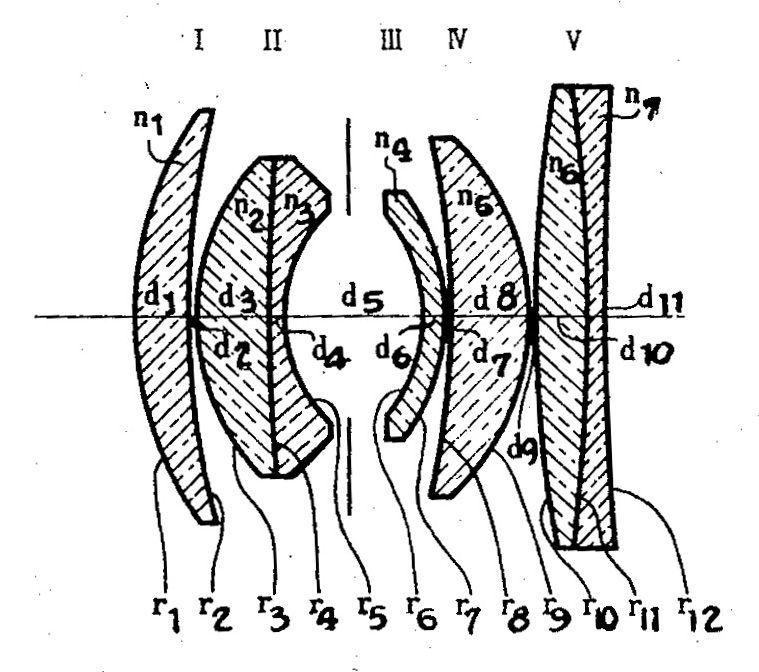
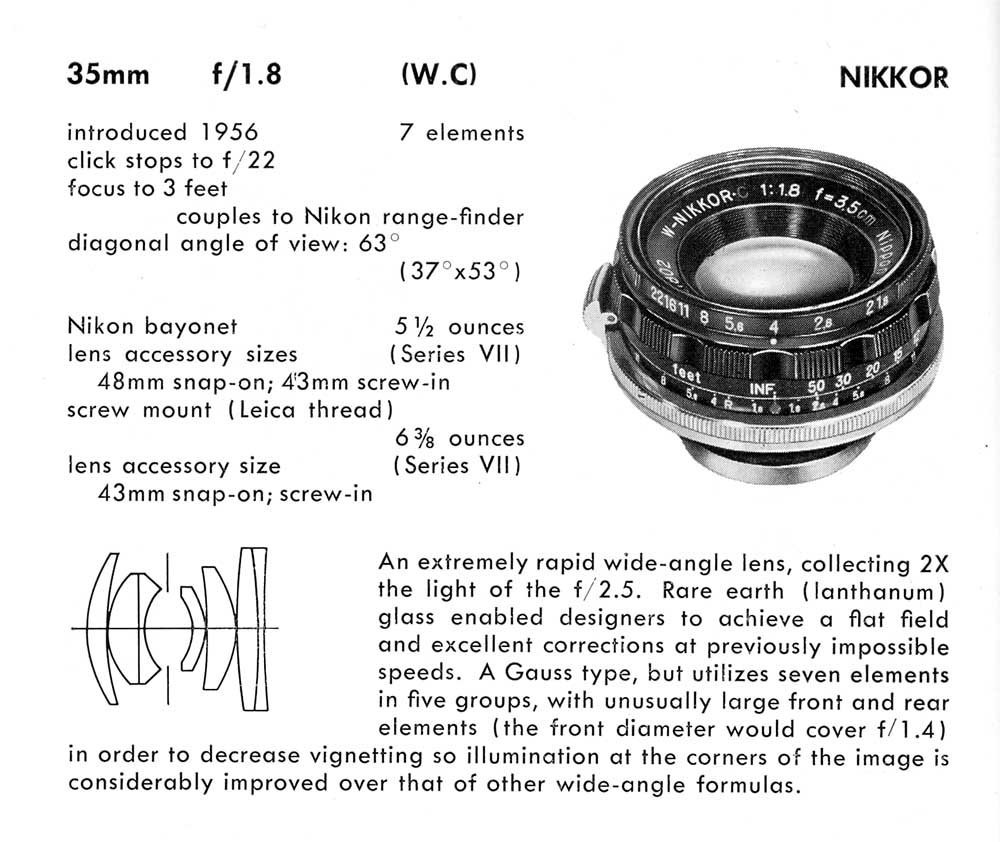
Hideo Azuma then went on to complete in the winter of 1955 the Nippon Kogaku W-Nikkor 3.5cm/1.8, which was released in September the next year becoming the first 35mm lens faster than f/2 in the world. It is a revolutionary unique design, with almost no distortion, and earned a patent in Japan in 1956, and eventually a 1959 United States patent (above). In a blog post Marco Cavina writes (in Italian) “From the raw patent data it is clear…the designer essentially used three types of glass: Lanthanum Crown with rare earth oxides, Dense Flint and Dense Crown.” See his article for a color-coded diagram that shows (from left for the illustration above) the first and second elements (n1 & n2) are lanthanum, the second being cemented to a Dense Crown concave lens (n3) forming the second group (II), followed by the aperture, then a concave Dense Flint lens (n4), a lanthanum element (n6), and then the rear element group (V) made up of a fourth lanthanum lens (n6) cemented to another Dense Flint one (n7). Hauro says (in Japanese) “the design uses a newly developed La (Lanthanum) glass material for all convex lenses at the time, which improves spherical aberration and field curvature, resulting in significant improvements in sharpness and flatness of the field.”
Curiously in the Japanese patent I found, along with the seven element / five group lens that was produced, there is also a design for a six element / five group one with a single element at the very back, instead of the cemented two-piece element. While I’m sharing technical links; I also found this digital optical bench of the lens, which is waaaaay beyond me, but hopefully interesting to some.
In Cameraholics Select Nikkor Thousand and One Nights Haruo says (in Japanese) “What is so amazing about this lens is that it created a new lens type that went beyond the Gauss and Xenotar types. Until then, the mainstream approach to optical design was to gradually improve performance by adding or attaching one element after another to the basic triplet or Gauss type. It is said that there were only a few designers in the world who could create new lens types, including Ludwig Bertele. I remember that in the midst of all this, a Japanese man named Azuma came up with an invention of the same caliber, which attracted worldwide attention. This sparked a wave of invention-level designs from various companies across Japan. It was truly the dawn of a new era for Japan as an optical powerhouse. A great lens truly has a history.” Hauro writes in this Nikon blog (in Japanese) “Azuma’s achievements were significant, and it is no exaggeration to say that he ‘laid the foundation for aberration balance in Nikkor lenses.'”
Hauro concludes “The greatest feature of this type is the presence of a cemented lens at the end. The presence of this doublet (a cemented lens consisting of one convex and one concave lens) improves the spherical aberration and coma that are inherent in fast lenses. It also significantly improves the correction of lateral chromatic aberration (color shift and color bleeding in the peripheral areas). Furthermore, the concave lens closest to the film plane also acts as a field flattener (a lens that flattens the image plane). In reality, it is difficult to design a high-performance photographic lens with an angle of view exceeding 62 degrees using a simple Gaussian type lens. Moreover, it is amazing that he was able to conceive of and commercialize such an unprecedented large-aperture wide-angle lens in this day and age. Even when looking at lenses from later manufacturers, it is clear that Azuma’s ideas were superior. This is because lenses from later manufacturers generally do not depart from the Gaussian type.”
Chris Andreyo, Managing Director and Head Engineer of Skyllaney Opto-Mechanics shared in an email to me “The rear lanthanum element indeed causes a lot of the ‘magic’ found with the Nikkor 3.5cm/1.8 optical formula. It’s the reason the lens is so sharp wide open even into the corners, and does help the lens to give it its unique rendering.”
The W-Nikkor 3.5cm f/1.8 was first released in S-mount for their own Nikon rangefinders and Contax bodies, whose mount is about the same. A year later it arrived in LTM with this ad (below) from around September, 1957 announcing (in Japanese) “The long-awaited Leica version is now on sale.”
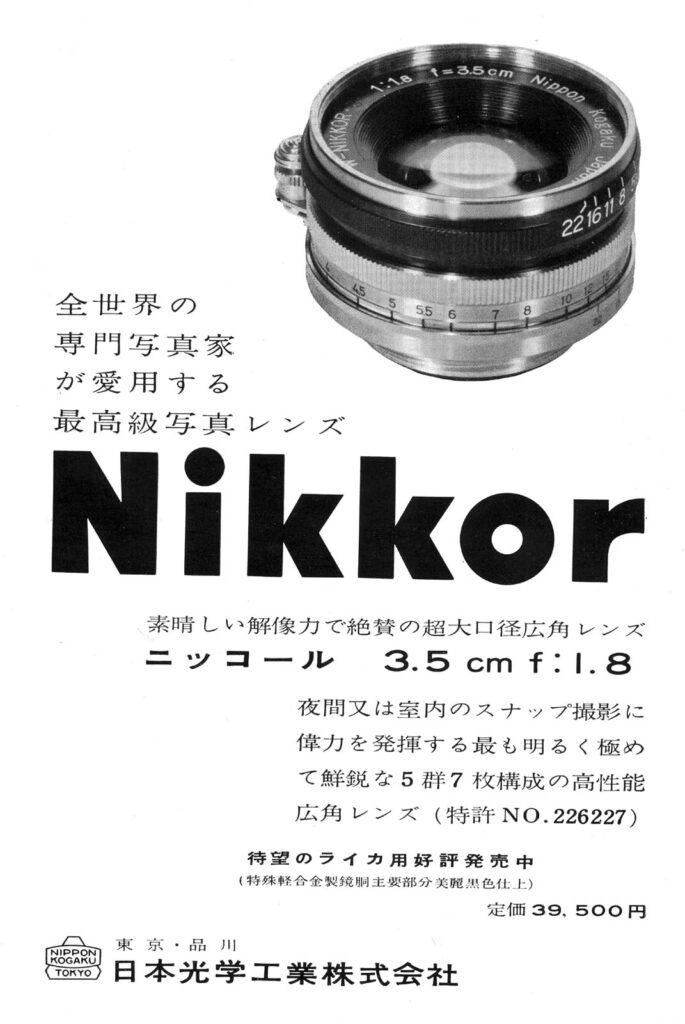
In the 1959 book Nippon Kogaku published for their 40-year anniversary they noted (in Japanese) “The W-NIKKOR 3.5cm F/1.8 wide-angle lens has become widely used as a semi-standard lens.” Robert writes in the NHS Journal #27, March, 1990 “By all standards of the time, the 35mm/f1.8 Nikkor was a very modern lens, and undeniably the best wide angle Nippon Kogaku made during the rangefinder era.” However, they produced no more than 1,580 in LTM, whereas they made almost 7,000 in the S-mount, which is one of the reasons Omnar is doing conversions of the S-mount to M-mount now. Robert shared with me in a message there is no exact date for the end of production of this lens, “but up to at least the end of rangefinder production which trickled on to at least 1964. Brand new Nikkor rangefinder lenses were available in stores until 1968 or later. I would think that such a popular lens would have been in production demand until at least 1964.”
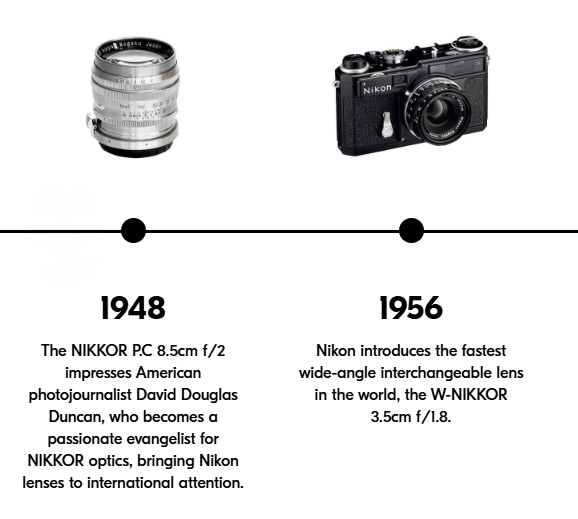
Lanthanum Glass
A column titled “Rare-earth lenses” in the May, 1958 issue of Popular Photography starts out with “If you own one the new lenses made with ‘rare-element glass,’ you’re a lucky one – it’s probably a very good lens. Reason is that such glass, made from hard-to-find so-called rare-earth elements like lanthanum, posses properties which make the lens designer’s lot a happier one.” They were first developed by Kodak in 1941, as well as by the Chance Brothers & Company Ltd. in England at about the same time. I bought a copy of this 1943 Kodak ad as thought it showed well some of the sought after characteristic of rare earth elements in the right-hand image. You can click on the ad to open it larger and read it:
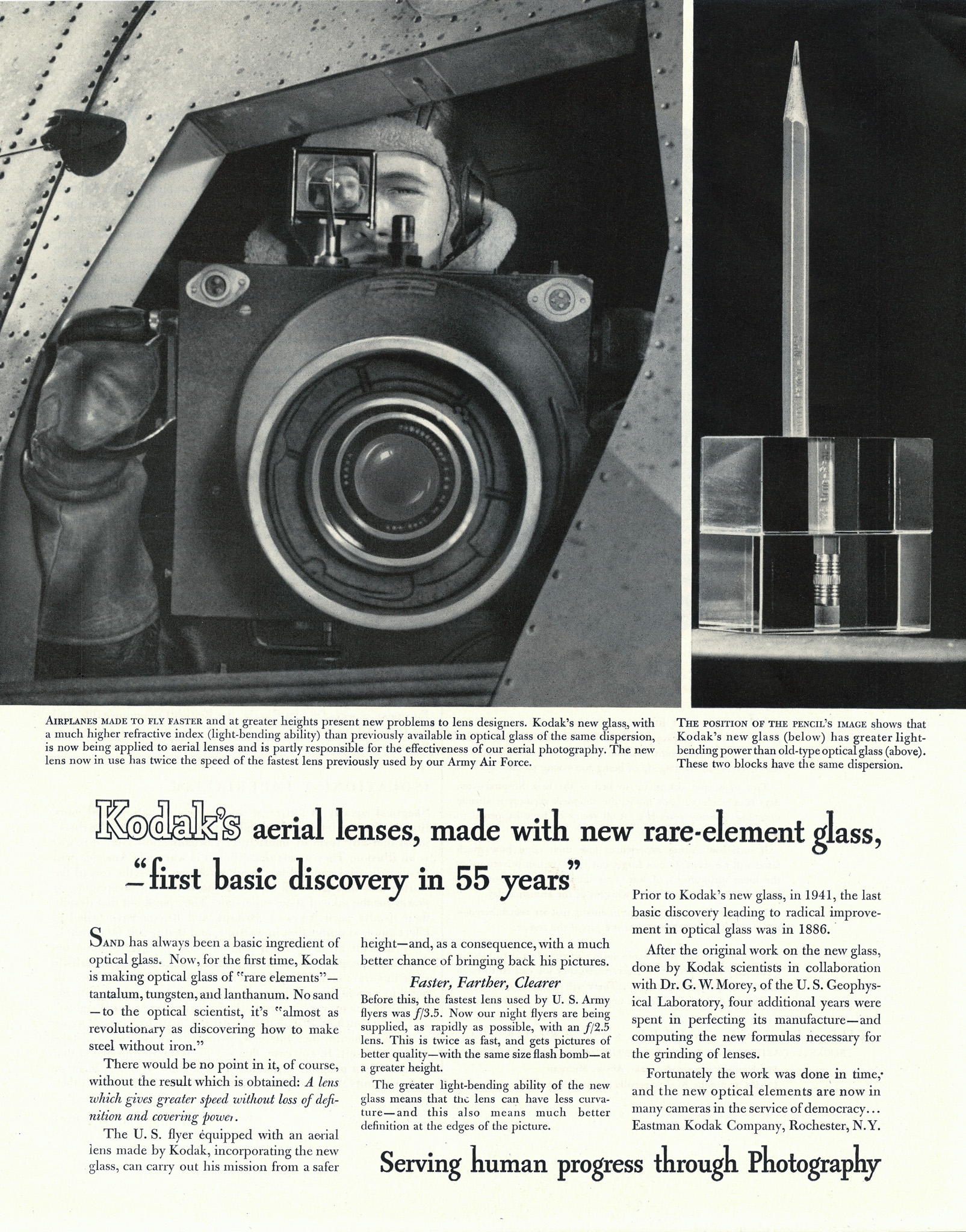
The properties of the lanthanum glass meant the lens could be designed with less elements, therefore making for a smaller overall size. Chris last year said “The exotic elements on this lens is amply helping the lens achieve its sharpness. These elements cannot be remade today under current international regulations regarding rare-earth glass material composition. Nikon did make a reissue of this lens in early 2000 era. The reissue is not as sharp as the original, I’ve had multiple copies of the reissue here for service and conversion, and the original formula versions from the 1950’s are sharper. The reissue is not able to be made in the same way, and thus it’s not able to achieve the same sharpness.”
I’m no radiation expert and did wonder about the safety of lenses with Lanthanum elements. This post indicates they are safe, and I have read they emit not much more than background radiation, but defiantly don’t grind it up and eat it. Ken Rockwell says “In 2018 my lens still measures .0001 mSv with the lens sitting on my Geiger counter.” Richard Haws says in his blog that lanthanum “also made the glass a bit more nutritious so fungi would grow easily. This is why you’ll see some sample of this lens with fungus damage at the rear. It’s ugly but it won’t affect your photos so long as it’s not serious.” It can be cleared up by putting the lens in sunlight or with a UV light, but don’t overheat the lens, less risk balsam separation of the cemented elements.
Rendering of the W-Nikkor 3.5cm/1.8
Anson Tang describes “The lens appears sharp when wide open, with a hint of softness around the highlights. It maintains a moderate level of contrast even at wide apertures, resulting in solid and well-defined images…Out-of-focus areas resemble the scumbling technique in painting, which involves applying thin, translucent layers of paint over existing layers to create a subtle, hazy effect that adds depth and luminosity. This gives the bokeh nice tonal variation and texture.” He also covers the color quality and has an f/2 comparison to a couple Leica lenses on his post too.
In looking at his own photographs taken with this lens Haruo says “The outstanding feature is that there is no unnatural bending of the light source. I don’t remember ever seeing a picture, even when the light source was a neon sign at night, that looked unnatural. The defocus image around the maximum aperture periphery is very soft and nice.” In Japan’s Map Camera’s Kasyapa for Leica blog article on the lens they say (in Japanese) “What’s surprising when you shoot with it is its straightforward rendering even at wide aperture.” And “At wide apertures, the vignetting and soft flare at the edges are striking. However, even under these conditions, the resolution lines are sharp, and the fact that there is no image degradation even at the edges is truly impressive. Stopping down by about two stops instantly transforms the image into a sharp, well-defined rendering. The deep blacks characteristic of Nikkor lenses promise powerful images even in monochrome, giving this lens a dual appeal of both softness and a firm, no-nonsense feel.” They also appreciate the “gentle tones” and “subtle nuances” it captures.
I meet Chicago film photographer Hong Joon Lee at a camera show in September, 2025 and he says the W-Nikkor 3.5cm/1.8 is the only lens he uses on his Nikon SP. I asked if I could share a couple of his film images from the W-Nikkor:
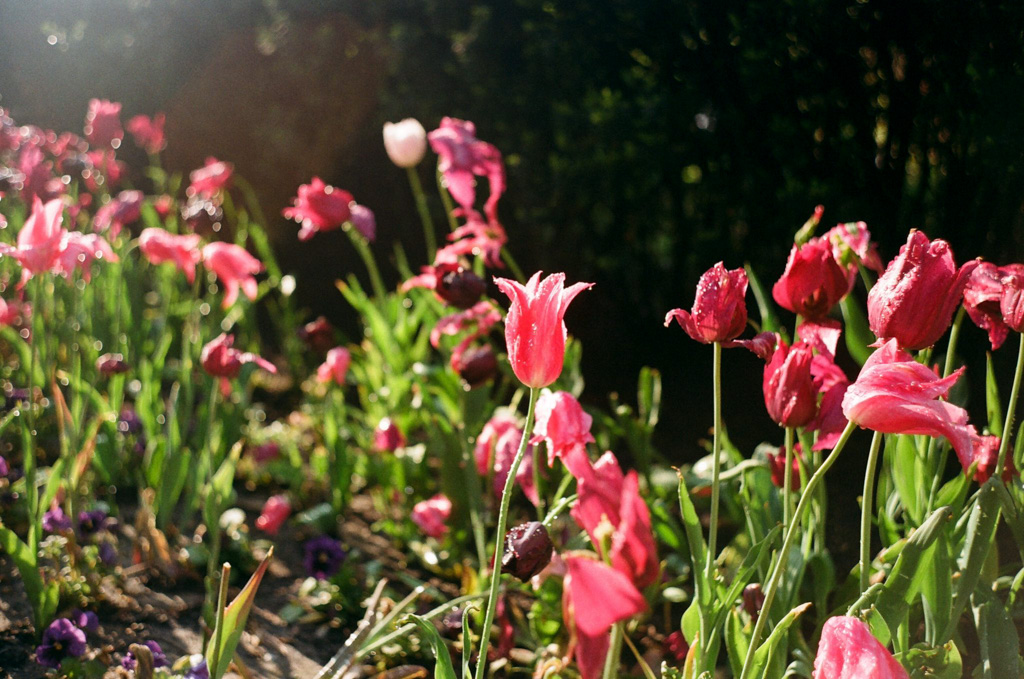

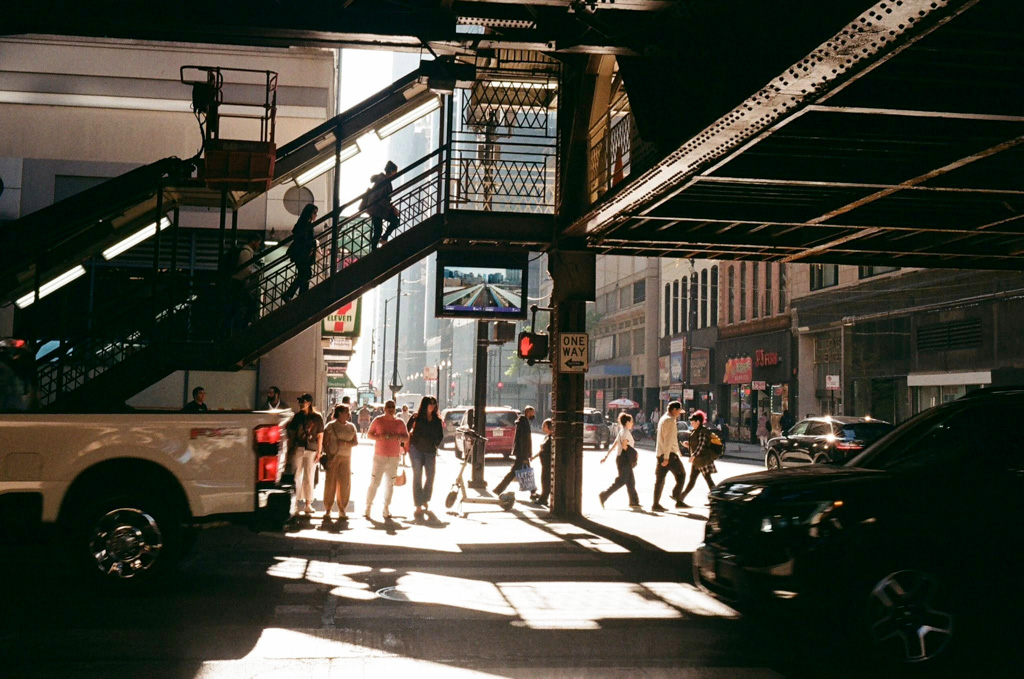
For more film examples this Camera Naniwa blog post has both color and B&W images, noting wide open (in Japanese) “One of the attractions of this lens is its veil-like depiction at full aperture and its contradictory resolution.” Agata Urbaniak says in her review on 35mmc “Wide open the W-Nikkor 3.5cm/1.8 is sufficiently sharp for selective focus type images. Focus is critical as areas just out of it tend to have this sort of woolly look so if you miss it by a little bit the subject might end up looking unpleasant. Past that bit of woolliness the bokeh is very pleasing, slightly bubbly at times, not very swirly, not distracting but full of vintage character.” She also reviews B&W and Infrared photography with the lens and shares more information, so worth a read. And if you would like even more examples see Chiuan Lin’s Fickr album for a variety of images, and this Flickr users album for some nice images on film.
Looking through the some twenty-six pages of this Rangefinder Forum thread where members share their photographs, taken with the lens both with film and digital cameras, gave me confidence that in everyday use this could be a wonderful lens for myself. From reading the comments it sounds like with the W-Nikkor 3.5cm/1.8 any vignette and glow are pretty much gone by f/2.8.
After many, many hours of learning the history, reading owner’s raves about the lens, and reviewing images way too late into the night, I just knew this was going to be one of those lenses that if I did not try it, I would always be wondering about it. Then Chris shared with me last year “one of the reasons I love the W-Nikkor 3.5cm f/1.8 formula is, its as close to a fast 35mm Sonnar rendering lens as one can hope to get. There is no Carl Zeiss 35mm f/1.4 Sonnar lens that exists…. But, the W-Nikkor 3.5cm f/1.8 lens is as close as we can get rendering wise maybe. I’m aware the W-Nikkor 3.5cm/1.8 is not a true Sonnar formula design, but it renders very much like one due to how the formula is arranged with its pivotal rear element. Sometimes I like to only shoot Sonnar lenses on a photo excursions. For the 35mm entry, I sometimes will use the CX38-28 (Contax T 38mm Sonnar), joined with the Bertele 5cm f/2 lens and a Carl Zeiss (CZ) 8.5cm/2 or Contax-G 90mm/2.8 Sonnar lens…for this all Sonnar lens shooting experience. I will sometimes supplement the CX38-28 for the NK35-18…and have the NK35-18 join the Bertele and CZ 8.5cm Sonnar lens…and not think twice that one of those is not a true Sonnar formula. That is how engrained in my mind and shooting behavior the NK35-18 has become in rendering like a Sonnar lens…I don’t distinguish it as not being a Sonnar lens when I’m seeking Sonnar like rendering…the lens formula is included in that Sonnar rendering group based solely on the merits of the rendering it is able to achieve. That probably was the “nail in the coffin” moment for me, in terms of this W-Nikkor 3.5cm/1.8 formula becoming the dominant 35mm focal length formula I use. My mind subconsciously see’s it as a 35/1.8 Sonnar lens. For a Sonnar lover, this is game over for all other lens formulas then, as Summilux, Distagon, Nokton…they cant compete regardless of what they do, because they do not have the Sonnar rendering in my book.”
With that I knew I needed to find a LTM copy to try on my M11.
Technical Performance of the W-Nikkor 3.5cm/1.8
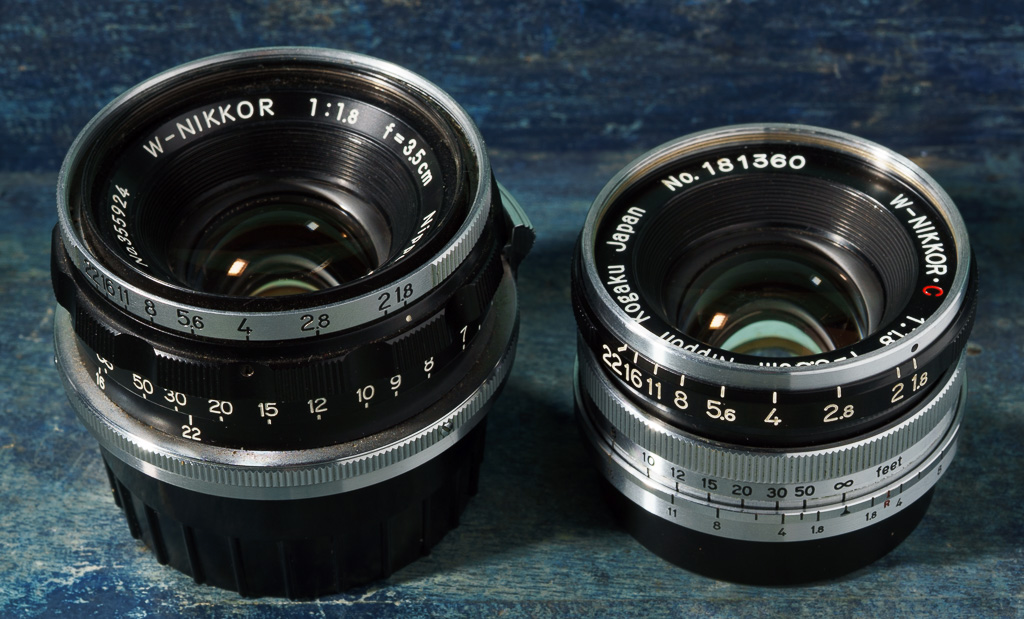
Chris also emailed me “I will say this about the NK35-18/ W-Nikkor 3.5cm/1.8 lens: It is so sharp, I sold my personal copy of the Leica 35/1.4 ASPH Summilux FLE lens, because I could not see myself ever using the FLE lens in any future situation where I would choose that lens while also having access to the W-Nikkor 3.5cm/1.8… It’s just that good. My poor FLE Summilux received no love from me once I got the Nikkor 3.5cm/1.8. I use the W-Nikkor 3.5cm/1.8 lens nearly exclusively wide open at f/1.8 on a Leica M11. Its has no trouble keeping up with the 60mp sensor on that camera. The Nikkor 35cm/1.8, is able to be sharp wide open even into the far corners of the image. It has a very flat focus field – great for architecture. It nearly as sharp as the Leica 35mm ASPH Summilux lens wide open, but with arguably a much more enjoyable bokeh and rendering.”
He continues “I have also the Leica 35mm Summilux V2 (from 1972), and the Nikkor lens is again much sharper at all apertures compared to this lens. The classic 35mm Summilux however has a different rendering then the Nikkor 35, so I keep both and alternate between the two depending my mood and subjects to shoot. I find that the 35mm Summilux v2 goes well with the Leica M9/ M10 where the higher resolution of the Nikkor 3.5cm/1.8 goes better with the Leica M11…this is partly also down to personal tastes. I have found that the colour palette of the M11 camera goes well with the classic Zeiss and Nikkor lenses, while the colour palette of the M10 goes well with the classic Mandler era Leica lenses…again, personal taste this…for some they may prefer the reverse. The Nikkor 35cm/1.8 has some glow in the outer areas of the frame wide open, but this glow I actually prefer in the photos due to the added character and rendering it contributes to the final image output. While the glow is there, the sharpness is evidently present also.”
The Kasyapa for Leica article relates “The background blur can sometimes appear as a double-line blur depending on the situation, but that’s part of the charm of these old, large-aperture lenses. The in-focus plane is sharper than you might expect.” Jason Schneider states in a forum post the lens has “Gorgeous rendition with very sharp core combined with a ‘magic glow’ in images shot wide open and at f/2.8. Extremely sharp at f/5.6 on down.”
I found Nico Venditti’s work with a W-Nikkor 3.5cm/1.8 using a macro helicoid adapter on a Hasselblad X2D on Flickr and asked if I could include it as I liked the look and marveled at seeing the hairs on the butterfly. Click here to see the full resolution image, and click Back to album while there to see more of his work with this lens:

Chris wrote “There are many lenses that are considered collectors items for various reasons. The W-Nikkor 3.5cm/1.8 in its current form I find is highly undervalued actually. It is not possible in today’s modern era to remake this formula in the same way the originals were made. Thus, the classic specimens have a finite number of good copies that dwindles downward with each passing year. Because so few LTM versions were made, and until recently, the S-Mount versions were film only lenses until the full frame mirrorless revolution arrived, the lenses unique sharpness and rendering has been more or less a niche secret amongst Nikon rangefinder camera fans and the few lucky ones to own the LTM versions. It being a fast 35mm Sonnar surrogate maybe is not widely understood either since not many reviews exist of this lens that really focuses on its rendering abilities.”
He continues “With all this praised heaped unto it from me, it does have one minor weakness in my observations. While it is very sharp wide open for what it is, stopped down to the mid aperture zones around f/4-f/8…lenses like the Nikonos 35mm/2.5 and W-Nikkor 3.5cm/2.5 are actually sharper at this point. Not to go on a tangent, but the slightly slower 3.5cm/2.5 Nikonos formulas are some of the sharpest classic 35mm lenses I’ve ever tested. Those lenses will exceed the sensor resolution of the Leica M11 in the mid aperture zones…quite simply stunning achievements really for lenses that are approaching 70 years old.”
As mentioned before, Nippon Kogaku focused on the resolving power of their lenses. And it was front and center on the cover of this 1958 Nikkor lens sales brochure that I bought. On the inside cover the copy says “The professional photographer who lives by the lens is unimpressed by numbers-for-numbers sake. True, a lens must have speed…But it must also have resolution, enough definition to ferret out every detail and to record it-sharp and clear-on the negative.”
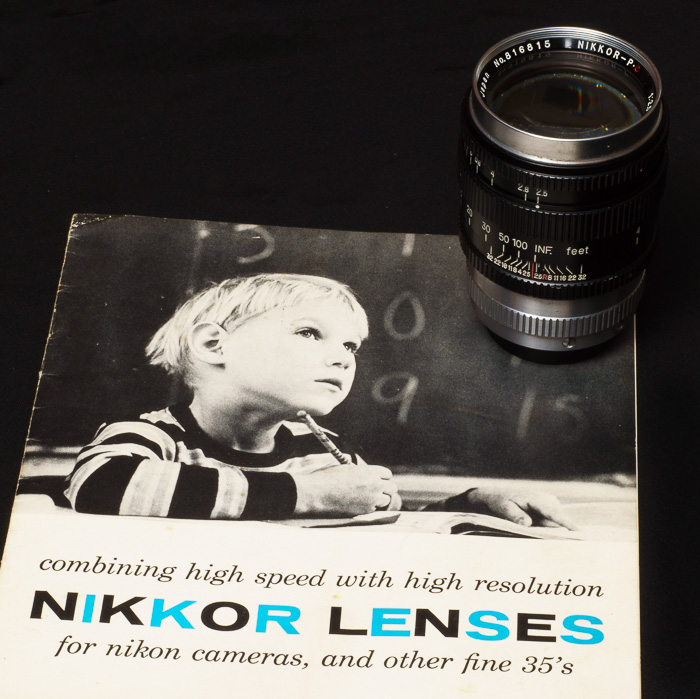
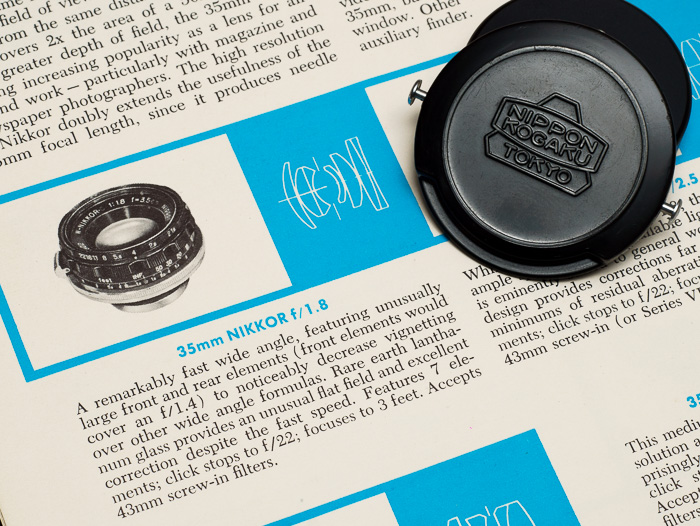
Inside the ad copy (below) about the lens includes “A remarkably fast wide angle, featuring unusually large front and rear elements (front elements would cover an f/1.4) to noticeably decrease vignetting over other wide angle formulas.” You can find a PDF of this entire brochure in Pacific Rim Camera’s Reference Library.
In his lens review video Ashwin Rao notes the W-Nikkor “is remarkable for being extremely sharp with minimal to no distortion.” Agata says in her review on 35mmc “There is a bit of a field curvature present, especially close-up, which contributes to decreased sharpness on the sides of the image when shooting at maximum aperture. Contrast isn’t very high but it is far from low. Subjects rich in detail and textures look crisp and well defined.” She and other reviewers do mention it is not very good at flare control, even though it is a coated lens. Richard shows several frames with flare issues, along with other test photos at different apertures, a strip down of the lens, and a guide for repairs. This episode of Vintage Lens Tasting Notes shows the same scenes through the aperture range, and includes a flare test at various apertures.
Richard also notes “Chromatic aberration can be observed wide-open but it’s not terrible. It will not distract you and you won’t get it in real-world scenarios. It improves by f/2.8 and you won’t see any of it from f/4 onwards.”
Chris says “The Nikkor 3.5cm f/1.8, can sometimes have focus shift depending on how the glass was made. Some copies exhibit no focus shift, others have a mild amount…it has to do with the amount of aberrations in the glass itself, which vary from copy to copy. Likewise, the early 35mm f/1.4 Pre-ASPH Summilux, there exists copies also that have some focus shift, and others that have none…again due to the aberration variation in the elements which is a tolerance zone that occurs when manufacturing. An optical block that has a lot of pre-loaded aberrations (say more glow then normal), will focus shift more…then say a copy which has almost no glow (is low on the aberration pre-load), and thus as the iris stops down, there occurs less of an effective focal length recompilation because the low aberration tolerances specimen was not in a heightened state of aberration to begin with. Again, this same phenomenon is why some Leica 50mm f/1 Noctilux lenses have focus shift, and others don’t…its down to each specimens glass tolerance stack up which affect the aberration heightening summarization (what we term as: aberration pre-load).”
What Followed from the Competition, and the End of LTM
The following year in 1957 Canon matched in speed the 35mm/1.8 with their LTM lens, and then the next year the very rare Zunow 35mm/1.7 arrived, which there is very little published about. In August, 1958 Canon released their 35mm/1.5 LTM becoming the fastest 35mm for a few years. Leica did release their 3.5cm/2 that same year in both LTM and M-mount which eventually became known as the “Eight-Element,” but it was not until 1961 that Leica had a lens faster than f/2 with the introduction of their 35mm/1.4 in M-mount, that went on to be nicknamed the “Steel Rim.”
However, when Leica introduced their new proprietary M-mount in 1954 with the M3 everything changed. Nippon Kogaku notes in their 50 Years of Progress (in Japanese) “it (M-mount lenses) dominated worldwide sales for 30 years. The change in the Leica mount, which had been the world’s standard, prompted each camera manufacturer to adopt its own mount and become self-sufficient in lenses, resulting in a sharp decline in shipments of interchangeable lenses to other companies. This was a major blow, as production and sales of Leica-mount lenses had been booming at the time. (Nippon Kogaku) Lens production volume was cut in half. As a result, we shifted our focus to proprietary camera lenses and urgently needed to develop a unique lens lineup.” (Thank you to NHS member Herman Kempers in the Netherlands for sending me images of these pages from the Nippon Kogaku 1967 50th anniversary book.)
This change of focus meant the end of Nikkors for Leica bodies as all Nikkor S-mount lenses designed and produced after 1958 did not have an LTM version. Thus, no LTM Nikkor 21mm/4, Olympic 50mm/1.4, or 350mm/4.5. And then with the Nikon F’s arrival in 1959, other than Leica, the SLR replaced the rangefinder in most manufactures lineups for many years. However, Nippon Kogaku did make a small batch of Nikon rangefinder bodies for photojournalists covering the 1964 Olympics in Japan. Nippon Kogaku did not change their corporate name to Nikon until 1988, and remain part of the Mitsubishi Group to this day.
Similar 35mm Lenses
In 2001 Konica released 1,000 UC-Hexanon 35mm/2 LTM’s which is based on the optic in their early 1990’s Konica Hexar AF point-and-shoot camera, and it is often mentioned as having a similar lens formula to the W-Nikkor. But, the Hexanon has no lanthanum elements and Davidde.com writes “the front element of the rear lens group differs in orientation to the Nikkor.” See his website for a lot more information about this lens, as well as Marco’s article. Ken says the Hexanon has more distortion, and in forum posts by those that have used both the Nikkor and the Hexanon, lenses I found they say the Nikkor is much better, except for in flare control at wider apertures due to the modern coatings on the Hexanon.
In 2005 Nikon released 2,500 special edition all black W-Nikkor 3.5cm/1.8 in S-mount with SP camera bodies in Japan – both sharing the same serial number. However, the lens does not contain lanthanum glass. Chris says it is “not as sharp and rendered differently” because they “used modern glass with a slight formula recompilation. Based off these observations, I would say the original recipe . . . is what makes the old Nikkor-S 3.5cm f/1.8 formula unique, and why it can not be easily recreated in modern form.” Some other observers have said it seems Nikon tried to give the reissue a “vintage” rendering, but missed the magic of the original, and from what I have read those who have both lenses prefer the mid-century original. After looking at this comparison (the answer to which lens is which is on the third page) I also think the original is better, at least for what I’m looking for in the rendering.
Hideo Azuma’s Legacy
It is said (from Japanese) that Hideo Azuma “disliked publicity, remains largely unknown.” Before the 3.5cm Nikkors, he was involved in the development of the famous first micro lens for the Nikons, the high-resolution Micro-NIKKOR C 5cm/3.5, and between the two 3.5cm’s he developed the notable W-Nikkor 2.5cm/4! His “right-hand man” was Saburo Murakami who designed the Nikkor-N 5cm/1.1, and Hideo was also the mentor of the famous Nikon lens designer Zeni Wakimoto. I’ve seen listed a used copy of a book titled Nikon Glasses Book Basics by a Azuma Hideo, but I can find nothing more about his career.
A remarkable legacy. And it seems Hideo’s W-Nikkor 3.5cm/1.8 is the best of the era, a mid-century optical masterpiece. However, what I find truly remarkable is this lens is not some remarkable feat of the past, but what looks to be some lanthanum magic and unique design that helps bring feeling to the photographs that is still very much valid today. And can not be reproduced exactly in the same way again.
Original W-Nikkor 3.5cm/1.8 Options
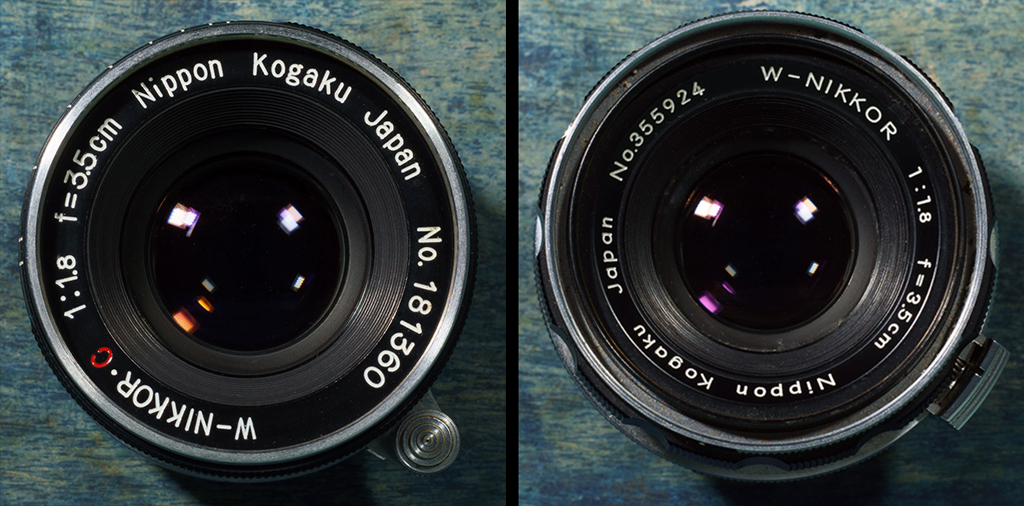
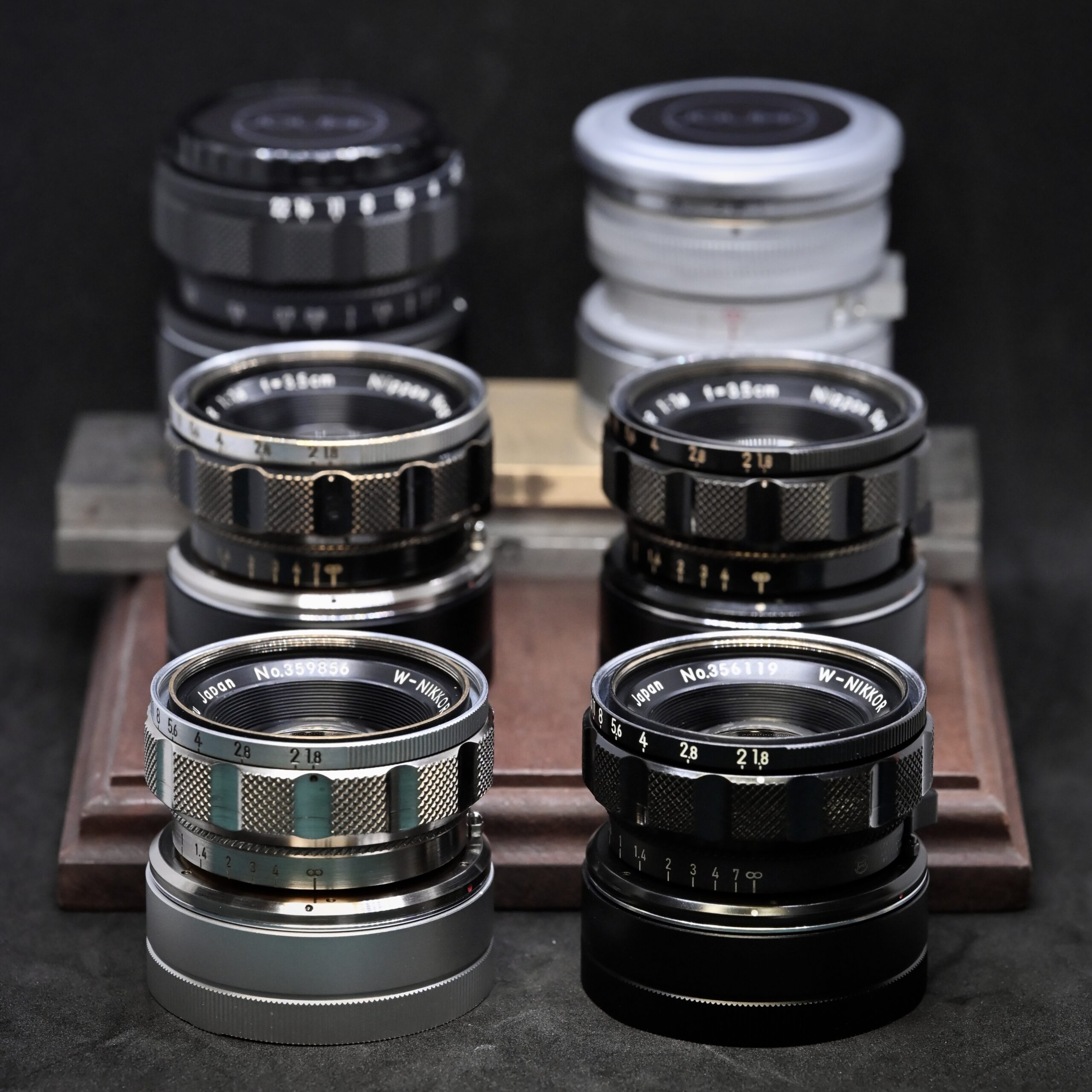
In the NHS Journal #11, March, 1986 article Three’s Company by Joseph Higham notes that with the introduction of the Nikon SP camera body in 1957 Nippon Kogaku removed the red “C” from the front ring (above left on the LTM) which indicated the lens was coated as all their lenses were coated by then. Also, “all Nikon cameras, lenses and accessories adopted a much more modern type face.” For example the number 3 moved from a flat top (left) to rounded on the top (right on the S-mount), the letter “N” widened, as well as the lower case “a” & “g” became less curvy, among other changes. And on both the LTM and S-Mount the font did not necessarily change over the entire lens at the same, but I found some where one part is updated and another part of the lens has the older font. This website also has a physical comparison between the LTM and S-mount versions.
W-Nikkor 3.5cm/1.8 LTM (Leica Thread Mount)
Easily adapted to M-mount with an LTM to M-mount ring, but only less than 1,580 made – see Roland Vinks’ Nikon serial number data base. Others say only 1,470 produced. Dr. Randol Hooper in his article titled The “Other Nikkors”… in the NHS Journal #11, March, 1986 states “the 35/F1.8 was the only screw mount (LTM) Nikkor to have its very own unique numbering sequence, with all the other lenses having numbers intermixed with the bayonet (S-mount) versions.”
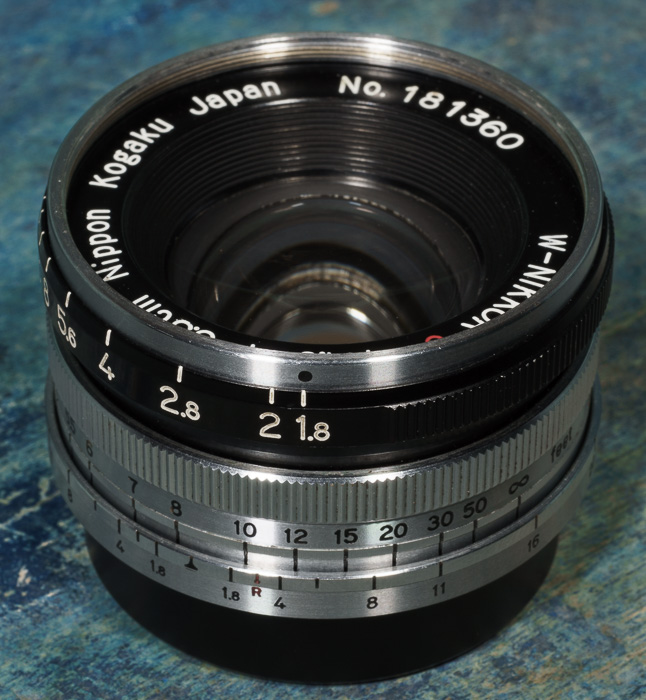
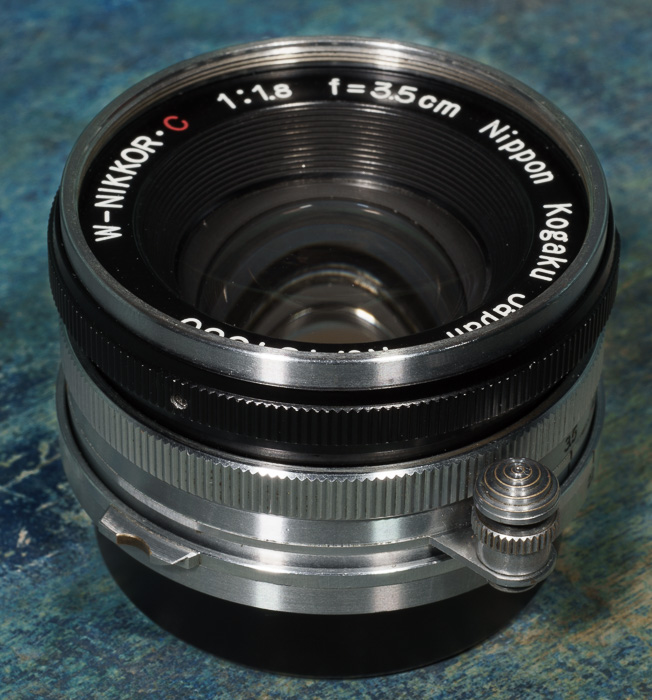
- Widest opening on the aperture ring is to the right (opposite of Leica made lenses)
- 9 aperture blades
- Aperture and focus rings turn independently like a modern lens
- Focus mark and DOF scale set to the one side from center when mounted (above)
- Minimum focus of .9m / 3′
- Infinity to the right (same as most Leica made lenses)
- Long focus throw of about 180°
- Has an infinity lock, which can be used as a focus tab
- Lens is coated, even if not engraved with a red C
- Distance scale in feet
- 43mm threaded filter, cap and hood ring
- 47mm / 1.9″ Wide x 27mm / 1.1″ Protrusion Off Camera
- Reported Weight 185g / 6.5oz
The Price
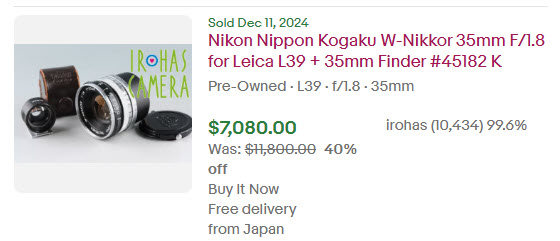
In November, 2024 Japan Camera Hunter Bellamy Hunt told me “The LTM version is rare and highly collectible. I rarely see them, but you would expect to pay at least $4-5k USD for a clean one.” One did go for $2,225 in an eBay auction I watched in the States in November, 2024, but it took $5,800 to win one in a 2023 Yahoo Auction I found. Evidently one sold for over $7,000 in December, 2024 on eBay (below), and since then the LTM ones seem to be going for around $3,300 to almost $13,000 on there, except for a couple in April this year that sold for around $2,000 in auctions, but they were not from camera stores and did not state clearly the current optical condition of the lens. My understanding is Map Camera in Japan tends to be pricey, but looks like the LTM’s are also going for $4,300-$6,800 there. At this time Igor’s Camera Exchange in the States has one of them in less than mint condition for $3,095.
W-Nikkor 3.5cm/1.8 S-mount
Native mount for Nikon and Contax rangefinder film cameras. From Robert’s The Complete Nikon Rangefinder System “the factory states only “6,901 in Nikon mount.” Also, see Roland Vinks’ Nikon serial number data base. Robert writes in the NHS Journal #27, March, 1990 the serial numbers starts at #351801 and comes from “the focal length (35) and the speed (18).” Omar shared with me in an email that “From our experience, the older copies of the lens seem to be sharper and newer copies have a better flare resistance.”
Approximately only the first 75 had a black aperture rings as shown in the 1956 ad and 1958 Nikkor lens sales brochure above. They are expensive collector items now, with one going for €6,000 at auction in June, 2024. When they changed to silver aperture rings, Robert says they started with a “brightly finished chrome that was toned down a bit as time passed. The earlier bright ring may have been prone to flare.”
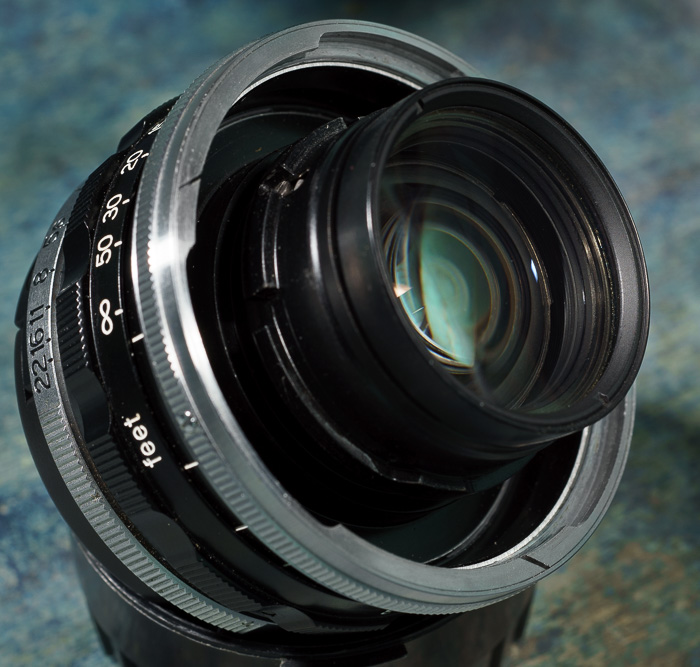
Unfortunately, the S-mount version can not be used with an S to M mount adapter on Leica bodies as the large rear element (below) protrudes a good ways out and the metal rim around it interferes with the rangefinder cam. Some brave handy souls have shared on forums they are replacing that rear metal rim of their S-mount version with a slimmer one and then could adapt it to M-mount. Chris has found this can be a hit or miss conversion method as on some of “the lenses the rear elements are cemented in place and need careful mods to de-flange it.”
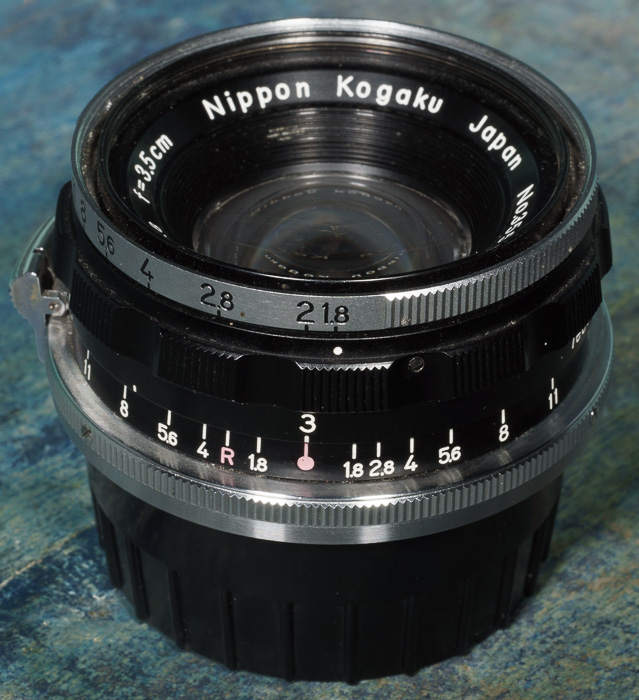
- Widest opening on the aperture ring is to the right (opposite of Leica made lenses)
- 9 aperture blades
- Aperture and focus rings rotate together, so an aperture scale on both sides
- Minimum focus of .9m / 3′
- Infinity to the left (opposite of most Leica made lenses)
- Very long focus throw of about 260°
- Very smooth and light turning focus ring which is large and shaped similar to early Nikkor SLR lens that followed
- No focus tab
- No infinity lock
- Lens is coated, even if not engraved with a red C
- Distance scale in feet or meters
- 43mm threaded filter, cap and hood ring, and separate 48mm unthreaded ring for a clip-on hood
- 55.8mm / 2.2″ Wide at the mount, about 53mm / 2.1″ at the focus ring x 26mm / 1″ Protrusion Off Camera
- Weighs 160g / 5.5oz
- Seem to be going for about $1,000 for a really clean one, but some deals out there down to about $600
Omnar NK35-18 MkII M-Mount
Omnar Lenses completely rehouses the optical block of an S-mount W-Nikkor 3.5cm/1.8 into a modern high-quality M-mount body with several improvements (listed below). They aim to build their lenses with “no-compromise mechanics” as good as the best of the major German brand. Omnar is a joint venture between Hamish and Chris who both share a passion for rangefinder lenses, and a love of Sonnars. The original aperture control ring, optical block with its iris assembly, and the front ring (with the name and serial number) are all retained. Mounted in a new, mostly brass housing, designed, manufactured and assembled in Scotland with the highest quality modern mechanics.
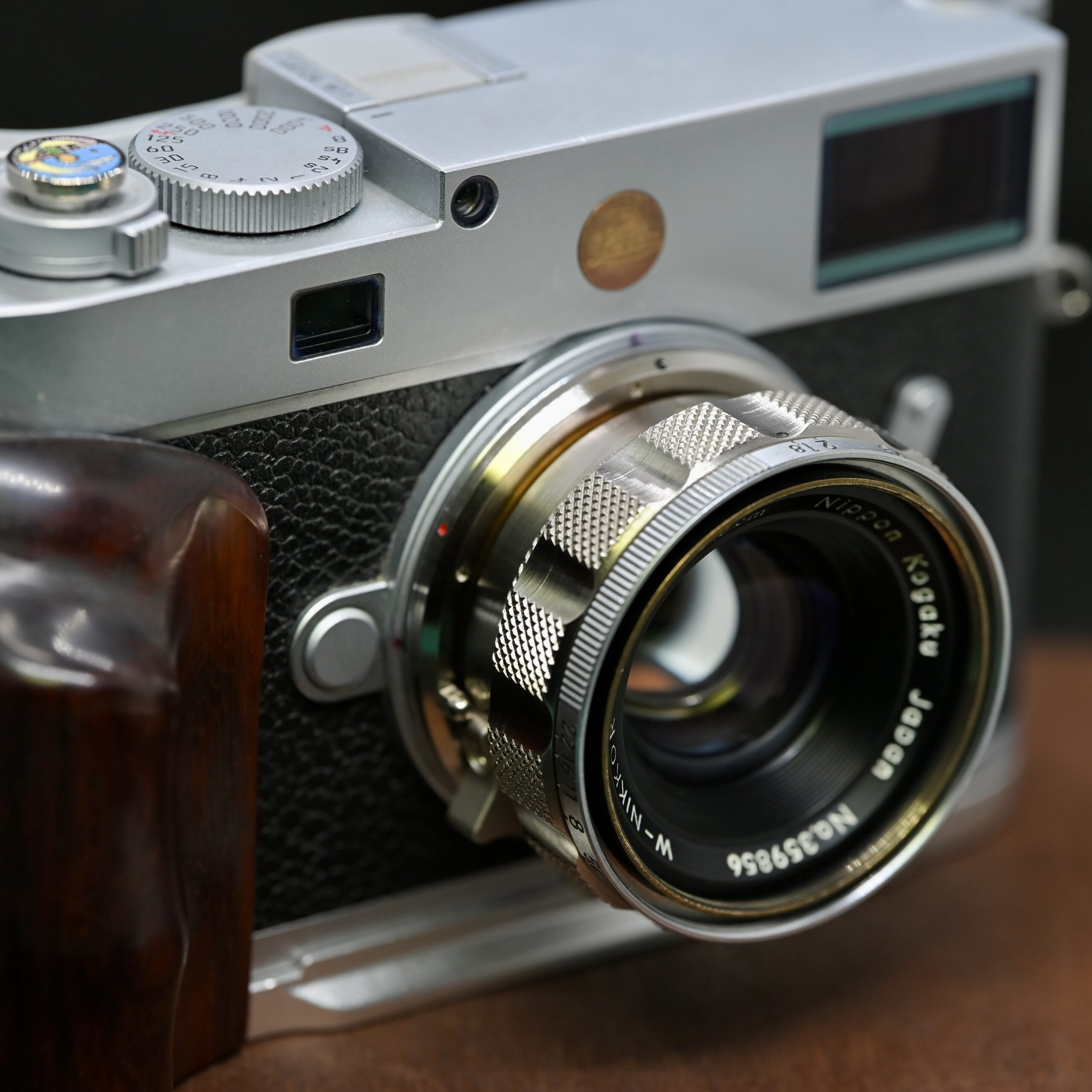
- Widest opening on the aperture ring is to the right (opposite of Leica made lenses)
- 9 aperture blades
- Aperture and focus rings rotate together, so retains orginal aperture scale on both sides
- Improves the rangefinder coupled close focusing to .65m / 2′ 2″, and adds uncoupled close focusing down to 0.35m / 13.8”
- Focus direction reversed, so same as most Leica made lenses.
- About 90° focus throw for the rangefinder coupled range, similar to modern lenses, and about a further 90° for the uncoupled range
- Adds a modern focus tab
- No infinity lock
- Lens retains original coating
- Distance scale in meters, no DOF scale
- Original 43mm threaded filter, cap and hood ring, and separate 48mm unthreaded ring for a clip-on hood
- Available in Nickel Plating, Silver Chrome, Gloss Black with Brassing, Matte Black, and Satin Black (below)
- M-mount with 6-bit recessed indents for DIY coding
- 29.1mm / 1.1″ Protrusion Off Camera
- Weighs ~230g
- Link for more info and to get onto the NK35-18 MkII 2027 waitlist
Hoods & Caps
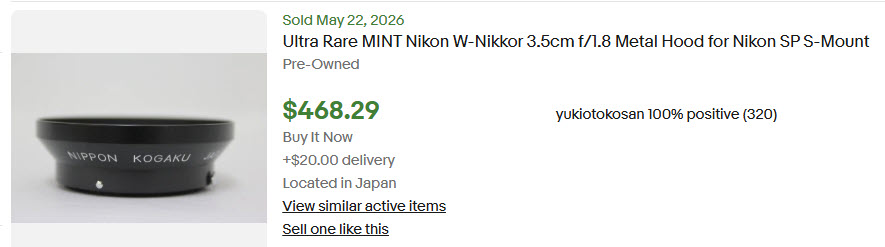
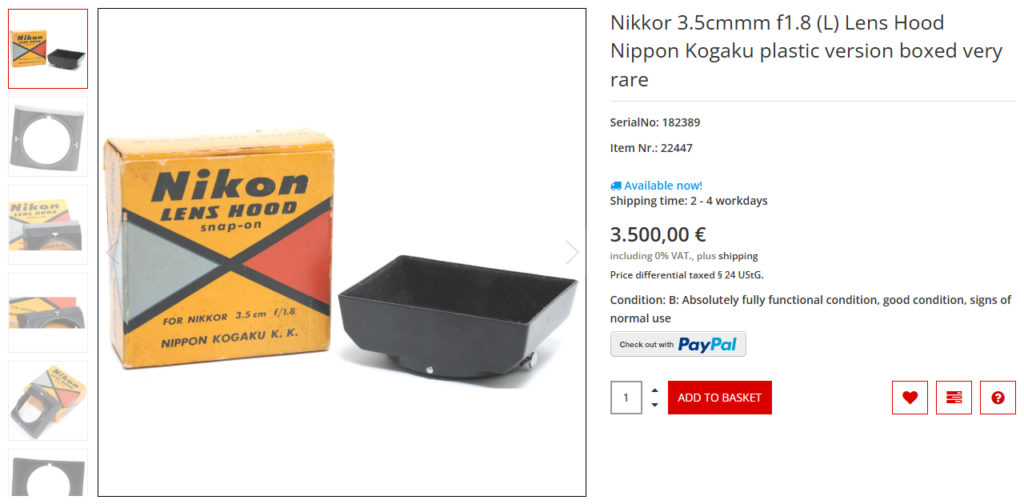
The S-mount took a now rare, and thus now very expensive (above), 48mm Nikkor AC-521 reversible, clip-on lens shade made out of aluminum. I have also seen published a model number of AS-48 for a hood for the S-mount lens. The LTM takes a 43mm snap-on round ES-43, or a very rare square hood hood AC519, the later I found an example for sale in 2026 at Photo Arsenal Worldwide in Austria (below).
Tom Abrahamsson, of Rapidwinder for the Leica fame, made replica hoods at one time. Some NHS members have shared 3D printable hood files here and here, with a forum thread too. I happened across on Instagram Planar Studio’s posts using an old Contax 49-55mm step-up ring with a new 43-49mm ring to form a hood. Old Lens Junkies is selling a $200 replica 43mm screw-on hood that should work on both versions, but of course there are generic 43mm hoods out there that should do the job too.
The original front lens caps are not inexpensive either, with the Nikon branded 43mm rangefinder lens caps going for about $50, and the Nippon Kogaku ones around $100. I’ve also noticed the use of a 48mm slip-on cap on the S-mount.
And now where…
I hope this was a fun and interesting read from my research, with lots of rabbit hole tangents to explore, about this unique legendary lens, but if you have additional insights about the W-Nikkor 3.5cm/1.8 for this roundup please comment below. Part 2 will be my experiences photographing with the LTM version of this lens, and if I have determined it is my new primary 35mm, which will publish in a week on 35mmc. You can find me on Instagram @Rollinphotoj.
Finally, I just want to note that I approached Hamish with the idea of these articles in December, 2024 after doing a lot of reading on these lenses for myself, and then wanting to share what I had found with the 35mmc community. While Hamish Gill is part owner of Omnar, he did not advise me what to write here, nor did a machine…
Share this post:


Comments
Jonathan Leavitt on Why I’m Choosing the W-Nikkor 3.5cm f/1.8 LTM or Omnar NK35-18 MkII Conversion as my 35mm (Pt. 1 of 3)
Comment posted: 17/08/2026
I do own a good copy of the LTM version, as well as the Canon, and the Nikkor F2.5, in fact, all the lenses that Nikon made for LTM. Well except for the Micro Nikkor F3.5. I passed up a chance to buy a clean copy of that this year because, well, some things have their limits. Your article has inspired me to take the whole group out and look at them more carefully. Thank you for the good work.
Comment posted: 17/08/2026