

For context, my wife is a pioneer minister. One of the pleasures of being “Mr Vicarage” is that I get roped into preparation for various church activities. The pioneering aspect of her ministry means these can be quite varied and, at times, unexpected.
So I found myself, one rather warm summer Friday, undertaking a recce for a pilgrimage walk planned for a group a few weeks later. The route would run from just outside Cambridge to Ely Cathedral.
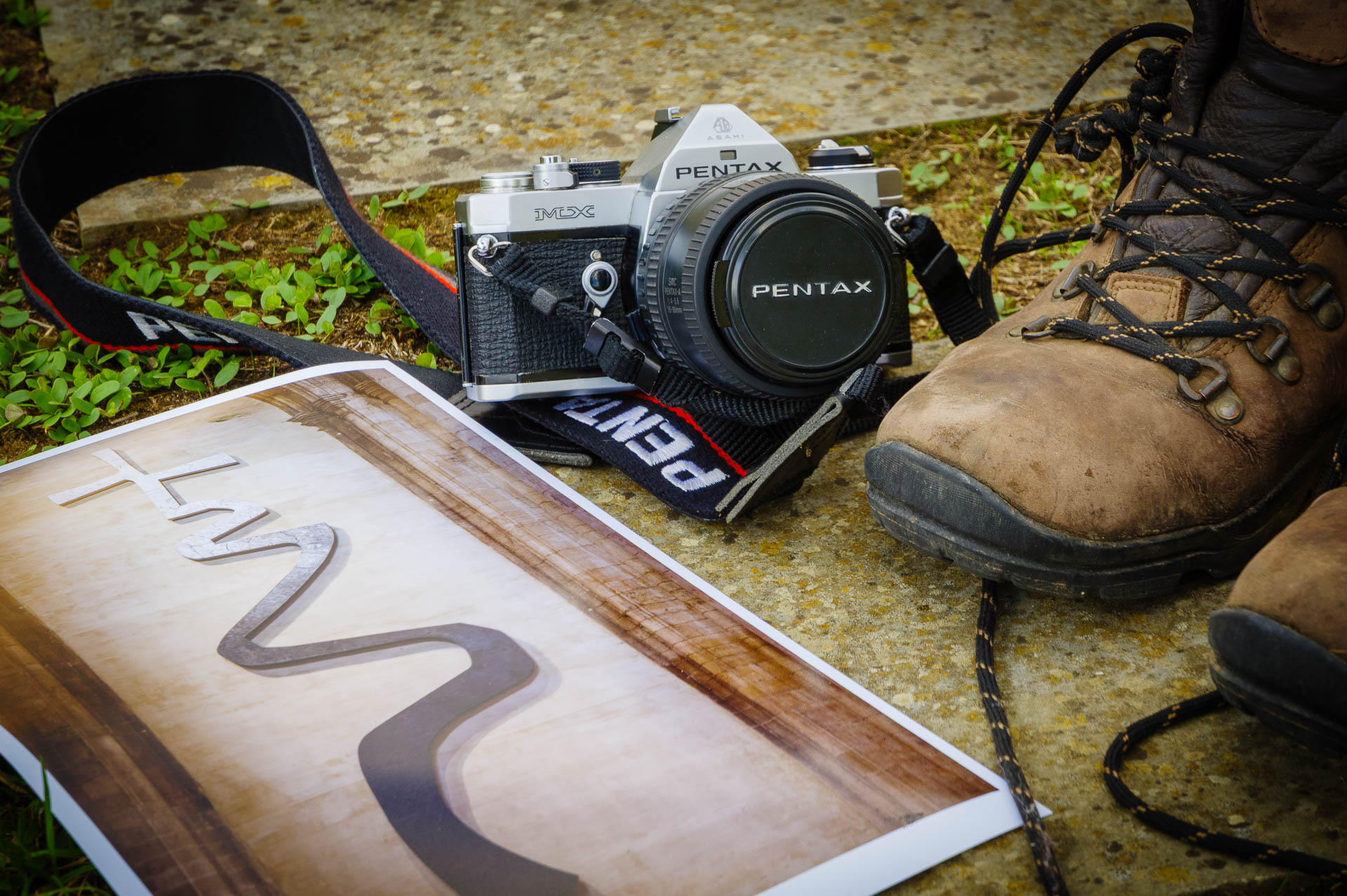
Aside from the “gear acquisition syndrome” and technique, photography has become something of a reflective practice for me. So naturally, a camera was coming along for the 15-mile “practice” pilgrimage. It could have been one of my digital cameras — my wife would probably have preferred that, as she needed photographs for the pilgrimage guide she was preparing. Instead, I took a Pentax MX and my “plastic fantastic” SMC-A 35-80mm f/4-5.6 zoom, loaded with Kodak Ultramax 400.
The lens has been with me since I bought it second-hand as a student in 2000. Never particularly inspiring optically, having moved to digital, it spent years at the back of a cupboard. Recently I have rediscovered it as a useful lightweight walkabout zoom on my pentax film SLR’s
In the guide my wife later produced for the pilgrimage proper, she wrote about noticing: walking slowly enough to see the landscape, the people we’re with and things that might otherwise disappear into the background. I hadn’t thought about the recce in those terms at the time. I was mostly thinking about the distance, the weather and whether the route actually worked. But looking back at the frames I took, I think that was what I was doing with the camera.
I wasn’t looking for five great photographs. I was looking for things that made me stop.
So here are five frames from 15 miles, two “pioneer” pilgrims, one SLR and lightweight zoom kit lens, walking the proposed route.
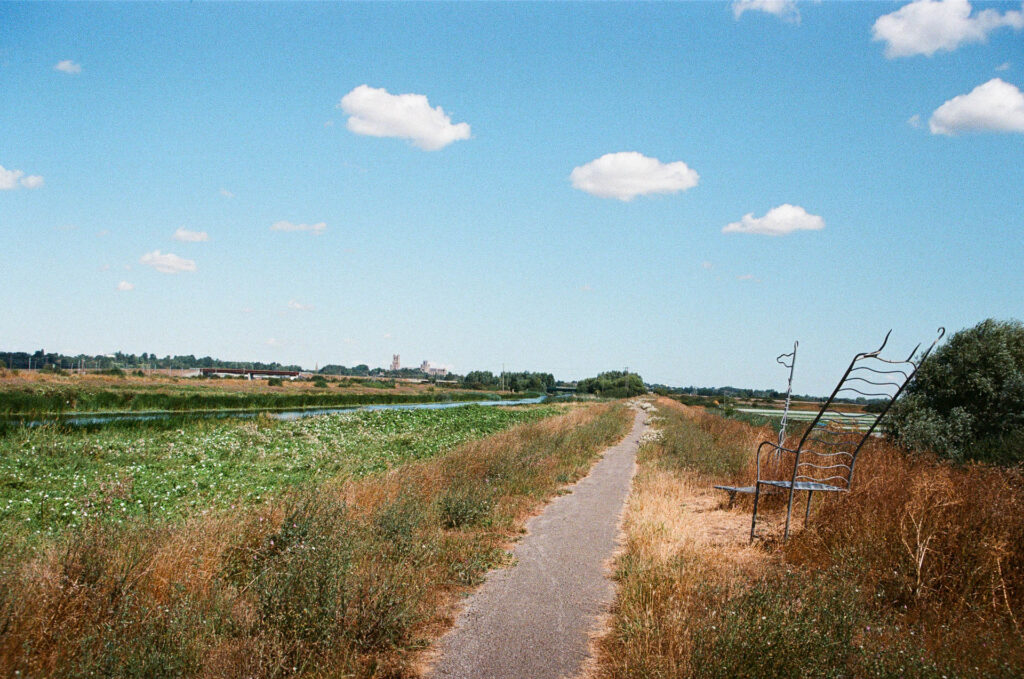
Although the planned walk would end at Ely Cathedral, on the recce we started in Ely and walked the route in reverse. We hadn’t gone far, following the Great Ouse beneath the Ely southern bypass, when we encountered this large metal throne looking towards the “Ship of the Fens” in the distance.
We paused, considering the miles ahead and the likely relief our group would feel when they finally saw the cathedral getting closer. There was something appropriate about sitting there and looking towards the destination, even though we were about to walk away from it.
The MX’s meter was also beginning to misbehave — if it was giving any readings at all. Time for Sunny 16. Fortunately Ultramax is forgiving, although it does have rather crunchy grain.
The route was mapped out, but neither the walk nor the camera was going to behave entirely as expected.
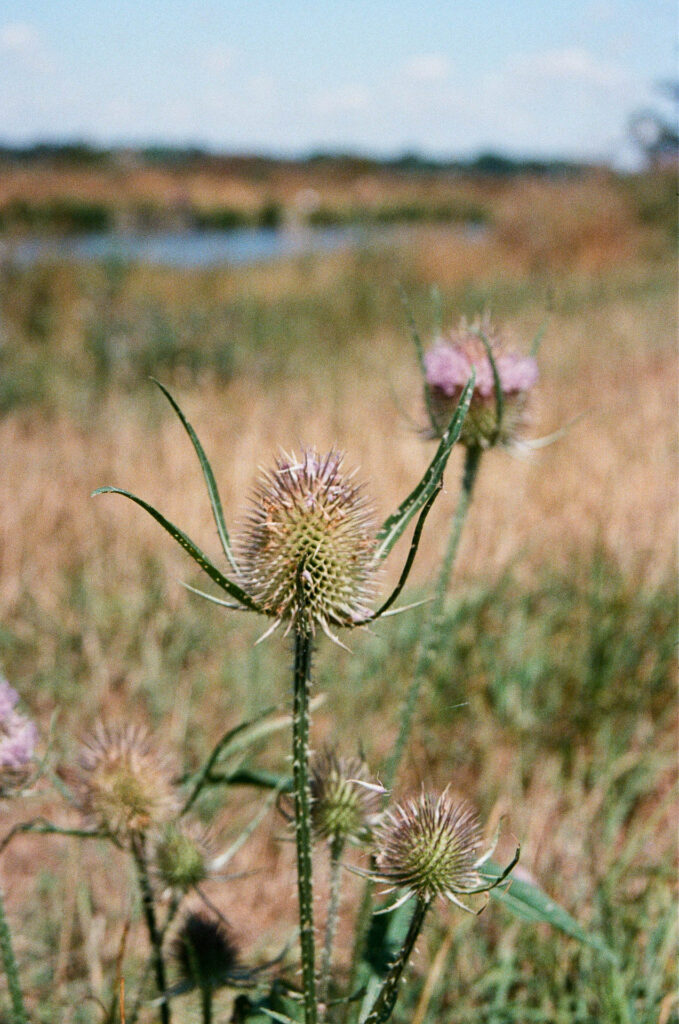
Thistles were everywhere. Spiky, yet beautiful, green and purple against the baked landscape after a summer of drought.
At walking pace, the little things beside the path have more opportunity to become visible. A thistle isn’t exactly a remarkable discovery, but each flower is unique in its own way.
The six-bladed diaphragm in this plastic 90s kit lens is hardly renowned for its bokeh. Here, though, I quite like it. Combined with the Ultramax grain, it seems to suit the subject. Perhaps that’s one of the pleasures of walking with a camera. You don’t necessarily find something extraordinary. You simply have time to notice the ordinary.
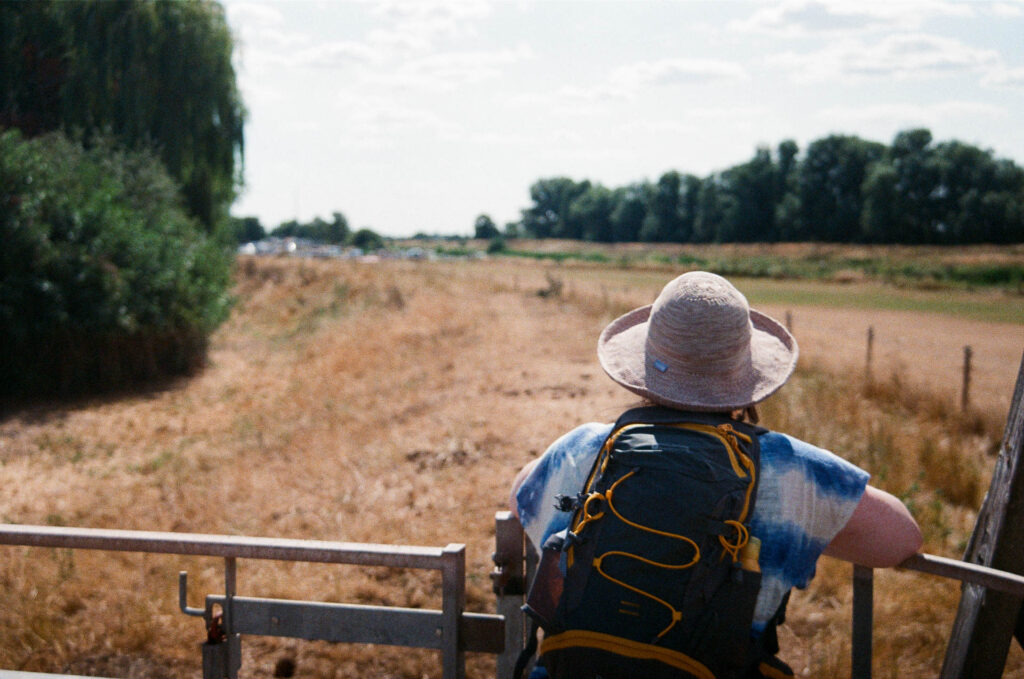
My wife has long suffered the fate of being both model and “person for scale” in many of my photographs. I took a few portraits along the way, but it was this back-of-the-head shot that made it into my five frames.
We had paused before one of a number of kissing gates along the route. Our tradition has always been to kiss when passing through a kissing gate. This photograph makes me think less about portraiture and more about companionship. It isn’t really a photograph of the person. It’s a photograph of a companion, walking the same road as me. Adjusting our pace. Waiting for one another. Talking. Being quiet. Sharing a moment of intimacy.
A small thing but a reminder that this was a journey we were sharing.
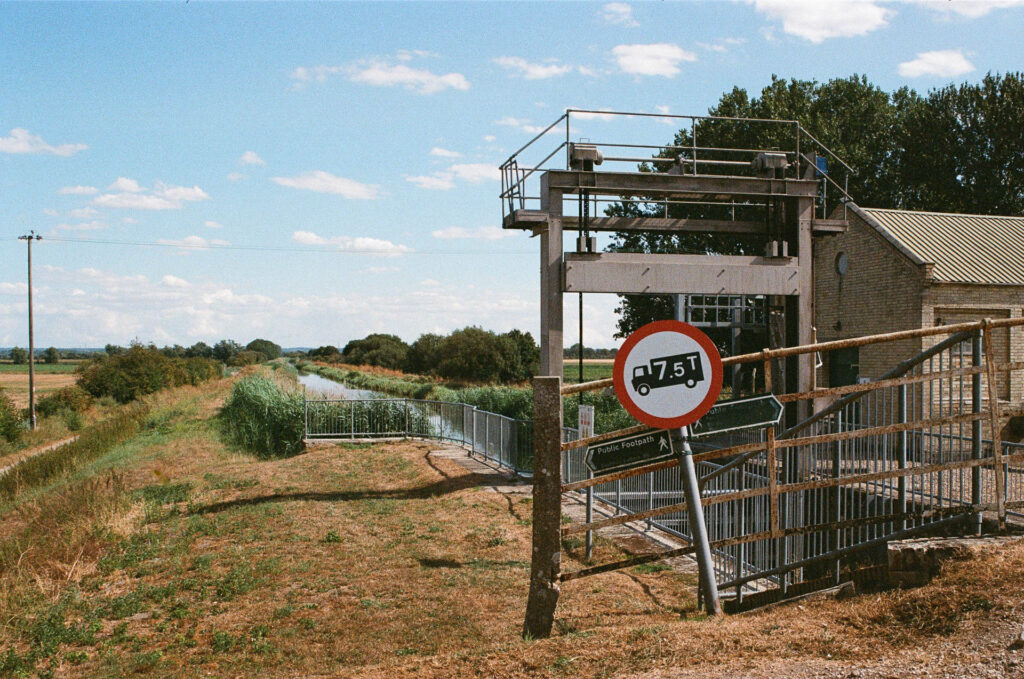
We had moved on a long way by this point, crossing one of a number of drainage channels and sluices along what had now become the River Cam. This faded, slightly “wilting” signpost caught my eye. By then the afternoon temperature had reached 27°C and I was beginning to feel rather like it looked.
Some summers we might have thought that was hot, but after the multiple heatwaves of recent years perhaps our assessment of what constitutes a warm day for a long walk has become a little skewed.
Rather like the signpost.
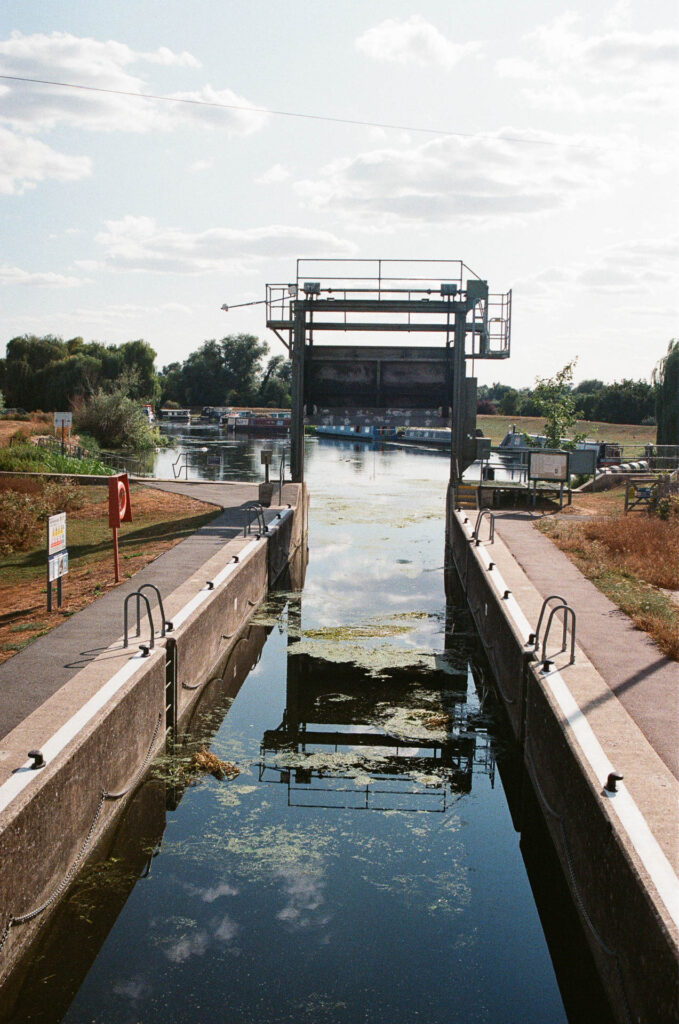
A three-mile detour caused by a closed bridge meant we reached Bottisham Lock rather later — and more tired — than intended. We paused on the bridge before setting off on the final mile or so towards Waterbeach station and the train back to Ely.
I love reflections, and here the clouds and blue sky reflected in the man-made structure got me thinking about the landscape we’d just travelled through. The Fenland landscape can look wonderfully natural, but so much of it is shaped by people. Rivers, drainage channels, sluices, locks and paths are all part of the story.
The route itself wasn’t new either. People had travelled through this landscape long before us. We were following paths made by others towards a destination that has drawn pilgrims for centuries. Yet our particular journey was new.
Two people. One Friday. A slightly broken light meter. A closed bridge. A warm afternoon. Five photographs.
In her pilgrimage guide, my wife described a path as being both “given and newly walked”. I think that’s true of photography too.
The landscape is given.
The path is given.
The light, weather and season are given.
But the seeing is ours.
Perhaps that’s what photography does for me when I’m walking. It gives me a reason to stop. And stopping changes the journey.
You don’t always know what you’re looking for when you set out. You just keep walking. And every so often, something makes you stop.
If you are interested, more about this walk to Ely can be found here
Share this post:


Comments
No comments found