

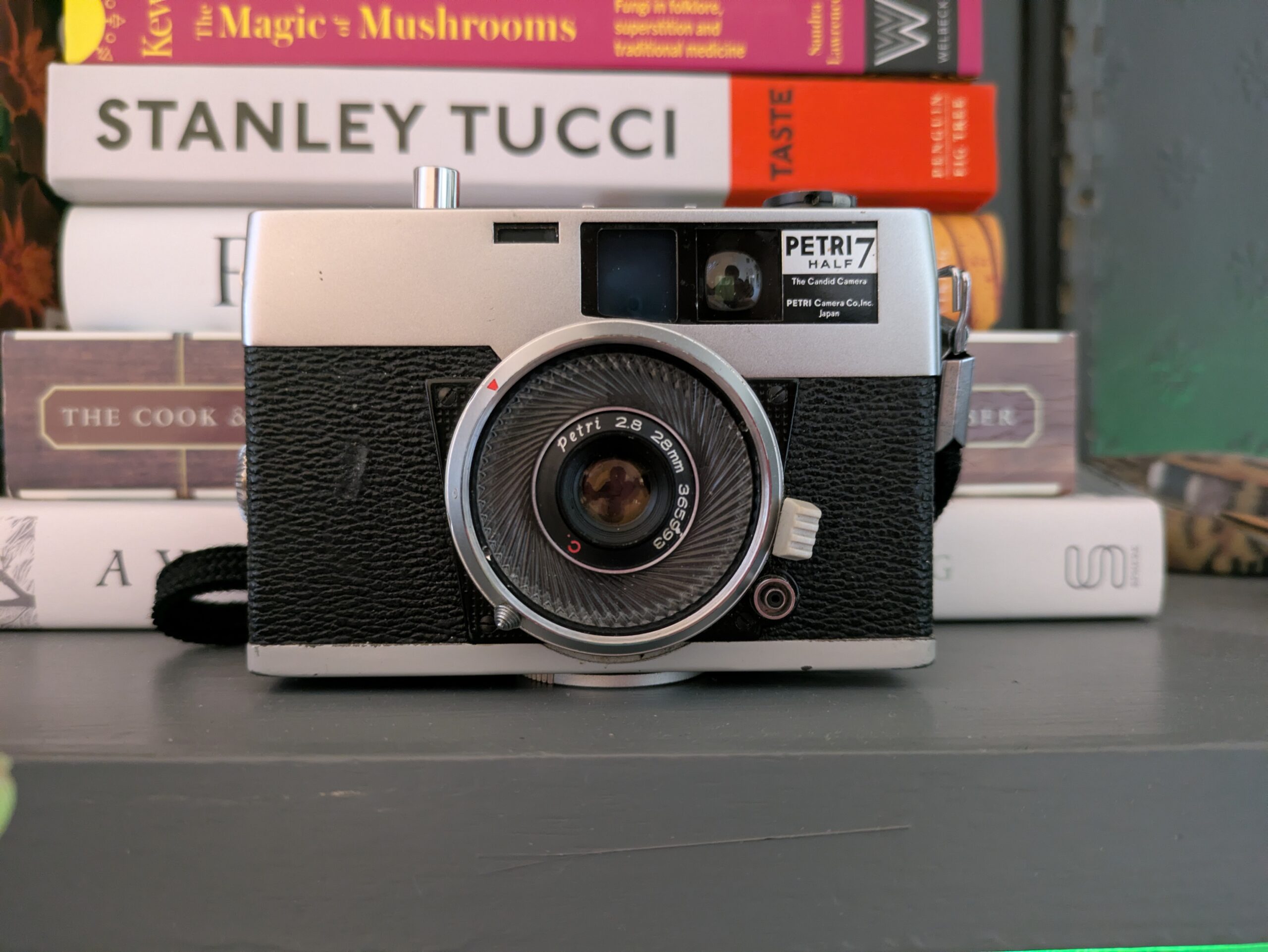
The Petri 7 Half is a half-frame compact camera with zone focusing and the option of manual control at a fixed speed of 1/40sec, as measured by me, or automatic exposure using a selenium cell and a trapped-needle system to set the exposure.
I found an online instruction book at the ever-reliable butkus.org and learned that I should be able to see an exposure scale in the top of the viewfinder with red over and under sections at either end but I could see nothing. Undeterred I took the top panel off to reveal this:
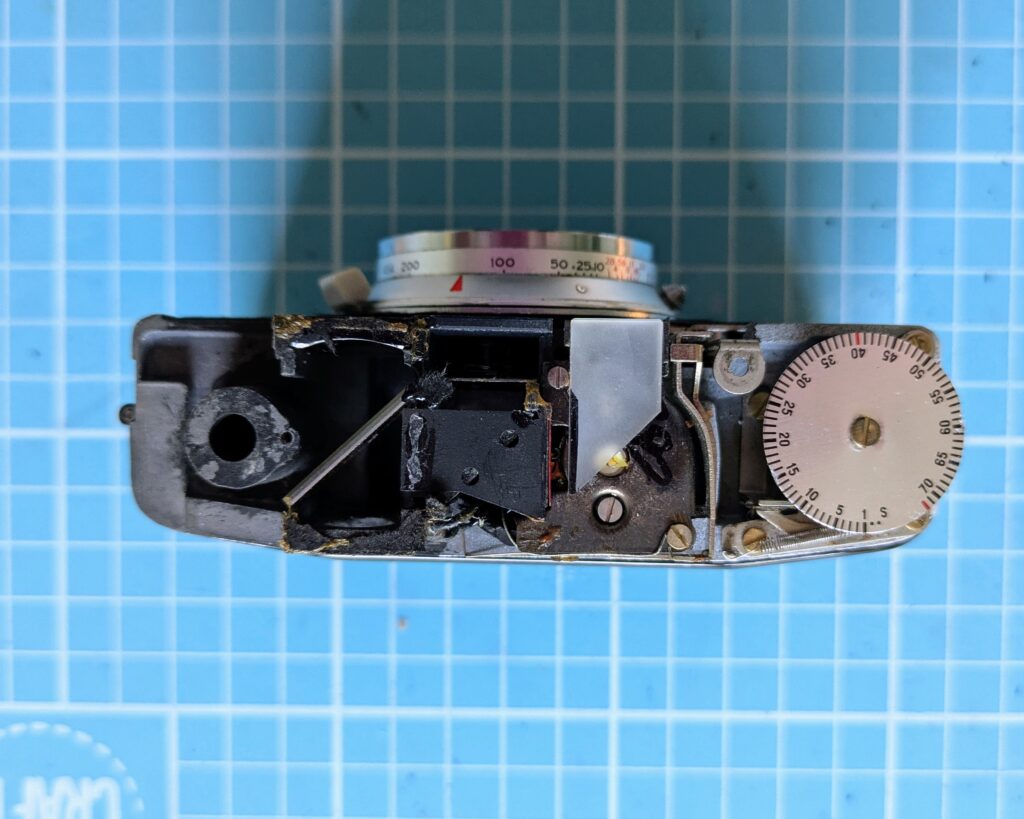
I have removed a piece of black card that covered the mirrors. The piece of Perspex right of centre has an aperture in the front of the camera and in theory light entering there bounces off the 45 degree face turning the light to the left and shining through the exposure scale. Light from there travels to the semi-silvered mirror, again at 45 degrees, where it should combine with the viewfinder image. The black panel with the two dots in the middle sits over another semi-silvered mirror which combines light from a window next to the viewfinder and shines through a transparent sheet with the three zone-focusing symbols. Ultimately these three streams of light are combined.
I can see the focusing images so why cannot I see the exposure scale? If you have followed me this far, well done.
The black panel in the middle has some residue that looks like glue on the extreme left edge. My hypothesis is that there should be a light-guide between the pointer scale and the mirror to conduct and concentrate the light that has got this far, and this has come off and been lost. Combine this theory with the fact that the shutter release button leans quite a bit and the frame counter is bent to one side and I think this camera has been dropped.
Now I was inside the camera I shone a bright light on the selenium cell but there was no movement. I have read that the connections to these calls can corrode so the next job is to remove the threaded ring that holds the metering assembly in place:
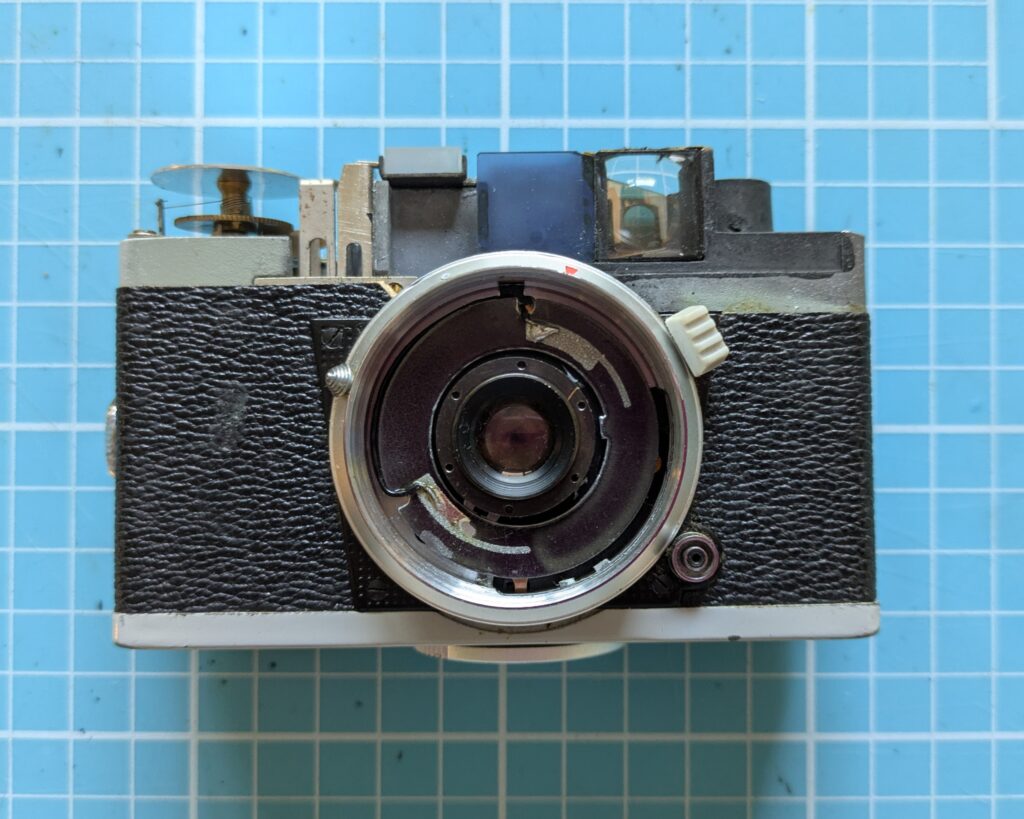
You can see the light sensor which lies under two quadrants that side over each other to adjust the amount of light reaching it according to the speed of the film, from 25 ASA to 200 ASA. Here is a picture of them:
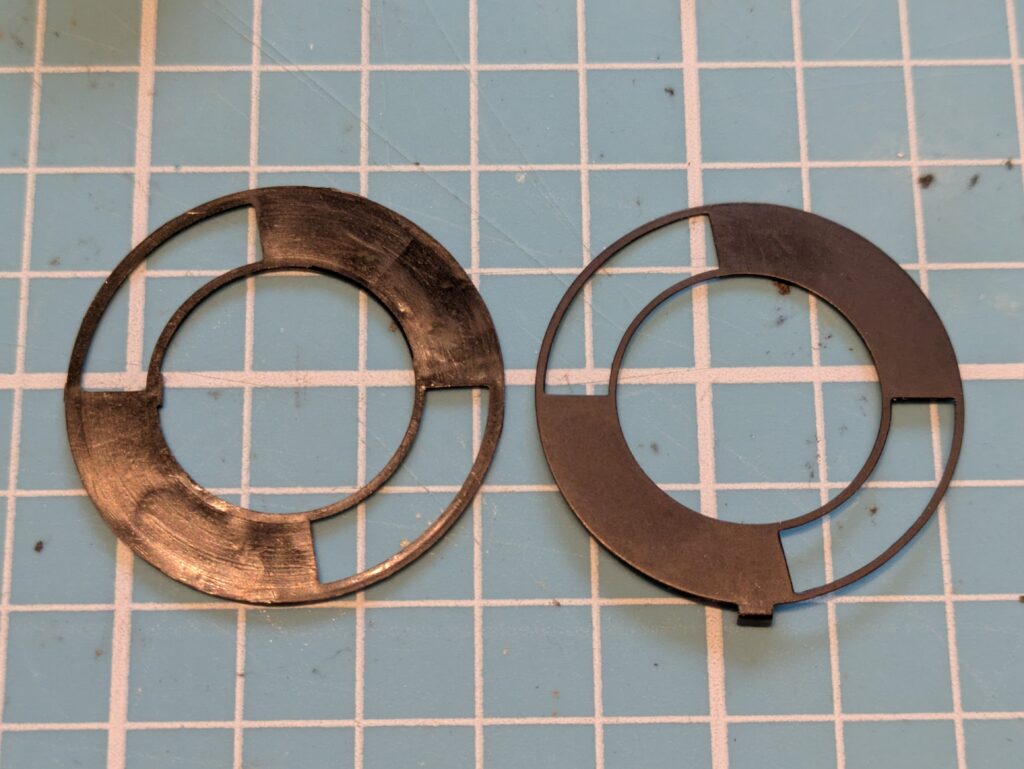
The ring on the left is fixed and the right-hand one has a tab at the bottom which is moved by the ASA ring. The soldered joints seemed fine. When I shone a light on the lens in this condition the meter needle swung to the far end. After reassembling it and disassembling it again a couple of times I belatedly came to the conclusion that the part of the cell that was permanently covered still works and the rest has died due to long exposure to light. I wasn’t having a very bright day, no pun intended!
Not to be deterred I thought I would try using the camera in manual mode which fixes the speed to the 1/40s. Incidentally, I measured this speed by putting my camera-phone into slow-motion which records at 240 fps, shining a light on the front with the back open and setting off the phone and filming the shutter opening and closing. I just had to count the frames when light was visible and then do the maths.
We happened to be spending a day in Harrogate so I thought I could probably shoot 36 frames at the RHS Harlow Carr garden. I had not heard of Flic Film but apparently they are based in Alberta, Canada. I like the idea of an 18-shot film for half-frame and general camera testing. It’s just a pity that develop and scan costs the same as a 36. I have no idea who makes the original stock, perhaps it’s them? In retrospect a slower film would have been preferable.
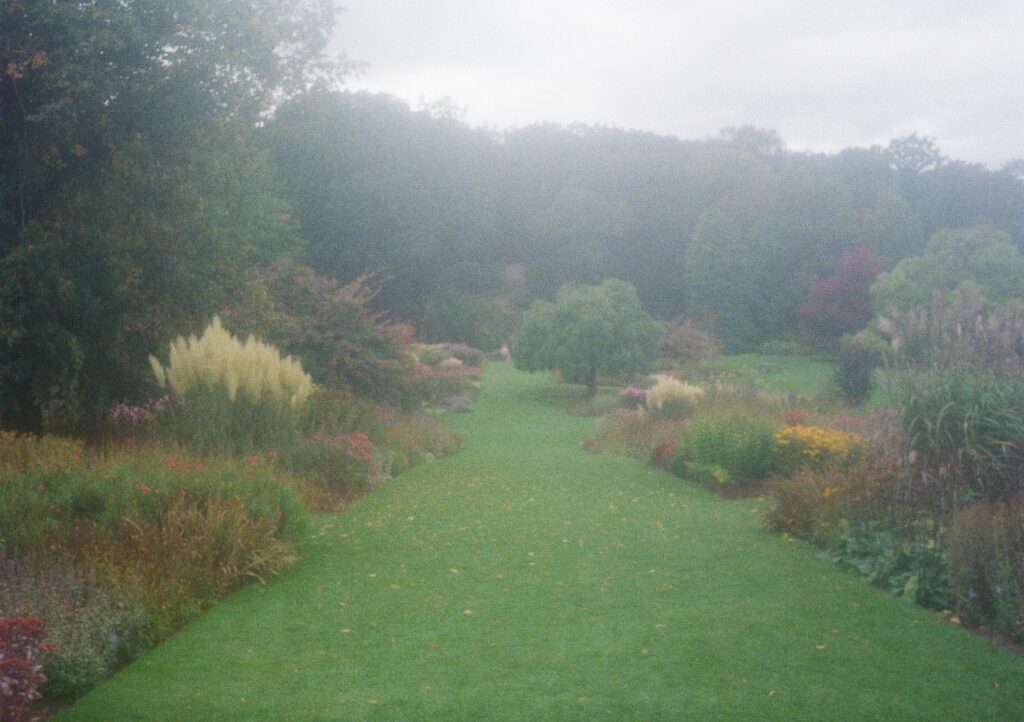
Here is the first frame I took, I think it was f/22:
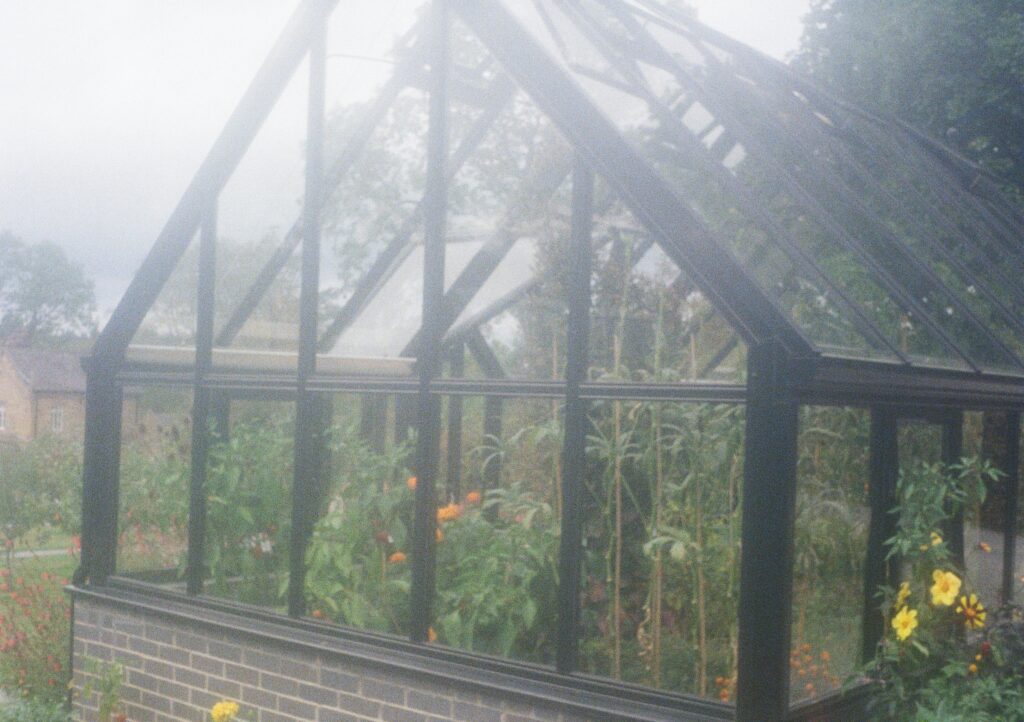
Needless to say I wasn’t thrilled with this shot. Is it a light-leak? It seems too even to me but I’m open to suggestions.
The rest of the reel of 36 are very similar. I was going to abandon this post but it occurred to me to see if Google Gemini AI could make anything of this picture.

That’s quite impressive. Here are four more before and after shots to justify my title:
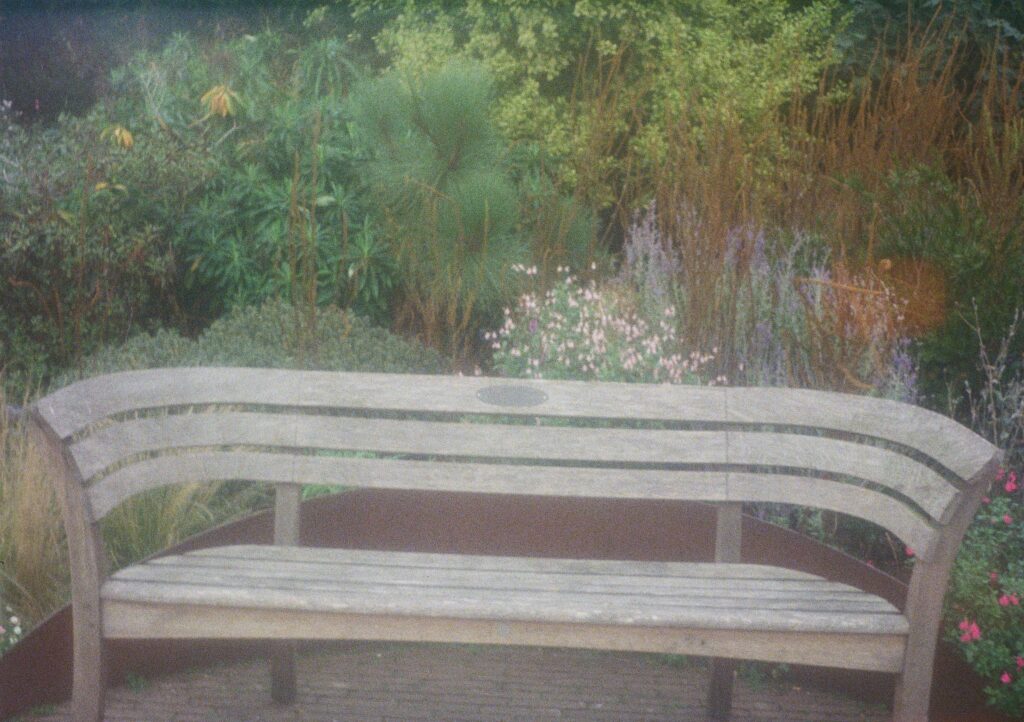

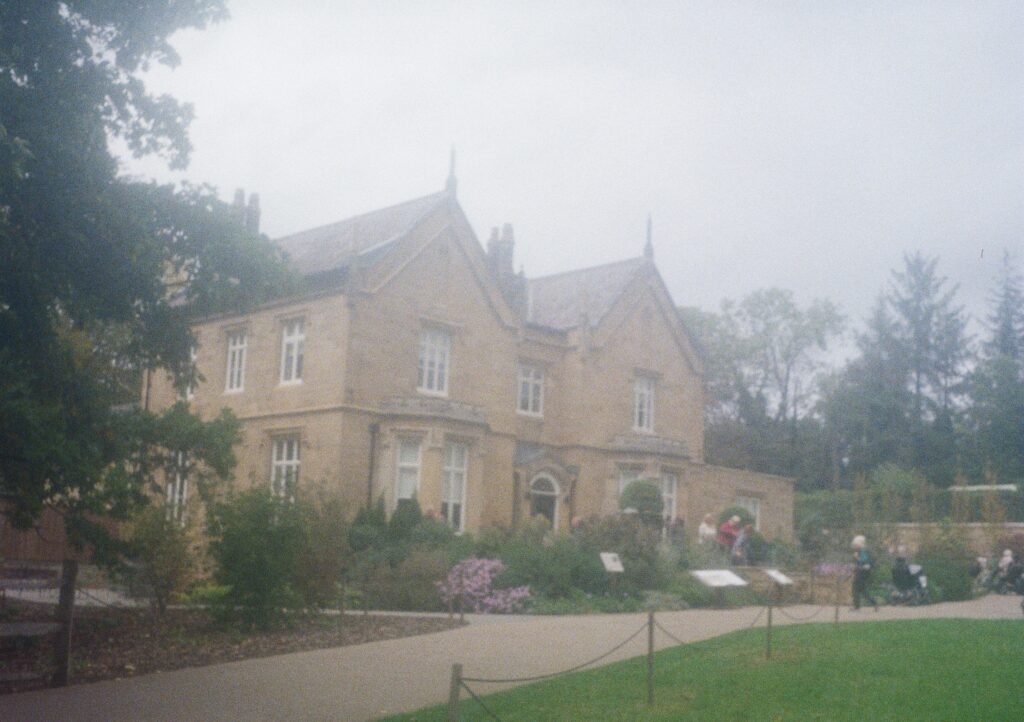
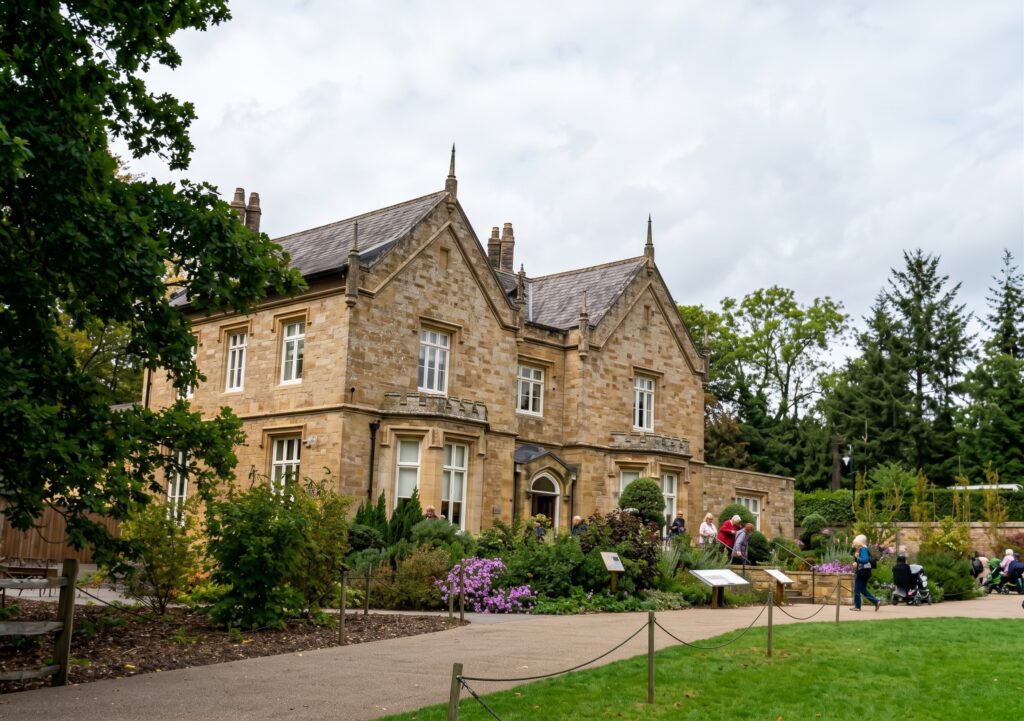



I think you will agree these photographs are quite acceptable.
Can I ask the experts on this site why they think all my frames are ‘misty’? I have never experienced this before and don’t like to blame the film or the processing so have to assume something faulty with the lens, although it looks quite clear.
And if you have read this far, thank you.
Share this post:


Comments
Andrew on 5 Frames with a faulty Petri 7 Half and Flic Film Apollo 18
Comment posted: 09/11/2026
The other possibility is still the lens. It will almost certainly be a Tessar design, and if the rear element has become separated due to balsam deterioration, that might give that effect even if it looks superficially ok.
That’s my 2c worth, but not worth more than that!