My Doubts about Film Photography

By David Pauley

There are moments when I ask myself why I bother shooting these old film cameras. Often that question comes when I’m exasperated or discouraged. Maybe the color on a batch of scans is off owing to less-than-scrupulous attention to temperature in the developing tank. Or the grain on some prints is distractingly chunky. Or I repeatedly miss focus at critical moments. Suddenly I remember that digital camera I had a few years back: the ease of focus, the trueness of the colors. Why am I bothering with film cameras, a darkroom and scanner—all of this complicated rigmarole?

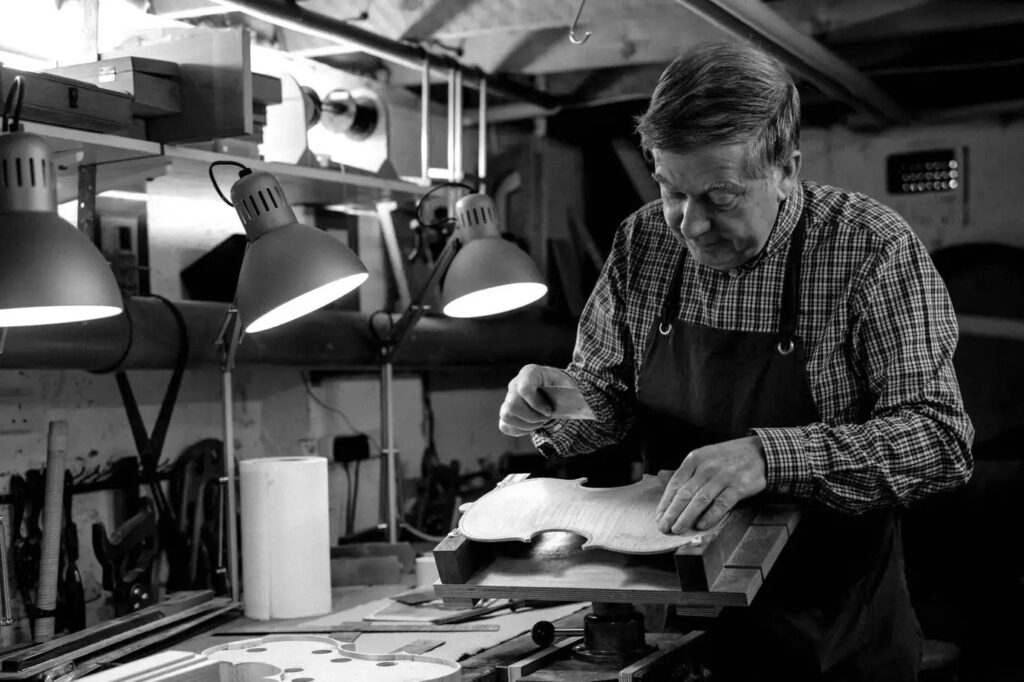
Sam’s.  (2025). Leica III, Summarit 50mm f1.5. Kodak UltraMax 400.

Over time, I’ve become aware that those discouraging moments actually belong to a larger story. Zooming out a bit, I can see there is often a period of irrrational exuberance before that stretch of exasperation: a time when I feel on top of the world, when camera and darkroom feel like natural extensions of my mind’s eye and I can’t imagine a better way of moving through life. 

In those heady moments, I not only like the photos I’ve been making but harbor some pretty grand ideas about the future. Although most of the time I am committed to remaining an amateur, I may suddenly have visions of book projects, of gallery walls. I don’t ever go so far as to daydream about earning a living from photography—I’m not that far gone—yet still I hear the siren call of Recognition.
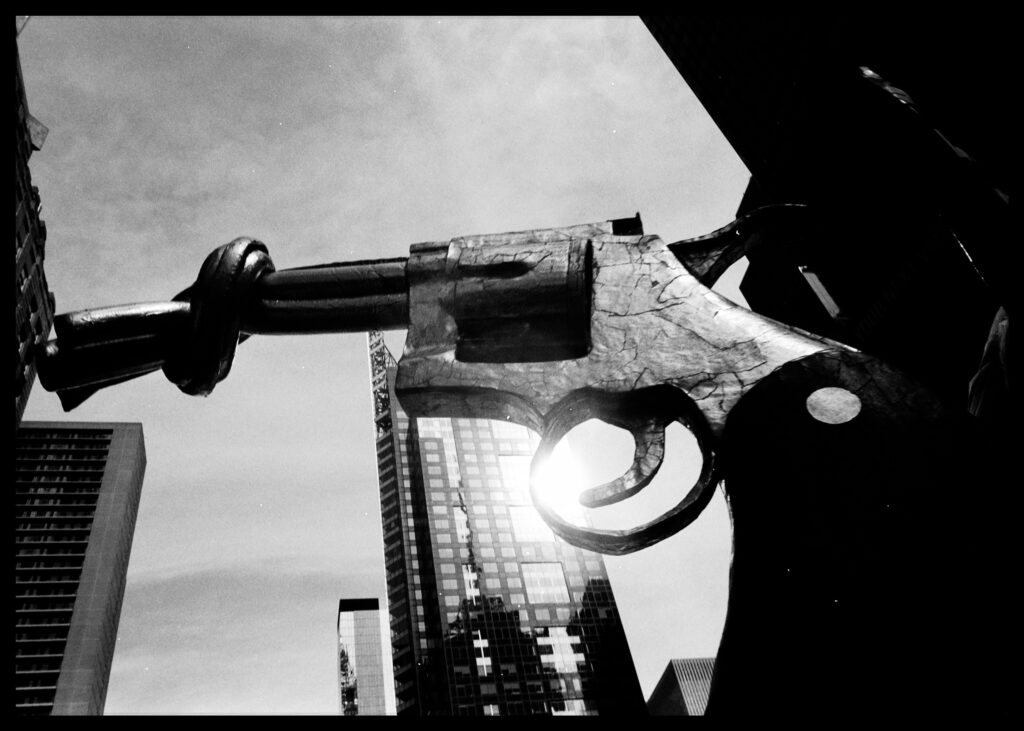
Anti-Gun Violence Sign at NYC No Kings Protest. (2025.) Leica III, Hektor 28mm f6.3, Ilford Pan F.

For me, these fantasies almost always mean a letdown is coming. Maybe my enthusiasm for a particular subject has run its course; perhaps I’m feeling frustrated with some new technique or at sea in some other area. Whatever the reason, I’ve crossed some internal threshold, and have begun piling expectations on an activity that at the end of the day I do for the pleasure it brings me (though I may not recognize that fact until the next set of negatives, when I decide I am actually quite a bad photographer). At such moments, I’m susceptible not only to Gear Acquisition Syndrome but to doubts about why I ever got into all of this in the first place.
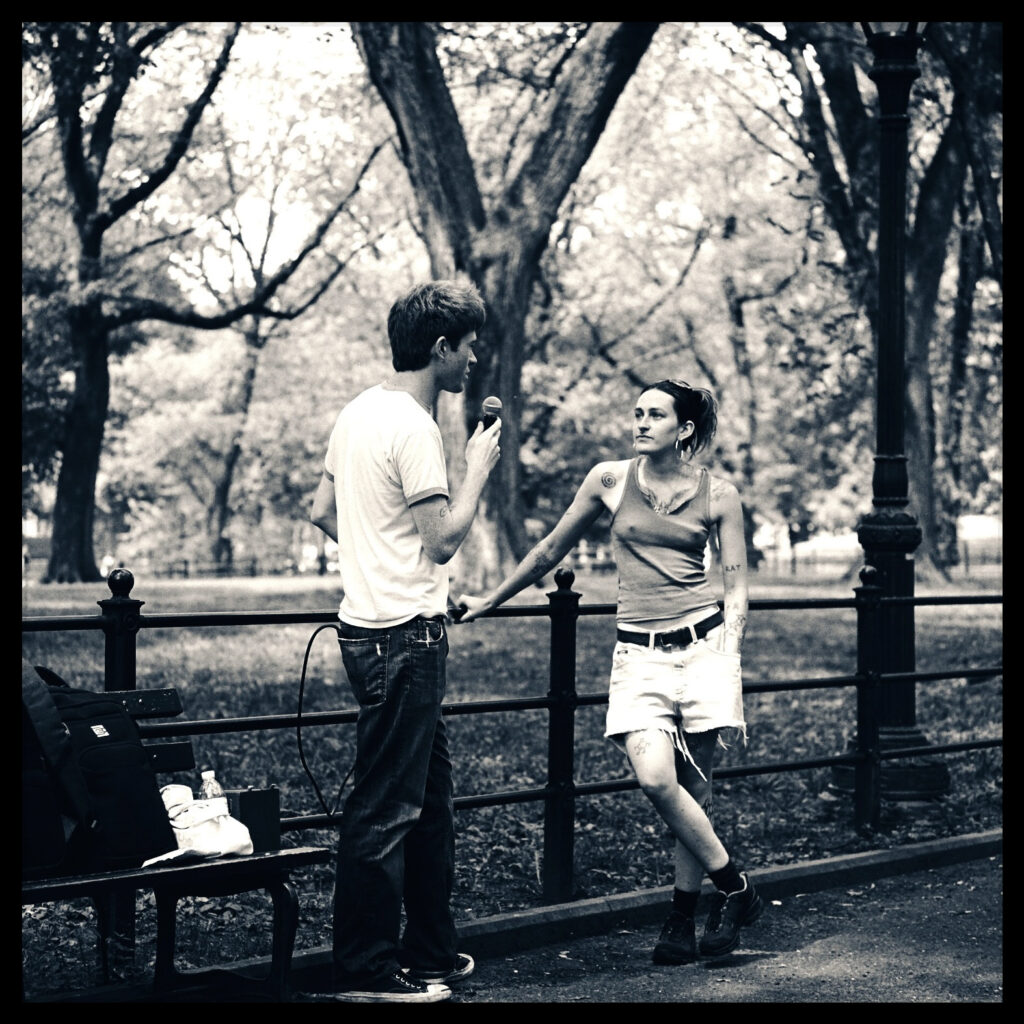
Arbus Territory, Literary Walk, Central Park. (2025).  Tele-Rolleiflex 135mm f4, yellow filter, Kodak Tri-X 400.
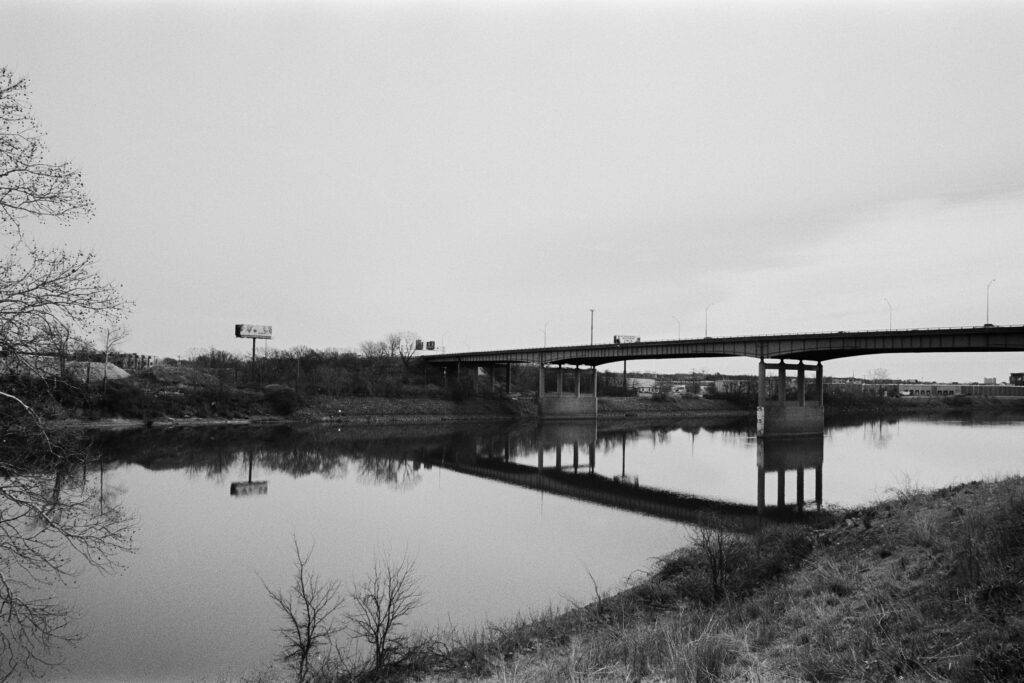
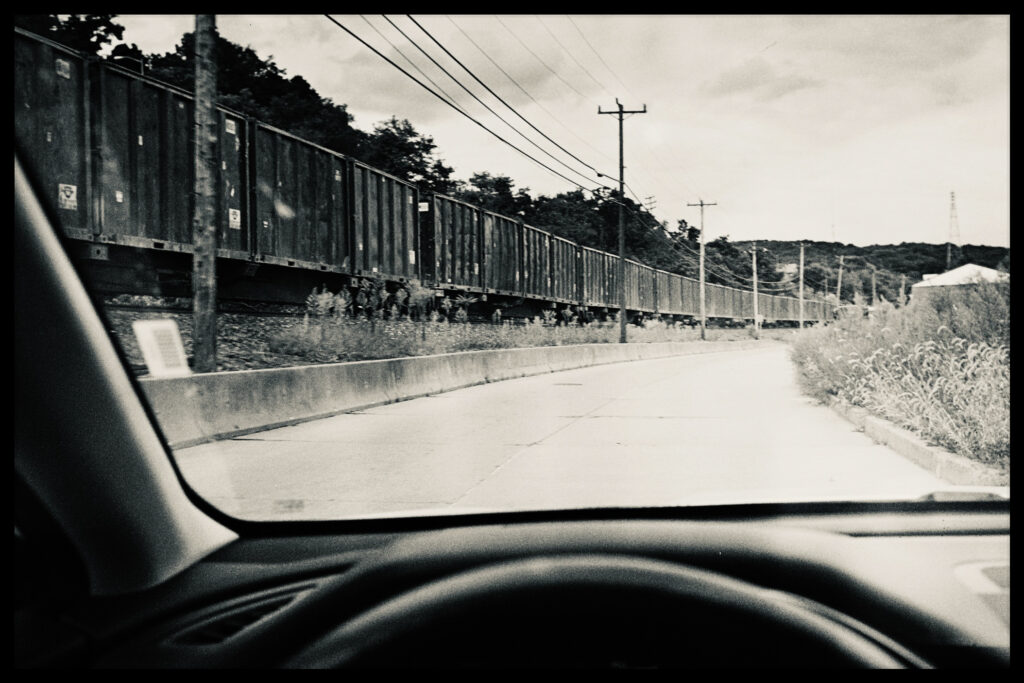
Bend in the Road, Rochester, Pennsylvania (2025). Leica III, Hektor 28mm f 6.3, Ilford XP2 400.
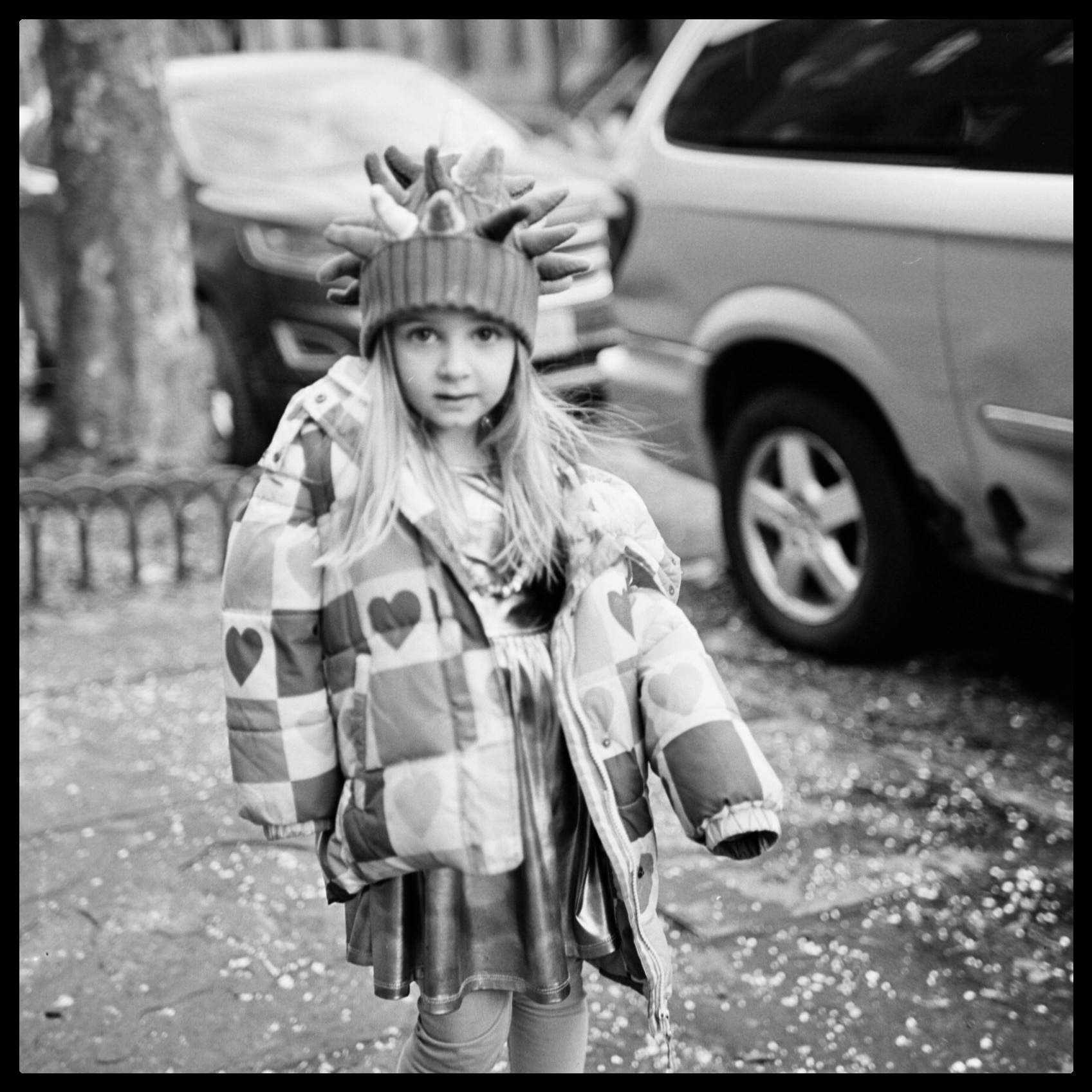
Atomic Hat (2025). Rolleiflex 2.8F, Kodak Tri-X 400.

When I had that “easy” digital setup a few years back, however, I pretty quickly drifted away from it. Try as I might, I couldn’t find much satisfaction in a digital workflow—the photos felt interchangeable; editing on a computer, it turned out, was anything but simple—and I really missed my time in the darkroom. I decided at that point that I would commit exclusively to film photography: doing so allowed me to be an amateur in the best sense, as in a person who does and makes what they love. Another resolution, a bit more challenging to keep: I would try to judge my efforts less by results from any particular outing than by dedication to process.
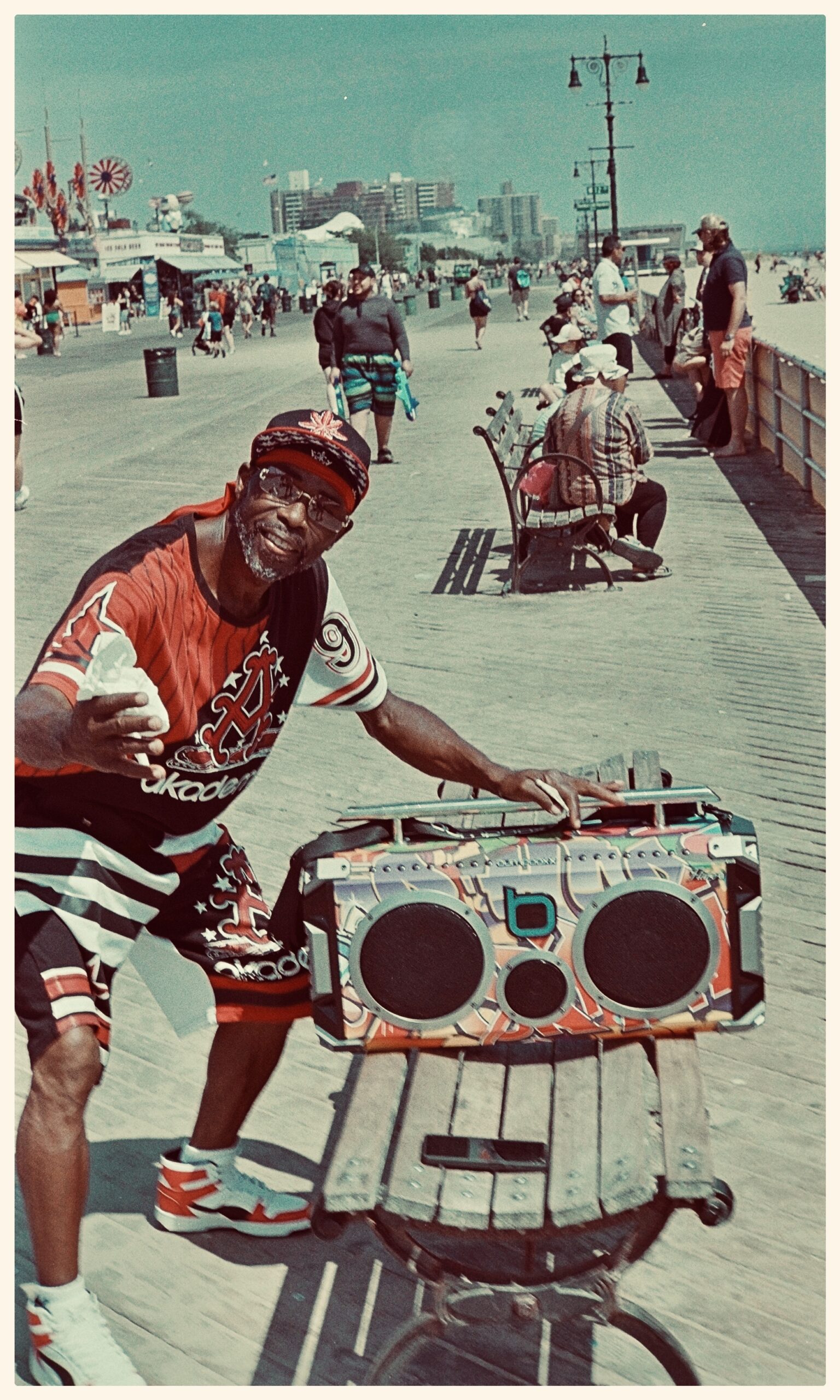
Dwayne Showing how he Peforms as “Guy with Boom Box” for Tourists and Tips, Coney Island Boardwalk (2025). Leica III, Canon 50mm f1.4, Kodak Ultramax 400.
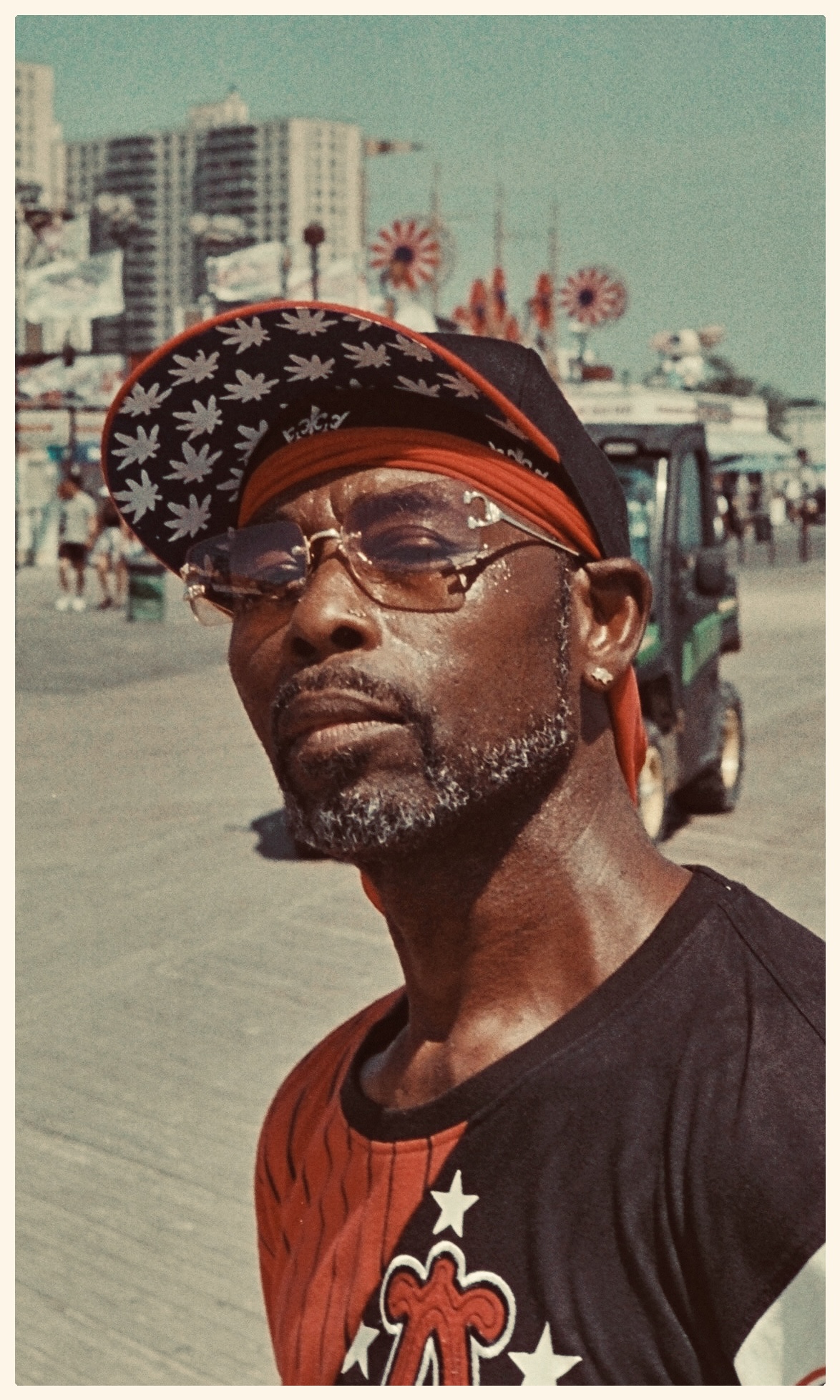
Dwayne: A More Serious Portrait (after we talk about life, raising kids and being the same age), Coney Island Boardwalk (2025). Leica III, Canon LTM 50 f1.4, Kodak UltraMax 400.

In photography as in most things, my doubts and daydreams will always be with me. Along with aperture, ISO and shutter speed, they are variables that I need to reckon with in this realm of my life. As I look back over binders of negatives from the past seven years I realize that the judgements I make about my work when I’m feeling low are scarcely more informed than those I arrive at when I’m feeling elated. A sober appraisal, for me at least, takes distance and time.

While hardly known for emotionality, Ansel Adams also came to favor this kind of reflection. That most obsessively systematic of photographers writes: “I often return to a print after days or weeks and see relationships that were not apparent at first.” He arrived at that approach from hard experience, having printed a whole exhibit’s worth of landscapes of which, unaccountably and atypically, not a single one sold. Though friends and critics had wondered whether Adams, headstrong, had perhaps printed the photos too “heavily,” it took the photographer a year’s distance to see what they meant: “When I looked at the photos a year later, I was appalled [….] how could I have printed them so dark?” (Adams, The Print, 1980, page 6). Caught up in the emotion of the moment, many of us fall short in our assessments.

So it is, on occasion at least, with my “bad” pictures. Although I don’t yet love all of the photographs in this post, none of them is as awful as I felt them to be when, in the throes of doubt, I first laid eyes on them.

And in a year’s time—who knows? They might even make me proud.

Thanks for reading.
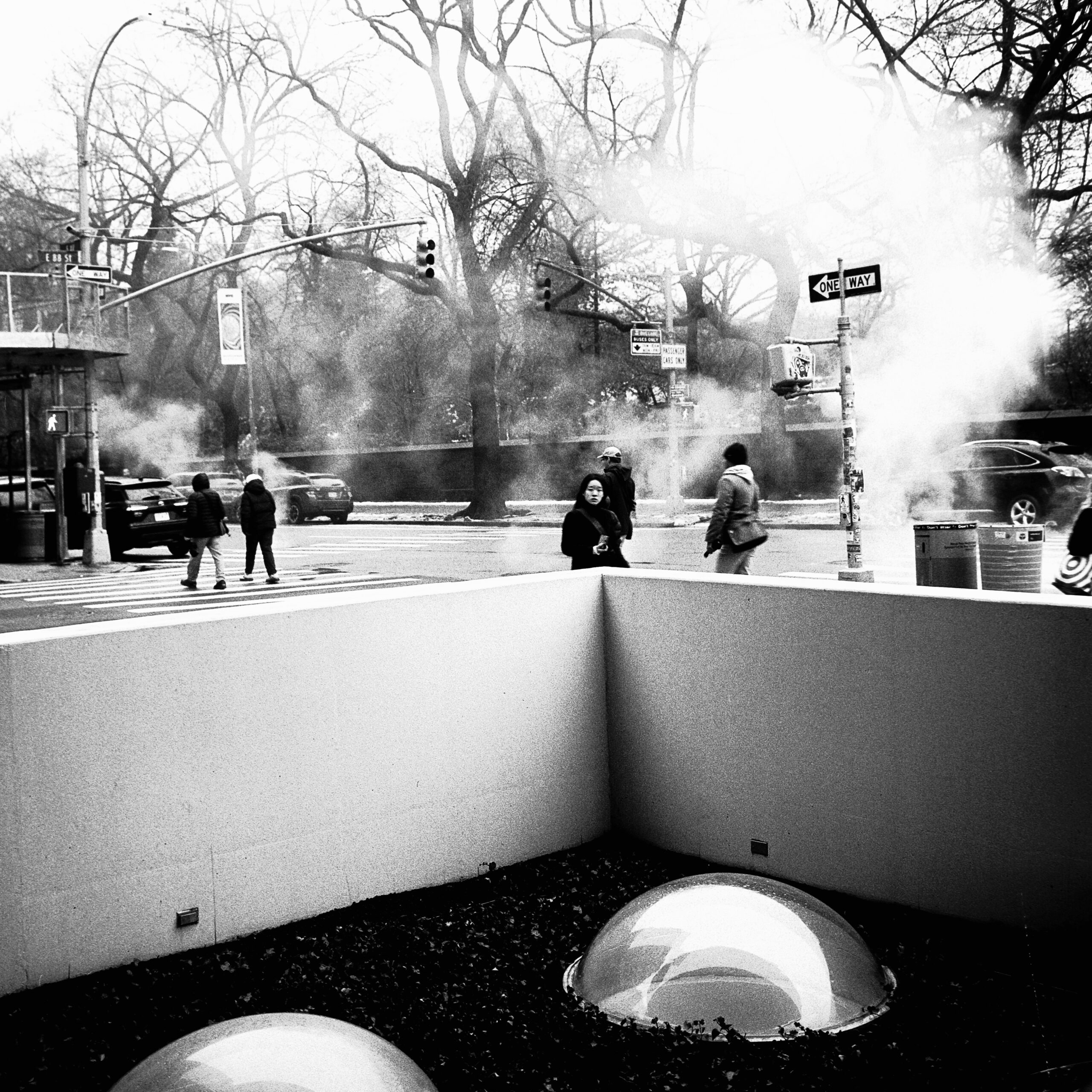
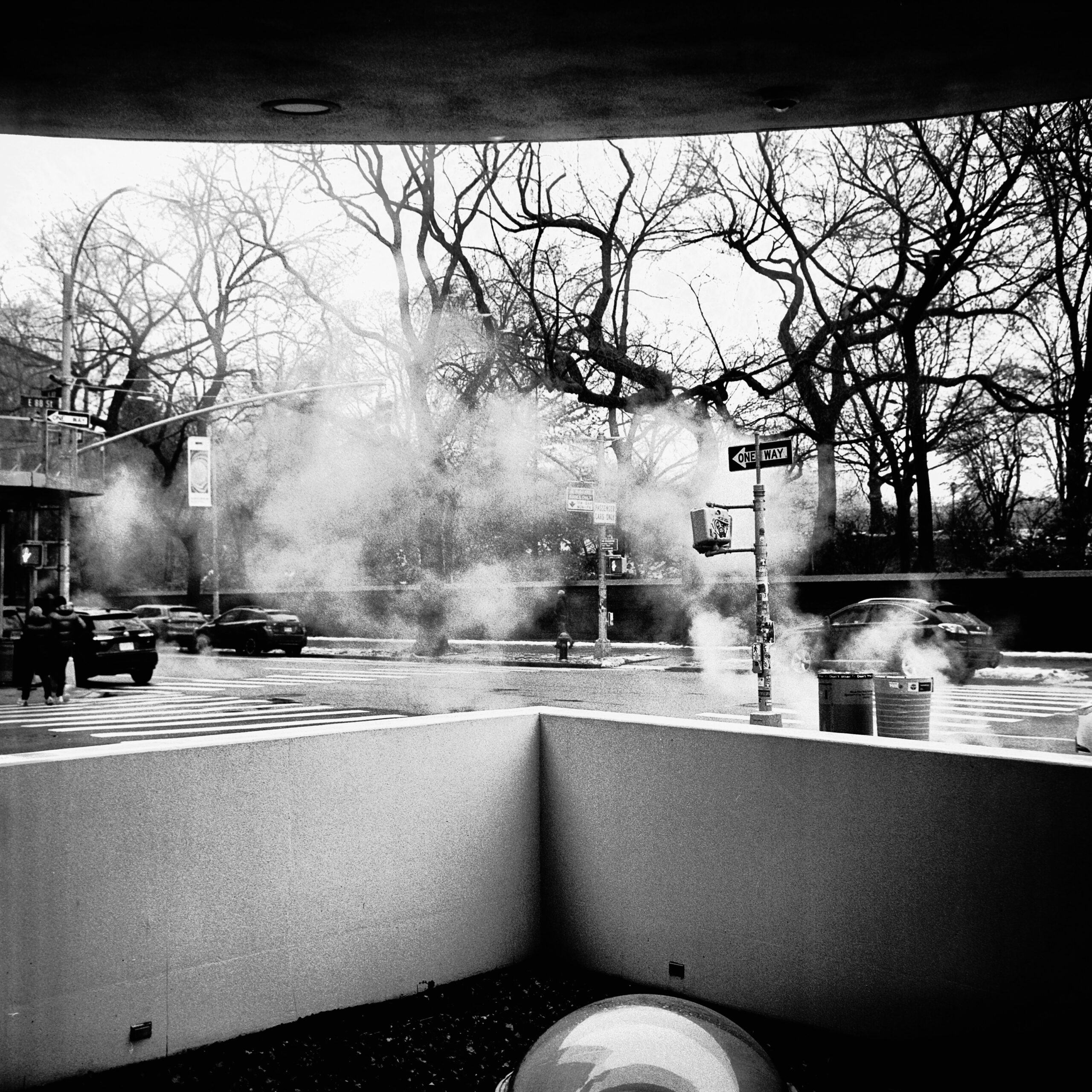
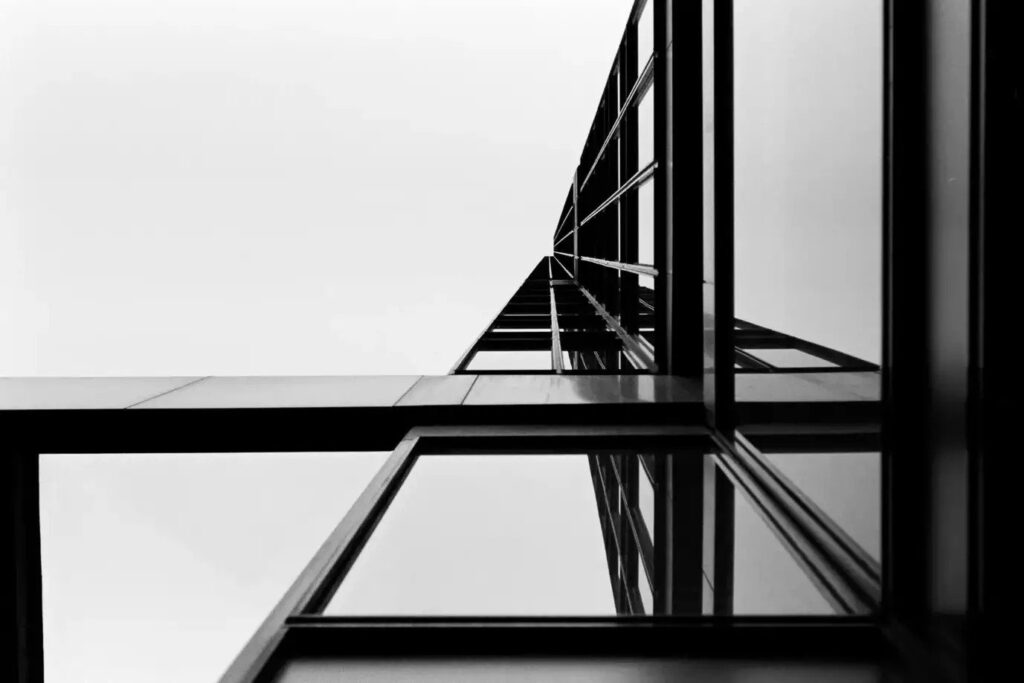
Guggenheim I — Here. (2025). Rolleiflex 2.8F, Kodak Tri-X 400.
Guggenheim II — Gone (2025). Rolleiflex 2.8F, Kodak Tri-X 400.


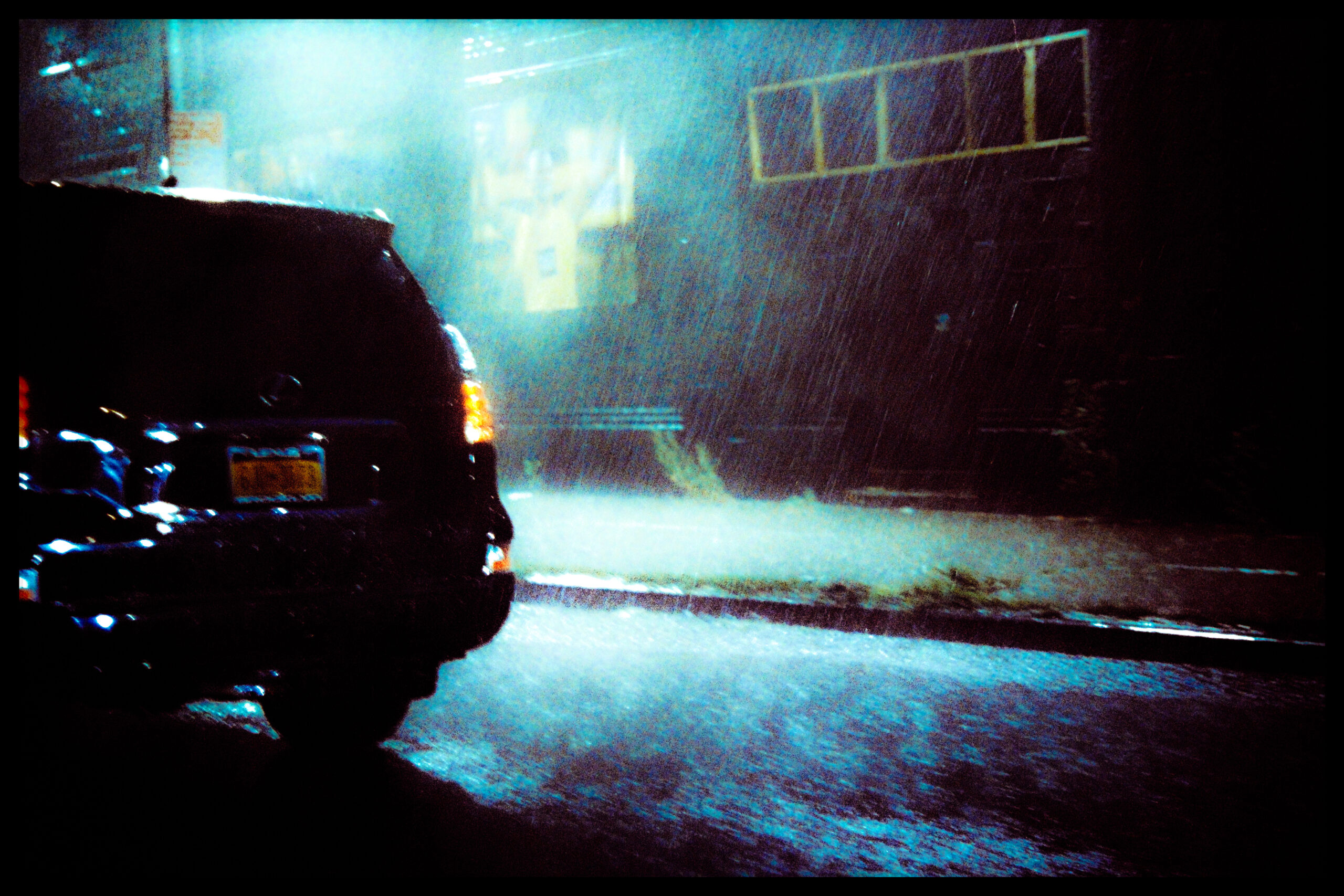
FEATURED IMAGE: Summer Downpour, Bed-Stuy. (2025). Leica III, Elmar 50 f3.5, Cinestill 400D.

Share this post:

About The Author

By David Pauley
I'm a Brooklyn-based photographer and psychoanalyst. My journey with photography began in middle school in the late 1970s and revived in 2019 when I bought a used film camera and installed a darkroom in my basement. I'm committed to analog photography and am enthusiastic about the expressive power of old cameras, traditional processes and methods. You can see more of my work at www.leica1933.com.
Read More Articles From David Pauley

Find more similar content on 35mmc

Use the tags below to search for more posts on related topics:

Donate to the upkeep, or contribute to 35mmc for an ad-free experience.

There are two ways to contribute to 35mmc and experience it without the adverts:

Paid Subscription – £3.99 per month and you’ll never see an advert again! (Free 3-day trial).

Subscribe here.

Content contributor – become a part of the world’s biggest film and alternative photography community blog. All our Contributors have an ad-free experience for life.

Sign up here.

Make a donation – If you would simply like to support Hamish Gill and 35mmc financially, you can also do so via ko-fi

Donate to 35mmc here.

Comments

Paul Quellin on My Doubts about Film Photography

Comment posted: 12/01/2026

I really have found this helpful David. There were plenty of 'yes that's me' moments in a short space of time. As I look down at my negative storage box, there is a set of shocking 5x4 colour negs on top of it, as I haven't bothered filing them. Stupid overestimation of what I could get out of that batch of chemicals. Oddly, I didn't get really cross about those, as I suppose I knew at the time it wasn't the film I was pushing... just my luck. It served as a reminder that making the exposure is only the beginning of the process, as it is with digital, but it is easier to screw up what follows than is the case with digital. You are very brave to leave digital behind, I don't think I could, primarily because I love insect photography so much. Your article will make me think about analysing my film output more carefully and maybe get some of the earlier negs out and scan them again. Thank you
Reply

Leave a Reply

Your email address will not be published. Required fields are marked *


Erik Brammer replied:

Comment posted: 12/01/2026

"plenty of 'yes that's me' moments in a short space of time" - I couldn't agree more... :-) Thanks, David, for your article.

Reply

Leave a Reply

Your email address will not be published. Required fields are marked *


David Pauley replied:

Comment posted: 12/01/2026

Thank you, Paul! Am thrilled to hear that you saw yourself in some of my worries and annoyances. Feel like we should start a support group...though maybe that's what 35mmc is! Keep shooting and if you ever scan those color 4x5s I'd love to have a look. No judgement...!

Reply

Leave a Reply

Your email address will not be published. Required fields are marked *


David Pauley replied:

Comment posted: 12/01/2026

Thank you Erik for reading and your supportive response!

Reply

Leave a Reply

Your email address will not be published. Required fields are marked *


David Brancaleone on My Doubts about Film Photography

Comment posted: 12/01/2026

I was enthralled as I read your insights and felt the sheer dedication you share with so many of those who write here.
Initially, I was taken with the discouragement I have experienced so often in the past eighteen months, since I returned to analogue myself.

The photos I find grip you. The reason they do may be the super dooper films. Could be. Perhaps the main element is the personal rapport between camera and the other; not reduced to a suitable subject to gawk at, but allowed to enjoy the status of a human being in a free and open exchange.

Colour is so difficult to do well. It can distract. It can be all over the place. But some of these photos still retain the subtle drive of monochrome.

Was it just the opening gambit that drew me in? Yes. But usually, when that is all there is, You're dusappointed. Not this time.
Reply

Leave a Reply

Your email address will not be published. Required fields are marked *


David Pauley replied:

Comment posted: 12/01/2026

Thank you David for your generous response! I agree that color is harder for me to work with. When it works it can be super rewarding but I often end up converting to monochrome when scanning or even darkroom printing. Not that my discouragement is limited to color; it's an equal opportunity thing. But then again so is my joy when things work! Keep shooting. Cheers.

Reply

Leave a Reply

Your email address will not be published. Required fields are marked *


David Hill on My Doubts about Film Photography

Comment posted: 12/01/2026

Ah, yes. I share your frustration with film. I shoot almost exclusively film, and am almost always disappointed when my mental image of the photographs I have taken are shown as reality when they come back. Almost, but not always. Sometimes there is that burst of surprise. Not often enough unfortunately.

Then I think do I really want a hobby where the things I do are controlled by computer chips? Haven't I spent enough of my life being controlled by the silicon god? And when I frame the enlargement of a photograph to hang on the wall, I feel that glow of "I did that. No autofocus, no matrix metering or composition guidelines here".

And part of the pleasure of my hobby is the tactile sensation of handling precision, hand crafted perfection. Just the feel of my Leica M4 or IIIc, a Rolleiflex, Nikon FM2 or some of my current exploration of Minoltas. The photographs may be rubbish, but the taking of them is profoundly satisfying.
Reply

Leave a Reply

Your email address will not be published. Required fields are marked *


David Pauley replied:

Comment posted: 12/01/2026

David thank you for beautifully articulating the upsides of this crazy analogue process. Although I'm not a golfer, I imagine it has something in common with the sense of reward--the dopamine rush-- that accompanies a well-played shot. These sense of accomplishment that comes with learning how to use these old tools is also very rich...despite the many days when I question my sanity for engaging in it. Thanks again for your response.

Reply

Leave a Reply

Your email address will not be published. Required fields are marked *


Alastair Bell replied:

Comment posted: 12/01/2026

"And part of the pleasure of my hobby is the tactile sensation of handling precision, hand crafted perfection. Just the feel of my Leica M4 or IIIc, a Rolleiflex, Nikon FM2 or some of my current exploration of Minoltas. The photographs may be rubbish, but the taking of them is profoundly satisfying." I absolutely concur with this. There is something profoundly satisfying about using a camera crafted 60 or more years ago and having it still do what it was designed to do. Equally the tactile feel of a manual focus Zeiss lens and the smooth way a Vario Sonnar zooms on my Contax RX is only enhanced on those days when it all comes together and you get an image that you look at and say "Yeah - nailed it". Its as much about the doing as it is the getting.

Reply

Leave a Reply

Your email address will not be published. Required fields are marked *


David Pauley replied:

Comment posted: 12/01/2026

Yes, Alastair! I think the tactile/physical part of this is huge. And it sets analogue photography for me in a separate category from almost anything else I do in life. It's quite a privilege really!

Reply

Leave a Reply

Your email address will not be published. Required fields are marked *


Peter Schu on My Doubts about Film Photography

Comment posted: 12/01/2026

I actually enjoy that I can discover something new in photos, which are many years old. I am also sometimes surprised, that I have overlooked a photo. It is strange, but I am more pleased with a good film photo than with a digital one. Digital is fine and I use it mainly, but not exclusively, in low light situations and with long tele zoom lenses. I don't understand that some people use film, but disgard the film after it has been scanned. For me, my analog archive is one of the reasons I use film.
Reply

Leave a Reply

Your email address will not be published. Required fields are marked *


David Pauley replied:

Comment posted: 12/01/2026

Totally agree, Peter! I spoke a few years back with the owner of a photo shop in Paris who told me his mostly young customers seldom come in to retrieve their negatives; the scans are all they're after. I recently heard the same thing from someone who works in a lab in Brooklyn. Hopefully some will get bitten with the darkroom bug and realize what a trove those strips of celluloid are. Thanks so much for writing.

Reply

Leave a Reply

Your email address will not be published. Required fields are marked *


Charles Young on My Doubts about Film Photography

Comment posted: 12/01/2026

David: I particularly like the photos with the Leica III. I am quite fond of mine, Chuck
Reply

Leave a Reply

Your email address will not be published. Required fields are marked *


David Pauley replied:

Comment posted: 12/01/2026

Thank you for the compliment, Chuck! We Barnack types need to stick together!

Reply

Leave a Reply

Your email address will not be published. Required fields are marked *


KF on My Doubts about Film Photography

Comment posted: 12/01/2026

EMBRACE THE IMPERFECTIONS. THAT'S WHY WE STILL USE IT
Reply

Leave a Reply

Your email address will not be published. Required fields are marked *


David Pauley replied:

Comment posted: 12/01/2026

Absolutely!!

Reply

Leave a Reply

Your email address will not be published. Required fields are marked *


Omar Tibi replied:

Comment posted: 12/01/2026

Grain is gorgeous!

Reply

Leave a Reply

Your email address will not be published. Required fields are marked *


David Pauley replied:

Comment posted: 12/01/2026

Yes!

Reply

Leave a Reply

Your email address will not be published. Required fields are marked *


Ibraar Hussain on My Doubts about Film Photography

Comment posted: 12/01/2026

Thanks David, for your thoughts and feelings about this.
And of course the pure classy photography - with your signature look and feel.
I like using AF 35mm cameras - it makes life easier. Now it’s a mix of AF 35mm or zone focus.
Reply

Leave a Reply

Your email address will not be published. Required fields are marked *


David Pauley replied:

Comment posted: 12/01/2026

Wise and kind words as always, Ibraar. I've never found an AF camera that speaks to me though zone focusing is my boon companion! If you have an AF camera recommendation would love to hear it, though my husband my divorce me if I buy any more cameras (I've been lately playing with an Olympus PEN-FT after reading your piece about them last year. Will report back with results one day soon). Cheers!

Reply

Leave a Reply

Your email address will not be published. Required fields are marked *


Ibraar Hussain replied:

Comment posted: 12/01/2026

Ah the FT - I hope you enjoy it. I had the F (the Gothic F did it for me) In regards AF - something small, classy beautifully made and quick with a large VF hmmmm…the Pentax MZ-S springs to mind - compact, very nicely built in Japan, you can use all of those K mount lenses And found the following on the web: 1/4000 shutter speed 1/180 flash sync P-TTL compatible flash, yes the same flash system as the digital SLR's are using. Fast 6 point AF with manually selectable user points. HyperOperation, a sort of HyperMode but with the aperture ring on the lenses. Full manual controls, it uses aperture ring on the lenses and a command dial that can act just like a shutter button. It has a 6 segment metering with a twist, it reads the exposure latitude from the DX code on the film canister, which means fantastic and very reliable exposure metering. It has the best metering ever seen on an analogue body. Pentaprism viewfinder with dioptre correction. Depth-of-field preview MTF, action/sport, depth-of-field and normal program line. Auto bracketing Multiple exposures Flash exposure compensation Full compatibility with non-autofocus lenses. Multisegment, centrumweighted and spot metering 2.5-2.8 fps.

Reply

Leave a Reply

Your email address will not be published. Required fields are marked *


David Pauley replied:

Comment posted: 12/01/2026

Thank you Ibraar for the recommendation and generous information about the Pentax MZ-S. It sounds like an amazing piece of kit...one that very well may find its way into my collection!

Reply

Leave a Reply

Your email address will not be published. Required fields are marked *


David Pauley replied:

Comment posted: 12/01/2026

PS if my husband murders me I promise not to blame you!

Reply

Leave a Reply

Your email address will not be published. Required fields are marked *


Ibraar Hussain replied:

Comment posted: 12/01/2026

Heheh!!!! Always a way around those issues! But I find that people tend to neglect AF SLR’s assuming Film needs to Be shot with a manual focus thing. My eyesight is quite bad and I can’t really many focus any more unless I have a huge VF - the AF makes it so much easier as Does the matrix metering which takes away a lot of tricky determining exposure in tricky conditions - just bracket and shoot. The Nikon F6 is another option or if you don’t mind some plastic the Minolta a-7 Maxum 7 which i enjoyed thoroughly

Reply

Leave a Reply

Your email address will not be published. Required fields are marked *


David Pauley replied:

Comment posted: 12/01/2026

...my EBay trigger finger is getting twitchy....

Reply

Leave a Reply

Your email address will not be published. Required fields are marked *


Ibraar Hussain replied:

Comment posted: 12/01/2026

You mussssssssst clixkkkk my precioussssss!!! In for a penny in for a pound - go for it - likely add another aspect and fun to the photography. That Pentax looks good - or if you don’t mind bulk - a Contax N1. And if you’re feeling some festive spirit your other half could go all in and buy you a Nikon F6 with a selection of lenses heheh!!

Reply

Leave a Reply

Your email address will not be published. Required fields are marked *


Erik Brammer on My Doubts about Film Photography

Comment posted: 12/01/2026

Hi David, in my view, the featured image, Sam's and Dwayne perfectly embody why you and most of us here do film photography. Wonderful!
Reply

Leave a Reply

Your email address will not be published. Required fields are marked *


David Pauley replied:

Comment posted: 12/01/2026

Thank you for such a lovely compliment, Erik! So glad you enjoyed them!

Reply

Leave a Reply

Your email address will not be published. Required fields are marked *


Danai on My Doubts about Film Photography

Comment posted: 12/01/2026

Thank you for sharing this thoughtful piece. In my return to film from a 20 year digital journey, I've come to appreciate the constraints as part of the creative process. I also learned to appreciate the delayed gratification I get from the analog process in contrast to our increasingly digital world filled driven by instant gratification.
Reply

Leave a Reply

Your email address will not be published. Required fields are marked *


David Pauley replied:

Comment posted: 12/01/2026

Thank you Danai! I never thought of the delayed gratification as a built in constraint of shooting film, but ot course it is. It makes to me in light of your observation that I would be a bit up an down in my relationship to film, as the "big reveal" of seeing images long imagined can lead to gratification...or the other thing. Thanks so much for sharing your thoughts.

Reply

Leave a Reply

Your email address will not be published. Required fields are marked *


Patrick Medd on My Doubts about Film Photography

Comment posted: 12/01/2026

‘We read to know we are not alone’.
Thank you for this, I think I’ll print it out and pin it to the wall of my darkroom.
Reply

Leave a Reply

Your email address will not be published. Required fields are marked *


David Pauley replied:

Comment posted: 12/01/2026

Thank you Patrick! My darkroom is a refuge but it can also at times be rather lonely, especially when things aren't going well. Good to have company!

Reply

Leave a Reply

Your email address will not be published. Required fields are marked *


Art Meripol on My Doubts about Film Photography

Comment posted: 12/01/2026

I started a photo career in the darkroom and with film. As soon as I possibly could I moved to digital. For professional work it's what clients want. But I'm wrapping up a long career and for the first time in almost 20 years I'm returning to film. It's hard!
For me I'm coming to understand one thing. Shooting on film is making a photograph. Shooting digitally is almost more like taking notes while planning to flesh out the image on the computer. I am not sure I'll ever be able to truly get going on film since I don't have a darkroom. If I did I fear I would return to those heady days in college when I would go into the darkroom after a quick dinner, put on music and only come out with the sunrise. I'm suffering with either developing a roll or two in the kitchen sink or sending them off. I'm not a very patient person. I really enjoyed the read and the struggle is real.
Reply

Leave a Reply

Your email address will not be published. Required fields are marked *


David Pauley replied:

Comment posted: 12/01/2026

Thank you Art! I have a friend, now in his 70s, who used to shoot for a major city newspaper. It's amazing hearing about the workflow of his days back in the 70s and 80s (processing the day's films in a basement darkroom before putting his kids to sleep then messengering the films and contact sheets to the editorial office late at night), but like you he couldn't wait to get away from it once digital came in (Unlike you he hasn't gone back!). Even though he doesn't shoot film much anymore he would agree with you, as do I, that there is a kind of craft to making these old silver-tone prints that is hard as hell but also substantial and when the stars align deeply gratifying. Would love as always to see more of your work. Cheers.

Reply

Leave a Reply

Your email address will not be published. Required fields are marked *


David Pauley replied:

Comment posted: 12/01/2026

Also meant to mention that I sometimes love those late night sessions in the darkroom. Okay, by "late" I mean 9 or 10 pm, not all-nighters like in college, but getting lost there trying to perfect a print can be pretty magical. Cheers. -D

Reply

Leave a Reply

Your email address will not be published. Required fields are marked *


Bill Brown on My Doubts about Film Photography

Comment posted: 12/01/2026

David, I have things in my life I call non-negotiables. Film is on that list. I've never owned a digital camera and I don't have a smart phone. I don't live under a rock. I have been a photo retoucher since 1976 and a digital darkroom specialist since 2006. I'm an analog person and film helps to keep me from being washed into the cacophony and crush of this digital world.
Reply

Leave a Reply

Your email address will not be published. Required fields are marked *


Alexandre Kreisman replied:

Comment posted: 12/01/2026

Way to go Bill!

Reply

Leave a Reply

Your email address will not be published. Required fields are marked *


David Pauley replied:

Comment posted: 12/01/2026

Amazing, Bill: good for you! I do some minor retouching to prints on occasion —spotting mainly —but am really bad at it and would love to have learned from someone like you. As for technology I am unfortunately glued to my phone, but did resolve not to replace my laptop after it went on the Fritz during the pandemic. I haven't missed it!

Reply

Leave a Reply

Your email address will not be published. Required fields are marked *


Bill Brown replied:

Comment posted: 12/01/2026

Forgot to mention how much I liked the opening image with the rain. Almost a film noir feel except it's in color. It made me imagine someone was trying to run you down. Maybe a hired hit because of your camera buying! As far as basic print spotting goes here are my top recommendations. Brush: Windsor & Newton Series 7 Red Sable 0 or 1. Other than a keen eye and study hand this is the most critical part. Use a magnifying glass if needed. Spotting dyes: In this day and time this is the tricky part. I have all my original dyes from back in the day, Marshalls and Spot Tone. A bottle lasted a really long time even for a person like myself who spotted work on a daily basis. Before I moved to digital in 2006, after 30 years as an analog retoucher, I had probably retouched/spotted well above 20,000 photographs. My specialty was removing/blending complex neg imperfections. Some of these prints took me upwards of 8 hours to retouch. My main client had his work printed point light source and this method showcased every flaw in the negative. That's where I came in. The key to this was that nothing could be visible after retouching/spotting. Sorry, got sidetracked. The water based dyes work best if placed on a glass palette and then let dry. Dipping into wet dyes is NOT recommended. Use distilled water in a small plastic cup to wet your brush then pick up a small amount of dye from the palette and gently twirl/blot it on a cheap non coated kleenex tissue. The twirling helps to refine and train the brush bristles to a fine point. You don't want the dye/water solution to be too wet or it can go too dark too fast on the print. Build into the tone density. Don't try to hit it in one touch. Work on a reject print to get a feel for it. This will sound obvious but the key to spotting is only putting dye on the spot. This is the delicate touch I mentioned. Hope this get's you started. Just ask me if you have a specific question. Best.

Reply

Leave a Reply

Your email address will not be published. Required fields are marked *


David Pauley replied:

Comment posted: 12/01/2026

I love your association to that rainy photo! That huge black SUV does look pretty intimidating... I believe it was an Uber we'd called to bring us back home from a restaurant in a different part of Brooklyn. Normally we would've taken the train but we didn't have an umbrella, hence the splurge. Thanks so much for the advice on spotting. I mostly don't bother with resin coated paper but when I make a fiber based print, often as a gift, I hold myself to a higher standard.

Reply

Leave a Reply

Your email address will not be published. Required fields are marked *


Mark Ellerby on My Doubts about Film Photography

Comment posted: 12/01/2026

My experiences with photography have much in common with yours and it feels validating that someone else understands, when I might feel a bit silly for thinking about it all too much (my own self-judgement).

I find that with my ups and downs and capricious appraisals of my own work, there is a wise part of me which knows which pictures to keep and which to discard, and that I've learned to trust. I often find that, a year later, I look back and think "hmm, I really like that picture actually", when at the time the impulsive part of me thought it was a bit rubbish and should just get rid of it.

My ego can readily inflate itself when confidence is running high and will search for ways to maximize satisfaction from the practice of photography, be that though trying to gain others' appreciation, fantasies of selling prints, or just trying to find more meaning in it for my own gratification. But I just end up feeling empty. At the end of the day, without the ego's influence, I just like doing it, and I'm only really happy when I'm doing it without a contrived purpose.
Reply

Leave a Reply

Your email address will not be published. Required fields are marked *


David Pauley replied:

Comment posted: 12/01/2026

Hi Mark, how beautiful your statement about the emptiness of chasing validation (oh by do I know about that) and also the pleasure of surrendering to the craft which brings deep satisfaction. (Among other feelings!). I really appreciate your response.

Reply

Leave a Reply

Your email address will not be published. Required fields are marked *


Jeffery Luhn on My Doubts about Film Photography

Comment posted: 12/01/2026

David,
I agree with many other responders . "That feels like me." I have returned to film except for some 'must be in color' scenes. I typically use a cell phone for those because it doesn't make sense to carry a digital camera and a film camera. It's all B&W for me now. I love the darkroom process. Fulfilling. Frustrating when dust, scratches, or other factors intrude, but that's okay.
Reply

Leave a Reply

Your email address will not be published. Required fields are marked *


David Pauley replied:

Comment posted: 12/01/2026

Hi Jeffrey, it's heartening to know you're out there doing this work as well. While I do shoot color I find black and white irreplaceable. I just recently began setting up a website (super prelimary, only the homepage at this point) and am debating keeping everything monochrome since that's where the bedrock is for me in all of this. That said for color snaps a smartphone is hard to beat!

Reply

Leave a Reply

Your email address will not be published. Required fields are marked *


Alexandre Kreisman on My Doubts about Film Photography

Comment posted: 12/01/2026

Dear David,

In french we would say; Courage!
I know and feel the same way, and to be honest I haven't taken an camera in month.
Sometimes, what we need is a "sabatical" from film and shooting and just recharged.
I wish you well and hope you'll find that spark in somewhere in spring ...
PS: I do not know what you use but friendly advvice, there are a lot of devices and machine that helps getting better, faster more consistent results. Also, I know you love your II and III but make your life easier witn an M from time to time. The gain of time and frankly the visibility quality increase is IMO a lot easier ....
Take care
Alex
Reply

Leave a Reply

Your email address will not be published. Required fields are marked *


David Pauley replied:

Comment posted: 12/01/2026

Salut Alex! Et merci pour votre commentaire! Given the gorgeous, luminous quality of your photographs, I would never imagine that you took a sabbatical, but of course I understand that we all need to recharge. (Photography for me the way I recharge from my career as a psychotherapist, an art form of sorts with its own rewards and frustrations, but that's a story for another day). I think the weakest link in my technical arsenal is my scanning setup. I use a digital camera on a stand with masks etc but the results I get are far inferior to those that come from a good lab. I do have an M3 : used to have two but just got rid of one. They are amazing cameras but the lightness and pocket ability of the Barnacks is hard to beat. Don't worry though I am keeping my other M3 as I know I would need to buy it again in a year or less, probably for much more money, as soon as it left my shelf! Merci encore!

Reply

Leave a Reply

Your email address will not be published. Required fields are marked *


Walter Reumkens on My Doubts about Film Photography

Comment posted: 12/01/2026

Many roads lead to Rome. The "analogue" or "digital" workflow is of lesser importance to me. My photos are taken on location, and over time you learn to SEE a worthwhile subject. For some people, this takes longer or doesn't work at all. This is what you used to read in LEICA advertisements in the past. I choose the right film in advance for the expected light and subject situation. At midday when the sun is strong, I'm more likely to use 400 film than 100 or even 50. I expose more with an external meter. In my experience, measuring with an Invercone has many advantages, or with a spot meter with at least two measurements to accommodate the lights and shadows that are important to me within the limited contrast range of the film I have loaded. Where there is nothing in the negative, even the best scan cannot help. With these specifications, my post-processing, both analogue and digital, is reduced to a minimum and I gain more time to continue searching for motifs with my camera. My "upstream" workflow, so to speak.

Thank you for sharing your thoughts, David.
Reply

Leave a Reply

Your email address will not be published. Required fields are marked *


David Pauley replied:

Comment posted: 12/01/2026

Thank you Walter! I would love to hear more at some point about the way that you meter (for highlights, shadows etc), though I know that also depends on film stock, the degree of contrast in the scene, etc. I have tried for years to master the Zone system but find my mind turning to Jell-o each time I do so. Hearing the wisdom of others is always welcome. Thanks.

Reply

Leave a Reply

Your email address will not be published. Required fields are marked *


Walter Reumkens replied:

Comment posted: 12/01/2026

Ansel Adams' classic zone system was developed more for use with sheet film. Each shot was given its own treatment from start to finish. I have had his three books, Camera, Negative, Positive, since the 1990s and had the same problems with them. What helped me was literature on exposure metering and contrast control, of which there are several books here in Europe. I can highly recommend Andreas Feininger's book "The Complete Photographer, Revised Edition", which was published in the USA. Writing about it in detail here would be difficult, if only because of the German/American translation, where details are important, as we have seen recently. What helped me was using the analogue Pentax Spotmeter V, which is often still available second-hand. Reading the manual helps you get a good grasp of the subject. Thank you David!

Reply

Leave a Reply

Your email address will not be published. Required fields are marked *


Graham Line on My Doubts about Film Photography

Comment posted: 12/01/2026

Many photographers can be their own worst editors and critics. Including AA, apparently.
My reasons for hanging on to a set of film cameras & lenses are pretty prosaic. Dealing with the menus and battery issues of digital cameras [ looking at you, Sony ] can drive photographic thoughts out of my head. My film gear might require a simple battery replacement, at most, to be ready for work.
Reply

Leave a Reply

Your email address will not be published. Required fields are marked *


David Pauley replied:

Comment posted: 12/01/2026

Hi Graham, I'm with you about menus. Even my handheld digital light meter has too many of those for me, and I often resort to using an older model with a comforting dial and needle instead. Funny about Adams. He doesn't explain really why he got those prints so wrong (the book implies he was trying to return to some earlier technique from the 1930s). If memory serves they were 5x7 contract prints of landscapes, not big enlargements. I also read somewhere recently that Peter Hujar, one of my very favorite photographers and a superior darkroom printer, once put a fist through a friend's darkroom wall in frustration as he tried to print a different photographer's work. He knew how to get the effects he wanted in his own prints most days at least, but couldn't wrap his head around aiming to realize someone else's look. In sum even our heros have dirt under their fingernails... Thanks for your kind response.

Reply

Leave a Reply

Your email address will not be published. Required fields are marked *


Walter Reumkens replied:

Comment posted: 12/01/2026

My humble opinion on Peter Hujar and "banging your fist against the wall". In my first photography course in the late 1970s, I learned that you have to view the photograph and the paper print as a single entity. If the exposure was too short when taking the photograph, you had to extend it during development, and it was helpful to know what had happened beforehand when printing. The consequence of this at the time was to use products from one manufacturer for everything from film to negative developer and paper, and to coordinate the processes. ILFORD was a very good manufacturer for these things at the time, and we got on very well with them. There was also relevant literature in the data sheets for the products mentioned. The ISO value for the film depended on the developer, whether ID-11, Perceptol or Microphen, which I wanted to use later. At my age, it's all too much effort for me now, especially because of the chemicals, so I have my black-and-white film developed by a specialist laboratory, with whom I coordinate the ISO value of the film in advance. It's usually box speed. That's why I'm not a fan of always using new films. The entire workflow changes, even in the labs, and Kodak + Ilford/Kentmere know what they have to do. Everything else is just a fad and a passing trend. Peter Hujar, Friedlander and all the others would never have worked that way.

Reply

Leave a Reply

Your email address will not be published. Required fields are marked *


David Pauley replied:

Comment posted: 12/01/2026

You are absolutely right, Walter. Hujar was apparently obsessed with using Tri-X 400 and printing on Agfa Portriga Rapid paper, a paper that gives his photos their luminosity and vast tonal range (they grey tones are just incredible, as are the whites. OMG). It's a sad irony that Afga discontinued production of that paper the same year Hujar died, all too young, from complications of HIV/AIDS (1987). One can only imagine what he may have made of the digital revolution had he lived to see it.

Reply

Leave a Reply

Your email address will not be published. Required fields are marked *


Bill Brown replied:

Comment posted: 12/01/2026

Agfa Portriga Rapid. The first professional photographer I worked for, Bank Langmore, had stacks of those paper boxes waiting to be opened and used. Those prints his darkroom printer, Ron Evans, produced were absolutely stunning. They spotted beautifully too. Check out Banks work. https://www.afterimagegallery.com/LangmoreErwitt.htm His youngest son, John Langmore, has his own amazing collection of cowboy work too. http://www.johnlangmorephotos.com/open-range/ They had a father-son exhibition at the Briscoe Museum in San Antonio in 2015. I was privileged to spot 26 vintage silver gelatin prints of Banks for this exhibition.

Reply

Leave a Reply

Your email address will not be published. Required fields are marked *


David Pauley replied:

Comment posted: 12/01/2026

OMG, Bill! Those cowboy photos are drop-dead gorgeous, both father's and son's. I feel like I've been transported a million miles away from Brooklyn, NY. And the quality of the printing is just mind-blowing. Really exquisite and your story of working on them is amazing. If you're willing I would love to interview you at some point for a profile for 35mmc. You have a perspective on this art form that few people do. My email is [email protected]

Reply

Leave a Reply

Your email address will not be published. Required fields are marked *


Tony Warren on My Doubts about Film Photography

Comment posted: 12/01/2026

What it is to be an amateur. You have nicely described what, from ,any of the comments most of us are. And that is why we do what we do after all. For the love of it. Many years ago now I went through the stage of needing to validate my efforts through ocmpeteions and dog the occasional wedding or portrait. But in the end I realised that, like many have said, the thing that really appealed and agve me satisfaction was actually doing it and meeting the challenges that come with it. Camera design has inexorably developed to remive all the things we enjoy, culminating in the mobile phone. I have really enjoyed your thoughtful article and also the very accomplished illustrations. What a wonderfully varied playground you enjoy.
Reply

Leave a Reply

Your email address will not be published. Required fields are marked *


Tony Warren replied:

Comment posted: 12/01/2026

Correction:- ..From many of.. and ...efforts through competitions and also the... Eyesight problems and a bit of dyslexia!

Reply

Leave a Reply

Your email address will not be published. Required fields are marked *


David Pauley replied:

Comment posted: 12/01/2026

Thank you Tony for your kind words and wisdom. Thank goodness I don't compete or compare myself (unfavorably or otherwise) to peers in my actual career — I've been a therapist for so many years that I have developed a respect even for folks who work very differently than I do, provided they have integrity - but show me a Sally Mann or a Lee Friedlander or (fill in name or your favorite photographer) and I go green with envy. My ego says "I wanna do that!" It's the darndest thing and a real distinction from actually enjoying this amazing way of seeing the world.

Reply

Leave a Reply

Your email address will not be published. Required fields are marked *


David Pauley replied:

Comment posted: 12/01/2026

I meant a real distraction from enjoying this amazing way of seeing the world.

Reply

Leave a Reply

Your email address will not be published. Required fields are marked *


Tony Warren replied:

Comment posted: 12/01/2026

I agree David and sadly we need distractions from what we are seeing in the world.

Reply

Leave a Reply

Your email address will not be published. Required fields are marked *


Gary Smith on My Doubts about Film Photography

Comment posted: 12/01/2026

Great shots of Dwayne!

I started shooting 54 years ago. Cameras come and go. Somewhere along the way they ended up being digital. A little farther down the road I started shooting film again.

It's all good.
Reply

Leave a Reply

Your email address will not be published. Required fields are marked *


David Pauley replied:

Comment posted: 12/01/2026

Thank you Gary so much. Am thrilled you liked the shots of Dwayne! You're very right about cameras and technologies coming and going. They are of course just tools for seeing or self-expression or whatever. But I often lose track of that!

Reply

Leave a Reply

Your email address will not be published. Required fields are marked *


David Hume on My Doubts about Film Photography

Comment posted: 12/01/2026

A really lovely article David, thank you. There is so much that is so well expressed. I found it not really to be about film photography, but about much wider and more important themes, which I offer as high praise. Cheers.
Reply

Leave a Reply

Your email address will not be published. Required fields are marked *


David Pauley replied:

Comment posted: 12/01/2026

Thank you David for your kind words, which rallly touched me.

Reply

Leave a Reply

Your email address will not be published. Required fields are marked *


Scott Ferguson on My Doubts about Film Photography

Comment posted: 13/01/2026

Hey David,

I think this might be my favorite post on 35mmc -- I identify with so much of what you write about both your/our pendulum swings from grandiosity to self doubt, and why we love doing it so much when it goes well. Also quite interesting is our relationship with certain photos over time. Like many who have commented here, I frequently recoil when I see what comes back from the lab compared to the idealized version that I had in my imagination when I took a shot I thought would be good. Sometimes/often, it's because I made a mistake, either with focus or exposure or both -- sometimes I discover I framed it entirely differently than I 'saw' it through the viewfinder. Other times, it's just being overconfident/overoptimistic and idealizing what I was shooting. And then sometimes I start to like and then love what I shot, not only do I accept what is really there compared to what I imagined, I start to love it more than whatever I thought it might be. Then the next batch will come in and it happens all over again. But the alchemy of getting those photos we love, that we share with pride, the feel of the moment we shot that lingers in our memories, it's a wonderful thing and I think what keeps us all going.

There's a wonderful Ring Lardner short story called "Mr. Frisbie" written from the point of view of the world's richest man's chauffeur. The world's richest man bought a house 'about the size of the Yale Bowl' that incidentally had a three hole golf course on the property -- he had never golfed before and decided to try taking a shot before turning the course back into lawn, and hit a drive so perfect that he was instantly addicted to the sport. And the chauffeur became his caddy. The man rarely, if ever had a shot that good again, but the chauffeur was the only person who knew how to get him to say 'yes' to anything, which involved waiting very patiently until after the world's richest man made a good shot at golf. I think that's how we feel when we spot a keeper that either lives up to, or grows into or beyond our hopes when we took it.

There's also some shots that are in some liminal zone that I kind of love but also doubt at the same time -- usually because they have one aspect that feels quite special that is somewhat offset by another aspect that is problematic. I think your post here and Alexandre Kreisman's recent post on his failures have gotten me thinking about those photos again. I love that 35mmc is a place were it's not all about our best showy 'portfolio' shots -- I think I learn more from sharing my cherished imperfections than I do when everything went perfectly.

Keep shooting and writing!
s
Reply

Leave a Reply

Your email address will not be published. Required fields are marked *


David Pauley replied:

Comment posted: 13/01/2026

Thank you Scott! I love the Ring Lardner story, which I'd not heard of before: it's spot on. During our pandemic decampment upstate I briefly took up golf — played nine holes every day—sans cart—as soon as the sun was up. I has a few gratifying shots and a rush here and there of dopamine but mainly learned from those six months that I would never be much of a golfer (though the walks were spectacular). Photography definitely has its hooks much deeper into me and I'm glad to see into you and so many of us here. Onward! And thanks.

Reply

Leave a Reply

Your email address will not be published. Required fields are marked *


Leonel Leyva C on My Doubts about Film Photography

Comment posted: 14/01/2026

Hi David.

Your words resonate with many of us who read and contribute to this blog... We're a group of people who share those same feelings, doubts, and satisfactions with film photography.

I won't be able to stop taking photos on film... (unless they stop making it...)

Everything about film photography is so enjoyable, and part of that enjoyment is the mystery of not knowing the final image until you develop it in the darkroom...

But all of this reminds me why we do it: Because it brings us joy...

Thank you for your article. It's very motivating because I feel a strong connection to your experiences.
Reply

Leave a Reply

Your email address will not be published. Required fields are marked *


David Pauley replied:

Comment posted: 14/01/2026

Thank you so much for your kind words, Leonel! I'm thrilled that this story rang true to your experience as well. Whatever the frustrations and disappointments, as you so rightly state, the joy is real and keeps us coming back for more. Let's keep shooting and sharing. Cheers!

Reply

Leave a Reply

Your email address will not be published. Required fields are marked *


Alexander Seidler on My Doubts about Film Photography

Comment posted: 15/01/2026

So many of you here, whose photography i very much respect. Feels good to be part of the group that shares Davids thoughts.
Reply

Leave a Reply

Your email address will not be published. Required fields are marked *


David Pauley replied:

Comment posted: 15/01/2026

Thank you Alexander! It's true there is strength in numbers...a real gift to be part of this community.

Reply

Leave a Reply

Your email address will not be published. Required fields are marked *


Ibraar Hussain on My Doubts about Film Photography

Comment posted: 15/01/2026

I think you’ve broken the record for the amount of comments and engagement.
Great great post, the type of which I’m sure we’d all like to see more of.

Now when’re you going to have fun with an AF SLR? ;)
Reply

Leave a Reply

Your email address will not be published. Required fields are marked *


Bill Brown replied:

Comment posted: 15/01/2026

Skip the AF SLR David and find someone you can borrow a Contax G2 from. Now that's fun!

Reply

Leave a Reply

Your email address will not be published. Required fields are marked *


David Pauley replied:

Comment posted: 15/01/2026

Thanks Ibraar! I have been very happily surprised and moved by the response. Actually on Sunday night before it went live I wondered whether this post might be one that went nowhere ... am thrilled that it has had legs, as I think they used to say in movies about the newspaper business. Still perusing the web for thoughts about an AF camera...

Reply

Leave a Reply

Your email address will not be published. Required fields are marked *


Ibraar Hussain replied:

Comment posted: 15/01/2026

Yes but the metering isn’t great. I’d get that Pentax or similar SLR - quicker, better metering, better at zone focus setting, vast selection of lenses, and besides David has been shooting Rangefinders.

Reply

Leave a Reply

Your email address will not be published. Required fields are marked *


David Pauley replied:

Comment posted: 15/01/2026

Oh goodness! A Contax G2...I love Zeiss optics for sure. Not sure it would be in the budget but hey you never know! Thanks Bill.

Reply

Leave a Reply

Your email address will not be published. Required fields are marked *


David Pauley replied:

Comment posted: 15/01/2026

Good point Ibraar. My husband and my better judgement say "no new cameras for 2026" but New Year's resolutions are made to be broken...!

Reply

Leave a Reply

Your email address will not be published. Required fields are marked *


Scott Ferguson replied:

Comment posted: 15/01/2026

We have a G2 that I'd be happy to lend you if you fancy a highly automated rangefinder. It will be a very different experience from your Barnack, or the Rollei.

Reply

Leave a Reply

Your email address will not be published. Required fields are marked *


Ibraar Hussain replied:

Comment posted: 15/01/2026

I'll treat him to some Sargodha photos come the 18th! That smile will mean he'll give you the all clear!! hehehe!!! On a related note, I get the impression that many people (here and elsewhere in the www Film 'community') turn their noses up at 35mm AF SLR's, as if Film is "supposed" to be shot with a snail paced Manual Rangefinder (or SLR) or some compact (cheapo or expensive) meanwhile, AF SLR's are neglected and cheap - when in use they blow any of the others away. I wrote a piece about the Minolta Maxxum 7 titled "The Best for when you really have got to get that shot (on a budget)". for good reason

Reply

Leave a Reply

Your email address will not be published. Required fields are marked *


David Pauley replied:

Comment posted: 15/01/2026

Oooh, can't wait for the Sargodha photos! Rajiv will love seeing them too...perhaps they will soften him up! Interesting what you say about AF and possible prejudices against it here and in the film community generally. I think that may be right, even for me. I think in my case it's part of the push back against the perfection of the iPhone camera, the desire to "do everything myself" without intervention of tech. Which is absurd as lens choices film choices filters format etc are all manipulations of tech as well, but tech without electronics. Seems to be throwing useful babies out with wash water...!

Reply

Leave a Reply

Your email address will not be published. Required fields are marked *


David Pauley replied:

Comment posted: 15/01/2026

Thanks, Scott! That would be great!

Reply

Leave a Reply

Your email address will not be published. Required fields are marked *


Eagle Omomuro on My Doubts about Film Photography

Comment posted: 20/01/2026

Great photos and great story, David. The featured photo feels very cinematic. I’m not sure I can even properly define what ‘cinematic’ means, but if such a thing exists, this image has it. The light, the tone, and the seemingly accidental composition come together in a way that really invites imagination.
Reply

Leave a Reply

Your email address will not be published. Required fields are marked *


David Pauley replied:

Comment posted: 20/01/2026

Thank you so much, Eagle. I love the idea of inviting imagination, something I think I often fail to do with my photos (by being obsessed with technical details and transparency). You do the mood thing so well with your work, so your words really have weight for me.

Reply

Leave a Reply

Your email address will not be published. Required fields are marked *


Leave a Comment

Leave a Reply

Your email address will not be published. Required fields are marked *