Panoramas in the Flinders with a Nikon F2

By David Hume

There has been some nice discussion on 35mmc recently about panoramas. I like the way that people have been discussing the aesthetics of their creations and the various means by which this is done.

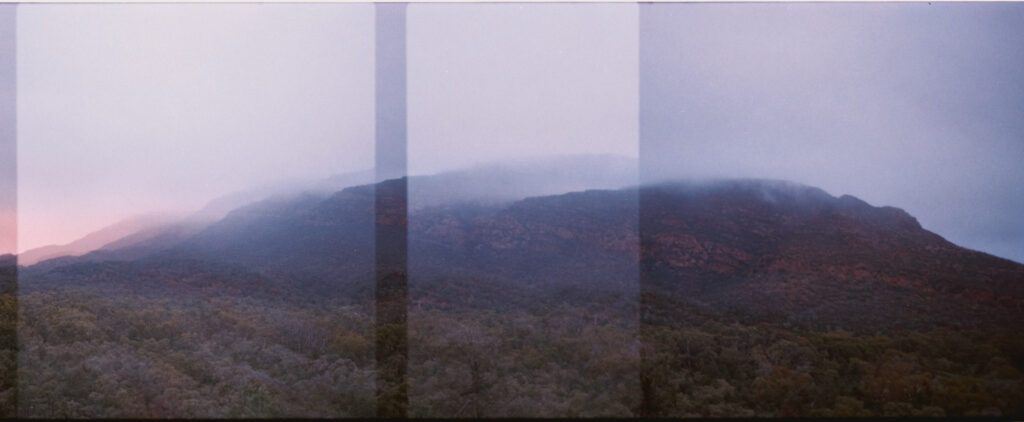
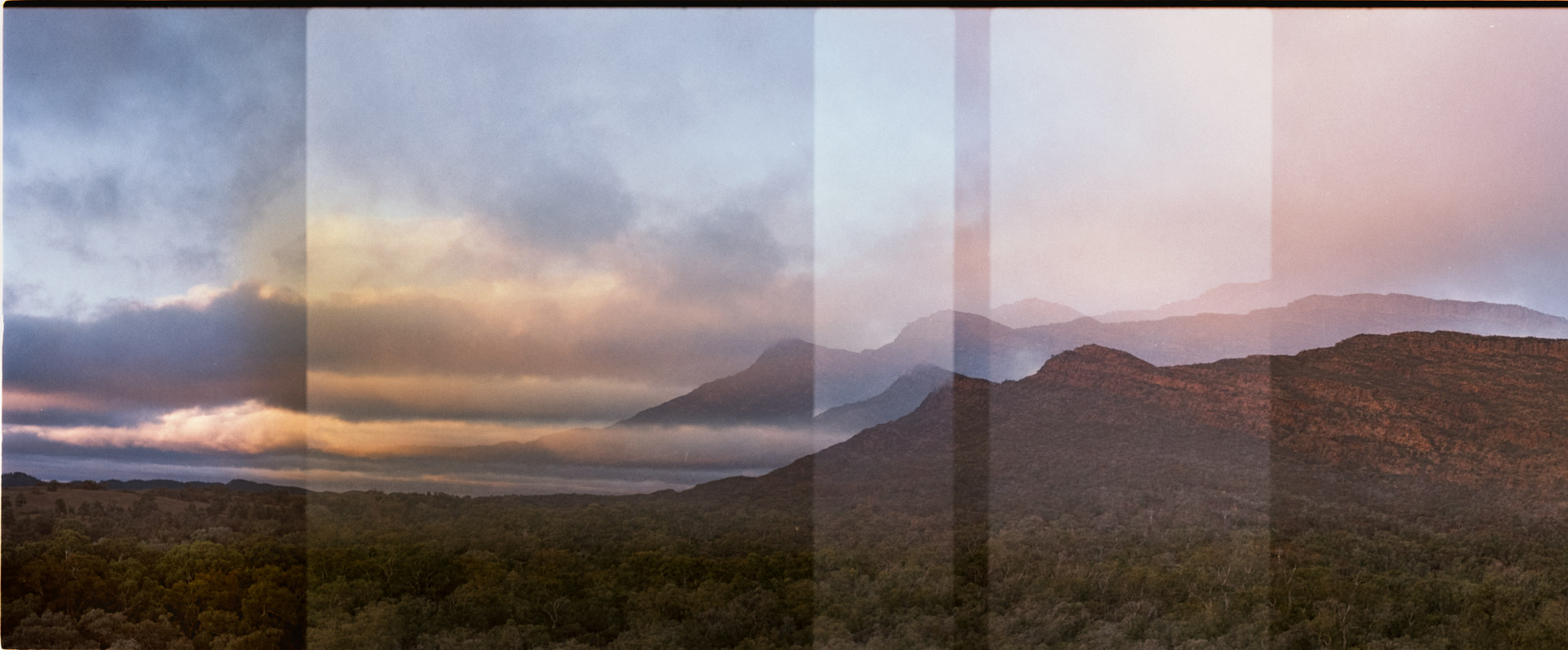
That, and a recent post I did about being in the Flinders Ranges prompted me to revisit a series of panoramas I made in the Flinders a couple of years ago. These were made on Portra 160 in a Nikon F2, using a standard 50mm f1.8 pancake lens.
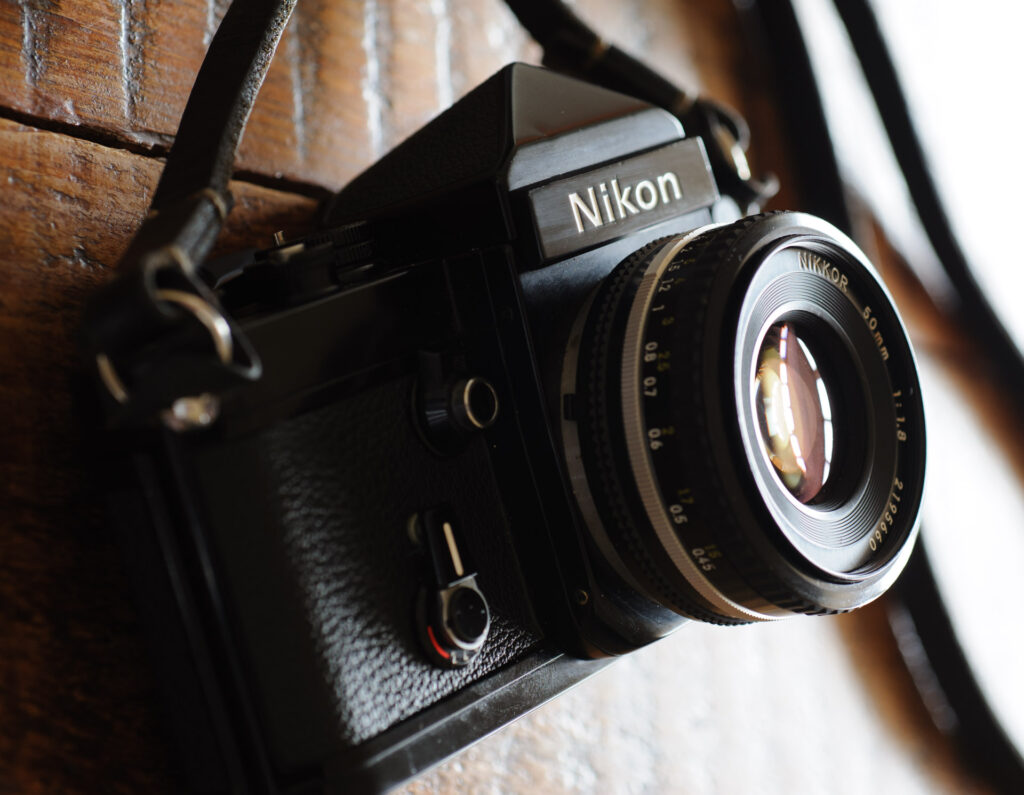
The F2 has been resting a bit lately, but it remains the 35mm SLR of which I am the fondest. It’s maybe not the most useful; if I had to take one camera and one lens on a holiday, I would probably take my FM2N because it has a light meter, but if metering was not a dealbreaker it would definitely be the F2.

It’s also the best camera I have for doing this kind of panorama and for that reason it was my main companion for a couple of years when this type of work was at the forefront.
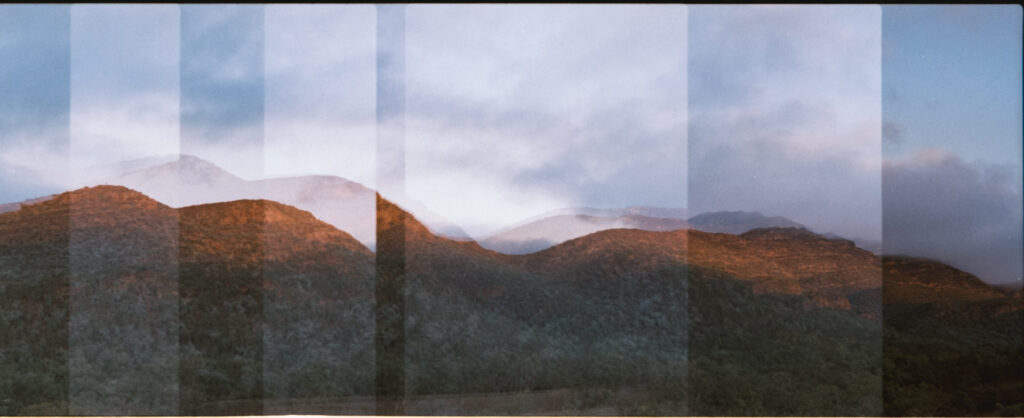
Looking back at this set, what I now remember most about this trip is the fact that I had an Achilles tendon injury at the time and it was really painful for me to walk. I was using a stick, and every morning I would walk from our room up to the same place at sunrise and make a panorama or two, and then again as the sun was setting I will walk up to the same spot and make a couple more.
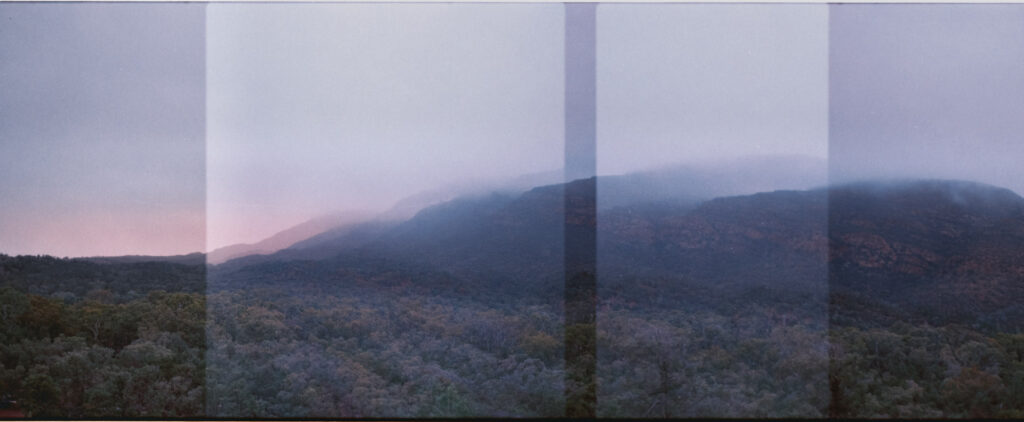
I’ve written more than a couple of posts here that reference this overlapping exposure technique; it’s done by hand-holding and partially winding on the film in between exposures and moving the camera slightly as this is done – making what I term an “in-camera pano.” You need to have one finger on the film release button on the bottom of the camera, and you press that when you’re part way through winding onto the next frame.  In this way the shutter cocks while the film is only partly wound. I felt this might also be interesting because to me it highlights the way we actually look at things. To my way of thinking when we take in a big horizon or landscape, we don’t do it all one go. Our eyes move from one place to another as we scan and lock-on as we move across. So I think this idea of multiple exposures;  each one little snapshot that make up a bigger image quite a realistic way of making a photograph. In a way it’s got some aspects of a Cubist painting. Another thing about it is the aspect of time. Instead of it being a 60th of a second or whatever – the process probably takes something like five or ten seconds. So if there are moving objects or people in the frame it can become pretty interesting. And if you think of what a Widelux does that’s the same thing with it sort of scanning – in a way that you don’t get using an X-Pan or something else that makes a single instantaneous exposure on a wide piece of film.
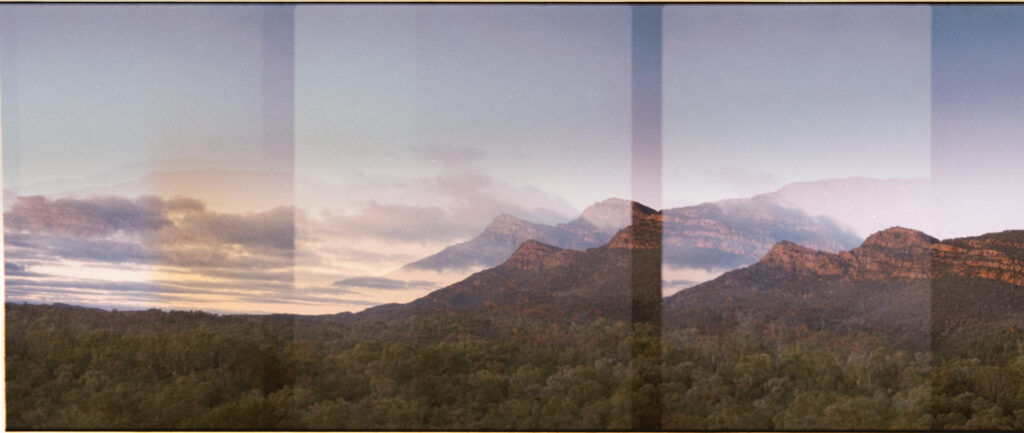
Anyway, the images are also interesting to me because they highlight a common theme that I also seem to have; returning to a particular place over time and seeing what happens. Seeing if that act of repetition will give rise to a series that is interesting.
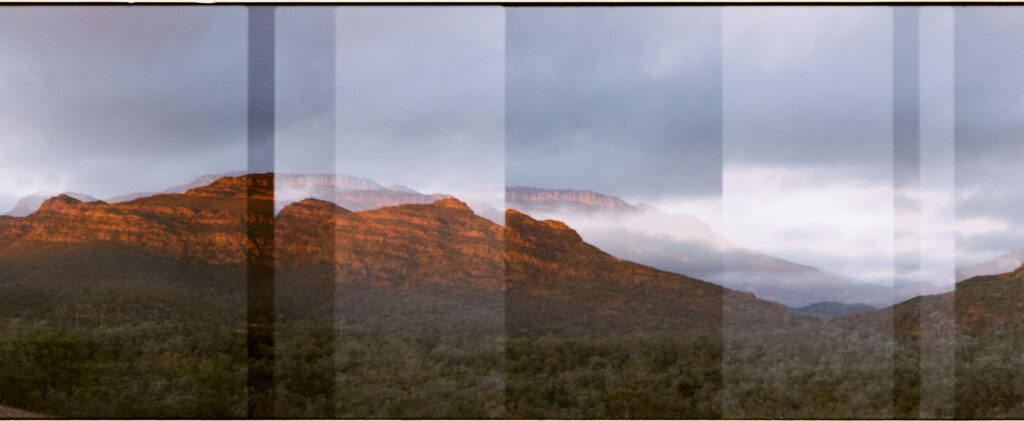
This series is also about digitisation and owning the final image. The images here are a record, but perhaps more so they are constructions.  The film I used here is Porta 160 and I used it because I find it very forgiving in retaining its highlights, and that its grain is nice and fine. I digitised it by using a digital camera (X-Pro3 adapted to my Micro Nikkor 60mm AFD lens in this case) over a lightbox. These days I use my Nikon Df if I’m doing this. Then I converted those raw files into positive images using Neg Lab Pro. In order to make those files easier to work with. I then saved an intermediate working file as a tiff and did more final work on them in Lightroom. So I don’t think of these as Portra colours in a , “Man, those Portra colours!” kind of way. I think they are MY colours. Having said that, I did get shop scans back with the film and so of course I had a base reference of those and my previous experience with Portra160 in my mind.
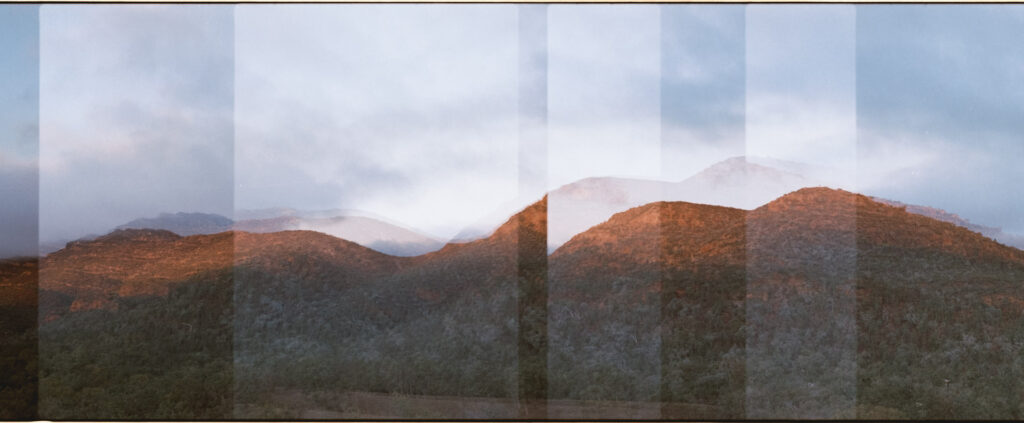
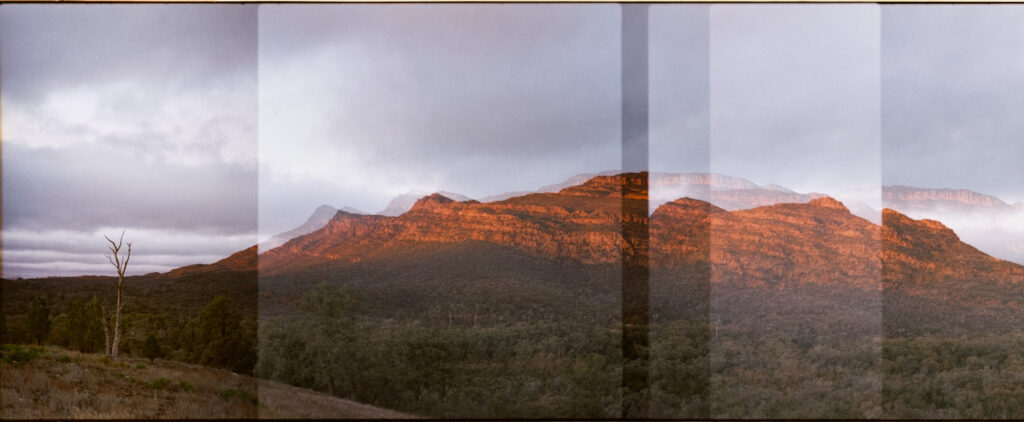
Looking back I feel these hang together quite nicely and I am currently pondering a number of projects in which they might be used. It was fun to bring these out and to think back over that rainy week with lots of nice skies and a very sore Achilles tendon.

Thanks for reading.

Share this post:

About The Author

By David Hume
David Hume is an Australian visual artist and photographer, best known for work depicting the Australian landscape. He also worked as a commercial editorial photographer for over 25 years, and has held a number of photographic exhibitions. He currently exhibits both painting and photography.
Read More Articles From David Hume

Find more similar content on 35mmc

Use the tags below to search for more posts on related topics:

Donate to the upkeep, or contribute to 35mmc for an ad-free experience.

There are two ways to contribute to 35mmc and experience it without the adverts:

Paid Subscription – £3.99 per month and you’ll never see an advert again! (Free 3-day trial).

Subscribe here.

Content contributor – become a part of the world’s biggest film and alternative photography community blog. All our Contributors have an ad-free experience for life.

Sign up here.

Make a donation – If you would simply like to support Hamish Gill and 35mmc financially, you can also do so via ko-fi

Donate to 35mmc here.

Comments

Michael Kaplan on Panoramas in the Flinders with a Nikon F2

Comment posted: 15/08/2026

David,

Wow. There is a lot to unpack here. Firstly, the images are gorgeous. The essence of the landscape is captured perfectly by the subtle tones and variation that is native to each image. And your description of how the human eye records space as it pans across a vista is perfect. Unlike a panning camera, we “break” down an image into parts that essentially form the whole. As your images so succinctly represent. A finally, your process was extraordinary. Imagine manipulating the camera and film advance to such a degree that you could create these images. Wonderfully painterly and abstract and a fitting follow up to the beautiful images offered in the previous article. Thanks so much for sharing. I love it.
Reply

Leave a Reply

Your email address will not be published. Required fields are marked *

David Hume replied:

Comment posted: 15/08/2026

Cheers Michael - thanks for your kind and thoughtful comment. And yes, I do find myself down a bit of a rabbit-hole at the moment about the relationship between photography and painting. It's fascinating to me how one informed the other in the 19th century and their relationships through the development of Impressionism and in to Cubism.

Reply

Leave a Reply

Your email address will not be published. Required fields are marked *

Gary Smith on Panoramas in the Flinders with a Nikon F2

Comment posted: 15/08/2026

These are certainly unique David; I can't say that I have ever seen anything quite like them. They are also complex. It doesn't hit you at first glance but then you realize that there are a number of overlays!

Thanks for sharing.
Reply

Leave a Reply

Your email address will not be published. Required fields are marked *

David Hume replied:

Comment posted: 15/08/2026

Cheers Gary. I do find it interesting when an image contains a certain ambiguity, to reward the viewer with continued attention and observation. But I also think it can't be too heavy-handed; an invitation rather than a demand.

Reply

Leave a Reply

Your email address will not be published. Required fields are marked *

Tony Warren on Panoramas in the Flinders with a Nikon F2

Comment posted: 15/08/2026

"It's photography Jim but not as we know it" to paraphrase James Tiberius. An interesting ,and very dexterous, technique that definitely produces an interesting effect. I think your feature image is most effective but probably because it looks most photographic. Some of the others work but in a more abstract way.
Reply

Leave a Reply

Your email address will not be published. Required fields are marked *

David Hume replied:

Comment posted: 15/08/2026

Hi Tony! And to continue with the Star Trek theme; imagine Kirk and Spock took the transporter back to nineteenth century earth... If they'd had an eye out for developments in photography they might have seen that when negatives rather than plates were used, photographers started composing images out of multiple negatives in the final print. There were schools of thought about the merits or otherwise of this at the time of course. The idea of what is "photographic" has been discussed certainly since the 1850s when at the first meeting of the London Photographic Society Sir William Newton read a paper proposing that soft focus and blur could be advantageous assets to those using photography for artistic purposes. It's a fascinating topic for study. Goodness knows what they'll be saying round Stardate 2256...

Reply

Leave a Reply

Your email address will not be published. Required fields are marked *

Tony Warren replied:

Comment posted: 15/08/2026

Absolutely, David. Of course, in those early days, photogrphy's place in the arts was measured completely against more conventional media (at the time). Today it stands apart, and has done for some time, so your application of its technology is as valid as, say, an unmade bed installation. For myself, I look for both information and visual stimulation from a photograph or any work of art, but not necessarily at the same time, but a bonus if both are there. So, may photography live long and prosper.

Reply

Leave a Reply

Your email address will not be published. Required fields are marked *

Alexander Seidler on Panoramas in the Flinders with a Nikon F2

Comment posted: 16/08/2026

Very beautiful, David !
Reply

Leave a Reply

Your email address will not be published. Required fields are marked *

David Hume replied:

Comment posted: 16/08/2026

Thanks Alexander!

Reply

Leave a Reply

Your email address will not be published. Required fields are marked *

Walter Reumkens on Panoramas in the Flinders with a Nikon F2

Comment posted: 16/08/2026

Stunning images created by an artist using professional techniques.
Reply

Leave a Reply

Your email address will not be published. Required fields are marked *

David Hume replied:

Comment posted: 16/08/2026

And hello and thanks to you, Walter.

Reply

Leave a Reply

Your email address will not be published. Required fields are marked *

David Pauley on Panoramas in the Flinders with a Nikon F2

Comment posted: 16/08/2026

I can't think of how to work a further Star Trek reference in, and as a former Trekkie it's kind of killing me...! In the meantime, I really love these images, David. The variations, blur and tacticle quality to me set them apart from most panoramas (the spectacular light and colors don't hurt either). Have your printed any of them? Would love to see what they look like on a wall. I've resisted the lure of making panoramas with film cameras until now but your images are giving me ideas. Either a faithful homage with my Nikon FE (love the film rewind button hack you recommend) or perhaps something more traditional with my Hasselblad SWC mounted on a tripod. I always worry about having everything perfectly aligned but if I lose that inhibition I could see this becoming very interesting. Thanks David for the reflections, photos and inspiration. - DP
Reply

Leave a Reply

Your email address will not be published. Required fields are marked *

David Hume replied:

Comment posted: 16/08/2026

Hi David. Yes, in this series I was thinking of making a little book or something like that. But at the moment I'm playing around with lots of ideas of printing and haven't really worked any of them out. I've put that on hold but I'm hoping to do a residency next year and just take a few weeks thinking about that sort of thing. I have printed some of these pretty big. But not of the Flinders. I did some seascapes as well and also some work in Venice that I printed almost 2 metres wide. I initially did them in a 6 x 6 folding camera, and of course the larger film means you can really print them as wide as you feel like. But it doesn't work in a Hasselblad. I also did some digitally in India, but it's not the same as having no choice and just seeing what you get. I also did some in an Olympus Trip 35. That was a spur-of-the-moment thing while on holiday. https://www.35mmc.com/19/10/2023/olympus-trip-35-on-holiday-part-2-getting-arty-in-italy-by-david-hume/ Live long and prosper... David.

Reply

Leave a Reply

Your email address will not be published. Required fields are marked *

Sroyon on Panoramas in the Flinders with a Nikon F2

Comment posted: 17/08/2026

This is a really cool technique! Can I ask, how do you estimate how much to advance the film, and how much to rotate/move the camera for the next exposure? I mean, I get that the imprecision or imperfection is kind of the point, but do you have a rough estimate based on experience, or just wing it completely?

Also I like the sound of recent posts "discussing the aesthetics of their [panoramic] creations and the various means by which this is done". I don't end up reading all articles posted on 35mmc (more's the pity) but do you mind linking me to a couple of your favourites? Panorama aesthetics and techniques are something I'm also interested in!
Reply

Leave a Reply

Your email address will not be published. Required fields are marked *

David Hume replied:

Comment posted: 17/08/2026

Hi Sroyon - hope you're well. To work out the advance; imagine one full stroke advances one frame. So in this case I look through the viewfinder, see where the frame ends, and for half a frame overlap would move the camera half way to the next piece of the scene while giving it half a stroke. I don't quite remember with these ones what the rationales were. I think I probably was going for about three frames per panorama? Maybe three exposures spread over double the coverage of one frame? But I do remember a friend of mine was talking about this and saying. "Do you know how difficult this is?" and my immediate reaction was, "No, it makes perfect sense" There is also article on 35 MMC by a company who makes a camera that does this (but no more easily than a roll-film camera with no shutter interlock) and I think they explain it maybe better than I do, because they say how tricky it can be - search SuperPanos for that one. And the link I posted to David P above explains how I did it in an Olympus Trip 35 in Italy. And that was interesting because I was not planning this at all, and I only just worked out I could do it while I was on holidays and so I had to wait till I got home to see if any of them were going to work out. I would not recommend it with that camera though because it's very dependent on how tightly the film grabs onto the winding sprocket whereas with an SLR it's totally lever dependent. I have also done it with an Olympus XA2 and that article is on here as well under a whole role with an Olympus XA2 if you want to search that. In that instance I just shot one complete role of transparency film as one very very long panel and I made it into a movie. That should give you enough to get along with. I must say that when I look at most of the other things I see around with this technique I don't really like them. So I think it's a case of finding something that suits one personality and aesthetic as well as how own brain works to see if it's going to be anything worth pursuing. In terms of articles about panoramas in general, I think I was just referring there to a few that I had seen about comparing using something like an Xpan with say cropping a band out the middle of a 6x6 SWC for example which is what David P above might end up doing. It was mostly a debate about whether cropping a pan out of a regular frame is different from pre-visualising and having no options after the event. Certainly in my case, it's all about pre-visualisation and then creating in the camera. Oh, but of course there is a bucket load of luck involved as well! But as I say the more practice the luckier I get. I don't really do it much anymore because I'm less inclined to be travelling with film I think. Anyway, I hope you have fun with this. All the best David.

Reply

Leave a Reply

Your email address will not be published. Required fields are marked *

Sroyon replied:

Comment posted: 17/08/2026

Wow, thank you for your detailed reply! I'm not sure if I'll try it myself but it's interesting to know how you do it :)

Reply

Leave a Reply

Your email address will not be published. Required fields are marked *

Leave a Comment

Leave a Reply

Your email address will not be published. Required fields are marked *