

Choosing Iceland as our destination for escaping the bleak midwinter in New York was, um, counterintuitive? The first idea was the Caribbean which seemed like a good shout, but as we were noodling over a destination my wife Beth floated the alternative idea of going to Iceland, and I jumped on it without hesitation. I had visited a couple of times for a work project in 2019 and fell in love with the small island nation, and always wanted to return. Plus it was one of Beth’s long cherished ‘bucket list’ destinations and she had a birthday coming up.
So we cashed in some miles and reached out to some friends to get advice on an itinerary and were very excited until about noon on the day we were set to depart, when I got a notification that our flight was in the process of being canceled. After some digging online, we learned it was due to a big winter storm in Iceland. We ignored this potential omen as we were itching to go, having dropped our dog with a sitter and being poised fully packed for the airport, including lots of winter gear and my Hasselblad “landscape kit”, and a very robust supply of 120 film, since I wasn’t confident I’d be able to source film in Iceland. We spent a fitful day trying to rearrange our trip, eventually getting a redeye flight on Saturday, March 21, two days later than planned after some incredibly frustrating experiences with glitchy online AI chat threads, which was the only option from the airline for trying to rebook flights.
Day 1, Sunday
Our flight was a redeye and landed a little early and we sailed through Icelandic passport control & baggage claim. It was a little before 6am (2am in NY) as we blearily went about picking up our rental car, a heavy duty Toyota Land Cruiser Four Wheel Drive. When we stepped outside into the Reykjavik predawn we were greeted by driving winds and blizzard conditions that nearly blew our roller bags into a snow drift.
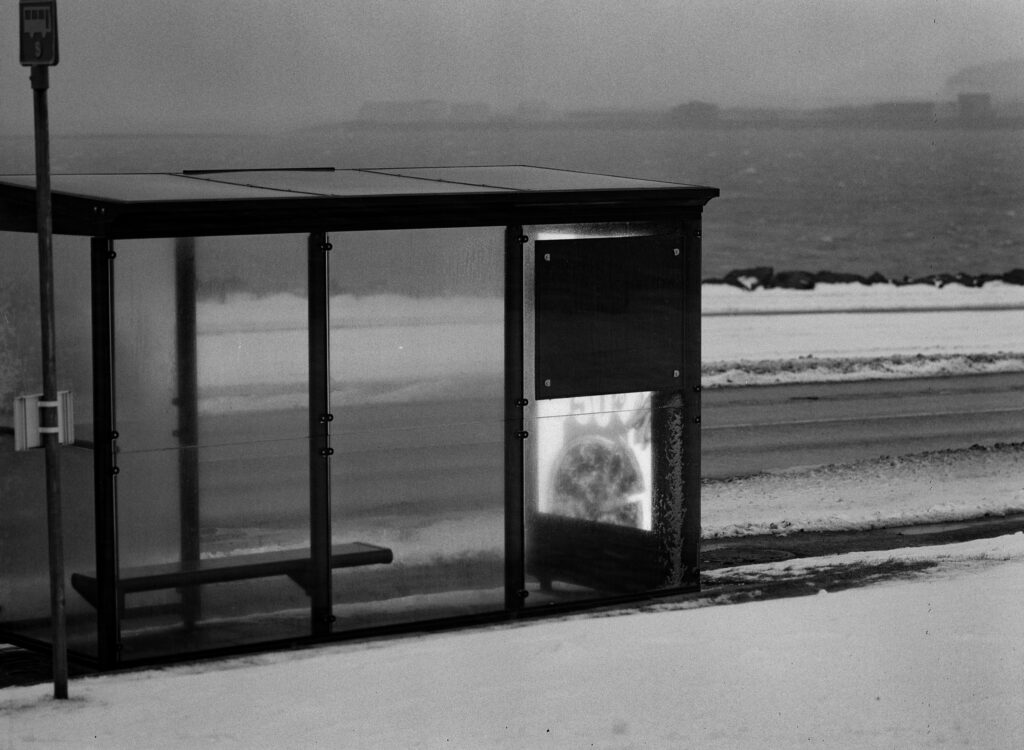
Since our hotel room wouldn’t be available until the afternoon, following a tip from a friend, we headed straight from the airport to Blue Lagoon, a world famous geothermal resort featuring dazzling aquamarine silica mineral waters heated by the Island’s active vulcanism from the spreading tectonic plates of the Atlantic Ocean. The drive to Blue Lagoon was foreboding; for long stretches we were the only vehicle on the road. If the sun was coming up, we wouldn’t have known. As we drove on through the muffled grey gloom and wind-driven snow we could hear each other having the same nervous thought in the silent car, “What were we thinking going to Iceland during winter storm season?”
We had booked our tickets for Blue Lagoon at the JFK Lounge from a third party website as the official site wasn’t offering next day bookings at that point. As we pulled into the empty parking lot, I started to have paranoid thoughts that they were closed on Sundays and we’d been taken by some internet scam. We were close to an hour early, and there were very few signs of life until another lonely car pulled in. We parked beside them and I ventured out into the freezing morning to see what was going on.
After a long walk through a narrow lane carved into the basalt landscape that looks more lunar than terrestrial, I made it to reception and saw one or two employees starting to get ready for the day. No-one was staffing the admissions desk, but a friendly lifeguard told me they were indeed open that day and we could come back at 8am. Okay! We were on for our morning thermal spa in freezing conditions! As it turns out there were plenty of other people just as crazy as we were enjoying the hot water and freezing air.
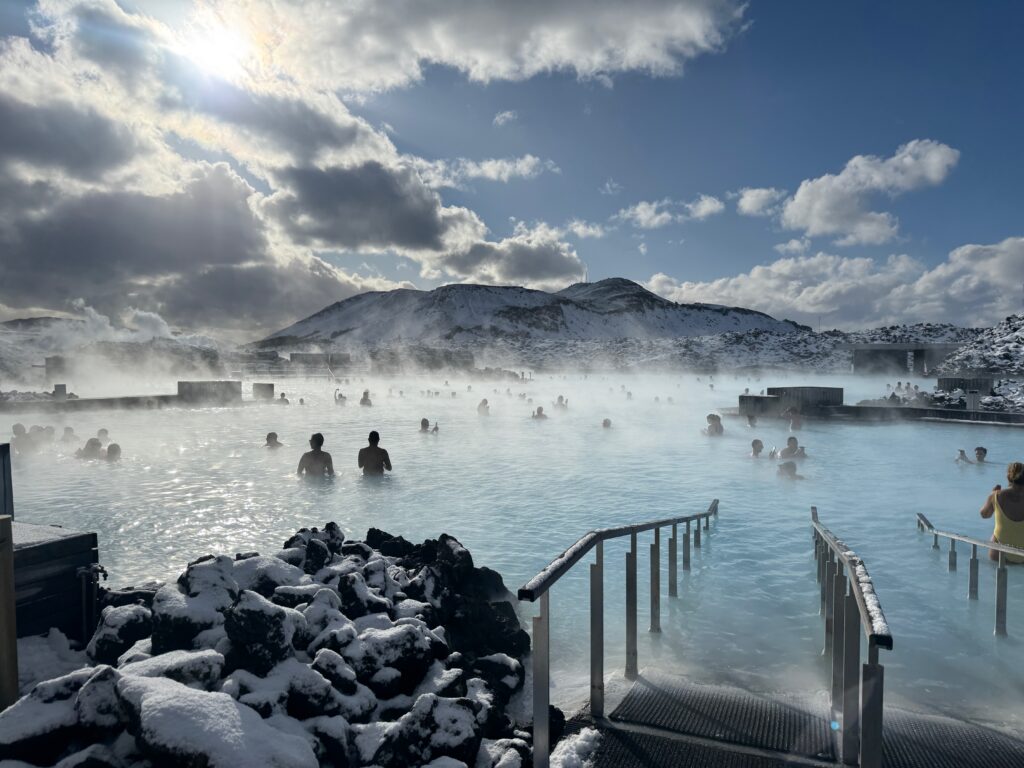
Eventually the sun peaked out and we had a lovely morning floating around and trying on different mineral masks that are a feature of the resort along with a ‘wade up’ bar serving beer, wine, smoothies and some kind of signature Windex blue frozen cocktail. Plenty of people were drinking the cocktails despite the early hour, but we made do with a green smoothie that was very nice.
I would have loved to shoot some film at Blue Lagoon, but I wasn’t properly equipped for aquatic conditions with the Hasselblad or permission from the resort, so I had to make do with some iphone photos. They sell very effective water housings for samrtphones at the concession stands and the baths were packed with people taking selfies and group photos.
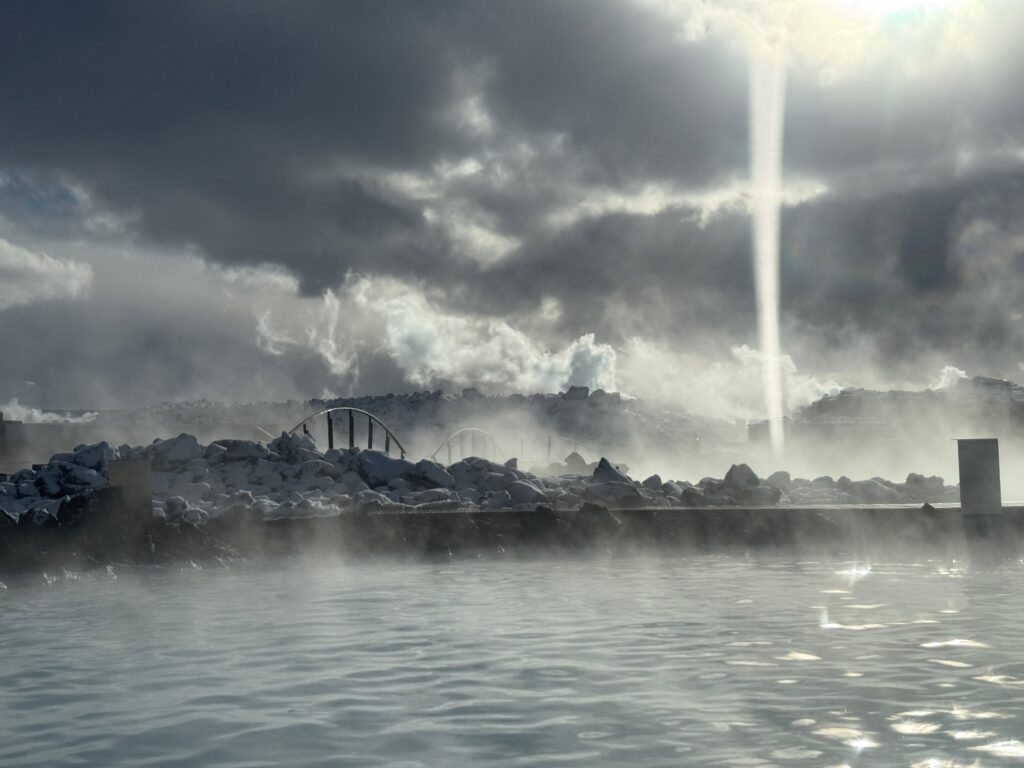
I’m kind of interested to see that even my iphone photos are improving as I learn more and more about photography.
Lunch at the resort’s elegant restaurant was delicious. Maybe a week in Iceland wasn’t going to be so bad after all…
It was about a 45 minute drive to Reykjavik from Blue Lagoon, and after a few brief appearances, the sun was gone for the day and there were times when conditions on the highway were almost full white-out blizzard. I was also fighting drowsiness after the all night flight and a couple of hours in the warm geothermal baths. About half way to Reykjavik, we spotted a small roadside hotel and pulled in and asked them if we could rest a bit on one of the couches in their lobby as a safety precaution to avoid falling asleep at the wheel. They couldn’t have been nicer and let us doze off on their big sofas and gave us some coffee after we roused ourselves to finish the drive.
We managed to get ourselves to the hotel and checked in, and had a quiet dinner, where I was nodding off every five to ten minutes.
Day 2, Monday
Waking up after a good night’s sleep, the first item on the schedule was a visit to the studio of one of Iceland’s leading fine artists, the sculptor Steinunn Thorarinsdottir. I would have loved to photograph her in her studio and her delightful husband Jon at their cozy home with the Hasselblad, but it felt presumptuous/invasive to show up with a medium format camera before I’d even met them, so I left the Hasselblad in the Toyota and had to make do with the iPhone again.
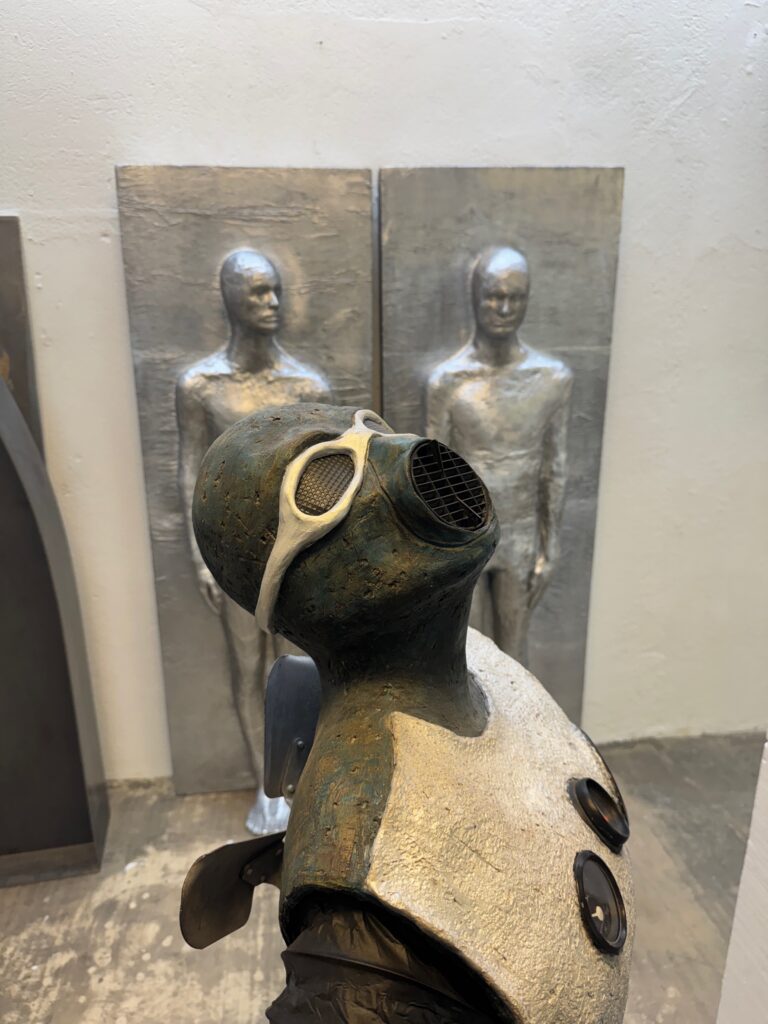
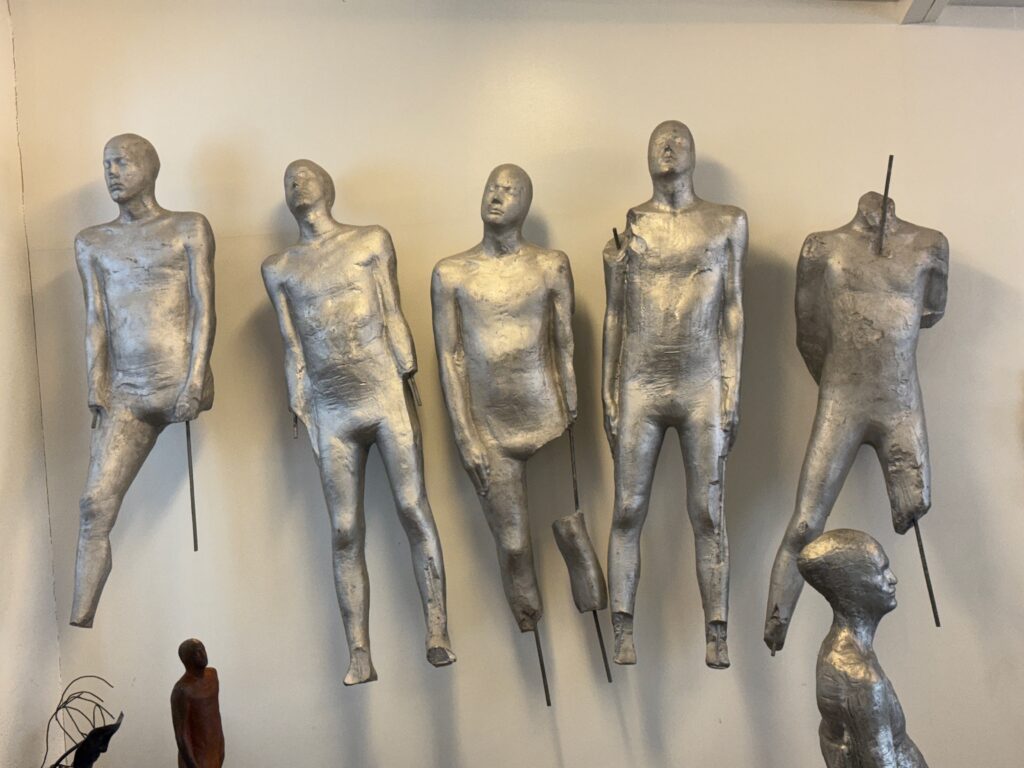
We became immediate fast friends with Steinunn and Jon, a retired TV presenter, over a lovely Nordic brunch of smoked fish and delicious breads and spreads made from skyr, an Icelandic cousin of yogurt. It was quite special to meet such wonderful people, and we were starting to feel like our time in Iceland was going to be pretty memorable whatever the weather, which we learned was colder than usual that week, even for Icelanders.
Jon was kind enough to give us a quick driving tour of the west end of Reykjavik on our way back to our car and I dropped pins at a couple of places that I wanted to come back and shoot with the Hasselblad, including a lighthouse. Beth, no fool, decided to take it easy in the hotel while I set out to shoot some landscapes on film. But while there were intrepid joggers out in the parks as I drove out to the isolated point where Grotta, the lighthouse is located, I arrived to driving sleet & snow in 40-50 mph winds that made it virtually impossible to set a shot on a tripod while protecting the lens. I tried repositioning the car to an angle where I could get a good shot through the passenger side window, which is harder than you’d imagine; the rearview mirror was blocking the best angle and I had to twist into a very awkward position to get around it.
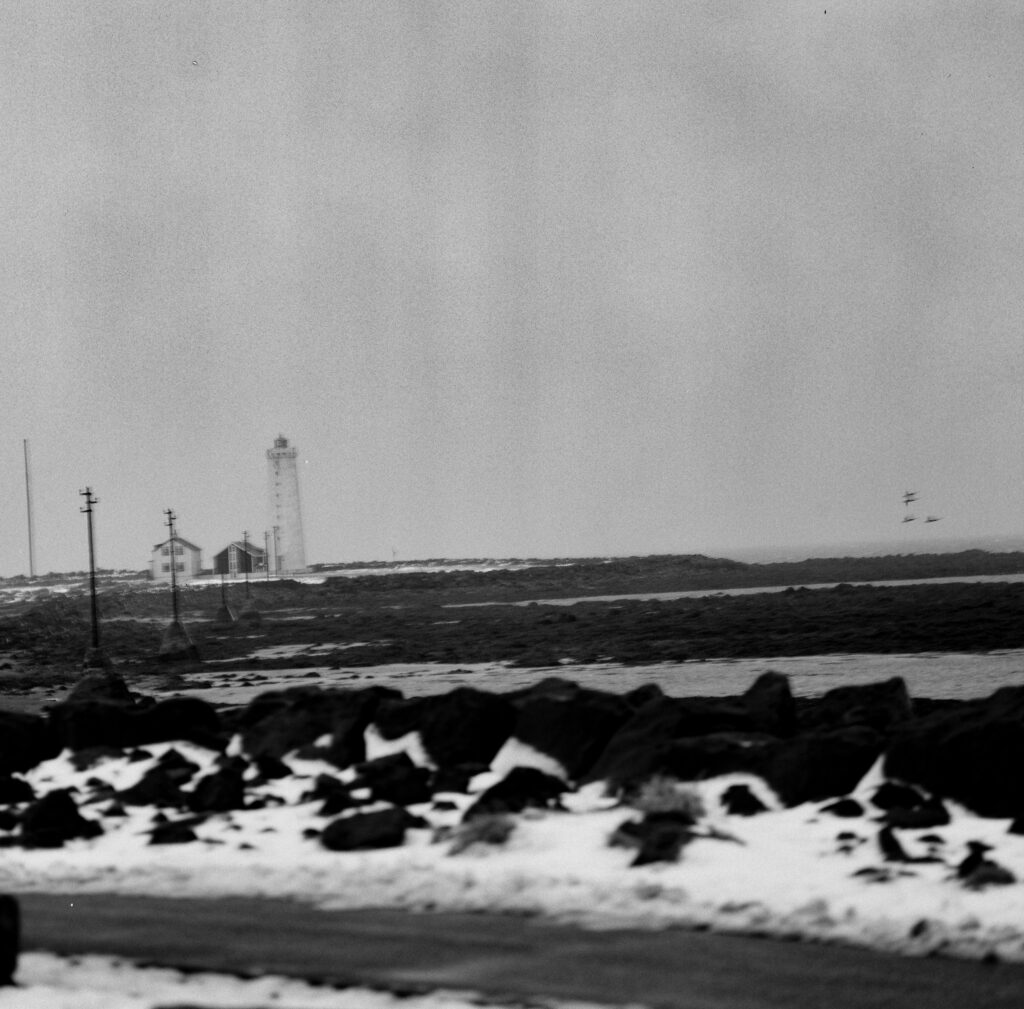
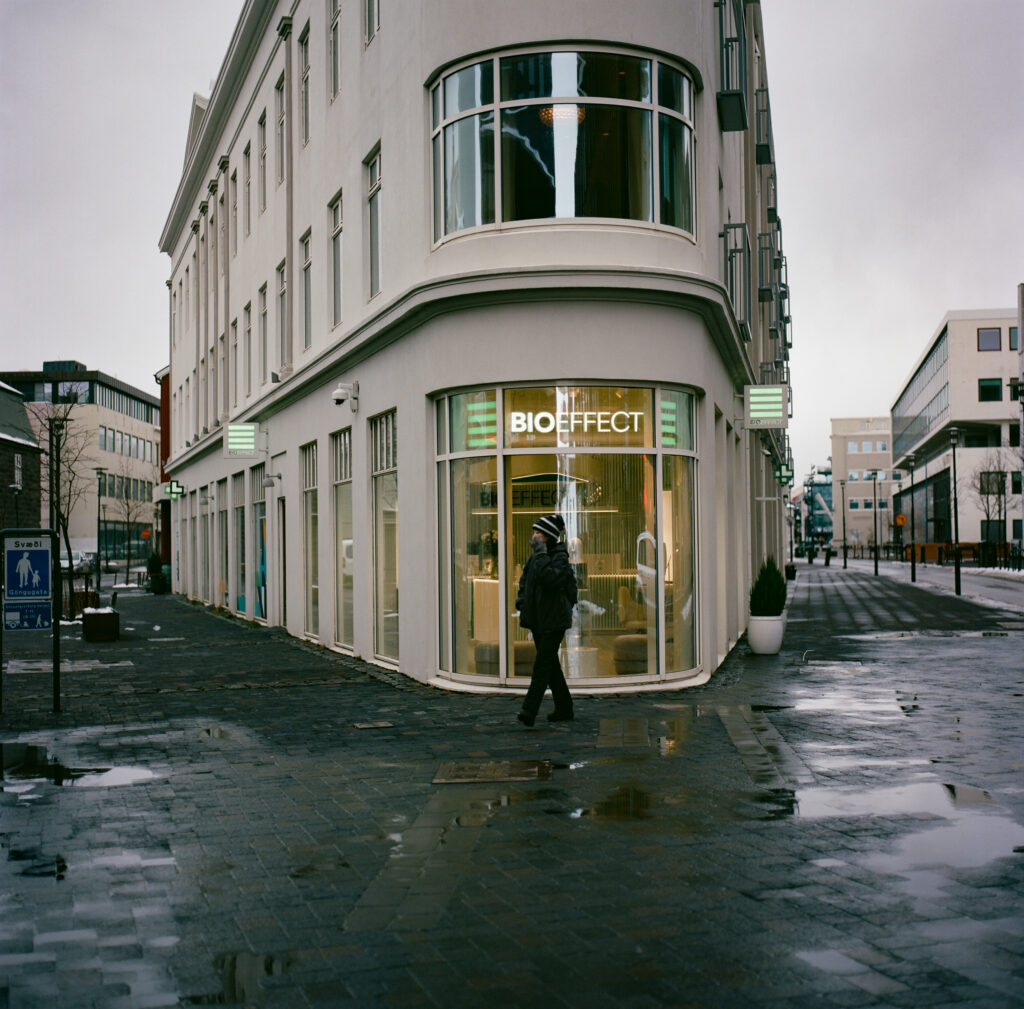
With almost no visibility through the low-hanging fog, mist & snow, I realized I was on a fool’s errand and headed back into the city. I grabbed one or two shots on the way from the parking garage back to our hotel. In town, the winds were not as strong and the sleet and snow had stopped. I ran into a charming group of UK-based spring breakers from the Isle of Man who were lying on the snow waiting to meet up with their friends. As I was lining up my shot, the group swelled from 3 to 11 people who were all happy to pose for an American with an unusual looking camera.
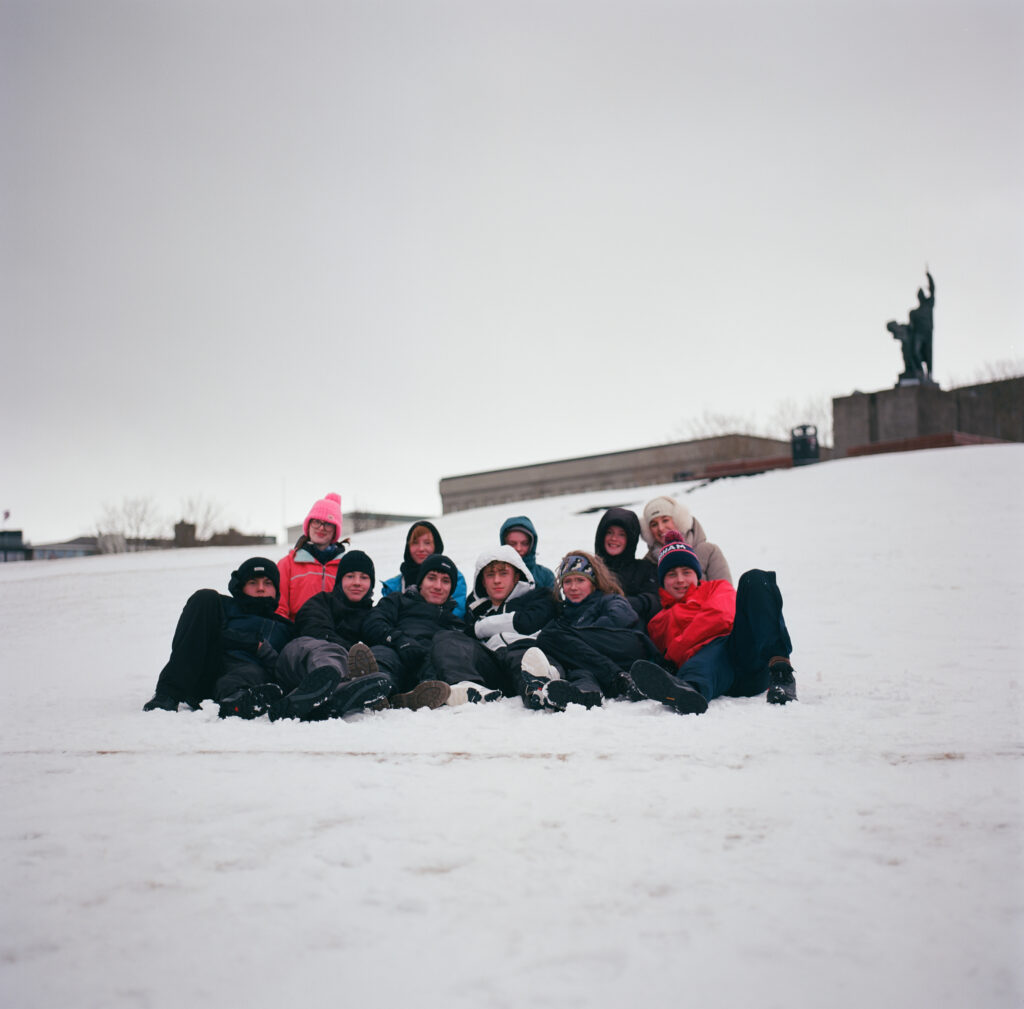
Between the grim weather and jetlag, I wasn’t feeling inspired to do a deep dive into Reykjavik street shooting, so only grabbed a shot or two on short walk back to the hotel. But I like the combination of Iceland, Ektar and the 503CW! (A recent acquisition after my 500CM gave up the ghost, inspired somewhat by Mike Amos’s remarkable post of MF photography shot on a 503CW.)
We had another quiet dinner at a wonderful fish restaurant, and I managed to stay awake for the entire meal.
Day 3, Tuesday
On Tuesday morning we set out in the Toyota and headed east on the Ring Road along the south coast. The heavy winds were starting to die down, but the weather was still deeply overcast. Worryingly, the advance forecast for the rest of our time on the island was looking pretty foreboding, another major winter storm was on the way Thursday and it looked like we might not see the sun or sky again until we got back to New York.
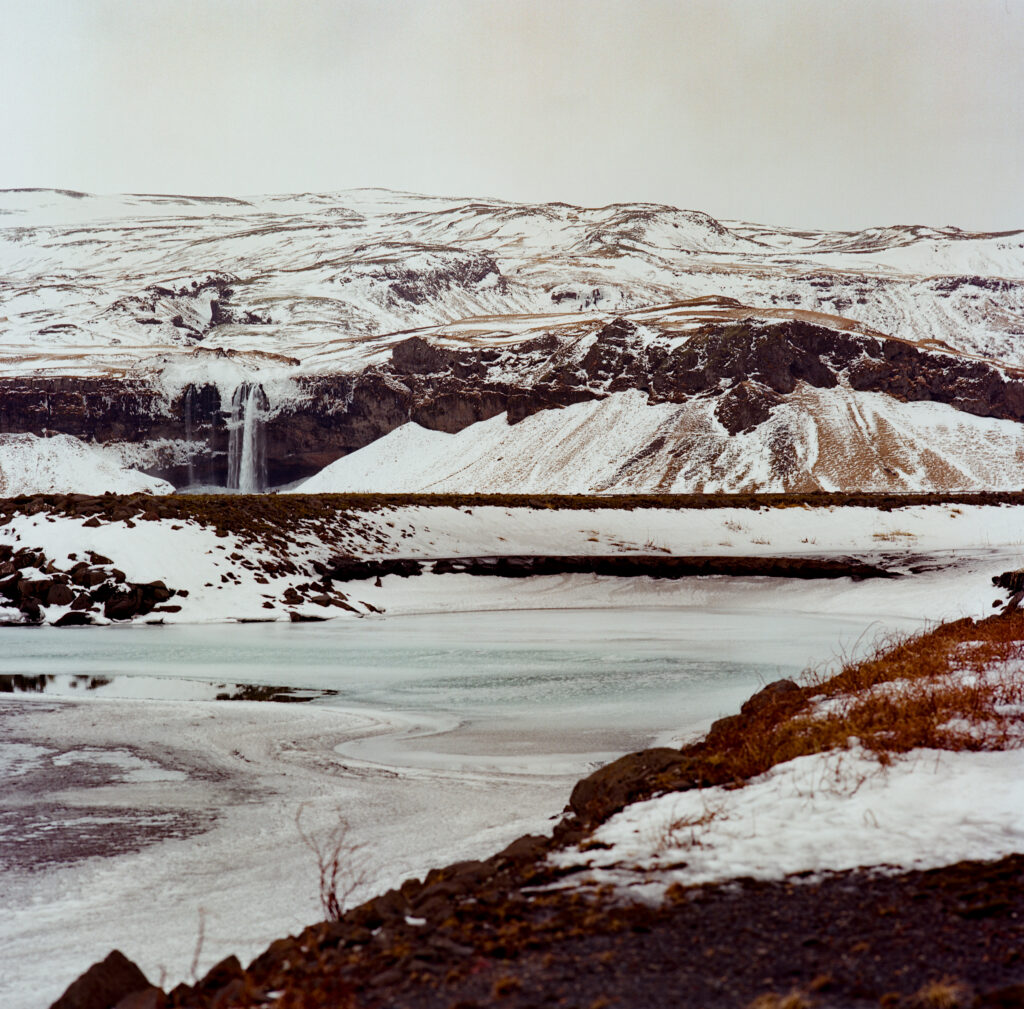
Nevertheless, the landscapes were epic and we took our time driving to our first hotel, stopping any place that looked interesting, including this small but high waterfall Beth spotted along the highway. Even in the gloom, I like the subtle colors of the icy groundwater, and the plants and volcanic earth on Ektar.
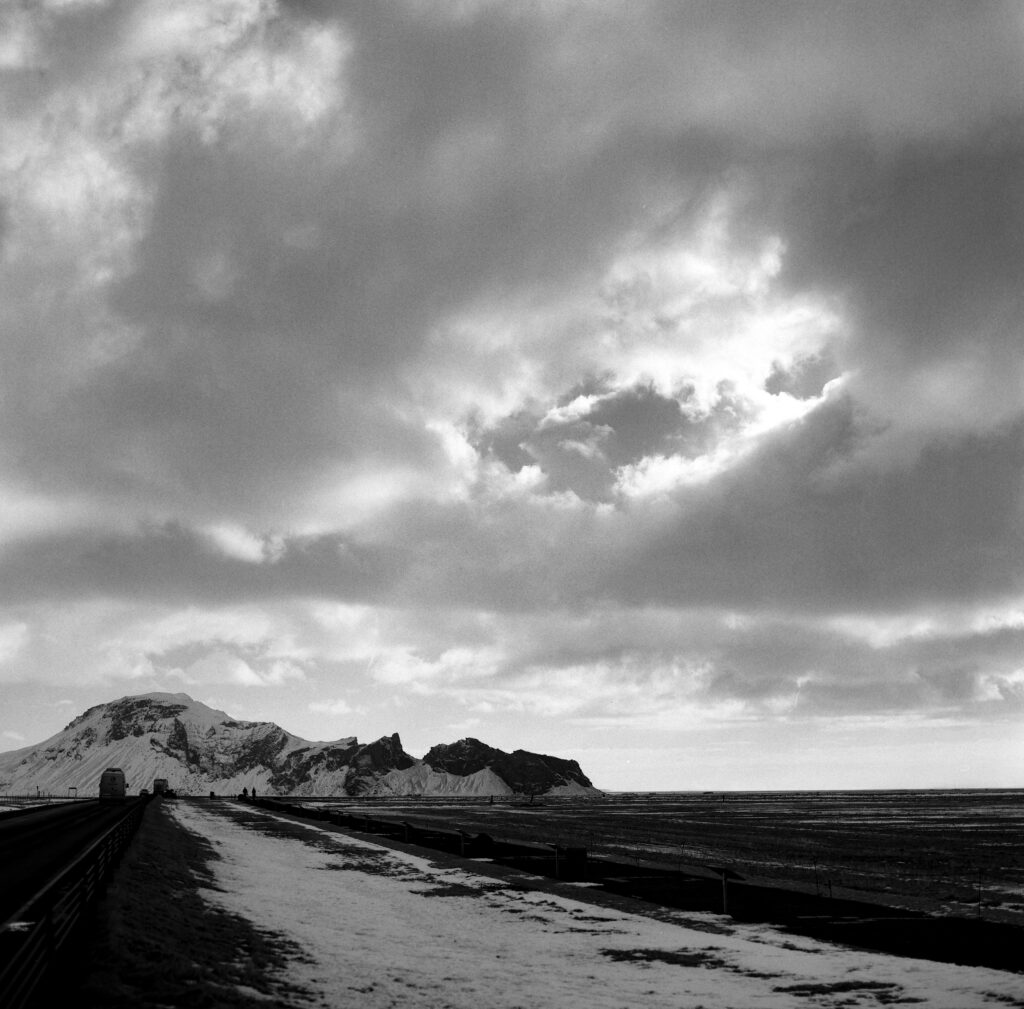
One of the great features of a Hasselblad V series film camera is the ability to switch from color to black & white from one frame to the next, and I had a feeling this landscape would look great on Delta 100 with a red filter to catch some of the drama of the sky. I love the feeling of vastness and depth on this frame with the trucks receding toward the distant mountains mirrored by the greater vastness and depth of the cloudscape above.
Our hotel, Skalakot, is set on an old horse farm. Jon had told us that before WW2, the entire island was a rural agrarian economy with the hardy inhabitants living off the harsh cold land or fishing in the icy waters of the subarctic North Atlantic. Even after the War, when the US & Allies had set up air bases on the island that changed the economy and began the process of modernization, Jon had grown up on a farm without electricity. Now with international tourism as a/the leading industry, many families have converted their former farms into country hotels.
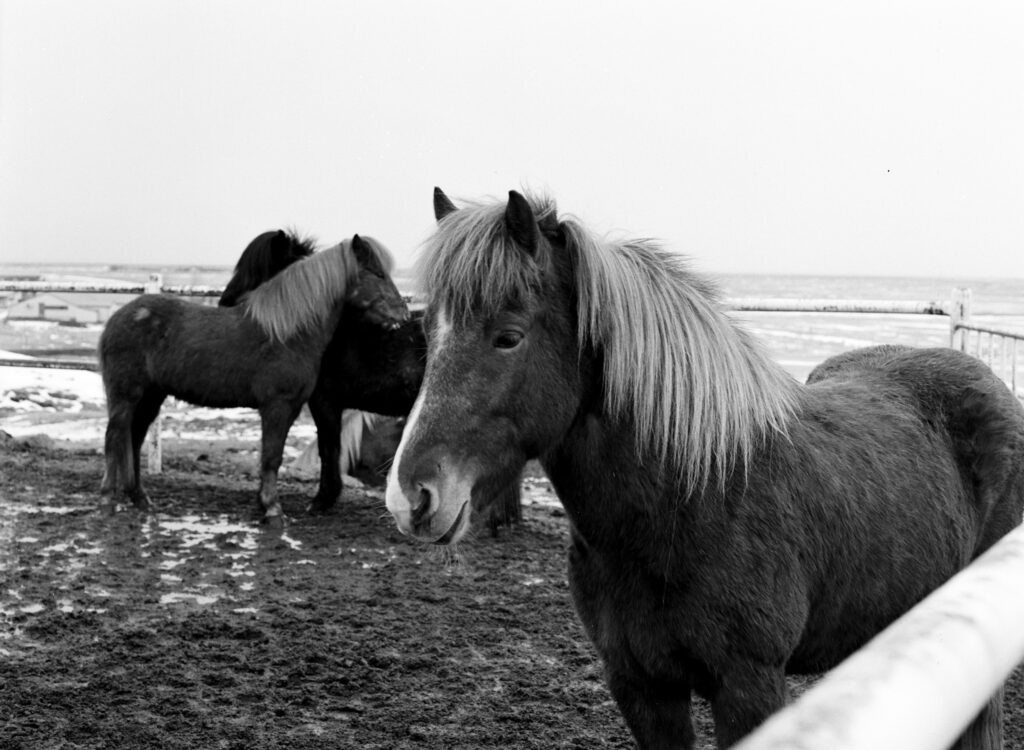
Once we were settled into our lovely room, we took a nice late evening walk and grabbed some photos, starting with the horses that Skalakot guests are able to ride for excursions into the Icelandic countryside.
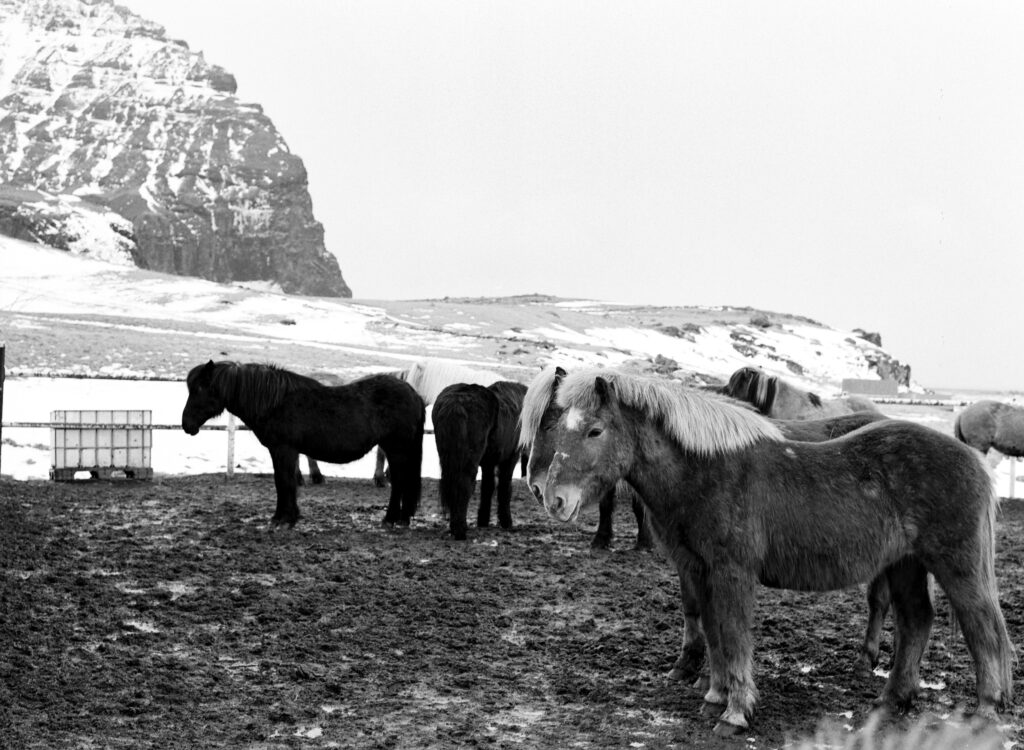
I think the horses look great on TMax 400 which worked worked well in the late overcast light.
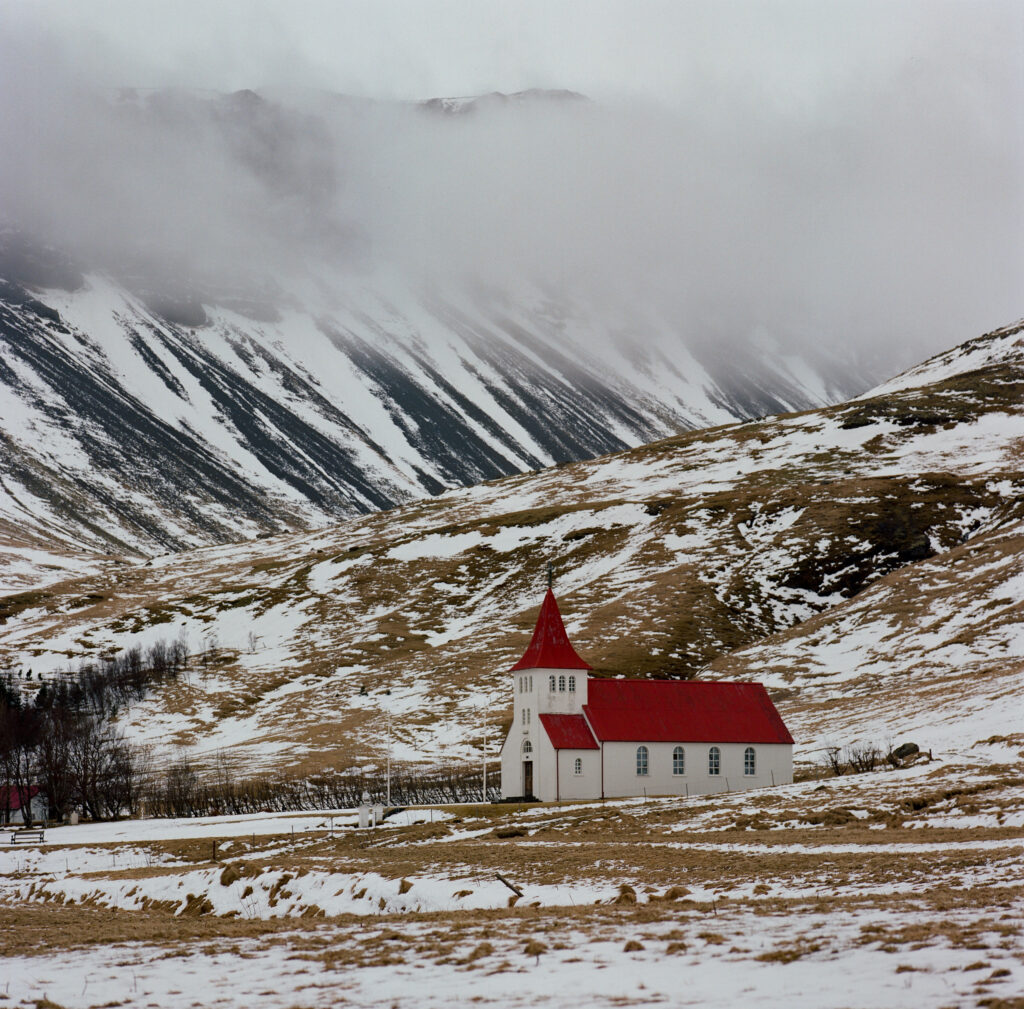
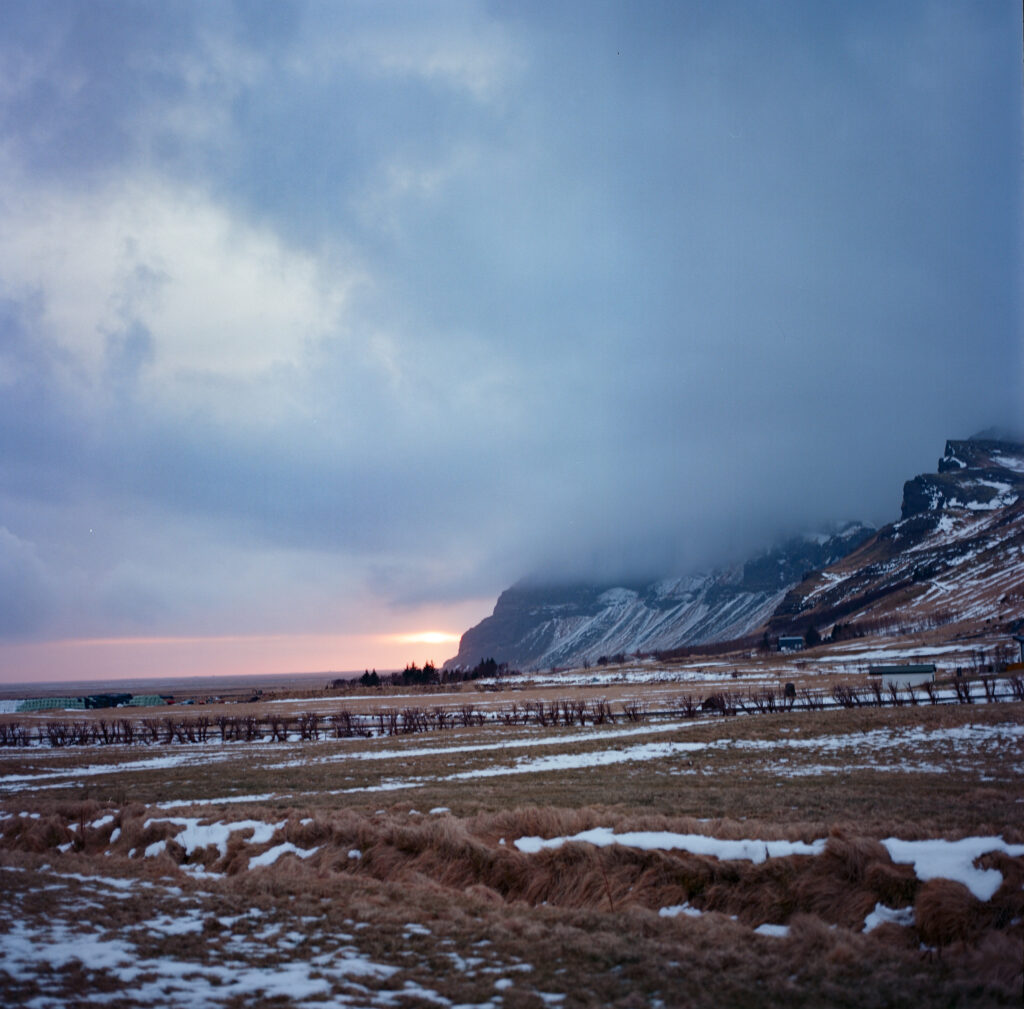
Skalakot is set in a pretty valley with a small church, and the rugged mountains were shrouded in low hanging clouds, always a good thing on film.
I lugged the camera bag and a tripod up the base of the mountain to take some slower exposures in the late light. Whether in color or monochrome, I love all of the different tones and textures between rock and cloud, earth, snow & ice and vegetation.
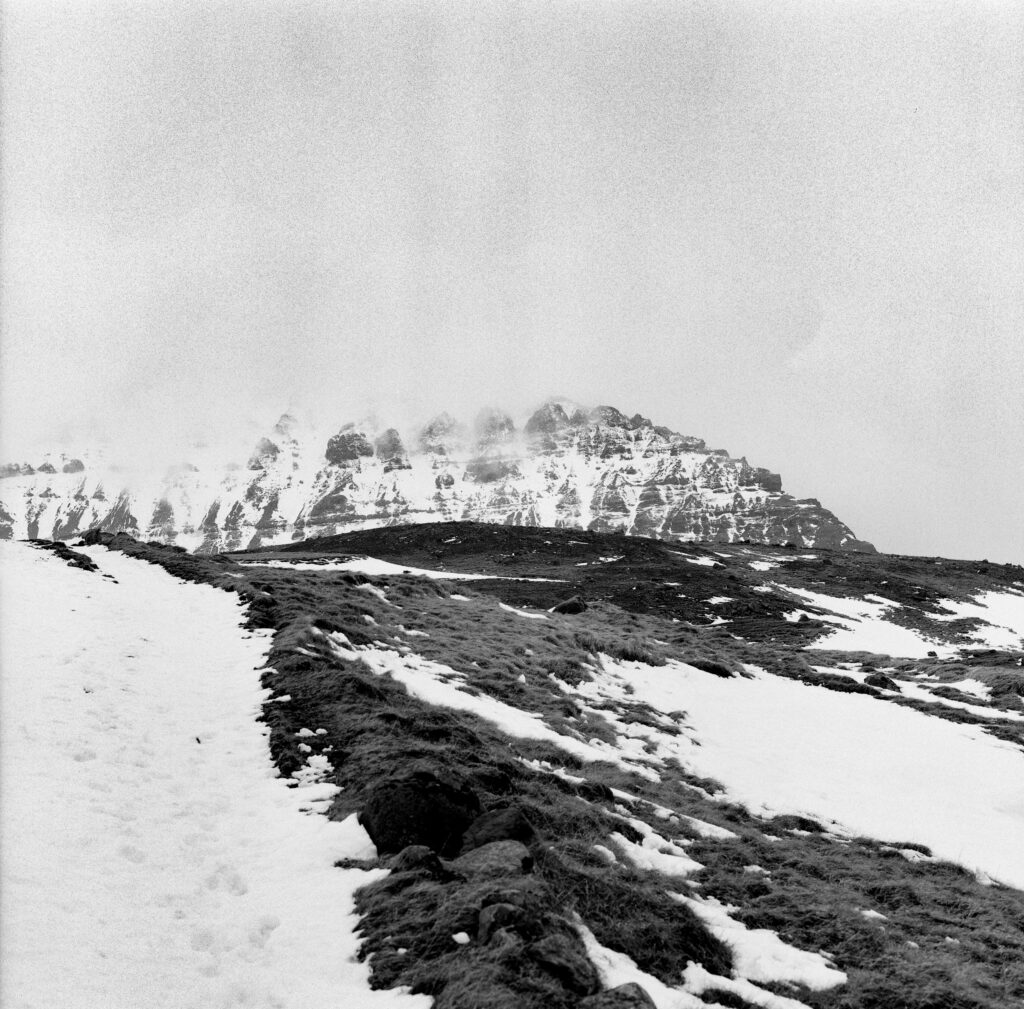
The clouds were rolling in lower and lower as the sun set over the North Atlantic.
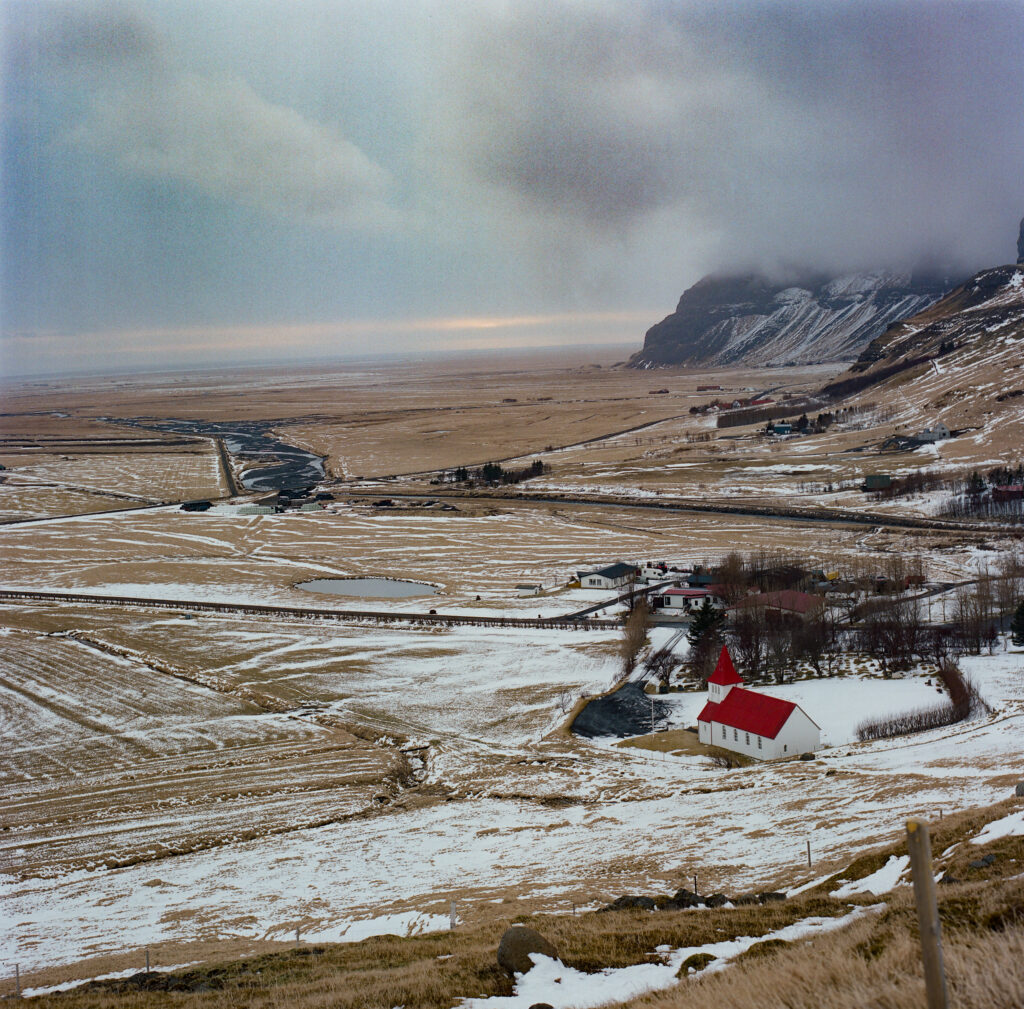
We were happy to be out and about in the gorgeous landscape and the weather was finally being a little more cooperative. Our anxieties and regrets about the Caribbean were increasingly out of our minds as we tuned into the grand vistas of Iceland.
Day 4, Wednesday
And behold, defying the forecast, Wednesday turned out to be a gorgeous sunny day!
After a lovely Nordic breakfast at Skalakot, we had a 3 hour drive straight east along the south coast of the island, and nothing on the schedule other than stopping any time we were inspired to get out and poke around. As the trip came together quickly we hadn’t done a lot of homework on the attractions along the coast, and were basically winging as we chose our stops along the way. But we were never disappointed! Our first major stop was at Vik, famed for its black sand beach.
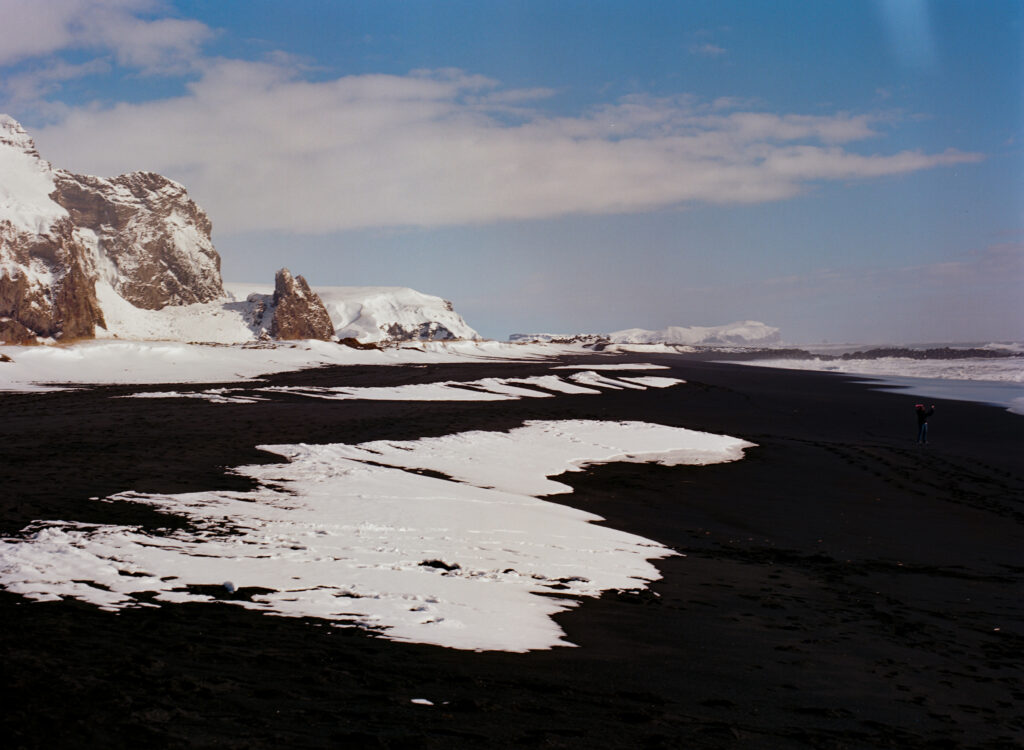
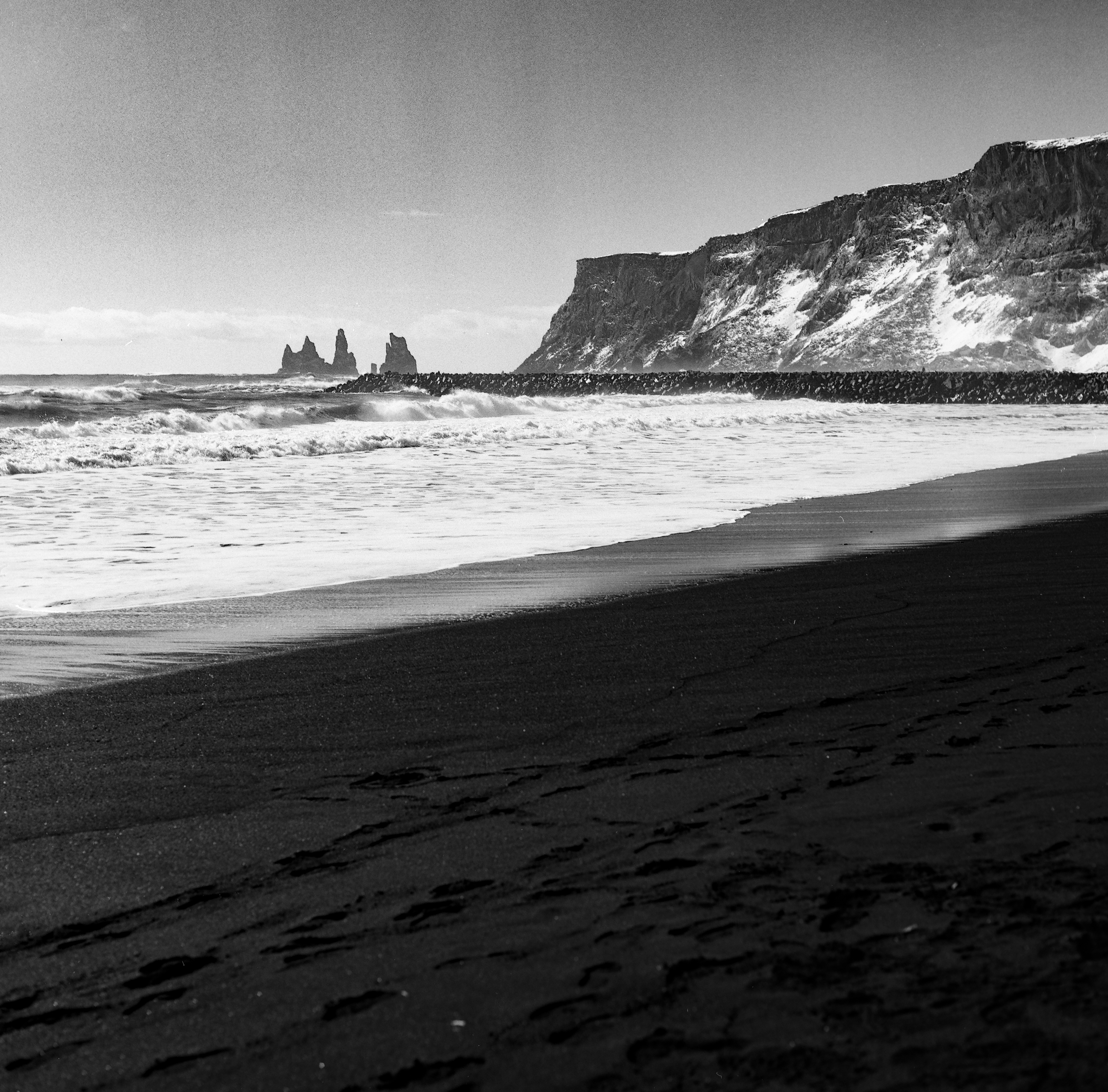
I love the drama of the rugged rocky coast in this shot with tiny people out along the shoreline, including a row of people on horseback deep in the frame on the right under the cliffs.
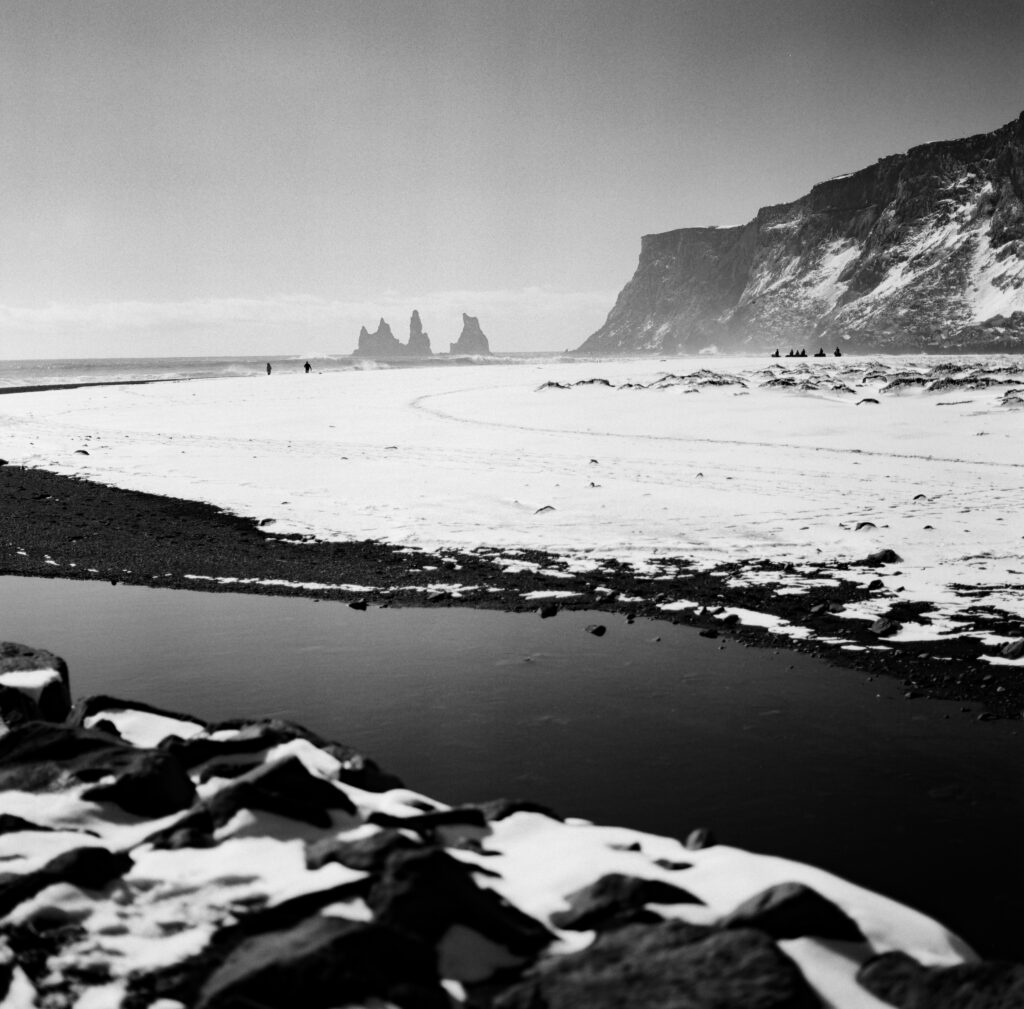
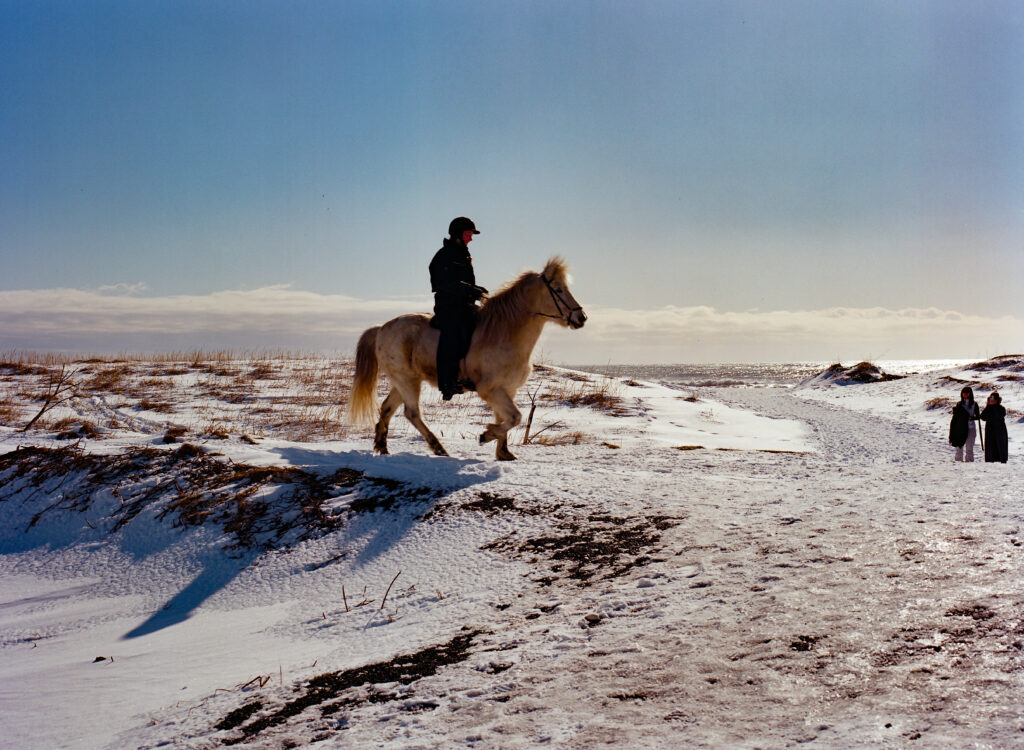
I grabbed some shots of the riders as they approached and love the timeless look of this image on Delta 100. Courtesy of an introduction by Hamish, I had asked a local photographer Laura Cogan for advice on film stocks, and she advised bringing plenty of slower emulsions, which turned out to be a great tip now that the sun had come out, particularly as the Hasselblad’s max shutter speed is 1/500th. This shot of a line of riders silhouetted against the sea has a very nice timeless look.
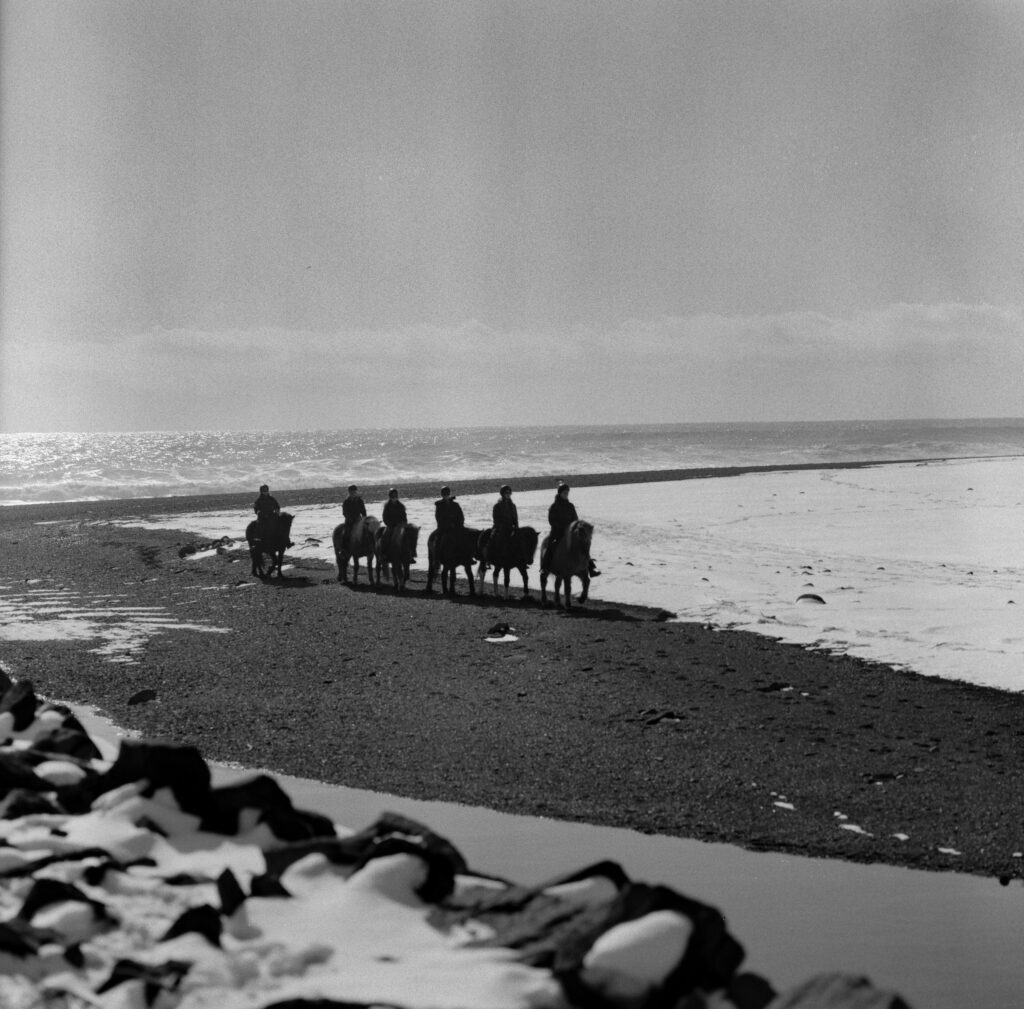
I shot mostly Delta 100 and Ektar and I think they both look awesome in the bright winter light. Iceland is famous for its horses and riding is a big attraction at places like Skalakot and the beach at Vik.
It was close to the end of “Northern Lights Season” in Iceland, and also Spring Break in many parts of the world, including China. Everywhere we went, there were young people enjoying themselves in the epic locations, often memorializing their travels on smartphone photos/videos, including this young couple doing a lively dance on the black sand beach.
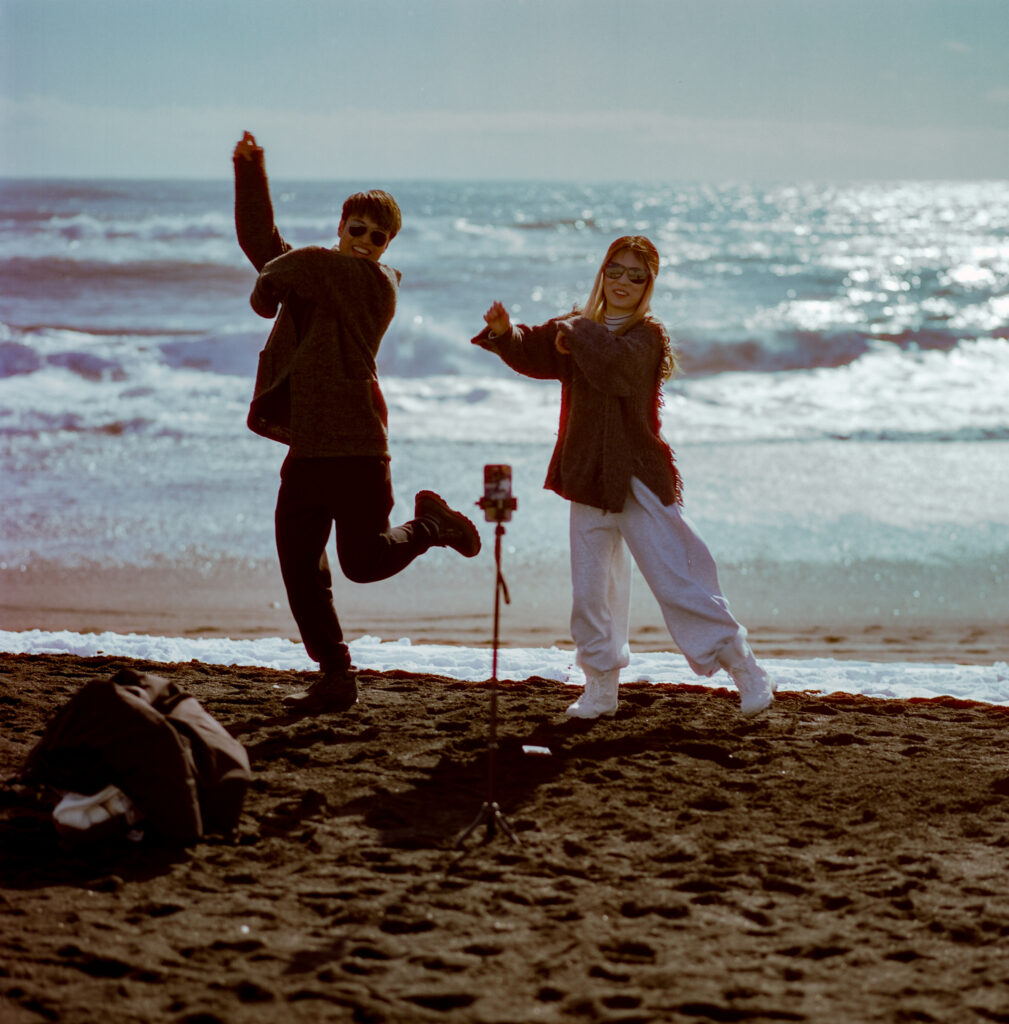
This was shot on Cinestill 50D, which wouldn’t have been my first choice for shooting a backlit beach scene because the lack of a halation layer plays some tricks with bright highlights off the surf, but I had loaded it thinking I was finished at the beach before spotting those dancers, and I couldn’t resist shooting a couple of shots of them.
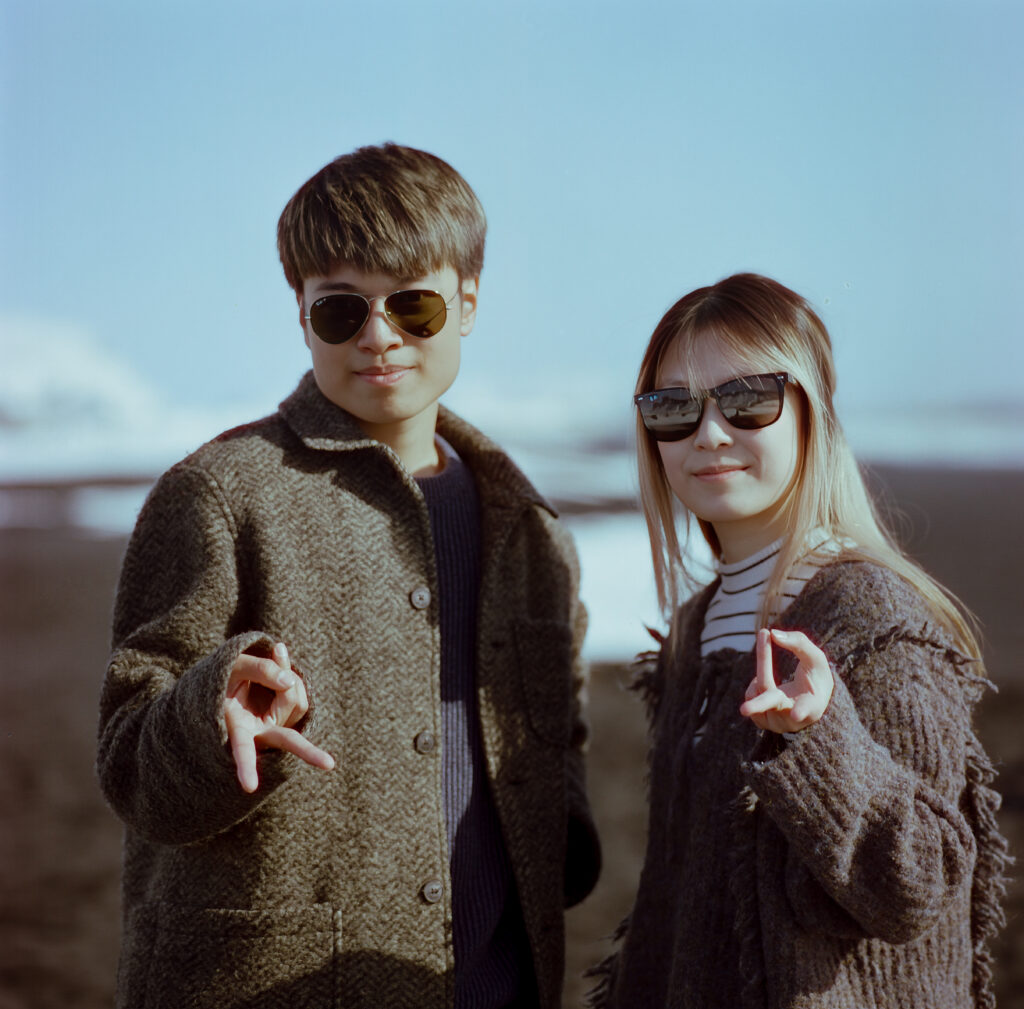
There’s something a little odd and off to my eye with the color rendering in these Cinestill shots that almost looks like they shot through a yellow/green filter. But the young dancers were good sports and were nice enough, after a combination of broken English and hand signals (I have zero Chinese, so credit to them!) to stop dancing long enough for me to do a 2 shot portrait.
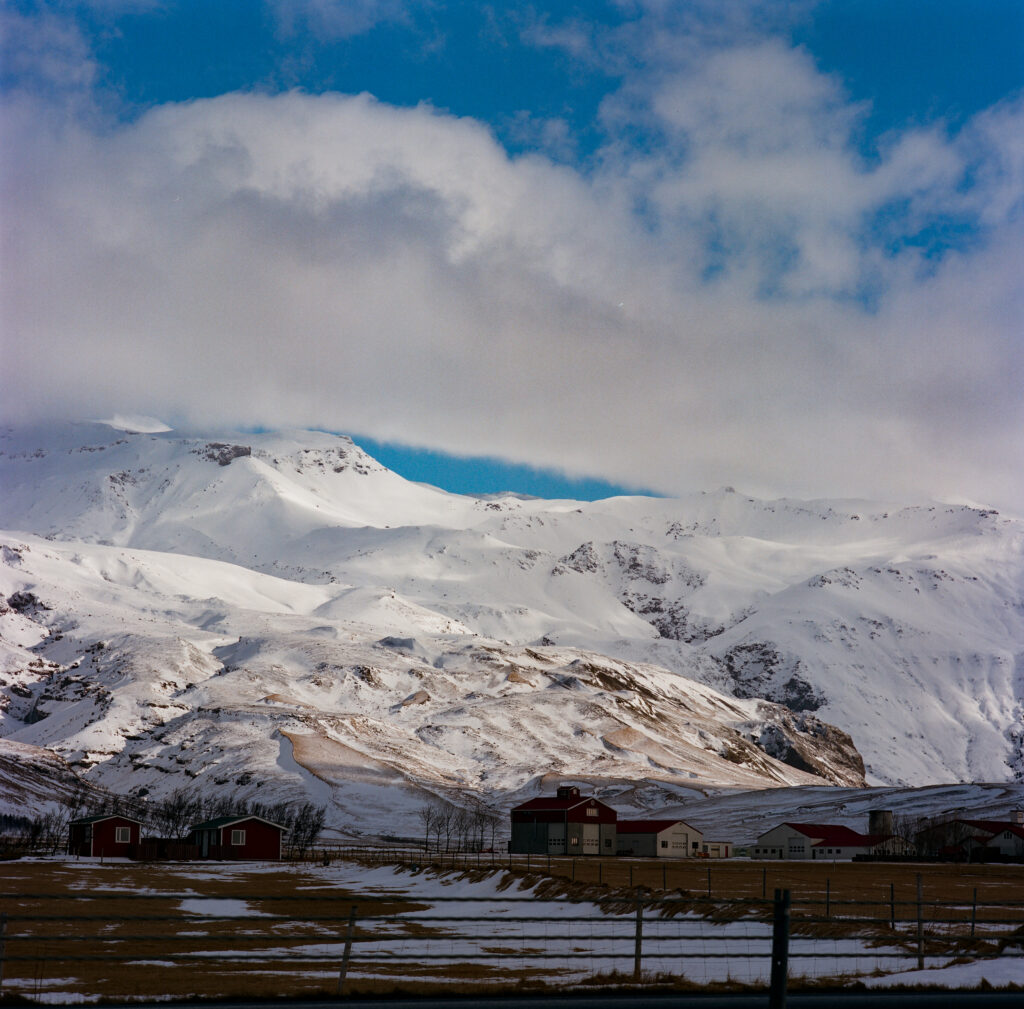
As we drove along the coast, we were having an amazing afternoon, enjoying the gorgeous day and the stunning landscap, including this glacial mountainside, now on Portra 160, which looks pretty great capturing ice, sky and low hanging clouds.
After our stops at Vik and other attractions along the ring road, we were 3&1/2 hours into our 3 hour drive and still had 2 & 1/2 hours to go. Backtiming from when the last dinner seating at our hotel was likely to be, we realized we had to make a push. So for the next couple of hours we drove past one gorgeous landscape after another without stopping, heading to the the southeastern edge of Iceland via a drive that felt like we were going to the end of world.
When we were bout 20 minutes from the hotel we spotted a busy looking parking lot and decided we had enough time to pull over and have a look around and what the attraction was. Again, we hadn’t done much homework beyond looking at the hotel websites, so we didn’t really know what to expect or to look for on that end of the island.
We were stunned by what we discovered when we followed the busy footpath out of the parking lot.
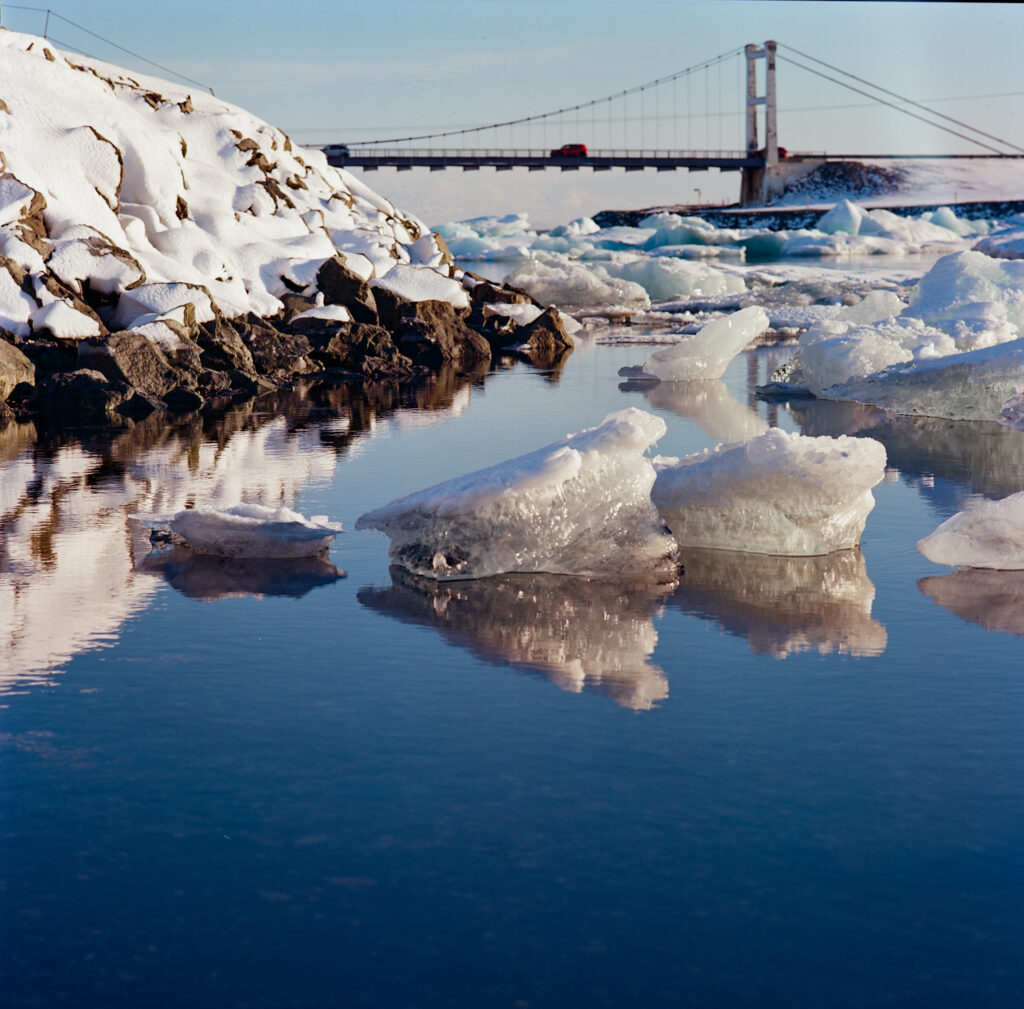
The Jokulsarlon Glacier Lagoon is one of the major attractions of the south coast of Iceland, famous for the 1,000 year old icebergs that are constantly calving off the Breiðamerkurjökull Glacier, and floating out into the North Atlantic. The slowly melting ice formations were awe-inspiring in the late afternoon light.
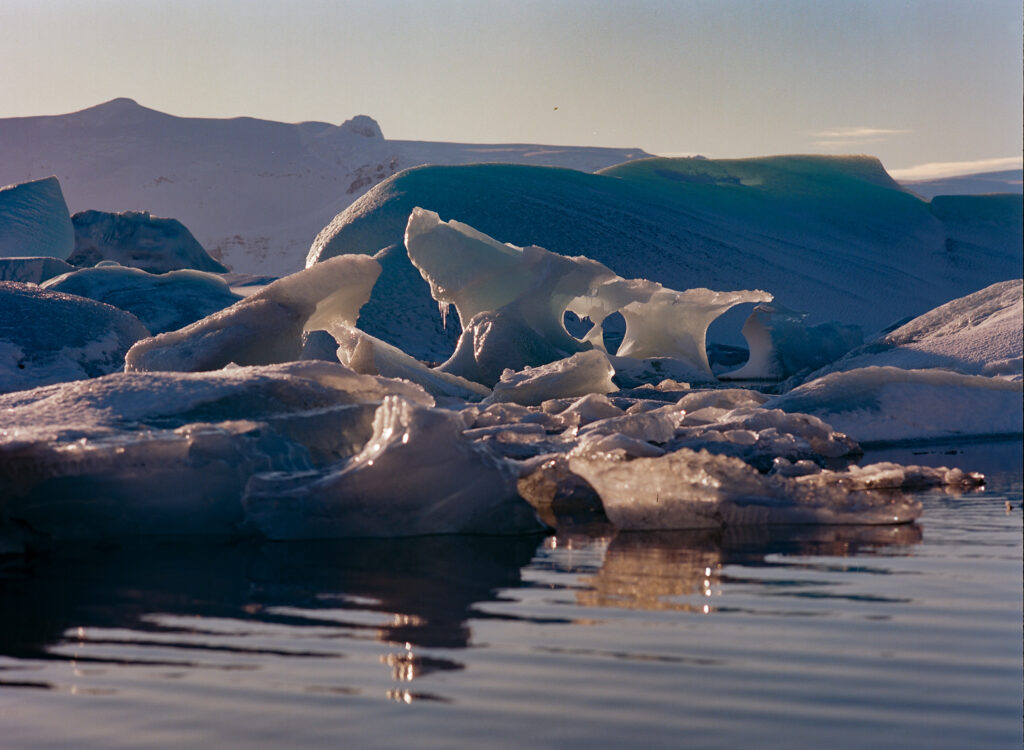
This small ice formation reminded me of a horse, fitting for a nation known for its horses.
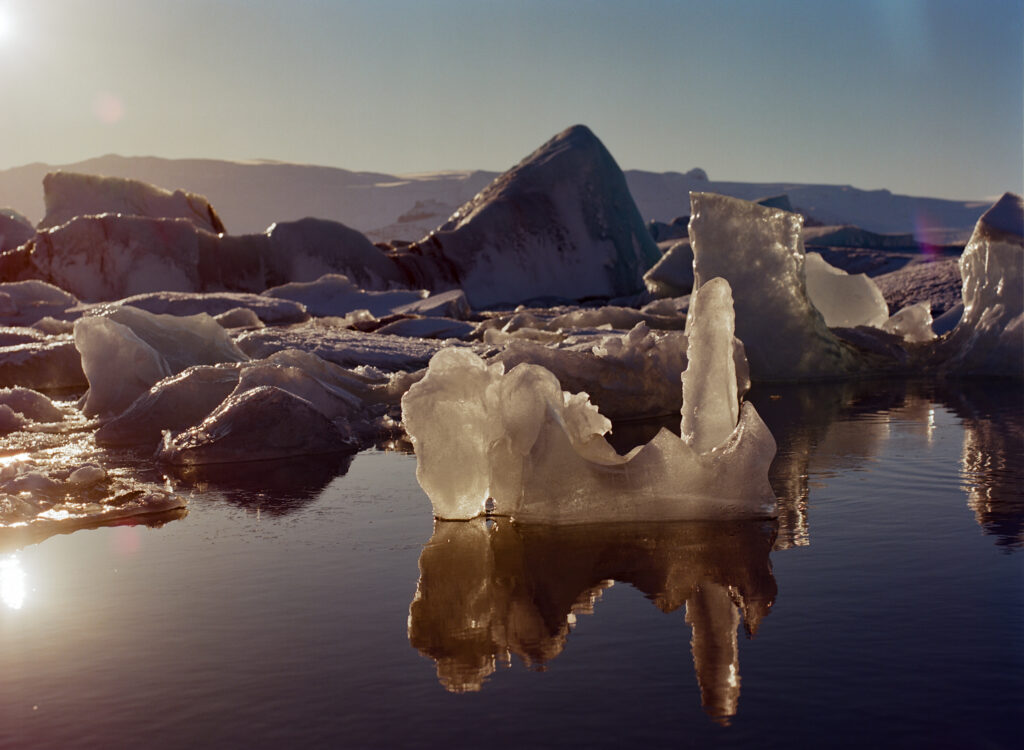
After spending over an hour exploring Jokulsarlon, it was getting pretty late in the day and we had to get ourselves to the hotel in time to check in, have dinner and then hole up for another major winter storm that was forecast for Thursday. So I packed up the Hasselblad and headed to the hotel, landing there just ahead of a busload of tourists, mostly from east Asia.
Day 5, Thursday
The next big winter storm lived up to its billing and we spent most of Thursday indoors at the hotel, also built on the site of an old farm. The hotel, a little under 2 years old, is sleek and modern with lots of wood and glass. But as a nod to the property’s history, they have the farm’s actual 1950’s era tractor, beautifully restored, on display in the lobby, and the seats at the hotel bar are topped with metal tractor seats.
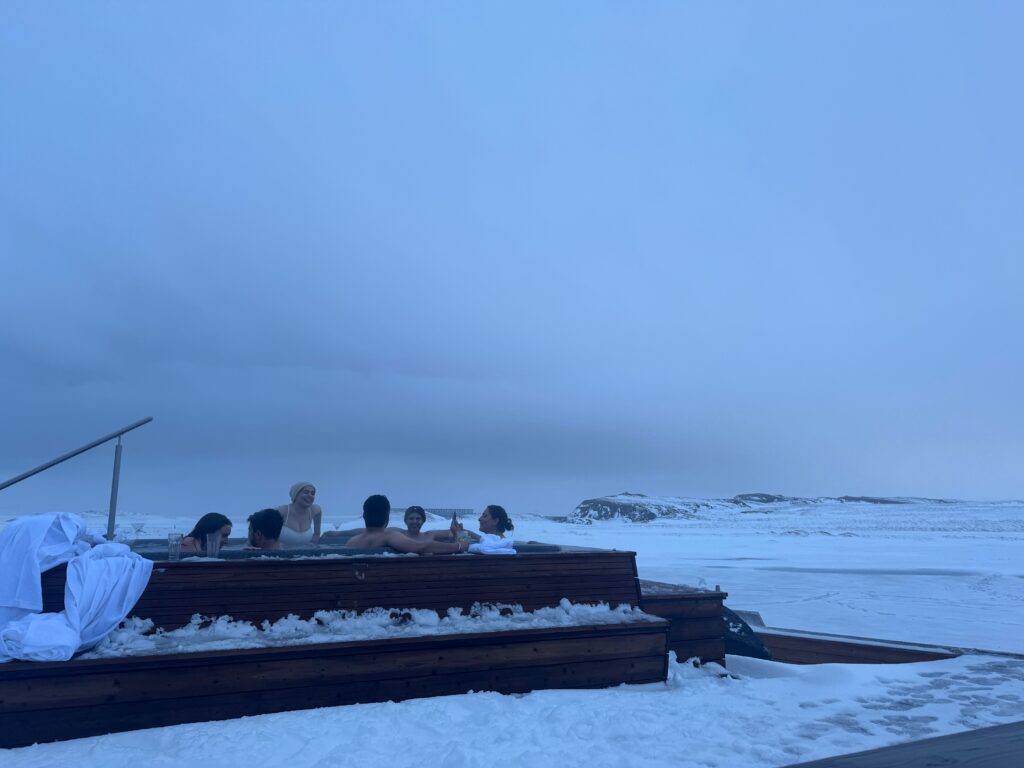
My only excursions of the day were out into the now familiar 50mph driving snow & wind to collect Beth’s gym shoes that had been left in the car in the rush to check in ahead of the bus. And once the winds died down enough, I went for a late afternoon hot tub on the deck of the hotel.
Day 6, Friday
After a bit of worry about getting stranded an the icy edge of nowhere and missing our flight home, Friday turned out to be another gorgeous sunny day, perfect for the long 5 hour drive back to Reykjavik that was destined to take about 10 hours in our emerging style of frequent stopping whenever the inspiration of the moment called for it.
Our first stop was Diamond Beach, which is connected by water to the Jokulsarlon Glacier Lagoon.
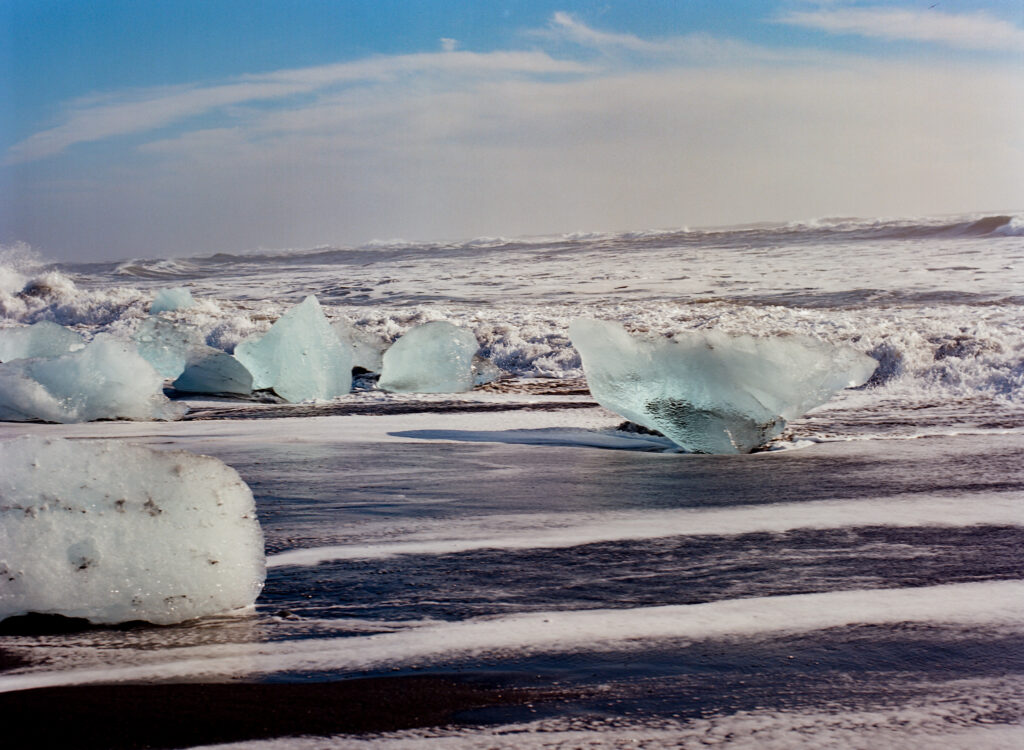
Diamond Beach is named for the profusion of ice bergs and boulders that litter the beach as they make their way from Jokulsarlon to the sea. It’s a gorgeous spectacle with the giant shards of ice against the black sand and the crashing surf. Timing photos of breaking waves takes a bit of patience and some luck, and this shot was one of my more successful efforts.
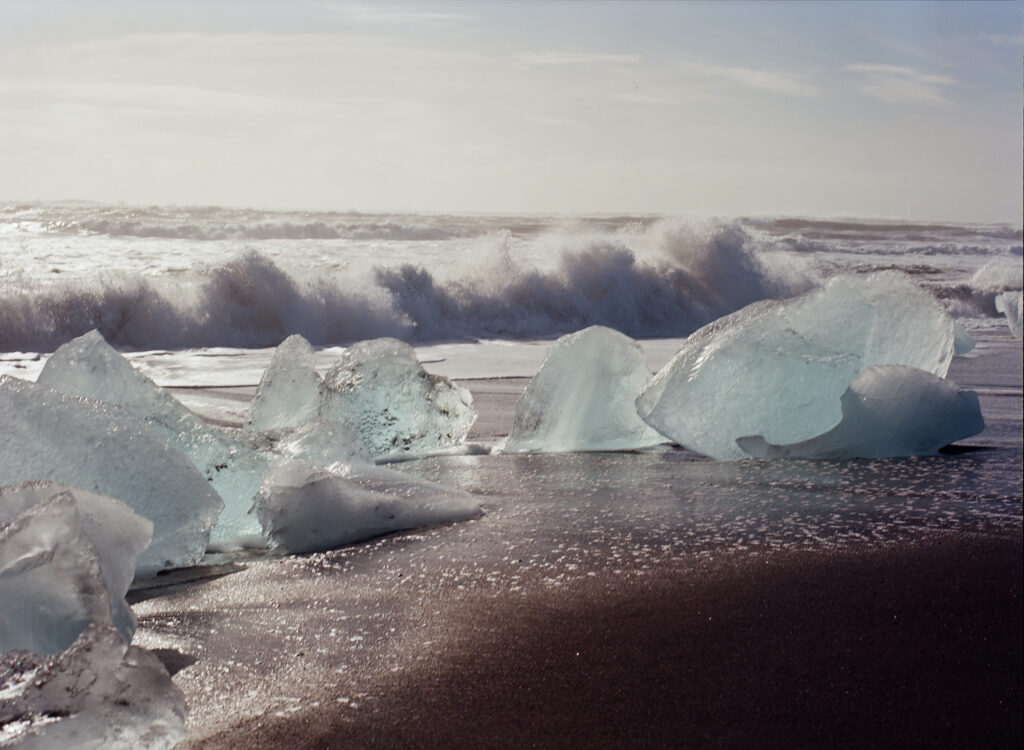
The ice was beautifully backlit by the morning sun.
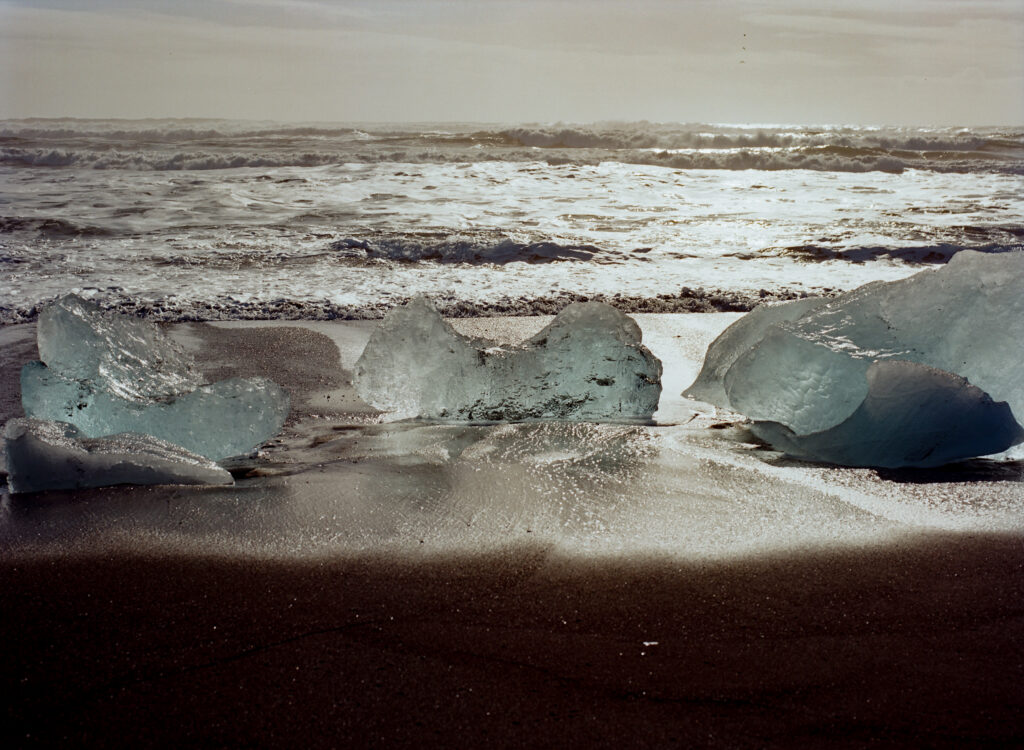
After shooting out a roll of Ektar, I switched to Delta 100, which also looks amazing, with stunning contrast between the black volcanic sand and the pale gleaming glacial ice and the white foam of the surf.
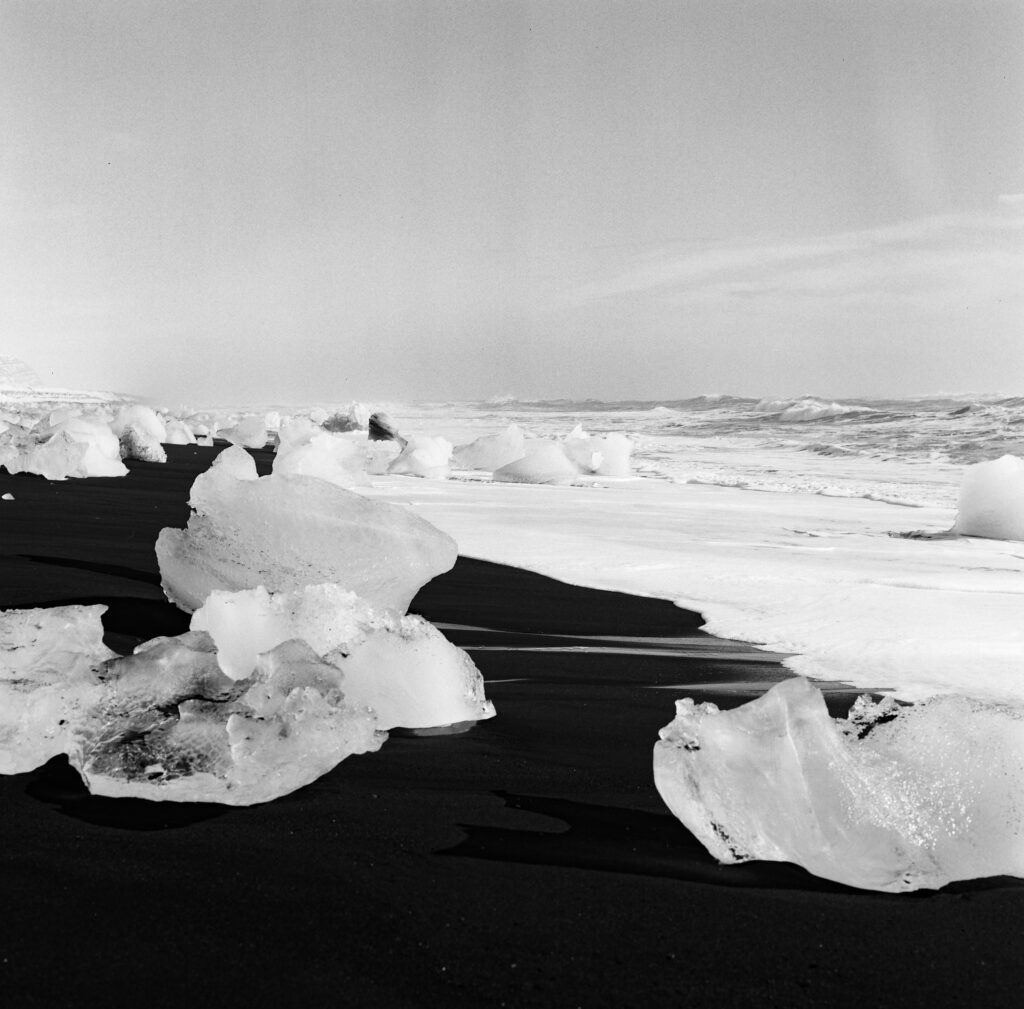
This was my last shot on Diamond Beach. As I was lining up another shot of a large ice berg with a round hole in the bottom, I kept moving closer to get a more dramatic angle through the hole and was startled by a rogue wave that went far further and much faster up the beach than any other waves had for the hour or so I had spent taking photos on the ice strewn beach.
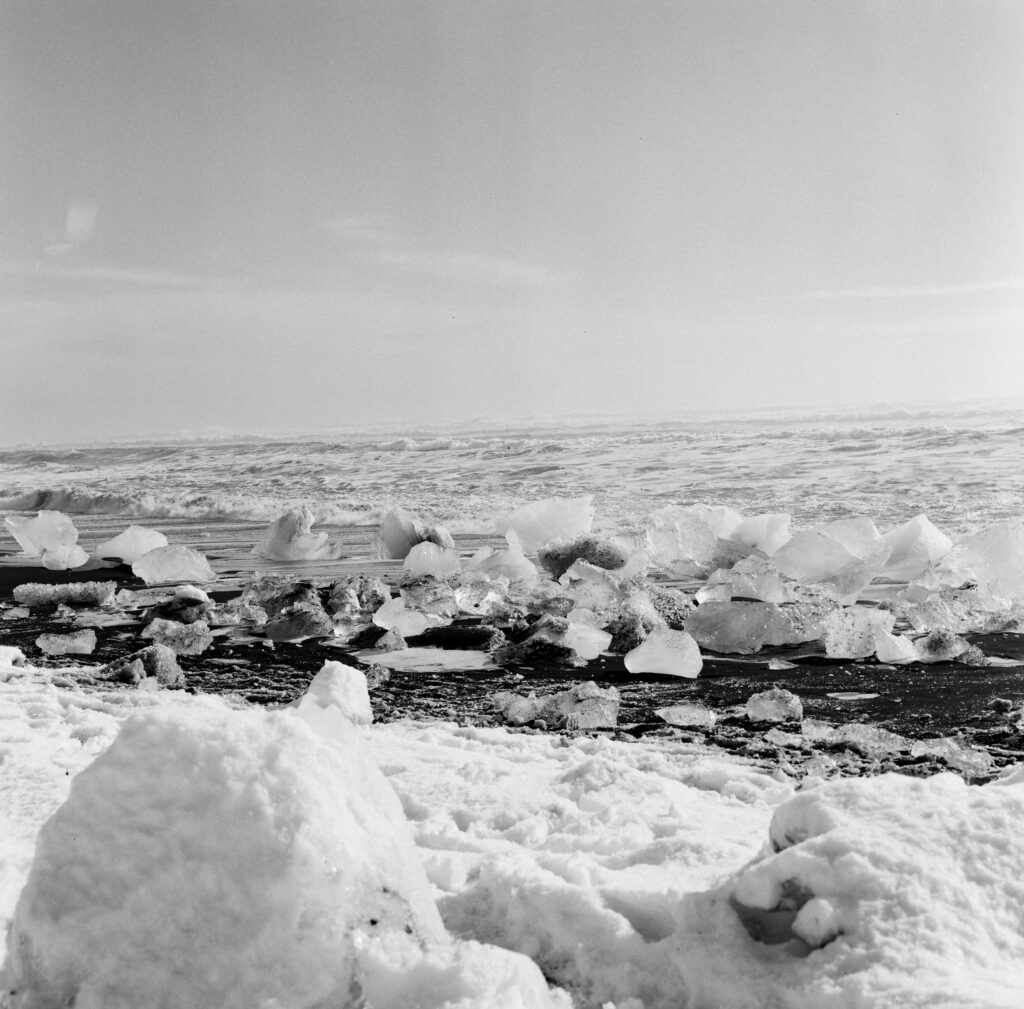
I fled up the beach, dodging ice boulders and bergs, and ended up calf deep in the icy water of the North Atlantic. Beth was caught by the same wave and fortunately we both had a change of shoes and socks in the Toyota, so the day wasn’t ruined at the start. But we were finished shooting on the icy beach with its erratic rising tide and decided to head back for another look at Jokulsarlon in the morning light. The only casualty of the misadventure was my Pentax digital Spot Meter, lost forever in the icy waters of the North Atlantic while I was dodging icebergs while fleeing a rogue wave.
I’ll miss that meter, but at least it makes for a good story!
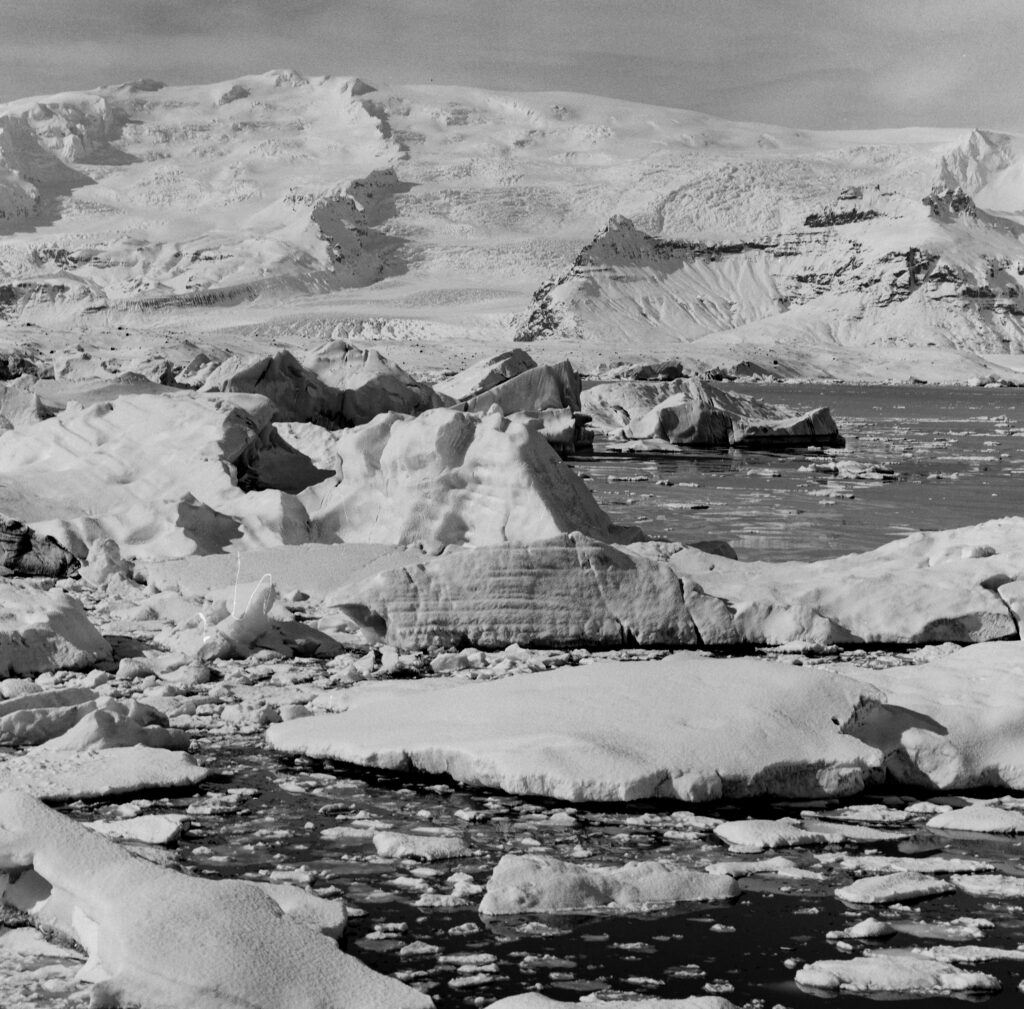
Jokulsarlon looks awe-inspiring in any light and is one of the most primordial sites I’ve ever visited. This shot of the glacier on Delta 100 looks like it could have been taken on the Shackleton Expedition, or in middle of the last great Ice Age when the most advanced form of image making was painting on cave walls.
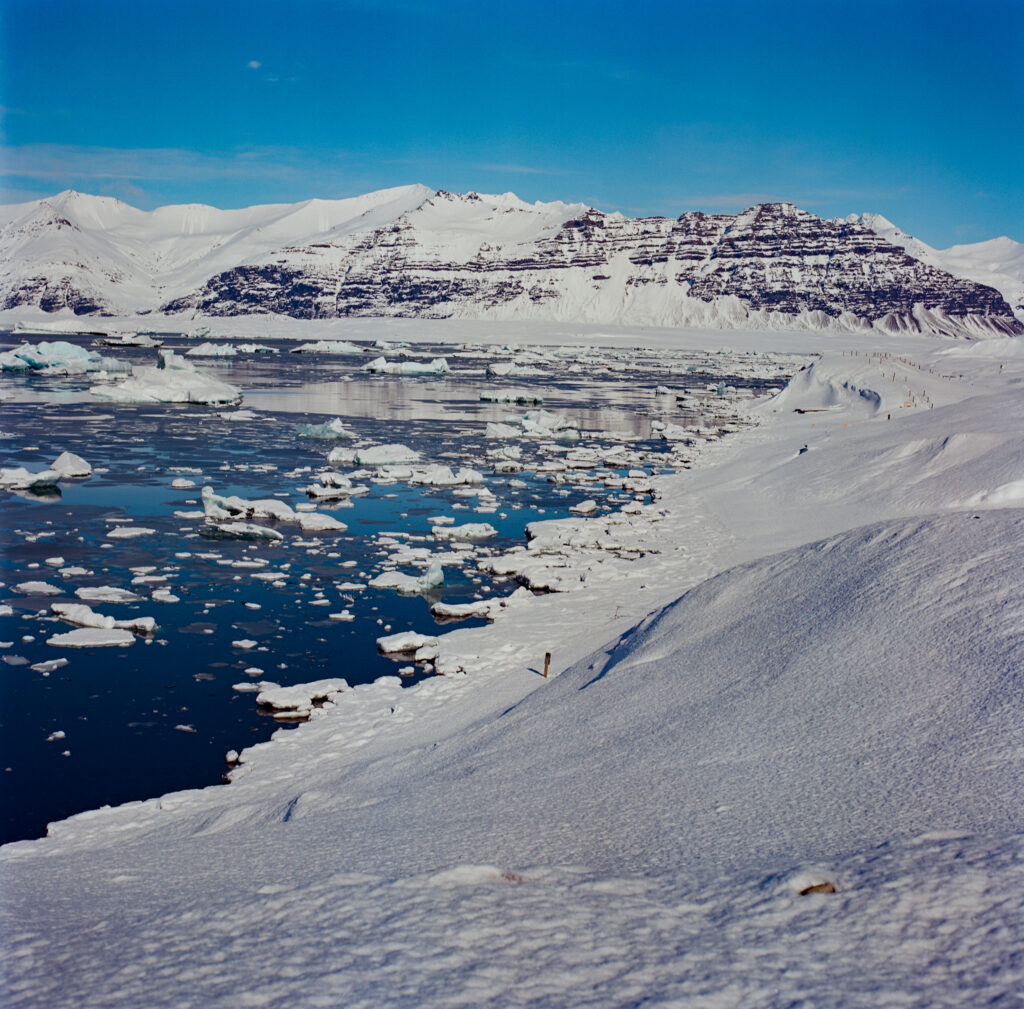
Somehow a color photo, while looking amazing, doesn’t give me the same ‘lost in time’ feel.
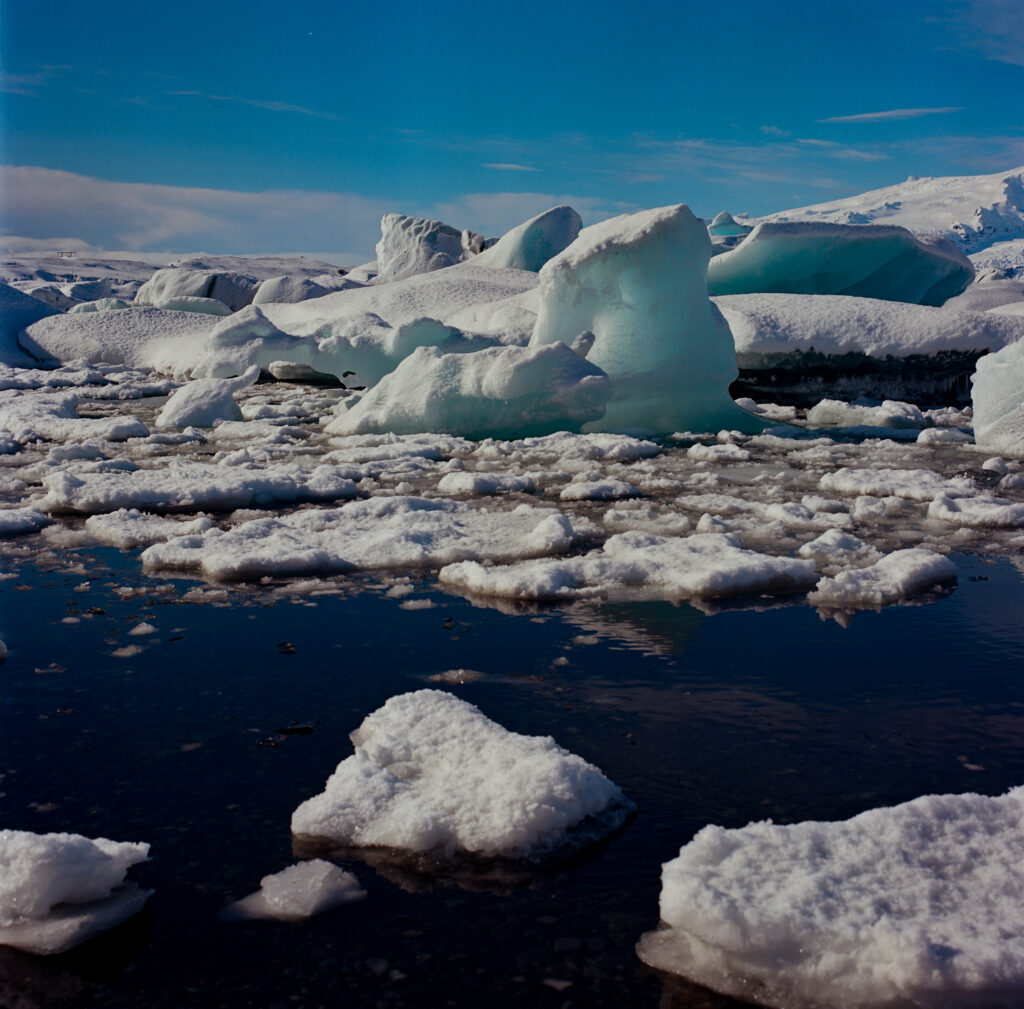
Again, the ice formations take on fantastic shapes, here is another one that reminds me a bit of a rearing horse.
I met Paolo, a very nice professional photographer from Madiera, Portugal who admired my Hasselblad. I in turned admired his late model Leica M6, which was loaded with Velvia. We traded portraits and Instagram handles. He was very pleased with his portrait and impressed by the fine grain and color captured on Ektar with the Zeiss Planar. I’ll be excited to see his Velvia shots when they come out of the lab.
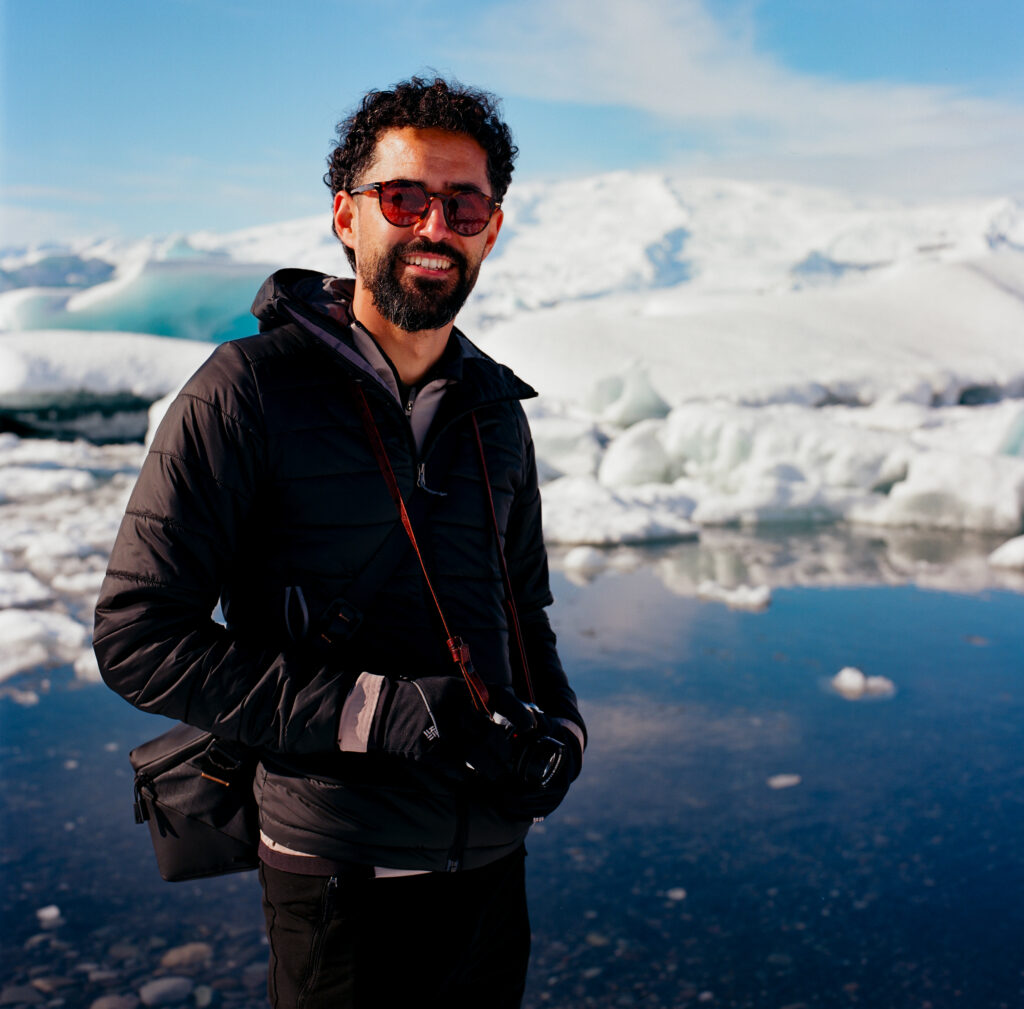
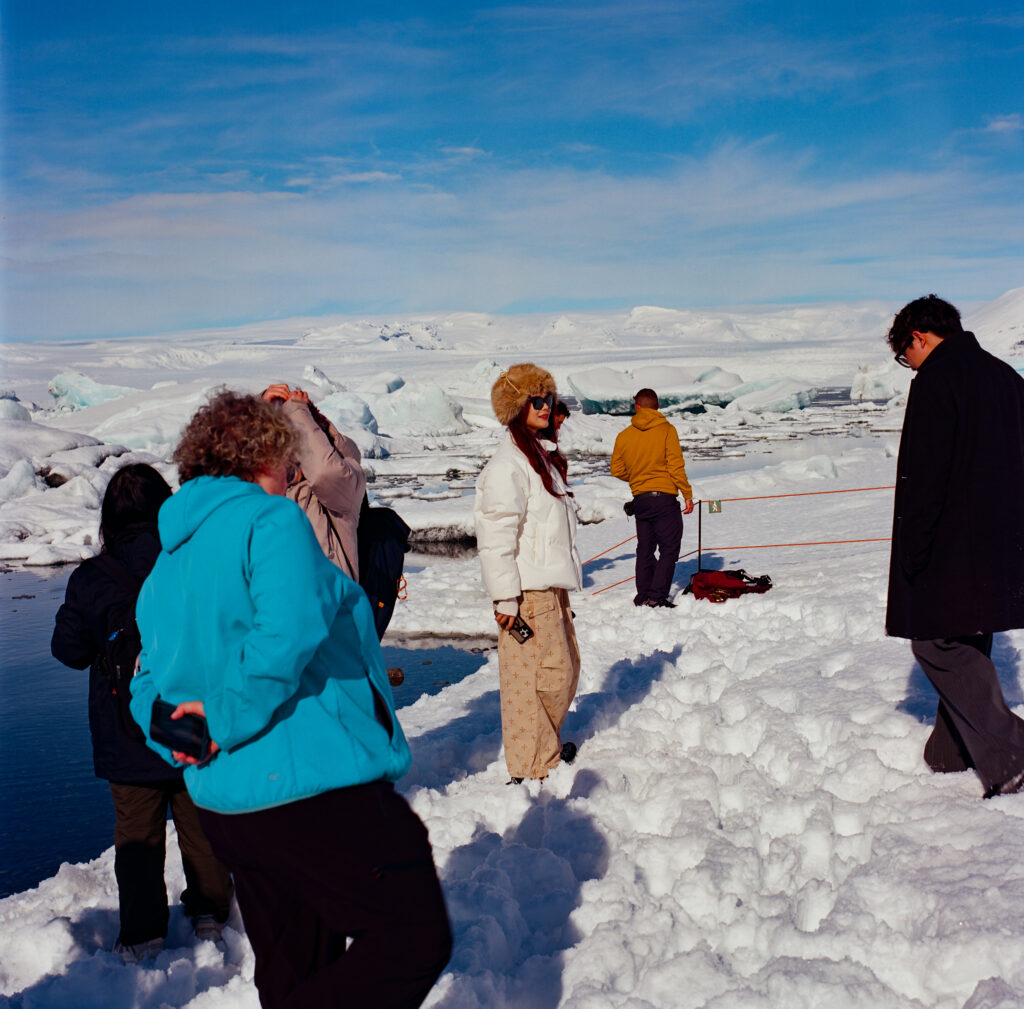
As in most places we went there were plenty of fellow tourists, including people who managed to make their cold weather gear look pretty glamorous.
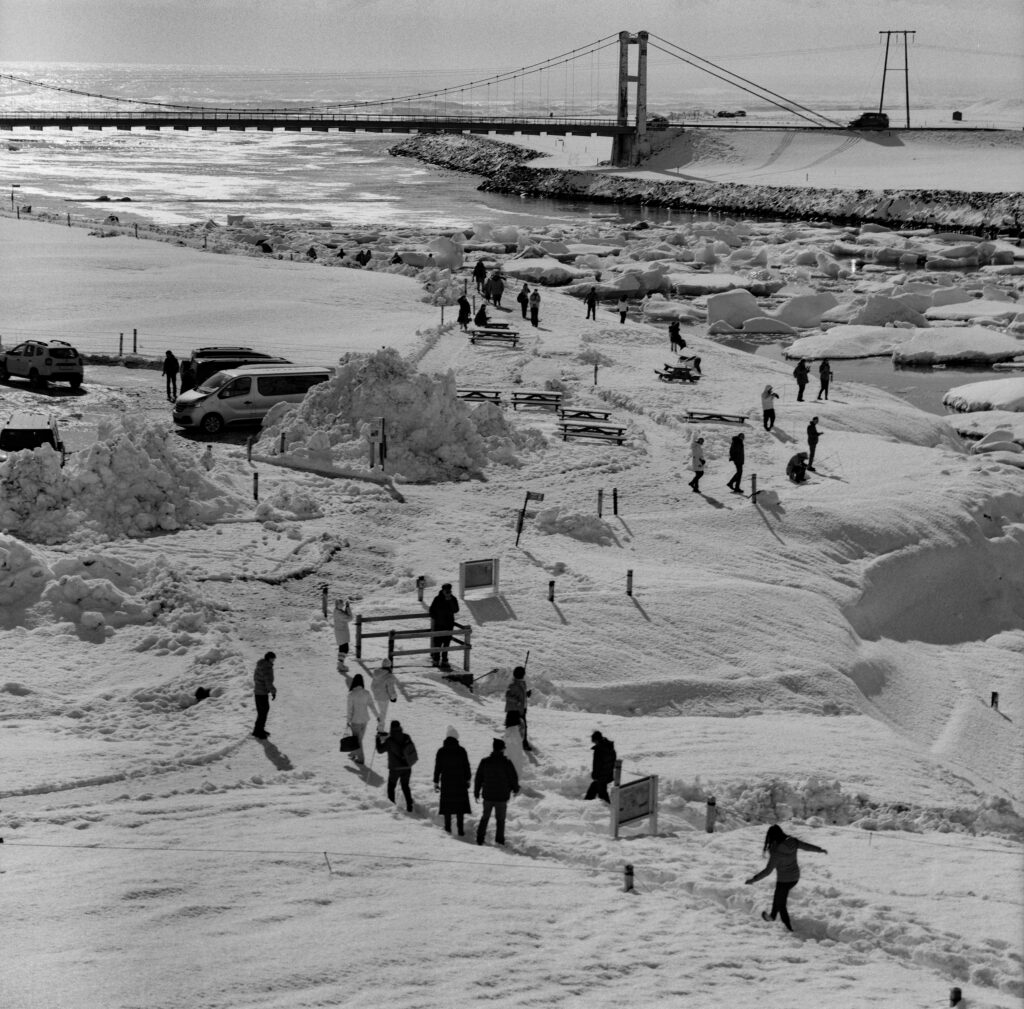
There is a small hill where you can get an elevated view of both the Glacier Lagoon to the north and Diamond Beach in the distance to the south and in between, the floe of ice bergs making their way out to the North Atlantic as well as my fellow visitors making their way to and from Jokulsarlon. I love the layers of depth and the graphic array of people on the icy footpaths from this shot on Delta 100.
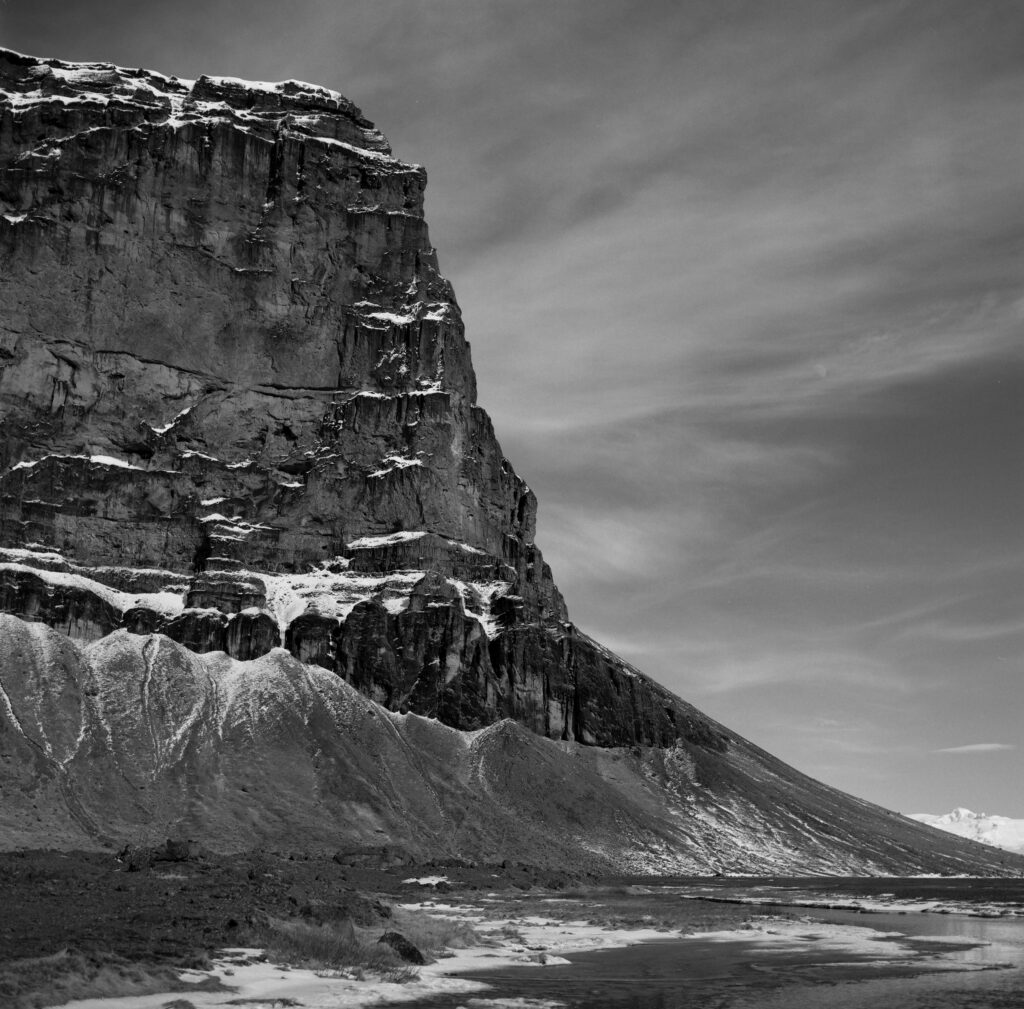
As we made our way westward along the south coast, we stopped at some of the places we had admired on the drive east when we didn’t have time to explore, including this dramatic mountain cliff with the moon low in the daytime sky. A great shot for my longest lens, the 150mm Sonnar.
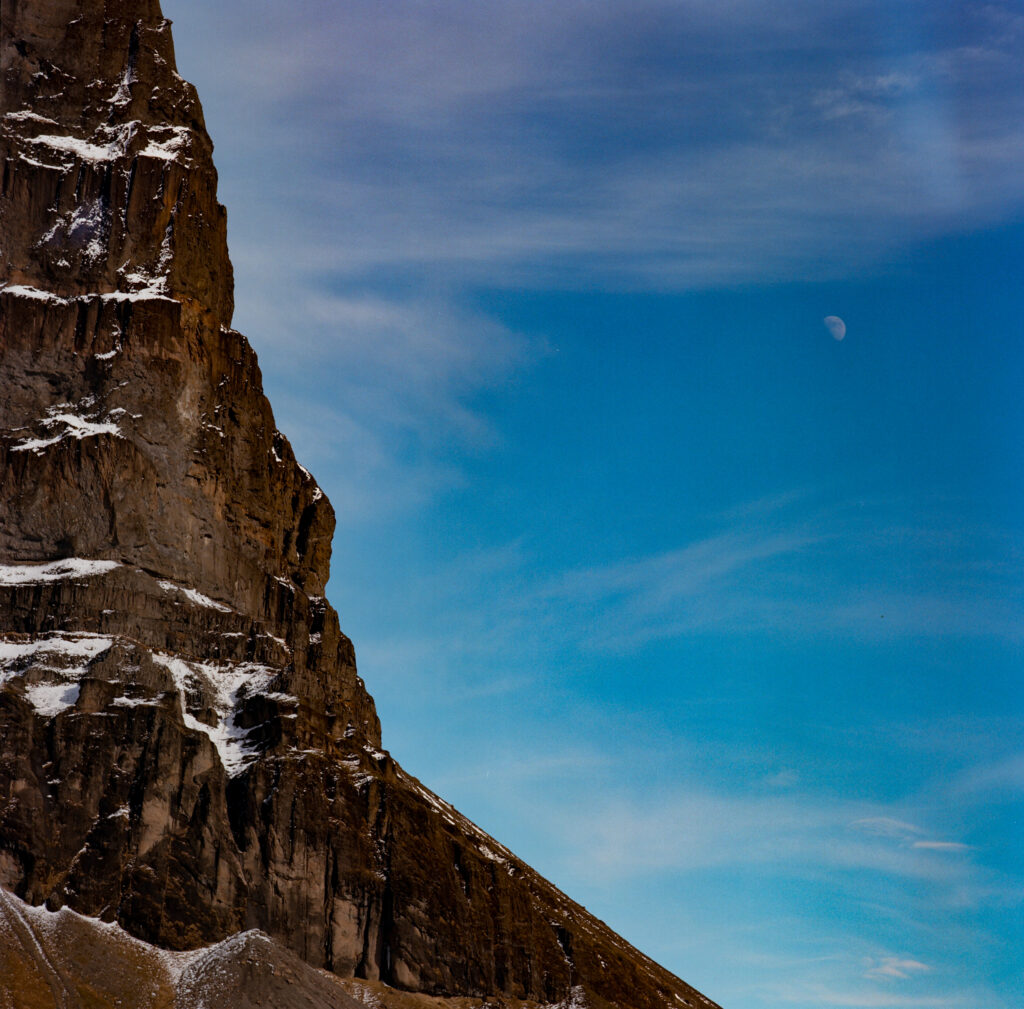
I thought that vista would have a strong ‘classic’ landscape look on black & white with a red filter, so I switched back to the 80mm Planar for a wider view to give a sense of the shape of the stark mountain jutting into the lowlands. You can still see a hint of the moon behind the thin cirrus clouds that were moving in.
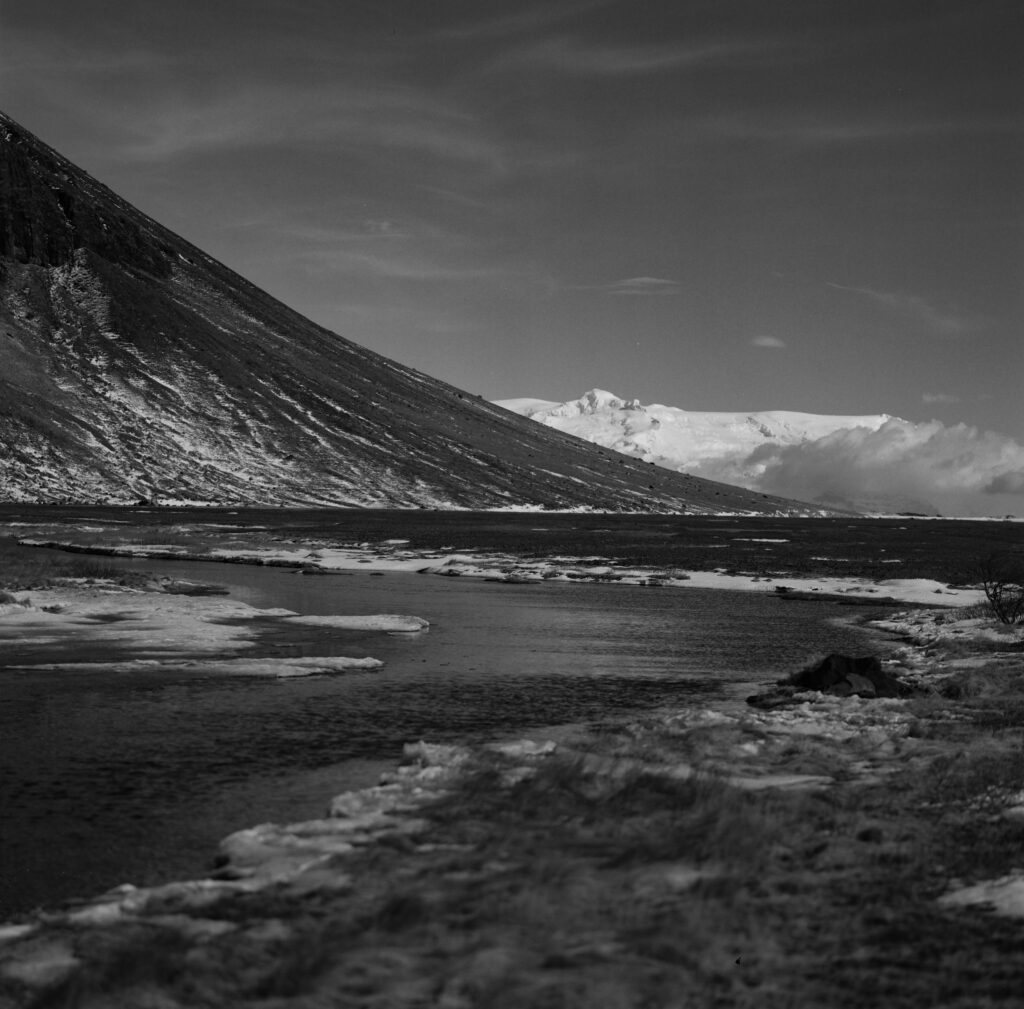
I also grabbed a shot of the shallow river next to the mountain and the Jokulsarlon glaciers receding in the distance, including some low hanging cloud/mist in the midground.
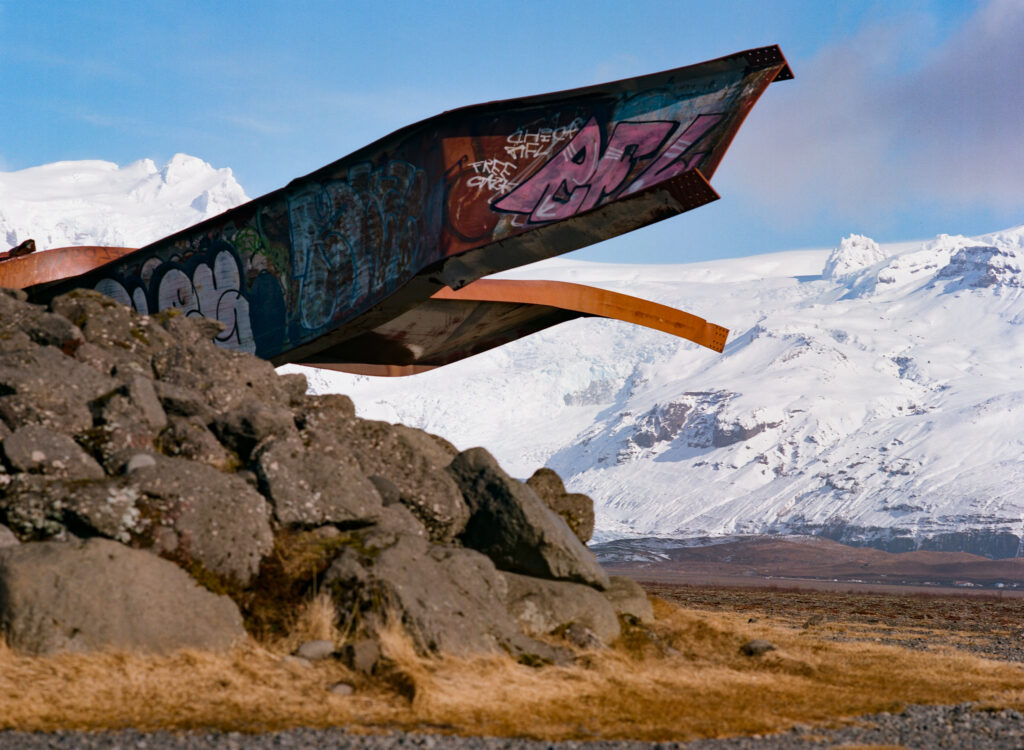
Another stop was at the Skeioara Bridge Monument, which is the remains of a steel bridge that was destroyed by a volcanic eruption in 1996.
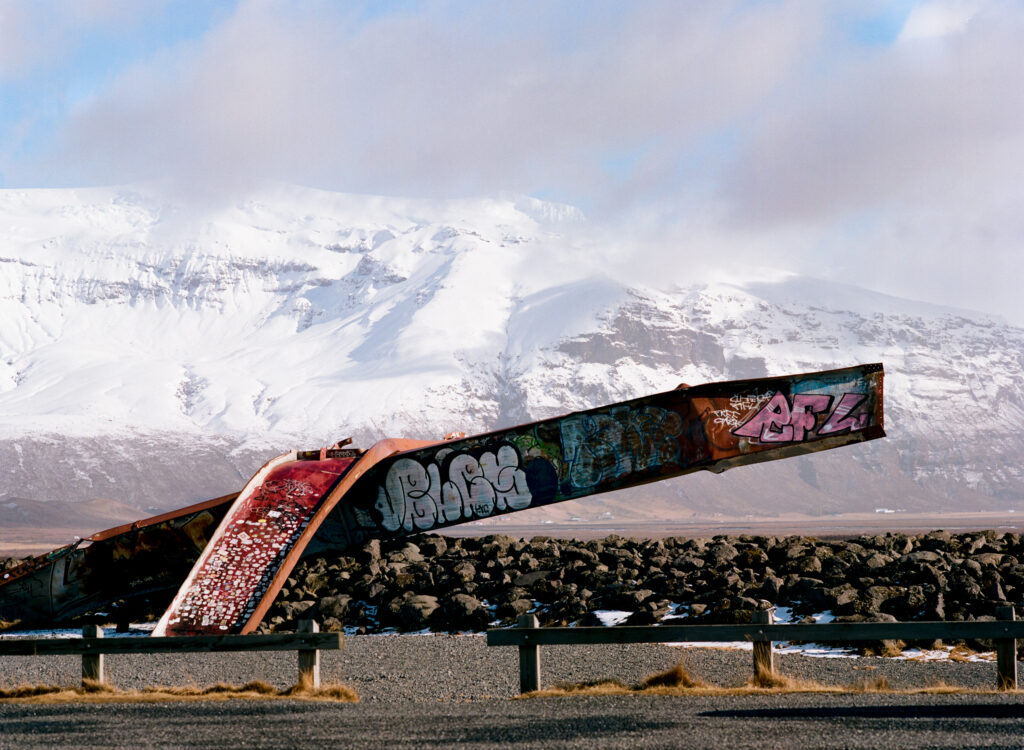
The juxtaposition of the mangled rusting steel hulk, urban-looking graffiti and the timeless power of nature is interesting.
The first hour of the drive was dominated by glaciers, which are quite big and impressive compared to the visibly shrinking ones I remember from the Canadian Rockies. This is not surprising, given that Iceland is 800-900 miles north of Banff and Lake Louise and well within the Arctic climate zone. But even the glaciers of Iceland are receding, as evidenced by the existence of the Jokulsarlon Glacier Lagoon made of ice that is steadily coming off of an outlet glacier connected to the massive Vatnajokull Glacier, the largest glacier in Europe.
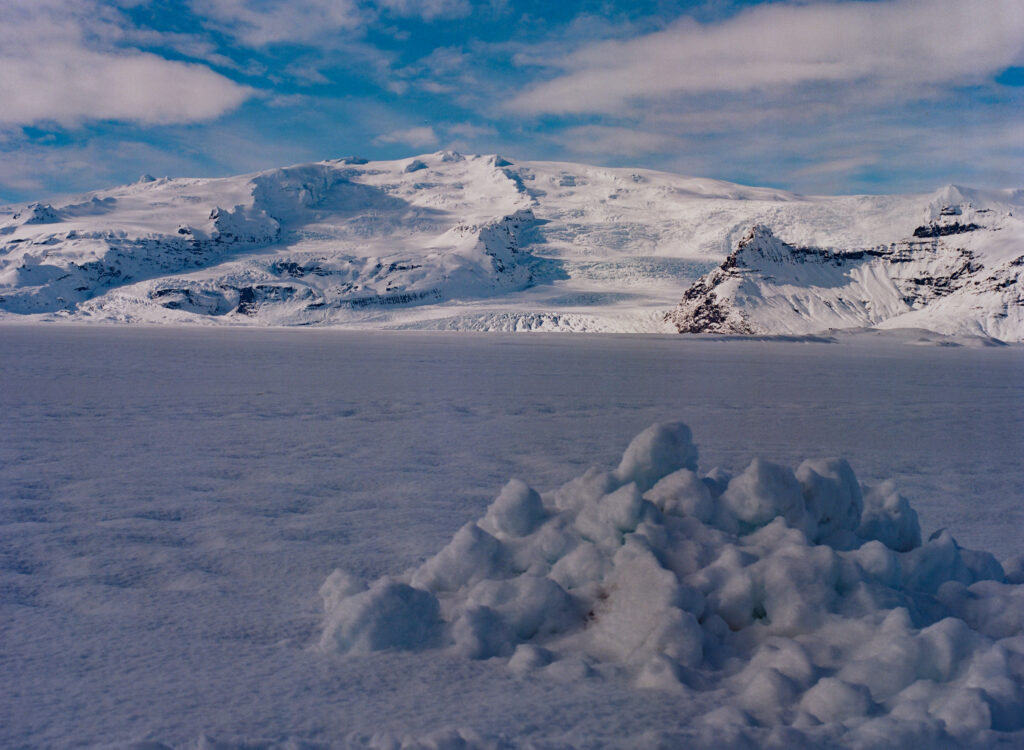
The big glacial zone on the far east of the island was followed by an area that had more of a brown “Badlands” feel, also quite beautiful and photogenic.
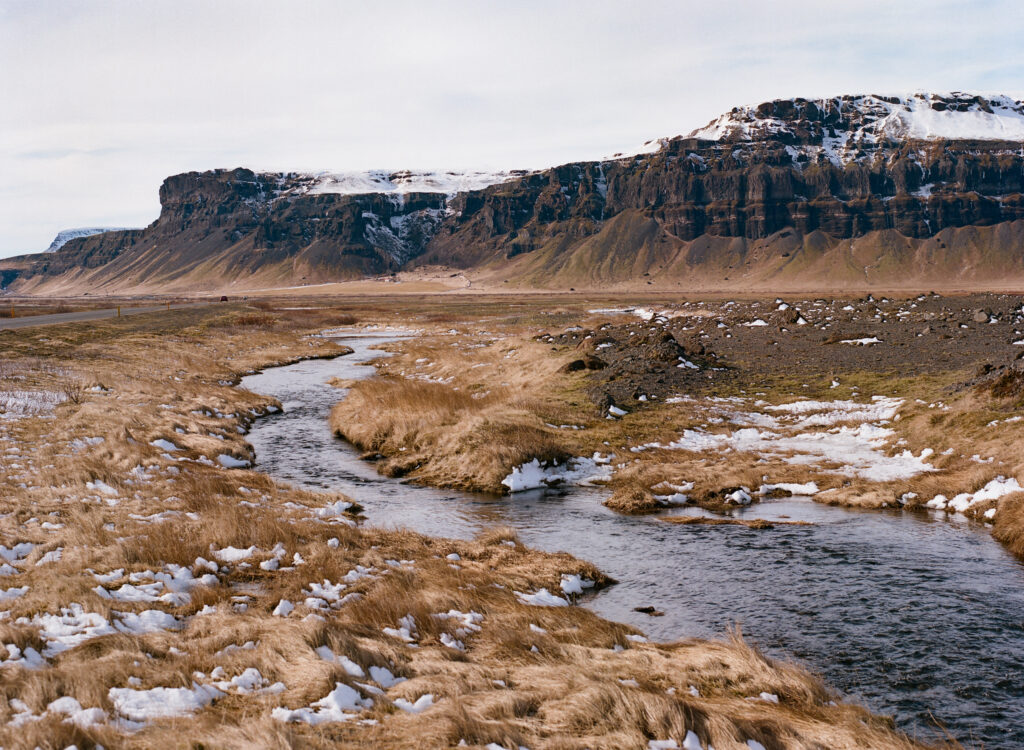
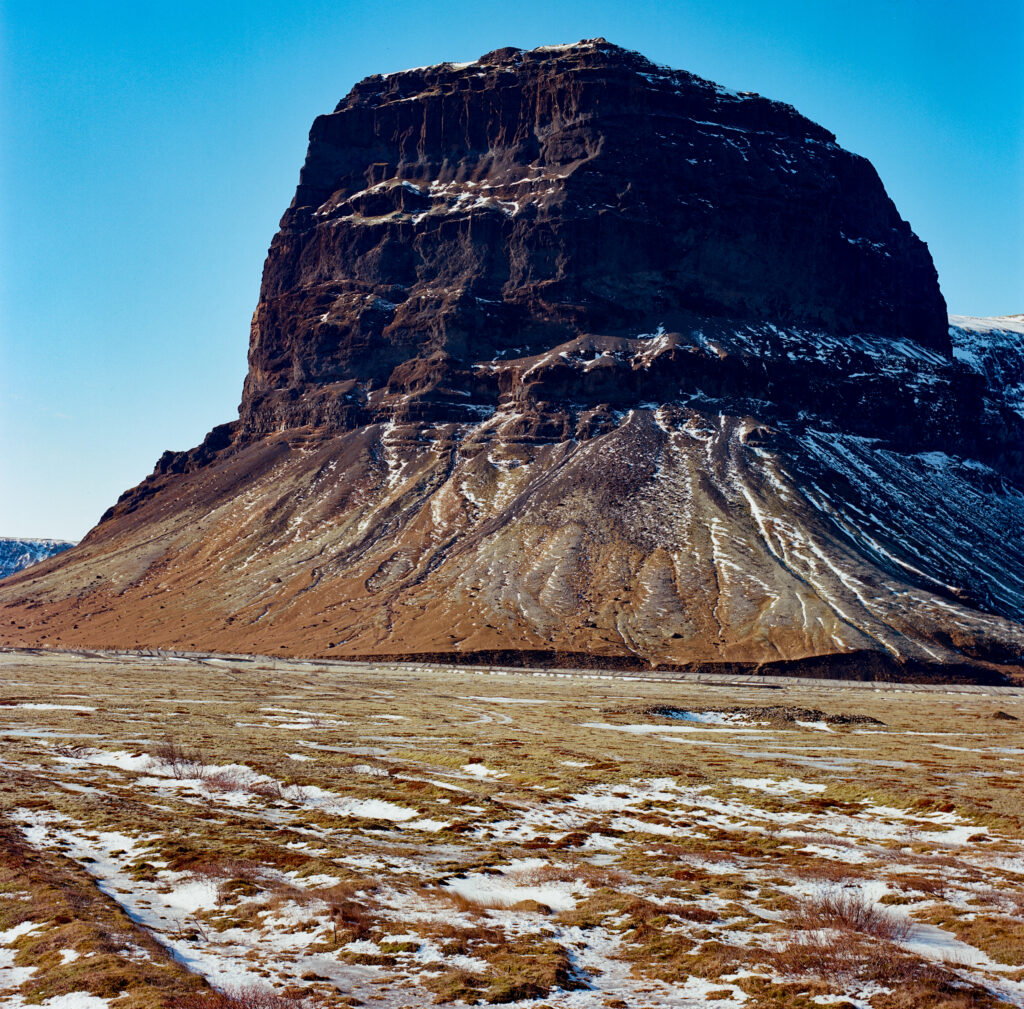
For many years, I have rated the Columbia Icefields Parkway in the Canadian Rockies as the most scenic highway I had ever visited, but now I have to say that the Ring Road along the south coast of Iceland has it beat. Immersing myself in landscape shooting in Iceland after about a year of NYC street shooting was a nice refresher, and I think the photos look amazing on the 503CW!
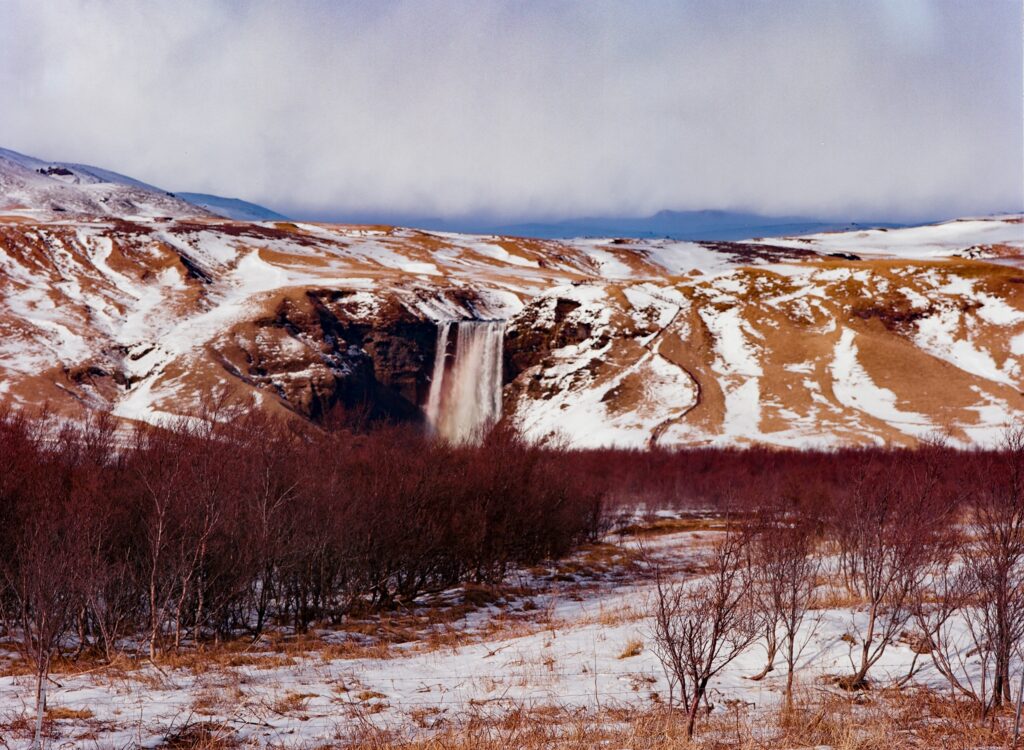
Our final stop before returning to Reykjavik was the Skógafoss waterfall, which we had seen in overcast conditions heading east. On our way back west it was very nicely lit by the late afternoon sun with just a hint of a rainbow in the mist from certain angles.
After that we headed into Reykjavik for a lovely final dinner with Leifur and Sasi, our friends who had helped us set up our itinerary including recommending the fabulous South Coast Ring Road, Skalakot and Jokulsarlon. We had a delicious meal and wonderful company to celebrate a fabulous week in one of the most beautiful places we had ever been. As it turned out, the flight delay was a blessing in disguise, as we enjoyed the best weather of our stay on the exact two days of our major sightseeing drives. We were coming home with wonderful memories, some cold weather clothing made in Iceland by 66 North, and 22 rolls of 120 film with many, many indelible images.
It was one of the trips of a lifetime, and I have a feeing we’ll be back!
FEATURE IMAGE: VIK BEACH, Hasselblad 503CW, Zeiss Planar 80mm f2.8, Delta 100
Share this post:

Comments
Jeffery Luhn on Iceland! A Photographic Travelogue shot with a Hasselblad (and iPhone)
Comment posted: 18/04/2026
Comment posted: 18/04/2026
Tony Warren on Iceland! A Photographic Travelogue shot with a Hasselblad (and iPhone)
Comment posted: 18/04/2026
The contrasting phone, zeiss and Kodak lenses images I find interesting and point up the way lens design influences results. The phone shots have near perfection, bot in a graphic sense and colour wise. The Sonnar shots have a quite smooth rendering while the Ektar somehow has a little more bite. Maybe I should get out more but these things interest me,
Great article Scott. Thanks.
Comment posted: 18/04/2026
Comment posted: 18/04/2026
Simon Foale on Iceland! A Photographic Travelogue shot with a Hasselblad (and iPhone)
Comment posted: 19/04/2026
Comment posted: 19/04/2026
Erik Brammer on Iceland! A Photographic Travelogue shot with a Hasselblad (and iPhone)
Comment posted: 19/04/2026
And sorry to hear about the loss of your Pentax Digital Spotmeter. Get a replacement as quickly as you can before supply on the second hand market dries up. This is a piece of gear that I find very much indispensable.
Comment posted: 19/04/2026
Gary Smith on Iceland! A Photographic Travelogue shot with a Hasselblad (and iPhone)
Comment posted: 20/04/2026
You captured some great shots Scott!
Comment posted: 20/04/2026
Walter Reumkens on Iceland! A Photographic Travelogue shot with a Hasselblad (and iPhone)
Comment posted: 20/04/2026
Another brilliant travelogue, of course, which reminded me of a trip to Iceland I took quite some time ago. Digital cameras didn’t exist back then, and I took my photos using Agfa Professional slide film; they’re now slumbering, framed, in the usual slide boxes at my home. Perhaps I’ll take your report as an opportunity to unpack my slide projector again, as scanning the slides is no substitute for the larger wall projection. Perhaps that’s also the reason for my comments above.
At the time, I was travelling with a small group, guided by a 26-year-old Icelander who was studying in Germany. We didn’t drive along the Ring Road but travelled through the interior of the country in our four-wheel-drive Volvo minibus to various coastal towns. We spent the nights in tents that we carried in a support vehicle, which also contained a kitchen for preparing our meals. We travelled along gravel roads; here and there we had to get out because the path had been washed away and only vehicles without passengers could get through. We always managed to find a natural water source for washing. I mean, we saw things you don’t see on the usual tourist route. Our last night in the tent before returning to Reykjavik was on the meadow beneath Skogafoss waterfall, which you can see in one of the last photos. There used to be a school camp nearby, which served as a hotel during the holidays. I walked there from Skogafoss to have a long soak in the indoor swimming pool there. Before our final night in the tent, we had a few shots of high-proof schnapps, home-distilled and available at the time only in a few state-run shops. The long winters up there get you down. We were there in the summer, of course, and naturally had better weather, but it was never consistent; then the sun would peek out from behind the clouds for a short while and you’d have a bit of LIGHT....
I don’t know if a tour like that is still available today. But no tour of the Ring Road with good hotels and food can replace my trip. I spoke to other holidaymakers on the plane there and we shared our impressions. The same goes for here, partly in connection with the slideshow, with people who’ve already been to Iceland. It’s just as I’ve written. You’d like to go back there, wouldn’t you? Have a think about it, and find out more. Thanks for the report and the photos, Scott.
Comment posted: 20/04/2026
Comment posted: 20/04/2026
Comment posted: 20/04/2026
Alexander Seidler on Iceland! A Photographic Travelogue shot with a Hasselblad (and iPhone)
Comment posted: 21/04/2026
Comment posted: 21/04/2026
David Pauley on Iceland! A Photographic Travelogue shot with a Hasselblad (and iPhone)
Comment posted: 21/04/2026
Congratulations on your new Hasselblad and on writing this fantastic travelogue. Iceland has been on our list for a couple of years, but we haven't made the leap as yet. Your post makes it all the more appealing. I'm impressed with how seamlessly you made the transition from your typical NY focus on people/street/parks into a wilder landscape where the focus was on huge alien vistas (then I recall your gorgeous work from Vancouver...). In either space your gorgeous photos draw me in, the ice sculptures toward the end of the week in particular, though the frames of the young couple on the beach are also fantastic. I'll keep in mind your friend's recommendation to bring slower films to such an environment. You make those slower films sing here. Thanks again. -D
Comment posted: 21/04/2026
Comment posted: 21/04/2026
Comment posted: 21/04/2026