

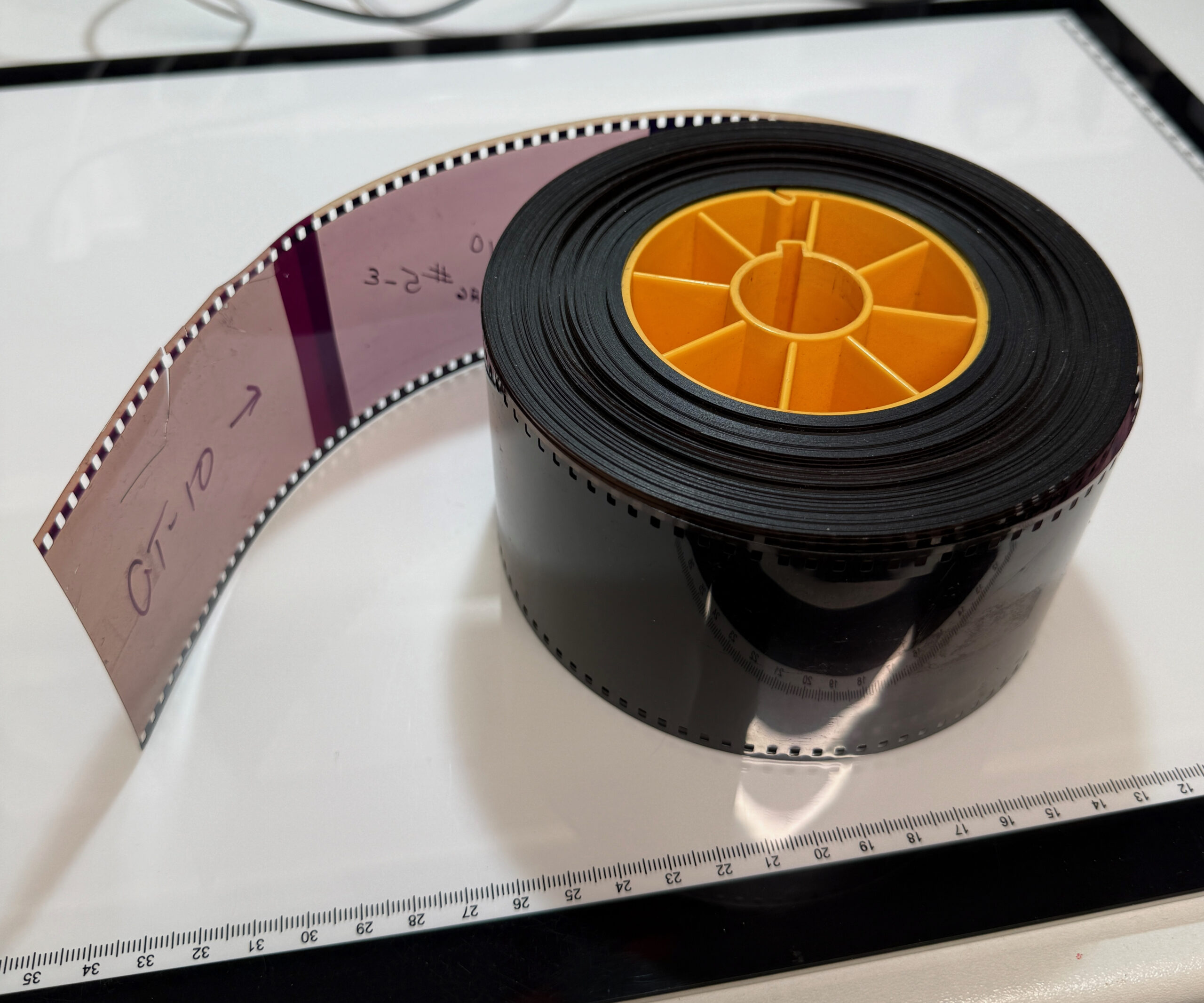
I had a rather significant birthday this year (!) and my family bought me a rather unusual present – a reel of 70mm colour transparencies from the July 1966 Gemini X space mission (the upcoming 60th anniversary being relevant here…). They bought it from eBay, trusting in an American seller that it was the genuine article (it was!), and being a space nerd (as well as an analogue photography nerd), it turned out to be the ideal gift.
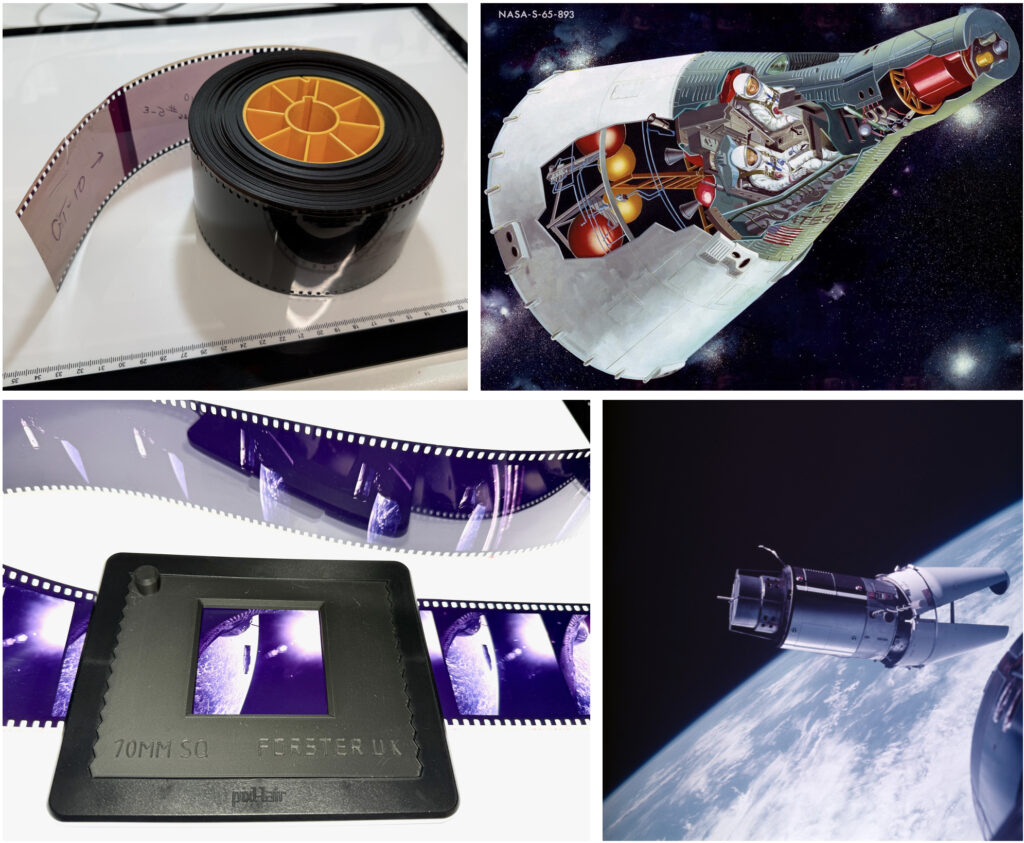
The reel was from the estate of a former NASA photo technician who must have ‘acquired’ it from the lab he was working in. A quick browse through the first few metres of the reel (not an easy task in itself – the reel weighs 860g, 1.9lb, and I was paranoid about damaging the film) revealed that it was a compilation of several individual films, each separated by a ‘test card’ that was pre-exposed before the mission.
My guess is that after the films were delivered safely back to Earth, they were developed at NASA’s Photographic Technology Lab (PTL) at the Manned Spacecraft Centre in Houston, TX, and the originals were locked away in a vault somewhere for safe-keeping – I think they’re currently stored at the Smithsonian Institution. However, various departments at NASA, the US Air Force, and the many contractors involved in the space programme, all needed to analyse the photographs and other data from the mission as they planned further missions.
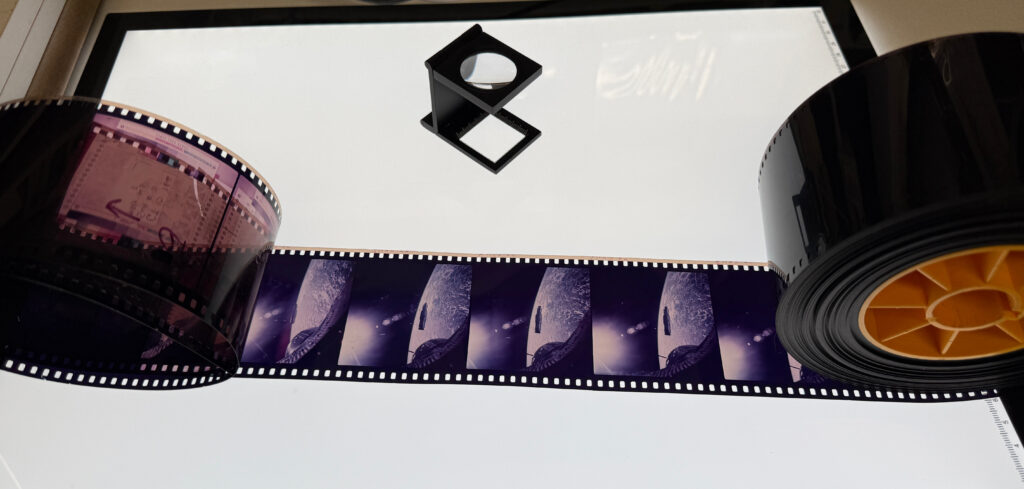
The most likely scenario is that a master reel was created from all the original films shot in space and duplicates were then made from it in the lab to be distributed around to the various departments as ‘working’ copies – this makes this reel a first – or second-generation copy of the original images that went into space … a fantastic present!
I decided this would make a nice project, and (hopefully) an interesting article for 35mmc, timed to coincide with the 60th anniversary of the launch of Gemini X on 18 July 2026. I would try to scan these 60-year-old transparencies in my home-darkroom and see what I could get from them.
I hasten to add … that you can download hi-res scans of many of these images direct from NASA, from the March to the Moon Mercury, Gemini, and Apollo Digital Image Archive (March to the Moon) or from NASA’s pages on Flickr, but where is the fun, challenge, or satisfaction in that? We analogue photographers like to do things the hard way … one day I may even try to print some of these in the darkroom, but that is some way off, so I’ll content myself with digital camera ‘scans’ for the time being, digitising the analogue positive using a DSLR, a film holder, and an appropriate light source.
When you take a look at the individual frames, the systematic and methodical approach taken by the NASA laboratory technicians is readily apparent.
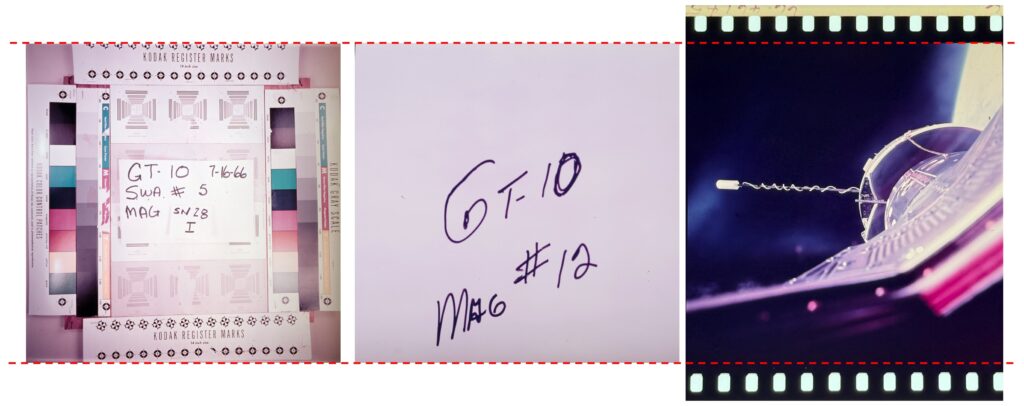
On the ‘test card’, GT-10 is the NASA shortcut for Gemini 10 (Gemini X), and the film was loaded (with the test card pre-exposed at the beginning) on 7-16-66 (16 July 1966 – I was a babe in arms at the time!), just two days before blast-off. This film was shot with a Hasselblad Super Wide C camera (NASA shortcut: SWA, a.k.a. SWC); by camera 5 (SWA #5); loaded with magazine 28-I (SN 28 I). In between the different films a technician has written on the roll the mission and magazine number (GT-10 Mag # 12), presumably as it was on the slide duplicating machine; and a unique reference number has been handwritten on the edge strip of every frame in the reel. The above frame, shot out of one of Gemini X’s windows showing the docked Gemini-Agena Target Vehicle (GATV, with the antenna sticking out) and the Earth in the background, is number 66 46145. Looking further into the reel, I found there were also films from Gemini VIII and Gemini IX – an exciting discovery.
This two-part article will look at the role photography played in the later Gemini missions, the cameras and films used, how I went about scanning and processing the transparencies on the reel, and the story around the missions and images themselves. Because the reel only contained images from Gemini VIII, IX and X, the emphasis is on those missions, but I include a bit about the earlier missions (Mercury and the earlier Gemini missions) and the final two Gemini missions, XI and XII. I haven’t attempted to look at Apollo or subsequent programmes, although I might explore the other pre-digital space missions in future articles. Part one looks at the cameras and films used in space, while part two covers the scanning process, and weaves the scans I made into each of the three missions covered by the reel of transparencies. It also looks at how Hamish from pixl-latr and Simon from ForsterUK saved the day and allowed me to fully enjoy this amazing gift!
Gemini
I believe that this nation should commit itself to achieving the goal, before this decade is out, of landing a man on the moon and returning him safely to the Earth. No single space project…will be more exciting, or more impressive to mankind, or more important…and none will be so difficult or expensive to accomplish…
President John F. Kennedy’s Speech, May 1961
Apollo was all about getting a man on the moon and safely back to Earth, which they spectacularly achieved in July 1969. But before Neil Armstrong and Buzz Aldrin set foot on the lunar surface, a massive programme of research, development, and many adventures had to happen, first with the Mercury Program, and then Gemini.
Explainer: I’ll use the American spelling, ‘program’, as opposed to ‘programme’, when referring to specific programmes, but ‘programme’ when talking generically … confusing, isn’t it?!
If Mercury was all about finding out whether it was possible for a human to survive in space (with the Soviet cosmonauts constantly being one step ahead!), then Gemini was all about establishing the procedures and systems necessary to support a lunar landing.
The American astronauts were pioneers on an unprecedented scale, doing things, seeing things, that man (Soviet cosmonauts notwithstanding!) had never experienced. And these experiences needed to be recorded for the benefit of the scientists and engineers, for posterity, and for the public, who were increasingly caught up with ‘space fever’. Computers were still in their infancy, and there were all kinds of electronic recording and telemetry devices sending data back to Mission Control, however, much of the information was recorded photographically, especially on Gemini and then Apollo. As the space programme developed, so did NASA’s recognition and understanding that photography had a hugely important role to play.
The Cameras
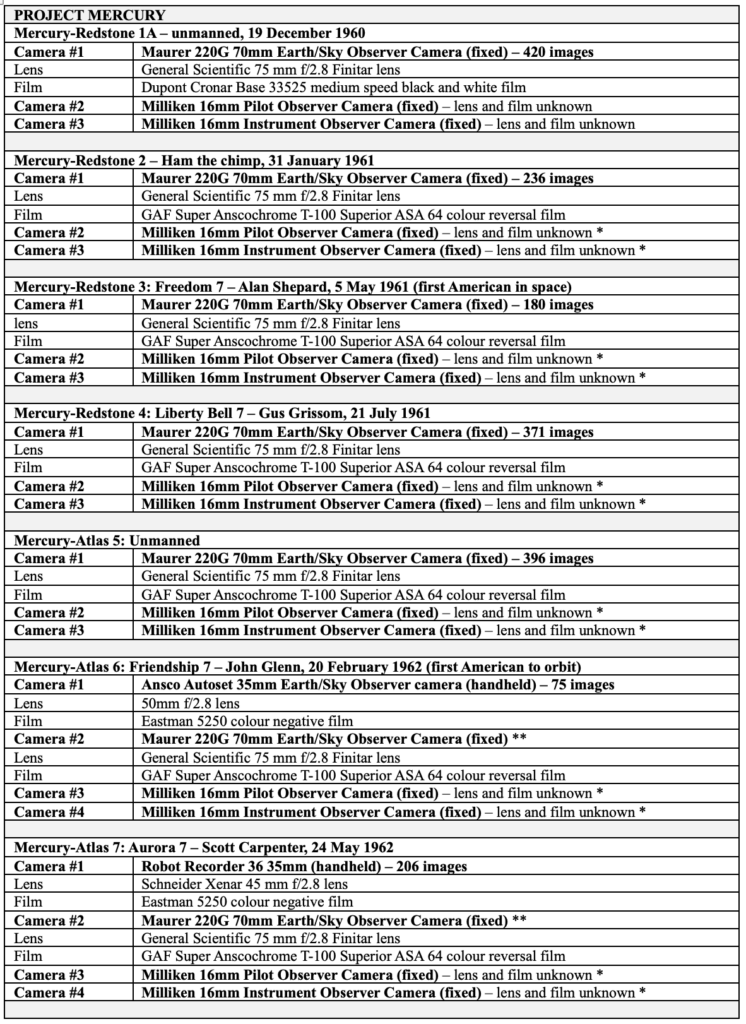
The first cameras in space were small fixed automatic ‘sequence’ cameras. There were several on board. A 70mm 220G Earth/Sky Observer camera made by J.A. Maurer Inc. fitted with a General Scientific 75 mm f/2.8 Finitar lens took pictures out of the capsule via a mirror through a tiny porthole and shot an image every 6 seconds. Looking at the images now (Mercury 2 mission images) you can watch the moment of lift off as the tower and the horizon disappear, in 6 second intervals!
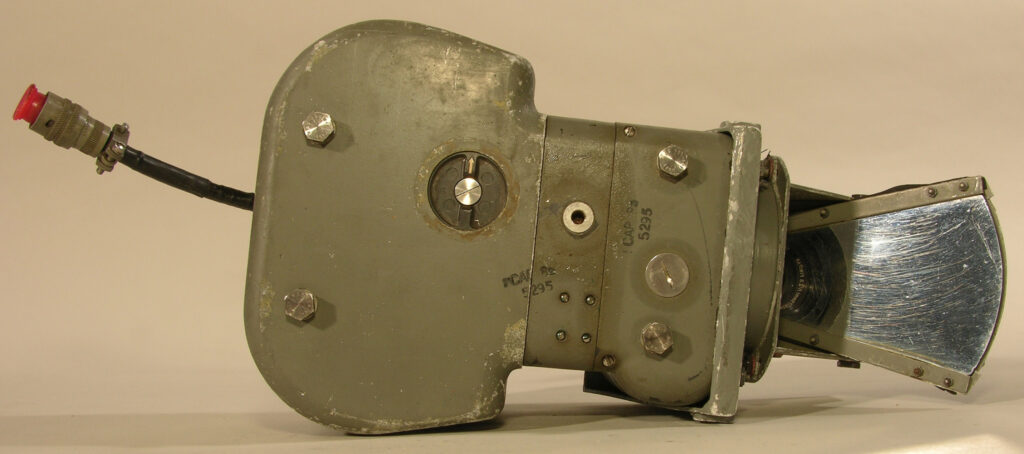
There were also two 16mm automatic sequence movie-style cameras looking inwards: a DBM 8B Pilot Observer Camera capturing what the astronaut was up to, and a DBM 7A Instrument Observer Camera looking the other way at the instrument panel, both made by D.B. Milliken Company.
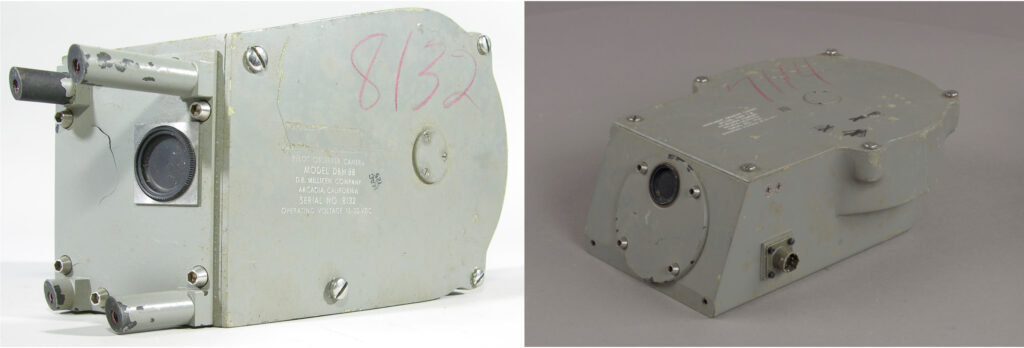
Both manufacturers had the advantage of being American manufacturers and already had connections with the US military: Milliken for their high-speed movie cameras; and Maurer for their normal movie, aerial reconnaissance, and ‘gun’ cameras. These passive cameras recorded Ham the chimpanzee’s terrifying journey on Mercury-Redstone 2 in January 1961 and Alan Shepard’s Mercury-Redstone 3: ‘Freedom 7’ mission in May 1961 becoming the first American in space, albeit for just 15 minutes and 28 seconds!
Explainer: NASA mission nomenclature is somewhat confusing. For example, ‘Mercury-Redstone 3: ‘Freedom 7’’ refers to the 3rd Mercury mission, with the ‘Freedom 7’ capsule being sent into space atop a PGM-11 Redstone SRBM rocket. All the Mercury capsules had the numeric 7 after their name, after the ‘Mercury 7’ astronauts. So, Mercury-Atlas 8: ‘Sigma 7’ is the 8th Mercury mission, with a capsule called ‘Sigma 7’, and by now they’d transitioned to the SM-65 Atlas ICBM. NASA then used Roman numerals for Gemini before reverting to numeric (Arabic) numbering for Apollo. Confusing, isn’t it?! And if it wasn’t already obvious, the uncomfortable connection between the early US Space Program and the US ‘Military-Industrial Complex’ with their Weapons of Mass Destruction, is unavoidable.
The Observer cameras also recorded Gus Grissom in ‘Liberty Bell 7’ atop Mercury-Redstone 4 in July 1961, although all the footage was lost when the capsule sank in 15,000ft of water after splashdown. The last flight for the Maurer 220G was in Mercury-Atlas 5, recording the exploits of another chimpanzee, Enos, atop the Atlas ICBM rocket booster. The more powerful Atlas rocket was needed to achieve orbit, so Enos became the first American … primate … to orbit the Earth!
All of the cameras so far were automatic fixed cameras with no input from the astronaut … or chimp. Astronaut-led photography was viewed by many in the Space Program as an unnecessary distraction from the much more important engineering work. The photography that has now become so familiar to us therefore began in a rather homespun, amateurish way, not in a multi-million-dollar programme with thousands of engineers working on it.
Ahead of his pioneering mission to be the first American human (after Yuri Gagarin had become the ‘first’ human in space for the USSR!) to orbit the Earth, Astronaut John Glenn popped into his local drug store (chemist) in Cocoa Beach, Florida, and picked up a $45 Ansco Autoset 35mm rangefinder camera (a re-badged Minolta Hi-Matic) with a 55mm lens. An RCA contractor made some small modifications, and Glenn took it into space on his Mercury-Atlas 6 ‘Friendship 7’ mission in February 1962. I’ve nothing against the Autoset (I have a Minolta Hi-Matic 7 myself), but it demonstrates how little NASA understood or cared about space photography at the time. The Autoset was mounted upside-down onto a bracket with pistol grip and over-sized trigger to release the shutter. A rudimentary pop-up viewfinder from a Polaroid camera on the ‘base’ of the camera allowed him to roughly frame his shots. Glenn found the camera easy to use, thanks to being in micro-gravity – ‘When I needed both hands, I just let go of the camera and it floated there in front of me’ he said in his later memoir.
Explainer: there is no such thing as ‘zero gravity’ as even in space tiny amounts (1×10⁻⁶ g) of gravity exist.
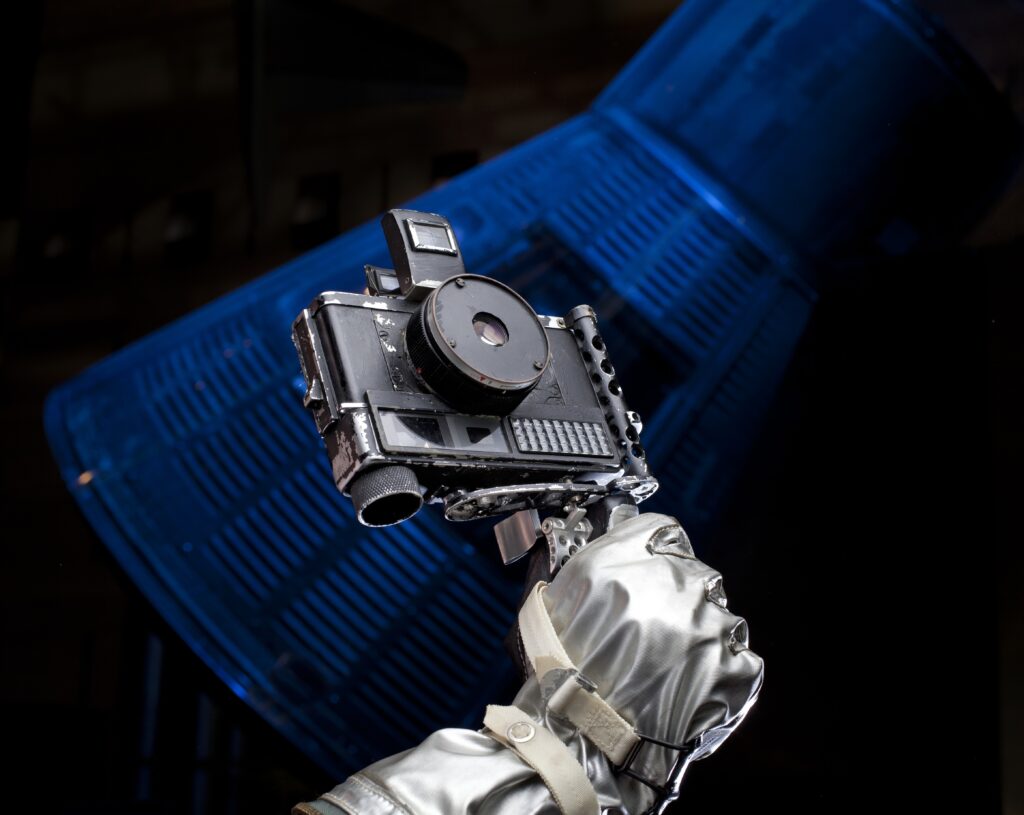
The photographs Glenn produced weren’t anything to write home about, although he still managed to shoot 75 frames with the Ansco Autoset, although his results would have been hampered by using what was effectively the sort of camera you would take on your holidays. That said, his images were ground-breaking – no one had ever seen what he was photographing – so I think we probably need to cut Glenn a little bit of slack and applaud his momentous achievement.
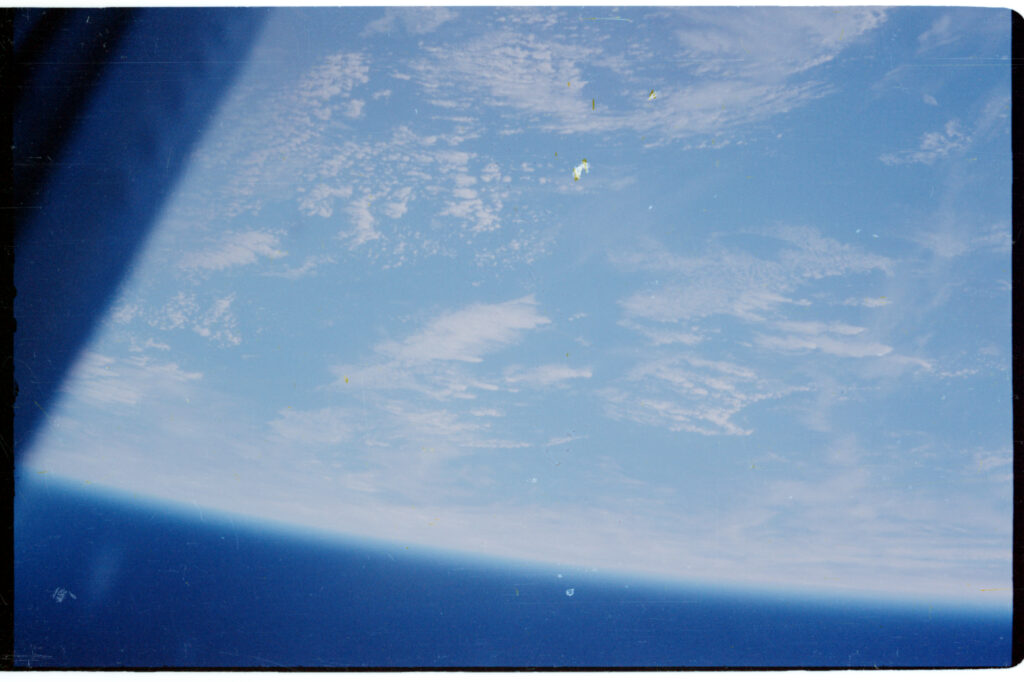
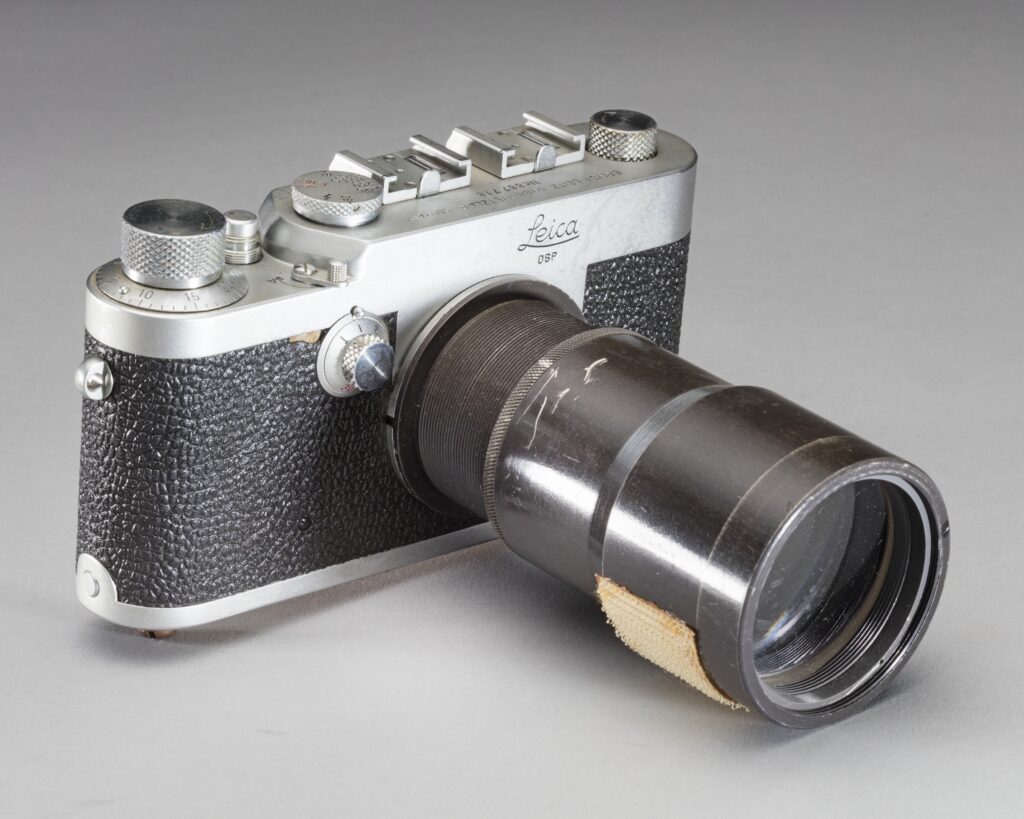
Glenn also used a Leica 1G, a so-called ‘technical’ or ‘scientific’ model, fitted with a spectrographic lens and aiming reticle to carry out the first human-operated astronomical experiment in space. On his first orbit, in darkness over the Pacific, Glenn took six ultraviolet spectrographic photos of stars in the constellation Orion with this camera. Equipped with a quartz lens and prism to form the star images into spectra, the camera imaged ultraviolet light that is blocked from view on Earth by the atmosphere. Because Glenn was wearing a spacesuit helmet and could not get his eye close to the built-in viewfinder, engineers added a custom reticle on top – to stabilise the camera, he closed his helmet visor and placed the reticle against the visor, cushioned with a small piece of rubber.
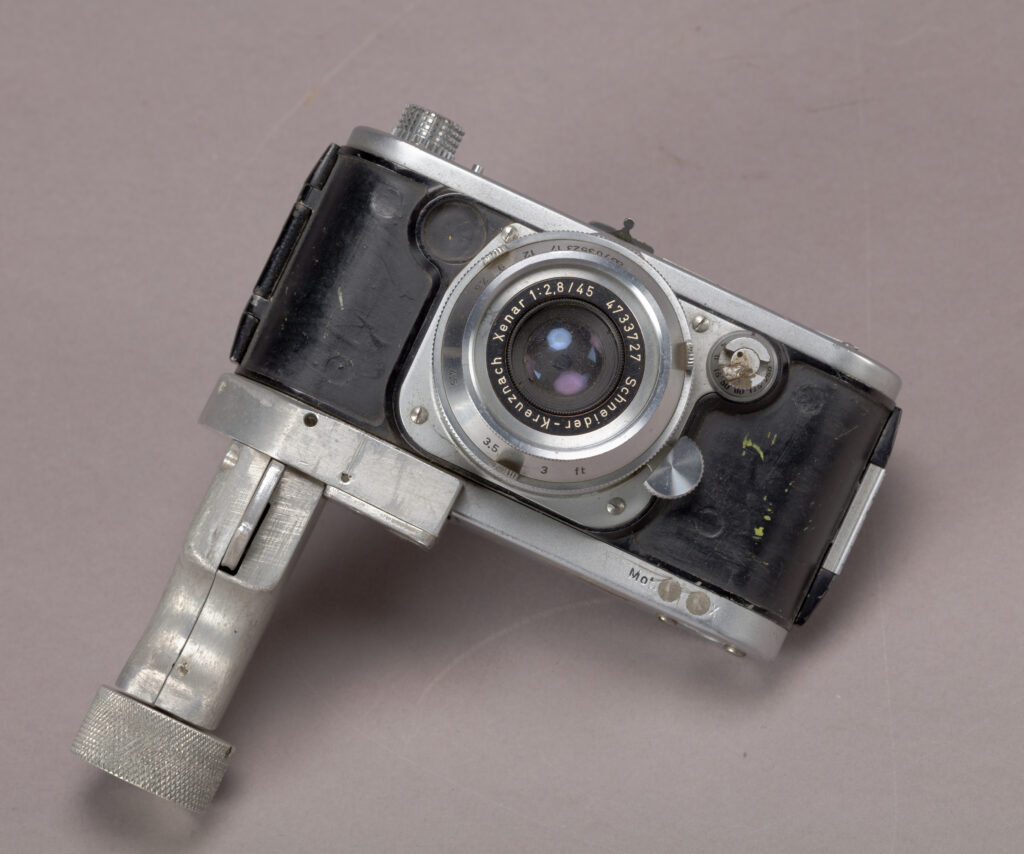
The next camera used in space was also a shop-bought model – a Robot Recorder 36 35mm used by Scott Carpenter on his Mercury-Atlas 7 ‘Aurora 7’ flight in May 1962. Robot cameras are fascinating pieces of photographic kit. Developed in Germany in the 1930s by a watchmaker and brought to market by Otto Berning, they used clockwork mechanisms to advance the film – I have a Robot II that I’m really looking forward to trying out and will write up the experience for 35mmc in due course. You wind up the mechanism with a knob on the top of the camera and can shoot multiple shots from one wind. The Robots were used by Luftwaffe pilots during the Second World War, with an over-sized winding knob on top to be used when wearing gloves – these models are much sought-after by collectors. They were also popular for technical and scientific uses, and the mechanism could easily be adapted to work with an intervalometer triggering the shutter at set intervals – they were even used in early speed and security/surveillance cameras! The Robot Recorder 36 with a Schneider-Kreuznach Xenar 45mm f/2.8 lens was one of these technical cameras producing the now-standard 24×36 35mm frame and was modified by NASA with a pistol grip with a knurled winder knob on the bottom and a trigger that could be used when wearing a spacesuit.
Explainer: the Mercury capsule was pressurised and had a supply of 100% oxygen, allowing the astronaut to remove his gloves and lift the visor of his helmet. This would have facilitated some basic camera handling, aided by the modifications made by NASA.
Although it’s not included in the example held by the National Air and Space Museum, the Robot would probably have had some kind of viewfinder or aiming reticle on the top. These Robots are a pig to load, so NASA attached a non-removable magazine to the camera with enough film for around 250 frames, but despite this, Carpenter must have worked hard to achieve the 200+ images shot during his 4-hour, 56-minute flight. In fact, NASA Flight Director, Christopher Kraft, later suggested that the 250 mile off-target landing of the Gemini 7 capsule could in part be attributed to Carpenter fiddling with his camera! This will resonate with many film photographers out there, the author included.
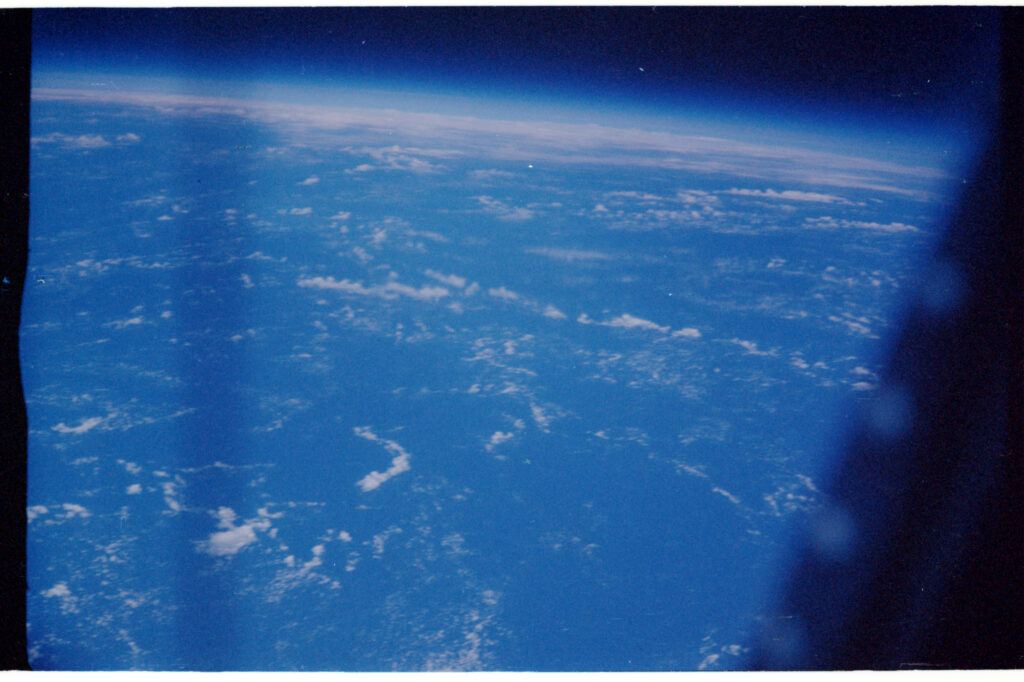
Most of the images, however, were unusable, although there were a few passable shots of cloud cover down below his orbit, and for the Flat-Earthers amongst us, a tantalisingly frustrating hint at the curvature of the Earth … it would take the higher orbit of Gemini, especially the record-breaking Gemini X and XI, to really dampen the conspiracy theorists’ ardour!
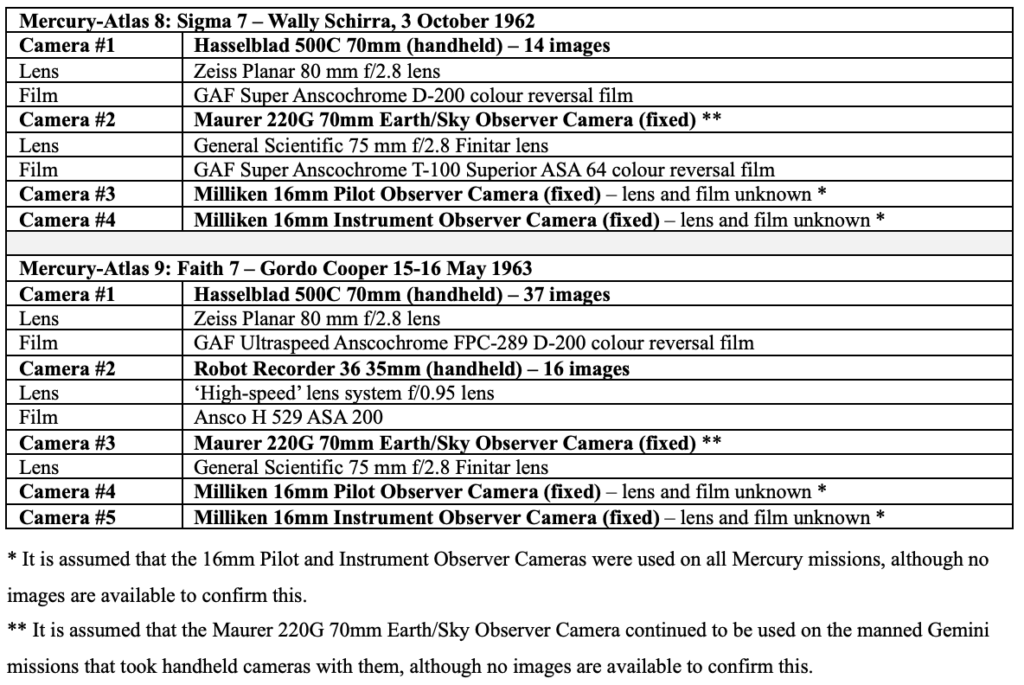
Later that year, astronaut Walter ‘Wally’ Schirra, who was a bit of an amateur photographer, popped into his local camera store in Houston, Texas, and bought himself a Hasselblad 500C. The $500 Swedish camera was at the top of the market and boasted interchangeable Carl Zeiss lenses and removable film backs. With Schirra enthusing about the 500C’s capabilities, NASA purchased one to evaluate – as NASA were only allowed to deal with American suppliers, they could not deal with Hasselblad direct so also had to buy from a local dealer.
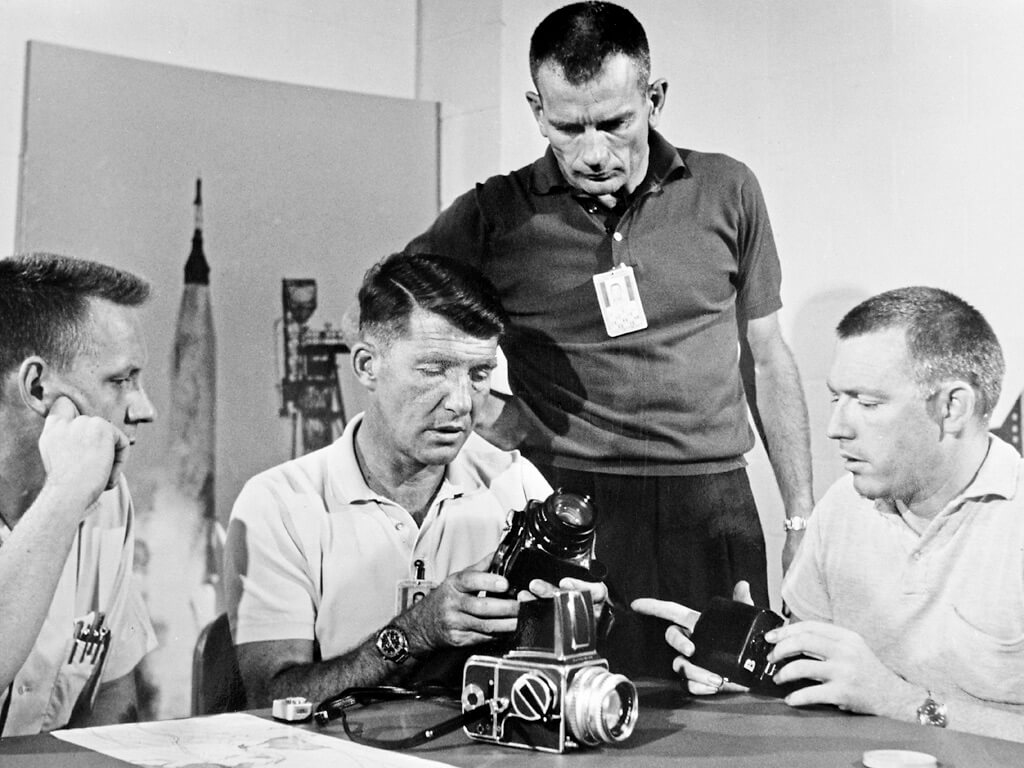
They opted for a 70mm film back, and NASA technicians modified the camera to make it ‘astronaut-friendly’.
Explainer: modifications included: stripping it down to save weight, including removing the mirror; removing the leather coverings and painting it matt black to reduce reflections; and removing the release catch for the film magazine to prevent it being accidentally bumped in flight. It was made so only a ground-based engineer with a wrench could free it! The waist-level-viewfinder was ditched in favour of a simple, custom side-finder/reticle that could be aimed while wearing a helmet and visor.
70mm film has a much bigger negative than Glenn’s 35mm, and therefore a considerable step up from the Autoset – Schirra subsequently used the modified 70mm Hasselblad 500C on his Mercury-Atlas 8 ‘Sigma 7’ mission in October 1962.
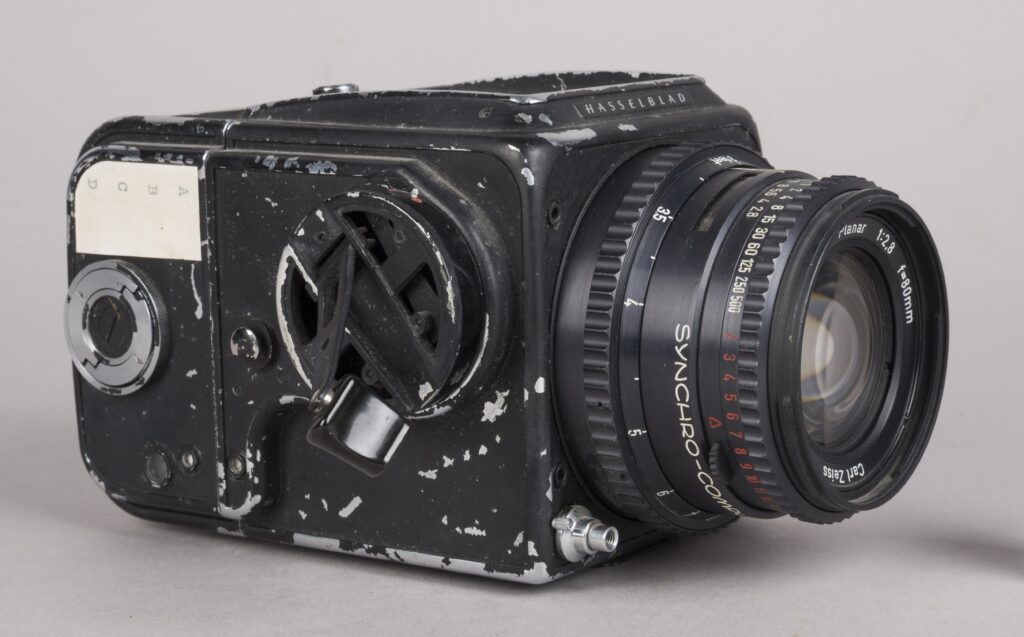
Explainer: 70mm is normally a format associated with motion picture film, but on a stills camera it has roughly the same negative size as 6×6 120 film, but with the benefit of a row of perforations at the top and bottom which improve the transport through the camera. Arguably, 70mm is a more robust format to use in such an extreme environment than conventional roll film. A 35mm negative is 864mm2 in size, but 70mm, based on the dimensions of a 6×6 120 negative, has 3,136mm2 of useable sensitised material, 3.6 times as much ‘real estate’.
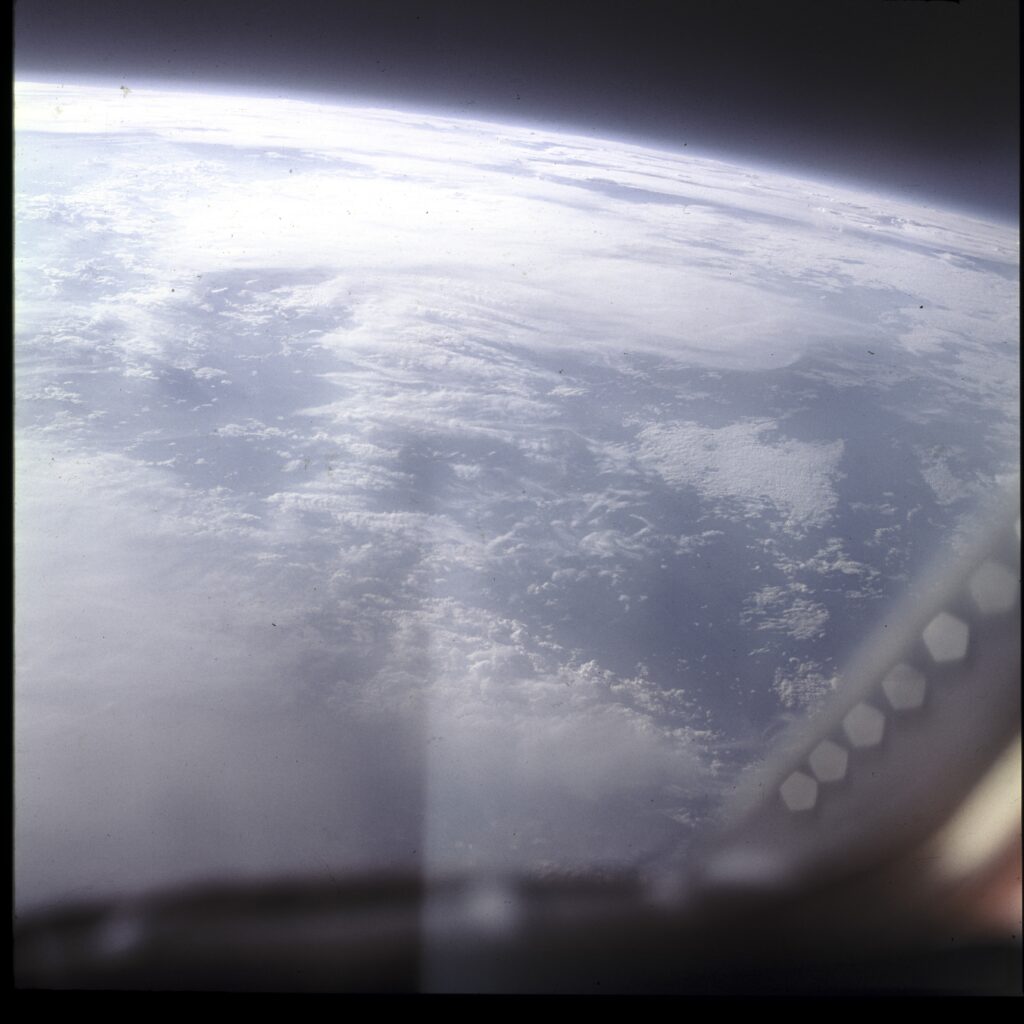
The 14 images captured by Schirra on this mission weren’t that great, but the improved resolution of the few that came out hinted at the scientific and engineering opportunities that space photography with decent equipment could deliver, and the project team began to take the whole thing more seriously, with the Swedish cameras being used on Mercury 9 and all of the subsequent Gemini missions.
James McDivitt’s famous shots of Ed White making the first American EVA (Extravehicular Activity or spacewalk) on Gemini IV in June 1965 (see below) demonstrated the potential PR value of space photography after the now-iconic images hit the front pages.
Explainer: The first person to walk in space was Soviet cosmonaut Alexei Leonov who made a 12-minute EVA from his Voskhod spacecraft in March 1965.
Hasselblad also now cottoned on to the commercial possibilities of associating themselves with the Space Program and wisely began a long collaboration with NASA and the space programme, for example, the iconic images of man walking on the moon in July 1969 were shot on Hasselblads. The project team managed to circumvent the clumsy procurement process through informal contact with the Swedish company and were eventually able to specify factory modifications, albeit billed and fulfilled from a US dealer.
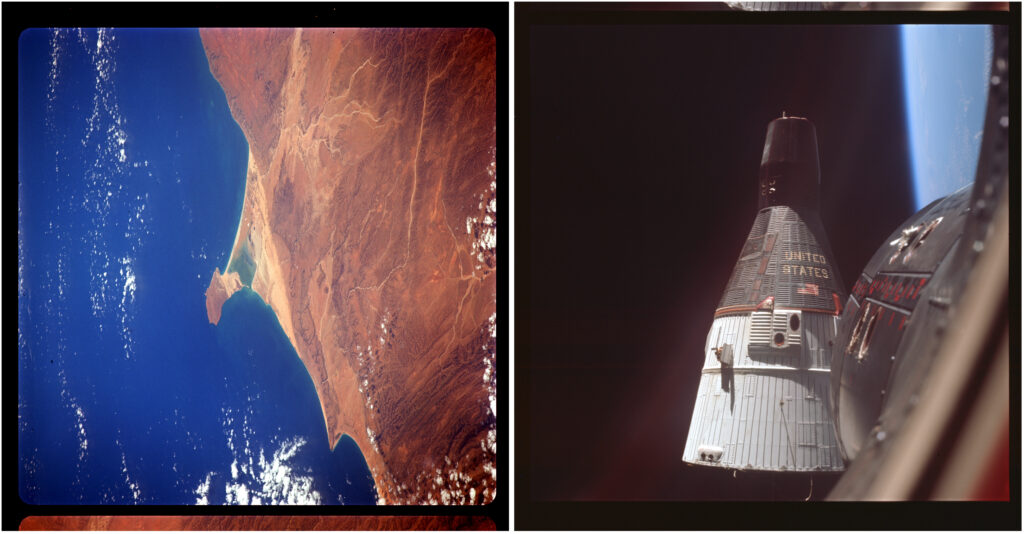
The quality of the images taken in orbit soon also began to justify the increased attention and investment photography was getting at NASA. The following two images from Gemini VI, taken with the Hasselblad 500C and the Zeiss Planar 80mm f/2.8 on Kodak Ektachrome SO-217 medium speed ASA 64 colour reversal film, amply demonstrate this.
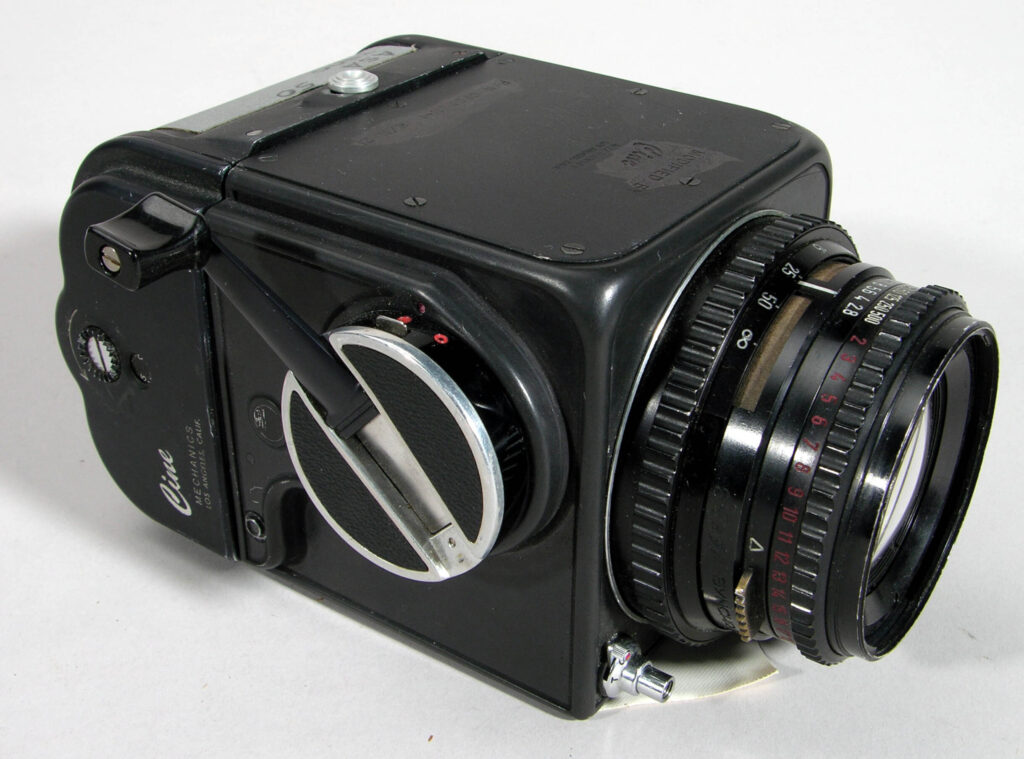
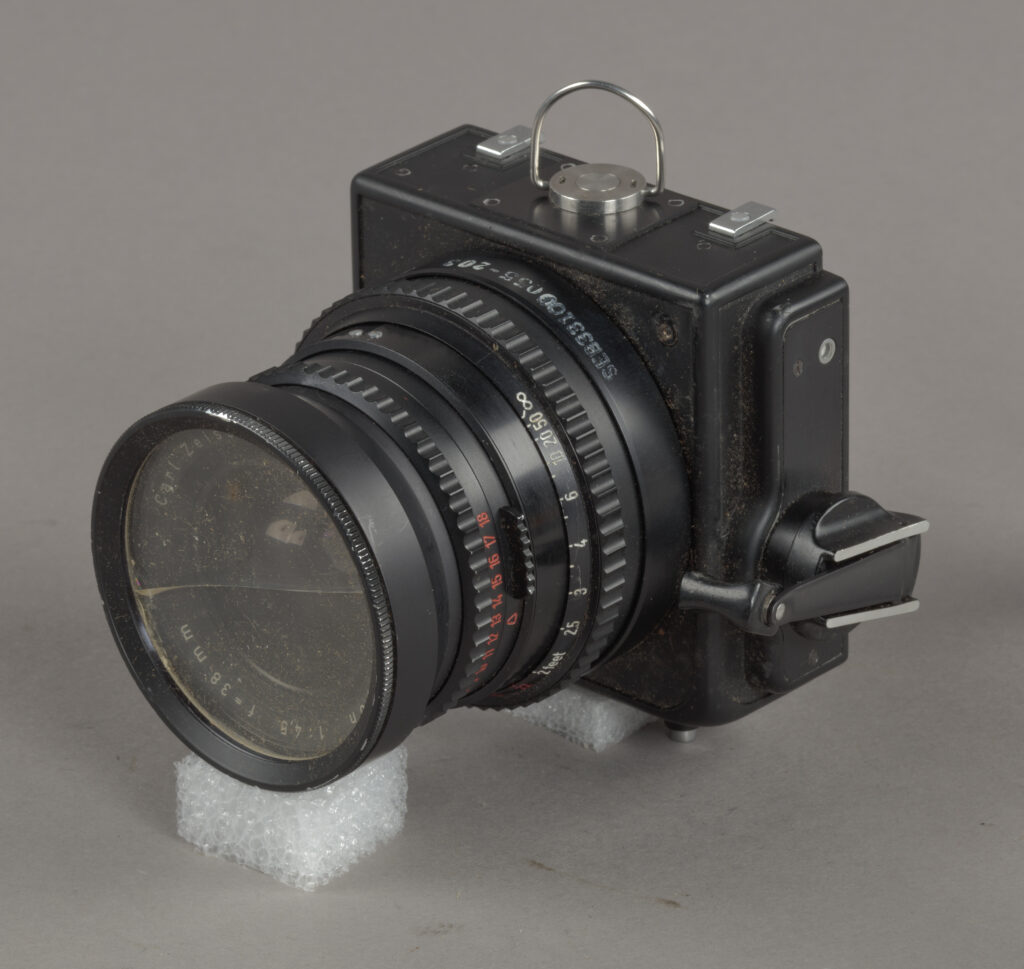
By Gemini IX, a second Hasselblad found its way into the capsule, the Super-Wide C, a.k.a. the SWC (sometimes mislabelled as SWA, Super-Wide-Angle) with a fixed Zeiss Biogon 38mm f/4.5 lens and still using 70mm backs. This usurped the 500C for the remaining Gemini missions. Unusually for a Hasselblad or medium-format professional camera at the time, the 38mm Zeiss lens was fixed to the body. It was roughly equivalent to 21mm lens on a 35mm camera and had a 91.1º diagonal field-of-view, preferred, presumably, to capture the amazing views from Earth orbit, but also able to focus down to just 12 inches. The body was very simple, with no mirror, ground glass, or waist-level-finder and just a winding mechanism – the shutter was built into the lens (like the standard Zeiss lenses for the Hasselblads), with the relatively modest speeds of 1 second to 1/500th second. There was a simple fold-up cold-shoe-mounted reticle sight not obvious in this photo to aid composition. Mike Collins famously let go of one of these during an EVA on Gemini X, letting it float away to become Sweden’s first ‘satellite’! More of that in part two of this article.
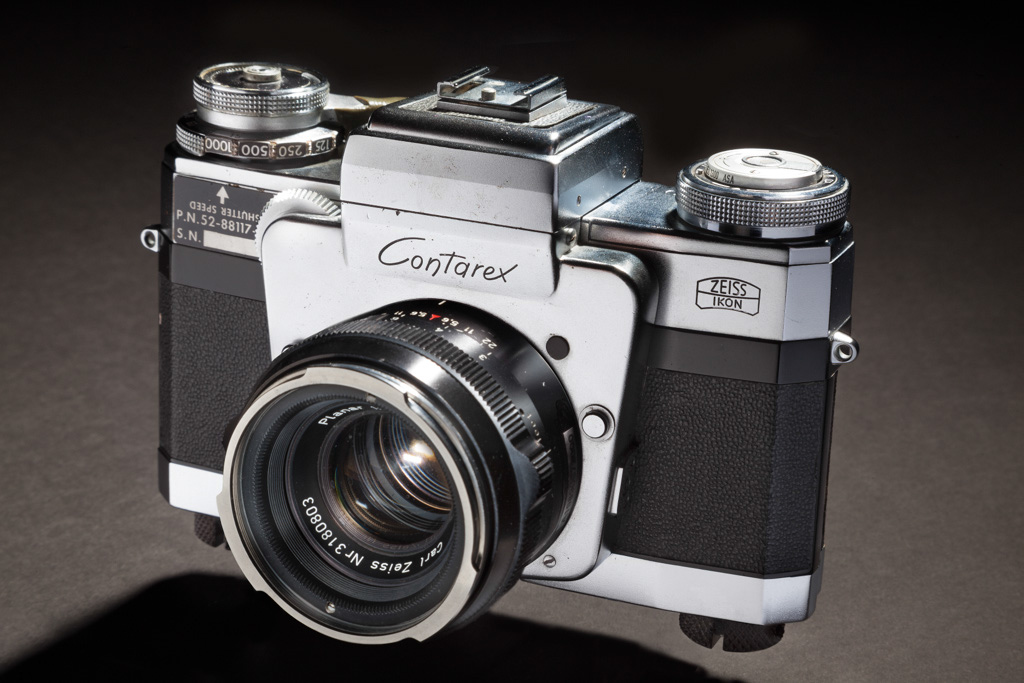
Other photographic players in the space programme were Carl Zeiss, whose involvement with NASA began with Mercury-Atlas 8 ‘Sigma 7’ with Zeiss lenses being fitted to the Hasselblads, and they went on to provide a modified Contarex ‘Special’ 35mm SLR with a Zeiss Planar 50mm f/2 lens for White’s pioneering Gemini IV EVA in June 1965. The camera was bolted to the top of the handheld gas-powered propulsion gun he used to manoeuvre in micro-gravity. The Contarex was also carried on Gemini V and VII.
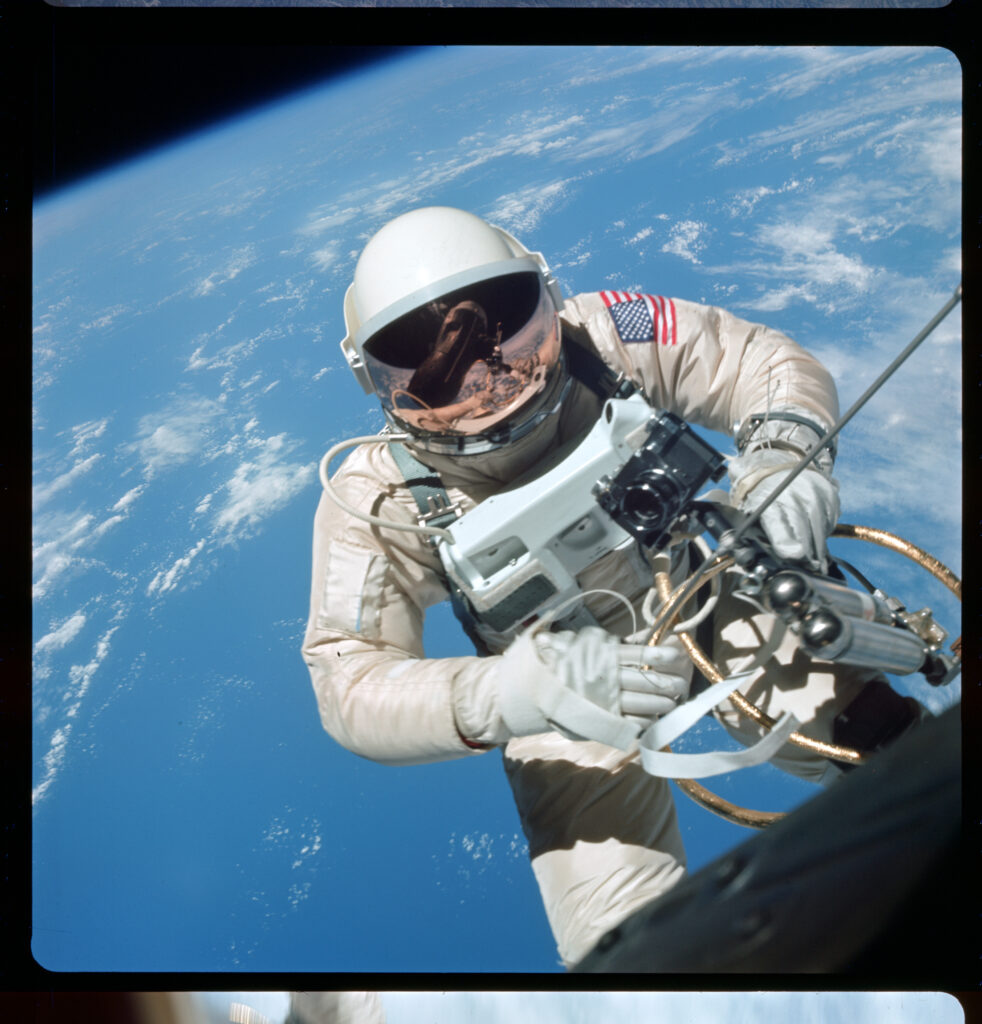
The shots White made during his 23-minute EVA are impressive, given the limitations of the 35mm format and especially as the gas-gun ran out after just 3 minutes requiring White to manoeuvre just by pulling at the umbilical tether connecting his to the capsule.
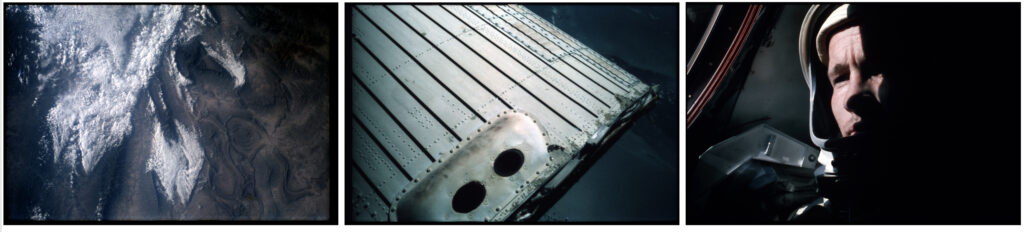
Explainer: Edward ‘Ed’ White and fellow astronauts Virgil ‘Gus’ Grissom and Roger Chaffee were tragically killed on 27 January 1967 in a fire that swept through the Command Module during a pre-flight launch-pad test. To honour their memory, NASA designated the otherwise routine test as ‘Apollo 1’, and all further missions, manned or unmanned, followed on from that numbering.
Another photographic giant, Nikon, began working with the NASA on the Apollo 15 mission in 1971 and has continued their association through the Space Shuttle era, on the International Space Station (ISS), and more recently with the Artemis Program.
Maurer had been working with NASA since the start of the Mercury Project (Earth Sky Observer Camera) and had been supplying custom 16mm movie cameras as ‘Data Acquisition Cameras’, or DACs, since Gemini IV in June 1965. These were fixed-position cameras shooting Ektachrome 16mm movie film used to automatically record footage that could be analysed back at NASA. 16mm movie cameras used film magazines that held about 130 feet of film which, at the standard 24 frames per second (fps), would have only provided about three minutes of footage. However, because Maurer cameras could be set for frame rates as low as 1fps, they could be set off and left to slowly click away while other more challenging activities were underway. Although these cameras were notoriously unreliable, they were used on all subsequent Gemini missions, found their way to the lunar surface with Apollo 11, and later on the lunar rovers as they zoomed around on the moon’s surface.
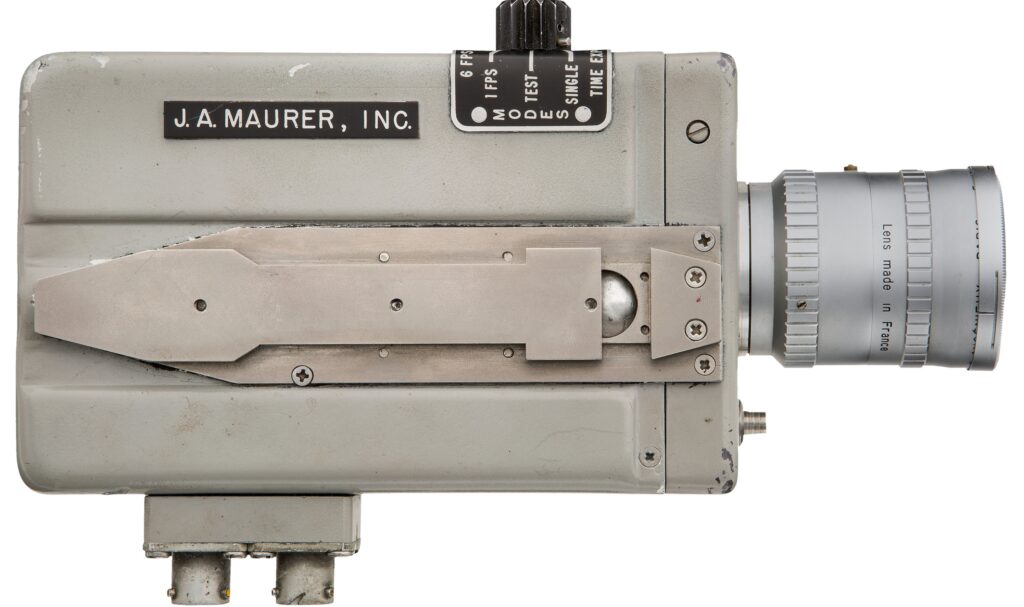
This relationship led to Maurer supplying custom 70mm ‘Space’ Cameras, which were used on Gemini IX, X, XI, and XII in conjunction with the Hasselblads. Far less elegant or sophisticated, the Maurer was selected less from a technical excellence perspective, more as a political necessity – the Space Program could not be seen to rely on foreign innovation. Paired with a (German-made …) Schneider Xenotar 80mm f/2.8 lens, it had a sighting ring attached to the top that helped increase aiming accuracy, an over-sized film advance lever, and interchangeable backs, but the ‘poor cousin’ of space cameras went on to produce many of the iconic images of the Gemini Program.
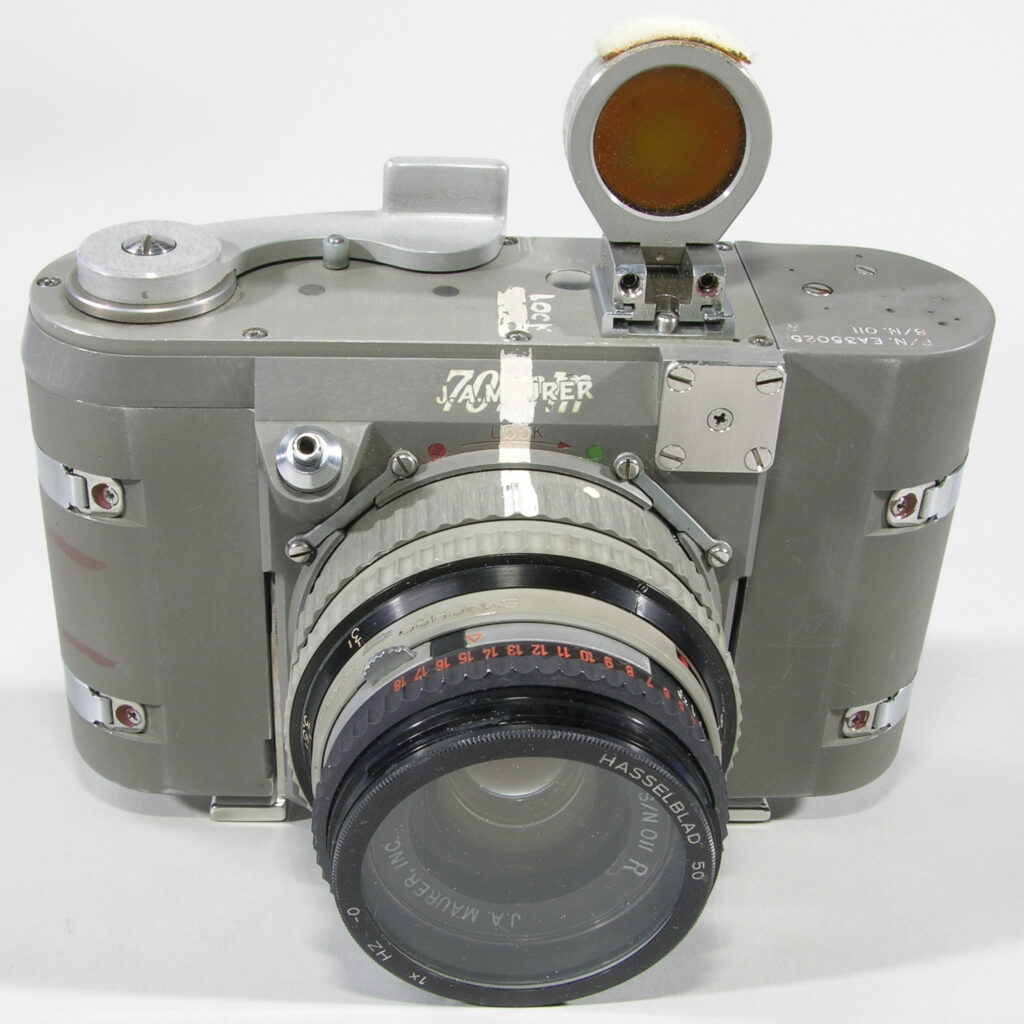
As well as being used for specific scientific experiments and general imaging, the Maurer was also used to see the effects of special filters. This groundwork massively improved the astronaut’s workflow in space and boosted the programme’s photographic capabilities, with this ‘ugly duckling’ of a camera paving the way for the amazing images that captured the world’s attention in subsequent missions.
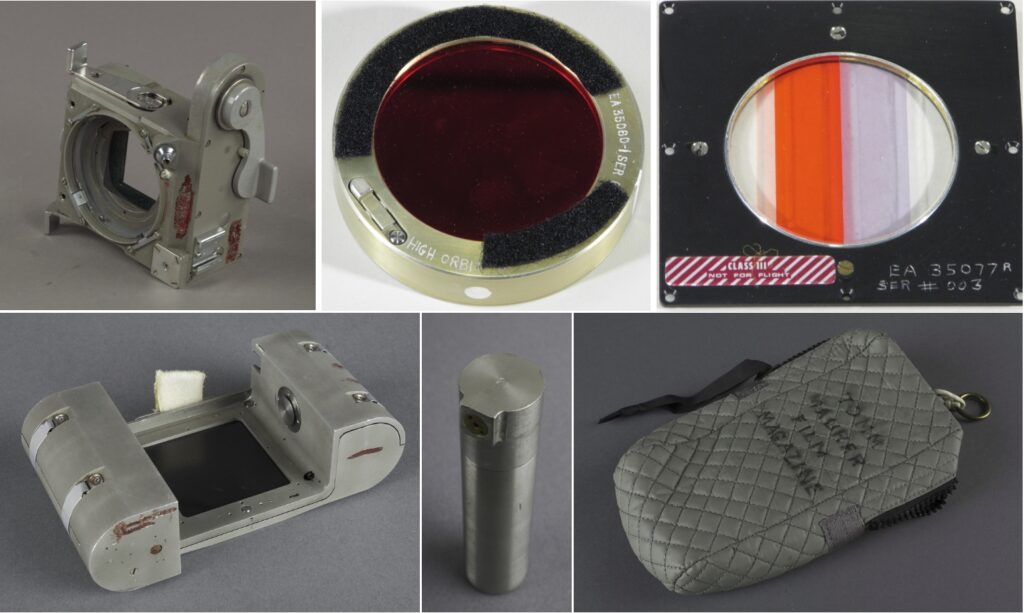
Along with thousands of other everyday tasks, NASA needed to discover whether ‘conventional’ (a.k.a. analogue or film) photography would be affected in the micro-gravity of space. For example, scientists were concerned that the film would ‘float’ away from the focal plane causing the images to be out of focus. To stop this, they devised a system which released a precise amount of gas to press the film against the plate at the focal plane at the moment of exposure to eliminate any curl of the film. A small CO2 bottle was inserted into a slot on the magazines used with the Maurer 70mm cameras. However, this possible film plane distortion didn’t seem to be an issue with the Hasselblads …
If the choice of hardware was a bit suspect in the early days of the Space Program, the choice of film was much debated at NASA, with all eyes on the prize of finding the optimum film stock to use on the lunar surface. Photography on Mercury and Gemini helped build the knowledge that eventually captured some of the most famous photos ever taken: Earthrise, Aldrin’s boot print on the lunar surface, and so on. This led to intensive collaboration with the technical experts at Kodak in Rochester, NY, although, initially, the films taken into space on the Mercury missions were off-the-shelf. John Glenn (Mercury-Atlas 6 ‘Friendship 7’) and Scott Carpenter (Mercury-Atlas 7 ‘Aurora 7’) both used Eastman Color Negative, type 5250, in their Ansco Autoset and Robot Recorder cameras. Type 5250 was a motion picture film launched in 1959 – it was rated at ASA 50 in tungsten lighting, ASA 32 in daylight, although the relevance of ‘daylight’ in space is questionable!
Schirra used GAF Ultraspeed Anscochrome FPC-289 D-200 colour reversal film in his Hasselblad on Mercury 8. Anscochrome was a subtractive, three-color chromogenic reversal film, made by the Ansco division of General Aniline and Film in Binghampton, NY.
Explainer: before the Second World War Ansco was part of Agfa but at the start of hostilities its US arm was seized by the US government and ran as a ‘hostile alien property’, being absorbed part of General Aniline and Film or GAF. That was sufficient for it to be viewed as an ‘American’ manufacturer when the Space Program came knocking …
Anscochrome was marketed as a faster alternative to Kodachrome, and although it required Ansco’s bespoke chemistry, it could be developed in home darkrooms, unlike Kodachrome, which had to be sent away to Kodak. Ansco struggled to compete with Kodak’s marketing muscle and withdrew from the photographic sector in 1977. Conservators in later years found the longevity and permanence of Anscochrome film to be suspect, causing quite a few headaches at NASA and the Smithsonian.
By the time the Gemini missions began, NASA had switched mostly to Kodak, although some Anscochrome was still used in 35mm format in ASA 50 and 200 speeds. The film of choice for most Gemini missions was Kodak Ektachrome SO-217 colour reversal film, used in the Hasselblad 500Cs and SWCs, which had an extra-thin base so more film could be fitted into a standard magazine. SO-217 was one of hundreds of specialised emulsions made by Kodak in Rochester, NY, on a special-order (SO) basis for the US government. It was a medium speed (ASA 64) colour-reversal film with a built-in UV-absorbing layer acting as a haze filter, and being typically use for aerial reconnaissance photography, it was well-suited to the task, with the ability to capture extraordinary detail. From Gemini XI and into Apollo, they moved to Ektachrome MS SO-368, still at the relatively slow ASA of 64. SO368 had a built-in yellow dye layer equivalent to a Wratten 2A filter, which blocked UV light, preventing blue casts at high altitudes and in space.
However, if 70mm Ektachrome was the ‘bread and butter’ of Gemini photography, there was a veritable cornucopia of alternative ‘specialist’ film stocks available to the astronauts. These included; Kodak 3400 Panatomic-X black & white aerial film; Kodak 3401 Plus-X black & white aerial film; Kodak 8443 Ektachrome Infrared Aero Film; and Kodak 2475 ASA 1200 black & white recording film. Many of these came from aerial reconnaissance, survey and astronomical applications, or other scientific and industrial settings. The photographic experimentation on the Gemini missions paved the way for lunar photography just a few years down the line, but also increased man’s knowledge of Earth’s atmosphere, its weather patterns, geological and geographical features (remember, there was a parallel programme of putting spy satellites with high-resolution cameras into orbit) and the stars, as well as answering many other scientific questions. This scientific exploration continued through Apollo and with all subsequent space programmes.
In the mid 1960s it was not a given that astronauts had any exposure to complicated ‘professional’ photographic equipment, so during their training they would have had a crash course in the basics of photography and detailed briefings on the cameras they would be using. Because NASA was still learning about the challenges of photography in micro-gravity and the harsh environment inside and outside the capsule, the photography element of the Gemini missions was of real importance.
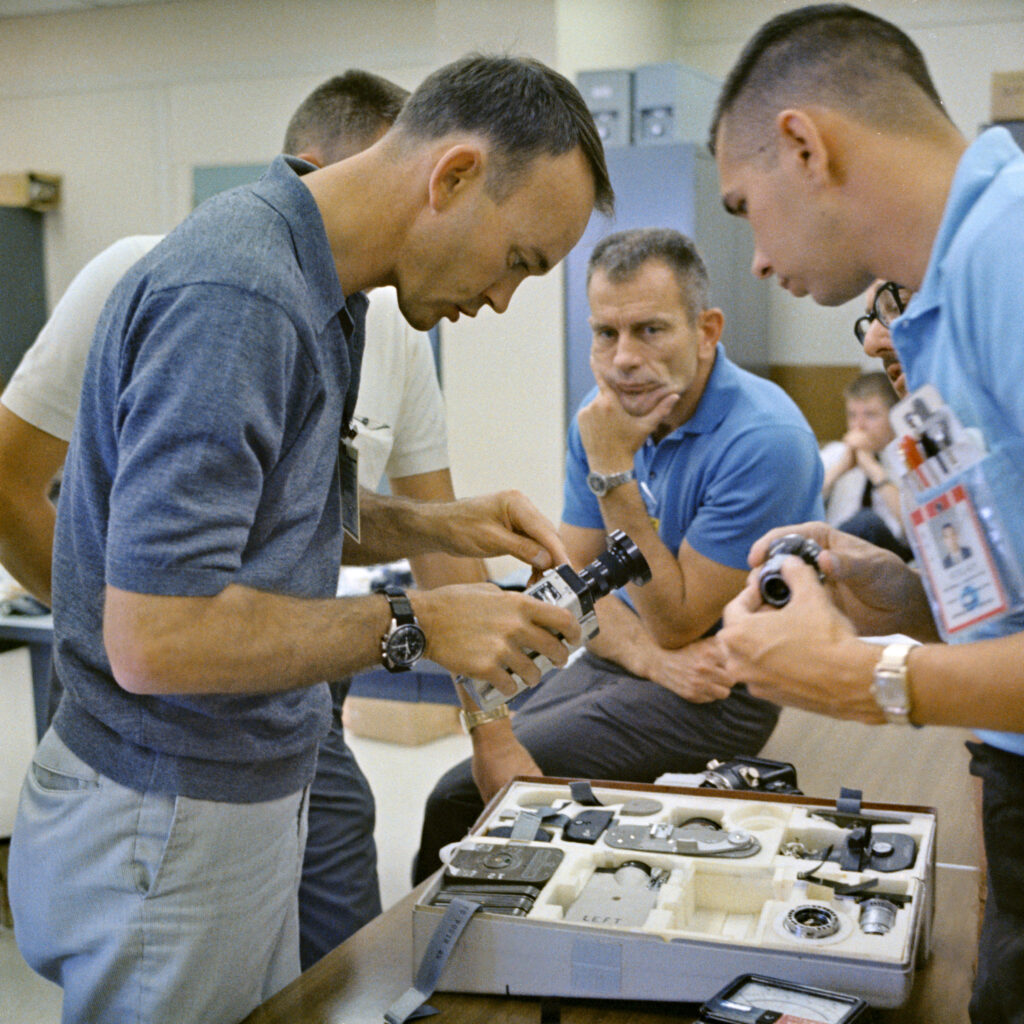
One thing to bear in mind is that all the photography and scientific experiments conducted during the Gemini flights took place in a tin box with a habitable volume of about 55 cubic feet (1.56 cubic metres), slightly larger than the front seats of a small car.
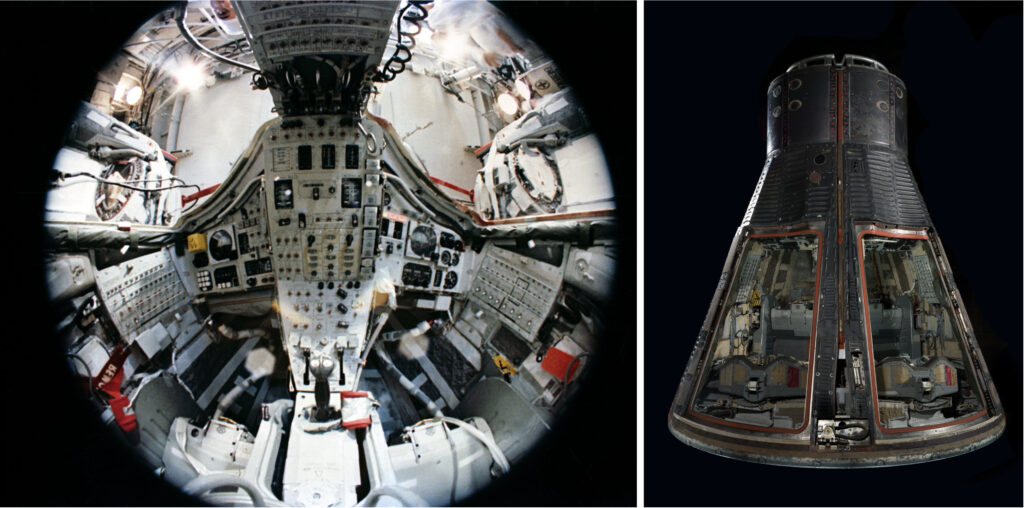
The astronauts sat in single, forward-facing seats below two individual hatches. Unless the hatches were opened – as they would be during an EVA – the astronauts could not stand up or move around. Each astronaut had his own window, but these were only 6 x 8 inches (15 x 20 cm), and when the hatches were closed, the windows were just a few inches from the astronauts’ faces. Frank Borman and Jim Lovell’s record-breaking 14-day Gemini VII mission in December 1965 is all the more impressive when you consider this claustrophobic environment – as well eating, drinking, sleeping, and everything in between (!), these two astronauts changed in and out of bulky spacesuits, manoeuvred their spacecraft, rendezvoused in orbit with Gemini VI-A, conducted numerous scientific experiments, and shot over 450 photos. Next time you complain about not having enough room in your camera bag or that your darkroom is a bit cramped, give a moment’s thought to these pioneering explorers and their almost-super-human achievements!
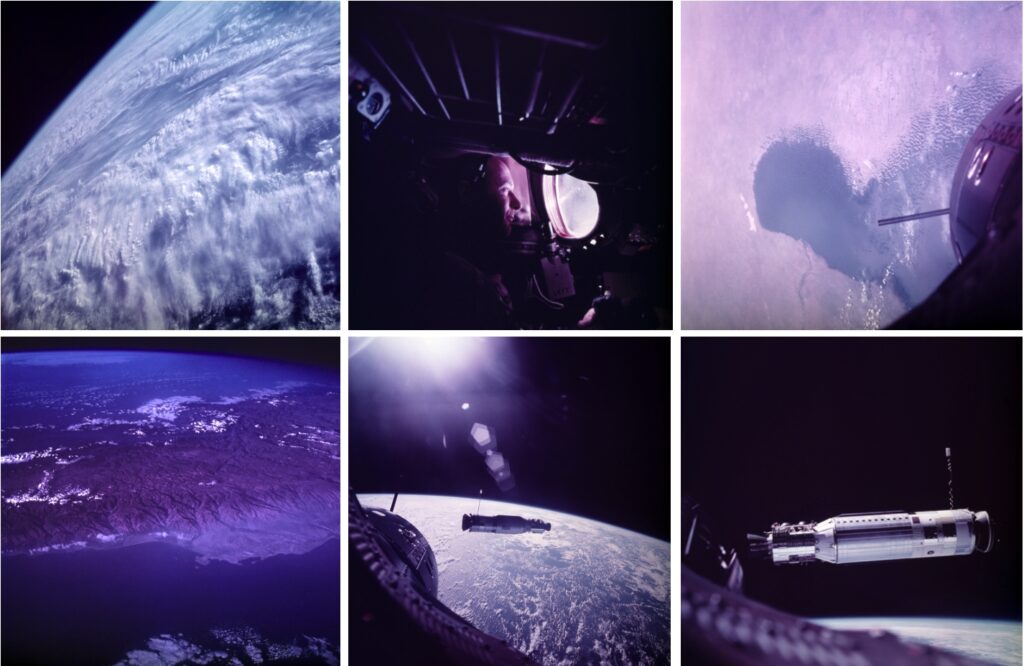
Part two of this article, coming out on the 60th anniversary of Gemini X’s splashdown on 21st July 1966, will look at how I went about scanning my birthday reel of Gemini mission photos using the pixl-latr film holder and a custom 70mm insert made by ForsterUK. I’ll also discuss the three Gemini missions included in the reel and include a selection of the scans I made.
Notes
Project Mercury and Gemini Cameras, Lenses, and Films
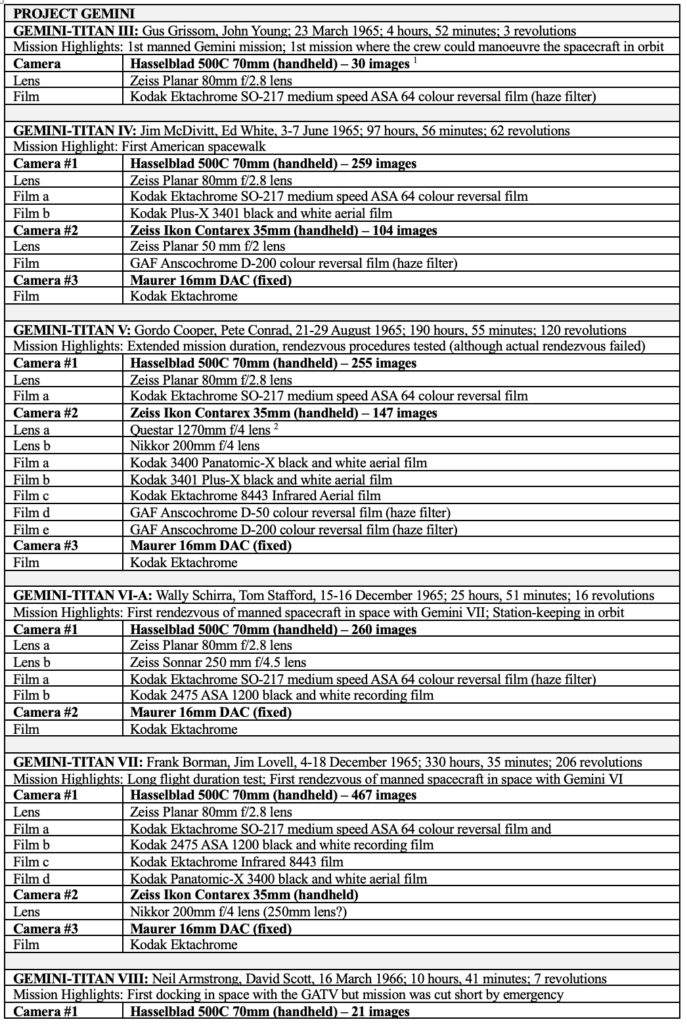
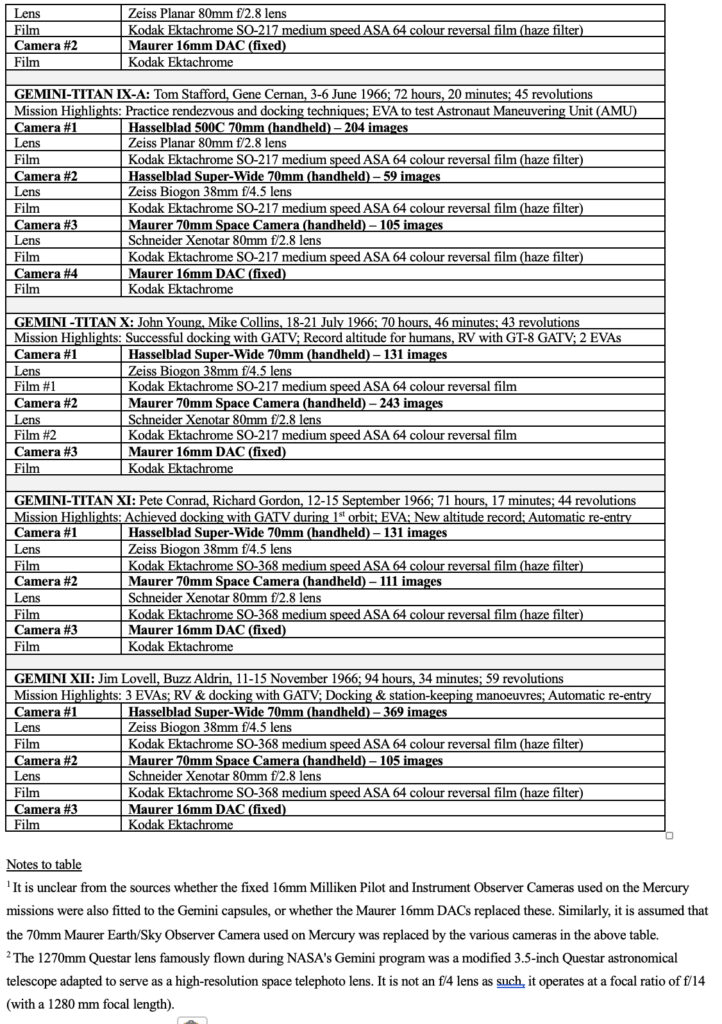
Sources and further reading
Images sources:
NASA Project Mercury https://www.nasa.gov/project-mercury/
NASA Project Gemini https://www.nasa.gov/gemini/
Gemini Overview Flickr https://www.flickr.com/photos/nasa2explore/albums/72157635042867316/
Gemini X Flickr https://www.flickr.com/photos/nasa2explore/albums/72157635072663810/
Gemini IX Flickr https://www.flickr.com/photos/nasa2explore/albums/72157634789297169/
Gemini VIII Flickr https://www.flickr.com/photos/nasa2explore/albums/72157635036072913/
NASM, The National Air and Space Museum: Smithsonian Institution (https://airandspace.si.edu)
The March to the Moon Digital Image Archive, Lyndon B. Johnson Space Centre, Arizona State University School of Earth and Space Exploration (https://tothemoon.im-ldi.com)
References:
Through Astronaut Eyes, Photographing Early Human Spaceflight by Jennifer K. Levasseur (Purdue University Press, West Lafayette, IN, 2020)
‘Observation Of The Earth Orbital And Suborbital Spaceflight Missions, Including The Unmanned Apollo-Saturn 4 And 6 Missions ( Mercury Program Through Apollo-Soyuz Test Project)’, NASA (eol.jsc.nasa.gov/searchphotos/Metadata/Apollo-Saturn_4-6_tables.htm)
www.zeiss.com/corporate/en/c/global-campaigns/50-years-moon-landing.html
www.filmatlas.com/entry/598
imaging.nikon.com/imaging/information/chronicle/rhnc12ti-e/
https://www.nikon.com/company/corporate/history/frontier/10/
Share this post:


Comments
Ibraar Hussain on Gemini on Film – the Cameras and Films Used on the Gemini Space Missions – Pt1
Comment posted: 18/07/2026
The Contarex images are especially impressive and it’s an especially impressive camera which is on my list.
Comment posted: 18/07/2026
Tim Bradshaw on Gemini on Film – the Cameras and Films Used on the Gemini Space Missions – Pt1
Comment posted: 18/07/2026
missions should own this. Same author previously did 'Apollo remastered', and a similar comment applies.
Comment posted: 18/07/2026
David Clark on Gemini on Film – the Cameras and Films Used on the Gemini Space Missions – Pt1
Comment posted: 18/07/2026
I have my own NASA artifact - a 70mm Hasselblad back used on the shuttles!
Comment posted: 18/07/2026
John Bennett on Gemini on Film – the Cameras and Films Used on the Gemini Space Missions – Pt1
Comment posted: 18/07/2026
My late father spent his career at McDonnell Aircraft (later McDonnell Douglas) and worked on the Gemini Project in St. Louis. He transferred from “Mac’s” aeronautical division. He returned to aircraft design after Gemini, preferring it to spacecraft.
Comment posted: 18/07/2026
Bill Brown on Gemini on Film – the Cameras and Films Used on the Gemini Space Missions – Pt1
Comment posted: 18/07/2026
Comment posted: 18/07/2026
Andrés Purriños on Gemini on Film – the Cameras and Films Used on the Gemini Space Missions – Pt1
Comment posted: 18/07/2026
Daimon Tilley on Gemini on Film – the Cameras and Films Used on the Gemini Space Missions – Pt1
Comment posted: 18/07/2026
Curtis Heikkinen on Gemini on Film – the Cameras and Films Used on the Gemini Space Missions – Pt1
Comment posted: 18/07/2026
Comment posted: 18/07/2026
Gary Smith on Gemini on Film – the Cameras and Films Used on the Gemini Space Missions – Pt1
Comment posted: 18/07/2026
Comment posted: 18/07/2026
Neal Wellons on Gemini on Film – the Cameras and Films Used on the Gemini Space Missions – Pt1
Comment posted: 18/07/2026
I'm writing to mention serendipity. After finishing another book on the space program yesterday, I ordered an Ansco Autoset like the one John Glenn used on Mercury. Looks like it will be here next week. I'm a camera collector and don't need much of an excuse but decided I wanted to shoot one and maybe put the story in my blog. The timing of your article is great.
Comment posted: 18/07/2026
John Eaton on Gemini on Film – the Cameras and Films Used on the Gemini Space Missions – Pt1
Comment posted: 19/07/2026
Comment posted: 19/07/2026
Scott Ferguson on Gemini on Film – the Cameras and Films Used on the Gemini Space Missions – Pt1
Comment posted: 19/07/2026
I also love how the astronauts were not particularly good at photos from outer space in the early missions, but that they and NASA has a spectacular learning curve that was producing stunning images by the time your Gemini rolls were shot. As a Hasselblad film shooter, I feel a bit of pride by association. I look forward to the next installment!
Comment posted: 19/07/2026
Ben Mackey on Gemini on Film – the Cameras and Films Used on the Gemini Space Missions – Pt1
Comment posted: 19/07/2026
Can't wait for part 2 in a couple of days.
Comment posted: 19/07/2026
Eric Rose on Gemini on Film – the Cameras and Films Used on the Gemini Space Missions – Pt1
Comment posted: 19/07/2026
Zheng Li on Gemini on Film – the Cameras and Films Used on the Gemini Space Missions – Pt1
Comment posted: 20/07/2026
I'm also both a space and photography nerd, and happen to have some NASA labeled 70mm cassettes, But alas, no space mission photos in them.
Comment posted: 20/07/2026
Jeffery Luhn on Gemini on Film – the Cameras and Films Used on the Gemini Space Missions – Pt1
Comment posted: 20/07/2026
Great article!!! I read it twice. What a unique birthday present for a space buff!
It's interesting to note that the astronauts had to learn how to shoot with various cameras in addition to the rigorous training they did with ship controls, suits, safety concerns, and a thousand other tasks. They were, and are, heroes to humankind. Thanks for your research and writing! Jeffery
Comment posted: 20/07/2026
Comment posted: 20/07/2026
Matthias Merges on Gemini on Film – the Cameras and Films Used on the Gemini Space Missions – Pt1
Comment posted: 20/07/2026
Comment posted: 20/07/2026
Comment posted: 20/07/2026
Ed Matejka on Gemini on Film – the Cameras and Films Used on the Gemini Space Missions – Pt1
Comment posted: 26/10/2026
Anyone have anything else to add? I have spent hours on this research and miraculously came upon this site today. To see GS listed as the lense for Alan brought a tear to my eye. Thank you