

The catalyst: Covid-19
When I was in my twenties, I loved to sketch strangers on buses and trains. When I emigrated to London, I turned my drawings into watercolours, etchings, sometimes linocuts. One day I was travelling in Piccadilly on a double-decker Routemaster, the old 1950s models with vertical radiators and frog-eye black headlamps. Perched on the tartan bench, near the white bar you hang on to, or the conductor does to shout: “Any more fares?” before pulling the overhead cord that goes “Ding! Ding!” to tell the driver to drive on, I was sketching. This time it was the guy sitting opposite. He smiled. I smiled. We both realized we were doing the same thing. We laughed and exchanged sketches. It was the first time drawing involved any human contact. In Rome, it was so private that only a friend ever saw my gallery of strangers. I never made any portraits with the cheap Zenit or the Canonflex I dropped and broke on a demo, when I panicked, challenged by a policeman. My interest in making portraits began because I liked sketching people with remarkable faces; thick eyebrows, unusually shaped heads. I didn’t really see them as people, more as abstract shapes, figments of my imagination. Not that I dared speak to them, but I wouldn’t hesitate to sketch them.
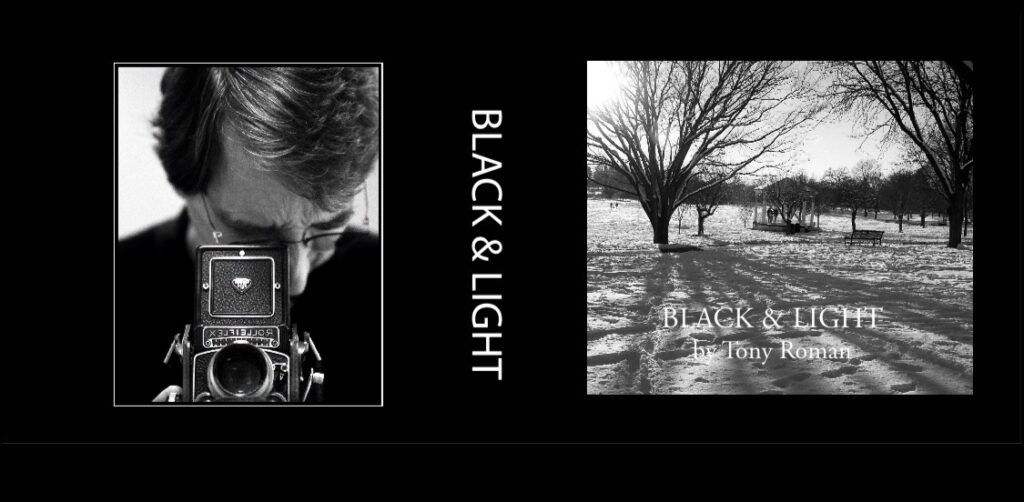
I forgot all about strangers until two summers ago when I bought a Rolleiflex with an f3.5 Tessar lens, the cheapest available on Kamerastore, after years of climbing the digital ladder, replacing one 35mm camera with the next deluded by the promise of ever-increasing digital megapixels and by the idea that technical improvements would improve my photography. Where are they now? Do they even exist or are they gone with the dead laptops they were stored on?
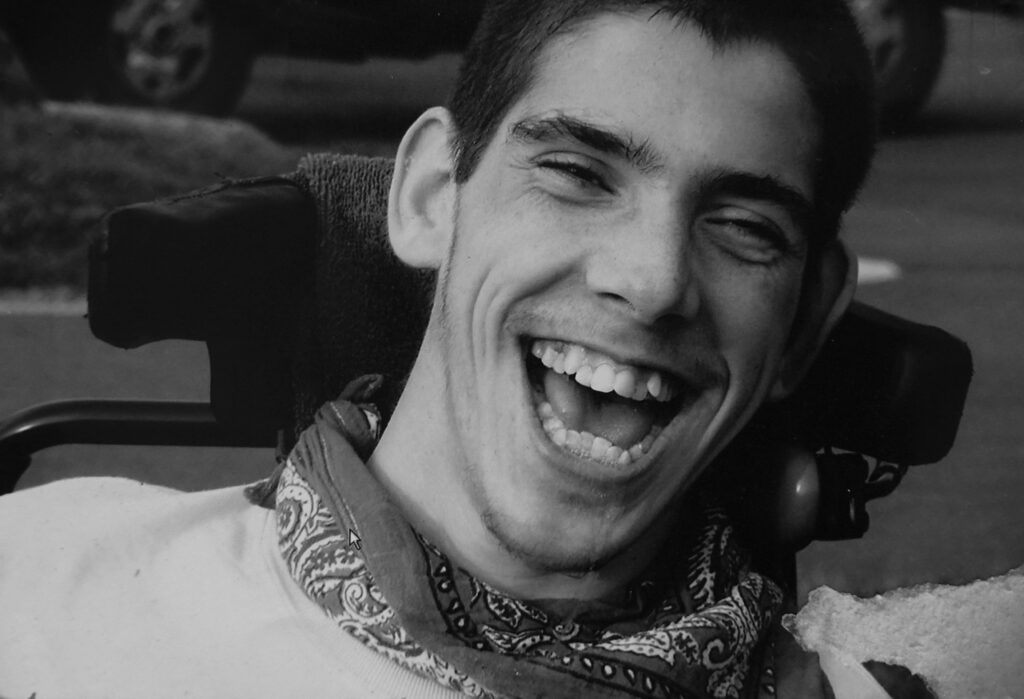
Except for the one image which I know where to find and when I took it, because I shall never forget the grieving American father in an Indian ashram who noticed my Nikon DSLR. He showed me a close-up of his laughing son who had recently died, but not before teaching his dad that even if you were paralyzed from head to foot, you could still be happy. “Would you be willing to take a photograph of the cremation tonight?” he asked at point blank range. I was humbled by his story, but hardly confident I’d get it right. The ceremony took place on a dark beach, lit up only by beacons, so I had a credible excuse for failure. Since my technical know-how wasn’t so great. We waited in silence. Then the spiritual leader appeared, surrounded by her retinue of monks in ochre, gentle chanting, and the sweet smell of incense in the air.
It wasn’t the first time I saw photography combined with death. When my Sicilian grandfather died, my uncle approached me discreetly holding his analogue camera, whispering apologetically that my grandmother had asked for someone to take photographs of nonno Rodolfo, as a keepsake. That was going to be me. I was only a teenager, now all alone in this small room with a corpse of someone I had loved, but whose presence I could no longer feel. Only a body now. No sense of my grandfather. He was gone. After I had taken several photographs as best I could, given the circumstances, zio Gaetano was going to get the roll developed, but everyone was hoping my grandmother would forget all about it.
After Covid-19
During the collective shock of Covid-19 and the changes it forced upon our society, we all learned to cross the road when another pedestrian was coming in the opposite direction. We all kept our distances. It was even printed on yellow and black stickers: KEEP YOUR DISTANCE! Initially, I told myself I could now spend more time on neglected projects, but a certain existential anxiety began to seep into my awareness little by little as well as a growing helpless despondency, the more I realized how much suffering Covid-19 was causing. The ever-increasing number of lonely deaths compelled me to ask what I might do with my own life to become a better person. The Pandemic made me wonder about the social masks we all wear. I was no exception. Could I face the challenges of dropping mine? I also questioned how I approached other people, even how I taught. Students were traumatized. Was there a way to interact differently with them? I was inclined to imitate informal youtubers in my online lectures and reframed everything I did. I also learned to try to listen more. What was it I missed most during the Pandemic? Human contact. Adopting a new attitude spread to other areas of my life, including photography and art in general. Covid-19 exacerbated binge-watching and I was sucked into social media more than before. But after Covid-19, I began experiencing digital fatigue, but even if I succeeded in breaking the digital cycle, I could not imagine what to do next. Then I read and watched countless articles and programmes about analogue and its surprising revival. These made me reconsider how I took photographs and why and consider their ultimate destination.
After all, my photography had been a private art form. Could I change my practice? If so, how? A photographic project began to form in fuzzy ways. To make it more tangible, I designed a logo for a cover of a non-existent photo-book which I named Don’t Talk To Strangers, before discovering that few photo-books ever reach any readership. The title was a reaction against the way society teaches us not to make contact with people we don’t know. But after Covid-19, I felt like doing the exact opposite. The logo featured an f3.5 Rolleiflex medium format camera. I sold the Sony Alpha with all its amazing lenses for a song, which I had bought when all that mattered to me was sharpness, bokeh, mega pixels and eventually full frame digital photography. But I kept a Sony I used for reproducing photographs from books and never regretted my Canon Camcorders, my first, the HF 10 and recently the XA 70, a small jewel for filming.
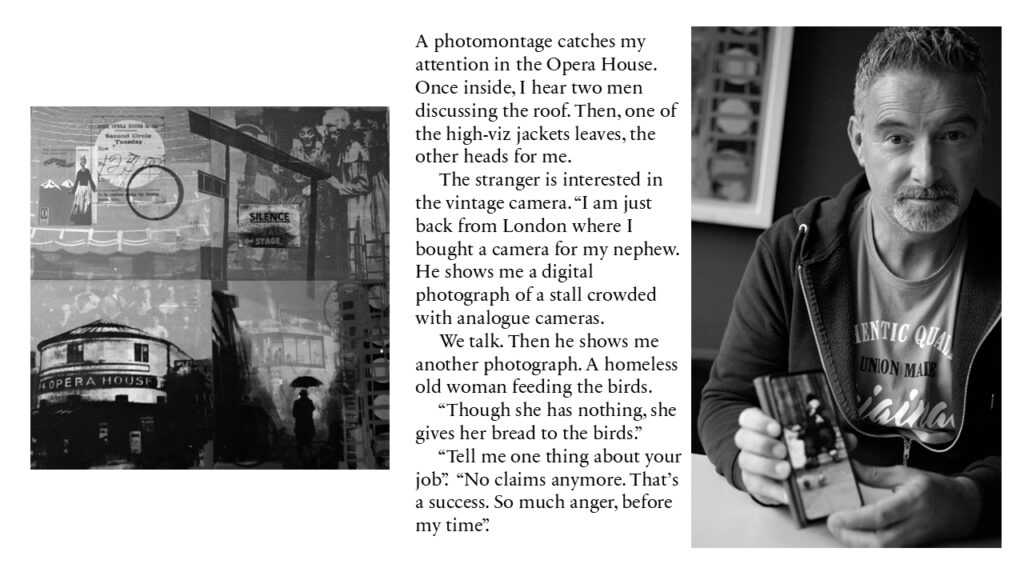
The Rolleiflex I found made good images, especially with the addition of red or yellow filters, despite my many mistakes. Paul’s Rolleiflex portrait inspired the first photo-story. But the Rolleiflex was unreliable. It felt too vintage, more than the Yashica Mat 24 I almost gave away to a student. Truth be told, I was unreliable too. Using automatic settings on digital cameras had made me lazy. What had happened to my concentration? Why wasn’t I checking aperture, focus, speed, ASA? I couldn’t even remember what film I had loaded. The obvious conclusion: relearning photography from scratch. Yes, this Rolleiflex was a disappointment, but so was I. The good thing about it was that it made me swallow generous helpings of humble pie. Less due to using dodgy vintage exposure metres, more to my lack of attention, overall shoddy practice, aided and abetted by digital forgetting.
What might replace the Rolleiflex? During my publishing career, I was sometimes art directing shoots, in studios surrounded by colour rolls dropping from ceiling to the floor, scary looking medium-format cameras, studio lighting. I was surprised that twin lens Mamiyas were affordable, costing only a fraction of the price of my Rolleiflex f3.5, let alone a Rolleiflex f2.8, due to their heavier weight and their preferred use as wedding cameras (even though Diane Arbus used a Mamiya C33 for fashion work, her daytime job, and later for the street photography she is famous for). So I opted for one. My first Mamiya, a C330s, came from a shifty person from Dublin, showing me the kit for sale in a large pub, his eyes darting from side to side. He seemed so impatient. Was he on something? He couldn’t find the box advertised with some extras. That said, his father’s camera was in really good nick, the speeds worked, and most of the lenses (the 250mm just back from repair from Rathmines, courtesy of Gunns in Dublin). A genuine bargain. I then came across a brand new C220f, still in its original cellophaned box, found in a lock-up in Arizona. I was the first person to ever touch it. Don’t get me wrong. I was still the main problem. I made lots of mistakes with both Mamiyas, but as cameras go, it was easier to use. I didn’t mind the weight, because I am used to carrying heavy back packs, so why the fuss? As for its unglamorous reputation, it keeps the price affordable to most.
When I started to walk aimlessly around town and strangers asked me about the Mamiya, I was inspired to ask them questions in turn, about their lives. Initially, I was compelled to interrupt, but always learned from these chance encounters, ephemeral moments of contact with total strangers.
The philosophy behind Don’t Talk To Strangers
For philosopher Edmund Husserl, after two thousand years of abstract thought, it was time to think again. His motto, which appears in Logical Investigations, was: “Back to the things themselves!” An encouragement to look around before casting judgement and forming opinions, to match set ideas against the real world around us. Doing so could have a strong effect on our perception of things. I found this extraordinary, given that Husserl was originally a mathematician. Here was someone inviting me to concentrate on lived experience, on my subjective response to the world, prompting me to question existing practice. To doubt it. To dare to be curious and consider if what John Berger calls another way of seeing was possible. To consider our habitual looking and look again. Husserl’s advice begins with “bracketing” or suspending judgement. We are always judging. But if you park this propensity to judge, other possible avenues may come into view. That’s the basis of field research. Not to ignore prior experience, but put it on hold and experiment with another way – to try and see the world the way others see it. For me, this was a revelation.
Could Husserl’s skepticism about norms and underlying habitual thinking be applied to street photography? I decided to try. Husserl made me see street photography in a new light. Who were these strangers? Was I aware of what it could mean to photograph strangers? The practice set in stone in street photography is neither to ask permission nor to be curious as to whom the people you grab into the frame may be. Instead, you could say that street photography objectifies them, in an apparently innocuous form of violence. For street photography, there are no subjects, really, only objects, commodified by street photographers themselves, whereby their images, posted online, end up joining all the other commodified objects in our lives.
These reflections led me to consider the work of Emmanuel Levinas whom Husserl deeply influenced. Because Levinas raises another dimension: the ethics of street photography. Levinas’s ethics in a nutshell: being alive is a shared existence. Are we prepared to ask ourselves how far we are willing to go to really get to know each other? The Other with a capital O? Levinas raised the possibility of intersubjective street photography or relational street photography. For Levinas, this is the paradox: while the Other’s face exceeds any representation of what one is – Levinas sometimes writes “face”, sometimes “the Other”, but he always means the same thing – because no single aspect sums up identity, given that there’s more to us, to you and me, nevertheless, resorting to Husserl’s approach, Levinas also points out that we can at least draw on our concrete lived life, because it consists in this being here and now and at least try to connect.
In practice, we are doomed to failure: that’s Levinas’s paradox. Even though your alterity and mine, as Levinas puts it “effaces the face”, including its very representation, I still try to make portraits of the Other, in the foreknowledge that I shall always fail. Even so, when you attempt dialogue, through listening, in the presence of the gaze of others, as a photographic practice, you seek to break the isolation and loneliness of being, the solipsism of selfhood, by means of the encounter with the Other. Can I learn anything from this ephemeral encounter? What can be shared? I keep trying, because your and my uniqueness must be said, although it cannot be said. I live Levinas’s paradox. In chance encounters, it is this strangeness of the Other that confronts me. A strangeness appearing as a face, as physical presence; but not a mere symbol of presence. Facing this experience, Levinas calls “the epiphany of the face”, the moment anonymous being becomes “incarnated” being (Emmauel Levinas, Outside the Other, 1993).
Whereas, for Henri Lefebvre, writing in The Production of Space, 1991, what can be shared is the space of the encounter. He also challenged our fixed ideas of space as a geometric abstraction, to argue, instead, that space is what we make ourselves. In producing it together, we effect a change. The chance encounter of Don’t Talk To Strangers happens in a concrete space, but one that is ephemeral. You create it when you meet a stranger. Actually, you create it only with the stranger’s help.
The haunting of photography history behind Don’t Talk To Strangers
Seeing the Stranger anew in this way, as Other, a not-me person with whom I wish to forge a contact, blends with lessons learned from photography history. At the back of my mind, the work of Alan Sekula about seafaring people and Joel Sternfeld’s Trading on Kings. Protesting the G8 in Genoa, 2001 where text and image combine both on the page and on the wall, in travelling exhibitions.
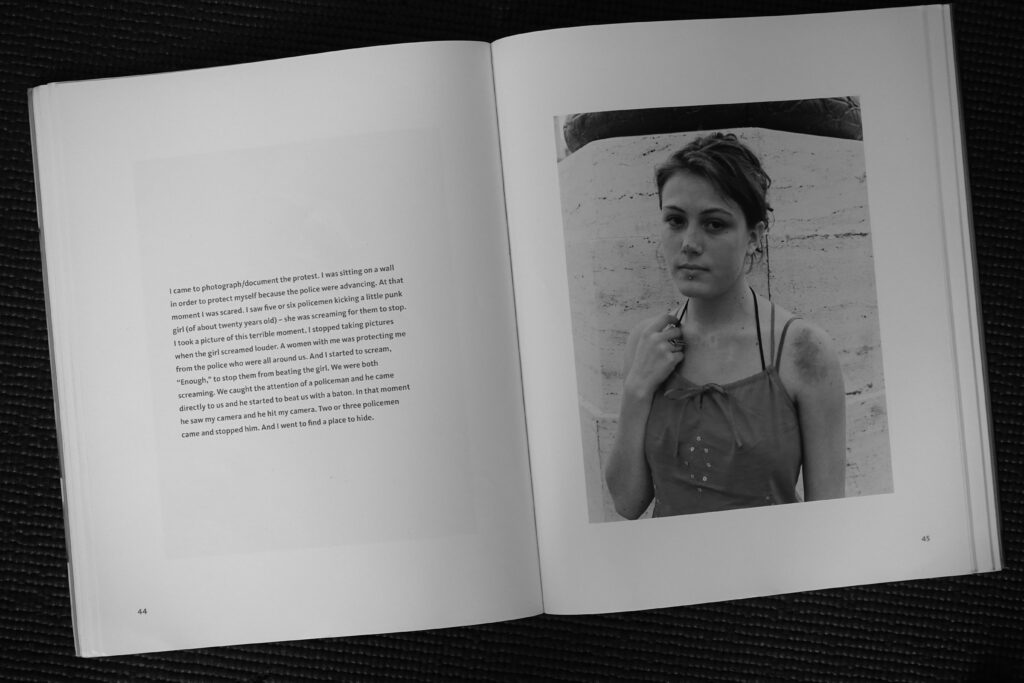
But the two photo-books that really struck me were James Agee and Walker Evans, Let us Now Praise Famous Men, 1960 (second edn.) and Paul Strand and Cesare Zavattini, Un paese, 1955.
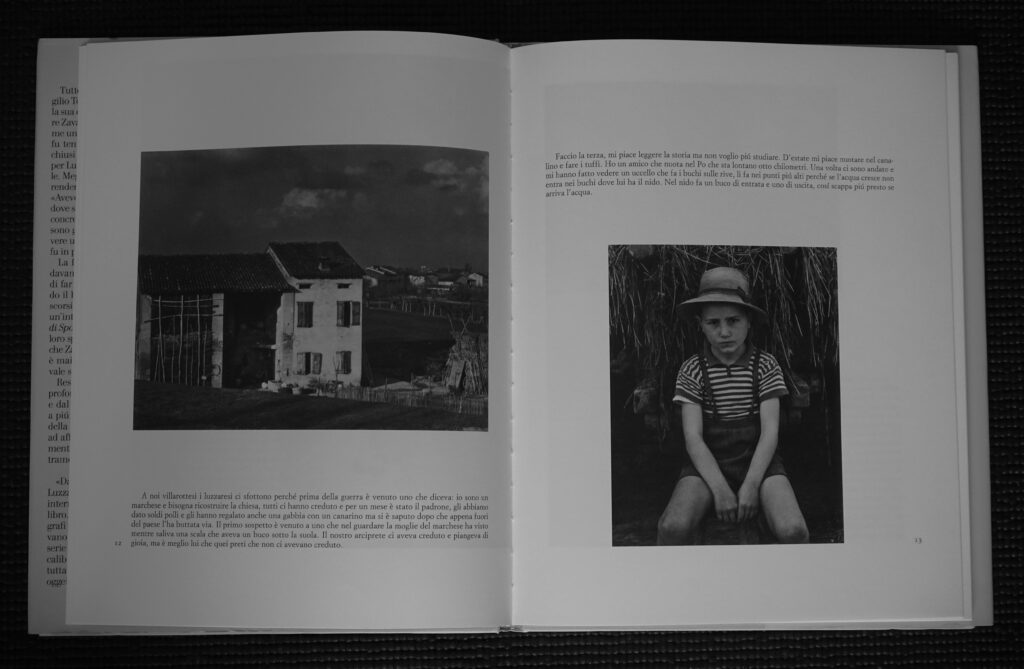
Cesare Zavattini’s theories also made me ponder. Zavattini, best known as screenwriter of Bicycle Thieves, Miracle in Milan and Umberto D., whose intellectual biography and related writings I published, taught me to “shadow” the real world and the people I meet during chance encounters.
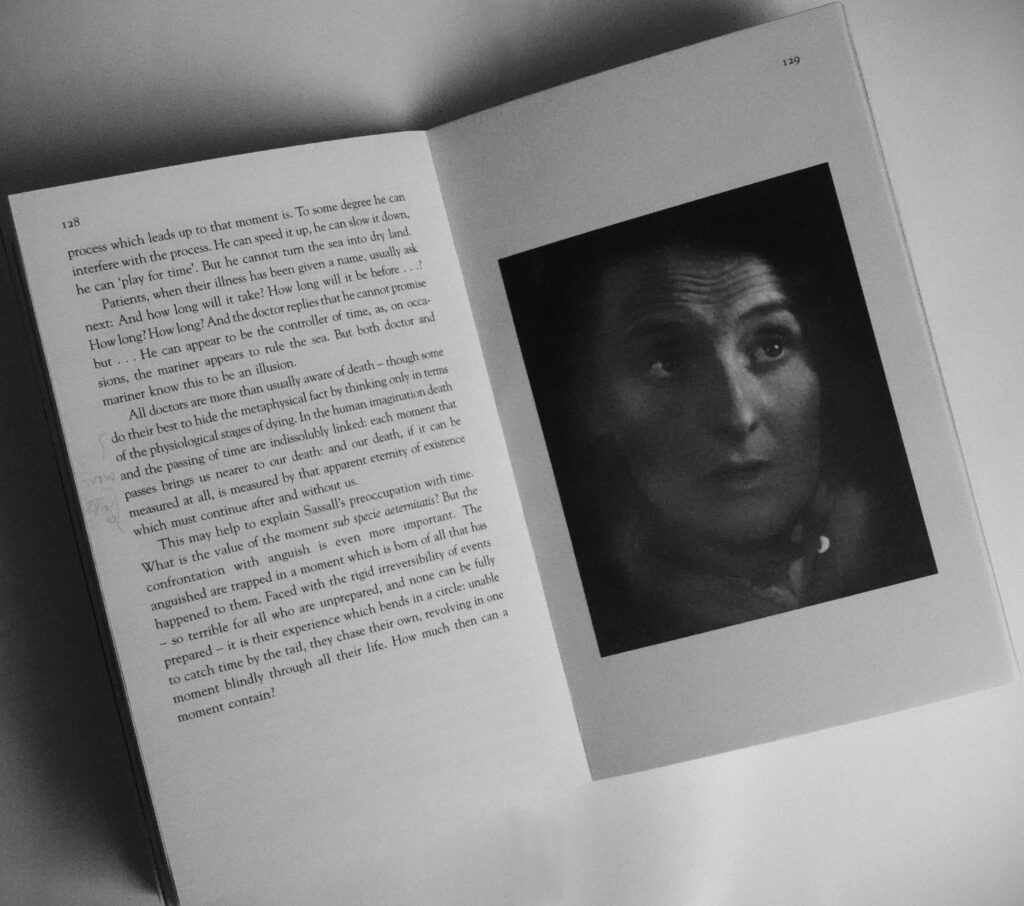
At the back of my mind there was also A Fortunate Man. The Story of a Country Doctor, 1967, by photographer Jean Mohr and writer John Berger, about a year in the life of John Sassall, a country doctor, someone who went beyond the call of duty to help others. Their book gave me a solid understanding of the Other by people who had never read Levinas. Mohr’s photography is interspersed with Berger’s careful observations, as both “shadowed” the doctor from village to village, from patient to patient. A labour of love indeed.
From practice back to theory: making Don’t Talk To Strangers
All this goes some way to explain how and why, when I began making photographic street portraits, I concentrated on each conversation I was having with strangers, warming to the exceptional, if ephemeral, moment, experiencing a kind of freeze frame perception, when everything around you seems to come to a standstill; a void of time, but with echoes resounding in the silence or hesitations between words. Yes, I talked too much; probably to reassure the other person. But I committed everything to memory and later wrote up whatever I could remember in a little blue lined A5 notebook. Gradually, a rhythm appeared. I learned to speak less; to try to be discreet. To ask a question or two, and only when it seemed helpful. I think there is a private space for telling, even in the bustle of town. If you stopped for a moment, the story would surely come. Often did. All I had to do was listen, really. Connect. Not something I could have done in any premeditated way. It came when it did and you could tell when it did.
What an eye-opener. I dare say that this project is not only taking on a life of its own, but also deeply affecting me. So deeply that it has drawn me into an ethical form of street photography. Over the past two years, I have made over 70 analogue portraits of total strangers with their consent. I would strike up a conversation, put the person into the picture, as to my plan, explain that I was gallery-oriented, not social media oriented, that pursuing portraits using old-fashioned film photography was what interested me, and promising to send scanned photographs when I had edited them.
When I realized how much it would cost to scan the negatives, I decided to buy a second-hand Epson 800, from someone who’d only used it to scan his family albums. When I began scanning negatives, I still had no idea how to shape this project. But my publishing experience helped me imagine a physical home for these images. I never saw them as standalone photographs. But where to put the text? Initially, I imagined a 6×6 square format with text on the left and the bleed image on the right or with a narrow white margin. But that idea wasn’t going anywhere.
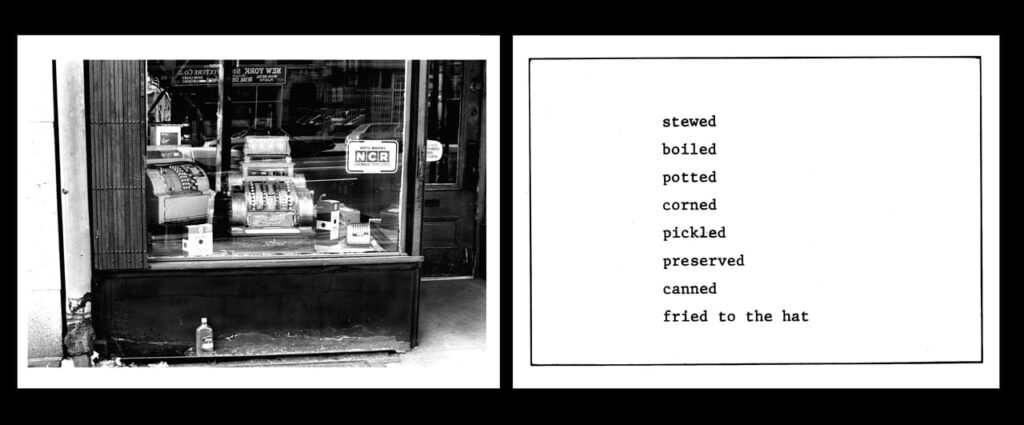
Last March I came up with a solution of sorts. Each photograph would appear next to an extended caption. I remembered American photographer Martha Rosler’s installation The Bowery in two inadequate descriptive systems, about alcoholics living in a New York neighbourhood. The title is typical of 1970s conceptual art, and hardly easy to grasp, unless you studied some linguistics and structuralism, topics I detested at university. The Bowery in two inadequate descriptive systems dealt with urban life and how the poor are represented by the media. Not a single portrait of people in the frame; only images of shop fronts facing some stereotypes used to describe alcoholics. Hence, the “inadequate descriptive systems” of the title. Civil society is not so civil after all, Rosler suggests. Or its media isn’t. We use derogatory terms to describe homeless people.
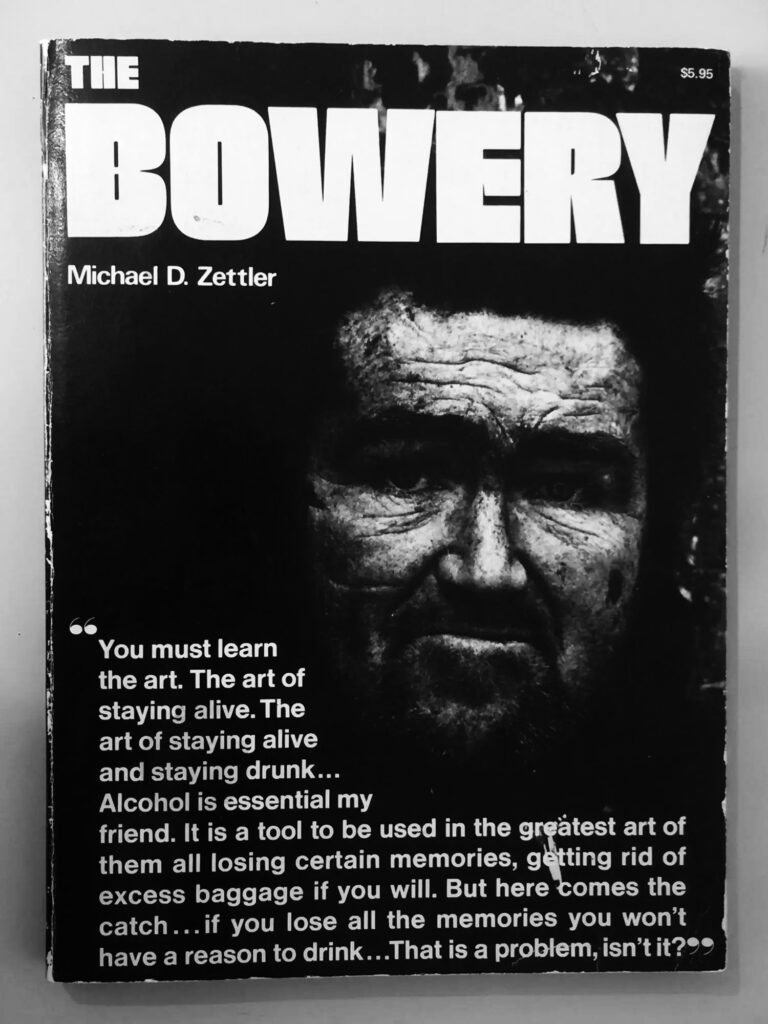
Rosler’s specific target was Michael Zettler’s photo-book The Bowery, which treated down and outs with condescension, nothing more than human waste. But Rosler’s wider target was street photography itself, for appealing to low instincts, to shock and entertainment.
Making makes you think more clearly. When I puzzled over how to combine text and image in the design, first making loose grids, serving as blueprints for positioning the photographs and accompanying text, I initially thought of text only as captions. But eventually they became as important as the photographs. I found grids too forbidding. So I began to let the images float, to see what would happen. I suppose these famous precedents which I knew and loved must have been at the back of my mind.
My project gathered momentum months ago, when I joined an online photography group called Urban photographers, many of whose members live in or near London. What a visionary project: to bring together lost souls working in isolation and even encouraging them to submit photographs for an exhibition (“Urban Lives Exhibition” The Handbag Factory, London SE11 5RB, 28 January-1 February 2027) of which 4 would be selected by a panel of anonymous curators and blown up to fit A2 exhibition panels. Could I be allowed to develop a critical kind of street photography, using Rosler’s example as a viable precedent? The exchange in the blog was promising. Rather than submitting 12 standalone photographs, I proposed 12 photo-stories, containing the combination of photographs and text I had envisaged. “Love it” was the response, when I sent some of these samples.
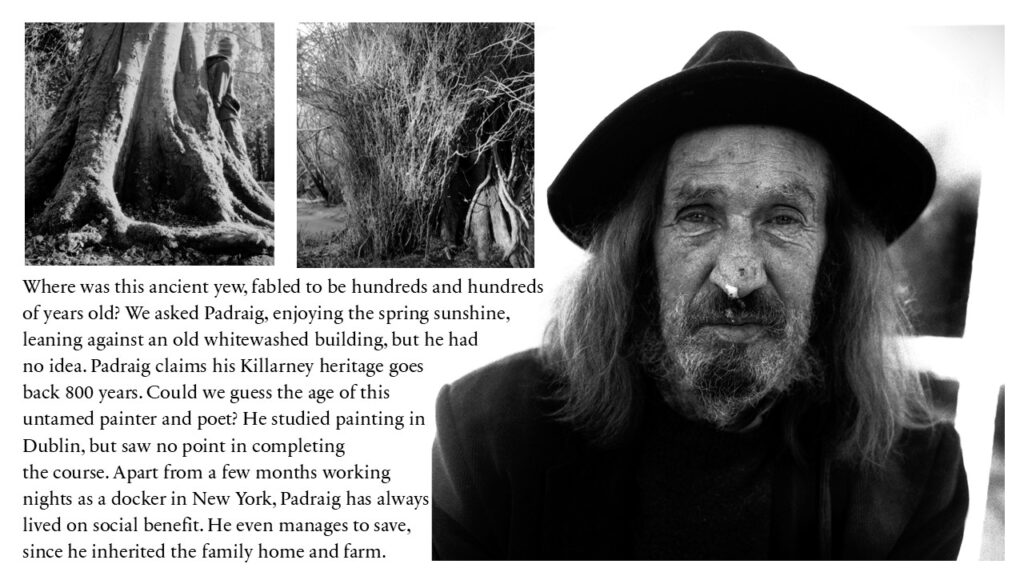
Padraig, an 80-year-old Irish man lives on an inherited farm, near Killarney. A former Stranger and I approached Padraig to ask him if he knew where the local famous ancient yews were in Killarney National Park. “No idea”. But Padraig let me make two portraits with the Mamiya. Only later did I realize that Mark and I had found the ancient yew. It was Padraig himself. Equally alive, still writing poetry, attuned to the changing seasons. So, I positioned Padraig’s portrait, in a sort of loose montage by association, near two photographs of trees. And Padraig’s story became part of the composition.
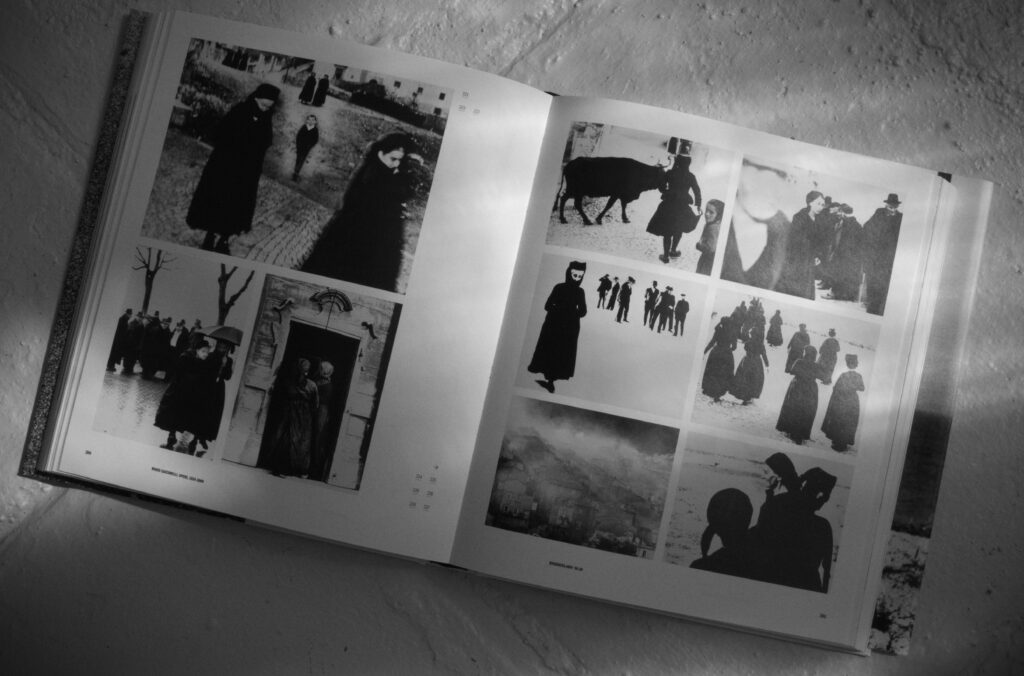
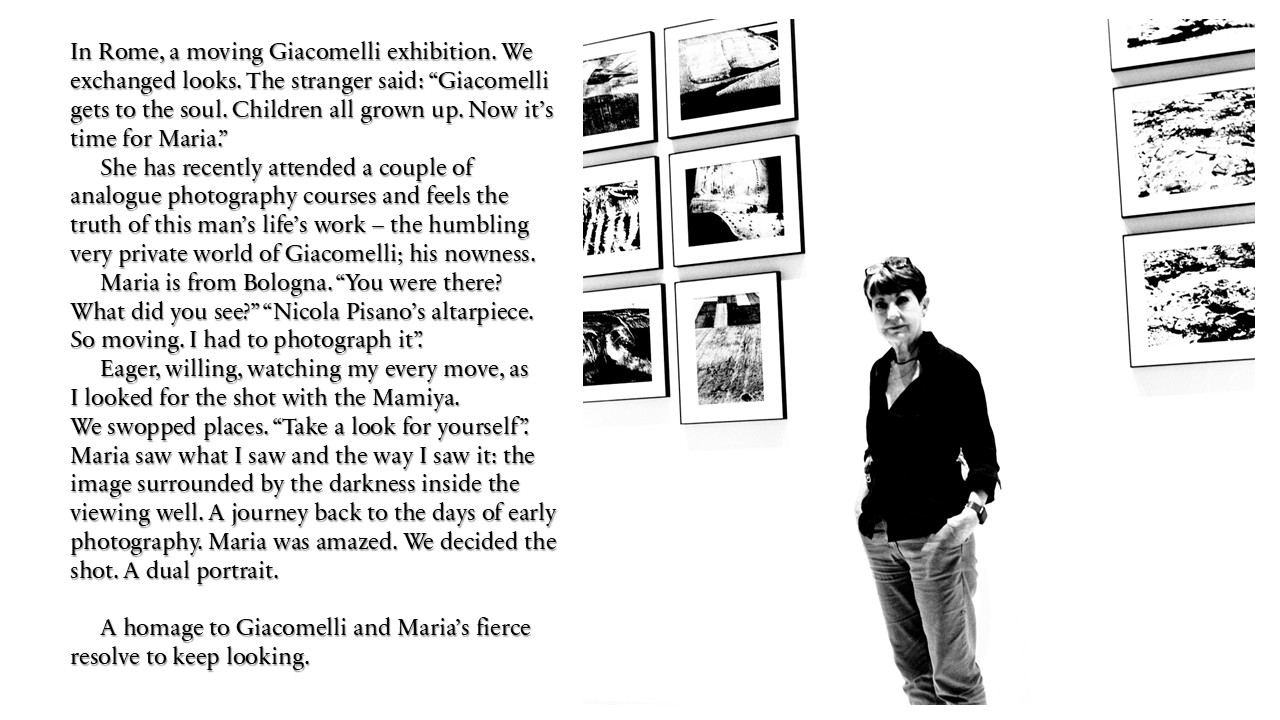
During an impressive retrospective exhibition in Rome of the works of Mario Giacomelli last summer, I met Maria from Bologna. We were sharing the stark white gallery space, dotted with high-contrast Giacomelli landscapes. We exchanged glances. Body language speaks volumes. It was clear to both of us that we shared the same emotion for being allowed to enjoy the same extraordinary show. Maria couldn’t help noticing the Mamiya. She was curious. I invited her to look into the viewing well. We were back in the 1900s, almost, but not quite, the dawn of photography. “A portrait?” Maria agreed. We discussed the shot, decided together how we might compose it. Harikrishnan, an Indian friend (and Assistant Professor in the Department of Visual Media and Communication, Amrita Vishwa Vidyapeetham, Kochi , India)
made the point that this photo-story showed him how image and text were conveying different conceptual levels, at once. He explained: “It is a portrait of a person, a conversation about photography and a reflection on seeing itself”. I discovered that I can’t take a distance from what I make. Intuition and experience surely help, but the whole logical planning seems to be more an intuitive feel for a situation evolving when you turn “back to the things themselves” rather than any plan, playing out according to preconceived intentions.
Don’t Talk To Strangers as it stands right now
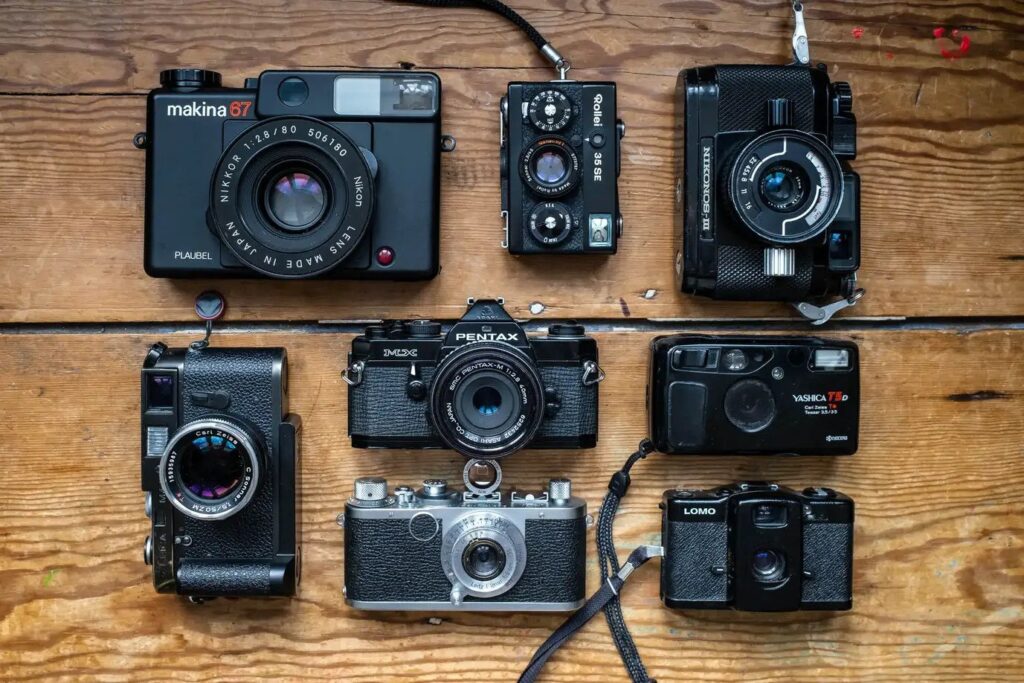
So far, I have dwelled on the ideas behind this project, its history, its making and who inspires me. I want to end with more tangible aspects, attempting a diary of the last two days working on Don’t Talk To Strangers. So the other day, I took the Mamiya C220f as well as the new Rollei 35, which I was going to try for the first time in my life. I had made a note of two reviews by Hamish Gill on 35mmc and watched some youtube programmes about the camera. They are quite expensive. But then suddenly, out of the blue, one was advertised by MPB as “good” yet priced at 132 euros. I didn’t hesitate. The others had the f2.8 lens and cost 350 euros or more. I could live with the Tessar f3.5, no problem. A couple of cosmetic scratches? These would put off a collector, but I am no collector. I found an inexpensive cap and yellow filter from eBay, using my vintage but as good as new L398 Sekonic to do the metering.
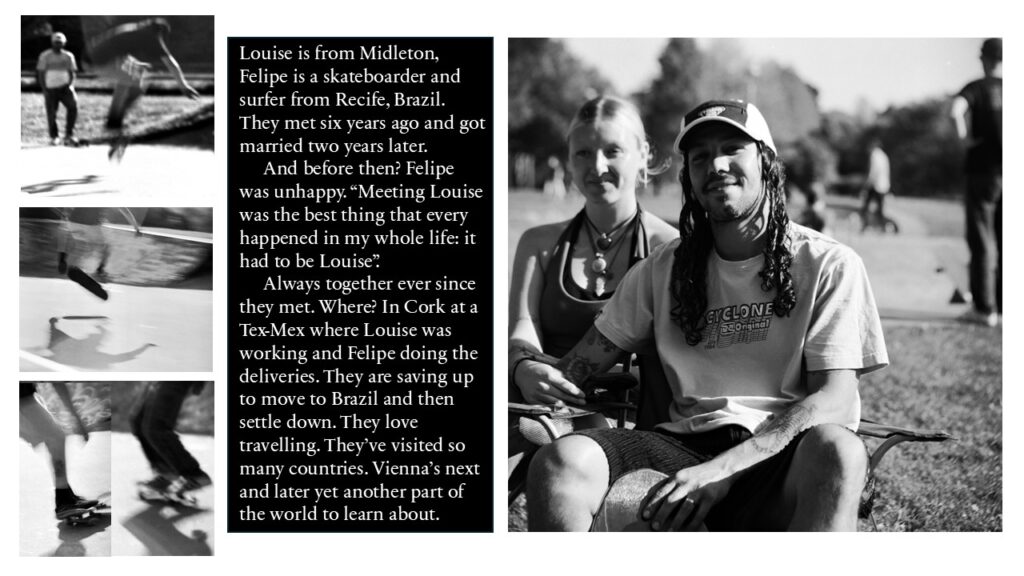
Compared to handling my Mamiya, the skateboarders came easily into shot with the Rollei 35 and I didn’t find zone focus so difficult. When I photographed Brazilian skateboarder Felipe and Louise and they told me their story, I made the Mamiya do the background acrobatics, as well as their portraits, knowing I wouldn’t find it easy. Sure enough, seeing the action the wrong way around confused me. The pressure made me aware that I was far too concerned with sharp focus, even viewing through the magnifying glass. Although I managed to crop some of the moves, it wasn’t easy. When I tried the Rollei 35 the other day, in the same place, I only had to worry about when the skateboarders came dangerously close, in a dare-devil attitude. I just accepted the dare and sidestepped the advancing skateboard.
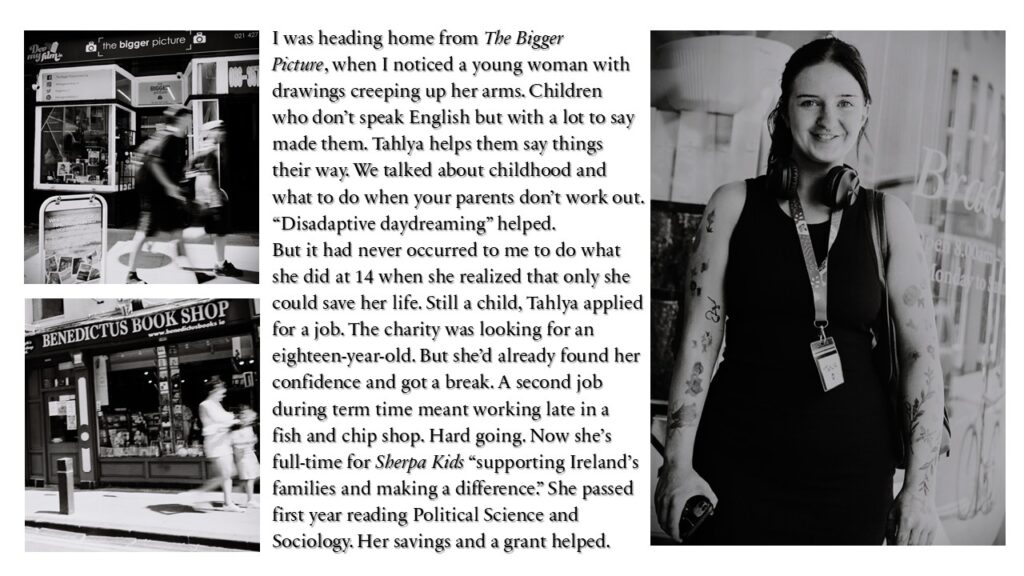
After dropping off two rolls of Ilford black and white film to The Bigger Picture lab, I loaded a roll of Ilford C41 at 400 ASA, I was heading home, walking down North Main Street towards the quays, when I noticed this young woman. I felt inspired to say something appreciative about her surprising small red and turquoise drawings done so well, they seemed to be creeping up her arms. My remark was well received. These childlike drawings were made by children who don’t speak English but have a lot to say. She helps them say it their way. Now, sometimes I hear people complain about young people for being obsessed with smartphones and supposedly becoming very selfish. I can’t say my experience has confirmed such a view; rather, this chance encounter proves exactly the opposite. Tahlya and I talked about children, her childhood, mine and what to do when things don’t work out with parents. She told me: “They call it disadaptive daydreaming” out of a situation. This trick we shared. Another approach was to look elsewhere for good models of behaviour.
But never had it occurred to me to do what she had had the courage to do at 14, when she realized that she, and only she, could extricate herself from her life, such as it was then. What happened was that Tahlya, though still a child herself, applied for a job with a charity working with children. The post was advertised as suitable for an eighteen-year-old. Yes, Tahlya was only 14, but already her fearfulness been replaced by a new-found confidence and determination with which she faced the interview. She was given a break. After nine months, she secured a second job. Going to school meant working late in a fish and chip shop, then struggling to get to class on time; but it had to be done. Tahlya now works full-time for Sherpa Kids “supporting Ireland’s families and making a difference” and has passed her first year of Political Science and Sociology at University College Cork, funded by a grant and her own savings to make up the difference. Classes are packed, with 1,000 students in a classroom, all looking at AI on their phones to figure out the key concepts. No chance to ask lecturers any questions. They’re always in a hurry. Learning off by heart” is a easy solution to get a pass, but not Tahlya’s idea of scholarship. We worked out a couple of portraits with the Mamiya, the first on the spot where we met, the second outside the shiny curved glass of Bradleys. “Sociology, right? So, you’ve heard of Max Weber? But not of Alfred Schutz’s The Phenomenology of the Social World, right? Schutz takes Weber to task. He’ll give you a good grasp of sociology, even if your lecturers don’t teach him”.
No shots left. Our conversation had also come to its natural ending. I dropped off this extra film and went back the way I came, walking past the same spot, but now the street was empty. Had we really met? The C41 Ilford negs were ready the next day, but there was a problem. More humble pie? Catalan Bruno showed me the scans. He pointed out the painful thick white gaps where there should have been fixed emulsion. The machine had overheated. Bruno gave me a free roll of black and white and didn’t charge for processing – very typical of him really.
After I submitted my 12 photo-stories, rather than 12 iconic shots, the curators asked me to send lone photographs. “They liked the concept,” I was told reassuringly. Clearly, they didn’t. The fact is that the phenomenological attitude is at odds with “best practice,” precisely because it follows Husserl’s invitation to “go back to the things themselves”, meaning the world of lived experience which inevitably means questioning our street photography habit patterns, to experiment with connecting with people and hearing their stories, as Berger and Mohr, Sternfeld, Zavattini and others have done, instead of worrying about mirror slap, the noise of the shutter that might alert others to your secretly taking aesthetic shots and claiming it for yourself as art: a case of wait and see.
As Tahlya used to do, I felt like day-dreaming. I found myself in a scene from Luigi Pirandello’s Six Characters in Search of an Author, admittedly, a scene Pirandello never wrote. I imagined six people stepping out of their portraits to plead with me, the author. One of them speaks up for the others: “Are you really going to allow each of us to be stripped out of our stories, divorced from our people?” They stare me down in frustration and defiance. “Don’t you understand what is at stake? Our integrity, not yours”? I then got over any personal regret, to ponder what this crux says about cultural politics, curatorial practice, inclusiveness. I was wrong. The injunction of Don’t Talk To Strangers should be taken literally. Iconic images should not be challenged by relational images and we should not “go back to the things themselves”.
Share this post:

Comments
Eric Rose on Don’t Talk To Strangers
Comment posted: 18/08/2026
Comment posted: 18/08/2026
Comment posted: 18/08/2026
Gary Smith on Don’t Talk To Strangers
Comment posted: 18/08/2026
Comment posted: 18/08/2026
Comment posted: 18/08/2026
Comment posted: 18/08/2026
Comment posted: 18/08/2026
Comment posted: 18/08/2026
David Hume on Don’t Talk To Strangers
Comment posted: 18/08/2026
Firstly, your prose is delightful, and thus the attention needed to do your thoughts and experiences justice is well rewarded. I think that the way it ties your evolving rationale to that of many other photographers and writers is a great illustration. It demonstrates how photography - or any other art form - grows from conversations between practitioners; conversations conducted not in person but through their work and writing.
There is a deft exposition of your own experience, but also an invitation to explore the work and thoughts of any number of the photographers and writers you mention.
And then there's even some gear talk! Bravo, and it's so nice to see this here. Cheers, David.
RichardH on Don’t Talk To Strangers
Comment posted: 18/08/2026
On a practical level, you remind me of how the TLR camera with its waist level viewfinder can initiate conversations.
Comment posted: 18/08/2026
Walter Reumkens on Don’t Talk To Strangers
Comment posted: 19/08/2026
Comment posted: 19/08/2026
David Pauley on Don’t Talk To Strangers
Comment posted: 19/08/2026
And thanks so much for this thought-provoking piece. While reading it I kept thinking of Susan Sontag's damning critique of photography: the implicit violence in "taking" someone's photo, with or without consent, and the inevitable commodification of the resulting images: cheap thrills for late-capitalist nobodies. I don't share Sontag's dim view of photography most days, and in optimistic moments feel there is something profound and perhaps even transcendent in the impulse to find meaning in life by making images, whether via pencil and paper as with your early sketches, or with film, or even pixels, though as a film photographer I'm a bit grudging about this last point. Your desire to pair your photos with narrative details about your subjects seems interesting and worthwhile, whether your galleries agrees or not. I hope you'll keep at it and circle back here with more images and reflections soon.
Comment posted: 19/08/2026
Comment posted: 19/08/2026
David Brancaleone on Don’t Talk To Strangers
Comment posted: 19/08/2026
I will say this about Susan Sontag. Her On Interpretation contains at least one excellent incisive essay about Robert Bresson, really profound, in that she is able to see the connexion between Husserl's phenomenology and Bresson's "transcendental" filmmaking, understood as spiritual, though this was not how Husserl used the term. For Husserl, it meant something like grounded, conxt-based thinking, borrowing it from Kant, but using it in his own way. Paul Schrader, the following year, only 24, published Trascendental Film 1972, clearly inspired by Sontag's essay on Bresson.
Even with its weaknesses, Sontag's The Pain of Others is also really good, despite her old tendency to condemn documentary photography as a whole. I just think she's wrong. As wrong as John Berger on the same issue, 40 years earlier. Her essay praising painter of modern life photographer/artist Jeff Wall is really poor. Don't get me started.