

It’s been almost 9 years since I got my first lens in Leica thread mount. It was Canon 135mm f/3.5 and I was blown away by how well it stood the test of time even though it was a good quarter of a century older than any lens I have used on digital up to that point. This opened a world of possibilities as the mount seems to have more variety in terms of the number of lens manufacturers than any other.
Over the years my collection grew and eventually I began to want something a bit different, perhaps a lens I haven’t seen anybody else shoot with, an uncommon brand, or something with a bit of a story behind it. There are a fair number of custom-converted lenses on Ebay and so far I have pulled the trigger on three of them. They all had the same flaw – despite being advertised as rangefinder-coupled, they were awfully miscalibrated. Two wouldn’t go anywhere near infinity and one, while usable as-is if you’re patient, presented various degrees of back-focus at different distances.
This means to truly take advantage of these otherwise very desirable optics I needed to make further investments and wait months while the repairs were taking place. So I grew to distrust the sellers’ assurances that focus has been tested and should work accurately, barring the minor differences between particular cameras.
The pains of shooting with a rangefinder
I am far from being fussy about focusing. And it’s not even that I use a lot of very old lenses, often in various states of disrepair, but my camera isn’t too reliable either and the patch doesn’t align at infinity. When I occasionally find a lens that focuses “correctly” according to the rangefinder, I know for a fact it does not. If I ever part with it and send it off to be calibrated, it will be challenging once I use it again as I’m so used to focusing in front of the subject. I just learned to live with it.
That’s why I got the idea of perhaps trying to convert a lens myself. How terrible of a job could I do compared to the badly calibrated lenses I had to pay big money to fix? However, in the past I had some grand plans of getting into camera repair that I quickly abandoned. I just didn’t have the eyesight or the patience for it. I performed very simple fixes on a couple of cameras and just let go of this whole silly venture.
As easy as it seems?
Lenses, I imagined, might perhaps be simpler? In my collection I have a Dallmeyer Dalrac 135mm f/4.5 that had terrible vignetting caused by the round rangefinder cam. The optical block could be unscrewed and mounted on a Leitz Hektor 13.5cm f/4.5 helicoid and only required minor adjustments in terms of focus. The Hektor features a mini cam and the vignetting was greatly improved.
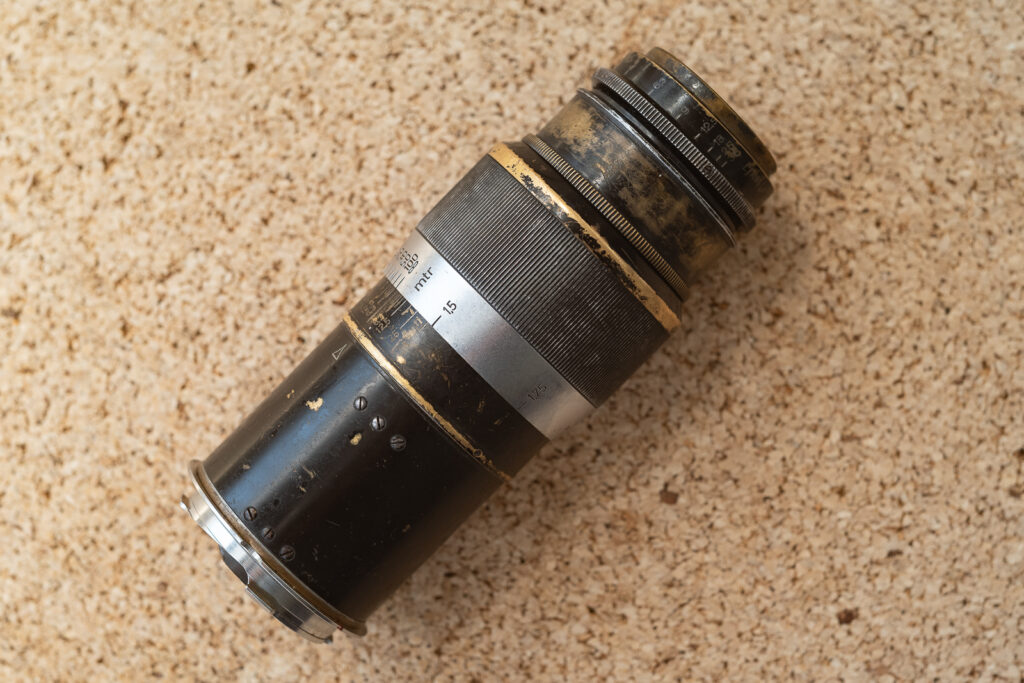
I hatched a plan to try this with an optical block of another 135mm lens. Besides the Hektor helicoid I got especially for the Dallmeyer, I had another whole Hektor I could experiment with. I have way too many 135mm lenses and this is my least favourite one of them all. But it has that lovely all-brass build quality typical of Leitz lenses from the 1930s.
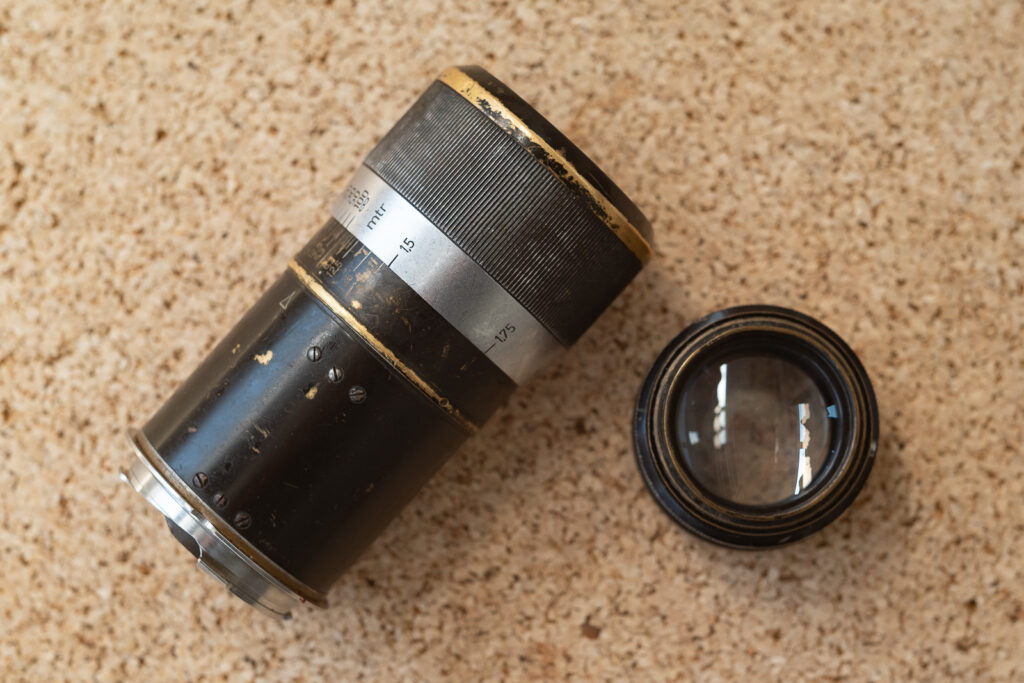
The optical block simply unscrews from the rest of the lens; the screw mount is 42mm
In theory this transplant should be easy provided both were actually the same focal length. This is not always the case and lenses marked with the same focal length value can actually differ by a few millimetres in either direction. Impossible to ascertain this beforehand and just had to be tested in practice.
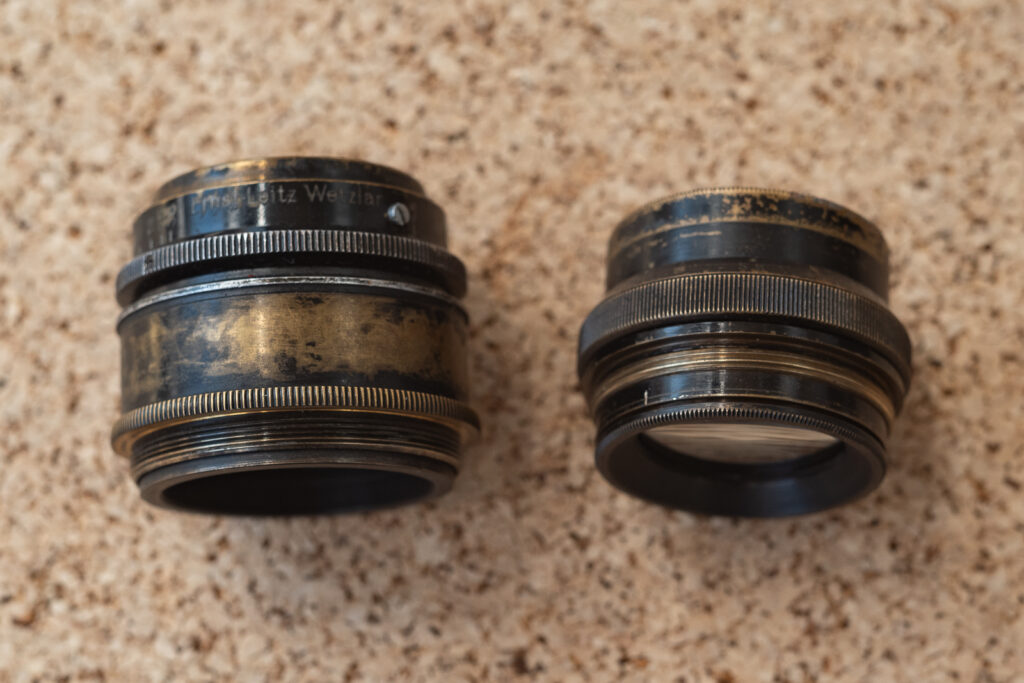
The boyer is shorter and smaller overall, with a mount measuring 39mm vs the Hektor’s 42mm
l’attrait de Boyer
I can’t remember when I learned about the no longer existing company called Boyer. Probably when investigating other French brands, like Angenieux or SOM Berthiot. What’s special about Boyer is their chief designer – Suzanne Lévy-Bloch. Even today, lens design is a very male-dominated profession. Lévy-Bloch, a highly skilled and educated mathematician and optician, began designing lenses for Boyer in 1925 and carried on for 40 years. She was one of the very first women lens designers in France. Sadly, today she is mostly forgotten.
This bit of back story was enough for me to want to add a Boyer lens to my collection. But my collection is composed of lenses I use and they never made lenses for LTM or any other 35mm rangefinder mount I could easily adapt. So I had to do it myself.
As easy as it seems!
There are several Boyer Saphir (all of their lenses were named after various precious stones) 135mm f/4.5 on Ebay but a pre-war uncoated one caught my attention. It features a 39mm screw mount. The Hektor has a 42mm one. First thoughts – the optical block is smaller than the Hektor’s which is great news as in theory this would mean it will focus past infinity and that is easy to resolve.
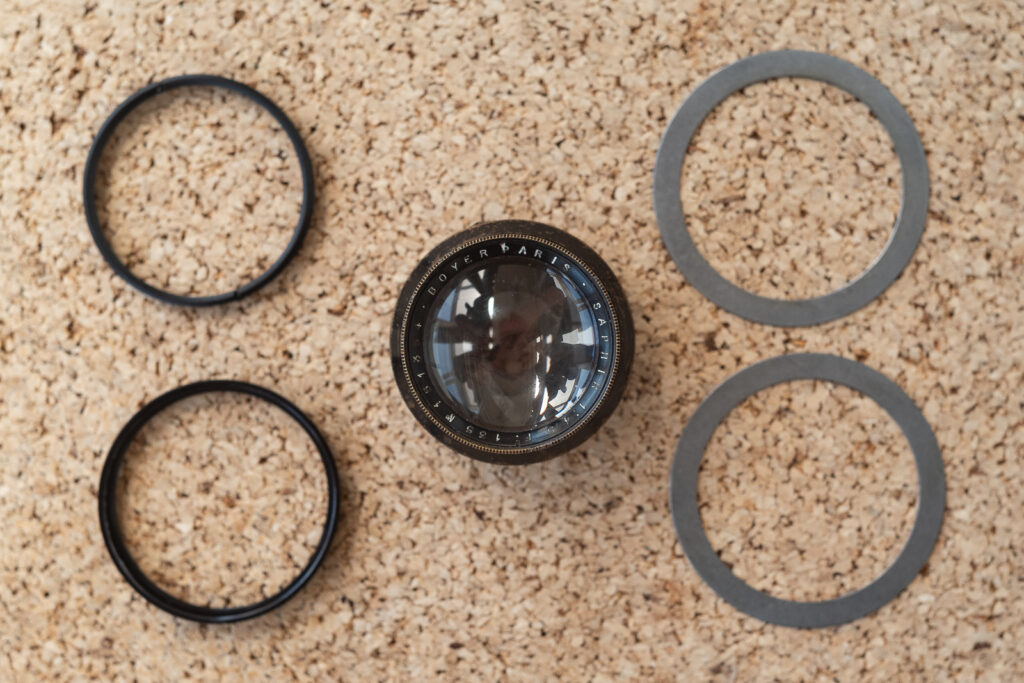
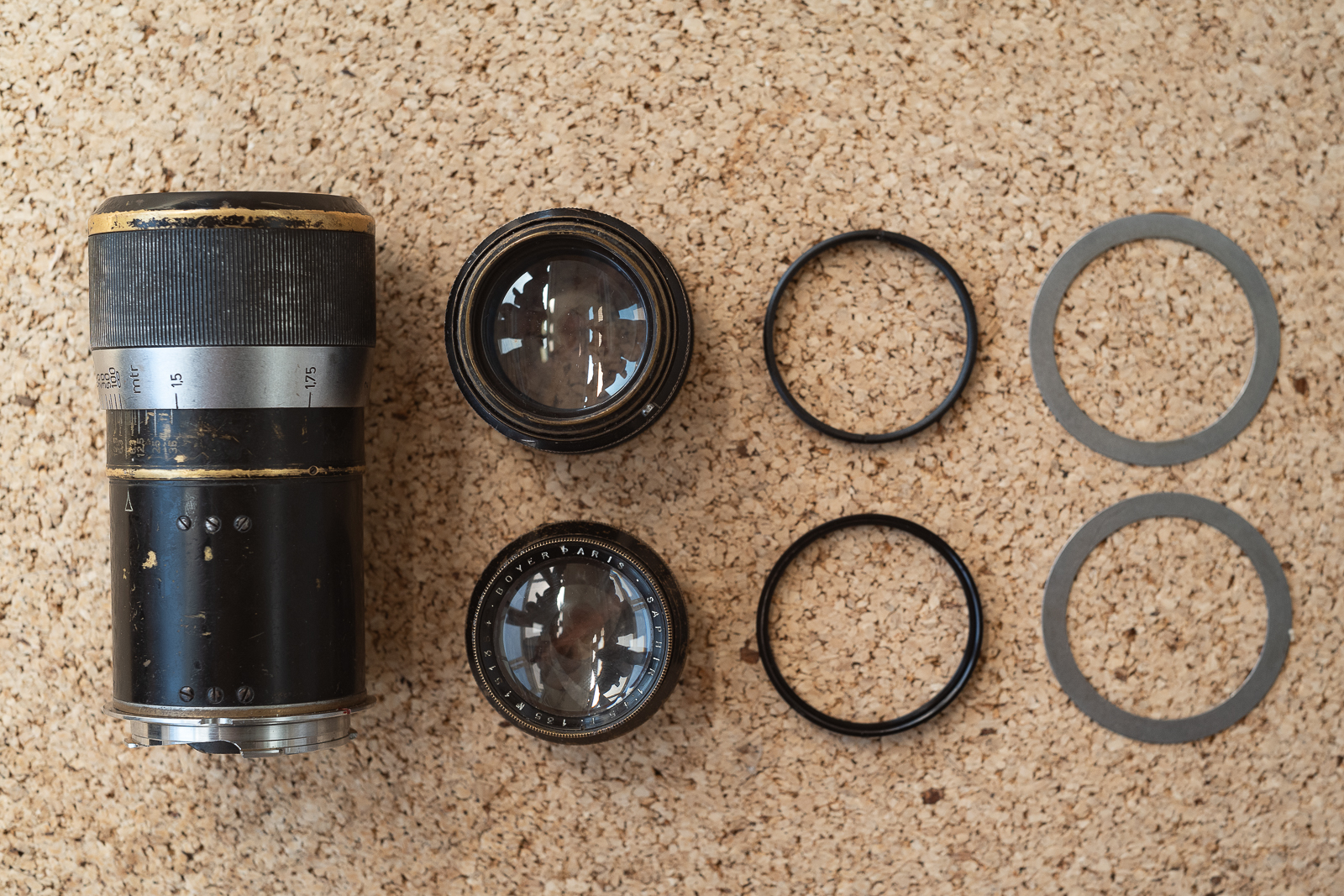
TL: M39 to M42 adapter; BL: 3mm thick M42-M42 spacer ring; R: two 0.5mm thick 40mm internal diameter shims; C: optical block of the Boyer Saphir 135mm f/4.5
In practice this proved to be true – infinity fell at somewhere around 6ft when simply holding the optics in place, slightly further with the soon acquired M39-M42 adapter. These are easy to find as their most common use is to adapt Soviet M39 lenses to M42 SLRs. Next stop was to add a bit of extra space between the lens and the helicoid. At first I got a 5mm M42-M42 spacer ring (meant for astrophotography) but that prevented it from reaching infinity, not by much but still. So instead I got a 3mm one and some 40mm 0.5mm thick shims. Annoyingly, these are a bit too large but next available size was 37mm which was too small. 38mm would have been perfect.
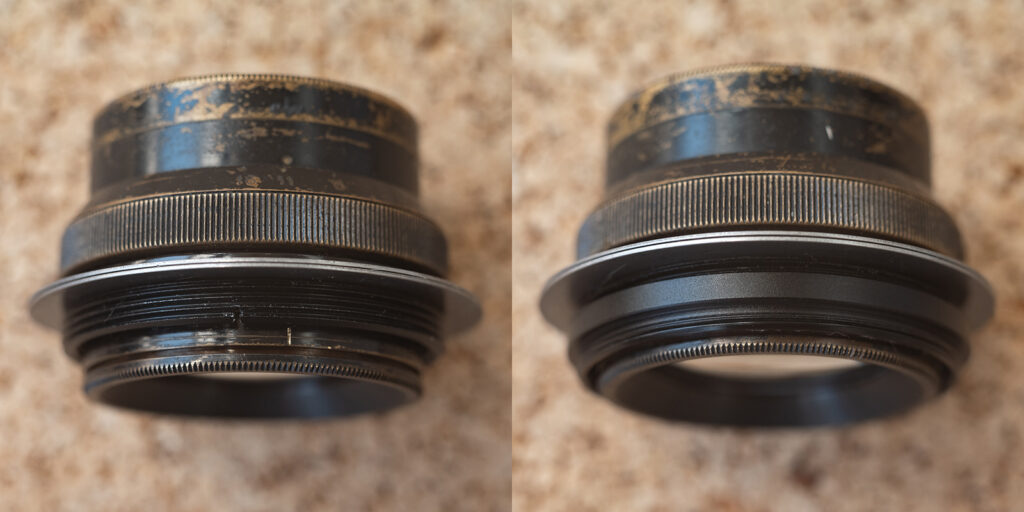
Left: shims go between the lens and the M39 to M42 adapter; right: the 3mm M42 extender ring screwed in place
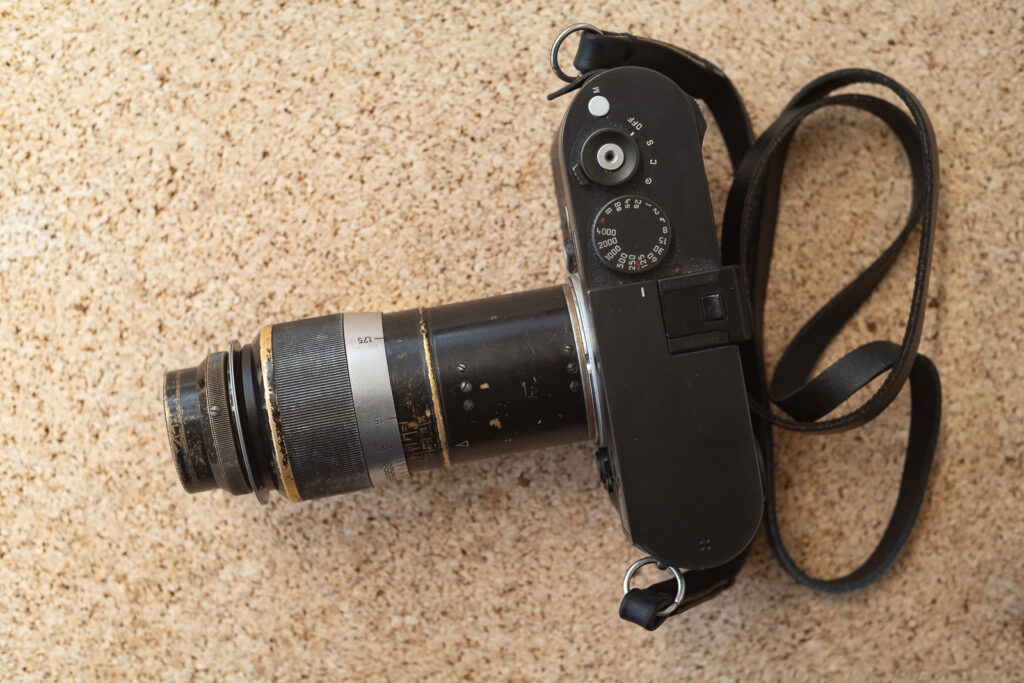
And that’s it! Most of this article is just fluff and the entire process is described in the two paragraphs above. Honestly, finding some of the adapters I use for adapting lenses with rangefinder-coupling was more hassle than converting the Boyer lens. I’ve been very lucky that the Boyer matches the Hektor so closely and despite there being tiny differences in focusing, it’s no more tricky to focus than any other 135mm I own. The small vignette in the corners is also common among them and the only 135mm f/4.5 lens I have that has none of it is the Steinheil Culminar.
Final thoughts
This is of course a non-destructive conversion and I can simply unscrew the optics and pop the Hektor back on. It only uses readily available off-the-shelf components and no tools are required. 135mm lenses are some of the simplest lens designs out there and various enlarger and large format lenses are relatively easy to find. Also, you can find a fully working Hektor for around 80 pounds, less than that if it’s moldy/foggy or if it’s missing the optics altogether. I’d say it was a fun project but calling it a project feels like overselling it. It was truly that dead easy.
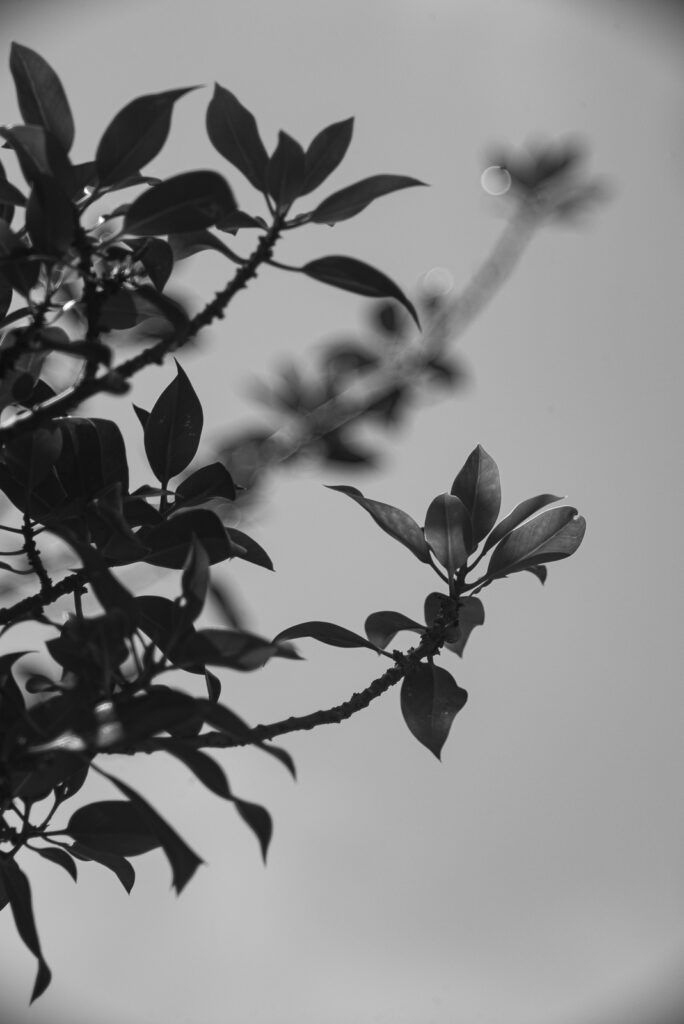
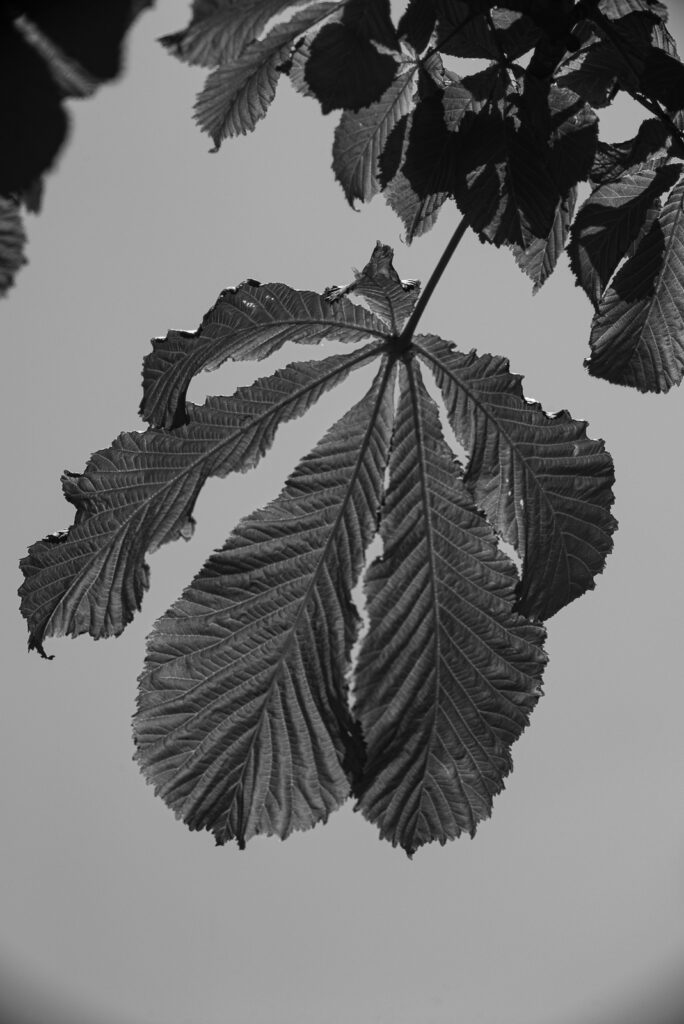
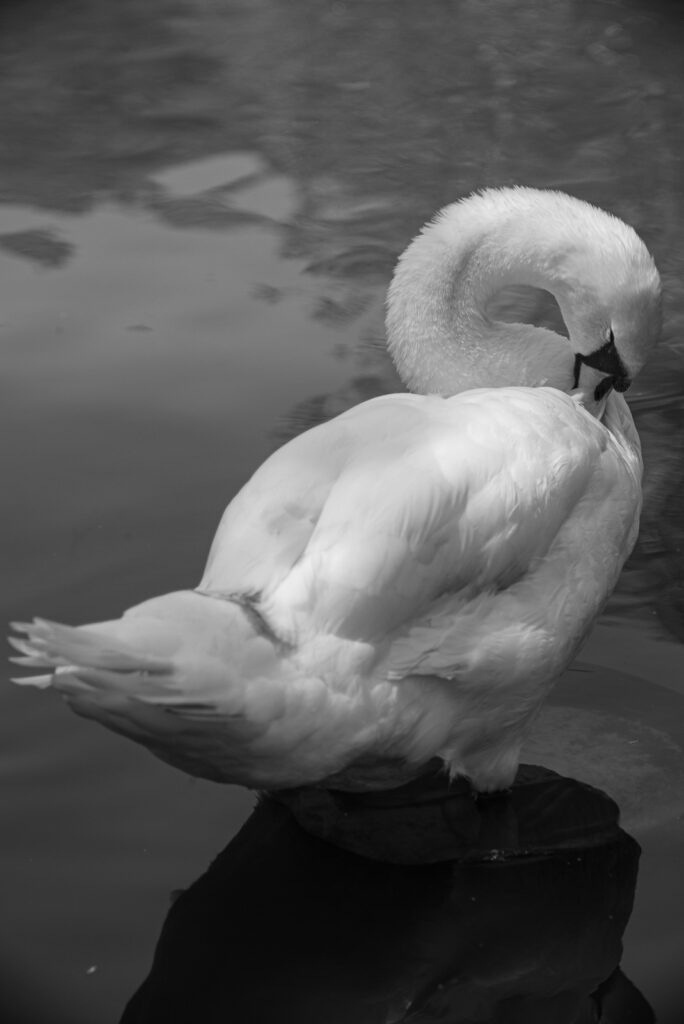
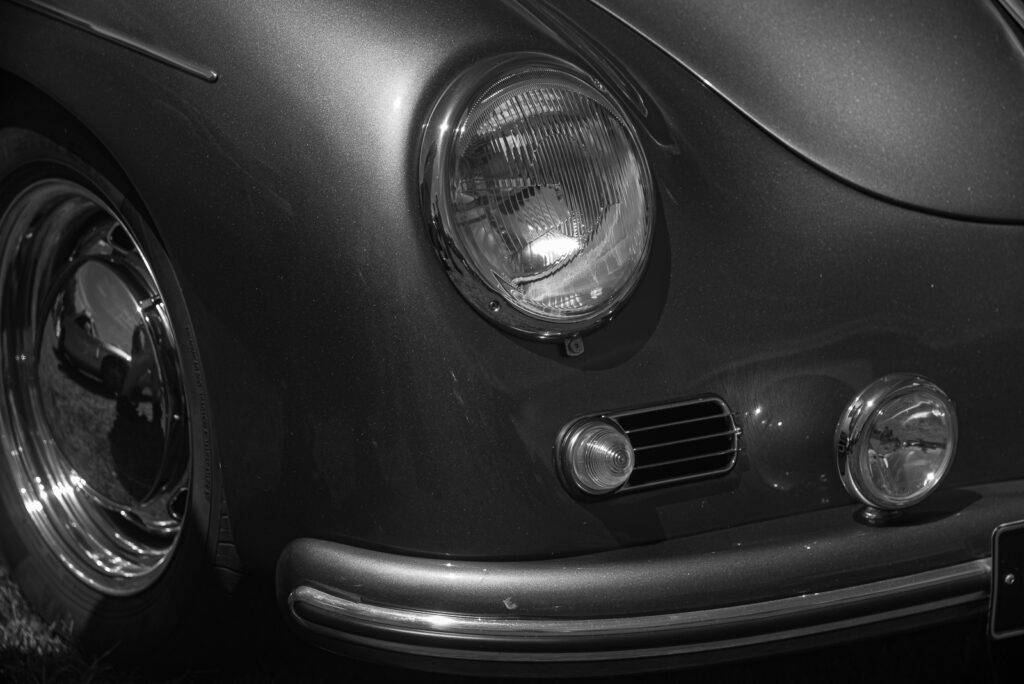
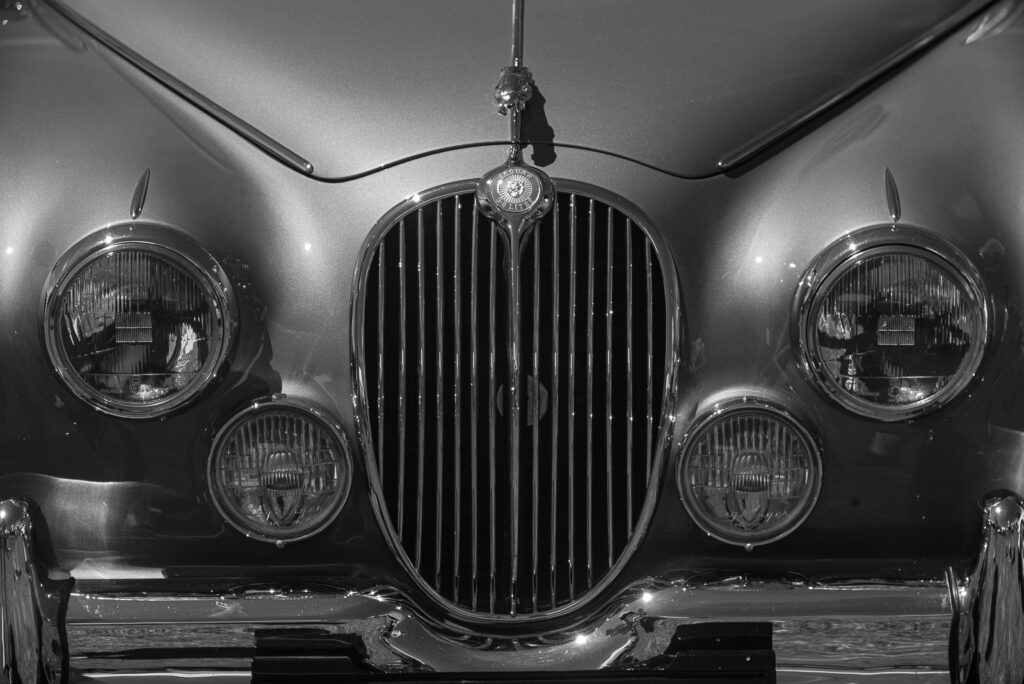
This is not a lens review but a few samples won’t hurt! All at f/4.5 and focusing done using the rangefinder. More shots, including in colour on a mirrorless camera, can be found on my Flickr.
Share this post:



Comments
Amro Gebreel on No tools, no skill, no know-how – the simplest way to convert a lens to LTM
Comment posted: 19/07/2026
Definitely worth a try on some old lenses that I don't even have a use for.
Comment posted: 19/07/2026
John Eaton on No tools, no skill, no know-how – the simplest way to convert a lens to LTM
Comment posted: 19/07/2026
David Pauley on No tools, no skill, no know-how – the simplest way to convert a lens to LTM
Comment posted: 20/07/2026
Russ Rosener on No tools, no skill, no know-how – the simplest way to convert a lens to LTM
Comment posted: 22/07/2026
Comment posted: 22/07/2026
Simon Foale on No tools, no skill, no know-how – the simplest way to convert a lens to LTM
Comment posted: 30/07/2026
Comment posted: 30/07/2026