

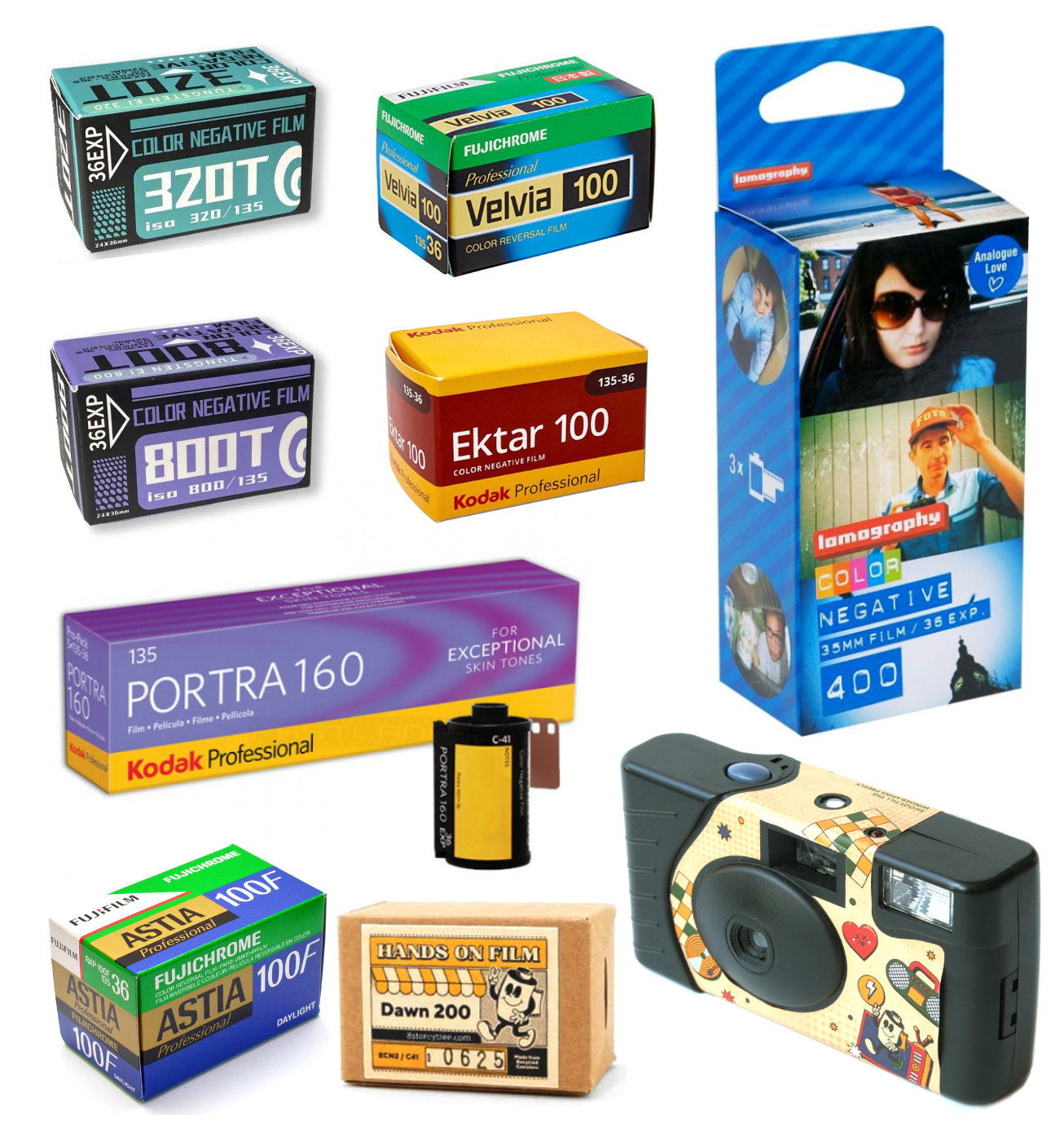
I predominantly shoot black-and-white film, preferring digital if I want to take colour photos. But in 2025, besides my usual quota of B&W, I also shot nine rolls of 35mm colour film, which for me is decidedly more than normal. What’s more, the nine rolls include eight different emulsions, shot on six different cameras. So I thought it would be interesting to write a post – a sort of round-up – selecting one shot from each 35mm roll.
A quick note on developing and scanning. I develop and print black-and-white film at home, but I haven’t ventured into colour, mostly because I don’t shoot much of it. Rolls 1, 3, 5, 6 and 7 (C-41 process) were developed by Whampoa Colour Centre in Singapore, Rolls 2 and 4 (slide film) by Ruby Ye Photo, and Rolls 8 and 9 (ECN-2 process) by Hands On Film. Rolls 2, 3, 4 and 7 were “scanned” at home using a digital camera and pixl-latr, while the rest were scanned by the lab.
Roll 1: 800T
Camera: Hasselblad XPan
Lens: Hasselblad 45mm f/4
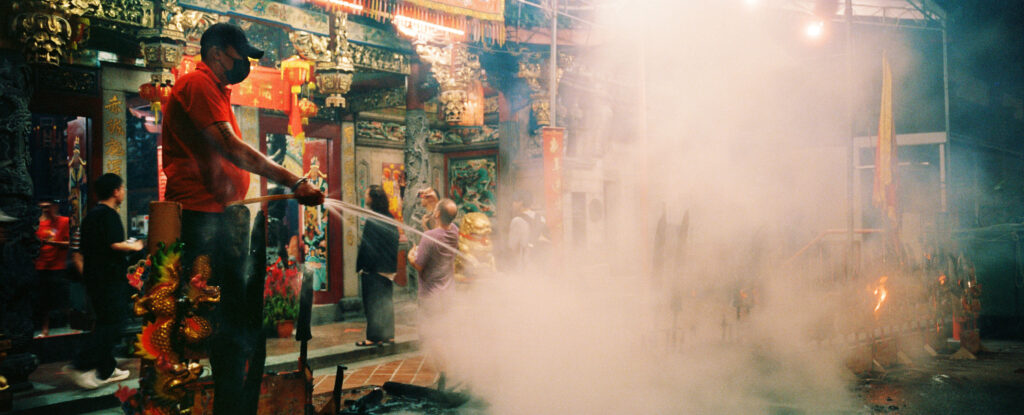
My first colour roll of 2025 was shot, appropriate enough, on New Year’s Day – but the Lunar New Year, not Gregorian. Several Chinese temples in Singapore are open all night on Chinese New Year’s Eve, and prayers and rituals continue through the night. To mark the occasion, my friend Muzi and I went for an all-night walk, visiting various Chinese temples throughout the city. Muzi (whose photo appears on the next roll) is Chinese, and into Taoism, so she was a good person to have on this walk.
I took this photo around 3am, with a Hasselblad XPan borrowed from my friend Li Ling. The XPan, as you may know, takes panoramic photos which are almost twice as wide as a typical 35mm frame. It’s an interesting challenge to compose in a way that fills, and makes good use of, the wide format.
The film is sold by a Chinese company, but funnily enough, there’s no brand name on the box – it only says “800T Color Negative Film” (800 indicating the ISO, and T for tungsten balance). The edge markings on the negative say “Eastman 5219”, which indicates that the stock is Kodak Vision3 500T motion picture film (with the remjet layer removed, since 800T film is intended for the C41 process). As such, the film appears to be a Chinese version of Cinestill 800T, albeit significantly cheaper. Be that as it may, the high ISO was helpful for night photography (especially since I was using an f/4 lens), as was the tungsten white balance.
Roll 2: Fujichrome Velvia 100
Camera: Leica M6
Lens: Voigtlander Nokton Classic 35mm f/1.4 SC
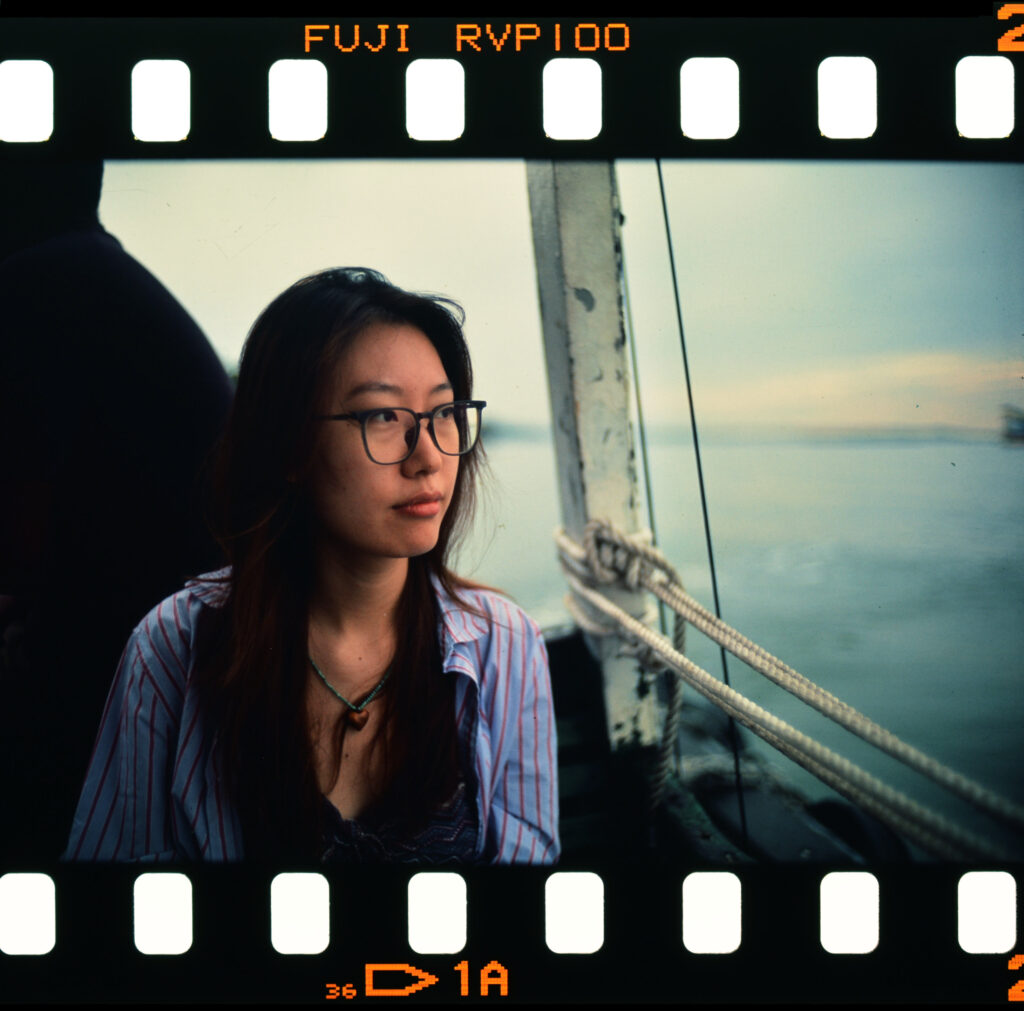
I took this photo of Muzi on a bumboat to the island of Pulau Ubin. The Leica M6 was a loan from Li Ling, who also lent me the XPan (always grateful for friends who lend me gear – expensive gear at that!) I borrowed her M6 and Voigtlander lens specifically because I wanted to try the classic 35mm focal length on a Leica. I have a Leica M3, but its viewfinder only has framelines for 50mm and up. I could, of course, use an external finder, or just guess the framing. But the M6 with its dedicated 35mm framelines gives the “true experience”.
This was the first of two rolls of slide film that I shot this year. Fuji Velvia is known for its punchy, saturated colours, but in the soft early-morning light, it surprised me with its delicate pastel tones.
Roll 3: Lomography Color Negative 400 (expired)
Camera: Lomography Sprocket Rocket
Lens: 30mm f/10.8 (fixed lens)
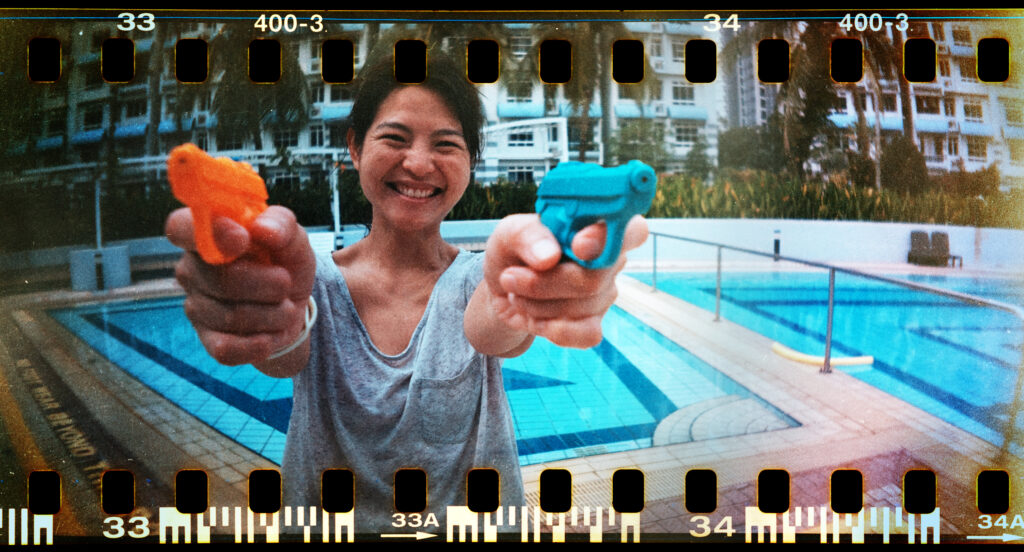
Last summer I bought a Lomo Sprocket Rocket – a direct result of trying the XPan mentioned earlier in this post, which gave me a hankering for the panoramic format.
In many ways, the two cameras are polar opposites. The XPan was conceived with a no-expenses-spared philosophy, with top-tier lenses, build quality and features. The Sprocket Rocket, on the other hand, is a plastic camera with only two aperture settings (f/10.8 and f/16) and a fixed shutter speed – about as basic as they come. Nevertheless, they are both panoramic cameras. And guess what: the Sprocket Rocket, despite being a order of magnitude cheaper, can do something which the XPan can’t: expose the sprockets. The frames are 72mm wide, for an aspect ratio of 3:1 – even wider than the XPan.
I got the camera secondhand, and the seller included a few rolls of expired film. Among them was this Lomo 400 film, so I thought it was only appropriate that I shoot it in a Lomo camera. I happily take the Sprocket Rocket to the pool, and I don’t mind if it gets a few splashes – something I would never ever risk with a Hasselblad XPan. Fun cameras take fun photos!
Roll 4: Fujichrome Astia 100F (expired)
Camera: Minolta X-370s
Lens: Minolta MD 50mm f/1.7
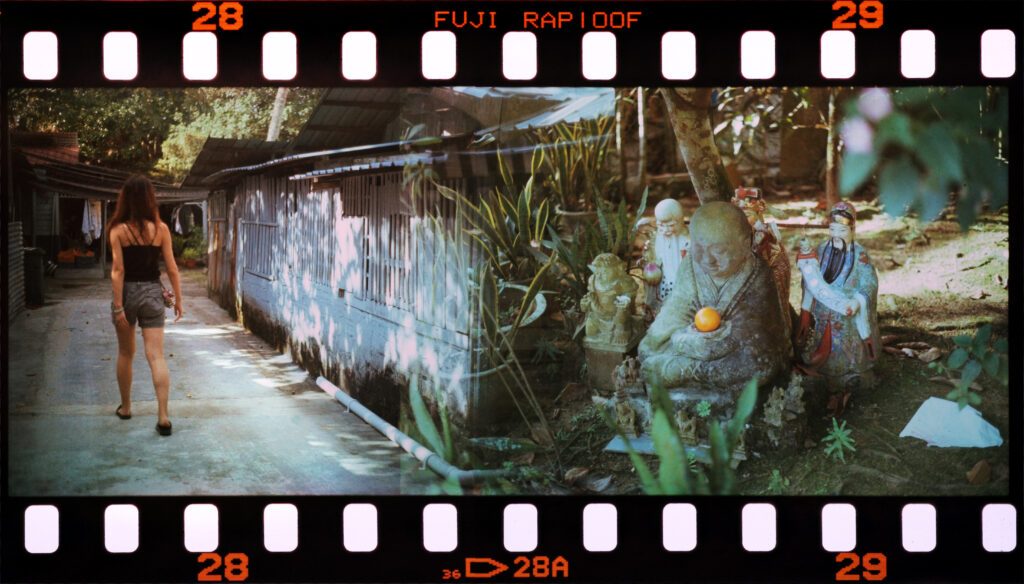
The Sprocket Rocket camera also came with a roll of expired Fuji Astia slide film. The two frames above, shot in Kampong Lorong Buangkok, are partially overlapping. The film didn’t advance properly – it seems like a one-off; I haven’t had this problem on my Minolta before or since – but somehow the frames blend really well. These kinds of happy accidents are one reason why I love shooting film.
Fuji Astia was discontinued in 2010, so it’s rare and rather expensive. This particular roll expired 15 years ago, and I had no idea how it had been stored. Besides, slide film typically doesn’t age as well as negatives. I rated it at EI 50 on a wing and a prayer, and dropped it off at the lab.
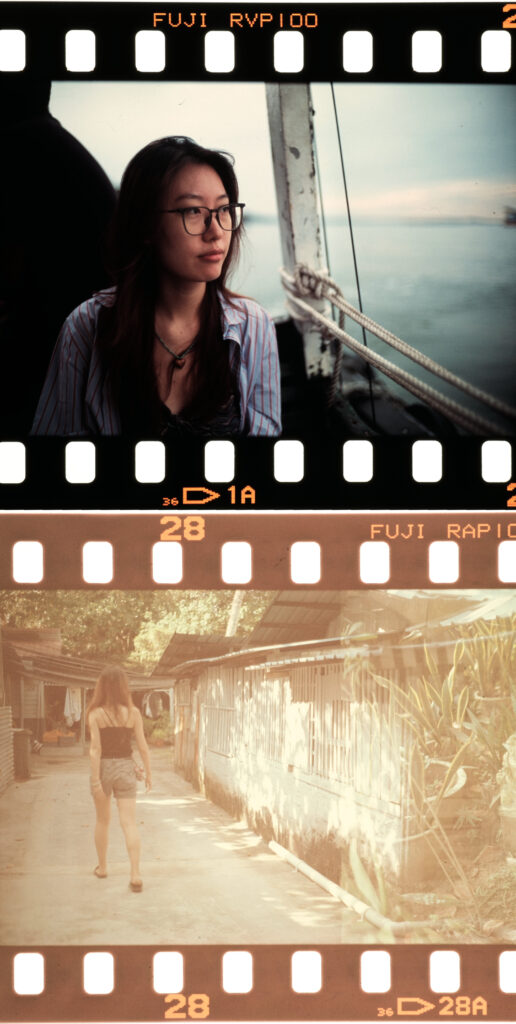
Imagine my delight when I went to collect the roll, and saw that the photos look pretty good after all! Low contrast and an overall sepia tint, but still usable. The two photos below compare the aforementioned (fresh) Fuji Velvia and the expired Astia, both “scanned” with my camera at identical settings. The Velvia is perfect as is, but the Astia is not as bad as it looks. With a bit of post-processing in Affinity, I was able to recover fairly realistic colours, as you can see in the edited diptych above.
Roll 5: Kodak Portra 160
Camera: Leica M3
Lens: Voigtlander Nokton Classic 35mm f/1.4 SC
I have this long-standing curiosity about whether, with appropriate scanning and post-processing, one colour-film stock can be made to look like another. For instance, can Portra be made to look like Ektar, or vice versa?
I decided to find out for myself – but don’t get too excited, I haven’t completed my test yet. The first part of the experiment, which I have completed, was to load Portra 160 in one camera and Ektar in another (my Leica M3 and the aforementioned M6). What I then did was to take a photo on one camera, swap the lens, then take the same photo on the other camera at the same aperture setting, only changing the shutter speed to compensate for the ISO. I kept this up until I had two nearly identical sets of exposures on Portra and Ektar, with a variety of subjects, colours and light.
The next part, which I have also completed, is to scan both rolls of film in three different ways: (a) by a lab, using a Noritsu scanner, (b) home scan, using a flatbed Epson Perfection V700, and (c) with a digital camera.
The third and final part, which I have been procrastinating on, is the post-processing and comparison. I’ll get to it someday. (Narrator: “We shall see.”) And when I do, I’ll share the results on 35mmc and my Instagram.
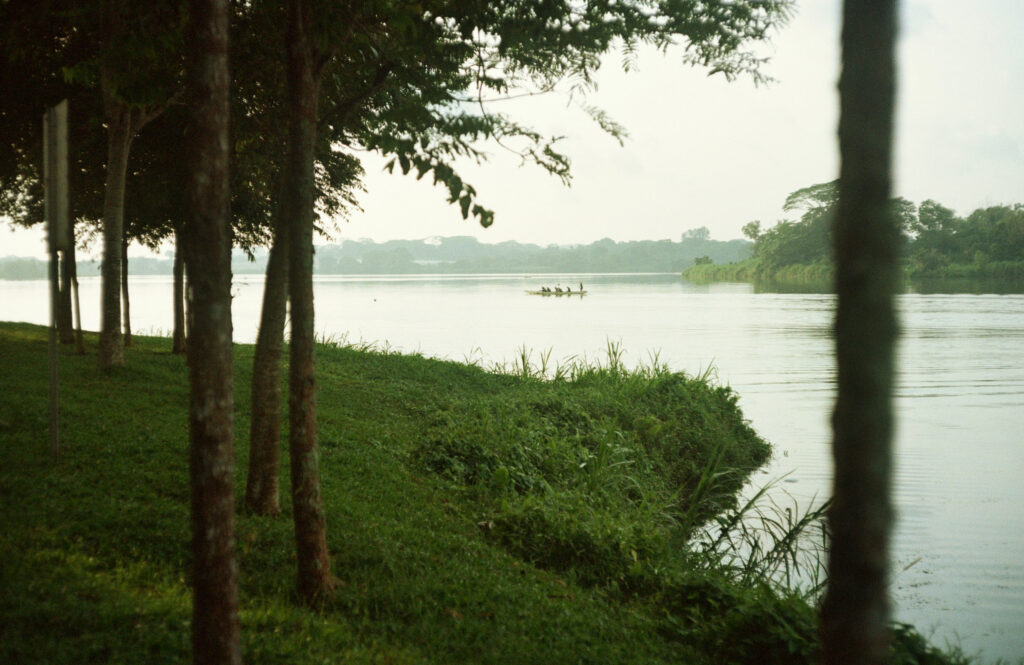
The photo of the lake is a Noritsu lab-scan, lightly edited to match how I remembered the scene.
Roll 6: Kodak Ektar 100
Camera: Leica M6
Lens: Voigtlander Nokton Classic 35mm f/1.4 SC
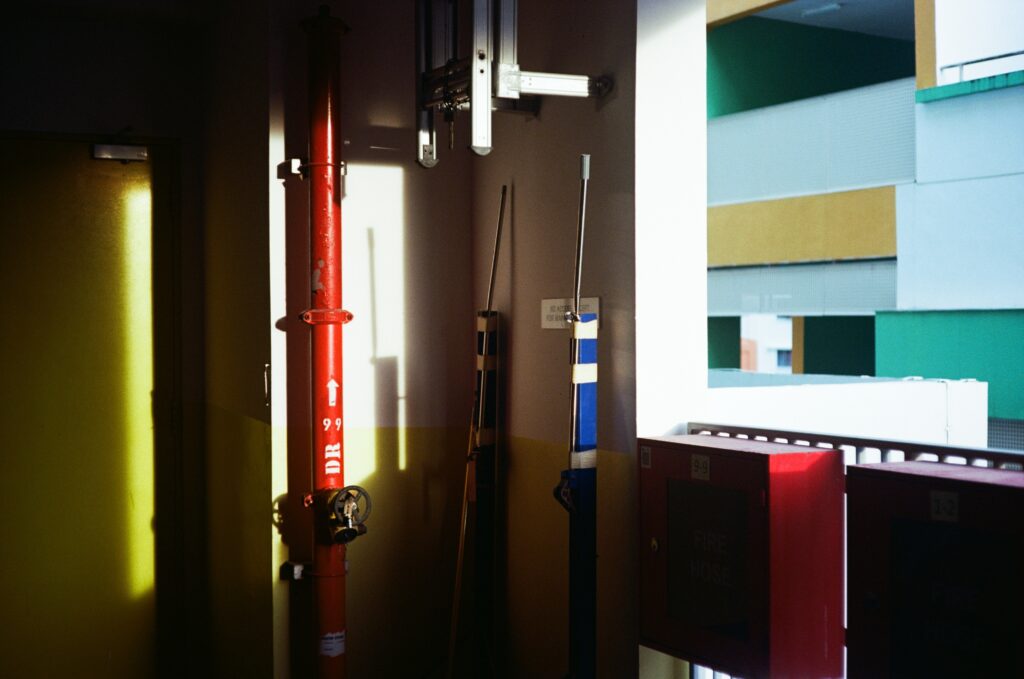
This photo is from the same experiment, from the Ektar roll. Ektar is known for saturated colours – the colour-negative equivalent of Fuji Velvia, you might say – and this was the perfect subject.
Roll 7: 320T
Camera: Leica M3
Lens: Voigtlander Nokton Classic 35mm f/1.4 SC
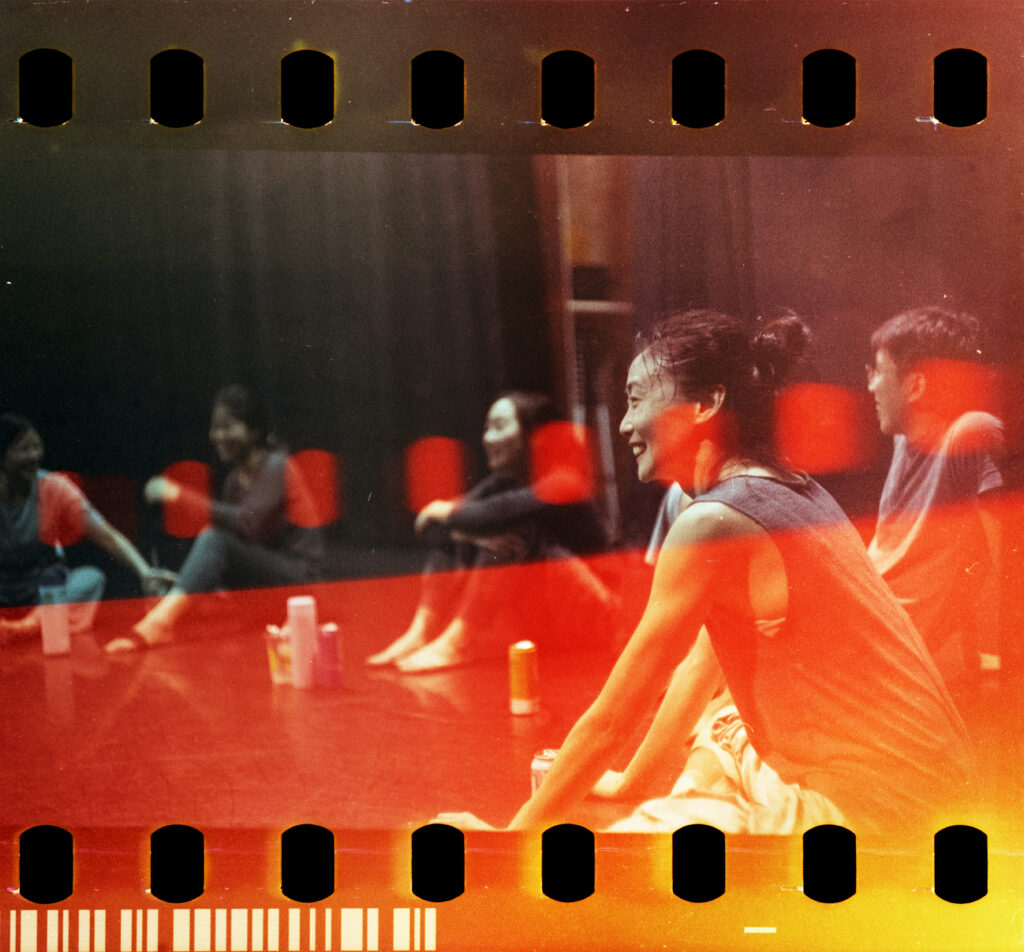
Having shot a roll of Chinese 800T film (see Roll 1) and being happy with the results, I thought I’d try their 320T. The edge markings say “Eastman 5213”, which reveals this film to be repackaged Kodak Vision3 200T.
I suspect the company’s quality control is not the best, because I had multiple issues with this roll. First, when advancing the film, I had to use more force than normal. I don’t like this because it puts undue strain on the camera’s transport mechanism. Second, although I rated the film at EI 200, it turned out underexposed. And third, as you can see in the photo below, I got some light leaks. I’m pretty sure this was a manufacturing issue because I’ve shot multiple rolls on this camera with no problems, and also, having previously encountered light piping with Cinestill 800T, I was careful to load and unload the film in dim light.
I’m not sure if I’ll buy this brand again, because when I use fresh film, I like to get predictable results. But as it happens, I quite like the light leak in this particular shot.
Roll 8: Kodak Vision3 200T
Camera: Hands On Film disposable camera
Lens: Unknown (fixed lens)

I’ve used toy cameras before, but this was my first time shooting with a disposable camera. The camera, pictured in the header image, is from an independent film shop called Hands On Film, and features artwork by my friend Cyann. It came pre-loaded with Kodak Vision3 200T (based on the edge markings, which say “Eastman 5213”). So this is the same film stock that’s used in 320T (Roll 7).
Disposable cameras are usually set to something like f/8 and 1/100 sec, which means you have to be shooting either in very bright conditions, or with the in-built flash. I used flash for nearly all my photos on this roll, including this low-angle shot of my friend Muzi.
Roll 9: Dawn 200
Camera: Minolta X-370s
Lens: Minolta MD 20mm f/2.8

Dawn 200 film is packaged and sold by Hands On Film, who also sell the aforementioned disposable camera. The edge markings say “Eastman 5207”, which means it’s respooled Kodak Vision3 250D. Dawn 200 still has the anti-halation layer, and needs to be developed using the ECN-2 process (not standard C-41).
I took this photo of my friend Redwan in the Hands On Film shop. Redwan wanted to buy a film camera, and I was there to drop off my Dawn 200 for developing. There was one frame left on the roll, so I took this shot to finish it. Since the photo was taken in a film shop, and happens to be the last of the roll, I thought it was a nice choice to round off this article.
Thanks for reading, and if you like my work, feel free to connect with me on Instagram.
Share this post:




Comments
James Billings on My 2025 on Colour Film – 9 rolls, 8 emulsions, 6 cameras
Comment posted: 23/01/2026
The image of Muzi on the boat is super- I really love the tiny depth of field the rope on the right of the image portrays, and the 200T image also has some wonderful cinematic vibes!
Thanks for the article!
Comment posted: 23/01/2026
Art Meripol on My 2025 on Colour Film – 9 rolls, 8 emulsions, 6 cameras
Comment posted: 23/01/2026
I cannot count the thousands of rolls of Velvia I've shot. Sure was nice to see that lovely film here.
Comment posted: 23/01/2026
Comment posted: 23/01/2026
Gary Smith on My 2025 on Colour Film – 9 rolls, 8 emulsions, 6 cameras
Comment posted: 24/01/2026
One would think that with today's s/w you could scan negatives shot on one film and end up with positives that look like they came from another film but I think I'm getting to the point where (since I don't print) there's no real point in not just shooting digital FF and forgetting about my MF and LF film cameras.
Comment posted: 24/01/2026
Alexander Seidler on My 2025 on Colour Film – 9 rolls, 8 emulsions, 6 cameras
Comment posted: 25/01/2026
Comment posted: 25/01/2026