

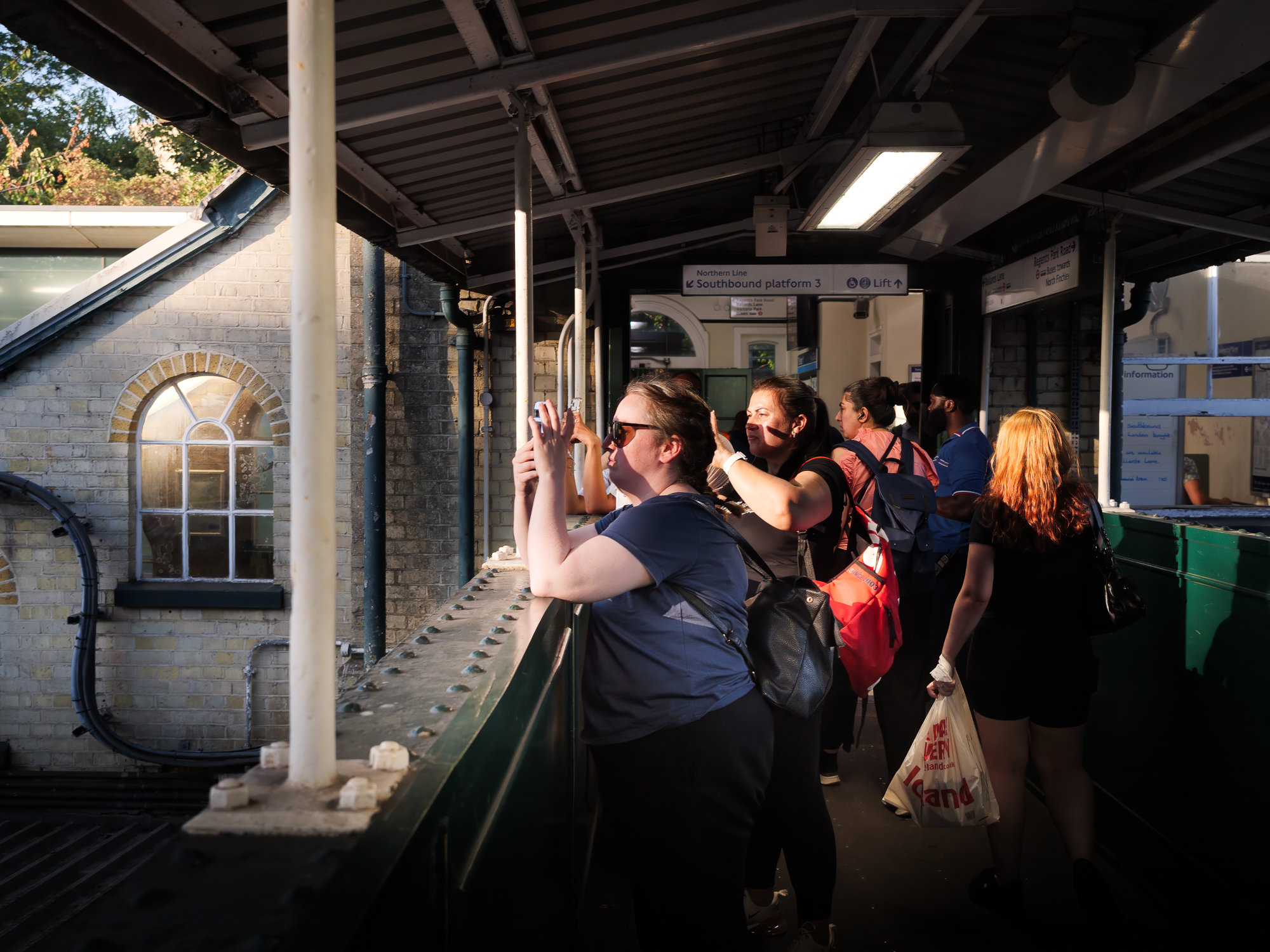
Where were you when the eclipse happened? On 12 August 2026, at 7 p.m., I was on the bridge at Finchley Central Station. The sun was low over London, and people had stopped to look at it. They stood on the high bridge, facing the sun, waiting for the eclipse to begin and then for the light to change, many of them holding their phones towards the sky. The evening was very hot; you can almost feel the heat of the day through the photograph.
I had not prepared my camera to photograph or video the eclipse itself, and I did not want to trust my eyes to a pair of cheap eclipse glasses. Instead, I found another way of looking at the event and raised my camera towards the watchers.
A station is normally about movement: arriving, departing, catching the train, getting somewhere. And then suddenly people stop. The bridge became an observatory. They were not tourists who had come specifically for an astronomical event. Even some of the station staff, whose usual task was to keep people moving, stopped to watch.
For a few minutes, the familiar progression from daylight to evening was interrupted. The sun was still there, but the light became dimmer, and then bright again. There was something instinctive about the scene. These thoroughly modern people, with their smartphones raised towards the sky, were doing something much older: turning towards the sun when something unusual happened to it.
We rarely look directly at the sun, we just see what its light reveals. Perhaps we, human beings, are often better at recognising light than seeing where it comes from. When the peak of the eclipse had passed, and I walked towards the platform, I wondered exactly what I had photographed. The people on the bridge were recording the eclipse. I was recording them. The eclipse itself was outside the frame. So were the images and videos people had captured on their phones. What remained were the people, the phones in their hands, the sunlight on their bodies, and the sense that something was happening just beyond the picture.
They saw the eclipse through their screens; I was looking at them through my Panasonic Lumix G9 and Olympus Zuiko 12–40 mm f/2.8. I was not outside the phenomenon I was photographing; I was part of it.
So, where were you when the eclipse happened? For about 20 minutes, I was on a bridge at Finchley Central, in a summer of heatwaves and no rain in London, under Amber Weather Alerts, watching people watch the sun. Perhaps the photograph can tell us one thing with certainty: we were there, but did we see it?
The photograph: Finchley Central Station, London, 12 August 2026, during the eclipse. Panasonic Lumix G9 (original), Olympus Zuiko 12–40mm f/2.8, Program mode, ISO 400. I was interested in the people watching the eclipse as much as the eclipse itself.
Share this post:

Comments
David Dutchison on The Eclipse Was Real, But Did We See it? – A One Shot Story
Comment posted: 25/08/2026
Comment posted: 25/08/2026
Walter Reumkens on The Eclipse Was Real, But Did We See it? – A One Shot Story
Comment posted: 26/08/2026
Comment posted: 26/08/2026
Paul Quellin on The Eclipse Was Real, But Did We See it? – A One Shot Story
Comment posted: 26/08/2026
Comment posted: 26/08/2026
Keith A Yeo on The Eclipse Was Real, But Did We See it? – A One Shot Story
Comment posted: 29/08/2026
Comment posted: 29/08/2026