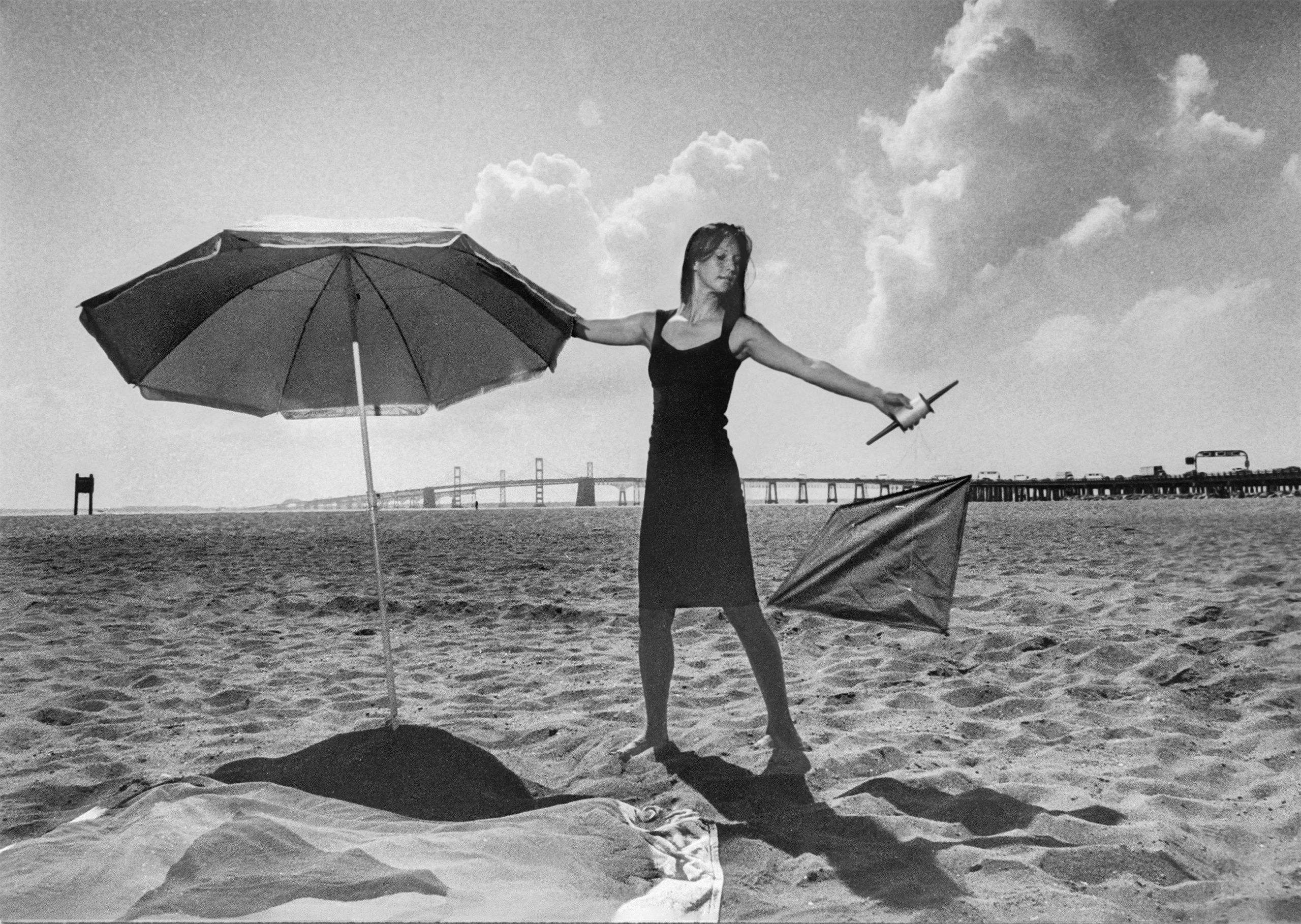
An actor balances a beach umbrella while flying a kite.

Relearning Film – Notes from a Returning Shooter

By Ned MacFadden

I’m relearning 35mm film.

I grew up shooting on film. I’m 55 now, so my first camera was around 1984, when I was sixteen: a Minolta X-700, which I still have.

Getting back into film hasn’t been smooth. Over the last two years, I’ve shot a brick of Shanghai GP3 100 and several rolls of Tri-X 400, experimenting more than seriously shooting. My X-700 died after a few rolls (I’ll get it fixed one day), and the cost of sending film out for processing discouraged me. So I returned to processing at home, picking up a CineStill Lab Box and using DF96 Monobath to make things simpler. I’ve realized that journaling and better notes are essential if I want to move past “happy accidents.” This writing is the beginning of that journey.
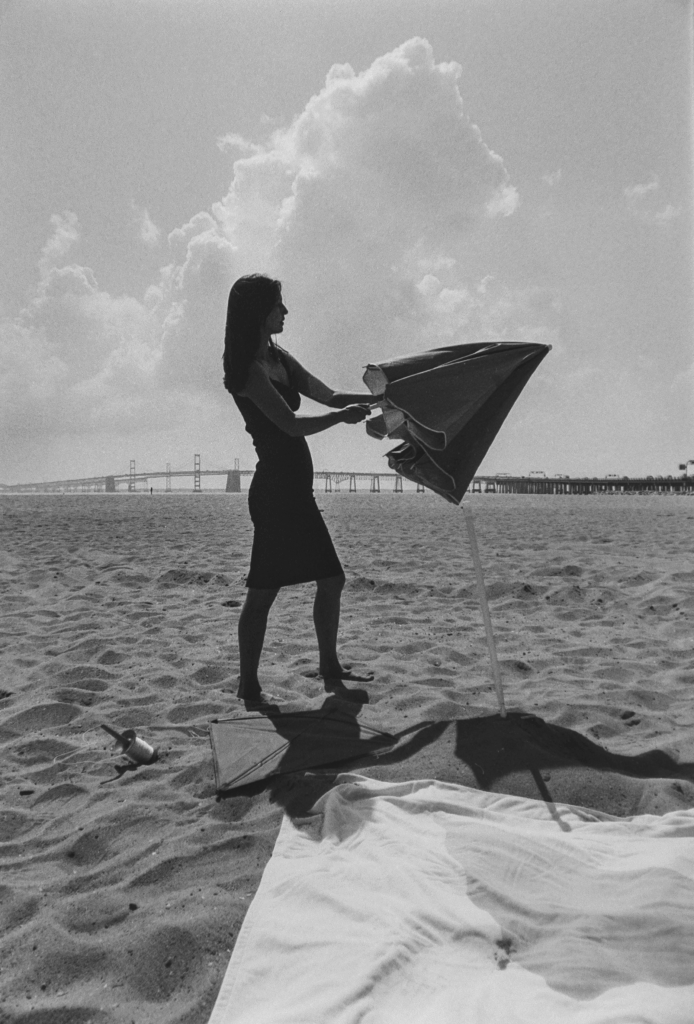
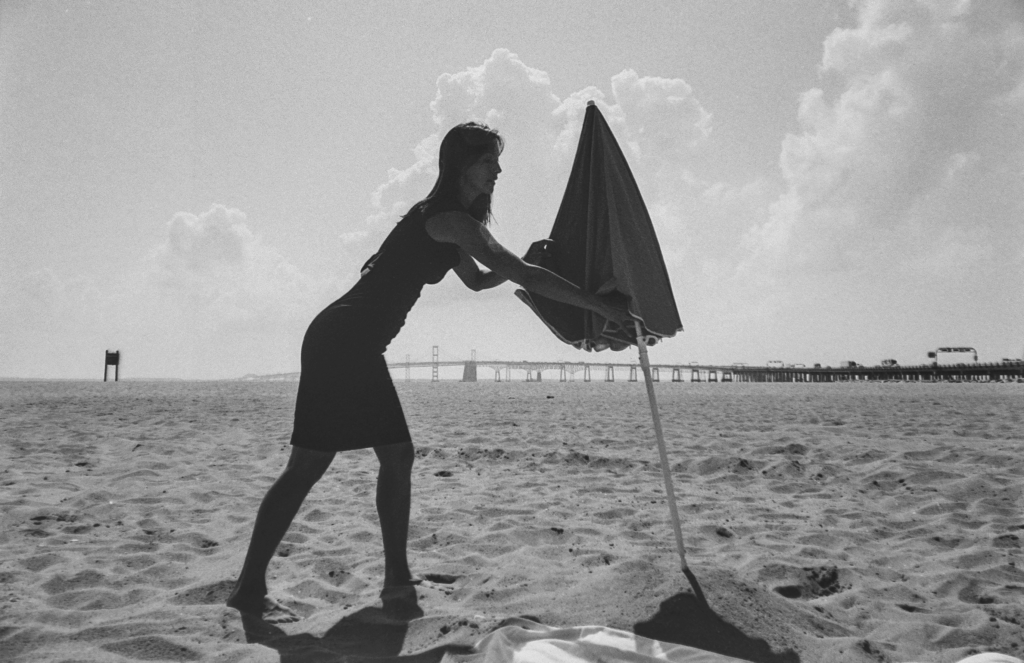
An actor begins to open an umbrella
Embracing the misfiring flash.
A silhouette of an actor and umbrella on a beach.
Despite the flash misfiring, this might be my favorite of the whole roll.

August 15, 2025- I shot a roll of Tri-X 400 at Sandy Point State Park. I worked with a wonderful actor who was game enough to wear a black dress on a blistering hot day. My kit that day consisted of a Minolta XD11 paired with a Minolta 24mm f/2.8 and an ND8. I love the O setting the camera offers, a mechanical shutter option that syncs with flash at 1/100 even if electronics fail (an Ebay purchase cheaper than repairing my X-700 that currently sits on the shelf). For lighting, I used a Godox AD200 strobe mounted on a 13-foot light stand. A Godox transmitter connected to the camera via a PC sync cable sat on a dummy hot shoe to break any connection that might fry any circuits. For behind-the-scenes footage, I brought along an Olympus E-M1 Mark II with the Olympus 8–25mm f/4, mounted on a small tabletop tripod. When I can I’ll replace this setup with an action cam to cut down on size and weight, and a more effective way to record the process.

I didn’t take detailed notes on my meter readings (ugh). I know I did a reflective reading on the sky and an incident reading for the flash hitting the face.I know I bracketed exposures at f/11, f/16, and f/22, but I don’t remember the specifics. Typically, I like the background to sit about one stop under the subject so the subject sits on top exposure-wise. But I honestly don’t remember what I did. If I were to do it again, I’d stack neutral-density filters so the sky read f/5.6 while keeping the strobe light’s intensity and distance set for f/8 on the face, and I’d bracket at f/5.6, f/8, and f/11 to minimize diffraction while still covering my bases exposure wise.
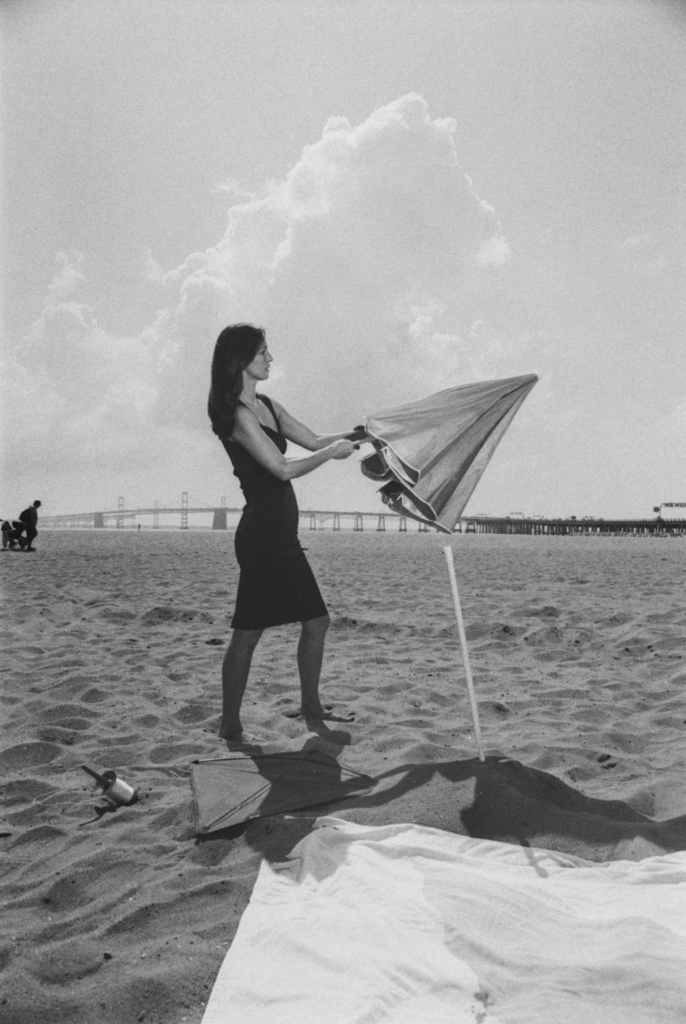
The actor and umbrella prop lit by the flash.
Intruders trudge onto the set.

How did the roll come out? Focus is suspect. Exposure was inconsistent on the face, the black dress (perhaps beyond my current skill set) thin on the negative, and the clouds missing the detail I remember. We may have drifted from the strobe. I don’t remember if I took a reflective reading of the dress; if I did, I blew it. Looking back, a reflector on the AD 200 would have given me a larger spread of light to work with, and I could have brought a second Godox flash just for the dress. But I decided I wanted to go as light as possible. In the future, I want to clearly mark the subject’s spot and shield the lens when pointing towards the sun. Some of the images have lens flare, which I like except when it lands on or near the face.
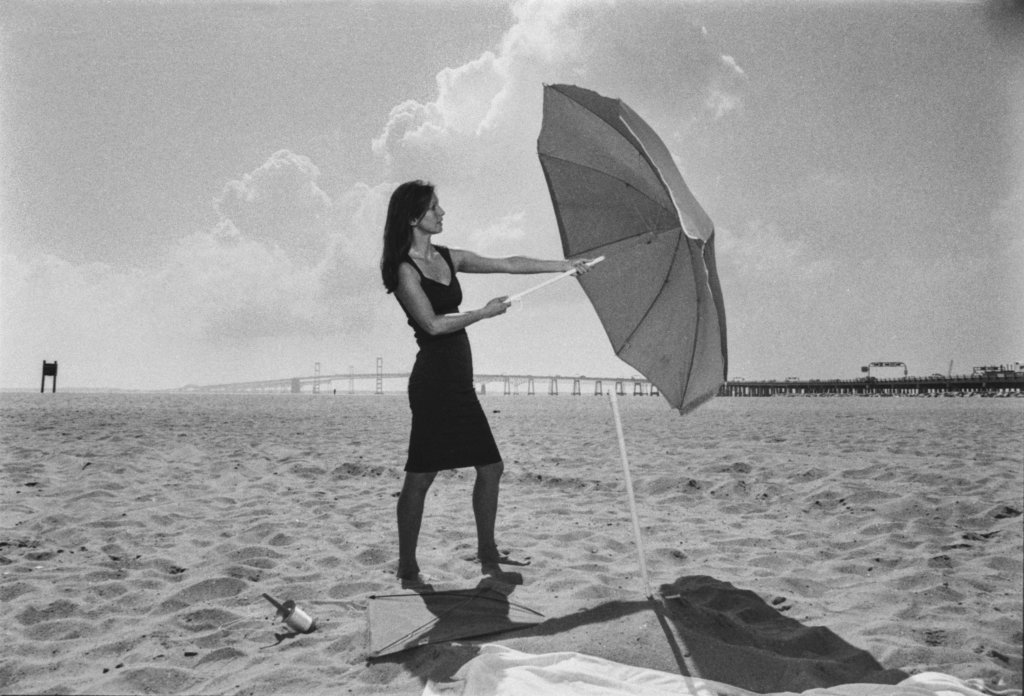
An actor opens an umbrella on a beach.
I have a Minolta right angle finder VN 1x 2x. I should be more intentional about using it consistently to help improve focusing. I’m not sixteen anymore.

Processing the film is improving. I still need better temperature control. I may have been too hot, and there has been user error in loading film into the LabBox. There are scratches and dust spots from mishandling. And despite processing inconsistencies seen in the negatives this roll feels like the point where things are starting to click.

Digitizing negatives has been an ongoing experiment. I first digitized the negatives using a lightbox with a Sony A7RIII and Minolta 100mm f/2.8 macro, bracketing and merging exposures in Photoshop with isolated curves adjustments. A second time I used the Olympus E-M1 Mark II with the 8–25mm f4 lens, not an ideal setup, but I wanted to try the camera’s auto-HDR mode, having the camera bracket and merge files into a single JPG. So in the spirit of working with what you have at the moment, I let it rip. The results are smaller than the frame due to the lens’s limitation of not being a macro lens, but the captures got me thinking about creating collages to compensate (an essay for another time). My approach was unscientific enough not to bother with comparing the results of the two workflows.
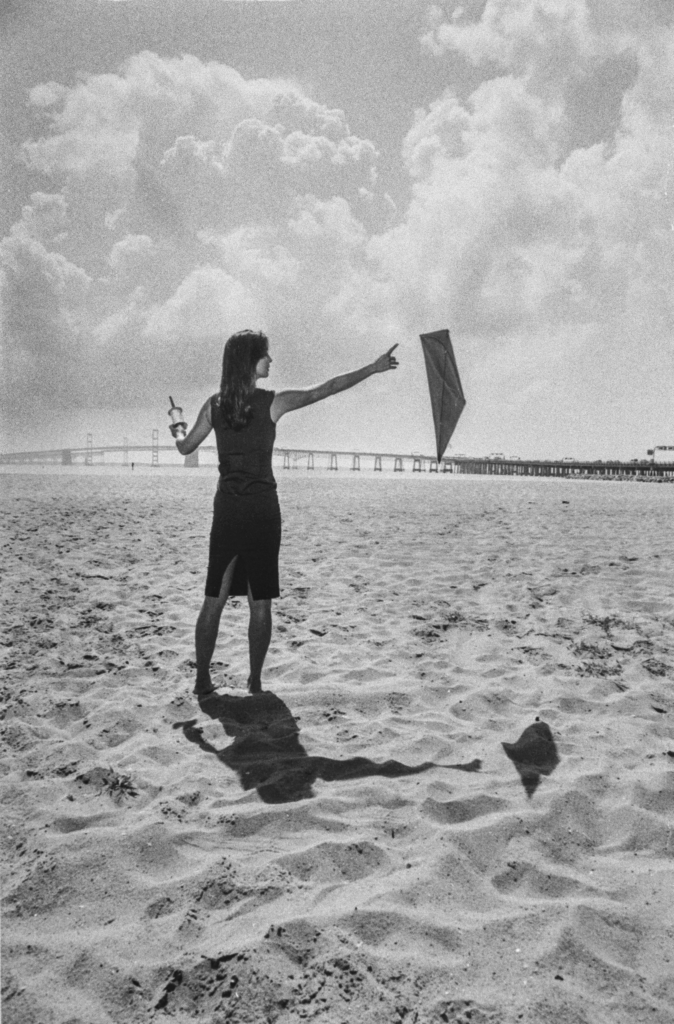
An actor, arm extended, holds a kite.
Not a drop of wind. The actor would throw the kite into the air.

I wrestle with how much film should be manipulated in post. There is something about the medium that makes me think that whatever happens at the time of exposure is sacred and is not to be disturbed. There is precedent of course for film to be manipulated. Aubrey Bodine, for instance, would shoot clouds separately and combine them to enhance different images. Nonetheless, I felt a bit of an imposter taking a preferred exposure of the subject and inserting into a preferred composition of the background.
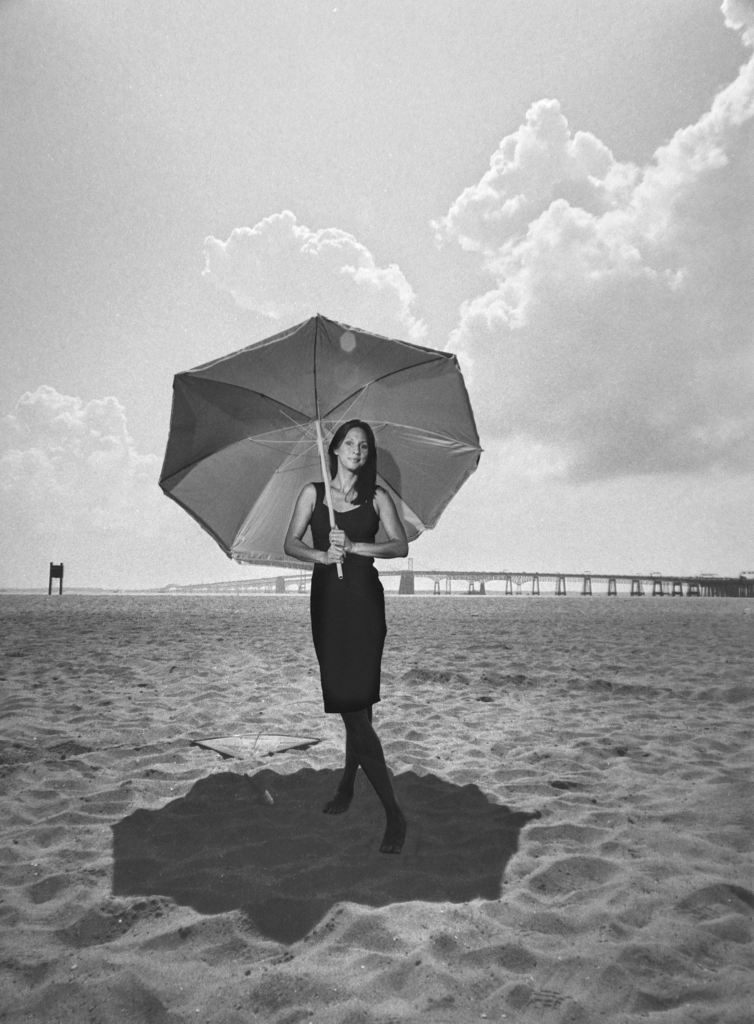
An actor with an open beach umbrella on their shoulders smiles for the camera.
A composite: the actor from a closer frame placed over a wider view of the location.

So, a lot of work to do. But I’m excited to see how things develop (insert smiley face here).

Thank you for reading!

You can find more of my snaps on Instagram.

Share this post:

Find more similar content on 35mmc

Use the tags below to search for more posts on related topics:

Donate to the upkeep, or contribute to 35mmc for an ad-free experience.

There are two ways to contribute to 35mmc and experience it without the adverts:

Paid Subscription – £3.99 per month and you’ll never see an advert again! (Free 3-day trial).

Subscribe here.

Content contributor – become a part of the world’s biggest film and alternative photography community blog. All our Contributors have an ad-free experience for life.

Sign up here.

Make a donation – If you would simply like to support Hamish Gill and 35mmc financially, you can also do so via ko-fi

Donate to 35mmc here.

Comments

Geoff Chaplin on Relearning Film – Notes from a Returning Shooter

Comment posted: 15/01/2026

My favourite is the opening shot because the composition works for me. I'm surprised you think you have focus problems - shooting at f11-22 that shouldn't be an issue. On the other hand diffraction will reduce sharness, condiderably at f22 especially. A co-operative model, hopefully she enjoyed the sun!
Reply

Leave a Reply

Your email address will not be published. Required fields are marked *


Ned MacFadden replied:

Comment posted: 15/01/2026

Hi Geoff! Thank you for the comment. I can't describe how hot it was. She was amazing to say the least. I think your right about diffraction coming in to play. Thank you for the feedback.

Reply

Leave a Reply

Your email address will not be published. Required fields are marked *


Karen on Relearning Film – Notes from a Returning Shooter

Comment posted: 15/01/2026

This post is giving me major FOMO. We are the same age and I long for the darkroom days. Beautiful shots and I’m in favor of happy accidents.
Reply

Leave a Reply

Your email address will not be published. Required fields are marked *


Bob Janes on Relearning Film – Notes from a Returning Shooter

Comment posted: 15/01/2026

I never really got into flash photography with film, so I applaud you for that.
You mention a Minolta 100 Macro, is that an SR mount lens or A-mount? If A mount then a Minolta Alpha/Dynax/Maxxum 7 or 9 would be right up your street, as they remember the settings for the last 7 films you took....
Reply

Leave a Reply

Your email address will not be published. Required fields are marked *


Ned MacFadden replied:

Comment posted: 15/01/2026

Hi Bob, it is an A mount lens. Thanks for the info! I need little excuse to add to my camera arsenal. There seem to be some good prices out there on Ebay.

Reply

Leave a Reply

Your email address will not be published. Required fields are marked *


Safiyyah on Relearning Film – Notes from a Returning Shooter

Comment posted: 15/01/2026

Hang in there; it does get better. I've always thought that film is more of an art and skill than digital in many aspects. And the setting you chose for your first outing is a huge challenge in my opinion under the best of conditions! Good job.
Reply

Leave a Reply

Your email address will not be published. Required fields are marked *


Ned MacFadden replied:

Comment posted: 15/01/2026

Thank you for the support Safiyyah!

Reply

Leave a Reply

Your email address will not be published. Required fields are marked *


Scott Ferguson on Relearning Film – Notes from a Returning Shooter

Comment posted: 15/01/2026

Hey Ned,

Welcome back! I too am recently returned to shooting film, which I've similarly been chronicling here on 35mmc. I find your process fascinating, as it's very different from mine. I feel like you have a much more sophisticated knowledge of the technology from your early days shooting film, not to mention darkroom which I have yet to attempt. I'm intrigued that, right out of the gate, you are doing a pretty complex setup with a lot of gear and ideas on how to control all aspects of making an image from lighting to metering to post and even doing composite image to balance subject and sky. My approach, even when doing posed portraits, has been more about capturing moments in natural light. Often that means skipping the part of the day when you were shooting with the model to wait for more beautiful light, and trying to learn how and where to move the camera to take the best advantage of the angle of the sunlight. I think that might be an artifact of the fact that I started shooting in the Canadian Rockies doing landscapes on a Hasselblad, and a lot of the art of landscapes means waiting for the light. And now that I'm back in NYC shooting more people and street, my main camera is a Leica M3, which I think is a brilliant camera suited to shooting quickly in available light and less easy to use with modern flash technology. As I get better at shooting I have less 'sad accidents' per roll, but I think my orientation is much more 'street' and yours feels 'studio', even on a beach. In some ways we are approaching things from opposite ends, but both approaches are totally legit. Some day I'd love to do a studio session with the Hasselblad, but for now I'm more into hitting the streets of NYC and hunting for cool things to shoot.

In terms of this photo set, I think my favorite is your featured image because of the graphic composition with the shapes of the beach umbrella and the kit. The only thing I. might have done differently is to mix up the compositions and try some closer and further shots from the model, either by moving the camera, the model or swapping lenses. Also, would you consider a colored filter to get more out of what looks like a pretty dramatic sky? I love using a red or orange filter on days like that when I'm doing landscape, but tend to go with a lighter touch and use a yellow or yellow/green filter if I'm shooting people. If I had a flash to get enough exposure on the person's face, I might be tempted to go with a stronger filter to take advantage of the sky. In any event, I'll be excited to see your progress and learn from your process. Keep shooting and keep posting!
Reply

Leave a Reply

Your email address will not be published. Required fields are marked *


Ned MacFadden replied:

Comment posted: 15/01/2026

Hi Scott, thank you very much for your thoughtful response! I'm embarrassed to say colored filters never crossed my mind. That is a wonderful solution to my sky issue. I'm a big fan of clouds and just hate losing opportunities to connect with the environment like that. Colored filters are getting ordered today. I think a good assignment for me would be a landscape series. I have mostly been focused on portraits or experimental works. A landscape series would really challenge me to consider selecting angles that connect with the available light- I appreciate the suggestion. And I totally agree that greater shot variety would have told a more complete story. Thank you for the feedback!

Reply

Leave a Reply

Your email address will not be published. Required fields are marked *


Scott Ferguson replied:

Comment posted: 15/01/2026

I think you'll have fun shooting with filters if you like a dramatic sky! And I think landscape is a great 'entry point' to getting back into film shooting -- I used to get very nervous and hurried when trying to dial in focus and exposure and thinking about framing in my early days of shooting people, whereas most geological formations have been in place for millions of years and often it's more about setting up the camera and then waiting for the right light or cloud formation. I built up some confidence and familiarity with the gear shooting landscape when I was on a project in Canada and then spent the last 6-7 months teaching myself how to shoot people using a 35mm rangefinder in available light. I still have plenty of room to improve with any kind of shooting, but it's been a lot of fun and I've gotten some good ones now and then!

Reply

Leave a Reply

Your email address will not be published. Required fields are marked *


Ned MacFadden replied:

Comment posted: 15/01/2026

That’s awesome. Sounds like you’ve really been putting in the reps and having fun with it. I got a Canon G-III QL a couple summers ago to dip my toe into what shooting with a rangefinder is like. I ruined two of the rolls save one I think while figuring out how to thread the LabBox, which is a shame because it was totally user error. A totally strange experience for me, but perhaps more reps will unlock it for me. The size certainly makes it fun to hold. A snow storm approaches this weekend, and could provide an excellent opportunity for some interesting exposures with the filters. I might have to walk it to find a spot, so the G-III might get the call!

Reply

Leave a Reply

Your email address will not be published. Required fields are marked *


Alexander K on Relearning Film – Notes from a Returning Shooter

Comment posted: 15/01/2026

I applaud your efforts in taming flash! I've never gotten the hang of it even on digital cameras. With regard to some of your problems, the focussing issue might be caused by inverted focussing screen, which probably is realistic to fix by yourself. About clouds, did you use any filters? Yellow filters do wonders with b/w film in many situations, and especially by darkening the sky. In your case, I'd try an orange one too. Shadows would be deeper, but you have a flash to fill them! Also these filters would allow to open the aperture more, useful as you use a high-speed film.
Reply

Leave a Reply

Your email address will not be published. Required fields are marked *


Ned MacFadden replied:

Comment posted: 15/01/2026

Thank you Alexander for your insights! I am definitely going to be getting some filters. Excellent solution!

Reply

Leave a Reply

Your email address will not be published. Required fields are marked *


Gary Smith on Relearning Film – Notes from a Returning Shooter

Comment posted: 15/01/2026

Thanks for your post Ned! I too have been posting about my stumbling back to shooting film. I'm a bit older than you and I think I've decided that developing and scanning my own might be less expensive than sending out - the jury is still out. I did determine that Cinestill's Df96 monobath doesn't work well on all film stocks so I have returned to trustworthy Kodak D-76.
Reply

Leave a Reply

Your email address will not be published. Required fields are marked *


Ned MacFadden replied:

Comment posted: 15/01/2026

Thank you for the tip Gary! I was hoping a monobath would simplify things, but I think when I have run out I will go back to D-76 as well.

Reply

Leave a Reply

Your email address will not be published. Required fields are marked *


xtalfu on Relearning Film – Notes from a Returning Shooter

Comment posted: 16/01/2026

Congratulations - it's inspiring.
Reply

Leave a Reply

Your email address will not be published. Required fields are marked *


Ned MacFadden replied:

Comment posted: 16/01/2026

Thank you for the feedback!

Reply

Leave a Reply

Your email address will not be published. Required fields are marked *


Danai on Relearning Film – Notes from a Returning Shooter

Comment posted: 16/01/2026

Nice write up and some cool shots! I too am recently returning to film. Welcome back!
Reply

Leave a Reply

Your email address will not be published. Required fields are marked *


Ned MacFadden replied:

Comment posted: 16/01/2026

Thank you Danai!

Reply

Leave a Reply

Your email address will not be published. Required fields are marked *


CHRISTOF RAMPITSCH on Relearning Film – Notes from a Returning Shooter

Comment posted: 16/01/2026

I actually really almost prefer the ones where the flash misbehaved, like your favourite one! As a heavy reddit user, I would caution you on monobath though - there are frequent posts of it going wrong, and really there doesn't seem to be much increase in 'simplicity'. Still, it definitely worked for this project. Welcome back to film!
Reply

Leave a Reply

Your email address will not be published. Required fields are marked *


Ned MacFadden replied:

Comment posted: 16/01/2026

Thank you for the warning Christof. Now that I have shaken off some rust on the shooting end, I need to double down on the processing side of things. Thank you for the feedback!

Reply

Leave a Reply

Your email address will not be published. Required fields are marked *


Security Camera Installation Riverside, CA on Relearning Film – Notes from a Returning Shooter

Comment posted: 19/01/2026

Reading this piece feels like sitting down with a thoughtful friend who’s rediscovering an old passion and candidly sharing both the frustrations and small victories along the way; the author’s willingness to unpack technical missteps, creative decisions, and the emotional pull of film photography not only makes the learning process accessible but also celebrates the deeply personal nature of working with analog tools, reminding us that mastery isn’t just about perfect exposures or sharp focus but about the joy of exploration and the stories embedded in every imperfect frame.
Reply

Leave a Reply

Your email address will not be published. Required fields are marked *


Ned MacFadden replied:

Comment posted: 19/01/2026

Beautifully put, you really capture the heart of why film matters.

Reply

Leave a Reply

Your email address will not be published. Required fields are marked *


Eagle Omomuro on Relearning Film – Notes from a Returning Shooter

Comment posted: 20/01/2026

Thank you for the story. And for the featured photo, there’s an interesting storytelling magic in it. I’m not sure whether it was intentional or accidental, but it works beautifully either way.
Reply

Leave a Reply

Your email address will not be published. Required fields are marked *


Ned MacFadden replied:

Comment posted: 20/01/2026

Thank you! I appreciate your feedback.

Reply

Leave a Reply

Your email address will not be published. Required fields are marked *


Leave a Comment

Leave a Reply

Your email address will not be published. Required fields are marked *