

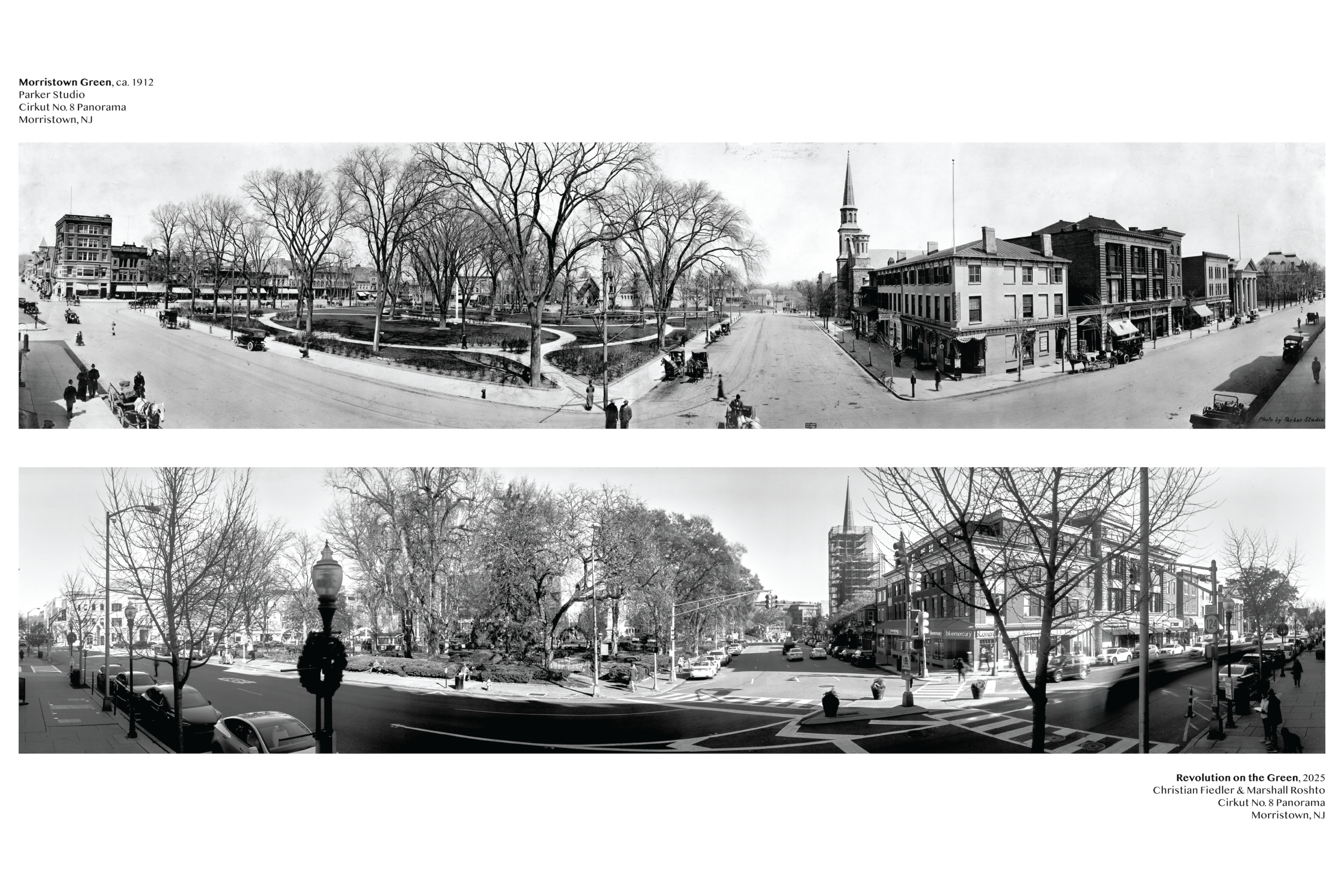
Like many great tales from New Jersey, our story begins at a bagel shop. On a fall morning in Morristown, while standing in line for a breakfast sandwich, I noticed a beautiful mural of our town center mounted on the wall. Looking closer, it wasn’t a mural at all; it was a detailed, rich panoramic photograph taken of the Morristown Green sometime around the turn of the 20th century, with horse-drawn carriages side-by-side with early Model T’s, pedestrians in shockingly formal attire, and beautiful landscaping in the town’s iconic central square.
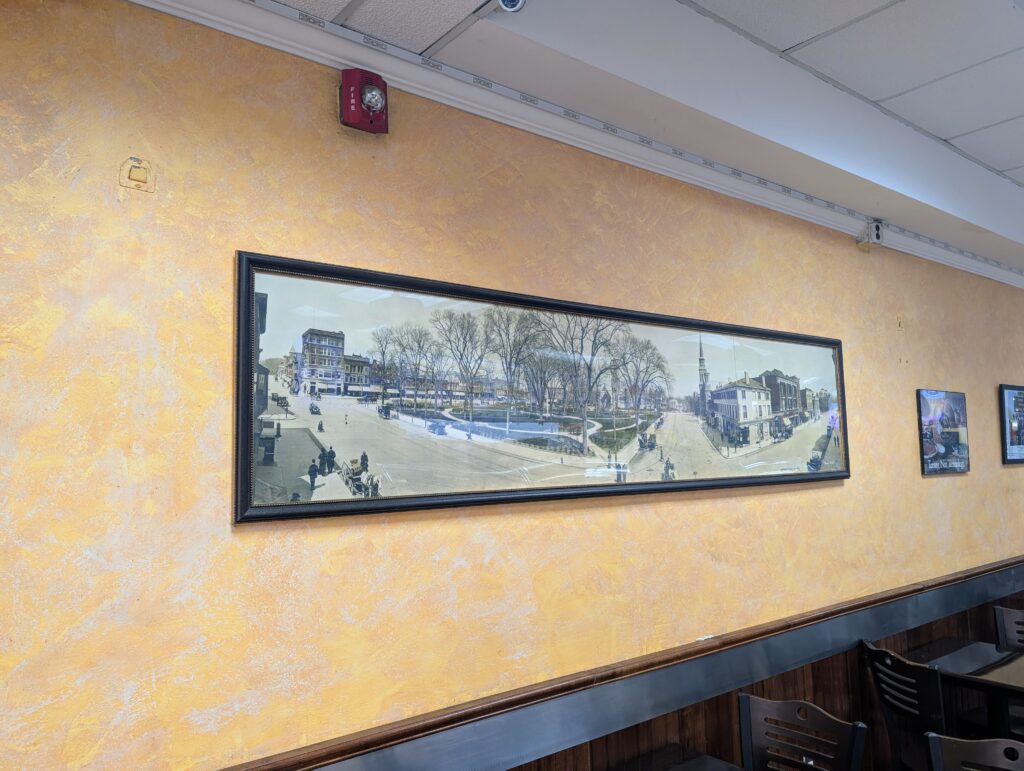
I mentioned the image to my friend Marshall, who had also seen it and was impressed by its scale and elegance. We decided it would be a worthy project to re-create it as closely as possible, showcasing what’s changed and what’s stayed the same over the past hundred years in our Colonial-era town. What followed was a year of research, tinkering, darkroom work, and connecting with an online community dedicated to a very unique camera.
Research
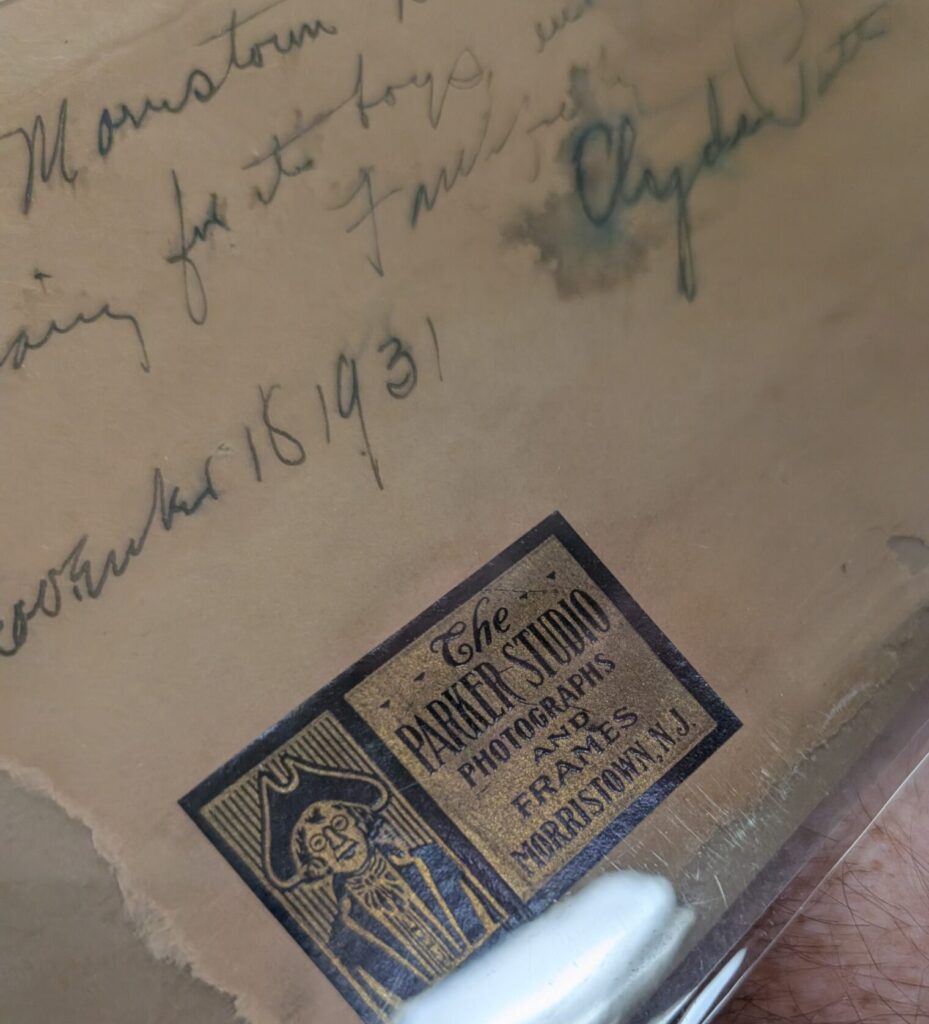
Our first port of call was to learn more about the print itself. Luckily, Morristown boasts a top-notch research center in the town’s library, where we were able to locate archival scans of the original as well as contact prints. The staff at the history center unveiled a trove of research about the original photographer, William Parker, who ran a sophisticated and successful studio in town from the turn of the century through the 1930s, and helped us date the image to right around 1910.
We also learned more about the camera based on looking at the prints: it had to have been capable of a more than 180° image, since South Street was fully visible in both directions, and it had to be capable of creating truly massive negatives — at least 8″ x three feet. What kind of camera could shoot the equivalent of more than three 8×10 sheets in a single image?
Further research turned up a few camera candidates. Kodak’s Panoram and the Al-Vista cameras were popular panoramic cameras of the era, but were unable to swing enough to match the extremely wide perspective. What about the Globuscope camera, made famous as a prop in Ghostbusters? Too late in history, having been invented in 1981.
Eventually, we came upon Kodak’s “Cirkut” cameras and knew we had a match: popular in the 1910s, capable of very long panoramas, and they even included a model — the No. 8 — which shot on spools of eight-inch film. As it turns out, many famous panoramic images were taken on the Cirkut family of cameras, especially of lined-up military groups, graduating classes, and baseball teams, as well as cityscapes like our own. We picked up a copy of America by the Yard, a wonderful study of historical Cirkut images compiled by Robert MacKay, for further inspiration while we worked on acquiring one for ourselves.
Sourcing and Building
Turning to eBay for parts, we found a number of Cirkut cameras for sale but few in good shape. Eventually, Marshall and I landed on a strategy of piecing together a full camera from individual pieces and broken cameras, ensuring their complex clockwork and gear mechanisms functioned, and that there were no light leaks. One ace-in-the-hole in this project was Marshall himself; as a mechanical engineer with an interest in horology, fixing up a fine mechanical instrument was right up his alley.
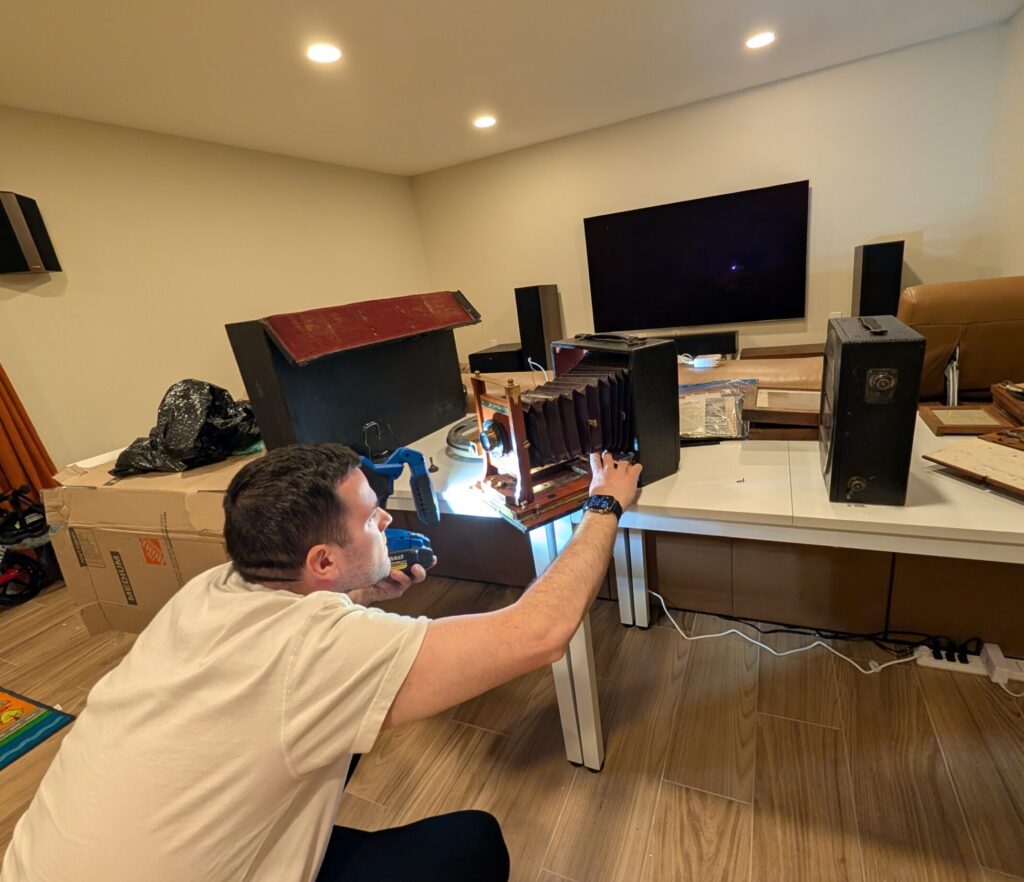
The process of repairing such a complicated antique also nudged us to start interacting more with the online community. There aren’t too many Cirkut shooters left, but the ones out there have been friendly and generous with their time and resources. One of our first stops in learning how these cameras work was Pacific Rim Camera’s reference library, which had original instruction manuals for the No. 8 Cirkut available. I also connected with Skyy, a Cirkut photographer whose YouTube channel is brimming with details on the construction and operation of the cameras. Skyy was also kind enough to sell us custom rolls of 8-inch Cirkut film — essential since the Kodak-manufactured versions are long out of production. Made with Agfa Aviphot, these were perfect since the shooting and development characteristics are so well documented.
After hours of research and tinkering, we eventually had the camera winding and rotating perfectly.
Shooting
To mimic the original photograph properly, we chose to shoot in late November 2025 when the trees had lost their foliage but snow hadn’t yet fallen. We also scouted out the original location to position our camera at, and figured out that the Parker Studio had shot it from an elevated position, likely the roof of a single-story building on South Street that had been long since replaced by five-story condominiums.
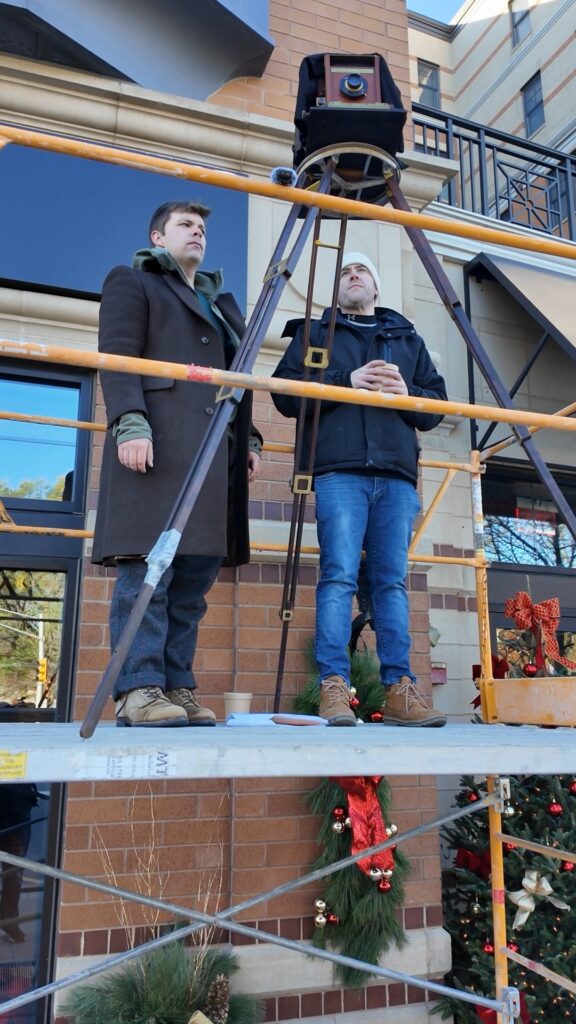
To get as close as we could, we rented professional scaffolding, which we recruited a team of friends to construct right in front of the original perspective. This also led to permitting with the town, although they were kind enough to waive fees for us given that it was a project of historical interest rather than a professional production.
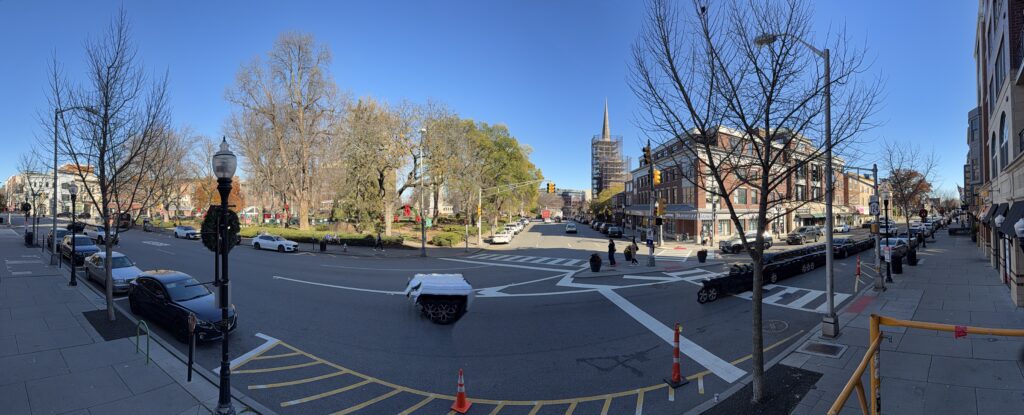
On a chilly morning, not unlike the morning that I first saw the original picture on the wall of a bagel shop, we set up our scaffolding, climbed atop, leveled our tripod and focused our image.
The shooting process for a Cirkut is quite different from anything I’d done before. First, the tripod is set up to be as level as possible. Then, the camera is focused like a large-format view camera with a twist: it’s spun side-by-side to ensure all the desired elements are in focus, in frame, and aligned to the horizon. Lastly, it’s rotated to its leftmost perspective.
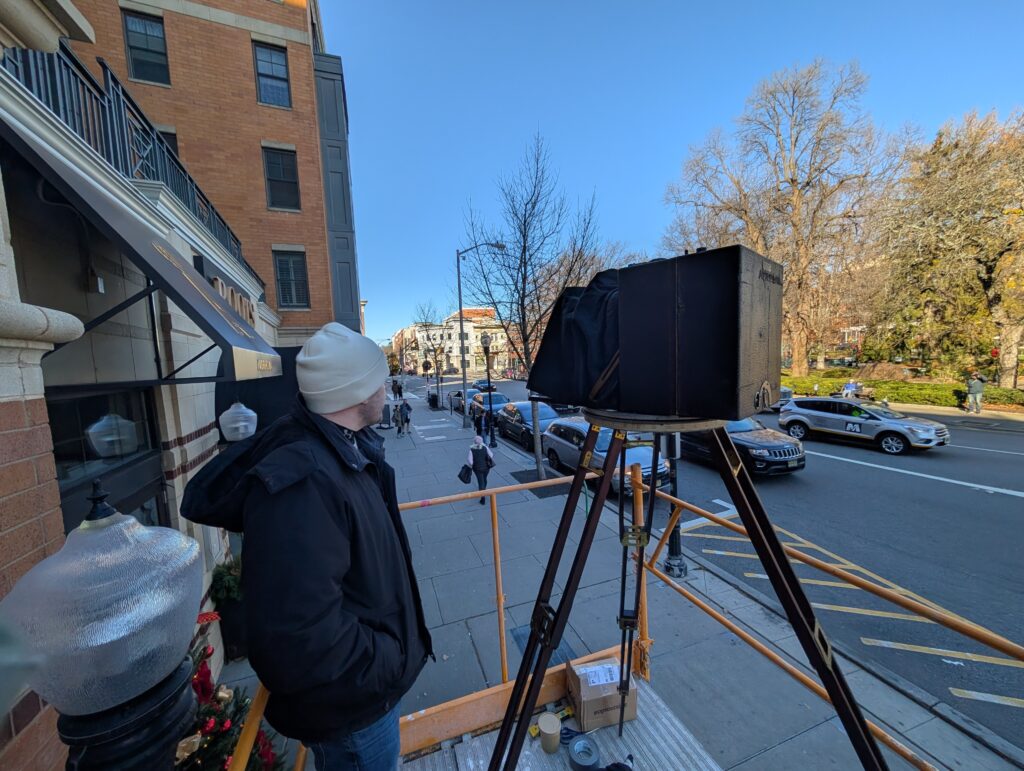
Once focusing is complete, the film back is loaded. Essentially giant rolls of 220 film, the 8-inch spools have paper leaders that allow for loading in subdued light. The leader is pinched onto the motor, which doubles as a take-up drum, and the back is sealed. Then, we wound the drum just like a clock, and installed the correct gear for the focus we were shooting at: infinity on our original 11” doublet lens.
The back is then mounted to the front standard and the entire unit gets slid forward until the motor-driven gear interfaces with the toothed tripod. Like many swing-lens panoramic cameras including the Widelux and Horizon series, the Cirkut’s shutter speed is a factor of how fast the camera rotates — the shutter remains open the entire time! A handy selector on the rear of the film back displays equivalent shutter speeds from ½ second to 1/12 second, which we set for our exposure.
Finally, we clicked the switch on the film back and the Cirkut hummed to life, smoothly panning from left to right along our intended view, taking in the same perspective that Parker had captured 110+ years prior. We repeated the process six more times, capturing a total of seven negatives on the day of our shoot.
Developing and Scanning
Development represents another challenge for the aspiring Cirkut shooter. Standard equipment is simply not large enough for a negative several feet long. Again, the online photography community came in handy to help us find a path forward. Based on Drew Tanner’s description online, we cloned his setup for Cirkut development, which uses a large tube that the negative is loaded lengthwise into for processing.
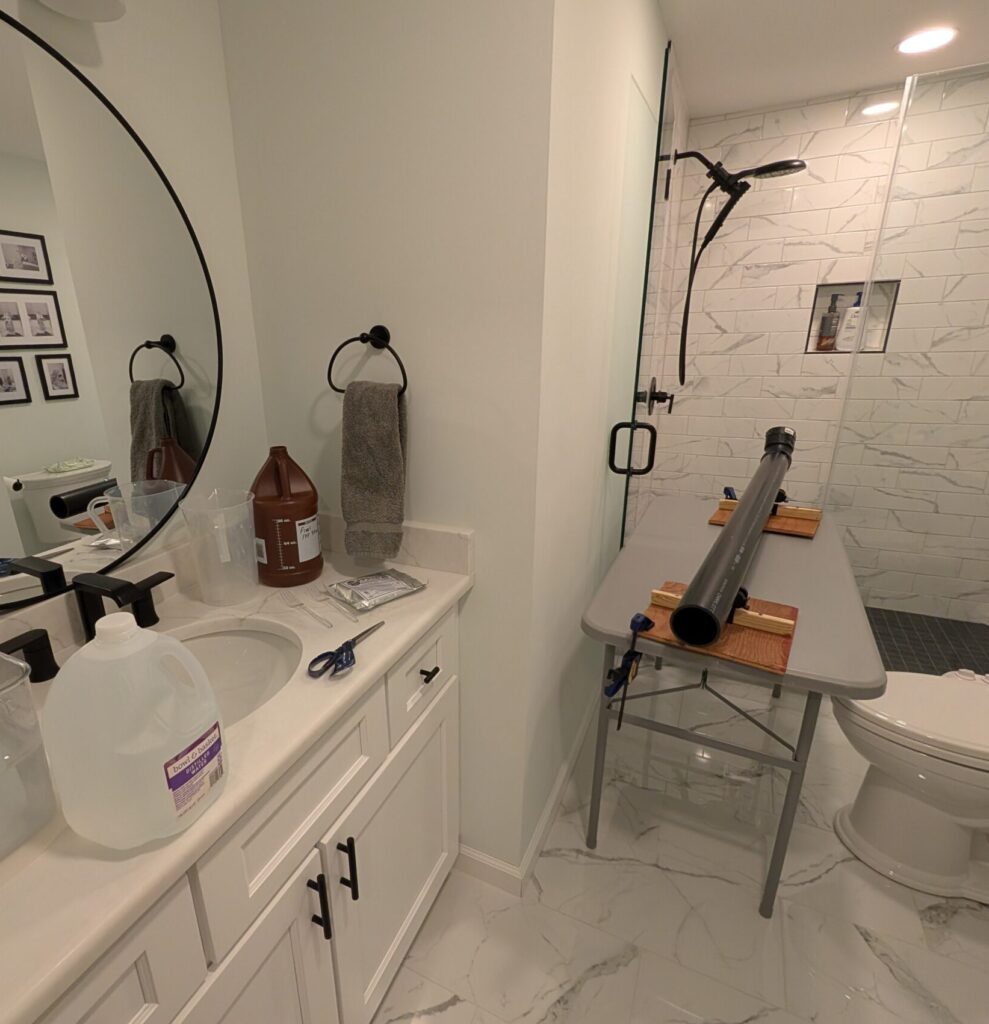
The process is as follows: the Cirkut negative is unwound in the dark, clamped to a screen (necessary to reduce stiction), and loaded into the tube. After a prewash, the film gets 15 minutes of constant agitation — accomplished via rolling the tube on casters — followed by a stop bath, fixer, and wash. Afterwards, the negative is pulled out of the tube, run through Photo-Flo, and hung to dry. The process takes close to 40 minutes per negative, meaning we spent hours and hours in our home darkroom (a guest bathroom) getting the images processed.
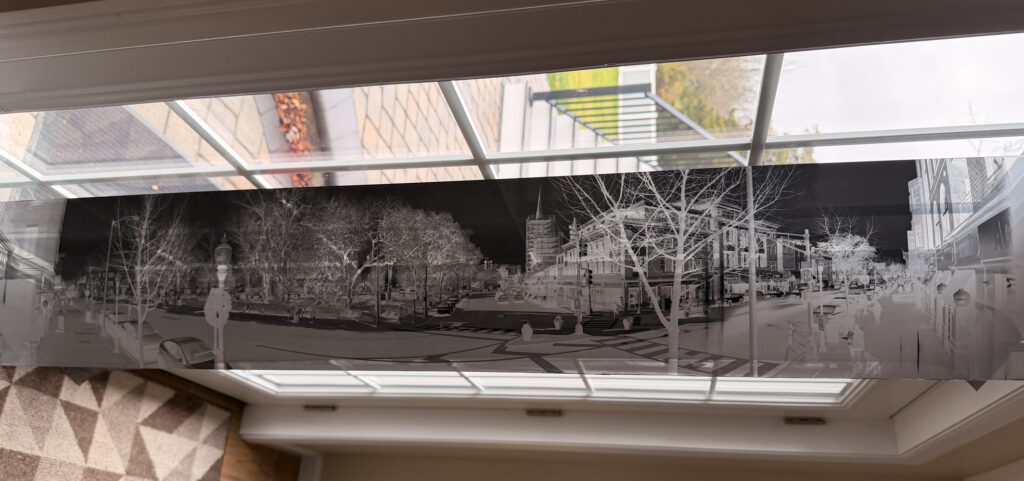
Scanning was difficult as well, and I wasn’t confident enough in my home scanning abilities to attempt it myself. Luckily, Pro-Lab in Clifton, NJ found a way to scan each negative in parts and return them as extremely high-definition TIFF files. From there, they were straightforward to stitch together as full-size images and to do some adjustments in post.
Results
We were thrilled with our end result in this project, which becomes striking once presented next to the original image. The two together tell a story of both stasis and change in our 300-year-old town, with the Green still laid out the same but the trees having grown much larger. The buildings, too, tell a story of development; many of them clearly have the same structure but have new facades and identities. Even the growth of tradition is visible in the images, with our modern rendition featuring the Green’s Christmas lights and the iconic “Santa House” — now famous traditions which got their start only a few years after the original image was taken around 1910. Standing in front of the two prints, a century feels like not very long at all.
The images will be on display together at the Morristown & Morris Township Library’s F.M. Kirby Gallery through the spring of 2026. A high resolution version is also available online here.
We owe great thanks to the Morristown & Morris Township Library, North Jersey History & Genealogy Center, Pro-Lab in Clifton, Socialmocracy and Drew Tanner on YouTube, and Pete R., Paul T., and Jason W. for their assistance on the day of the shoot.
Share this post:

Comments
Miguel Mendez on Revolution on the Green – Recreating a Kodak Cirkut Photograph from 1910
Comment posted: 01/03/2026
Comment posted: 01/03/2026
Charles Young on Revolution on the Green – Recreating a Kodak Cirkut Photograph from 1910
Comment posted: 01/03/2026
(Next to Lake Superior), Marquette MI has a shop with lots of historic photos, but I have never seen such panoramic photos.
Chuck
Comment posted: 01/03/2026
Bill Brown on Revolution on the Green – Recreating a Kodak Cirkut Photograph from 1910
Comment posted: 01/03/2026
Comment posted: 01/03/2026
Adrian Riu on Revolution on the Green – Recreating a Kodak Cirkut Photograph from 1910
Comment posted: 01/03/2026
Comment posted: 01/03/2026
Art Meripol on Revolution on the Green – Recreating a Kodak Cirkut Photograph from 1910
Comment posted: 01/03/2026
I wonder what the same scene will show in another 100 or so years?
I did something very similar and yet not at all the same when I documented sites along the civil rights trail across America. An art director collected historic photos taken in the 50's and 60's when the sites entered the public eye and we then chose one for each site and tried to replicate it, knowing many were probably shot with a speed graphic. I tried to find the exact place in space for my camera to match and get a lens as close as possible to the one used for field of view. it was one of the coolest challenges I've tried and very satisfying. But what you guys did is so far beyond that. Please post in the future about what you do next with that beautiful beast of a camera.
Comment posted: 01/03/2026
Comment posted: 01/03/2026
Comment posted: 01/03/2026
Jim Palmer on Revolution on the Green – Recreating a Kodak Cirkut Photograph from 1910
Comment posted: 01/03/2026
Comment posted: 01/03/2026
Jeffery Luhn on Revolution on the Green – Recreating a Kodak Cirkut Photograph from 1910
Comment posted: 02/03/2026
What a great article about a very ambitious project!! I've seen several large panoramas from that period and assumed they were contact prints because of the sharpness and lack of grain. I never knew what camera was capable of that. You enlightened me! I applaud your dedication to achieve such great results. I hope you manage to take some more photos and show them to us. Congratulations!
Jeffery Luhn
Comment posted: 02/03/2026
Leon Winnert on Revolution on the Green – Recreating a Kodak Cirkut Photograph from 1910
Comment posted: 02/03/2026
And when you look at the places in them, compare to today. At times so much and yet so little has changed. As your picture clearly demonstrates.
A while back I came across a 1780’s street map of the town in England where I live, Horsham. One summer evening I used it to navigate my way around the town centre. It was still largely relevant and accurate. 220 years on the buildings had mostly changed but to all intents and purposes the footprint of the street layouts was unchanged.
As for the camera. I recall in the late 50s cameras of that style being used to take school photographs – at my school. There was a game that could be played by a cheeky chappy should he so want. He would ensure he was standing at the end of the group where the camera would begin its travers. After it had moved past him he would run around the back of the group and stand at the far end to be photographed for the second time.
Oh look its me and my twin brother. Not!
Happy days.
Comment posted: 02/03/2026
Comment posted: 02/03/2026
Comment posted: 02/03/2026
Bill Brown on Revolution on the Green – Recreating a Kodak Cirkut Photograph from 1910
Comment posted: 06/03/2026
Comment posted: 06/03/2026