In the nature reserve in the Netherlands / Germany – A One Shot Story

By Walter Reumkens

A discussion with a community member here on 35mmc led us to cameras “Made in Germany”, and we soon found ourselves talking about Carl Zeiss Jena and the “Contax D” with the Biotar 2/58mm lens from the same manufacturer. I bought it a good 10 years ago from a house clearance dealer who knew little about photography and was more interested in the business side of things. I got it cheaply, though, even though it turned out after the first roll of film that it would be better to have it serviced.

I’m writing about this camera, which is engraved with “CONTAX D” ZEISS IKON VEB – that is, a state-owned enterprise of the GDR.
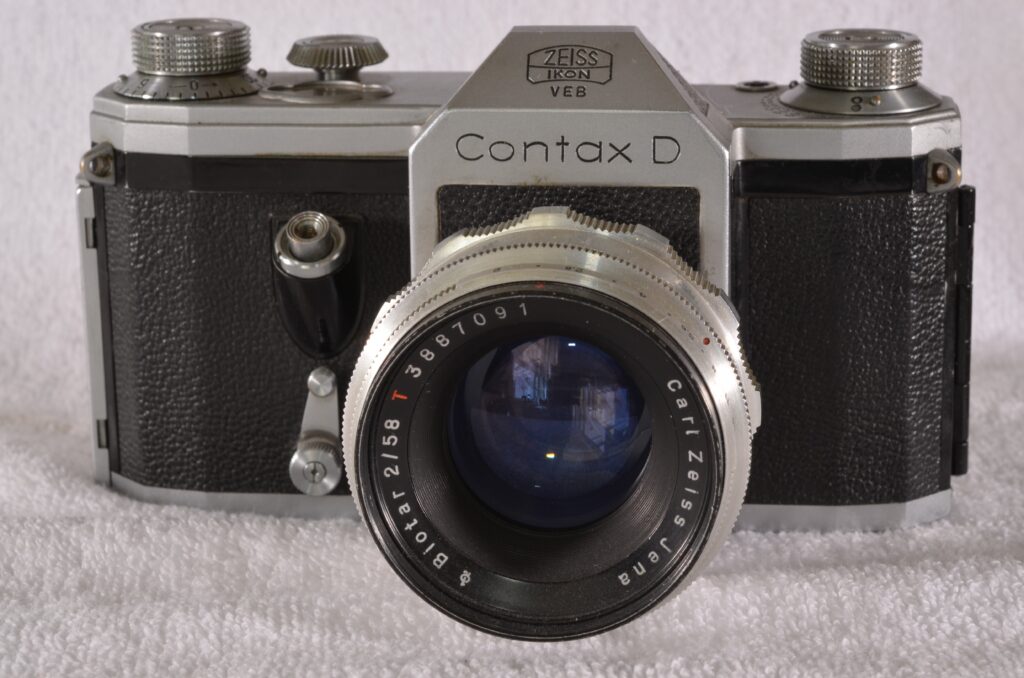
 

The photo was taken before the camera was serviced at Foto Olbrich in Görlitz, Saxony – the town on the border with Poland where ‘Meyer Görlitz’ lenses used to be designed and manufactured. I believe the specialist shop is now run by the third generation of the family; it’s a small family business that I can highly recommend for servicing cameras and lenses from the GDR era.

The camera is considered a classic: robustly built, good quality, with a huge viewfinder, a great, powerful shutter sound, and a legendary lens.

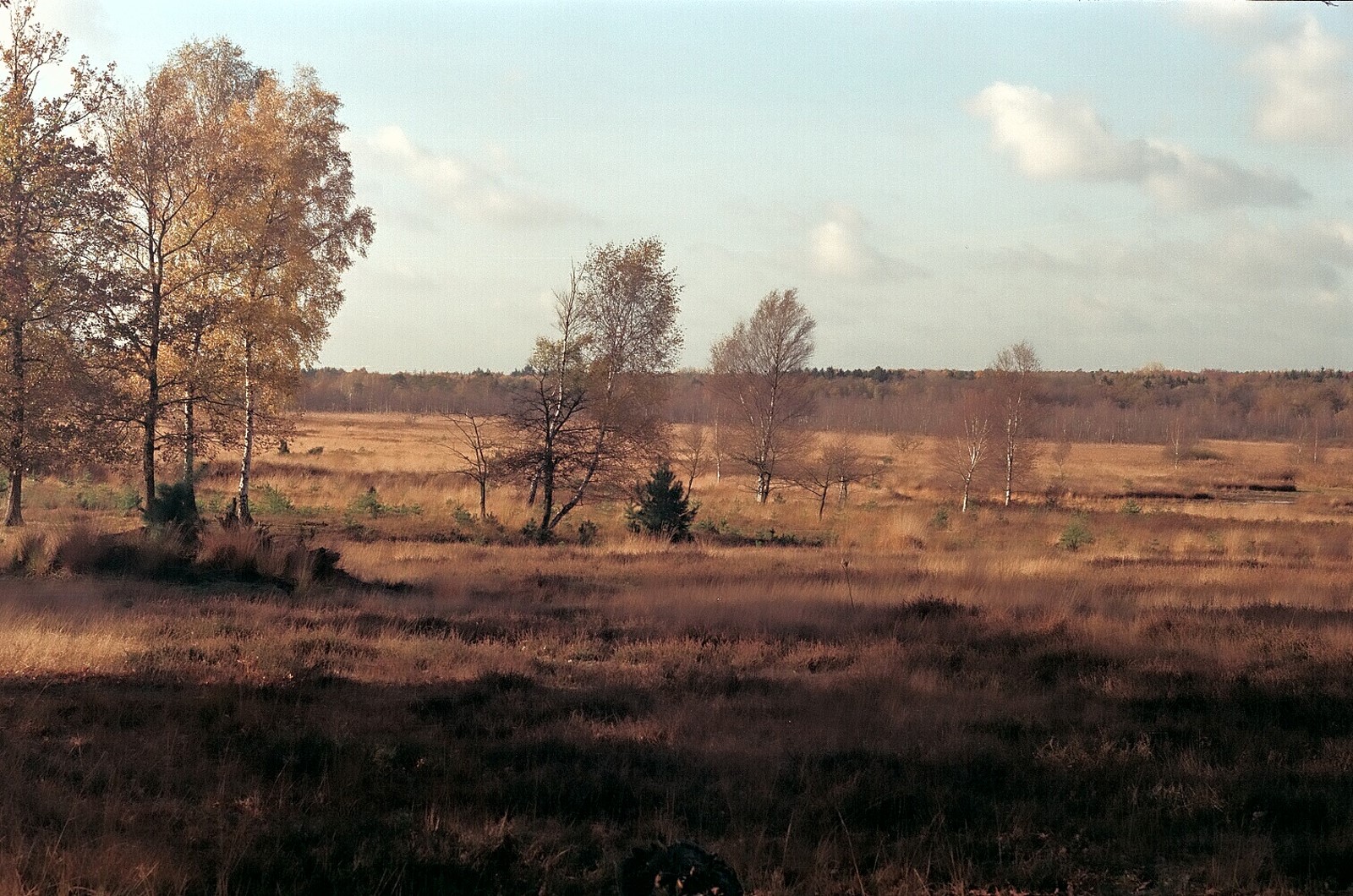
I took the photo shown above in the Maas-Schwalm-Nette Nature Park in Germany, on the border with the Netherlands. The border runs virtually right through the middle of the picture here. It was my first roll of film with such an old camera. As it has no light meter, I had a Gossen Profisix with me, though I had little experience using it. The film was called ‘Paradies 400’, the own-brand of a large chemist’s chain in Germany. The origin of the film is unknown. I shot at ASA 400 on a late autumn afternoon. At box speed, there shouldn’t really be any pastel tones, so the character of the photo must be down to the film, the lens or the exposure.

I still don’t know to this day. Perhaps someone can help me.

.

Share this post:

About The Author

By Walter Reumkens
Walter Reumkens lives in Mönchengladbach, a medium-sized town in North Rhine-Westphalia, Germany. He is a retired graduate in public administration, worked in the IT sector for 40 years and has been a passionate photographer for over 50 years. In addition to numerous analogue and digital Nikon cameras (SLR, DSLR, DSLM), he also uses cameras and lenses from other manufacturers. To find out whether, alongside the ‘typical, highly touted luxury cameras’, other manufacturers also produce very good, reliable and user-friendly products that fully satisfy experienced photographers.
Read More Articles From Walter Reumkens

Find more similar content on 35mmc

Use the tags below to search for more posts on related topics:

Donate to the upkeep, or contribute to 35mmc for an ad-free experience.

There are two ways to contribute to 35mmc and experience it without the adverts:

Paid Subscription – £3.99 per month and you’ll never see an advert again! (Free 3-day trial).

Subscribe here.

Content contributor – become a part of the world’s biggest film and alternative photography community blog. All our Contributors have an ad-free experience for life.

Sign up here.

Make a donation – If you would simply like to support Hamish Gill and 35mmc financially, you can also do so via ko-fi

Donate to 35mmc here.

Comments

Gary Smith on In the nature reserve in the Netherlands / Germany – A One Shot Story

Comment posted: 24/06/2026

I love your featured shot Walter! My Contax is a Japanese branded camera and hopefully I'll finish the roll up today. I guess the Zeiss-branded lenses are also Japanese. I also have a few "older" German cameras (a Barnack iiic and an M3) but to be honest, they don't seem to be getting a lot of use these days. I think it has to do with the immediacy of digital. At 72, I'm not very patient. Thanks for your posts!
Reply

Leave a Reply

Your email address will not be published. Required fields are marked *

Walter Reumkens on In the nature reserve in the Netherlands / Germany – A One Shot Story

Comment posted: 24/06/2026

After the Second World War and the division of Germany, there were two companies called ‘Zeiss Ikon’. One was in Stuttgart in the Federal Republic of Germany (FRG), the other in Jena in the German Democratic Republic (GDR). The cameras that Ibraar recently showcased were manufactured in the FRG, whilst my Contax D was made by Carl Zeiss Jena. In the West, they mostly had a leaf shutter; in the East, a focal-plane shutter. Zeiss Ikon/Carl Zeiss Jena was nationalised (VEB) and changed its name to Pentacon. The Contax trademark rights were transferred to Zeiss in the FRG, but no more cameras were built because the West German camera industry went into insolvency; the products were no longer selling, as the industry had failed to keep up with progress. Only Leitz remained; its customers loved the old technology, but users struggled with innovations, and the cameras were bought here more as status symbols. Zeiss produced good lenses but was unable to manufacture a camera itself. A partnership was formed with Yashica in Japan, which built the Contax SLRs with Carl Zeiss lenses; these were initially manufactured in Germany, but were later produced in Japan under Zeiss’s supervision. I’m not sure if it was always Yashica; it may also have been Cosina. The Contax brand rights are now held by Kyocera. Thanks for your feedback, Gary.
Reply

Leave a Reply

Your email address will not be published. Required fields are marked *

Gary Smith replied:

Comment posted: 24/06/2026

At some point I may get around to my article about twins born hundreds of miles apart: my Voigtländer and my Kodak Retinette. It seems that there was quite a bit of shuffling with Zeiss Ikon. August Nagel and his friend Carl Drexler founded Drexler & Nagel in 1908 to produce photographic equipment. In 1926 he merged the operation with three other operations with funding from Zeiss to form Zeiss Ikon. By 1932 he had left Zeiss Ikon, formed another operation which he subsequently sold to Eastman Kodak which became Kodak AG based in Stuttgart.

Reply

Leave a Reply

Your email address will not be published. Required fields are marked *

Walter Reumkens replied:

Comment posted: 24/06/2026

Later, Voigtländer also became part of Zeiss Ikon. For Zeiss Ikon’s outdated management, Voigtländer’s excellent innovations were seen more as obstacles to their Contarex, Contaflex and Icarex models than as the future of the company; they were never produced, and then, naturally, the lights went out. These cameras sat on the shelves of camera shops; they were no longer state-of-the-art and, on top of that, more expensive than the first Japanese cameras. They remained on the shelves right up until the company went into administration – nobody was buying them any more. It’s all an interesting yet sad story. You really ought to finish that article you mentioned, Gary.

Reply

Leave a Reply

Your email address will not be published. Required fields are marked *

Ibraar Hussain on In the nature reserve in the Netherlands / Germany – A One Shot Story

Comment posted: 25/06/2026

Thank you Walter
Made in west Germany or Wast Germany - the cameras were and still are beautiful
This is a wonderful camera and one which is in my list!
Ive a soft spot for Contax cameras. And Zeiss derived ones.
I had a couple of Pentacon Six medium
Former cameras but both were faulty which was a shame.

There was one camera labelled Carl Zeiss Jena - that was the Werra series.

A shame what happened after the war when Germany was plundered (and genocided) by both East and West and after unification as well when DDR businesses were broken
Reply

Leave a Reply

Your email address will not be published. Required fields are marked *

Walter Reumkens replied:

Comment posted: 25/06/2026

Thanks, Ibraar, that’s all true. As a so-called ‘Wessi’, I always walked past the Voigtländer and Zeiss Ikon cameras in the shops and bought Nikon cameras instead – but I’ve never regretted it. After reunification, I became more interested in cameras from the GDR, which were built under harsher conditions and, to me, seemed to come from another world. That’s why I chose this Contax D rather than a Contaflex. After buying it from an antique dealer, it had to go in for servicing due to shutter problems. Foto Olbrich in Görlitz fitted it with completely new shutter curtains and it now works perfectly. The company repairs all cameras and lenses from the GDR; I can highly recommend them. I also own a green Werra. Good luck with your search! https://kameramuseum.de/objekte/pentacon-contax-d-veb-zeiss-ikon/

Reply

Leave a Reply

Your email address will not be published. Required fields are marked *

Ibraar Hussain replied:

Comment posted: 25/06/2026

I meant made in west Germany or East Germany (not Wast)

Reply

Leave a Reply

Your email address will not be published. Required fields are marked *

Ibraar Hussain replied:

Comment posted: 25/06/2026

Now you’ve got to try a Contaflex!

Reply

Leave a Reply

Your email address will not be published. Required fields are marked *

Walter Reumkens replied:

Comment posted: 25/06/2026

If only you knew how many cameras I’ve got waiting to be used. A former colleague has the Contaflex II, which I’ve used before. I’m currently rather taken with Voigtländer, specifically the Ultramatic CS. We’ll just have to wait and see. First up, it’s the turn of the Contax D and my RTS again. :-)))

Reply

Leave a Reply

Your email address will not be published. Required fields are marked *

Walter Reumkens replied:

Comment posted: 25/06/2026

Ibraar, my automatic translation isn’t quite right. Before I buy something new, I’d have to sell something old first. But what? It’s not always easy to decide when you’re going through a break-up. So, once I’ve got some money in the pot again, I’m leaning towards the Ultramatic CS or the Bessamatic CS. It would be better if I could just stop this obsession.

Reply

Leave a Reply

Your email address will not be published. Required fields are marked *

Ibraar Hussain replied:

Comment posted: 25/06/2026

The Ultramatic CS is the most beautiful camera ever - it’s build quality and level of finishing and feel makes a Leica M or Rolleiflex look and feel like a Halina My review coming on 13th July - with the Septon 50mm f2 is a wonderful combination

Reply

Leave a Reply

Your email address will not be published. Required fields are marked *

Ibraar Hussain replied:

Comment posted: 25/06/2026

The Ultramatic is quite a bit more refined and nicer in every way to the Bessamatic It handles better and just overall the coolest camera

Reply

Leave a Reply

Your email address will not be published. Required fields are marked *

Ibraar Hussain replied:

Comment posted: 25/06/2026

So forget the Bessamatic - get an Ultramatic CS, you won’t regret it

Reply

Leave a Reply

Your email address will not be published. Required fields are marked *

Walter Reumkens replied:

Comment posted: 25/06/2026

I’m really looking forward to your article. To me, it also looks a bit ‘more refined’. I’m sorry, but despite all their technical excellence, they’re often a bit too baroque for my taste. The very finest and best model was never actually produced; the Zeiss Ikon management were against it because it was made by VL: https://www.klassik-cameras.de/WestdeutscheSLR.html#Voigtlaender_132 This camera might have prevented the company from going into administration. Thanks Ibraar!

Reply

Leave a Reply

Your email address will not be published. Required fields are marked *

Gerard on In the nature reserve in the Netherlands / Germany – A One Shot Story

Comment posted: 25/06/2026

It is so sad that after the Wall fell, the Western Treuhand tore down the VEB factory, which had been producing one SLR camera for every three SLR''s in the WORLD.
One even invented special bacteria to get rid of the millions of plastic Trabant cars, once the pride of the people in the DDR.
Reply

Leave a Reply

Your email address will not be published. Required fields are marked *

Walter Reumkens on In the nature reserve in the Netherlands / Germany – A One Shot Story

Comment posted: 25/06/2026

But there are quite a few things in what you’ve written that aren’t right. Why don’t you check with some reliable sources?
Reply

Leave a Reply

Your email address will not be published. Required fields are marked *

Leave a Comment

Leave a Reply

Your email address will not be published. Required fields are marked *