

Orchestras run on two things. Music and food.
Most documentation skips the food. Concert halls, polished instruments, formal attire — that’s what ends up in the frame. But I wanted to start in the car park outside the community centre, during the lunch break, before any of that.
I’m the fourth horn in the Symphonique des bords de Loire, a community orchestra in the Vendée. Which means I was inside the story, not observing it from a safe distance. I know these people. I count rests next to Corentin, our first horn. I watch Victor — oboe, cor anglais, and the man who quietly keeps the whole enterprise running — arrive with a tote bag full of provisions. I see the conductor holding a food container and chatting, no baton, no authority, just a man at lunch with his colleagues.
That’s what I wanted to photograph.
The weekend in question was a two-day rehearsal: Saturday, a double violin concerto with two Chinese guest soloists; Sunday, a full general rehearsal without them. Three distinct sessions, three distinct moods. And I decided early on that each one would get its own camera and its own film. The technical choices were the point — not accidents, but a deliberate attempt to let the medium say something about the moment.
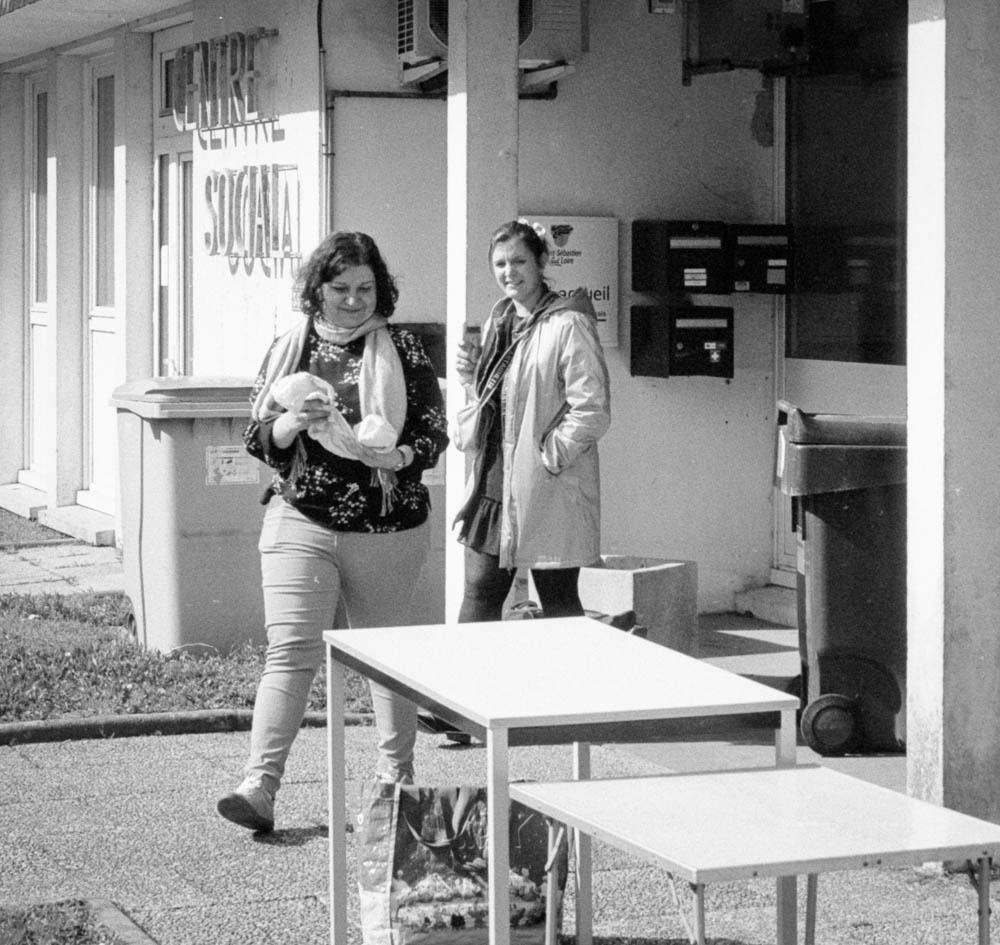
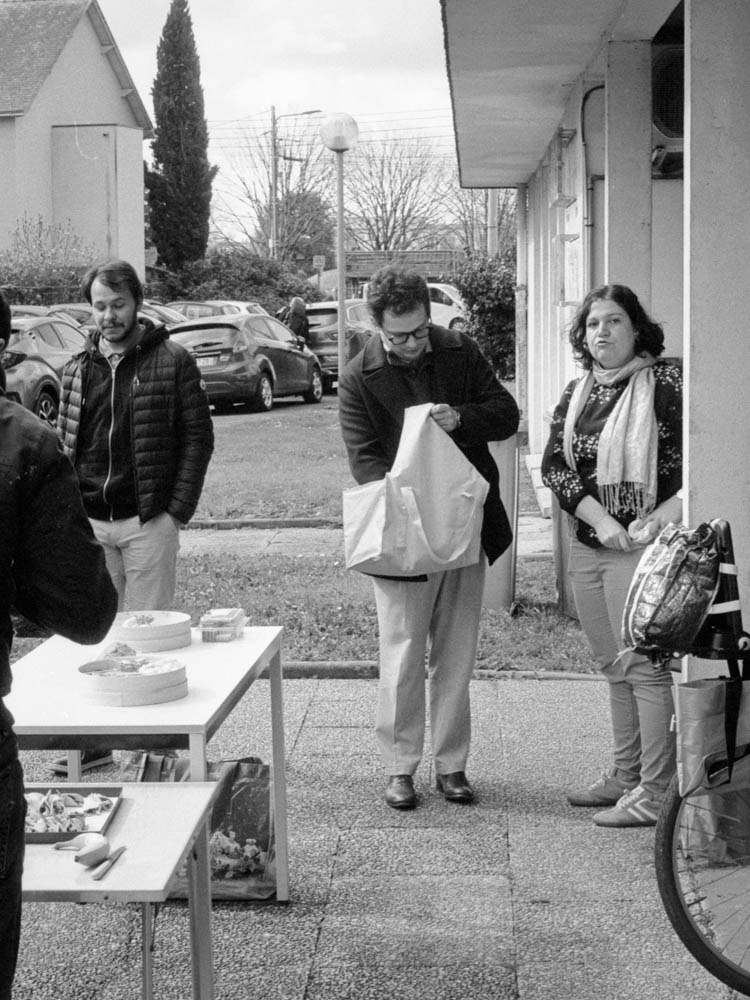
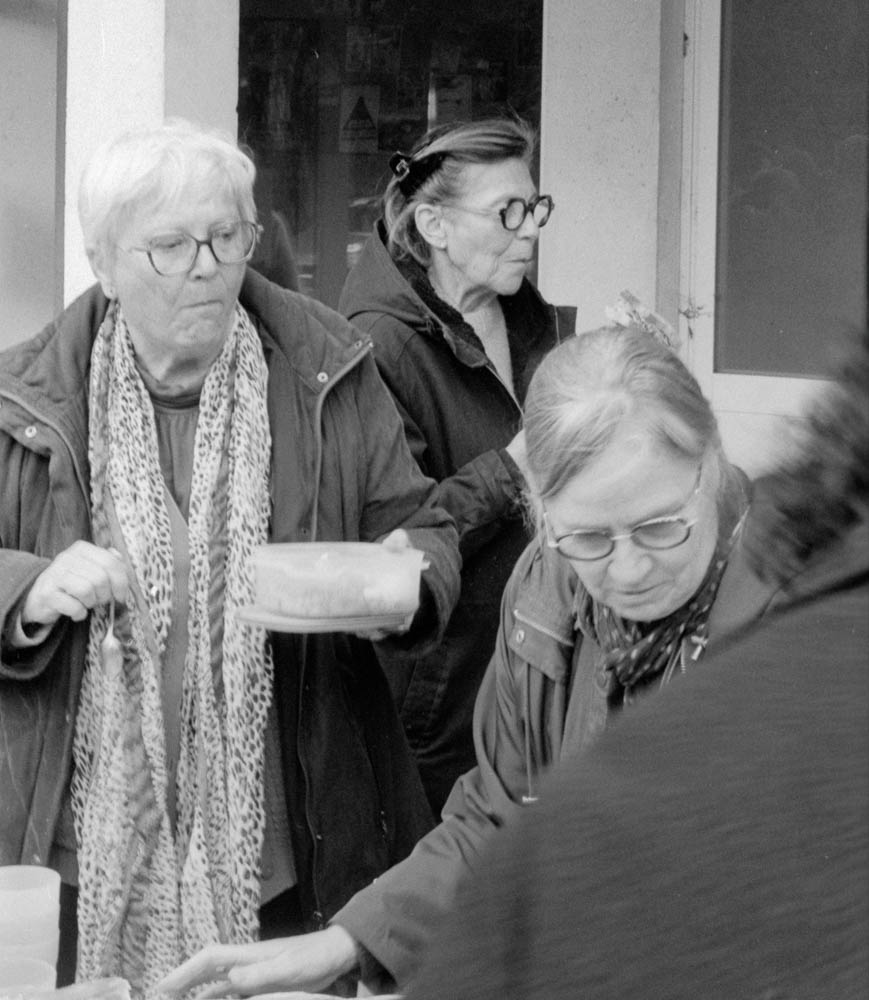
Lunch: Pentax ME Super, Fomapan 100
I loaded the Pentax ME Super with Fomapan 100 and spent the break outside. Aperture priority, natural light, box speed. No pushing, no games.
The choice was deliberate. I knew I’d be shooting indoors later — mixed fluorescents, available light only — and I knew I’d be pushing hard. So this needed to feel different. Calmer. The breath before the dive.
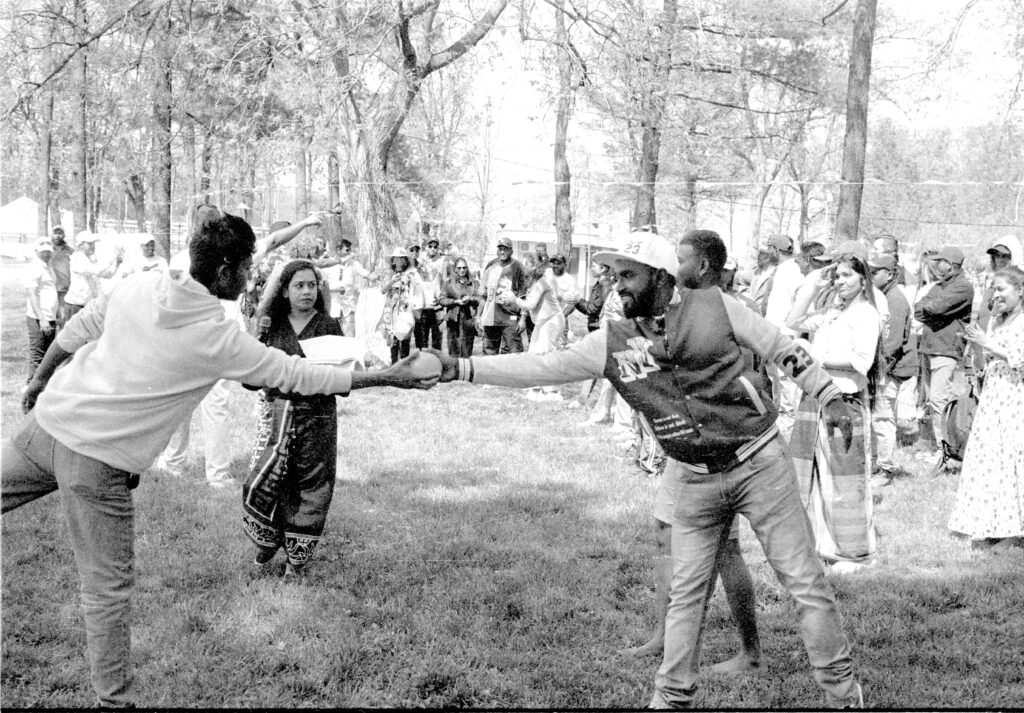
Fomapan 100 in good daylight gives you an honesty that suits candid work. The faces, the bread, the containers of salad, the glass bottle catching the sun — none of it staged, and the film doesn’t try to make it anything other than what it is. Fine grain, gentle contrast, a quality I’d describe as unhurried. It suited a car park lunch among friends.
The two Chinese violin soloists weren’t there yet. They’d arrive later, after the tables were packed away. For now it was just us: teachers, retirees, students, professionals, amateurs. All ages. The usual mix. Gathered outside a community centre with a faded sign, sharing food before three hours of work.
This isn’t a fancy conservatory. It never was. That’s rather the point.
THE CONCERTO: Canon AE-1 Program, HP5+ at 1600
The lunch break ended. Tables folded. And then they arrived.
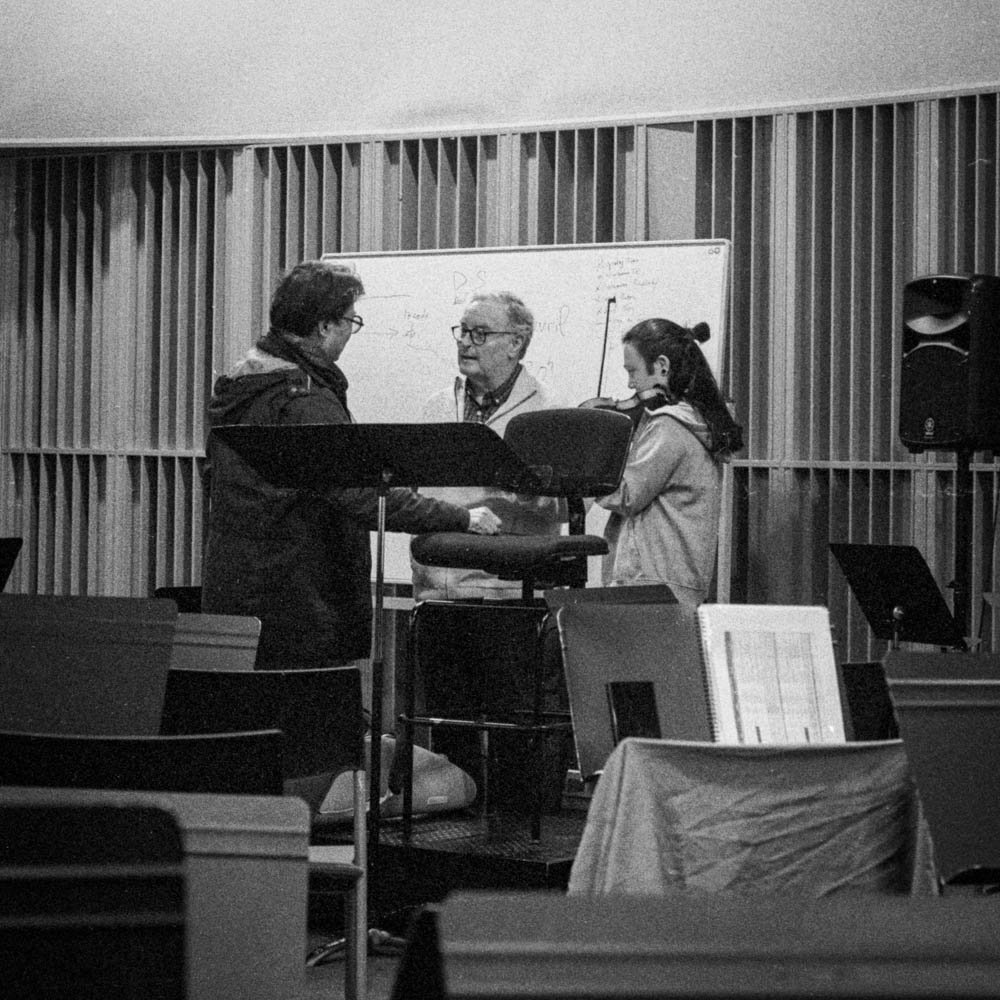
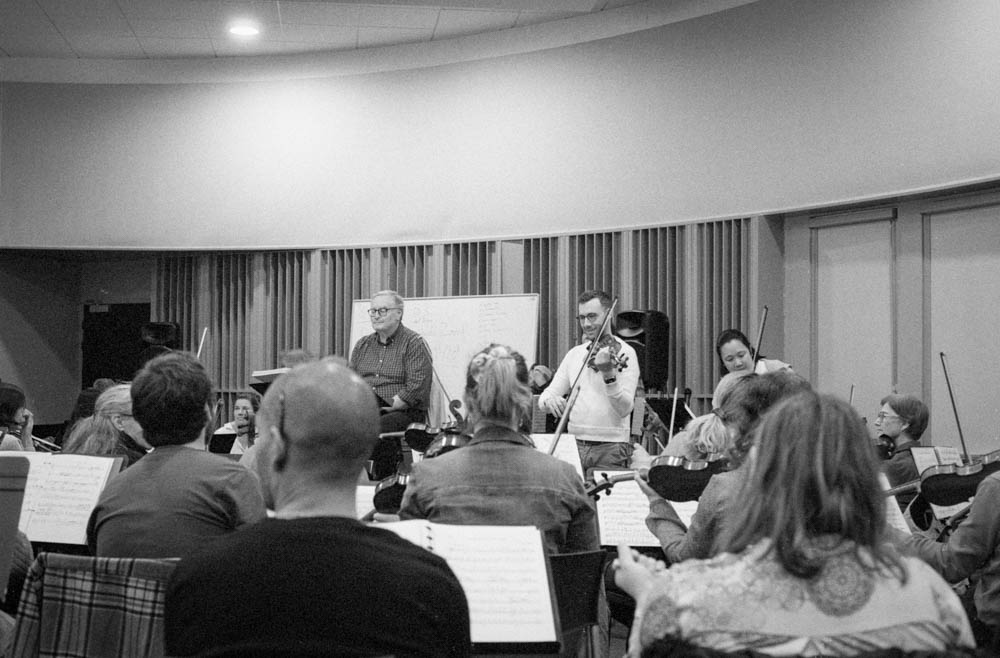
I put down the Fomapan and loaded HP5+ pushed to 1600. Swapped the Pentax for the Canon AE-1 Program in Program mode — no thinking about shutter or aperture, just framing and timing. The sunlight was gone. The fluorescents were on.
What you witness photographing a concerto rehearsal is translation. Not just musical ideas passing between conductor and players, but something more specific: two soloists from one tradition finding a shared language with an orchestra from another. He stops us. Softer in the strings. They adjust. He stops again. A touch more projection. Over and over, not because anyone is wrong, but because everyone is finding the same musical space.
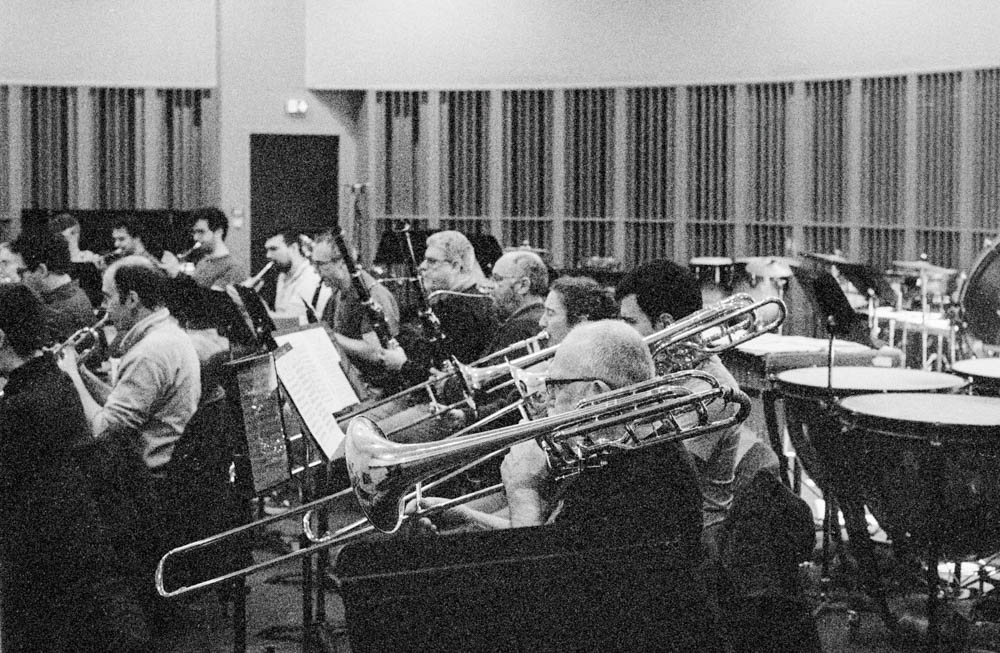
HP5+ at 1600 sits in the right place for this — not the fine, almost invisible grain of the Fomapan, not the raw declared grain of 3200. Textural, controlled, appropriate. Honest about the work without dramatising it. I photographed from my seat in the horn section and from the aisles during breaks. From there I see the whole machine differently than an outsider would: I know which passages are coming, which sections are struggling, the rhythm of the room. But through the viewfinder I see something else — the strings moving in that eerie synchronised way, the brass gleaming under the fluorescents, Corentin next to me absorbed in something difficult, glasses slipping, completely gone.
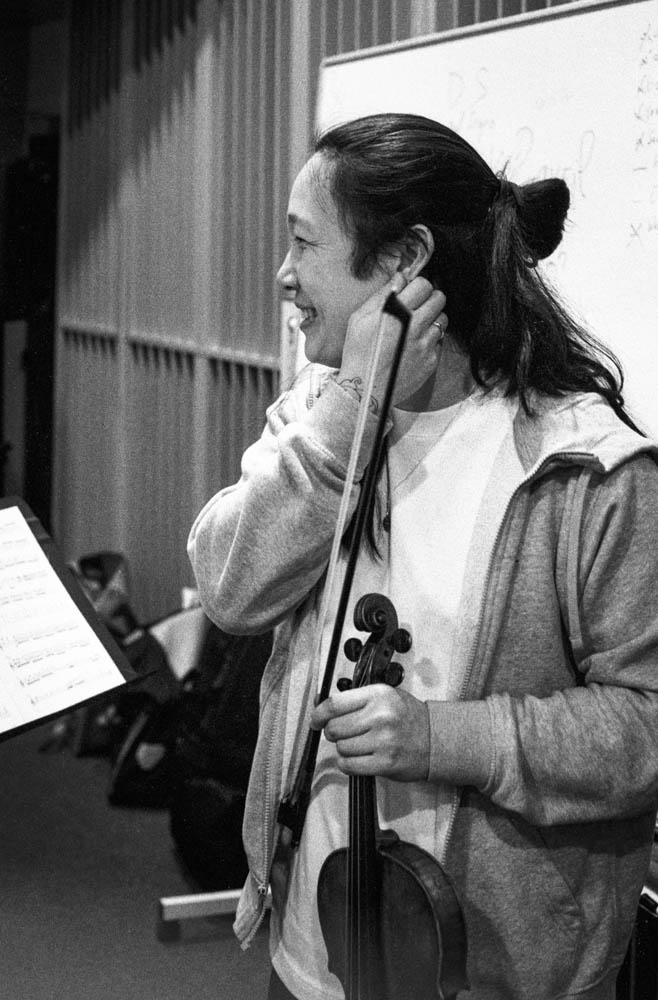
GENERAL REHEARSAL: Nikon FE, HP5+ at 3200
Sunday. No soloists. Just us and the grind.
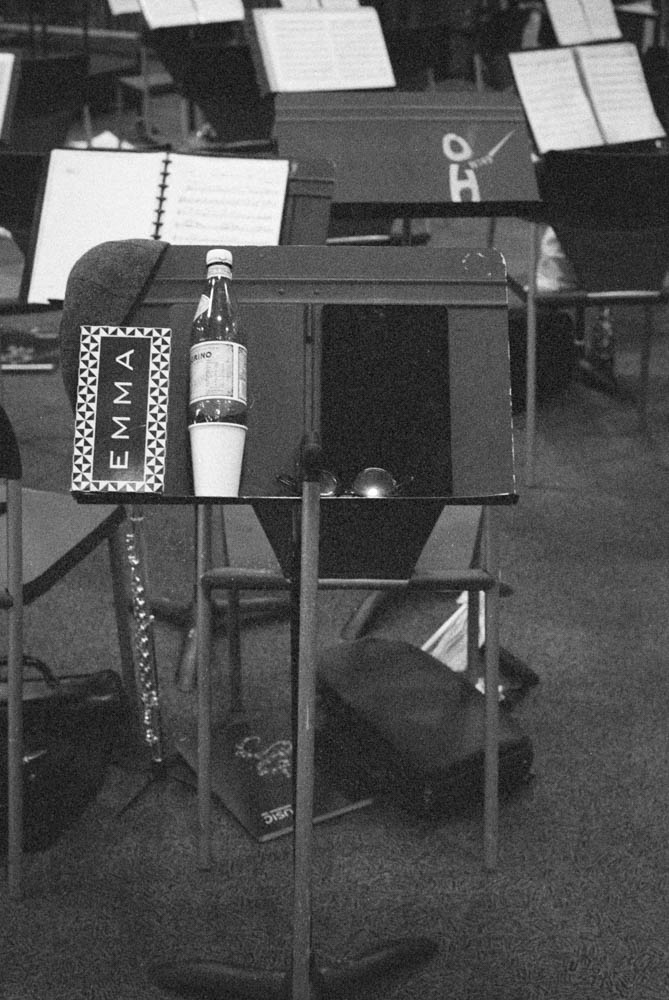
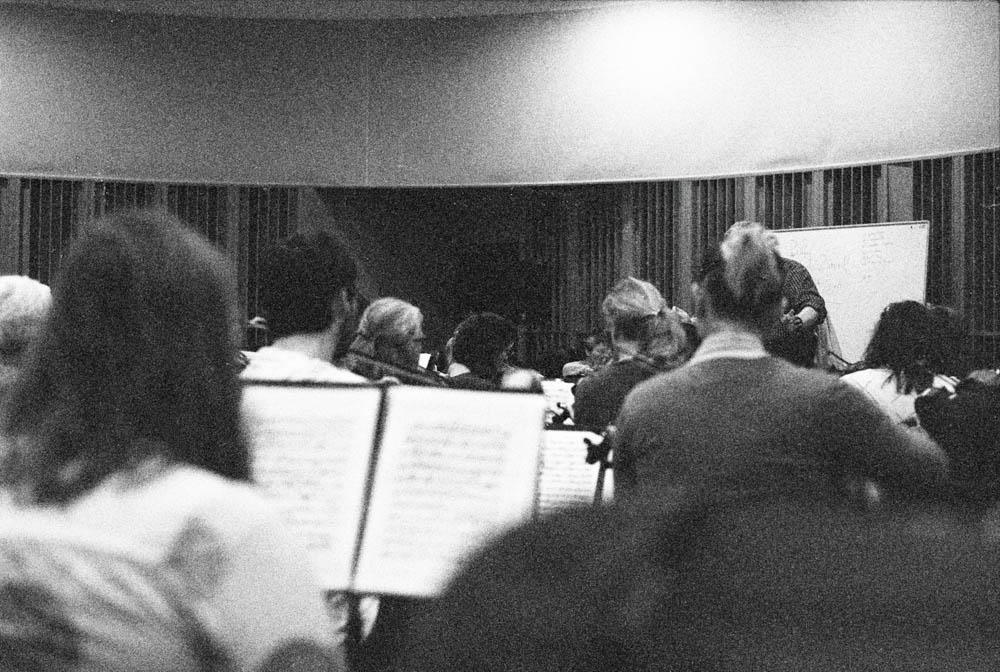
I loaded HP5+ pushed to 3200. Same 50mm philosophy, different camera — the Nikon FE this time — and three stops of push. More grain, more contrast, more raw. If Saturday was work, Sunday was iteration.
You can feel the difference when the guests aren’t there. Saturday had a particular energy — the stakes of building a shared language with people from outside the ensemble. Sunday was just the regulars. The people who were eating lunch in the car park the day before. The conductor at the whiteboard, same as always, but now talking only to people he knows. No translation needed.
What general rehearsal looks like: we play. He stops us. Again. We play. From 47. We play. No, from 45. Over and over. It’s not glamorous. It’s not even particularly musical most of the time. It’s iteration — and the HP5+ at 3200 suits it. The grain is heavy but not ugly. Textural. Urgent. Honest about what it’s depicting.
Looking at the images now, what strikes me is the concentration. The hunched shoulders, the heads bent over sheet music, the conductor’s hands cutting through the air. Nobody is thinking about anything else. For these few hours everyone is just here, trying to make something work. The grain matches that energy; it says this is real, this is process, this is nowhere near the victory lap.
What the three rolls said
Laid out side by side, the contrast is striking in ways I’d hoped for but couldn’t quite predict until the scans came back.
Fomapan 100 HP5+ 1600 HP5+ 3200
Grain Fine, subtle Textural Pronounced, raw
Mood Relaxed Focused Urgent
Story Community Collaboration The machine
at rest at work in flow
The choices weren’t accidental. I chose Fomapan 100 for the lunch because I wanted calm. HP5+ at 1600 for the concerto because I wanted texture with control. HP5+ at 3200 for Sunday because I wanted the grain to do some of the work; to say without saying it that this is unglamorous, repetitive, necessary.
The photojournalists who shot jazz clubs in the 1950s understood this. You don’t hide the process. You lean into it.
Three cameras. Three films. One story.
Rehearsal is where the music is actually made. The concert is just the victory lap.
Share this post:





Comments
Gary Smith on Three Films, One Orchestra, One Weekend
Comment posted: 16/06/2026