

I grew up around my dad’s Mamiya ZE Quartz. I was curious about it and wanted to learn how it worked, but I never really did. Years later, when I started my first job, I decided to finally take photography seriously and step into film on my own terms. I was given an Olympus OM-10 with a 50mm Zuiko lens, which became my introduction to shooting deliberately and learning the fundamentals.
At the time, autofocus SLRs were becoming the norm. With my first paycheck, I bought a Nikon F65, followed a few months later by an upgrade to the Nikon F80. That F80 stayed with me for the next eight years and documented a large part of my early photographic development.
Eventually, like many others, I moved to digital. The transition made sense. Instant feedback accelerated my learning, and digital post-processing expanded what I could do creatively. For a long time, digital photography worked well for me.
Still, film never completely faded from the background. The slower pace, the simplicity, and the experience of waiting for developed negatives were things I continued to miss. There is a particular satisfaction in delayed results that digital photography does not replicate.
That interest resurfaced last year when I realized there was a local film lab, Downtown Camera, just a block from my office. With processing easily accessible again, I started looking for film bodies on Kijiji. Over time, I picked up a Minolta XG-M, a Nikon FE2, and even another Nikon F80, a camera I had sold years earlier and regretted letting go.
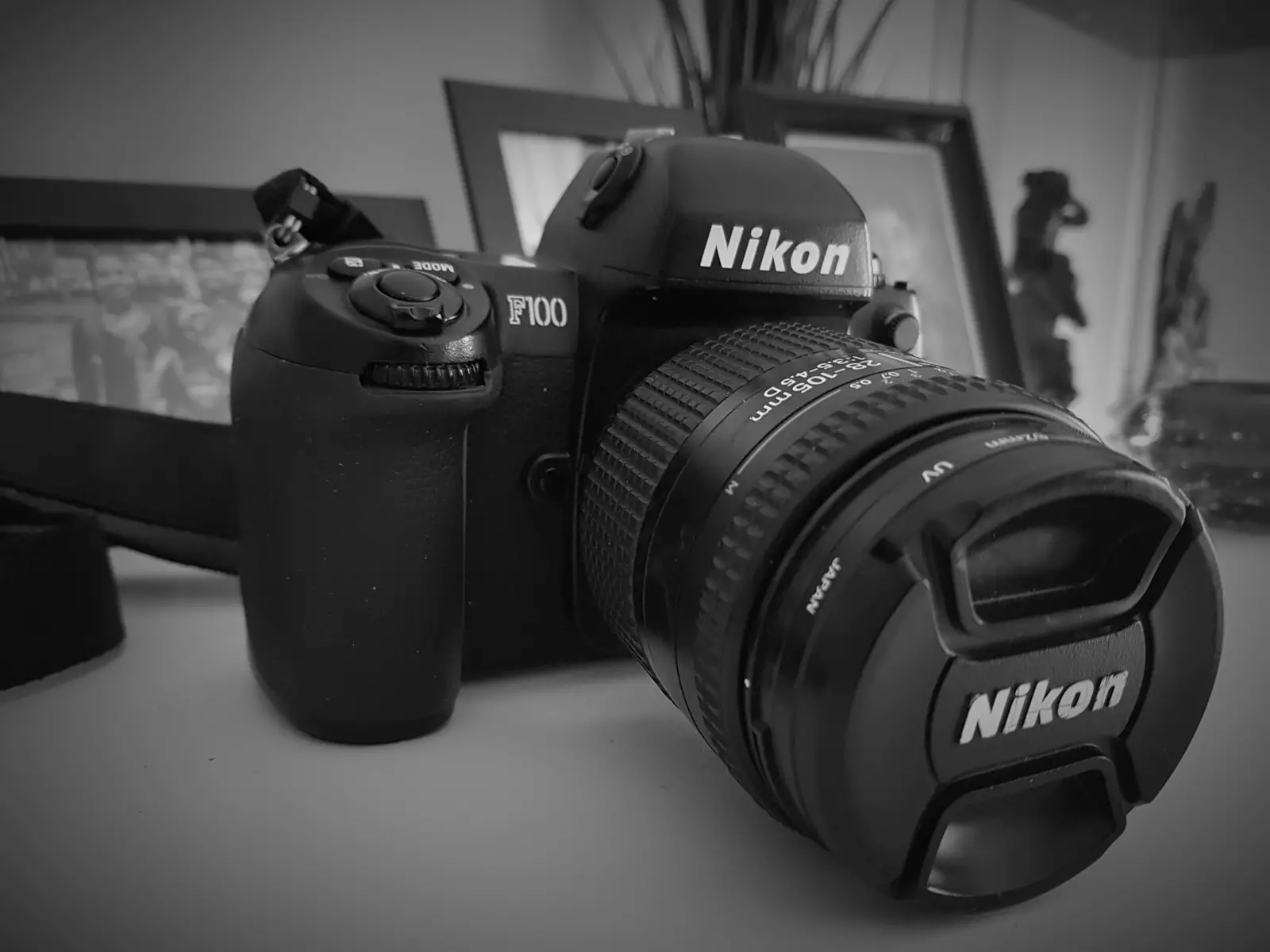
One camera, however, had always been on my list: the Nikon F100. Often described as Nikon’s most refined prosumer autofocus film body, it offers much of the performance of the F5 in a smaller and lighter package. When a clean F100 with a 28–105mm AF Nikkor lens appeared on Kijiji for $100, it was difficult to ignore. Considering typical market prices, it was an easy decision.
The F100 has quickly proven why it is so highly regarded. It works seamlessly with almost all Nikkor lenses, supports modern Nikon flashes like the SB-600, and includes features such as 3D matrix metering, spot metering, and a 1/8000s top shutter speed. Shooting ISO 400 film wide open in bright daylight is straightforward, without the need for neutral density filters. The camera stays out of the way and consistently delivers reliable exposures, which allows full attention to composition and timing.
For color film, I have often relied on Fuji Superia 100 or 200 for its cooler tones. This time, I decided to try Kodak ColorPlus 200. It is a consumer film, but the lower cost, helped by Downtown Camera’s prepaid development option, made it worth exploring. The results were pleasantly surprising. The colors are warm and slightly muted, with a character that suits everyday scenes well.
The images shared here are from a recent walk around Toronto. Reviewing the developed negatives reinforced why I enjoy shooting film. The process encourages patience, intention, and a closer connection to the final image.
I plan to continue experimenting with different films, lenses, and approaches as I document the places and moments around me.
Dhanesh R. is an amateur photographer based in Guelph, Ontario. He builds AI models when not out doing street photography.
Flickr: flickr.com/dhaneshr
Instagram: instagram.com/the_real_dhaneshr/
Share this post:






Comments
Scott Edwards on 5 Frames with the Nikon F100 and Kodak ColorPlus 200 – By Dhanesh R.
Comment posted: 27/10/2019
Charles Higham on 5 Frames with the Nikon F100 and Kodak ColorPlus 200 – By Dhanesh R.
Comment posted: 27/10/2019
Charles Higham on 5 Frames with the Nikon F100 and Kodak ColorPlus 200 – By Dhanesh R.
Comment posted: 27/10/2019
Comment posted: 27/10/2019
Kamales on 5 Frames with the Nikon F100 and Kodak ColorPlus 200 – By Dhanesh R.
Comment posted: 28/10/2019
eric on 5 Frames with the Nikon F100 and Kodak ColorPlus 200 – By Dhanesh R.
Comment posted: 28/10/2019
Comment posted: 28/10/2019
Marc Wick on 5 Frames with the Nikon F100 and Kodak ColorPlus 200 – By Dhanesh R.
Comment posted: 13/06/2020
Comment posted: 13/06/2020