

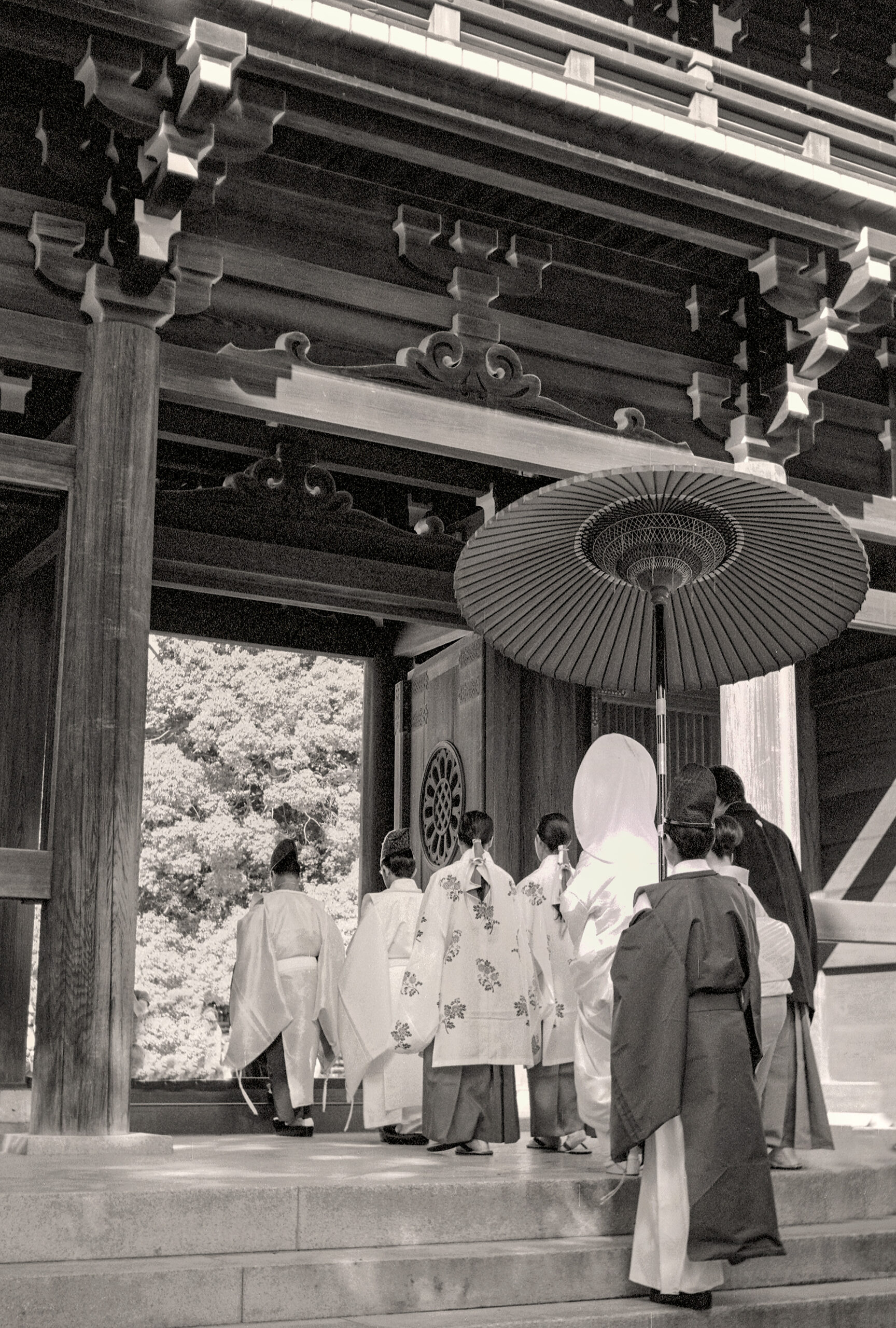
This photograph is a reminder of the benefits of waiting, combined with some local knowledge. It was made at the Meiji Shrine in Tokyo, a Shinto religious complex built to honor the Meiji Emperor who guided Japan’s entry into the modern world at the end of the 19th Century. The Meiji Shrine, also known as the Meiji Jingu, is rightly one of Tokyo’s most popular attractions for tourists, particularly those wielding cameras.
In my case on this trip, my camera of choice was the small Zeiss Ikon Contessa 35, the 1955 model, which has a folding 45mm Tessar lens. I use it with an auxiliary Voigtlander 50mm viewfinder, which I find to be close enough to the camera’s field of view. The viewfinder is extremely bright, much easier to compose with rather than relying solely on the camera’s squinty 1950s viewfinder. It is one of my favorite travel cameras.
One of the main attractions for photographers at the Meiji Shrine is the wedding parties that traverse the shrine grounds every weekend. I knew where the wedding parties came out of to begin their walk to the ceremony grounds. And I knew the wedding party would be stepping through a large gate, which is built with carved wooden beams.
So, I took a guess that a position to the side of the wedding staging office just by the entrance gate would work, as it gave me a view of the wedding party as it made the turn to go into the shrine grounds. Then they would literally be stepping into the shrine grounds, which if I could capture it well enough would symbolize the bride and groom stepping into a new life together. Plus, the spot was an easy location to stay out of the way of the procession.
The Zeiss Contessa 35 is a slow, deliberate camera. It uses a rolling dial to advance the film. It requires the photographer to cock the shutter before depressing the shutter, which is a lever on the side of the lens. The Zeiss lens on the camera punches way above its weight class. But you have to be a patient, and deliberate photographer to get the most of out of the camera.
In the case of this photograph, I first took a couple of readings with a small, hand-held light meter. The camera was loaded with Kodak Tri-X, which I can come pretty close to correctly guessing the right exposure. I knew the Shinto priest at the end of the procession would be carrying a large, red umbrella, which is held to symbolically protect the bride and groom.
I had one chance to get it right. I had previsualized the shot, so when the priests at the front of the party stepped through the gate, I engaged the shutter. The resulting photograph is one of my favorite made at the Meiji Shrine, and I’ve shot there countless times over the past 20 years.
Share this post:


Comments
Michael Flory on Here Comes The Bride – A One-Shot Story
Comment posted: 21/12/2025
Patrick Medd on Here Comes The Bride – A One-Shot Story
Comment posted: 21/12/2025
Charles Young on Here Comes The Bride – A One-Shot Story
Comment posted: 21/12/2025
John Eaton on Here Comes The Bride – A One-Shot Story
Comment posted: 21/12/2025
Floyd K. Takeuchi on Here Comes The Bride – A One-Shot Story
Comment posted: 21/12/2025
Dr Marcus Gunaratnam on Here Comes The Bride – A One-Shot Story
Comment posted: 22/12/2025
I used to do a “recce” the weekend before the wedding date to map out my route from the brides place to the church and reception if they were held in a different place to the church ,I used to grease a few palms to get assured parking and lighting inside the church if the priest was averse to flash going off with or without audible signal of correct exposure. I also used to in extreme circumstances use a tripod with a tele lens from the vestry.
I found that the Catholics and Anglicans were not averse to photos in the church, but the Uniting church (Methodists) were. Thus, my resorting to better lighting or a tele lens having ‘spoken’ to the sexton or greased his palm.
I used to use a Metz CT4 with my Olympus OM series film cameras but had a modified Sunpak flash with my Pen FT. Modified to take a lantern battery same Voltage but better recycling, as long as I did not take photos in quick succession.
I would shoot about 4 rolls per wedding, (2 rolls with the Pen FT).
By the time I had OM series film cameras I was shooting colour negs and had an arrangement with a Colour lab owner to produce 2x colour proofs, thus eliminating rejected prints being ordered.
I also used to give the colour negs to the couple as it avoided need for storage and need for reprints.
This was frowned upon by the Professional wedding photographers of the day, so much so that I was exposed to threats.
There is much involved in wedding photographs that involves planning and execution.
In the digital era one has to download to a CD and make it a present to the couple. The cameras are ‘goof -proof’ the flash cheap and the lenses mouth-watering, especially the MFT Olympus lenses.
By now you would have gathered that I am partial to Olympus brand, my love affair started with the Pen FT and carries on, I mourn the death of Maitani one can only imagine what innovations he would have created if he had been alive.