

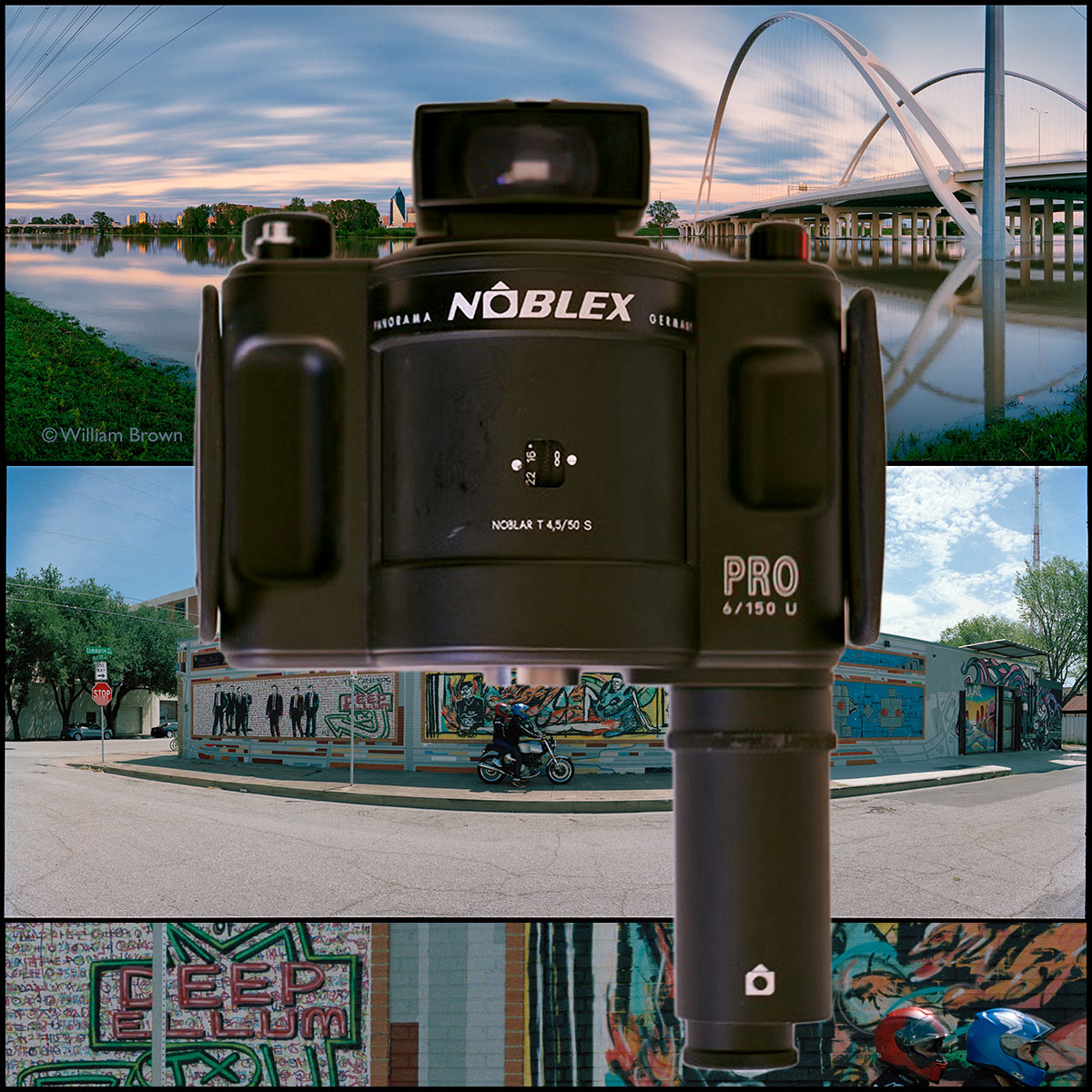
Before getting started I want to say I’m one of those individuals who finds the panoramic format as more than an afterthought or a quirky alternative view. Before using this dedicated panoramic camera my ventures into the wide composition all revolved around multi-frame compositing or the oft referred to poor mans pano. Just cropping a single frame into the desired aspect ratio. I grew up with Kodachrome 64 and as long as the original was sharp a substantial crop and enlargement was possible without grain interfering visually.
I started my professional photo finishing career at a world class lab located in Dallas and working with 40”x 60” prints from 35mm Kodachrome’s was an everyday occurrence. The year was 1976 and I was only just beginning to build my personal photographic archive so seeing these large scale prints definitely influenced my future shooting.
I commented on a post by Scott Ferguson that I thought shooting panos was similar to seeing in b&w. A sort of previsualization as it were. I was mentored by a photographer who saw a scene then chose a lens that matched his vision for the scene. As I analyze a scene and determine what elements are important to the composition my brain then attaches a focal length that it feels best aligns with this composition. My style of shooting is rarely a one lens style. I switch lenses frequently as I move through a scene. Part of my everyday kit is a Rollei Prego 90 with a 35-90 zoom. I shoot with it for final images but I also use it for previsualization.
This gives some context to how I approach shooting with this dedicated panoramic camera. Knowing the constraints or parameters I’m working with directly influences how I view a scene. It kind of goes along with the adage about trying to fit a square peg into a round hole. I’m usually a shoot for crop type so I have a sort of mental viewfinder that my compositions pass through first.
All that backstory brings me to the camera and lens combination. Knowing up front what I’m looking for compositionally immediately activates the mental viewfinder I mentioned previously. Looking for scenes that could be panoramic as opposed to those that must be panoramic directly impacts the final outcome. At least for me. What showcases the attributes of this camera and lens combination? Hopefully these 5 frames give a small insight into what those can be.
Because I only had possession of the Noblex Pro 6/150 U for a limited time in 2018/19 I decided to choose 5 frames from different film stocks so as to showcase some of the features of this camera. The three film stocks featured here are Portra 160, Portra 160NC and TRI-X.
Right upfront I will say this is a niche camera. Not everyone is drawn to panoramic images and on top of that this is a bulky beast. I however found myself under the spell this camera cast. As each new roll passed through this camera it seemed I became more a part of it.
The term hands on took on new meaning as I loaded the first roll of film. Careful attention to what you’re doing is mandatory before you can take your first shot. The photographer who was selling this camera and I shot a video of how to load the film that he gave to the new owner. All photos shown here were taken with the camera locked down on a tripod, leveled and a cable release attached. All metering was done with a Sekonic L-328 Digi Lite F. For many of you reading this you already know I’ve been documenting Dallas, Texas since 1978, the skyline since May 1979 and all on film. My first roll of film I shot with this camera would be dedicated to this subject while I participated in a photowalk in the Deep Ellum area of Dallas.
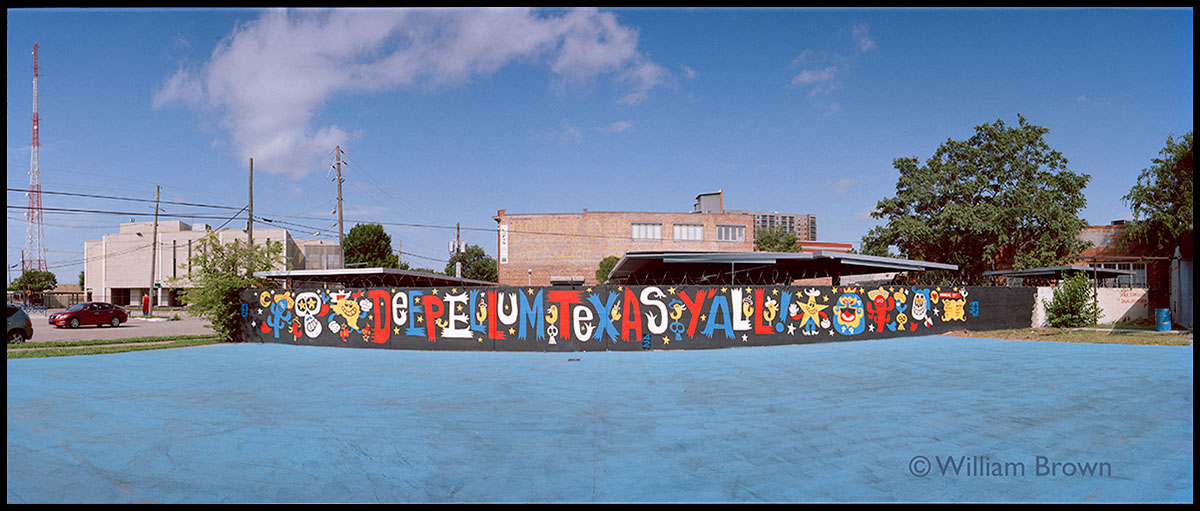
Photo 1: Kodak Portra 160 Deep Ellum mural
This mural and blue parking lot seemed to be the perfect first frame for me to get my feet wet with this camera. Nothing special exposure wise, just a straight on shot. A few years after this a 7-Eleven convenience store was built on this lot and gas pumps now occupy the location where I stood to shoot this. So glad I have this. Get out there and document your surroundings!
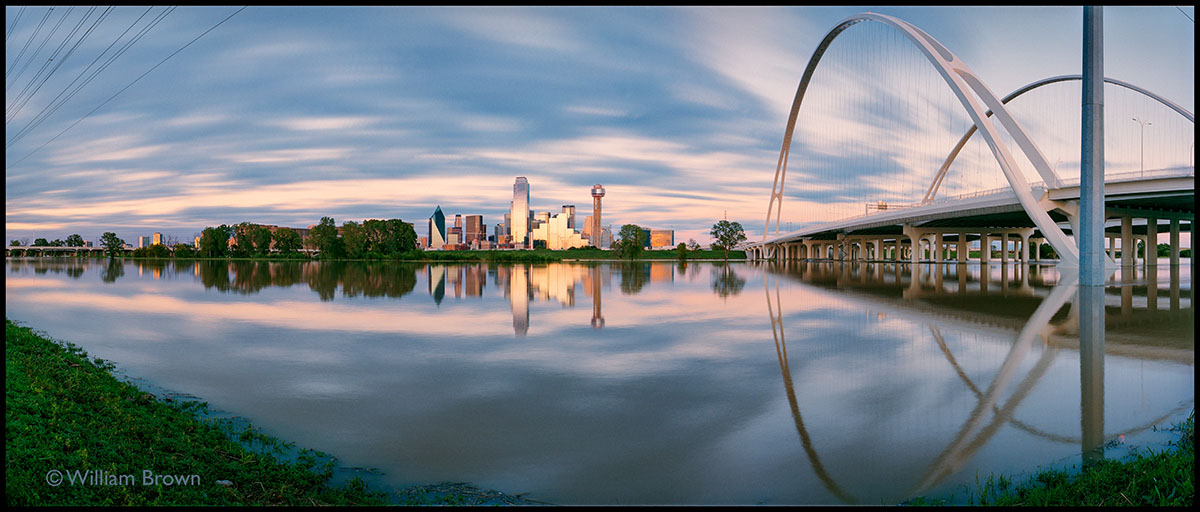
Frame 2: Kodak Portra 160_Dallas skyline with Trinity River at flood stage
This frame showcases one of my favorite features this camera has. Multi exposure on a single frame. Knowing I would be attempting this I drew up an exposure chart beforehand. After taking my light reading I looked at my exposure chart and determined 13 exposures would be needed to reach the proper exposure time. I didn’t write it down but I think it was 13 exposures at 1/15th second each. Because of how this camera works these 13 exposures took considerable time to complete. I really like the result though because the light and clouds were constantly changing during all that time.
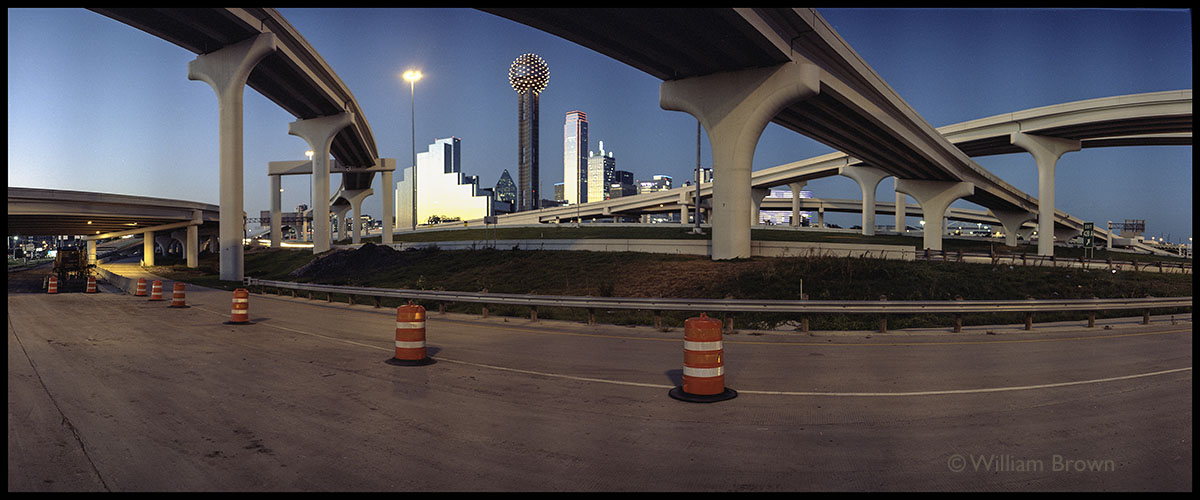
Frame 3: Kodak Portra 160NC (expired) Slow exposure module attached
With all the construction and reshaping of the roads in what is known as the mixmaster or canyon I wanted to try out an optional extended exposure capability. My results were mixed as sometimes the lens stuttered while rotating and my negative showed obvious vertical banding. This image shows some of the banding. I liked the intertwined structures of the roadways and orange construction barrels. I tried using my 21mm Biogon on my Contax G2 but it just wasn’t the same.
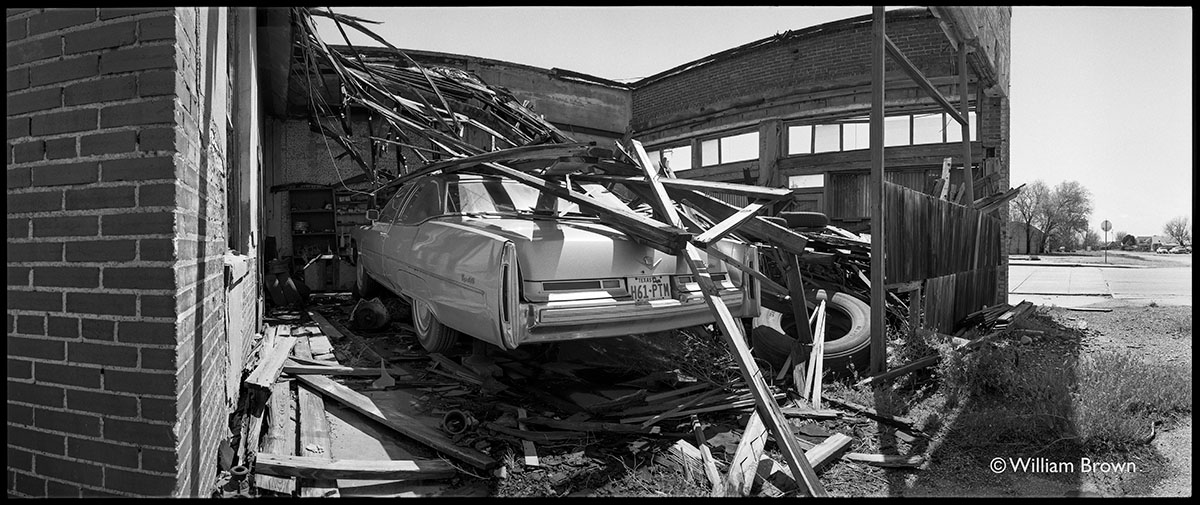
Frame 4: Kodak TRI-X Normal daylight
I definitely wanted to shoot some b&w images with this camera and I would be taking a roadtrip to visit my family in Guymon, Oklahoma so I would be on the lookout for potential subjects. The trip takes me from Dallas-Ft. Worth up through the Texas Panhandle. One of the small towns along the route is Chillicothe, Texas. I had driven this trip numerous times and the buildings fronting the road always interested me. I parked across the street and walked over to see what possibilities existed. As I walked around the edge of the building this scene confronted me and I knew this was my next shot. It seems like a moment frozen in time. The Cadillac buried under the rubble appeared to be in decent condition but why hasn’t anyone tried to free it from its burial? One of the many questions surrounding scenes like this.
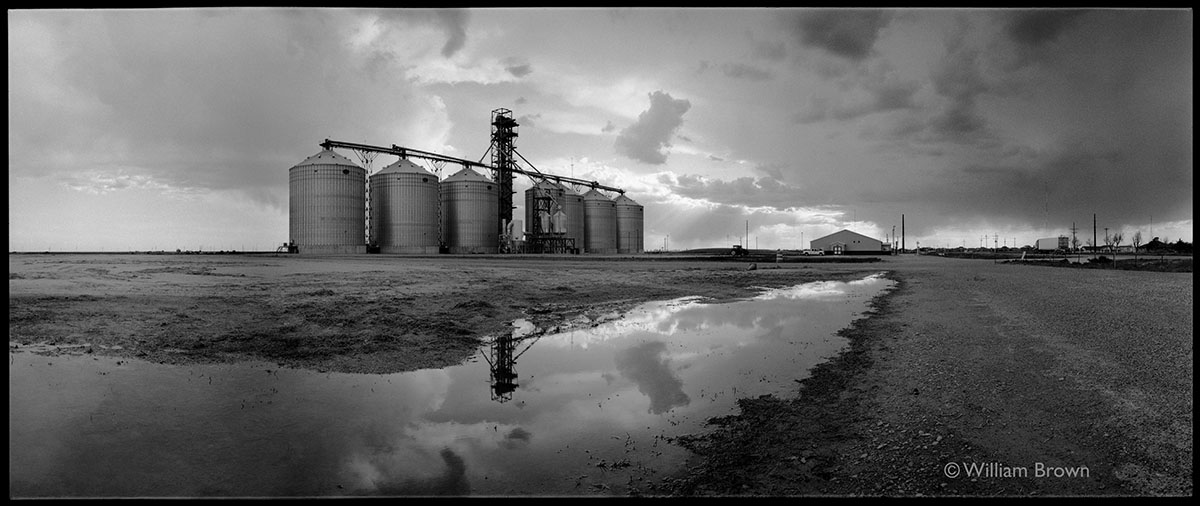
Frame 5: Kodak TRI-X
My last photograph was shot as I drove into Guymon. A new set of grain elevators had been completed since my last visit and the time of day paired with the weather conditions seemed to beg for me to stop and document it all. I set up the Noblex but the composition just wasn’t coming together. I packed everything back into my van and started to leave. As I made a sweeping turn to head to an exit I saw this standing puddle of water and knew this was the spot. I set my equipment back up, metered and shot one frame.
My time with the Noblex Pro 6/150 U was such a treat. The owner sold it and I had to say goodbye. Maybe someday I will own one of these behemoths but for now I just look at my negs or prints and remember how much I enjoyed our time together. If you like panoramic images I highly recommend giving one of these a test drive. It will make you feel needed again.
Bill
Share this post:

Comments
Simon Foale on 5 Frames with a Noblex Pro 6/150 U
Comment posted: 04/06/2026
Comment posted: 04/06/2026
Colin O'S on 5 Frames with a Noblex Pro 6/150 U
Comment posted: 04/06/2026
I especially like the long exposure of the interwoven roadways. "I tried using my 21mm Biogon on my Contax G2 but it just wasn’t the same." Exactly.
Comment posted: 04/06/2026
Comment posted: 04/06/2026
Mike Brooks on 5 Frames with a Noblex Pro 6/150 U
Comment posted: 04/06/2026
Comment posted: 04/06/2026
Walter Reumkens on 5 Frames with a Noblex Pro 6/150 U
Comment posted: 04/06/2026
Comment posted: 04/06/2026
John Bennett on 5 Frames with a Noblex Pro 6/150 U
Comment posted: 04/06/2026
Nice shots, Bill. Really shows the extent of what that camera can do.
Comment posted: 04/06/2026
Art Meripol on 5 Frames with a Noblex Pro 6/150 U
Comment posted: 04/06/2026
Comment posted: 04/06/2026
Comment posted: 04/06/2026
Gary Smith on 5 Frames with a Noblex Pro 6/150 U
Comment posted: 04/06/2026
Comment posted: 04/06/2026
Comment posted: 04/06/2026
Comment posted: 04/06/2026
Tony Warren on 5 Frames with a Noblex Pro 6/150 U
Comment posted: 05/06/2026
Comment posted: 05/06/2026
Comment posted: 05/06/2026
Alexander Seidler on 5 Frames with a Noblex Pro 6/150 U
Comment posted: 05/06/2026
Comment posted: 05/06/2026
Eric Rose on 5 Frames with a Noblex Pro 6/150 U
Comment posted: 05/06/2026
Comment posted: 05/06/2026
Scott Ferguson on 5 Frames with a Noblex Pro 6/150 U
Comment posted: 06/06/2026
Very cool post and incredible photos. I think I want a print of the Cadillac in rubble! The Noblex looks quite interesting, but kind of ungainly and definitely feels like a camera where you have to really fine tune your brain to work on its terms, as opposed to something you can kind of have in reserve in case you get a momentary inspiration. I'm intrigued by the frame that took 13 exposures and what calculations went into that. In any event, it looks great.
Now that the Noblex has moved on, what will you do for future times when you're feeling/seeing pano?
Also, thanks for the shout. I'm glad my post helped inspire you to share these incredible images!
s
Comment posted: 06/06/2026