Just a sec

Just a sec

By Geoff Chaplin

I often see older men (and they are always men – “camera ojisan” in Japan) sporting the latest digital equipment, following in the steps of Shinzo Maeda, the camera standing on a tripod, photographing a sunlit scene that has been photographed 1000 times before possibly to “prove” they are just as good as that pioneering photographer. Maybe they are pixel shifting to get an image that needs printing 2m by 3m to appreciate all the detail – but I think not.

The ‘rule’ for hand held photography is photograph at a speed of 1/focal_length or faster. What does this mean in reality? Different people are different – since childhood I have had a tremor in my right hand which can present difficulties. Some people cannot reliably get sharp images following the rule, some people can do a stop or more better. But in all cases sharpness is not guaranteed, there is a higher probability of getting a sharp shot at faster speeds, and as the shutter speed drops the percentage of fails increases.

Modern digital cameras offer image stabilisation with 4.5 stops (Sony A7Rii), 5.5 stops (A7Riii) or 8 stops (A7Rv – I want to get my hands on one of those!) improvement over the hand holding rule quoted above. The rule then becomes 2^S / focal_length (see the note below) where S = 4.5 or 5.5 in the case of the first two cameras mentioned.

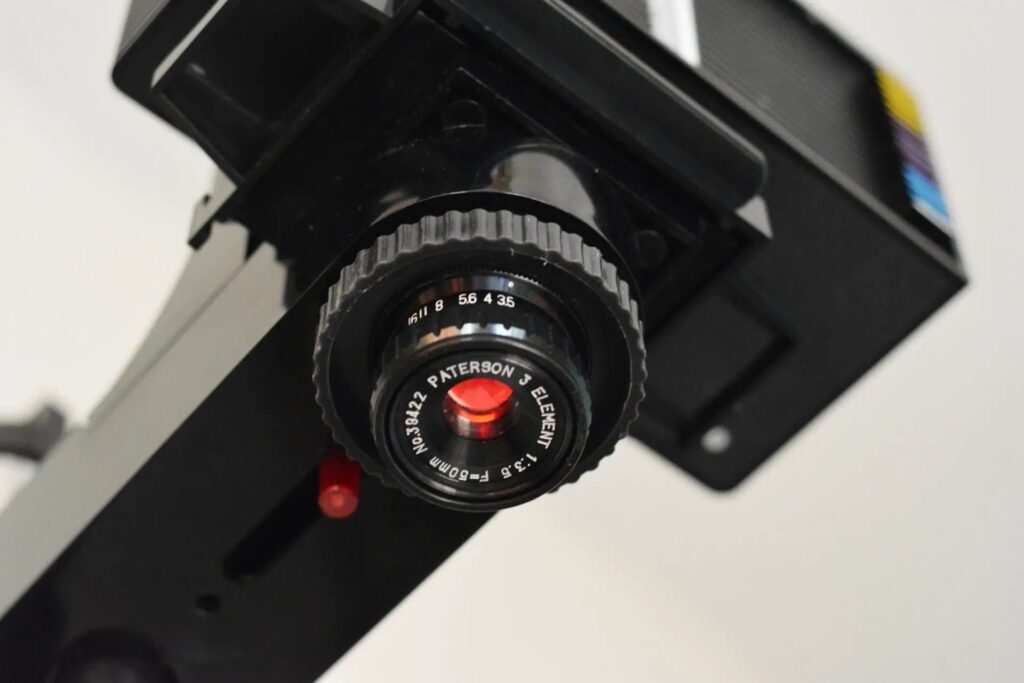
Image blur in a photograph which contains a sharp element – for example a long exposure photograph of a waterfall – is something that I always found attractive. Not being keen on lugging a tripod around I was keen to put the rule to a test. The featured image taken in a museum was using a 55mm lens at f8 and iso100 on an A7Riii with a shutter speed of 1.6 sec. The rule suggests 0.8 sec. Out of six images three were sharp.

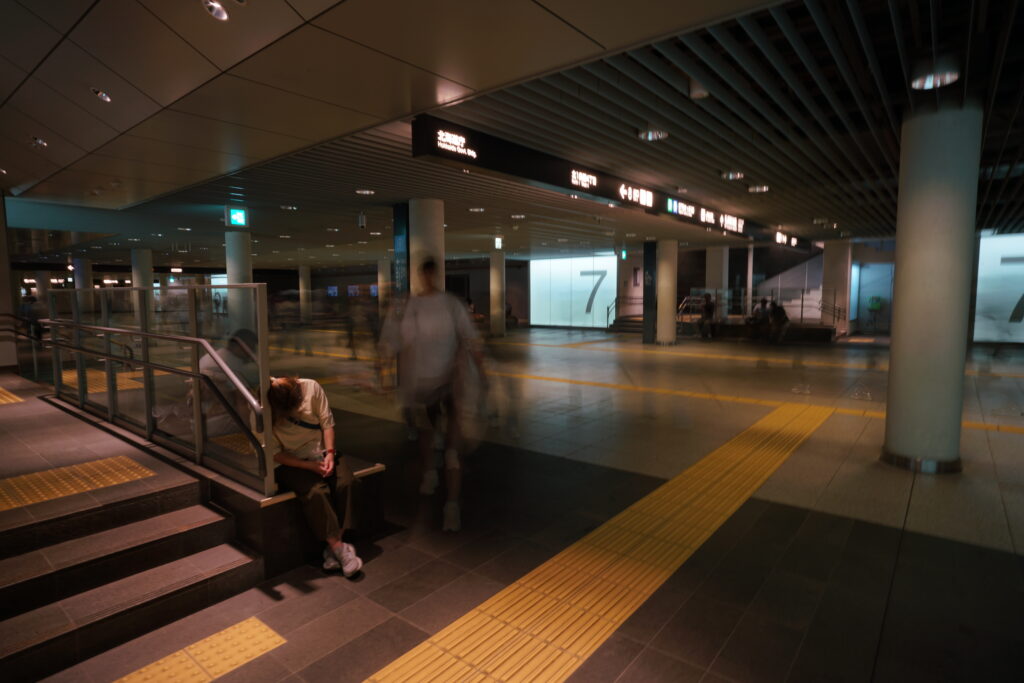
The following images were taken on an A7Rii with a 20mm lens at iso100 in an underground pedestrian street in Sapporo. The rule suggest 1 sec.
Just a sec
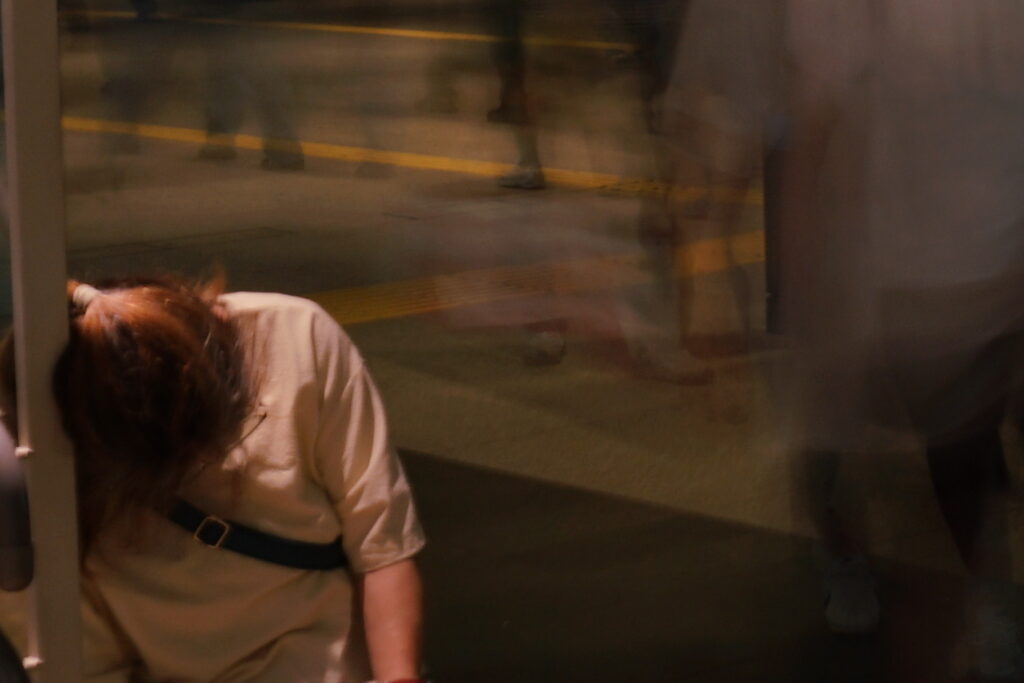
2 sec exposure at f22. I was leaning against a pillar. The gentleman (and wife and child) were passing my left shoulder as the exposure terminated.
Just a sec
Crop of the above. Focus was on the sleeping lady’s left sleeve. Diffraction at f22 softens the image.
Just a sec
1 sec at f11. There is slight blurring of the text on the sign. There are at least 15 people rendered as a barely visible blur (for example centre bottom) while others have disappeared entirely. The girl (right) was walking directly away from the camera.

Don’t be afraid of hand holding a digital camera at what might seem like stupidly slow shutter speeds. A little practice is required – the first time you take a one sec exposure the blank screen on pressing the shutter comes as a surprise causing a physical reaction. You need to try this a few times to get used to it. Also if possible make use of some support, either something to lean against or rest on. But once mastered – and don’t expect 100% success – it opens up a new world of possibilities.

NOTE: 2^S means 2 to the power of S. For example if S=3, 2^S = 2x2x2. If you don’t have a scientific calculator and need 4.5 stops calculate 4 and 5 stops (16 and 32) and add one half of the difference – giving 24 (the technically correct answer is 22.6). Shooting a 50mm lens this give 0.48 seconds (i.e. half a second) vs the technically correct 0.45 seconds (also half a second in practice).

Share this post:

About The Author

By Geoff Chaplin
Primarily a user of Leica film cameras and 8x10 for the past 30 years, recently a mix of film and digital. Interests are concept and series based art work. Professionally trained in astronomical photography, a scientist and mathematician.
Read More Articles From Geoff Chaplin

Find more similar content on 35mmc

Use the tags below to search for more posts on related topics:

Donate to the upkeep, or contribute to 35mmc for an ad-free experience.

There are two ways to contribute to 35mmc and experience it without the adverts:

Paid Subscription – £3.99 per month and you’ll never see an advert again! (Free 3-day trial).

Subscribe here.

Content contributor – become a part of the world’s biggest film and alternative photography community blog. All our Contributors have an ad-free experience for life.

Sign up here.

Make a donation – If you would simply like to support Hamish Gill and 35mmc financially, you can also do so via ko-fi

Donate to 35mmc here.

Comments

Michael Flory on Just a sec

Comment posted: 04/09/2026

Thank you for the helpful text and illuminating images. For a while I've been playing more with film than with digital images, but I'm trying to remedy my neglect of my A7Rii, and your illustration of its potential is very helpful, especially as I have some "essential" tremor (apparently inherited). This weekend, though, I'm taking my latest second-hand indulgence with me to the countryside, the Laowa 9mm F:5.6 rectilinear lens, which according to your formula should allow me about a 2.5-second handheld exposure! (I have my doubts about that.)
Reply

Leave a Reply

Your email address will not be published. Required fields are marked *

Geoff Chaplin replied:

Comment posted: 04/09/2026

Go on Michael, prove me wrong! I too have an essential tremor but it generally doesn't manifest itself in a way that affect taking an image. I think you'll probably get a 50% success rate with the 2.5sec exposure.

Reply

Leave a Reply

Your email address will not be published. Required fields are marked *

Michael Flory replied:

Comment posted: 04/09/2026

I'll have to try it! I've just been letting the camera figure out the exposure, which it seems to do well. Took my M3 to Prospect Park the other day. For the most part I don't mind not being noticed, but I do miss the conversations I'd have in Japan when older men with their own Leicas would strike up a conversation. "Ah! Leica!"

Reply

Leave a Reply

Your email address will not be published. Required fields are marked *

Geoff Chaplin replied:

Comment posted: 04/09/2026

I do the same and often find I'm shooting a 50 at 1/8 of a second without even thinking about it. The danger is you stray into territory where the success rate starts to drop unless you are more careful. M3 is an interesting case - apart from being a conversation maker - the rule can often be bettered by 2 or even 3 stops if you are careful.

Reply

Leave a Reply

Your email address will not be published. Required fields are marked *

Russ Rosener on Just a sec

Comment posted: 04/09/2026

Some people can't do math in their heads either! If I had to make those calculations I'd never be able to take a photo. Fortunately in addition to good image stabilization modern digicams have great screens to review what you've got, then modify settings. Yes it's chimping but it works. I like modern digitals which allow you to do multiple exposures in camera. I've done many on film too. Fujifilm digital cameras allow you to see a transparent version of the previous exposure so you can overlay the new exposure in real time. Composing like a collage artist.
Truly when it comes to photography, we live in "the best of times and the worst of times".
Reply

Leave a Reply

Your email address will not be published. Required fields are marked *

Geoff Chaplin replied:

Comment posted: 04/09/2026

Ha, ha, well said! Anyway, if it works do it - trial and error can often beat maths and is a great exploring tool.

Reply

Leave a Reply

Your email address will not be published. Required fields are marked *

Kodachromeguy on Just a sec

Comment posted: 04/09/2026

For film use, I remember learning years ago that camera motion was almost always more of a detriment to a photograph than lens aberration. So if in doubt, open up a lens and use a higher shutter speed. Of course, if you are using a tripod, then you can set the lens at its best aperture.
Reply

Leave a Reply

Your email address will not be published. Required fields are marked *

Geoff Chaplin replied:

Comment posted: 04/09/2026

Interesting point, more true nowadays with advances in lens manufacture. Thanks.

Reply

Leave a Reply

Your email address will not be published. Required fields are marked *

Jeffery Luhn on Just a sec

Comment posted: 05/09/2026

Thanks for this thought provoking article, Geoff. The math is above my pay grade, but your text helped. Yes, we can now depart from the limiting rule of using the focal length made into a fraction to guide us. In the film days, most photographers purchased the fastest lenses they could afford, especially if they wanted to shoot in low light. For color, Ektachrome pushed to 400 was the limit, and not very pleasing. These days with image stabilization digital bodies and high ISO settings we can shoot with vintage lenses like the Nikkor 180mm f/2.8 or the Nikkor 105mm f/2.5 indoors at speeds like 1/30 or even a 1/15 if we lean on something. Image stabilization (or VR) opens up a whole new world of possibilities and allows old lenses to come out and play. Hurray!
Reply

Leave a Reply

Your email address will not be published. Required fields are marked *

Geoff Chaplin replied:

Comment posted: 05/09/2026

Excellent point Jeffery, thanks. And those lenses tend to be much lighter than the modern counterparts. My Leica 135mm f4 Elmar works beautifully on a digital body (despite looking like a pig on a beauty parade).

Reply

Leave a Reply

Your email address will not be published. Required fields are marked *

Leave a Comment

Leave a Reply

Your email address will not be published. Required fields are marked *