

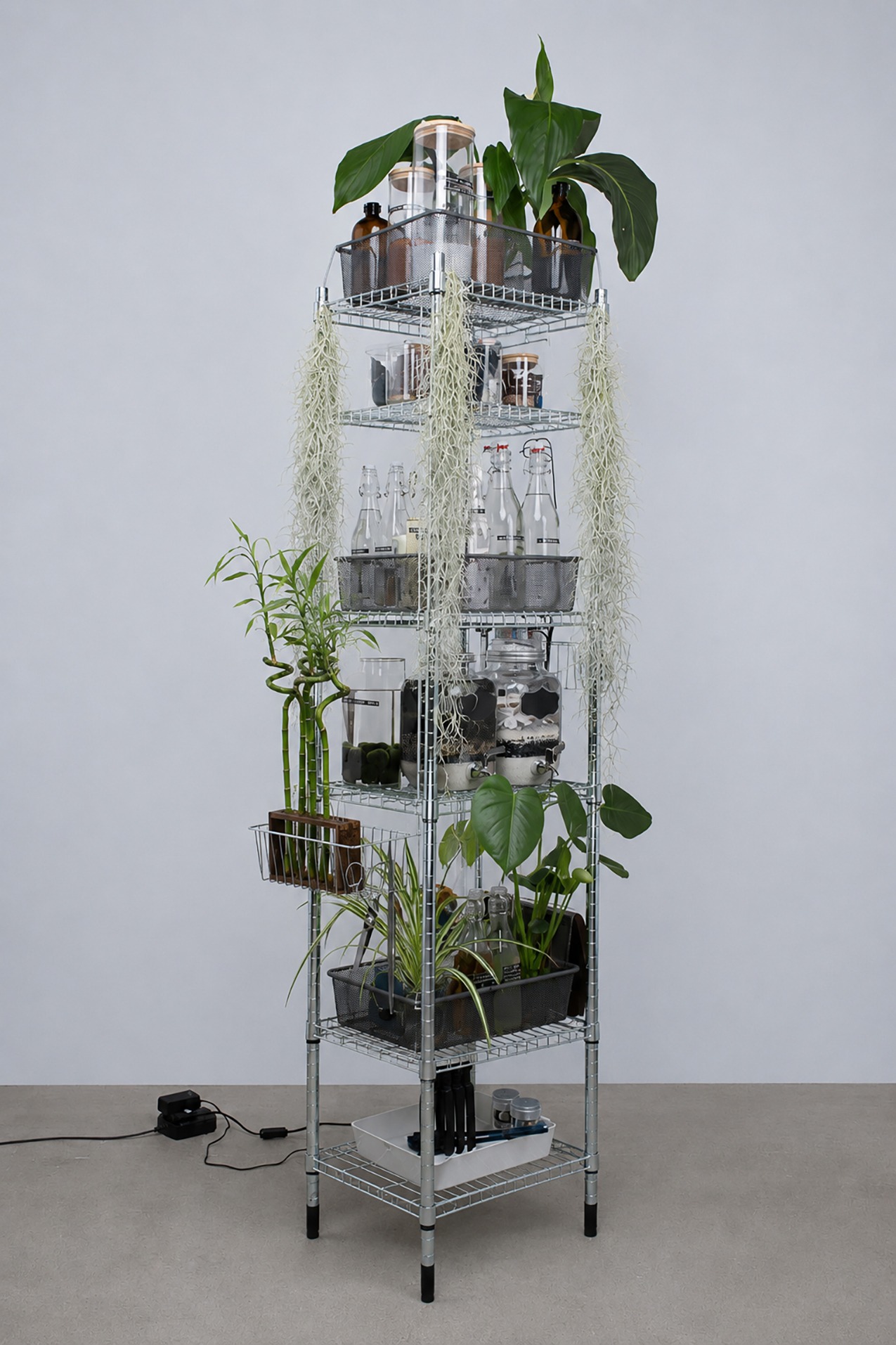
I started The Ecological Wetroom™ with a practical question: if cyanotype washing moves chemistry from the print into water, what happens if I refuse to let that water disappear from view? This is not a treatment manual, but an account of the experiments, measurements and problems that followed.
The point where I stopped looking away
What happens to a cyanotype after the image has been made? Most descriptions of the process end at washing. The paper goes into water, the yellow-green sensitiser clears, the Prussian blue image deepens, and the print is finished. I had spent years paying close attention to coating, sunlight, humidity, paper and water, yet I was still allowing the final washwater to disappear from my view.
That began to feel like a contradiction. My wider practice is cameraless and increasingly site-responsive. In climate-adapted cyanotypes I sometimes work with responsibly gathered rainwater, pollution-affected seawater or other local waters, available sunlight, plants and the specific conditions of a place. If I was asking water to become part of the image, I also had to ask what happened to that water afterwards.
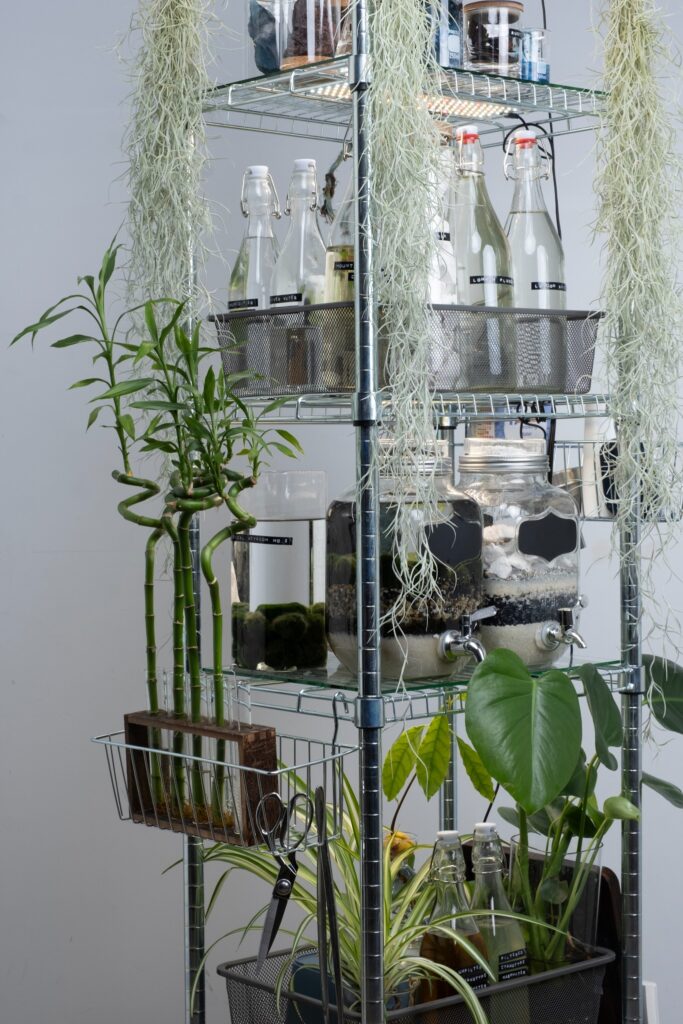
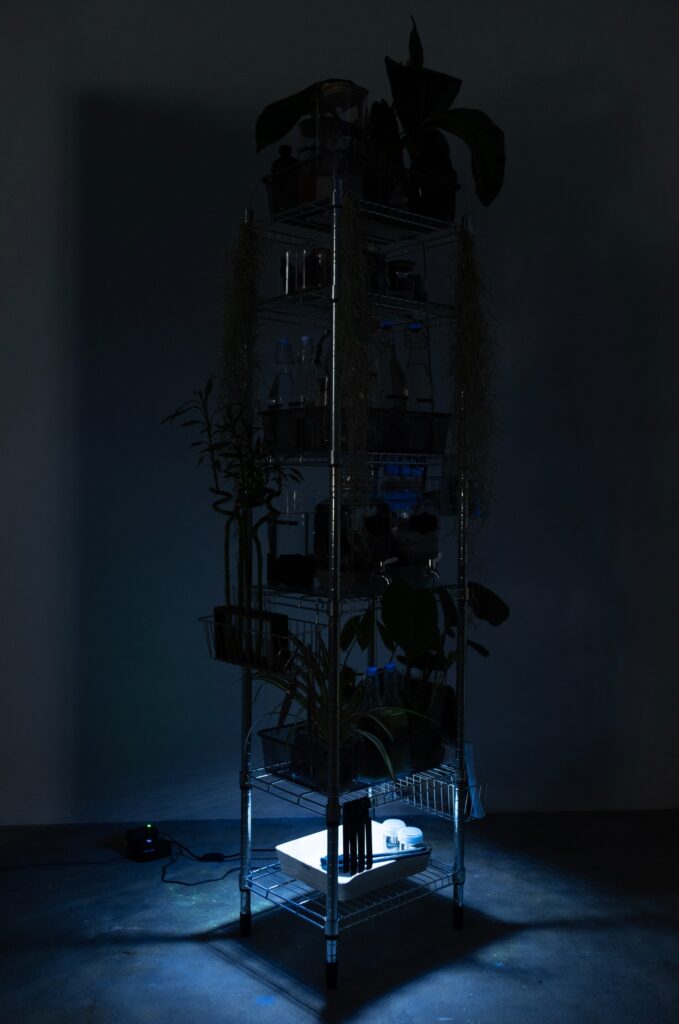
The Ecological Wetroom developed from that discomfort. It is a working installation that captures cyanotype washwater instead of immediately sending it down the drain. I collect the liquid in transparent vessels, observe its colour and volume, pass it through simple experimental DIY filters, retain the used media and residues, and compare what changes. Hydroponic plants sit within the system too, not as decorative shorthand for ‘nature’, but as living elements that require time, maintenance and care.
Cyanotype itself is a useful process through which to ask these questions because its history is so materially direct. John Herschel described the process in 1842, and Anna Atkins began publishing Photographs of British Algae: Cyanotype Impressions the following year. Atkins placed botanical specimens directly onto sensitised paper, producing images through contact, chemistry and light. Her work sits at the centre of my PhD research. I am interested in what happens when that nineteenth-century material intimacy is carried forward into a contemporary question about water, chemistry and waste.
Making the washwater visible
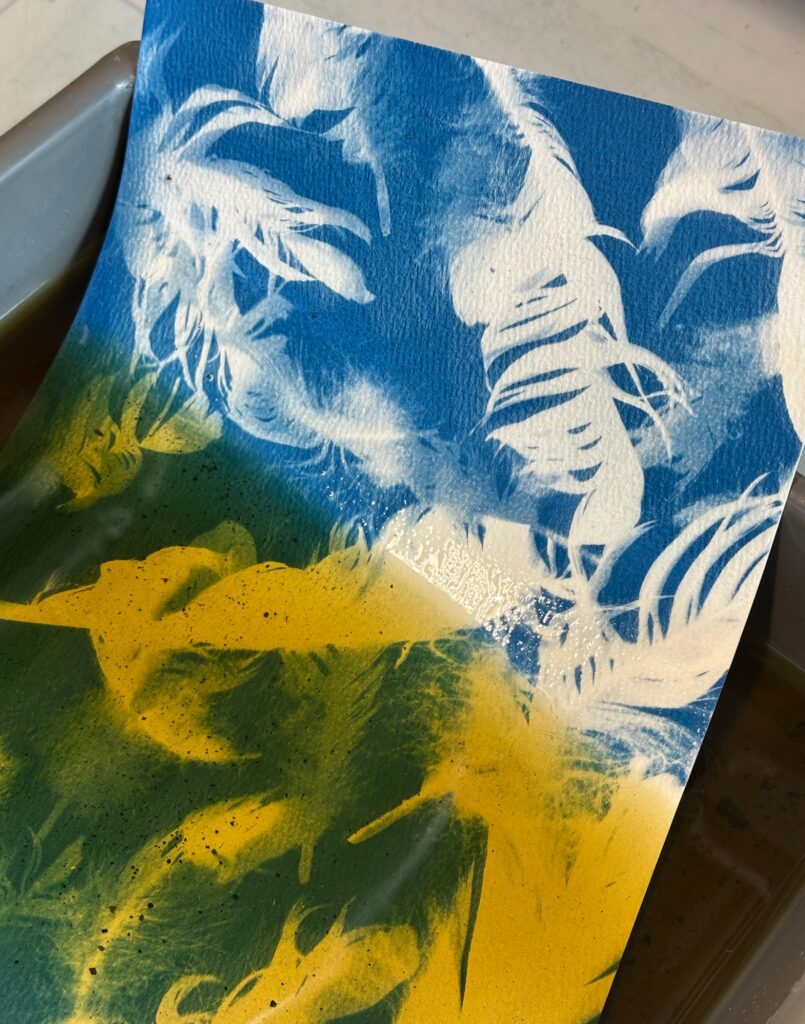
The practical starting point is simple: collect the washwater. When I wash a cyanotype, I use a labelled tray or vessel so the liquid remains visible. Even this small change alters the experience of making the print. The colour becomes something to look at rather than something that vanishes immediately. I can measure the volume, compare different washes, photograph the samples and keep a record of how they change over time.
From there I began building gravity-fed DIY filters from accessible materials. Different versions have used layers of gravel, coarse and fine sand, cotton, zeolite, chalk and activated charcoal. The washwater passes through the column slowly and can be circulated more than once. In the example shown here, the cyanotype washwater was passed through the DIY filter several times until it became visibly clear. Rather than being discharged, that repeatedly filtered sample was then transferred into the contained hydroponic section of The Ecological Wetroom™ and used to irrigate plants under observation.
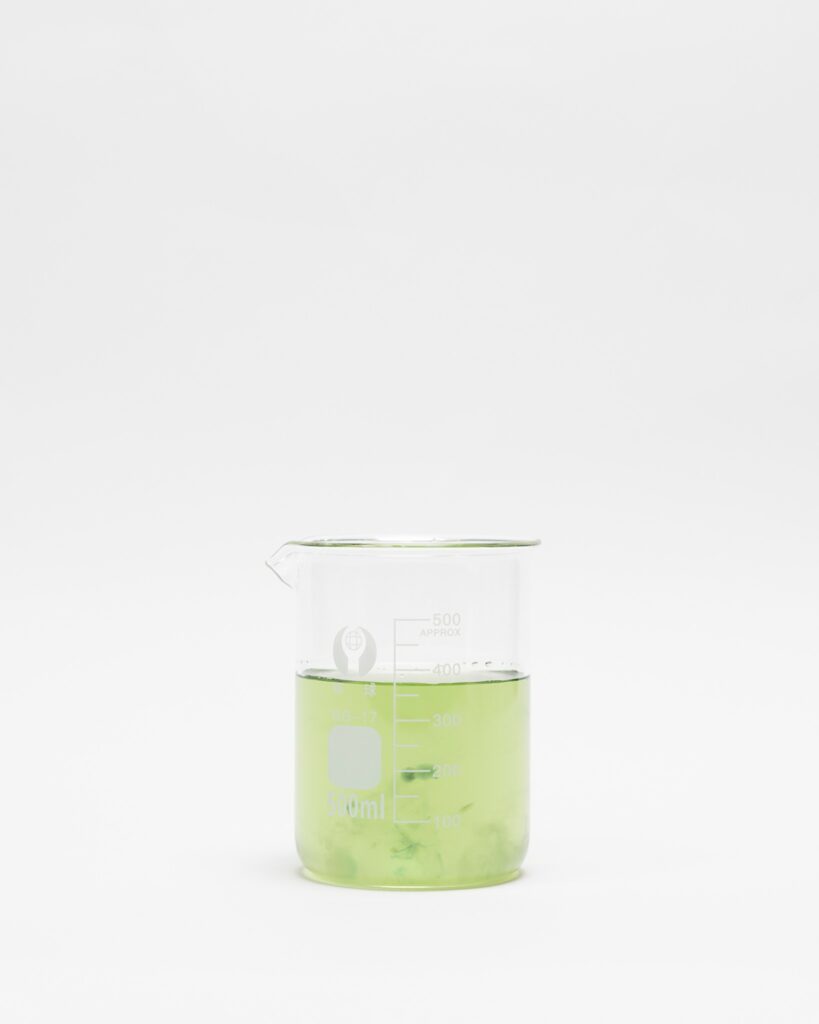
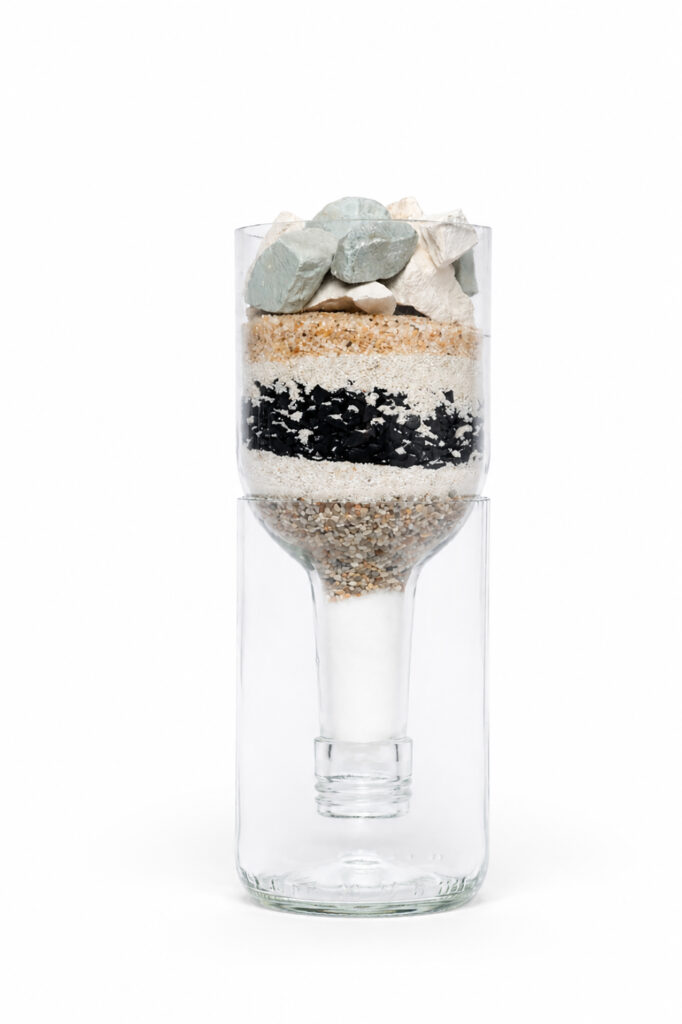
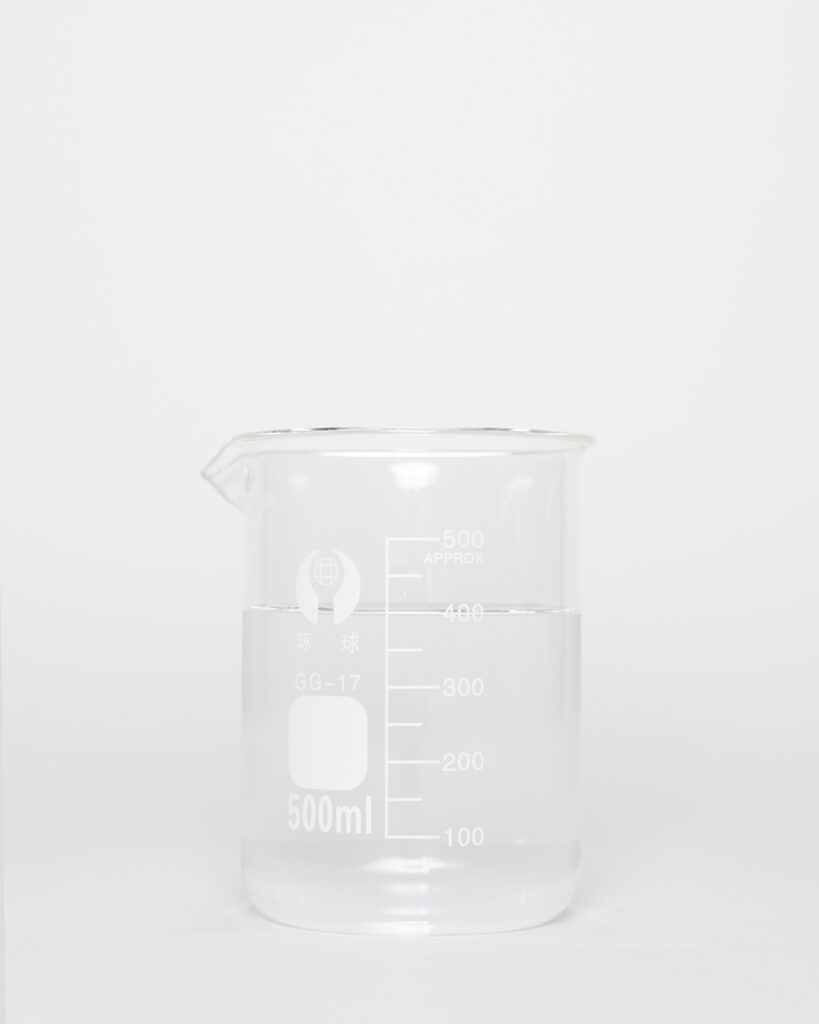
That is the tempting moment, and also the dangerous one. A clearer-looking sample is not the same thing as environmentally safe water. The filter is not magic. Matter that is no longer visible in the liquid may simply have moved into the cotton, charcoal, mineral layers, sediment or container. The filter therefore creates another material problem: what do I do with the media once it has accumulated photographic residues?
For that reason, I do not present the Wetroom as a treatment manual or a ‘green darkroom’ solution. The order of the layers, flow rate, saturation, chemistry of the washwater and number of passes can all affect the result. What I have is a research structure: a way of keeping materials in view long enough to ask better questions.
What the filter can — and cannot — tell me
Preliminary laboratory analysis has given the project one useful point of comparison. Analysis at Technological University Dublin, Ireland, compared untreated cyanotype washwater with a filtered sample. In that particular comparison, measurable iron decreased from 366.849 parts per billion to 87.110 parts per billion, approximately 76 per cent lower after filtration.
I think it is important to say just as clearly what that number does not mean. It does not show a 76 per cent reduction in every contaminant. It does not prove that the plants removed the iron. It does not establish that the water is safe to drink, for unrestricted reuse, or for discharge into the environment. The fact that I have used repeatedly filtered samples within a contained hydroponic plant experiment should therefore be understood as part of the research, not as a recommendation for general irrigation or reuse. The system is not certified wastewater treatment, and more repeated testing is needed. The result is interesting precisely because it gives me something measurable without allowing me to pretend the problem has been solved.
Why the plants are there
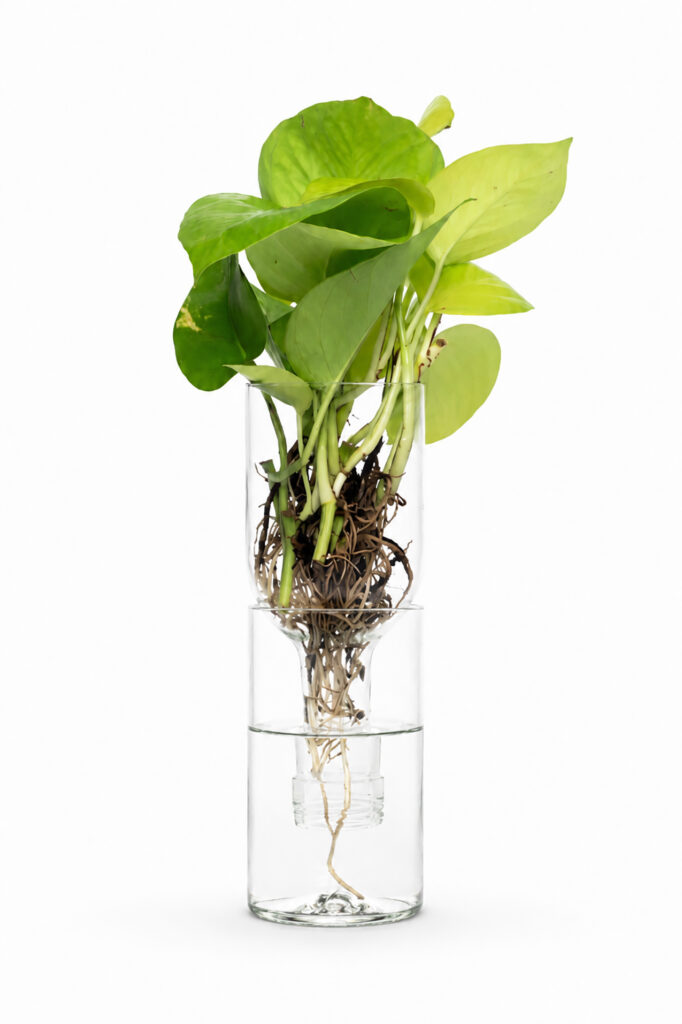
The plants complicate things further, which is why I value them. Their roots remain exposed in water and make time visible. They grow, discolour, shed material and require care. Some repeatedly filtered cyanotype washwater is introduced into this contained hydroponic stage rather than being immediately discarded, allowing me to observe what happens when that water remains within the system for longer. At the same time, I am cautious about turning phytoremediation into a claim that the plants are ‘cleaning’ the photographic chemistry. At this stage, I see them as part of a contained observational system rather than as a proven treatment mechanism.
What this changed in my own practice
One of the biggest changes the Wetroom has made to my own practice is behavioural. I now think about the wash before I make the print. How much water am I likely to use? Where will it come from? Can I collect it? What will I do with it after filtering? What happens to the filter itself? These are not glamorous questions, but they have started to feel as integral to the process as exposure time or paper choice.
This has also changed how I teach cyanotype. In workshops, participants can make prints while also collecting and comparing the washwater, looking closely at colour and volume, and building small experimental filters. The point is not to hand out a recipe that everyone should copy. It is to extend the same curiosity photographers already bring to exposure, chemistry and paper into the afterlife of the process.
That feels particularly relevant to analogue and alternative photography. We are often drawn to these processes because they are tactile, unpredictable and materially rich. We enjoy the fact that small changes matter. The Ecological Wetroom asks whether that attentiveness can continue once the image looks finished.
The 2026–27 bicentenary period of photography feels like a useful moment to ask this. Looking back at early photographic processes does not have to mean preserving them unchanged. It can also mean looking carefully at their material conditions and asking what we want to carry forward. For me, the challenge is to keep the tactile intelligence of analogue practice while becoming more attentive to water, chemistry, energy and waste.
A working system, not a finished answer
I am still developing the system. Future work will involve more laboratory testing, longer observation of filtration materials and plants, and a much more difficult question about what should happen to spent media once it has accumulated residues. I do not want the answer to be another version of ‘throw it away somewhere else’. If filtration simply moves the problem from liquid to solid matter, then the photographic process has not ended, it has only changed form.
For me, that is the most useful thing the Wetroom has taught me so far. Material responsibility in photography probably does not begin with a perfect substitute or a claim of zero impact. It begins with noticing what we use, measuring what we can, refusing to confuse transfer with disappearance, and remaining curious about the materials after the photograph itself appears complete.
“If filtration simply moves the problem from liquid to solid matter, then the photographic process has not ended, it has only changed form.”
About the author
Aindreas Scholz is an Irish-German photographer, lecturer and practice-led PhD researcher at Technological University Dublin, Ireland. His cameraless practice explores cyanotype, cyanolumen, water, plants, material responsibility and the ecological afterlives of analogue photography. The Ecological Wetroom™ forms part of his doctoral research into ecological and critical approaches to cameraless photographic processes through the legacy of Anna Atkins.
New York research and public events — October 2026
In October 2026, I will be in New York on a research visit supported by the Peter E. Palmquist Memorial Fund for Historical Photographic Research, continuing my study of Anna Atkins and early photographic collections in New York. The visit also includes two public-facing activities connected directly to the research:
Thursday 8 October, 5–6pm — Unfixed Landscapes: From Anna Atkins to The Ecological Wetroom™, Baxter St at CCNY, New York. An illustrated artist talk bringing together Anna Atkins, climate-adapted cyanotype, material responsibility and The Ecological Wetroom™.
Saturday 10 October, 11am–5pm — Cyanotype to Concertina: Building a Folded Sequence, Center for Book Arts, New York. A one-day workshop connecting nineteenth-century cyanotype, climate-adapted photographic practice, washwater awareness and the artist book.
Project: The Ecological Wetroom™
Share this post:

Comments
No comments found