Pairings, pt. 1 — Leica Summarit 50mm f1.5 + Rollei Blackbird

By Scott Ferguson

Inspired by what I learned in the recent “Goldilocks Challenge” comparing my different Leica 50mm lenses, I’ve embarked on an open ended project/rabbit hole of trying out different pairings of lenses with film stocks to find the most interesting/optimal combinations.  Ideally I’ll find pairings where the optical qualities of a given lens will match up with the photochemical properties of a given film stock and result in better photos!

In still photography as well as in my cinema career, I place a very high value in the technical qualities of an image, but always in the service of the creative meaning and emotional impact.  I am not a deeply scientific student of photography, on the film and tv side I depend on world class collaborators who have dedicated their careers to refining their craft, in terms of my personal photography, most of my learning and exploration is intuitive and coming from trial and error plus following tips from friends.  I can’t tell you about the chemical reasons a certain film stock has the properties that it has, nor do I get too deep into things like whether it has a tabular or non-tabular grain structure, and, to the dismay of many of my fellow 35mmc contributors I send my photos to a very good professional lab (Photo Life in Brooklyn) for processing, so I can’t advise on developer chemicals or temperatures.  I can tell you how my photos look to me based on my personal visual aesthetics/taste, and what they make me think and how they make me feel.  So those are the perspectives I’ll be exploring in these posts. I suspect I’ll be learning a lot about these films and lenses that I didn’t know from other more seasoned photographers in the comments, which is great, and part of why I like 35mmc so much as a forum!

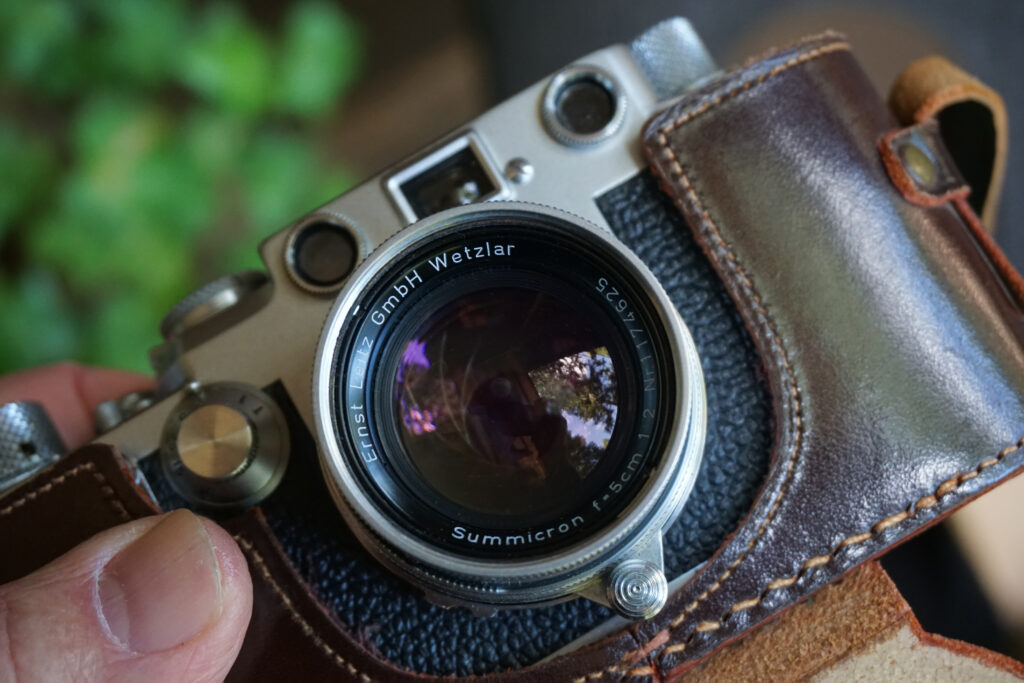
The first pairing I decided to try was a bit of a ‘deep cut’ shooting Rollei Blackbird with my 1957 Leica Summarit 50mm f1.5, neither likely to break into the top 10 of their respective categories any time soon.  The setting?  Washington Square Park on April 20, 2026, i.e., “420” the (in)famous informal national holiday for people who like to smoke marijuana.  I decided to shoot on that day at Washington Square based on a tip from Tibi, a photographer friend I’ve met out and about who frequently sets up a large format Linhof 4×5 camera with a Polaroid back on a tripod in popular gathering spots around NYC and sells instant photos to tourists and passersby.  I frequently grab a shot of Tibi when I see him as a bit of a good luck charm, and have a small collection of shots of him in various weathers and lighting conditions and corresponding outdoor gear.
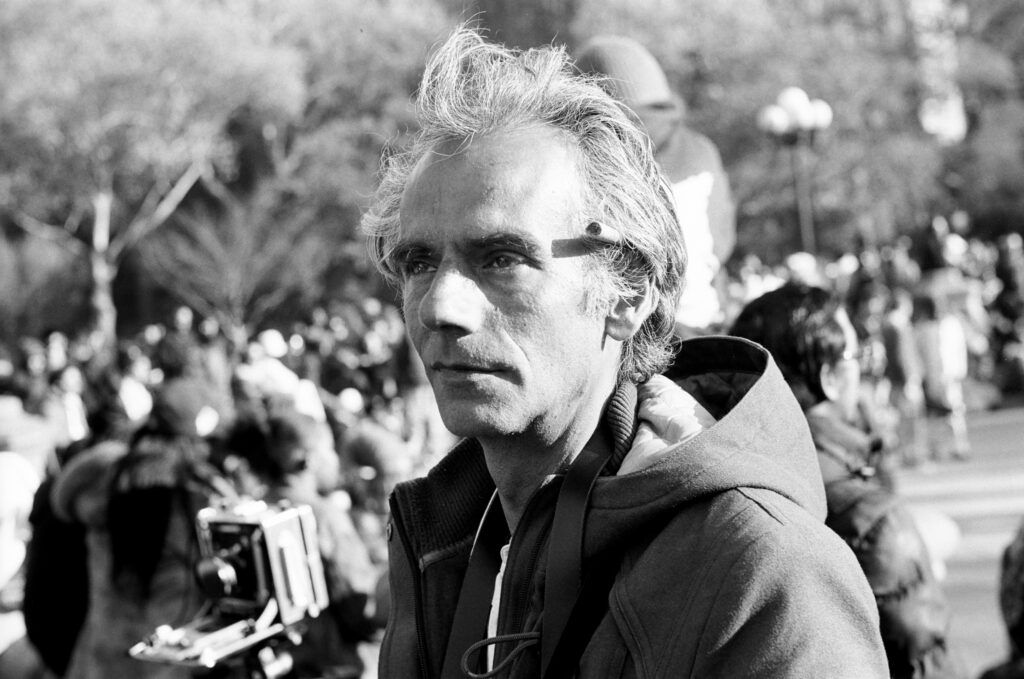
TIBI, except where noted, all photos in this post are with a Leica M3 on Rollei Blackbird with a Leitz Summarit 50mm f1.5

This shot has a really interesting vintage look to me — when I sent it to Tibi, I remarked that it looks a bit like a publicity still from a 1950’s Italian neorealist film.  I thought the light looked good through the viewfinder and Tibi stands out very nicely from the background, which falls out of focus pretty quickly, but doesn’t start to swirl or smear the way it does when the Summarit is below f4.  You can see his Linhof frame left, which adds to the vintage ‘period’ feel and the framing & composition gives him a bit of that neorealist Everyman/Hero look.
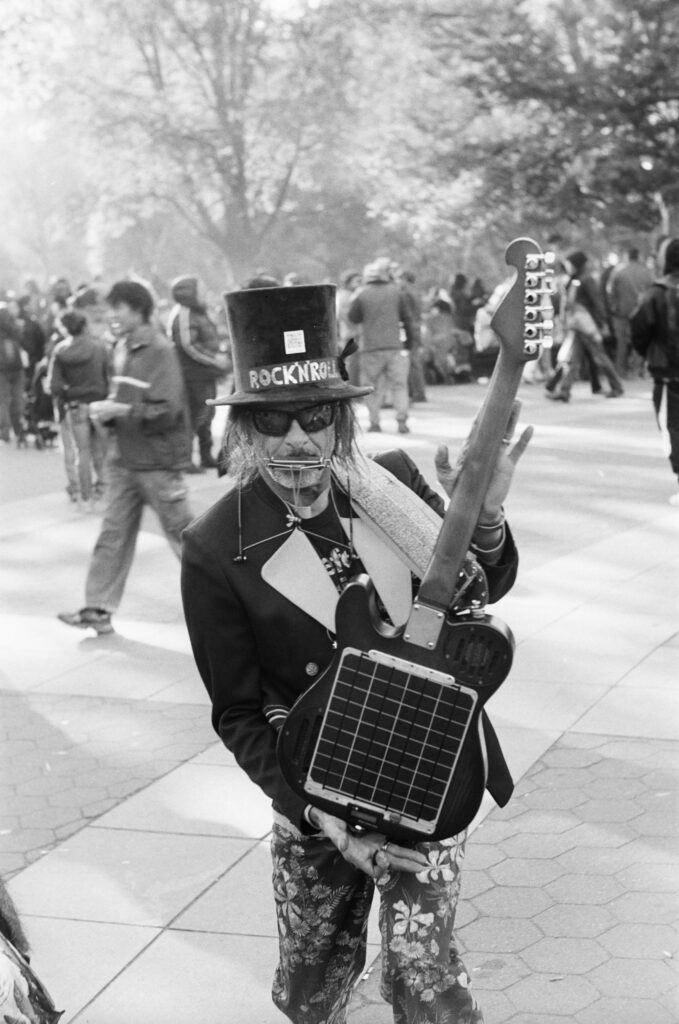
SOLAR GUITAR

This fellow with a solar powered electric guitar looks a little like a one man time warp, combining a 60’s rock vibe with 21st century tech.  This backlit shot is very different from what I’m used to with Blackbird, much softer and more going on in the middle of the zones as opposed to everything going to the extremes of dark and light.

Blackbird is a slow (ISO 64) fine grain high contrast film and the Summarit is a fast (f1.5) fairly low contrast lens that is known to be a little bit soft compared to more modern glass.  I can’t explain why it is so, but I’ve read a number of times that contrast is a factor in creating the appearance of sharpness, so a higher contrast image will appear sharper.  I also speculated that a lower contrast lens might add some more nuance to the middle tones on a high contrast film.  If the idea worked, I hoped that the film & lens would bring out the best qualities of each other and do better than they might individually or in other combinations.  If it didn’t work, either the film or the lens might dominate and look no different than others with the same film or lens, or they might cancel each other out by offsetting each other’s strongest inherent qualities and result in some middling bland quality, less that the sum of the parts.

I first tried Rollei Blackbird toward the end of my 2025 survey of black & white film stocks, as a bit of a ‘completist’ afterthought when I noticed a roll in the fridge of a Brooklyn film lab.
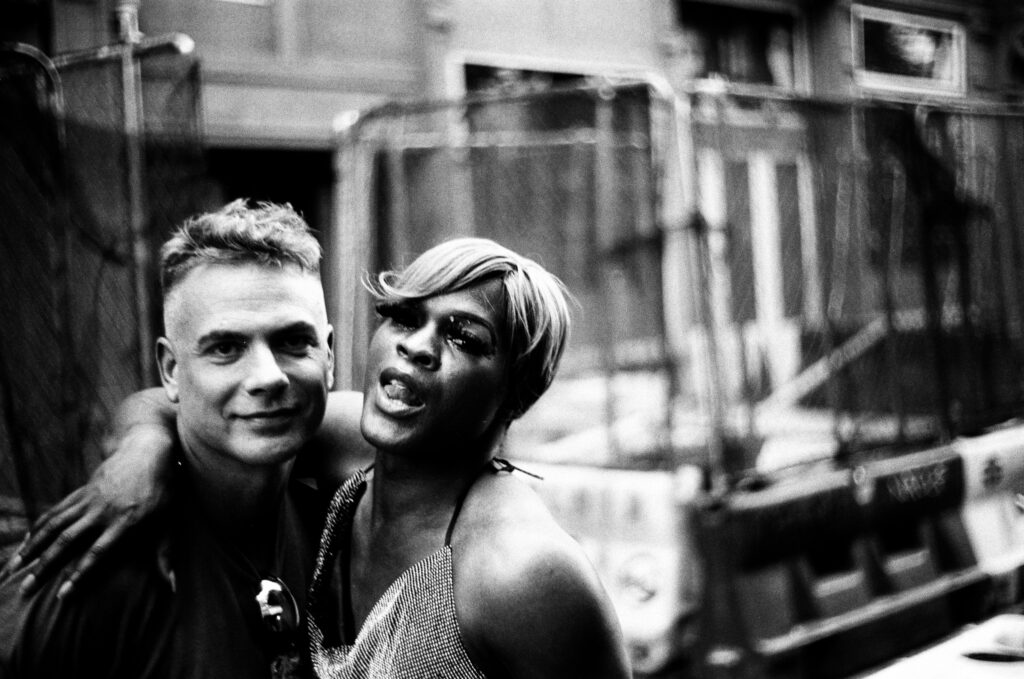
STRAWBERRY TREV + FRIEND, Leitz Summitar 50mm f2

I love this shot that I took on Pride Day, 2025 and still count it among my all-time favorite street portraits.  But on the Summitar which has a fair amount of contrast for a vintage lens, you can see how the skin tones go pretty quickly form dark to light without pausing too long on the middle, and there is almost a black “glow” in the shadows, which feels exciting as long as it doesn’t swamp the image into inky black depths, like in this  group shot taken a few frames later on the same roll.
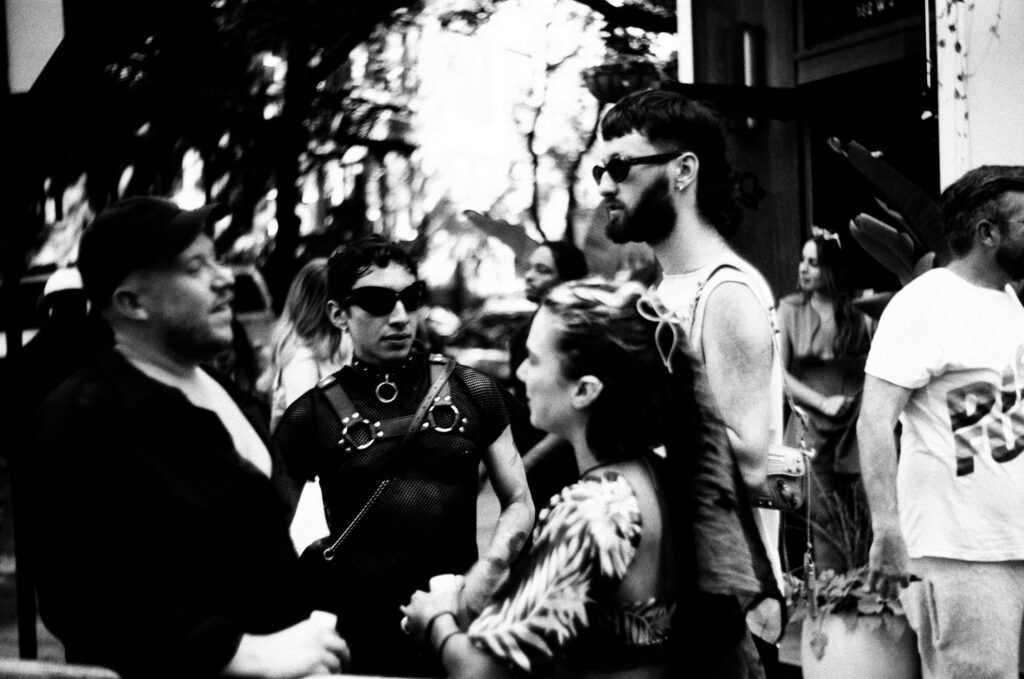
PRIDE DAY, 2025, Leitz Summitar 50mm f2

While I think it looks pretty cool in the shot of Strawberry Trev, those qualities often tended to overwhelm and I thought of the film as a ‘high risk/high reward’ stock.  Over a handful of rolls, I haven’t figured out how to master it with the Summitar, which is otherwise a pretty reliable and easy to use lens.

The Summarit is a bit of a ‘Cilantro’ lens, some people love it, others can’t abide it.  I am a fan, and this shot of Maikeru is another all time favorite portrait.  But I’m accepting a bit of softness here because I really like the other very strong qualities of this image, especially the vibrant almost glowing skin tones, but also the layers of overlapping bokeh hits from light coming through the soft, swirling tree branches in the background.  Also, Maikeru looks amazing
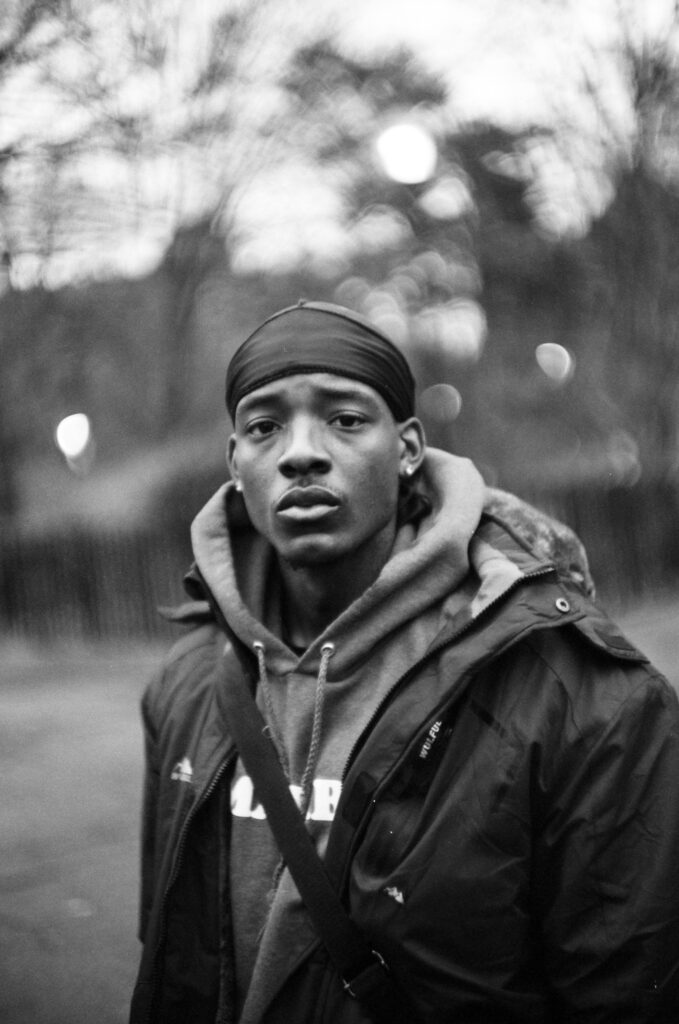
MAIKERU, Leitz Summarit 50mm, f1.5, Svema Foto 200

Back to the park on 420, and some early shots of a young woman called Pyramid and a friend…
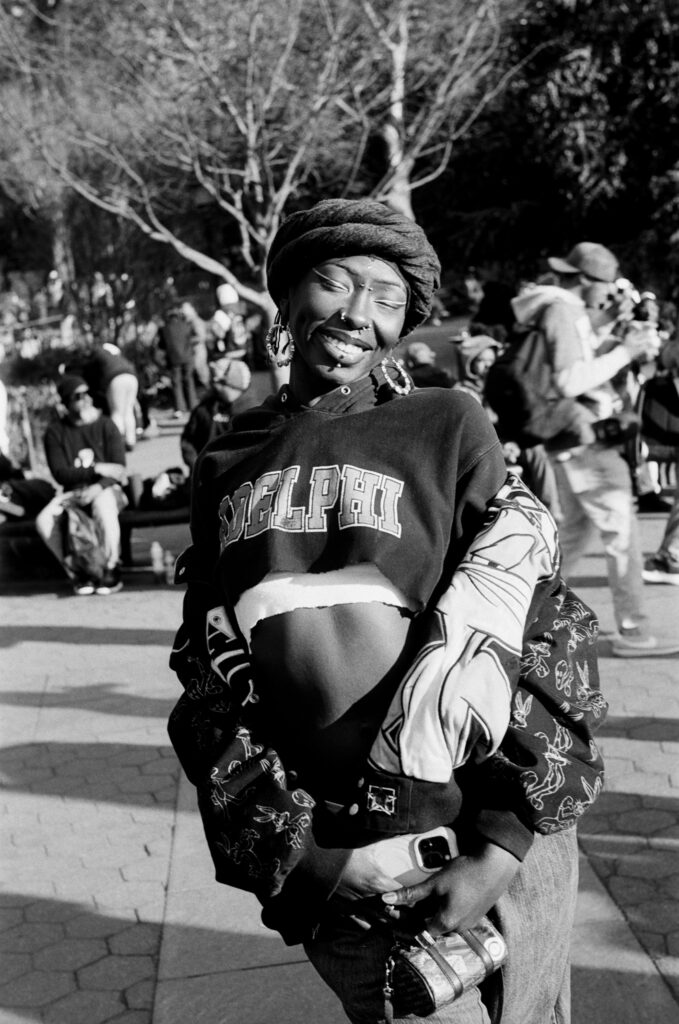
PYRAMID

I think these look sharper than most of my other Summarit portraits, and as I had hoped, the Summarit seems to be adding a good deal of nuance in the mid tones compared to other lenses I’ve tried with Blackbird.

It feels like my theory of using a higher contrast film with the Summarit might have something to it!
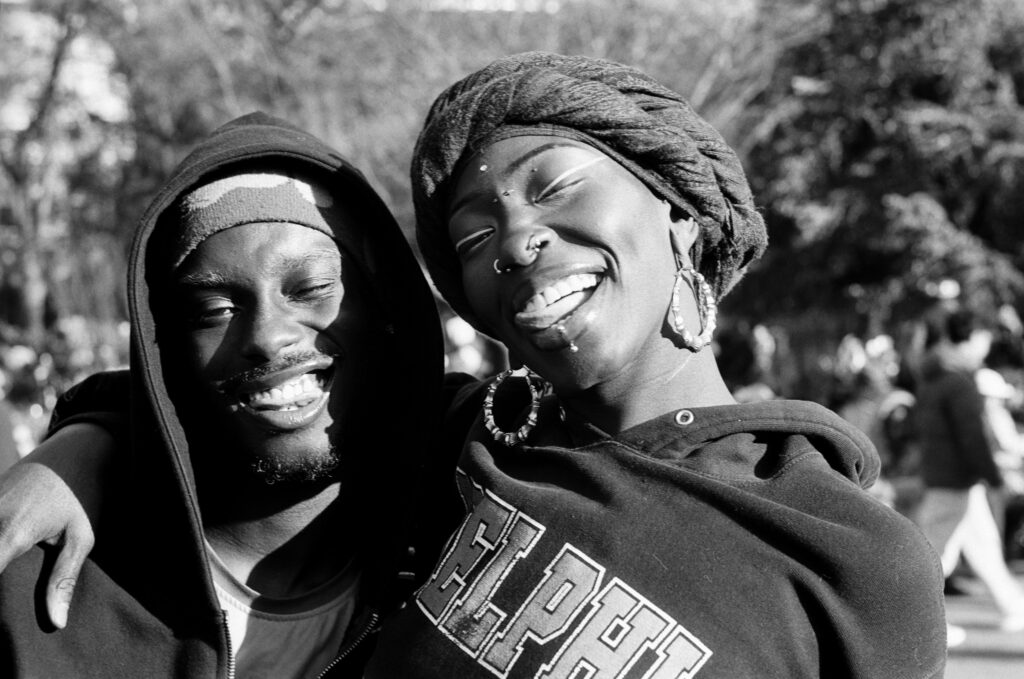
I think this paring also works on paler skin, much paler in the case of these two young women.

The one on the left has a bit of a ‘silent film vamp’ feel, and they look like they may have gotten started a little early with their 420 festivities.
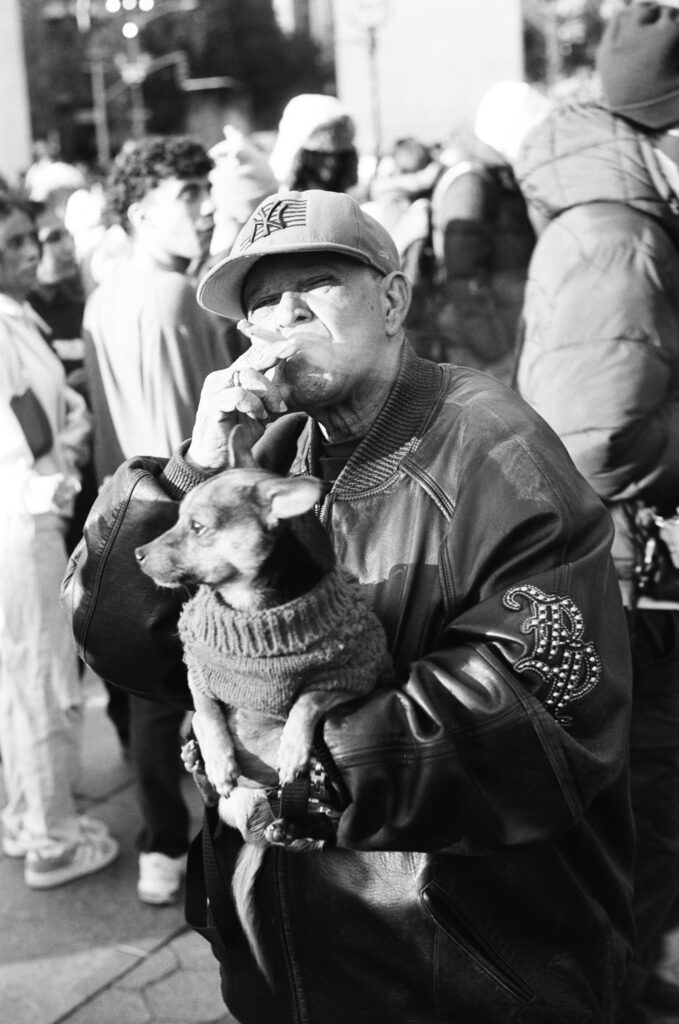
SPLIFF

I like the fortuitous motion blur that came when this man decided he wanted to take a drag during my shot, which happened as I was pressing the shutter.  There were a bunch of younger celebrants off camera to my left who found this hilarious and dissolved into an infectious puddle of giggles.
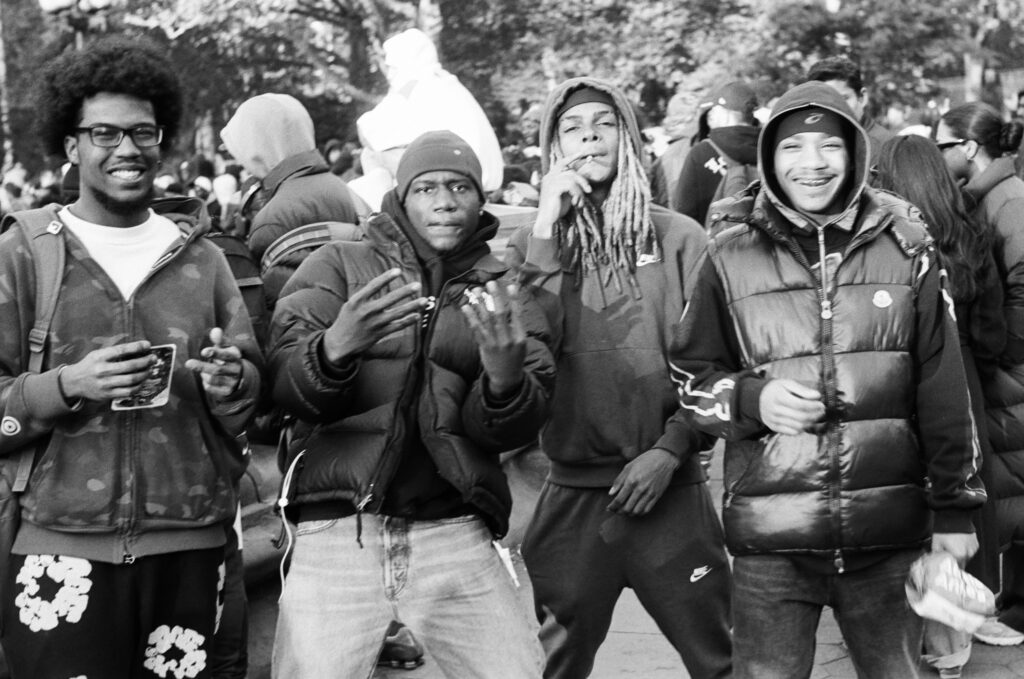
FOUR FRIENDS

I think I may have been the only person in the park who wasn’t stoned at this point in the late afternoon, but the vibe was very friendly and almost everyone I approached was very happy to let me take photos of them, including this nice group of friends.

I decided to grab singles of each of the young men, including this one who had a shiny gold ‘grill.’
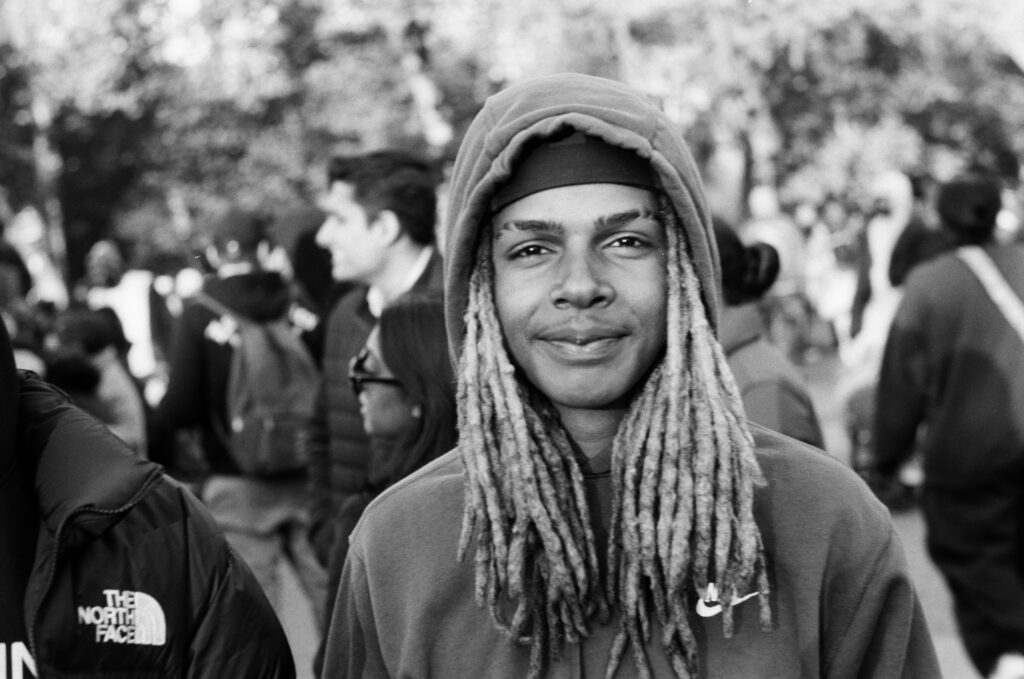
CHUCKYRICHH

While there was no hierarchy, Chucky was the most outgoing member of the group.
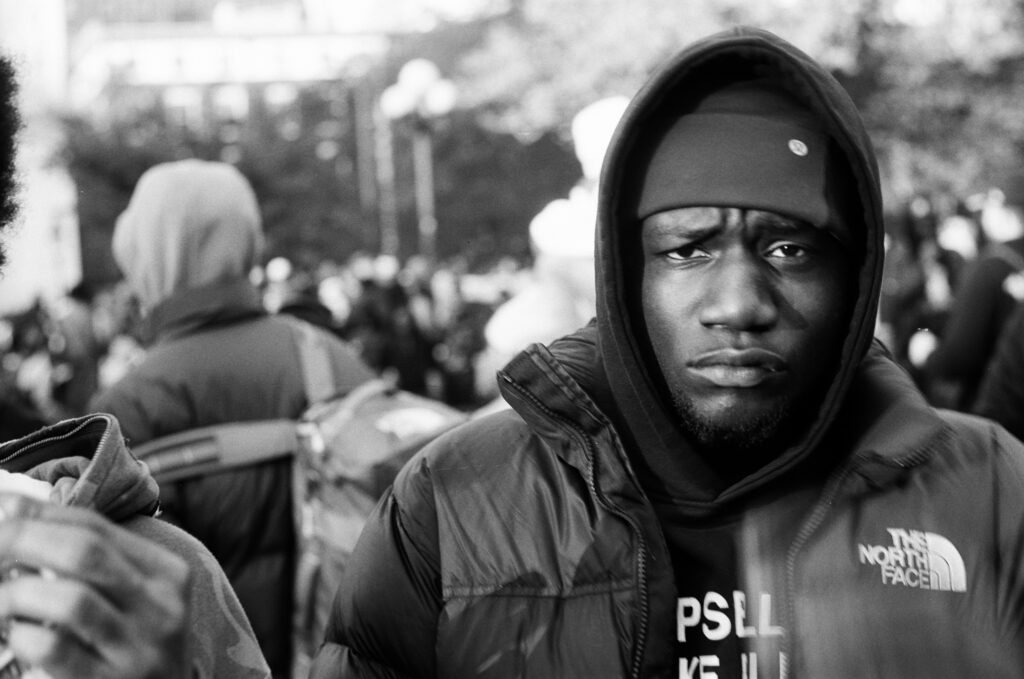
This shot starts to move into that Rollei Blackbird ‘black glow’ look, which I like here in a somewhat smaller dose than in those early Summitar shots, helped here with a little more subtle shading between black and white, courtesy of the Summarit.  I’m not sure, but think maybe the hoody is creating a micro shadow area that is  slightly under the exposure levels of the other shots on the roll.

Note:  most of this roll was metered 1 stop over, i.e., at ISO 32, and then processed at the ISO 64 box speed.  I’ve been habitually shooting this way for about 6-8 months based on a tip from Hamish.   I think this ‘black glow’, which is an interesting part of the the Blackbird ‘personality’ might emerge more if I meter at box speed, which I may do next time I shoot a roll.
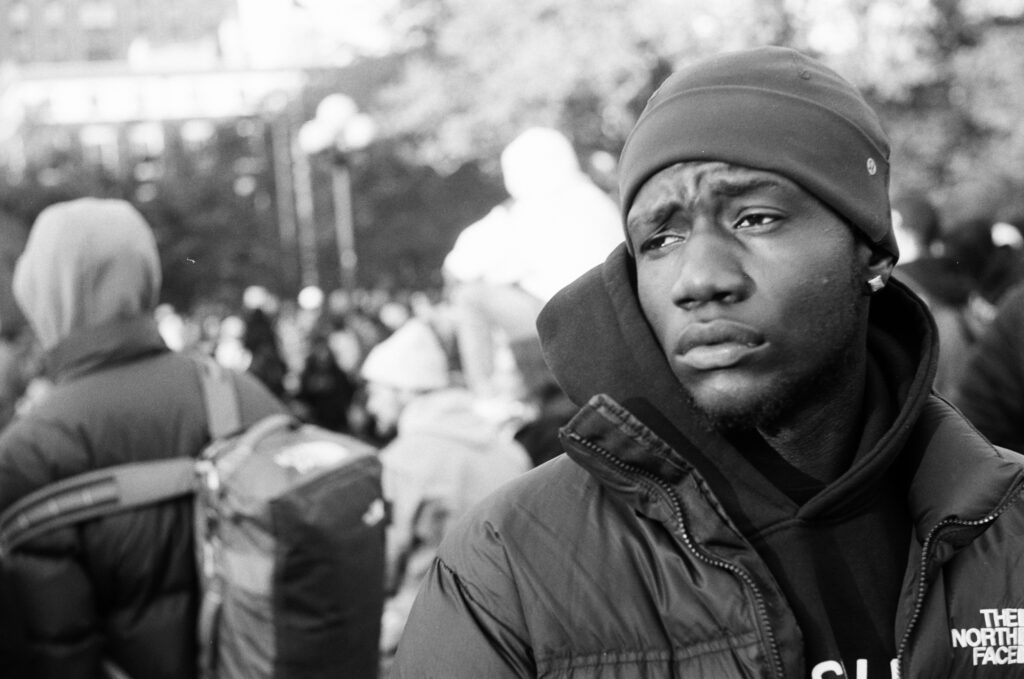
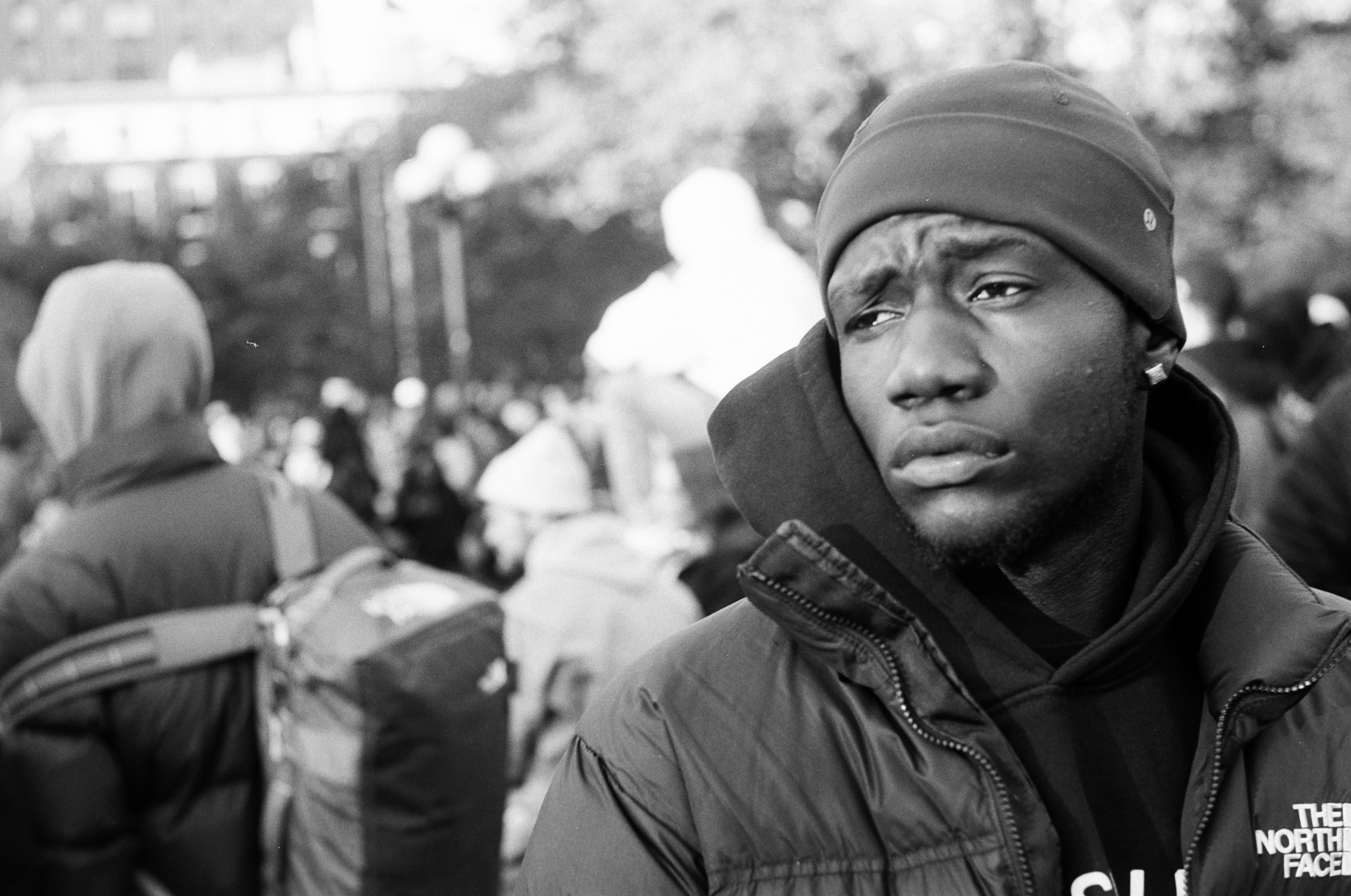
I think I was worried that this fellow moved on the first shot, you can see a bit of blur on his jacket, so I took a second.  I don’t know from what depths he pulled this soulful yearning expression, but I love it!  I think this is my favorite shot of the day.
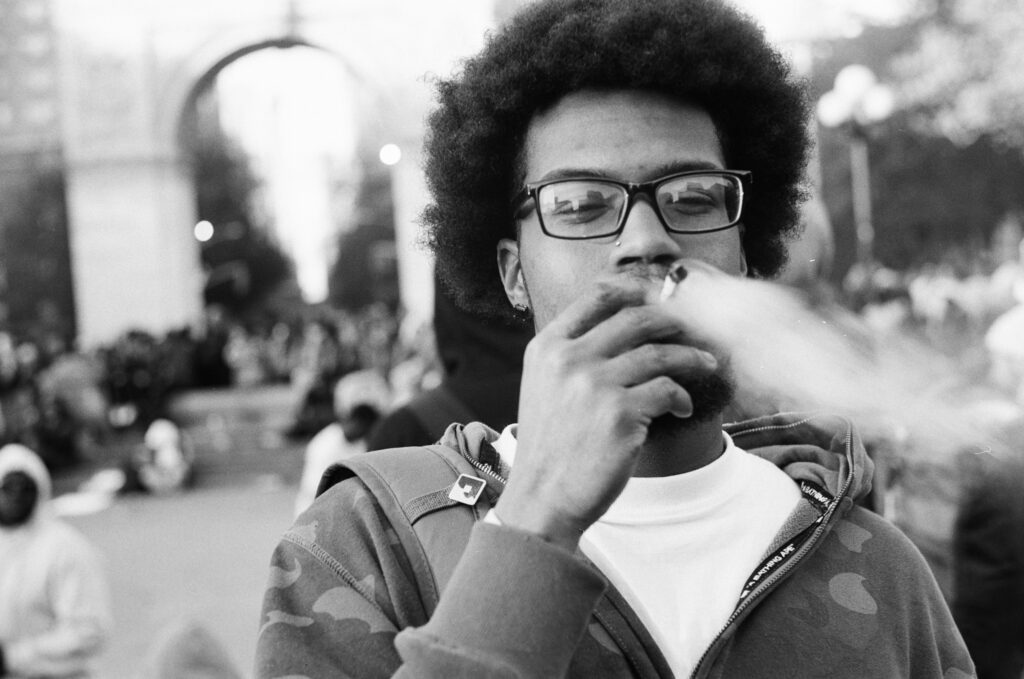
VONNEVERWOKEUP

Von took a big and perfectly timed drag just as I tripped the shutter.  Totally fitting as an end to my roll of Rollei Blackbird on 420.  I like the reflections on his glasses subtly showing the south skyline of the park, while we see the iconic arch a little soft in the background over his shoulder.

On this first foray, I was a little shy about going too wide open where the Summarit is at its softest and weirdest bokeh-wise, but I am very encouraged/excited about this pairing, as well as the overall concept of looking for the most interesting combinations of lenses with stocks.  These are some of the technically strongest/sharpest images I’ve made with the Summarit, and other than a few lucky shots like Strawberry Trev, I haven’t been this consistently successful shooting Rollei Blackbird with my other lenses.  For me, most of this roll was not just acceptable, but quite good.

I realize that some of the subtleties of experiments like these may be lost on my fellow 35mmc readers, who rightly suggest that a good photograph is a good photograph whatever camera, lens or film you are shooting, and nothing on the hardware and chemistry side of the process will rescue a crap photograph.  I readily agree that the most important pieces of equipment are a photographer’s eye and brain, and in many cases the differences I’m seeing in these ‘projects’ of mine may be either invisible or feel insignificant to other smart and talented photographers.  I’ll admit they are very much in the fine margins.  But I also believe when you are trying to raise your levels, the further and deeper you get into any kind of creative field, the finer the margins become.

This may be an idiosyncrasy of mine, but I also think I get a little hit of energy & motivation when I’m trying something that is just a little different than what I’m used to.  I remember hearing a story from a friend who played keyboards on Bob Dylan’s “Time Out of Mind” album and he said that Dylan would rehearse the studio band on a song until they got really good at it, then he’d go off with the producer Daniel Lanois and come up with some change to what they had learned, like shifting the key, tempo or time signature, and that’s when they’d start recording.  I respect photographers who have found the ideal approach that fits their style of photography and drill down on a single emulsion, camera & lens combination, and post workflow.  Perhaps these little projects of mine are a bit of a ‘cheat code’ where I’m trying to keep myself fresh and creatively on my toes, the photographic equivalent of what Dylan and Lanois were doing in the recording studio.

In any event, I definitely want to shoot more Summarit + Blackbird, but first we’ll look at the next matchup, also shot on 420,  the Leica Summilux 50mm f1.4 ASPH + Tri-X.

Stay tuned!


Share this post:

About The Author

By Scott Ferguson
Scott Ferguson is an independent film and television producer known for such films as Brokeback Mountain, Only Lovers Left Alive and The People vs. Larry Flynt, and the television shows The Night Of and Succession. While working around cameras and recorded images for his entire career, shooting still photography with vintage all manual cameras is a new and very stimulating passion.
Read More Articles From Scott Ferguson

Find more similar content on 35mmc

Use the tags below to search for more posts on related topics:

Donate to the upkeep, or contribute to 35mmc for an ad-free experience.

There are two ways to contribute to 35mmc and experience it without the adverts:

Paid Subscription – £3.99 per month and you’ll never see an advert again! (Free 3-day trial).

Subscribe here.

Content contributor – become a part of the world’s biggest film and alternative photography community blog. All our Contributors have an ad-free experience for life.

Sign up here.

Make a donation – If you would simply like to support Hamish Gill and 35mmc financially, you can also do so via ko-fi

Donate to 35mmc here.

Comments

Bill Brown on Pairings, pt. 1 — Leica Summarit 50mm f1.5 + Rollei Blackbird

Comment posted: 15/05/2026

Scott, Drilling down to discover the finer intricacies of process or equipment is so important. As a post/digital darkroom specialist I'm a firm believer in nuance and subtlety. There will come a moment for you when your research all comes together and it will feel like you knew exactly what to do in a specific shooting situation. That's the magic of it all. It's not magic really though, it's just lots of hard work. Keep pressing in.
Reply

Leave a Reply

Your email address will not be published. Required fields are marked *

Scott Ferguson replied:

Comment posted: 15/05/2026

Hey Bill, What a great insight. The magic is the hard work! I also believe the process is actually valuable, and love the connections I make with the people I shoot, even if they are fleeting. Even if they are stoned and I'm not. Thank you! s

Reply

Leave a Reply

Your email address will not be published. Required fields are marked *

Gary Smith on Pairings, pt. 1 — Leica Summarit 50mm f1.5 + Rollei Blackbird

Comment posted: 15/05/2026

It looks like a good pairing Scott, at least in your hands. I like the portrait of MAIKERU (but I was looking for another shot of NOLA SUPERSTAR).
Reply

Leave a Reply

Your email address will not be published. Required fields are marked *

Scott Ferguson replied:

Comment posted: 15/05/2026

I hope I run into Nola Superstar again! She had a remarkable presence that really shone on film. She would be fun to do a real session with. I thought she followed me on instagram, but I haven't been able to find her in my lists -- on a good day, I can end up meeting and swapping instagram info with 15 or more people. thanks for the kind words. a

Reply

Leave a Reply

Your email address will not be published. Required fields are marked *

Art Meripol on Pairings, pt. 1 — Leica Summarit 50mm f1.5 + Rollei Blackbird

Comment posted: 15/05/2026

Hi Scott. Any day I see a 35mmc post pop up with your name is a good day. Your posts delight me and inspire me. These may be, as you said, your technically strongest and sharpest but they're also emotional and storytelling. For me emotion and storytelling are the true goal, not that I reach it as often as I'd like. Your photo of STRAWBERRY TREV + FRIEND to me is such a NY photo. It feels like a candid from the set of Midnight Cowboy.
That first shot of the young man in the hoodie is a stunner. The hoodie is providing some great negative fill on his Oh-so-soulful face. The whole set is so much of a piece. I admire your drilling down on lens and film combos to achieve the look you want. You're pushing me to get moving! Thanks so much.
Reply

Leave a Reply

Your email address will not be published. Required fields are marked *

Scott Ferguson replied:

Comment posted: 15/05/2026

Thank you so much, Art! That means a lot coming from a photographer I admire as much as I do you! And I think we are very much in synch on the things we prioritize in our photos. I love the Midnight Cowboy reference for Strawberry Trev + Friend. Yes, I really think that guy with the hoodie has a special look, and I love the negative fill from the hood. Blackbird is really amazing when you hit it just right, but not an easy film to tame! I feel like the Summarit might be the way to go, but maybe being a little more daring with exposure to get some of those rich blacks like in the hoodie shot and Strawberry Trev. Yes, I think this lens pairing series will be fun, but I ended up taking a bit of a detour that you'll read about the next time my name pops up on 35mmc. Cheers, s

Reply

Leave a Reply

Your email address will not be published. Required fields are marked *

Jeffery Luhn on Pairings, pt. 1 — Leica Summarit 50mm f1.5 + Rollei Blackbird

Comment posted: 16/05/2026

Scott,
Another collection of fine photos! I like your working distance...close enough so you and the subject can touch fingertips. That gets you close, but not invasive. Great work! The one stop over exposure does wonders with dark skin. Right in the pocket with highlights. Keep posting!
Reply

Leave a Reply

Your email address will not be published. Required fields are marked *

Scott Ferguson replied:

Comment posted: 16/05/2026

Thanks Jeffery! It took me a good while to get comfortable enough to shoot people that close, but now that’s kind of my starting point and if I feel they’re amenable, I’ll back up for a wider shot either a length or a ‘cowboy’ (3/4’s so you can see the six guns). That was an interesting afternoon!

Reply

Leave a Reply

Your email address will not be published. Required fields are marked *

Ibraar Hussain on Pairings, pt. 1 — Leica Summarit 50mm f1.5 + Rollei Blackbird

Comment posted: 16/05/2026

Excellent reportage my friend. really sublime street portraiture and you've captured not only the mood but the soul of the people and the event. I couldn't take photos like these.
If I have one criticism it's about the 'digital darkroom' work (I know you get a lab to process and assume they're then done)- come on man, load them up into Light Room and get those blown highlights, blocked shadows and tones worked on! :) (If you don't mind, I did so and they're easily controllable - making the photos pop and shine to levels I haven't seen here).
Reply

Leave a Reply

Your email address will not be published. Required fields are marked *

Scott Ferguson replied:

Comment posted: 16/05/2026

Hey Ibraar, First, thank you that means a lot and I think you do lots of amazing environmental portraiture. And I’m not sure I agree with you that you couldn’t shoot like this. I’m the first to admit I’m less experienced in post than o am in shooting, and still not all that experienced in shooting compared to many of the people on 35mmc. I should probably take a class in Lightroom when I can. But I’d love to get some more specifics on the things you are seeing here and where and how you might adjust. I’ve done a bit of work on Lightroom, mostly adjusting exposure and blacks, but I may not yet be seeing the things you are. Thanks my friend!

Reply

Leave a Reply

Your email address will not be published. Required fields are marked *

Ibraar Hussain replied:

Comment posted: 16/05/2026

Thank you Scott. I spend most of my time working on the BW. I did a 3 month course in darkroom printing many years ago and carried it all over into PS and now LR. I recommend John Garret's books on B&W, taught me more or less all I know before the course. I couldn't help it!! I popped a few of the photos into LR and had a go to demonstrate what I mean, if you wish I could email them to Hamish and he can pass them over. It's only a small critique and has nothing to do with the skill and eye as a photographer but rather just tones and their relationship enabling the subject to stand out and not clash (and of course controlling the shortcomings of the standard Film scan/negative).

Reply

Leave a Reply

Your email address will not be published. Required fields are marked *

Scott Ferguson replied:

Comment posted: 16/05/2026

Hey Ibraar, Thanks for sharing the post improvements you did on my photos. This has opened my eyes to how much can be accomplished in that part of the workflow. I really need to learn how to use all of the amazing tools in Lightroom — the changes you made were both highly skilled and quite tasteful and inspired me about what is there in some of ky negatives that i didn’t even realize!

Reply

Leave a Reply

Your email address will not be published. Required fields are marked *

David Hume replied:

Comment posted: 16/05/2026

Hey Scott - I'd echo what Ibs has said; not because I feel there's a definitive way of doing things, but because it seems that the things you are now looking for can be found to a degree in post-work in LR, and if you don't do it now you'll face-palm when you do do it. So jump in - at worst you'll just gain a new respect for the lab scans, but you may be able to improve them... (to your tastes). I'd put it like this: the way I see it, a good lab has a responsibility to develop the negs so that they contain the maximum amount of information, and then scan them so that, also, the maximum info is pulled out of the neg and into the scan. I would always expect a lab scan to need work; indeed if it did not I'd be thinking, "Hey Lab, you're making decisions here that are actually not yours to make - they should be made by me." And I'm in no way a LR expert, but I get by. Someone with greater skills than mine could do more, but it becomes a matter of communication then. So - long story short - time to jump in!

Reply

Leave a Reply

Your email address will not be published. Required fields are marked *

Scott Ferguson replied:

Comment posted: 16/05/2026

Hey David, I did a face palm when I saw what Ibraar was able to do by pulling the mid sized jpegs I used for this post and I totally agree that I need to up my game in Lightroom! I’ve also been talking about this with Alexandre Kreisman so when you hear the same thing from three people you respect this much, I think it’s wise to listen! Thank you, s

Reply

Leave a Reply

Your email address will not be published. Required fields are marked *

Tony Warren on Pairings, pt. 1 — Leica Summarit 50mm f1.5 + Rollei Blackbird

Comment posted: 17/05/2026

Hi Scott. I have just finished a review of this film and I found, like you that it gives sharper results than most. I put this down to the fact that full blacks are really, really black, hence the monicker I guess, which gives the impression of clipping, enhancing sharpness. An interesting film that really does have character and very flexible in post, as Ibraar has found.
Reply

Leave a Reply

Your email address will not be published. Required fields are marked *

Scott Ferguson replied:

Comment posted: 17/05/2026

Hey Tony, I’ll be excited to see your review! I do like this combination with a lower contrast lens that adds some more interest in the midtones. I do like the ‘black glow’ that is a very distinctive feature of this as well as Retro 80s, another Rollei emulsion, but it’s not always easy to find the sweet spot where it adds interest and a unique look without overwhelming the image, at least in my few rolls on other more contrasty lenses. Cheers S

Reply

Leave a Reply

Your email address will not be published. Required fields are marked *

Ibraar Hussain replied:

Comment posted: 17/05/2026

I used to be a fan of Rollei retro 80s. 400s is more forgiving. Now I'm pretty much Fuji Neopan Across 100 and Ilford Pan F 50 all the way, lovely inky blacks, nice tone and very smooth without being tricky in awkward lighting, and easy to work on afterwards

Reply

Leave a Reply

Your email address will not be published. Required fields are marked *

Tony Warren replied:

Comment posted: 17/05/2026

Sure these films can lead to disappointments and 80S and older types are more forgiving. They are worth knowing tough and having as an option. In my case I will look to this one for architecture and townscape, but it gives some very good skin tones, as you show here. Rollei have some very useful films nowadays. I haven't used Acros but I will give it a try. FP4 was always my stadard until these new formulations came on the scene

Reply

Leave a Reply

Your email address will not be published. Required fields are marked *

Ibraar Hussain replied:

Comment posted: 17/05/2026

Thanks Tony I think each film for a purpose - FP4 in my experience is gentle with lovely tonality - I shot a very memorable portrait with it once. I think I developed in ID11 Still a fan of Rollei films Is Rollei RPX old school Agfa APX?

Reply

Leave a Reply

Your email address will not be published. Required fields are marked *

Scott Ferguson replied:

Comment posted: 17/05/2026

Hey Tony, I think part of the secret of the skin tones on this post is by matching Blackbird with a lower contrast lens, which tends to reduce the ‘chiaroscuro’ look you can sometimes get with that film. I do like it, and bet it looks great for architecture. I even like it when I hit it just right with a higher contrast lens like my Summitar, but I end up with more misses with that combo. At least for the kind of street portraits I’ve been doing lately.

Reply

Leave a Reply

Your email address will not be published. Required fields are marked *

Walter Reumkens replied:

Comment posted: 17/05/2026

Hello Ibraar and Tony! Please excuse me for butting in. I’m from Germany, and Agfa, Leica and Rollei were—and still are—right at home here. The information here is often different from what’s available worldwide. “Rollei-Film” has nothing in common with the well-known Rollei cameras except the name. The owner of a photographic equipment wholesaler has acquired the trademark rights. The Rollei RPX is presumably an aerial film from Agfa Gevaert in Belgium – at least the orthochromatic Bluebird. Rollei itself does not manufacture films; they are sourced and packaged here and there. The Agfa APX is a Kentmere, at least the 100 speed. The others are probably the same, but I haven’t been able to confirm that. Thanks! All the best!

Reply

Leave a Reply

Your email address will not be published. Required fields are marked *

Walter Reumkens replied:

Comment posted: 17/05/2026

Oh, what am I writing? It must be "Blackbird". :-)))

Reply

Leave a Reply

Your email address will not be published. Required fields are marked *

Scott Ferguson replied:

Comment posted: 17/05/2026

Thanks Walter, I think I had a bit about these cross branding issues when I was doing a survey of as many b&w films as I could try. I knew the Rollei films had nothing to do with the famous cameras, but they have a distinctive look in my experience, particularly Blackbird and Retro 80s. I also like Rollei Ortho 25 when I can afford to go that slow.

Reply

Leave a Reply

Your email address will not be published. Required fields are marked *

Walter Reumkens replied:

Comment posted: 17/05/2026

Hello Scott, I have no intention whatsoever of questioning the quality of "Rollei" films. I simply felt compelled to respond to Ibraar’s question: "Is RPX the same as Agfa APX?" If you look more closely at a film’s origins, rather than just relying on tables – which are often completely inaccurate – you realise you’re on thin ice. Suppliers – that is, manufacturers – do change from time to time, and then all our assumptions and experience with them completely fall apart. Is it really worth the effort then? I’d like to point out something else. When I attended courses decades ago, learnt to develop the exposed films myself and enlarge them onto paper, I learnt that every black-and-white film must be treated individually. With the same exposure, a film produces different results with developer A than with developer B. With an overexposed film, I had to shorten the development time, or vice versa. That’s why I still believe today that it’s best to develop black-and-white film yourself. I see things differently when it comes to scanning; the results from a specialist lab using a professional scanner are far better than even the best Epson scanner at home, no matter how hard I try. Your lab must be good, but was your Blackbird developed manually or using an automated process? For many years, I only shot colour film because I didn’t know of any lab that could develop black-and-white film. I’m too old to start doing it myself again, and there’s not enough of it to justify it. When I recently wanted to take up medium-format photography again and found a lab for it in another town, I realised they also develop black-and-white film. It’s actually a very good lab, but the black-and-white processes are standardised like the C41. They therefore recommend exposure at box speed. Anything else, including Rollei Blackbird or other special films, requires special treatment in the lab. If they do it, fine. If not, you won’t get the most out of the film. Then even the best Lightroom skills are of no use to me. If the negative is rubbish, even the best scan will be rubbish – what is Lr supposed to find there? Good light, Scott.

Reply

Leave a Reply

Your email address will not be published. Required fields are marked *

Walter Reumkens replied:

Comment posted: 17/05/2026

"Rubbish" isn't the right word in the automatic translation, of course, and that's not what I meant. If the development isn't adjusted to the exposure and film, details are lost in the highlights and shadows. But those details are missing even in the best scan afterwards! Not even "AI" can find them there!

Reply

Leave a Reply

Your email address will not be published. Required fields are marked *

Ibraar Hussain replied:

Comment posted: 17/05/2026

Thanks Walter, food for thought

Reply

Leave a Reply

Your email address will not be published. Required fields are marked *

Scott Ferguson replied:

Comment posted: 17/05/2026

Hey Walter, No worries on Google translate errors, I make lots of mistakes writing in my native language! And I wasn’t trying to challenge your comments on the origins of the Rollei stocks, just noting a couple that I like that feel different from other brands, whatever factory they come out of. Yes, as I learned you can end up down a bit of a rabbit hole choosing different stocks based on the name on the box, and learning to shoot photography at this stage of my creative life has been nothing if not a wonderful rabbit hole of learning. Part of my hesitation about getting into doing my own processing is that I’m a bit afraid of jumping into a rabbit hole inside a rabbit hole, but perhaps when I feel more fully confident in my skills and technique as a shooter, I’ll feel ready. Meanwhile I have a lab I like and trust to cover that part of the waterfront for me. I have huge respect for people with great experience and formal learning who understand the whole process, including darkroom post work. Meanwhile, I’m having a wonderful time teaching myself how to shoot, and hopefully what to shoot. Cheers, Walter

Reply

Leave a Reply

Your email address will not be published. Required fields are marked *

David Pauley on Pairings, pt. 1 — Leica Summarit 50mm f1.5 + Rollei Blackbird

Comment posted: 19/05/2026

Hi Scott,

As a dyed in the wool tri-x user, my wild days come when when I use HP5 or (gasp!) perhaps FP4. I so admire your fearlessness at giving less common film stocks a go, and finding the right lighting and shooting conditions to allow them to shine. That's clearly the case here with Blackbird. There's a soulful and painterly quality to the featured image in particular that for me transcends film stock and lens, though a grainier high speed film or a more clinical lens would likely have diminished that excellent photo's impact. Even though I may not follow you down this particular rabbit hole (when I load a slow iso film you can bet rainy and cloudy conditions will persist for the subsequent month), I'm thrilled to read along and learn.
Reply

Leave a Reply

Your email address will not be published. Required fields are marked *

Scott Ferguson replied:

Comment posted: 19/05/2026

Thank you David! I used to be kind of afraid to drop below ISO 400, but as I started to try to be more discerning about the qualities of different lenses and their strengths and weaknesses, I started to shoot lower ISO's more often to make it a little easier to shoot between f4 and wide open. At the same time, I began to appreciate f4 or thereabouts as a bit of a 'sweet spot' for portraits -- nice separation of subject and background, interesting bokeh without getting distracting, and not going all pearshaped in terms of of sharpness and clarity on most lenses. So I'm less afraid of slower films, at least as far down the chart as Pan F Plus @ ISO 50 -- shooting something lower like a 25 probably requires some kind of project or knowing I'm going to shoot a full roll in particular light. Yes that feature shot was a standout on that day, but I am very pleased with the combination of Rollie Blackbird, a film that I had begun to wonder if I could tame, and the Summarit, a lens that felt more applicable to art projects than general use.

Reply

Leave a Reply

Your email address will not be published. Required fields are marked *

Leave a Comment

Leave a Reply

Your email address will not be published. Required fields are marked *